






You are here
Exploding Trains and Crude Oil
By Jon Flanders - CounterPunch, March 1, 2015
Disclaimer: The views expressed here are not the official position of the IWW (or even the IWW’s EUC) and do not necessarily represent the views of anyone but the author’s.
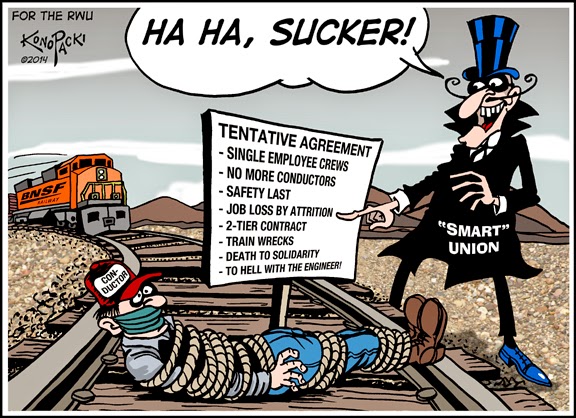 On the eve of the first conference bringing together rail workers and environmentalists in Richmond, California, we’ve had one oil train after another go off the tracks and explode. The latest was in Ontario, Canada. According to a news report, “Ontario Provincial Police said the derailment happened near Gogama, Ont., around 2:45 a.m. Saturday morning, with some of the cars catching fire and others falling into the Mattagami River.”
Environmentalists around the country have been protesting the “bomb trains” for several years now, but the 100 car unit trains are continuing to roll through hill and dale, towns and cities. Over a hundred years of the rail carriers influence in the halls of government make sure of this, up to now. This, despite the fact that we now know that fracked Bakken crude is more explosive than gasoline. The fireballs that have erupted lately dramatically illustrate this point.
As a retired railroad machinist, I have long been aware of the dangerous cargoes that travel by rail. I still remember the propane car that blew up near my shop while I was working, that propelled by the explosion, jetted a mile down the track through the departure yard, thankfully without killing anyone.
Nothing freight-wise from those years I spent on, under and over locomotives compare, however, to the vast quantities of explosive crude now running down a track probably not too far from you.
So I found this analysis from a retired frontline rail worker and engineer, Bubba Brown, particularly interesting in its insights into the changes the carriers have made, all done, of course, in the interests of maximising profits. In a Railroad Workers United Facebook discussion, Brown remarked:
“I think all of you are trying to make this phenomena more complicated than what I believe it really is. When I started railroading as a hoghead, there was much emphasis placed on train handling from the standpoint of controlling slack action. There wasn’t a great push toward fuel conservation then as now. Air brakes were used extensively toward this control of slack action in those days largely because of occupied cabooses, but as a result, reduction of slack action reduced damages to both freight cars and lading. Heavy slack action occurring at various undulations, causes a downward pounding and at curves produces a heavy lateral pounding which relates adversely to track alignment. When multiple cars loaded with sloshing liquids are handled with dynamic braking and throttle modulation instead of lightly stretching them, their lading takes on a harmonic effect thereby producing “waves” of slack action which adversely affect track alignment and the resultant derailments. The same hogheads that can successfully handle a double stack train use those same principles to operate an oil train (largely due to fuel saving practices) and produce horrible results. The current population of hogheads have been poorly trained in the use of air brakes (read non-existent here) toward train handling, with all emphasis placed on fuel conservation. I predicted when I retired that we’d be witnessing more accidents and more fatalities stemming from the rail industry’s reluctance to use the air and discipline assessment because of it, as the hogheads are scared to use the air.
These are my observations and opinions based on 40 years of railroading with about 37 of them as a hoghead. I offer them up as such and don’t really want an argument.”
And suffice to say, that other engineers in this discussion thread agreed with him. I realize that the railroad lingo in Brown’s remarks might confuse some people. There are two ways to apply brakes on a train, the air brakes that run the entire length of the train and dynamic braking, which reverses the locomotive traction motors, turning them into generators, which slows the locomotives down and as a result causes the cars to bunch up(slack action). Air brakes, on the other hand, are applied on the locomotives and the cars together. With the entire train slowed down by the air brakes, obviously more fuel will be needed to get back to speed. Hence the railroad’s current directives, with the results that Brown explains. 100 car oil trains are incredibly heavy, compared to mixed freight or intermodal trains.
So its not just oil company and carrier greed for cash generating cargo like fracked oil to blame for the current disasters, you can also chalk up the railroad’s desire to save just a little more fuel, at the expense of safety, for the mess we are in. Lets hope environmentalists listen to the rail workers, starting at the conference next week, for more insights like those of Bubba Brown.
Jon Flanders spent 25 years as a Railroad Machinist, member and past President of IAM 1145. Steering committee member of Railroad Workers United. Retired. He can be reached at: jonathan.flanders@verizon.net.
The Fine Print I:
Disclaimer: The views expressed on this site are not the official position of the IWW (or even the IWW’s EUC) unless otherwise indicated and do not necessarily represent the views of anyone but the author’s, nor should it be assumed that any of these authors automatically support the IWW or endorse any of its positions.
Further: the inclusion of a link on our site (other than the link to the main IWW site) does not imply endorsement by or an alliance with the IWW. These sites have been chosen by our members due to their perceived relevance to the IWW EUC and are included here for informational purposes only. If you have any suggestions or comments on any of the links included (or not included) above, please contact us.
The Fine Print II:
Fair Use Notice: The material on this site is provided for educational and informational purposes. It may contain copyrighted material the use of which has not always been specifically authorized by the copyright owner. It is being made available in an effort to advance the understanding of scientific, environmental, economic, social justice and human rights issues etc.
It is believed that this constitutes a 'fair use' of any such copyrighted material as provided for in section 107 of the US Copyright Law. In accordance with Title 17 U.S.C. Section 107, the material on this site is distributed without profit to those who have an interest in using the included information for research and educational purposes. If you wish to use copyrighted material from this site for purposes of your own that go beyond 'fair use', you must obtain permission from the copyright owner. The information on this site does not constitute legal or technical advice.
 This site is not the official webpage of the Industrial Workers of the World.