By Bruce Anderson – Anderson Valley Advertiser, November 11, 1989
On a sweltering day last summer, a diminutive, energetic woman stood talking to a pair of reporters on the Ukiah Courthouse steps. The woman leaned at the reporters, leading with her chin—as they’d say in boxing—as she talked. The woman was Judi Bari, associated primarily with Earth First!, but in reality an American radical in the uniquely American tradition. When she’d left off her talk with the reporters and had disappeared into this area’s class warfare headquarters, the Courthouse, one reporter looked at the other to say. “You know, that woman can talk! She doesn’t even come up for air. Not a breath.”
Well, Judi is a serious person living in an area and in a time when real feeling is considered bad form or just kind of crazy, so Bari finds herself fighting on many fronts against many kinds of opposition, but this lady can fight so effectively, it’s hard to associate her with cheerleaderism. “I really didn’t grow up with any political feelings,” she says, describing a sedate, if mildly fearful, upbringing by a pair of genteel liberals intimidated by the McCarthy-ite fifties. “My parents taught me Wobbly songs as nursery rhymes but told me not to say where I’d learned them,” Bari remembers with a disbelieving snort. “One of the best things about them was my parents lectured me and my sister against racial and ethnic hatreds. Later, when I was in college and came home wearing a Chairman Mao badge they said to me, ‘We’ve got to have a talk with you.’ I mean, this was kill your parents time, remember. So they went on to warn me against tying the sixties student movement to a foreign power. I came away with a whole new respect for my parents. They knew much more than I thought they did. And they were right, of course. We need an American radical left, not one looking overseas for a model.”
For years before that breakthrough discussion with her parents, Judi Bari was distinctly not a political person. “I was head cheerleader at my high school, for god’s sake! Can you believe that?” Frankly, no, but boundless renewable energy of the Bari dynamo variety can carry one to the heights of some peculiar organizations.
Bari began life in a working-class area of a town near Baltimore. Her neighbors all worked in the area’s steel mills. Bari’s mother later radically enhanced the family fortunes when she went back to college, emerging with the first PhD awarded to a woman in mathematics by Johns Hopkins University. Bari pere is a diamond setter, “which is, where I get my perfectly steady hands from,” his second daughter, Judi, says. Daughter number one is a science writer for the New York Times while daughter three is described by sister Judi as “a perpetual student.” Apparently the third Bari remains in school past the age of goal-oriented scholars.
“I had no political consciousness when I left high school. My big thing was to get dates with football players. I thought I had to act dumb and be cute and sweet because I didn’t know there were other social options available to me. It never really fit my personality.” Bari recalls her first political stirrings during her last year in high school when a star athlete asked her out. He happened to be black. Bari was visited by a delegation of white athletes who informed her none of them would ever again grace her with their stimulating company if she dated the black kid. “I didn’t go out with him.” she says with what is clearly a painfully nagging memory of capitulation to intimidation. She doesn’t say so, but it may be one of the only times Bari has ever given in.
From the la la land of high school, Mendocino County’s premier radical went to the University of Maryland in pursuit, not of higher learning and the elusive keys to life but in quest of football players, the odd status symbols of millions of misdirected young American women. “We called Maryland U, 13th grade” Bari recalls. “It was the place Spiro Agnew was referring to in his famous ‘effete intellectual snobs swept into college on the wave of the ‘new socialism’ speech.” Bari doesn’t recall much intellectual activity of any kind, but as a 1967 freshman she was in the right place at the right time. “It was one of those crank em-out schools. Agnew had just been elected as a liberal alternative—if you can believe that—to another right-wing crank named Mahoney who’d run on a straight racist platform of keeping blacks confined to their neighborhoods.” Bari was soon disillusioned with football players. “They were gross: just a bunch of big, dumb assholes who treated women very badly and who thought treating women badly was funny.” In a world in flux, there remains one constant—the personal behavior of the college athlete.
Bari soon began to meet company of a more interesting and hopeful kind, “As soon as I got away from home, I quickly figured out I didn’t have to go to class. I was soon into sex, drugs, and rock and roll.” Which in those wild days included, in its more alert manifestations, side trips into radical politics. “My first demo was a trip with hundreds of other students to the college president’s house one night to demand his underwear. The politicos in the mob tried to get everybody to chant ‘Elkins [the college prexy] must go,’ but they were drowned out by calls for Mrs. Elkins to give up her drawers.” But students there and everywhere were getting restless and more serious, as many of them had to consider the distinct possibility they could be shipped off as foot soldiers in the expanding imperial adventure in Vietnam.
Bari was soon one of the more politically active students at U Maryland, recalling with obvious delight her own transformation from flower child naïf to street fighter. “When Nixon invaded Cambodia in ‘70 we had flat out political riots. We took over Route 1 for anti-war protests.” Route One is the main road into War Maker Central, or Washington, DC. “I have an old picture that was in the newspapers of me giving water and flowers to the cops. I cringe now when I look at it, because I got as tired of hippies as I did of jocks. I was getting more and more of a feminist consciousness because I always seemed to be with men who had no interest in women beyond sex. One day I was on acid with this guy and I remember thinking, ‘God, what am I doing? This guy is totally disgusting.’ My friends and I all seemed to be having similar feelings. I stopped going out with men for a year, both as a reaction to football players and the dumb hippie exploitation of women through so-called, free love.” Love is never free as the cowboy songs tell us, a fact of life many women seemed to learn from their hippie experience.






 Recorded by Judi Bari, x332349, November 19, 1989
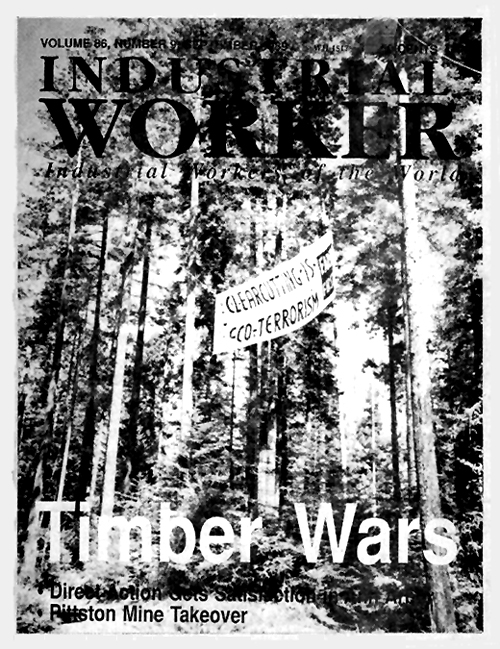 "You fucking commie hippies, I'll kill you all!" A shotgun blast goes off and the Earth First!ers scatter. What started as a peaceful logging road blockade had turned violent when a logger sped his truck through our picket line and swerved it towards the demonstrators. The loggers also grabbed and smashed an Earth First!er's camera and, for no apparent reason, punched a 50-year old protester in the face, breaking her nose.
 This site is not the official webpage of the Industrial Workers of the World.