






You are here
energy democracy
 The Environmental Protection Agency (EPA) has just issued the final text of the Clean Power Plan (CPP), a regulation whose purpose is to reduce the greenhouse gas emissions (GHGs) that climate scientists say are causing global warming. EPA and independent studies indicate that the
  Desperate to avoid climate regulation that may affect profits, polluting corporations are working hand-in-hand with governments, presenting a dizzying array of false solutions that deepen inequalities in our societies. There is a clear agenda: Manage the climate crisis without compromising profits, the power structures or the economic system that got us here, even if that means exacerbating the problem. Wall Street financiers, the synthetic biology industry, “green” venture capitalists and a host of others are jumping on the “we care about the climate, too!” bandwagon.
 Dear Gary Smith (GMB National Secretary for Energy),
 The following news items feature issues, discussions, campaigns, or information potentially relevant to green unionists:
 For the last twenty years, unions in the United States and internationally have generally accepted the dominant discourse on climate policy, one that is grounded in assumptions that private markets will lead the “green transition,” reduce emissions, and stabilize the climate over the longer term. Indeed, unions began attending the climate negotiations convened by the United Nations in the early 1990s, a time when the “triumph of the market” went unchallenged and the climate debate was awash with neoliberal ideas. Unions, therefore, focused on articulating the need for “Just Transition” policies to deal with the negative impacts on employment brought about by climate policies and to highlight the need for income protection, re-employment opportunities, education and re-training, and job creation.
 The following news items feature issues, discussions, campaigns, or information potentially relevant to green unionists:
 Ever since scientists discovered a runaway greenhouse effect on our nearest planetary neighbor, Venus, we've known that climate Armageddon is a possibility. Even though Venus is closer to the Sun than the Earth, Venus' thick cloud layer permits only one-sixth as much sunlight to reach the planet's surface. And while Mercury is nearly twice as close to the Sun as Venus, the surface on Venus is 10 percent hotter, measuring more than 864 degrees Fahrenheit. Why is Venus so hot? Its atmosphere is 97 percent carbon dioxide.
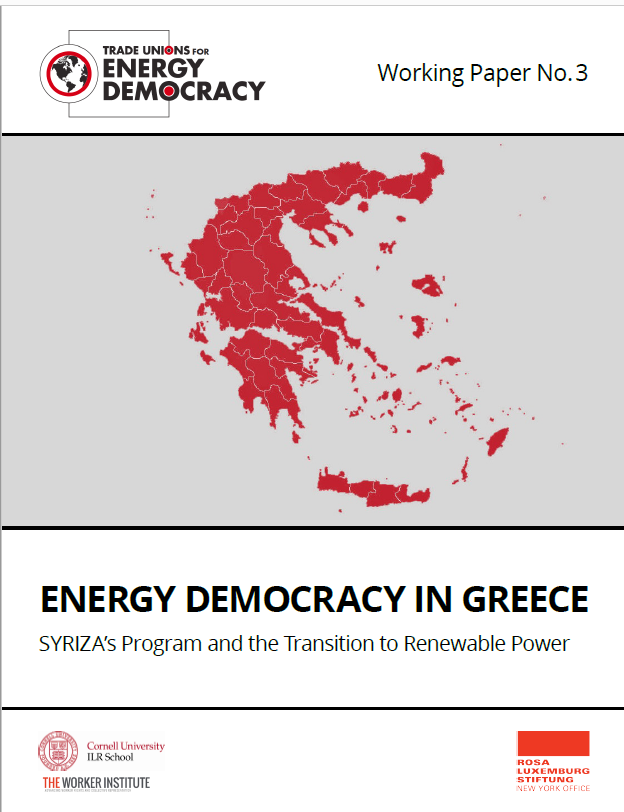 Since the financial crisis of 2008 and the subsequent “Great Recession,” governments have mostly scaled back or deemphasized their climate protection and “green” commitments. Lack of public funds and concerns about growth, competitiveness, and unemployment are frequently cited as explanations for this apparent loss of both ambition and urgency. The “green growth” narrative that colored various countercyclical “stimulus” spending packages from 2009-10 has been largely abandoned.
The Fine Print I:
Disclaimer: The views expressed on this site are not the official position of the IWW (or even the IWW’s EUC) unless otherwise indicated and do not necessarily represent the views of anyone but the author’s, nor should it be assumed that any of these authors automatically support the IWW or endorse any of its positions.
Further: the inclusion of a link on our site (other than the link to the main IWW site) does not imply endorsement by or an alliance with the IWW. These sites have been chosen by our members due to their perceived relevance to the IWW EUC and are included here for informational purposes only. If you have any suggestions or comments on any of the links included (or not included) above, please contact us.
The Fine Print II:
Fair Use Notice: The material on this site is provided for educational and informational purposes. It may contain copyrighted material the use of which has not always been specifically authorized by the copyright owner. It is being made available in an effort to advance the understanding of scientific, environmental, economic, social justice and human rights issues etc.
It is believed that this constitutes a 'fair use' of any such copyrighted material as provided for in section 107 of the US Copyright Law. In accordance with Title 17 U.S.C. Section 107, the material on this site is distributed without profit to those who have an interest in using the included information for research and educational purposes. If you wish to use copyrighted material from this site for purposes of your own that go beyond 'fair use', you must obtain permission from the copyright owner. The information on this site does not constitute legal or technical advice.
 This site is not the official webpage of the Industrial Workers of the World.