You are here

energy democracy

Why Ecosocialism: For a Red-Green Future

By Michael Löwy - Great Transition Initiative, December 22, 2018

The capitalist system, driven at its core by the maximization of profit, regardless of social and ecological costs, is incompatible with a just and sustainable future. Ecosocialism offers a radical alternative that puts social and ecological well-being first. Attuned to the links between the exploitation of labor and the exploitation of the environment, ecosocialism stands against both reformist “market ecology” and “productivist socialism.” By embracing a new model of robustly democratic planning, society can take control of the means of production and its own destiny. Shorter work hours and a focus on authentic needs over consumerism can facilitate the elevation of “being” over “having,” and the achievement of a deeper sense of freedom for all. To realize this vision, however, environmentalists and socialists will need to recognize their common struggle and how that connects with the broader “movement of movements” seeking a Great Transition.

Introduction

Contemporary capitalist civilization is in crisis. The unlimited accumulation of capital, commodification of everything, ruthless exploitation of labor and nature, and attendant brutal competition undermine the bases of a sustainable future, thereby putting the very survival of the human species at risk. The deep, systemic threat we face demands a deep, systemic change: a Great Transition.

In synthesizing the basic tenets of ecology and the Marxist critique of political economy, ecosocialism offers a radical alternative to an unsustainable status quo. Rejecting a capitalist definition of “progress” based on market growth and quantitative expansion (which, as Marx shows, is a destructive progress), it advocates policies founded on non-monetary criteria, such as social needs, individual well-being, and ecological equilibrium. Ecosocialism puts forth a critique of both mainstream “market ecology,” which does not challenge the capitalist system, and “productivist socialism,” which ignores natural limits.

As people increasingly realize how the economic and ecological crises intertwine, ecosocialism has been gaining adherents. Ecosocialism, as a movement, is relatively new, but some of its basic arguments date back to the writings of Marx and Engels. Now, intellectuals and activists are recovering this legacy and seeking a radical restructuring of the economy according to the principles of democratic ecological planning, putting human and planetary needs first and foremost.

The “actually existing socialisms” of the twentieth century, with their often environmentally oblivious bureaucracies, do not offer an attractive model for today’s ecosocialists. Rather, we must chart a new path forward, one that links with the myriad movements around the globe that share the conviction that a better world is not only possible, but also necessary.

TUED energy and climate retreat, Cutchogue, Long Island, April 3-4, 2017, hosted by Local 3, IBEW

By Staff - Trade Unions for Energy Democracy, February 25, 2017

A Discussion on Union Strategy and Policy in a Time of Resistance

April 3rd & 4th at Local 3 IBEW’s Education and Cultural Center in Cutchogue, Long Island, New York. Dinner and reception to follow (check out morning of April 5th).

See below for information about the purpose of the retreat and discussion topics.

Confirmed international participants:

Daniel Angelim (Trade Union Confederation of the Americas)
David Boys (Public Services International)
Daniel Chavez (Transnational Institute, Netherlands)
Hector de la Cueva (CILAC-Mexico)
Bruno Dobrusin (CTA, Argentina)
Simona Fabiani (CGIL, Italy)
Luz Gonzalez (CUT, Brazil)
Kate Lee (Union Aid Abroad /APHEDA, Australia)
Wol-san Liem (KPTU, Korea)
Maite Llanos (TUED, Geneva)
Sam Mason (PCS, UK)
Josua Mata (Sentro, Philippines)
Lance McCallum (Electrical Trades Union, Australia)
Philip Pearson (TUED, UK)
Allison Roche (UNISON, UK)
Ashim Roy (NTUI, India)
Asbjorn Wahl (NUMGE, Norway)

We are all energy unions now.

The retreat is being convened at a time when President Trump has made clear his enthusiastic support for more fracking of shale gas and shale oil, and his desire to remove regulations on fossil fuels. Executive Orders have indicated President Trump’s support for the Keystone XL and Dakota Access pipelines. A number of key US unions have endorsed these actions. Meanwhile, The White House has removed all references to climate change from its website, and the President has vowed to pull out of the Paris Climate Agreement and reign in the EPA.

Jobs and Climate Justice

We share a common atmosphere and all rely on the ecosystems that sustain life. All over the world unions and social movements are being drawn into struggles over the future of energy. Therefore a clear, compelling, and effective strategy for a transformative transition for energy is needed in order to meet the political challenges in the US and elsewhere.

Likely discussion questions:

  • The Trump Agenda: How can progressive labor in the US respond to the “energy superpower” argument?
  • What is the record of “labor-environmental” alliances and coalitions in the US and internationally?
  • Should we defend the Paris climate agreement?
  • Centers of resistance: What role for cities and states?
  • What is happening in key “carbon battlegrounds” countries like Australia, India, South Africa and the UK?
  • How can unions champion public renewable power and build union strength in the renewables sector?

A recent TUED Working Paper, Energy Transition: Are We Winning?, explains what is going on in the global energy system and the need for progressive and forward-looking unions internationally to work together to develop a more coherent and compelling approach to energy transition.

Pope’s encyclical sets the tone for June 29th Trade Union Climate Summit in New York

By Sean Sweeney - Trade Unions for Energy Democracy, June 17, 2015

Just 11 days after Pope Francis released his encyclical on the environment, New York will host a major gathering of 40 unions from 14 countries. With resistance to ‘extreme extraction,’ austerity and inequality all rising, unions see opportunities to begin to build a united global movement for fundamental change.  The Pope’s radical critique of the existing system is sure to resonate with the 100-person gathering.

More than 40 unions from 14 countries will participate in a one-day Trade Union Climate Summit in New York City on June 29th, 2015.  Hosted by 32BJ SEIU, approximately 25 unions from the US will be present, representing workers in energy, nursing and health care, public transport, food and retail, building services, as well as new organizing efforts among precarious workers in the New York City area. Roughly 30 allied organizations will also participate, including the Climate Justice Alliance, 350.org, and the Emerald Cities Collaborative. A full list of registered participants is here.

Why a summit?

The summit is being organized nine months after the massive People’s Climate March on September 21, 2014, and just 5 months before the ‘last chance’ UN climate negotiations (COP 21) in Paris in early December 2015. Unions and close allies will come together in New York determined to find ways to help better connect the rising climate movement with the growing global struggle against austerity and inequality.  Unions have been playing an important role in both movements, but in most instances fighting for climate protection (read: people protection) and building opposition to austerity, low pay and precarious work remain separate struggles. But the potential for building a new and tranformational ‘climate and class movement’ appears to be growing.

This potential seems particularly visible in Southern Europe where the left has won impressive electoral victories in recent months. Importantly, this is a left for which atmospheric and ecological degradation is not an afterthought, but a central question that reveals a basic truth: we live in a political economy that takes but does not give back. Both nature and labor are inseparable, and both are treated as a ‘resource’ from which value is extracted as needed and then dumped.

The June 29 summit in New York will hear from unions from Greece (Thessaloniki water workers) and Spain (Comisiones Obreras) as well as from Italy (CGIL) where the traditional political parties are also losing support. With an eye on the Paris climate talks, the summit will hear from two representatives from the main French trade union federation (CGT) regarding the preparations for the events around COP21.  The UN climate meetings have been the scene of large mobilizations in recent years, particularly Copenhagen in late 2009 and Durban in late 2011.

Unions representing 4.6 million workers have joined TUED

By Sean Sweeney - Trade Unions for Energy Democracy, January 3, 2016

Note: The IWW is not an affiliate of Trade Unions for Energy Democracy, or any of its affiliate unions, and this article is posted here for information purposes only:

The final months of 2015 saw a large growth in support for TUED in the US and UK

In the final months of 2015, seven unions representing approximately 4.6 million workers have joined Trade Unions for Energy Democracy.  Five of the unions are from the US and two are from the UK.

Screenshot 2015-10-11 13.39.10In a letter dated October 1, 2015, the General Secretary of the UK union Transport Salaried Staffs’ Association, Manuel Cortes, informed TUED that the decision to participate in TUED had been made by the union’s Executive Committee. TSSA is a 22,000 member union representing drivers working for railway companies, shipping companies, bus companies, travel agencies, airlines, call centers, and IT companies in the UK and Ireland.

unison-logo-tued

On October 7th, the policy committee of the UK’s second largest union, UNISON (1.3 million members) also agreed to participate in TUED. UNISON represents workers in a range of public services and hosted a TUED meeting in London on November 27 prior to COP 21 in Paris.  UNISON’s 2014 Warm Homes Into the Future report has drawn attention to the important role of energy conservation in the residential sector both for reducing energy use and for creating jobs. In a statement on the report, UNISON national officer Matt Lay said, “We need to lead the energy agenda and we are in a key position to achieve this.”
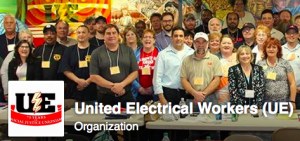
Screenshot 2015-10-11 13.42.22In the United States, the United Electrical Workers (UE) has also joined TUED, by way of a resolution passed at its 74th national convention in August 2015. The UE represents roughly 35,000 workers in companies like General Electric, and also newly-formed worker cooperatives, such as the Republic Windows and Doors in Chicago.

The resolution, “Protect our Planet for Future Generations”, endorsed TUED and other “worker-oriented efforts to address climate change.” The resolution called for “public ownership of the energy industry and for massive investments in renewable energy.”

NEA logo_horiz_CMYK.2

Also in October, the US’ largest union, the National Education Association (2.9 million members) joined TUED. The union has been supporting teachers with lesson guides on climate change. Another education union, the Professional Staff Congress, which represents 25,000 faculty and research staff working for the City University of New York, joined TUED in November.

nysutunited_150401_psccuny_01

Education unions from Australia, Romania, the US and the UK are now part of TUED, as is their global union federation, Education International (EI.) At its quadrennial world congress in July 2015, resolutions were passed to make sustainable development and climate change one of EI’s priorities in the coming years.

CA_C_57_logo

In late November 2015, District Council 57 AFSCME joined TUED. The union represents 25,000 workers in schools and community colleges, transit agencies, public works and services, clinics and hospitals, and water and wastewater facilities throughout Northern California and the Central Valley.

Screenshot 2016-01-02 12.20.17

Finally, in early December the 270,000 member union UNITE-HERE joined TUED.  The union represents workers in the US and Canada in the hotel, gaming, food service, manufacturing, textile, distribution, laundry, transportation, and airport industries. At the global level,UNITE-HERE has played a leading role in major campaigns around domestic workers and textile workers’ struggles in countries like Bangladesh. Ashwini Sukthankar,  Director of the Global Campaigns Department, will represent UNITE-HERE on TUED’s Global Advisory Group.

IPCC Report: First Thoughts on Next Steps

By Sydney Azari - Medium, October 14, 2018

The Intergovernmental Panel on Climate Change (IPCC) released an ominous report this week driving home an urgent and serious reality:without immediate action to transform society, climate catastrophe will not only be our children’s future, but our own.

The key takeaway from the IPCC report is this: if we do not radically transform every aspect of society starting NOW, we are facing ecological collapse and mass death in the short term. The report does not deeply analyse the geopolitical implications of such widespread environmental upheaval. Since human societies are inseparable from the environment, we know that the precarity resulting from collapsed ecological systems could lead to catastrophic and violent political outcomes as well.

The report has generated a shock through the consciousness of many people- mostly for what is unsaid. The foundation upon which we have built our lives is quickly crumbling. The American Dream, the white picket fence, and retirement will never be ours. It will never be our children’s. It will never be our children’s children’s. We are entering a time of uncertainty and pain that the hustle-and-bustle of everyday life hasn’t left much room to consider. This is a critical turning point, a challenge we must meet head on if we are to survive.

We cannot pretend that climate change does not mean that EVERYTHING we are accustomed to must change in response. Change is inevitable. Pain is inevitable. Uncertainty is inevitable. The outcome is unknown. The only variable that can be manipulated to change outright planetary collapse is our own agency in the situation.

Whether the shock of the report leads us to retreat inward or rise to the challenge will be determined by our capacity to locate meaning in the future and perceive a way toward it. Determining a direction forward is the difference between shock exhausting us or serving as fuel for the long journey ahead.

I hope these tactics can offer a light to draw us from the darkness.

(TUED Bulletin #76) New Unions and Regional Advances: A Mid-Year Report

By Staff - Trade Unions for Energy Democracy, July 30, 2018

This report is intended to update TUED’s participating unions, allies and supporters regarding the project’s considerable progress so far this year.

The first part of the report covers organizational developments. The second part addresses our research and analysis, highlighting how major reports from both the International Energy Agency (IEA) and BP have corroborated the main conclusions of recent TUED working papers. We believe this is a very significant development that confirms both the legitimacy and the importance of TUED’s approach.

If your union is interested in being part of TUED, you can find more information here.

Main Developments

  • TUED continues to grow. Unions representing 560,000 members have joined so far this year, with others actively deliberating. Today the project consists of 64 union bodies from 24 countries.
  • Regional and national expressions of TUED are taking shape in the Asia-Pacific region, Europe, South Africa and Latin America.
  • TUED’s research and analysis continues to have an impact on trade union debates and policy. Earlier this year, TUED’s Working Paper #11, Trade Unions and Just Transition: The Search for a Transformative Politics, became available in English and will soon be available in Spanish.
  • Partnerships and collaborations with policy allies and movement-based NGOs are moving forward. TUED is playing an increasingly significant role in building a global energy democracy movement.

If We All Became Vegan Tomorrow

By Chris Saltmarsh and Harpreet Kaur Paul  - New Internationalist, June 6, 2018

If everyone became vegan tomorrow, between 14.5 to 15.6 per cent of anthropogenic (human-made) global greenhouse gas emissions would be wiped out. That is huge. You would be forgiven if you thought it was higher, as a recent viral Guardian article, based on a new study out from the University of Oxford, sensationally reported that meat and dairy accounted for 60 per cent of agricultural greenhouse gas emissions, without stating the proportion of global anthropogenic emissions attributable to agriculture specifically.

With a current global average surface temperature increase of approximately 1.2°C, climate change has already caused harms, and any reduction in emissions would curtail further damage. Land currently used for meat and dairy production could be reforested, grains fed to cattle could be directed, water would be saved, and environmental damage caused by animal agriculture would cease.

While noteworthy, prioritizing dietary solutions is not only insufficient, but problematic. Imposing veganism on the majority world would hurt the rural poor. A survey of 7978 households in 24 countries across Latin America, Asia, and Africa, found that reliance on wild meat is highest among the poorest households and fills a gap when other food sources are not available. Many traditional and indigenous cultures surviving in relative harmony with natures have hunted meat sustainably long before the capitalist industrialization of agriculture. They’ve done so often with a profound respect for the animal and their role in the co-production of natures.

Winning Clean Energy & Climate Justice for All

By Sean Sweeney - The Murphy Institute, June 20, 2017

Sean Sweeney, from Trade Unions for Energy Democracy (TUED), speaking at the 2017 People’s Summit, held on June 9-11th, on the three tasks to win energy democracy in front of the labor movement today.

Full Report from an “International Meeting on the Energy Mix and the Commons” – Buenos Aires, Argentina (English)

By admin - Trade Unions for Energy Democracy, September 27, 2017; English translation provided by Daniel Chavez of this original report.

The Energy Mix and the Commons

On 4-5 September 2017, an International Meeting on the Energy Mix and the Commons was held at the ATE National trade union’s main office, in Buenos Aires, Argentina.

The meeting was framed within a broader process of exchange of knowledge and experiences on climate and energy policies in Argentina, Latin America and the world. The Argentinian State Workers’ Association (Spanish acronym ATE; acronyms will be for Spanish names where applicable) and the Autonomous Argentinean Workers’ Congress (CTA-A) are engaged in international processes towards the construction of regional and global alternatives, in particular the Development Platform of the Americas (PLADA) and the Trade Unions for Energy Democracy (TUED) initiative. The PLADA platform was conceived within the framework of the Trade Unions Confederation of the Americas (TUCA; CSA in Spanish) as a strategic political proposal centred around four dimensions—political, economic, social and environmental—aiming to contribute to the design and implementation of a regional model for sustainable development. PLADA proposes a gradual reduction in the use of fossil fuels, the universalisation of access to energy services, and the rationalization of those sectors of the economy that pollute the most. TUED, a global network composed of workers’ confederations and trade unions, focuses on democratizing generation, distribution and consumption of energy around the world.

The meeting was organised by ATE and CTA-A, with the support of the Transnational Institute (TNI, a worldwide network of scholar-activists based in the Netherlands) and the Latin American and Caribbean Confederation of State Workers (CLATE).

Building post-capitalist futures

By various - Transnational Institute - June 2018

Over several sunny days in June 2018, a diverse group of 60 activists and researchers from 30 countries convened for a multi-day meeting to discuss the collective building of post-capitalist futures. The meeting provided the opportunity for a rich exchange of perspectives and experiences, as well as deep discussion and debate. The goal of the meeting was not to achieve consensus both an impossible and unnecessary endeavour but rather to stimulate mutual learning, challenge one another and advance analyses.

One session of the meeting – Transformative Cities – was held not as a closed discussion but as a public event attended by 300 people at which prominent activists and academics engaged with municipal leaders and politicians on the role cities can play in building post-capitalist futures.

In line with the meeting, this report does not intend to advance one line of analysis, but rather summarise some of the key ideas and issues discussed and debated (not necessarily in the order they were articulated). To summarise necessarily means to leave things out. It would be impossible to fully capture the incredible richness of the discussion that took place, but hopefully this report provides a valuable sketch.

Read the report (PDF).

Pages

The Fine Print I:

Disclaimer: The views expressed on this site are not the official position of the IWW (or even the IWW’s EUC) unless otherwise indicated and do not necessarily represent the views of anyone but the author’s, nor should it be assumed that any of these authors automatically support the IWW or endorse any of its positions.

Further: the inclusion of a link on our site (other than the link to the main IWW site) does not imply endorsement by or an alliance with the IWW. These sites have been chosen by our members due to their perceived relevance to the IWW EUC and are included here for informational purposes only. If you have any suggestions or comments on any of the links included (or not included) above, please contact us.

The Fine Print II:

Fair Use Notice: The material on this site is provided for educational and informational purposes. It may contain copyrighted material the use of which has not always been specifically authorized by the copyright owner. It is being made available in an effort to advance the understanding of scientific, environmental, economic, social justice and human rights issues etc.

It is believed that this constitutes a 'fair use' of any such copyrighted material as provided for in section 107 of the US Copyright Law. In accordance with Title 17 U.S.C. Section 107, the material on this site is distributed without profit to those who have an interest in using the included information for research and educational purposes. If you wish to use copyrighted material from this site for purposes of your own that go beyond 'fair use', you must obtain permission from the copyright owner. The information on this site does not constitute legal or technical advice.