You are here

energy democracy

Bringing Power to the People: The Unlikely Case for Utility Populism

By Kate Aronoff  - Dissent, Summer 2017

One glaring omission in the postmortem handwringing about the 2016 election is the fact that most poor people in America—of all races and genders—simply didn’t vote. They were prevented from doing so by a number of structural barriers—voting restrictions, second and third jobs, far-flung polling locations—as well as a lack of excitement about two parties they saw as having abandoned them.

Enter: twenty-first-century electric cooperatives, a perhaps unlikely player in the contest for power between progressives and conservatives in the heart of so-called Trump country in rural America.

If there’s one thing poor, rural communities tend to have in common, it’s where they get their power—not political power, but actual electricity. Over 900 rural electric cooperatives (RECs)—owned and operated by their members—stretch through forty-seven states, serving 42 million ratepayers and 11 percent of the country’s demand for electricity. They also serve 93 percent of the country’s “persistent poverty counties,” 85 percent of which lie in non-metropolitan areas. REC service areas encompass everything from isolated farm homes to mountain hollers to small cities, with the highest concentrations in the South, the Midwest, and the Great Plains. And they might just offer an opportunity to curb the right and the climate crisis alike.

Nominally democratic, RECs have the ability to transform a sizable chunk of America’s energy sector—one of the highest-polluting parts of our economy. Servicing ratepayers whose top agenda may not be climate change, the push to integrate renewables into RECs’ energy mix nonetheless grounds the transition away from carbon-intensive fuels in something more material: energy bills. Member-owner reformers dotting the map of red and rural America are already waging fights over their cooperatives on two fronts: for basic representation and for energy efficiency. Their work—combining a zeal for small-d democracy with one for bringing down emissions—could hold the key to making sure the transition away from fossil fuels includes some of the poorest places in the country on the ground floor. Crucially, it could also help extend our much heralded clean energy revolution beyond liberal enclaves like New York and California. If successful, reformed RECs could give progressives a much needed foothold in places the Democratic Party has long since abandoned. They might also help greens refocus fights onto pocketbook issues.

Understanding the RECs’ radical potential, however, means understanding their history. Rural electrification was intended to accomplish one goal: to serve people neglected by the private sector. At the start of the Great Depression, some 90 percent of rural homes lacked electricity. For private utilities (the only game in town at the time) extending power lines to customers spread out over tens or hundreds of miles simply wasn’t worth the cost—especially considering that the vast majority of those potential customers happened to be poor.

Our Best Shot at Meeting Paris Goals? Make Energy Public

By Sarah van Gelder - Yes! Magazine, July 9, 2017

Mayors across the country have vowed to deliver on the goals of the Paris climate accord in defiance of President Trump’s decision to back out. But how can they, realistically, when the national government is questioning climate science and promoting coal, fracking, and pipelines?

Simply put: Make energy public. Instead of privatizing city services, as some policymakers have long advocated, a new report shows that public ownership gives cities and towns the best shot at meeting renewable energy and efficiency targets.

Reclaiming Public Services: How Cities and Citizens are Turning Back Privatization,” a study by the Amsterdam-based Transnational Institute, challenges the ideas that governments are ineffective service providers, that private companies are more efficient, and that austerity budgeting and reductions in public service are inevitable.

Cities and towns that want well-run water and sanitation services, low-cost access to the internet, and affordable housing should keep those operations public or run by local nonprofits, the report found. If these services are now private, the institute recommends “re-municipalization.”

The report is based on research involving 1,600 cities in 45 countries that have chosen public ownership over corporate ownership, especially of their energy and water systems. “These (re)municipalisations generally succeeded in bringing down costs and tariffs, improving conditions for workers and boosting service quality, while ensuring greater transparency and accountability,” the report concludes.

Both Hamburg, Germany, and Boulder, Colorado, for example, are making their electric power enterprises public in order to shift to green and renewable energy sources.

In France, 106 cities and towns have taken over their local water systems in the past 15 years, in spite of the fact that France is home to some of the world’s largest private water companies. During that time, the report found that no French cities went the other direction and privatized their water system.

The report focuses on water and energy services, but there are many other services that benefit from local public ownership—some unexpected. The French towns of Mouans-Sartoux and Ungersheim bought farmland and hired local farmers to supply organic produce for school lunches. In India, the Tamil Nadu government opened dozens of public low-cost restaurants run by impoverished women to feed the poor. Argentina privatized postal services in 1997, but just six years later, renationalized the service in response to the private company’s poor service and high prices.

Privatization is tempting; it can provide local governments with short-term cash infusions. What politician doesn’t like to fill a budget hole without raising taxes? But the infusions don’t last. The private companies must pay large sums to their shareholders and executives, which they often do by cutting corners on upkeep, wages, and services, or jacking up customers’ rates. Instead of circulating locally, that money leaves a city’s economy.

According to the report, once a service is turned over to a private company, many cities found it was difficult to maintain accountability. They faced cost overruns, poor service, and violations of contracts. Many found they saved money and improved services when services went back into public hands.

Although family-owned or worker-owned businesses and consumer cooperatives are essential to local economies, some services—like water and sanitation—are best operated at a municipal or regional scale, and multiple providers may not make sense. In cases of these natural monopolies, local public ownership especially makes sense.

Like an ecosystem, a functioning local economy requires diversity. It needs many forms of ownership and types of entities. To thrive over years, each entity must both give and take; they must be in relationship with the people, institutions, and ecosystems that make up each community. When a local economy is dominated by enterprises that work to extract value for Wall Street banks or corporations controlled by absentee owners, communities are drained of their common wealth. It is that concern that drives much of the opposition to big international trade deals, like the Trans-Pacific Partnership and Transatlantic Trade and Investment Partnership, which critics say favor corporate rights over those of local government.

On the other hand, local entities, whether operated by worker-owners, families, nonprofit enterprises, or local governments, seek out multiple bottom lines—multiple benefits for employees, young people, vulnerable residents, and other local enterprises. They also take responsibility for their own human and natural communities. That is how We the People and the natural world can thrive for the long term.

Our Best Shot at Meeting Paris Goals? Make Energy Public

By Sarah van Gelder - Yes! Magazine, July 9, 2017

Mayors across the country have vowed to deliver on the goals of the Paris climate accord in defiance of President Trump’s decision to back out. But how can they, realistically, when the national government is questioning climate science and promoting coal, fracking, and pipelines?

Simply put: Make energy public. Instead of privatizing city services, as some policymakers have long advocated, a new report shows that public ownership gives cities and towns the best shot at meeting renewable energy and efficiency targets.

Reclaiming Public Services: How Cities and Citizens are Turning Back Privatization,” a study by the Amsterdam-based Transnational Institute, challenges the ideas that governments are ineffective service providers, that private companies are more efficient, and that austerity budgeting and reductions in public service are inevitable.

Cities and towns that want well-run water and sanitation services, low-cost access to the internet, and affordable housing should keep those operations public or run by local nonprofits, the report found. If these services are now private, the institute recommends “re-municipalization.”

The report is based on research involving 1,600 cities in 45 countries that have chosen public ownership over corporate ownership, especially of their energy and water systems. “These (re)municipalisations generally succeeded in bringing down costs and tariffs, improving conditions for workers and boosting service quality, while ensuring greater transparency and accountability,” the report concludes.

Why Union Workers and Environmentalists Need to Work Together with Smart Protests

By Les Leopold - Alternet, June 21, 2017

As Trump slashes and burns his way through environmental regulations, including the Paris Accord, he continues to bet that political polarization will work in his favor. Not only are his anti-scientific, anti-environmentalist positions firing up some within his base, but those positions are driving a deep wedge within organized labor.  And unbeknownst to many environmental activists, they are being counted on to help drive that wedge even deeper.

Trump already has in his pocket most of the construction trades union leaders whose members are likely to benefit from infrastructure projects – whether fossil fuel pipelines or new airports or ...... paving over the Atlantic. His ballyhooed support of coal extraction  has considerable support from miners and many utility workers as well.

But the real coup will come if Trump can tear apart alliances between the more progressive unions and the environmental community. Trump hopes to neutralize the larger Democratic-leaning unions, including those representing oil refinery workers and other industrial workers.  That includes the United Steelworkers, a union that has supported environmental policies like the federal Clean Air Act and California’s Global Warming Solutions Act, and has a long history of fighting with the oil industry – not just over wages and benefits but also over health, safety and the environment.  

To get from here to there, Trump is hoping that environmental activists will play their part -- that they will become so frustrated by his Neanderthal policies, that activists will stage more and more protests at fossil fuel-related facilities, demanding that they be shut down in order to halt global climate crisis.  

Oil refineries present a target-rich arena for protest. On the West Coast they are near progressive enclaves and big media markets in California and Washington.  Yet many who live in fence line communities would like the refineries gone, fearing for their own health and safety. Most importantly, they are gigantic symbols of the oil plutocracy that has profiteered at the expense of people all over the world.

But from Trump's point of view, nothing could be finer than for thousands of environmentalists to clash at the plant gates with highly paid refinery workers. Such demonstrations, even if peaceful and respectful, set a dangerous trap for environmental progress. Here's why: 

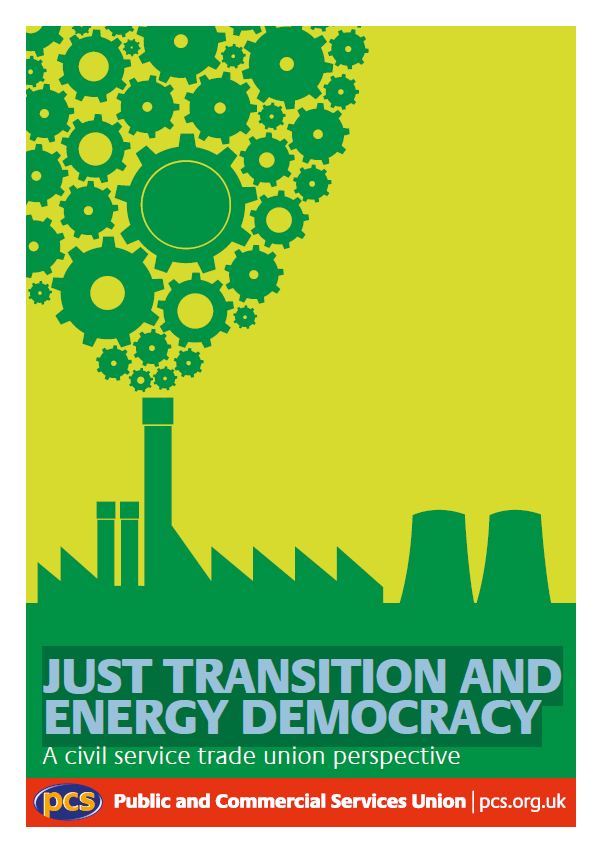
Just Transition and Energy Democracy: a civil service trade union perspective

By staff - Public and Commercial Services Union, June 22, 2017

New PCS pamphlet Just Transition and Energy Democracy : a civil service trade union perspective

We urgently need to transition to a zero carbon economy but this doesn’t have to come at a price for workers and communities. PCS will launch a new pamphlet on just transition and energy democracy at its annual delegate conference on 23 May. The pahmphlet makes the case for a just transition and energy democracy from the perspective of a civil service trade union, based on public ownership and democratic control of energy that provides an opportunity to re-vision and rebuild our public services for people not profit.  

ADC Green Fringe: Energy Democracy: A worker-public partnership for a just transition

Tuesday 23 May, 5.30pm

Brighton Conference Centre: Syndicate 2

Chaired by PCS vice president Kevin McHugh

Speakers:   

Chris Baugh - PCS assistant general secretary 

David Hall – Public Services International Research Unit (PSIRU)

Dorothy Grace Guerrero – Global Justice Now 

Bringing Power to the People: The Unlikely Case for Utility Populism

By Kate Aronoff  - Dissent, Summer 2017

One glaring omission in the postmortem handwringing about the 2016 election is the fact that most poor people in America—of all races and genders—simply didn’t vote. They were prevented from doing so by a number of structural barriers—voting restrictions, second and third jobs, far-flung polling locations—as well as a lack of excitement about two parties they saw as having abandoned them.

Enter: twenty-first-century electric cooperatives, a perhaps unlikely player in the contest for power between progressives and conservatives in the heart of so-called Trump country in rural America.

If there’s one thing poor, rural communities tend to have in common, it’s where they get their power—not political power, but actual electricity. Over 900 rural electric cooperatives (RECs)—owned and operated by their members—stretch through forty-seven states, serving 42 million ratepayers and 11 percent of the country’s demand for electricity. They also serve 93 percent of the country’s “persistent poverty counties,” 85 percent of which lie in non-metropolitan areas. REC service areas encompass everything from isolated farm homes to mountain hollers to small cities, with the highest concentrations in the South, the Midwest, and the Great Plains. And they might just offer an opportunity to curb the right and the climate crisis alike.

Nominally democratic, RECs have the ability to transform a sizable chunk of America’s energy sector—one of the highest-polluting parts of our economy. Servicing ratepayers whose top agenda may not be climate change, the push to integrate renewables into RECs’ energy mix nonetheless grounds the transition away from carbon-intensive fuels in something more material: energy bills. Member-owner reformers dotting the map of red and rural America are already waging fights over their cooperatives on two fronts: for basic representation and for energy efficiency. Their work—combining a zeal for small-d democracy with one for bringing down emissions—could hold the key to making sure the transition away from fossil fuels includes some of the poorest places in the country on the ground floor. Crucially, it could also help extend our much heralded clean energy revolution beyond liberal enclaves like New York and California. If successful, reformed RECs could give progressives a much needed foothold in places the Democratic Party has long since abandoned. They might also help greens refocus fights onto pocketbook issues.

Understanding the RECs’ radical potential, however, means understanding their history. Rural electrification was intended to accomplish one goal: to serve people neglected by the private sector. At the start of the Great Depression, some 90 percent of rural homes lacked electricity. For private utilities (the only game in town at the time) extending power lines to customers spread out over tens or hundreds of miles simply wasn’t worth the cost—especially considering that the vast majority of those potential customers happened to be poor.

Why Union Workers and Environmentalists Need to Work Together with Smart Protests

By Les Leopold - Alternet, June 21, 2017

As Trump slashes and burns his way through environmental regulations, including the Paris Accord, he continues to bet that political polarization will work in his favor. Not only are his anti-scientific, anti-environmentalist positions firing up some within his base, but those positions are driving a deep wedge within organized labor.  And unbeknownst to many environmental activists, they are being counted on to help drive that wedge even deeper.
Trump already has in his pocket most of the construction trades union leaders whose members are likely to benefit from infrastructure projects – whether fossil fuel pipelines or new airports or ...... paving over the Atlantic. His ballyhooed support of coal extraction  has considerable support from miners and many utility workers as well.

But the real coup will come if Trump can tear apart alliances between the more progressive unions and the environmental community. Trump hopes to neutralize the larger Democratic-leaning unions, including those representing oil refinery workers and other industrial workers.  That includes the United Steelworkers, a union that has supported environmental policies like the federal Clean Air Act and California’s Global Warming Solutions Act, and has a long history of fighting with the oil industry – not just over wages and benefits but also over health, safety and the environment.  

To get from here to there, Trump is hoping that environmental activists will play their part -- that they will become so frustrated by his Neanderthal policies, that activists will stage more and more protests at fossil fuel-related facilities, demanding that they be shut down in order to halt global climate crisis.  

Oil refineries present a target-rich arena for protest. On the West Coast they are near progressive enclaves and big media markets in California and Washington.  Yet many who live in fence line communities would like the refineries gone, fearing for their own health and safety. Most importantly, they are gigantic symbols of the oil plutocracy that has profiteered at the expense of people all over the world.

But from Trump's point of view, nothing could be finer than for thousands of environmentalists to clash at the plant gates with highly paid refinery workers. Such demonstrations, even if peaceful and respectful, set a dangerous trap for environmental progress. Here's why: 

Capitalism is destructive and unsustainable: It needs to be replaced

By John Bachtell - People's World, June 6, 2017

This article is based on remarks made by the author at the CPUSA National Labor Conference, May 20-21, in Chicago.

Several crises of contemporary capitalism have reached or are reaching dangerous tipping points. They are rooted in a path of destructive and unsustainable development.

They include extreme wealth and social inequality, job loss and dislocation from automation, and the existential threat posed by the ecological crisis.

These interconnected crises are impacting everything and must be addressed together. And they can be.

But standing in the way are Trump, the GOP and extreme right, and their main support base: monopoly-finance capital, the fossil fuel industry, and the military-industrial complex. Their agenda is intensifying these crises and must be defeated.

This underscores the urgency to build the broadest resistance movement and radically elevate the fight for unity of our multi-racial, male-female, LGBTQ, immigrant and native-born working class and people. This is central to guarantee the working class emerges as leader of the entire movement to break the extreme right political stranglehold and open the way for the challenging, contested, and complex transition to a just, peaceful, eco-socialist society.

Reclaiming Public Services: How cities and citizens are turning back privatisation

Edited by Satoko Kishimoto and Olivier Petitjean - Transnational Institute, June 2017

You would be forgiven, especially if you live in Europe, to think that public services are by nature expensive, inefficient, maybe even somewhat outdated, and that reforming them to adapt to new challenges is difficult. It would seem natural to assume – because this is what most politicians, media and so-called experts tell us continuously – that we, as citizens and users, should resign ourselves to paying ever higher tariffs for services of an ever lower standard, and that service workers have no choice but to accept ever more degraded conditions. It would seem that private companies will inevitably play an ever larger role in the provision of public services, because everything has a price, because politicians have lost sight of the common good and citizens are only interested in their own individual pursuits.

This book, however, tells a completely different story. Sometimes it may feel as though we are living in a time when profit and austerity are our only horizons. In reality, below the radar, thousands of politicians, public officials, workers and unions, and social movements are working to reclaim or create effective public services that address the basic needs of people and respond to our social, environmental and climate challenges. They do this most often at the local level. Our research shows there have been at least 835 examples of (re)municipalisation of public services worldwide in recent years, some of them involving several cities. In total there have been more than 1600 cities in 45 countries involved in (re)municipalisation. And these (re)municipalisations generally succeed-ed in bringing down costs and tariffs, improving conditions for workers and boosting service quality, while ensuring greater transparency and accountability.

Read the text (PDF).

Politicizing energy justice and energy system transitions: Fossil fuel divestment and a “just transition”

By Noel Healya and John Barry - Salem State University and Queen's University, Belfast, June, 2017

The burgeoning energy justice scholarship highlights the importance of justice and equity concerns in the context of global decarbonization and the transition to a green economy. This paper seeks to extend current conceptualizations of energy justice across entire energy lifecycles, from extraction to final use, to offer an analytically richer and more accurate picture of the (in)justice impacts of energy policy decisions. We identify two key areas that require greater attention and scrutiny in order to enact energy justice within a more democratized energy system. First, we call for greater recognition of the politics, power dynamics and political economy of socio-technical energy transitions. We use the example of the fossil fuel divestment movement as a way to shift energy justice policy attention upstream to focus on the under-researched injustices relating to supply-side climate policy analysis and decisions. Second, the idea of a “just transition” and the distributional impacts on “and the role of” labor in low-carbon transitions must be addressed more systematically. This focus produces a more directly political and politicizing framing of energy (in)justice and a just energy transition.

Download PDF Here.

Pages

The Fine Print I:

Disclaimer: The views expressed on this site are not the official position of the IWW (or even the IWW’s EUC) unless otherwise indicated and do not necessarily represent the views of anyone but the author’s, nor should it be assumed that any of these authors automatically support the IWW or endorse any of its positions.

Further: the inclusion of a link on our site (other than the link to the main IWW site) does not imply endorsement by or an alliance with the IWW. These sites have been chosen by our members due to their perceived relevance to the IWW EUC and are included here for informational purposes only. If you have any suggestions or comments on any of the links included (or not included) above, please contact us.

The Fine Print II:

Fair Use Notice: The material on this site is provided for educational and informational purposes. It may contain copyrighted material the use of which has not always been specifically authorized by the copyright owner. It is being made available in an effort to advance the understanding of scientific, environmental, economic, social justice and human rights issues etc.

It is believed that this constitutes a 'fair use' of any such copyrighted material as provided for in section 107 of the US Copyright Law. In accordance with Title 17 U.S.C. Section 107, the material on this site is distributed without profit to those who have an interest in using the included information for research and educational purposes. If you wish to use copyrighted material from this site for purposes of your own that go beyond 'fair use', you must obtain permission from the copyright owner. The information on this site does not constitute legal or technical advice.

