






You are here
Capital Blight: California's Water Crisis Began Over a Century Ago
By That Green Union Guy - IWW Environmental Unionism Caucus, June 26, 2015
Disclaimer: The views expressed here are not the official position of the IWW (or even the IWW’s EUC) and do not necessarily represent the views of anyone but the author’s.
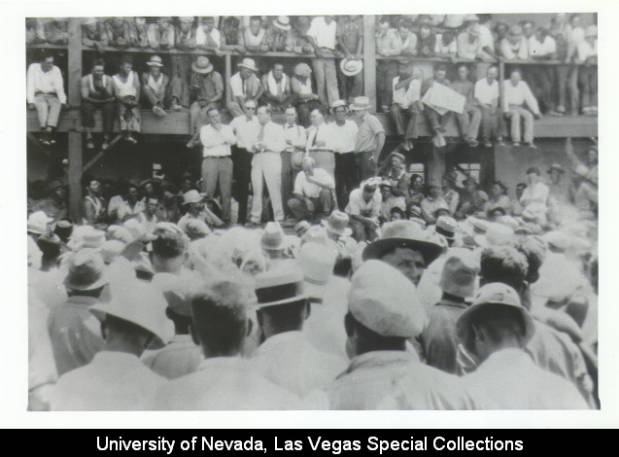 Editor's Note: The image at the right depicts a strike by laborers at Hoover Dam, which was instigated, in part, by members of the IWW. For a detailed account, see Break Their Haughty Power, by Eugene Nelson and Joe Murphy.
Anyone living in California would have to have been lost in the wilderness for the past few months to have missed hearing that the Golden State is in the throes of a water crisis of apocalyptic proportions. Although to those truly familiar with the politics and realities of water on the left coast, droughts, water wars, and water shortages are the rule, rather than the exception, but lately the buzz has escalated to a deafening roar.
The latest round in California's never ending watery angst reached a climax when the Los Angeles Times ran an op-ed penned by retired NASA hydrologist, Jay Famiglietti, (California has about one year of water stored. Will you ration now?) on March 12, 2015.
As ominous as that day of reckoning might sound, the situation is already wreaking havoc on the Golden State's economy and ecology. According to one report:
The drought shows no sign of letting up any time soon, and the state’s ($46 Billion) agricultural industry is suffering. A recent study by U.C. Davis researchers projected that the drought would cost California’s economy $2.7 billion in 2015 alone. In addition to the economic cost, the drought has subtle and not-so-subtle effects on flora and fauna throughout the region. This current drought may be contributing to the spread of the West Nile virus, and it’s threatening populations of geese, ducks, and Joshua trees. Dry, hot periods can exacerbate wildfires, while water shortages are making firefighters’ jobs even harder. And a little bit of rain won’t help. NOAA scientists say it could take several years of average or above-average rainfall before California’s water supply can return to anything close to normal.
The drought is affecting more than just agriculture, however. California's electrical needs are supplied primarily by hydro-electric power, but due to the vastly depleted reservoirs throughout the American southwest which are often accompanied by hydro-electric dams, nearly all of these facilities are far below the average levels. Furthermore, the Southwest’s two biggest hydropower plants, Lake Mead and Lake Powell are at unprecedented critically low levels, thus impacting electricity generation, and doing so during the hottest months of summer, when the grid is already stressed. It also requires water to produce steam for coal, natural gas and nuclear power plants, and they usually need water to cool them down. Huge amounts of electricity are needed to pump water across the desert.
The drought also impacts tourist-based economies throughout the state and the southwest as well. The Lake Mead National Recreation Area alone, in western Arizona and southern Nevada alone is the 6th most visited National Park unit in the country, attracting almost 7 million visitors each year and $260 million in local spending. More than 3,000 jobs and 125 small businesses depend on that economy. Similar impacts are being felt throughout California as skiing, river rafting and canoeing, camping, and fishing seasons have all been greatly aborted by the lack of snow and water.
California's freshwaters streams, at least those that are still flowing, are baking and killing off huge numbers of trout and salmon, not only degrading the biodiversity of these already greatly imperiled riparian environments, but also negatively impacting the livelihoods of fishermen. In some cases, once flowing streams have disappeared, leaving only stagnant cesspools in their wake, which have become breeding grounds for West Nile Virus bearing mosquitos.
Throughout the state, the drought has caused vast acres of forestland--at least those that haven't been devastated by clearcutting and liquidation logging over the past half century--to become potential powder kegs, thus greatly increasing the frequency and severity of forest fires. While foresters now acknowledge that forest fires are a natural cycle of a healthy forest ecosystem, the length of the fire season, which typically begins in late summer, in 2015 began in January. While it would seem to make ecological sense to let these fires burn naturally (and in some cases that is being done), due to almost a century of fire suppression--largely at the behest of timber capitalists and rural property owners--doing so indiscriminately would actually worsen the already imperiled forest ecosystems, because so many hectares of forestland are unnaturally dry, and to make matters worse, the fires could further threaten California's imperiled water infrastructure and freshwater environments. Worse still, the U.S. Forest Service as well as the California Department of Forestry and Fire Protection are subject to political manipulation. Fire suppression budgets have been cut, and pressure from timber interests and property owners has long politicized the priorities of these agencies such that sound ecological management take a backseat to capitalist considerations.
It's not as though more knowledgeable environmentalists, scientists, and climate justice activists didn't already know that the American southwest has been enduring one of the worst megadroughts in the past 1200 years. In early March, California's snowpack dipped to a record low 8% of normal. While scientists have ruled out climate change as the primary cause of this drought, declaring instead that this represents an abnormally low ebb in a somewhat cyclical pattern of wet and dry phases in the region, they nevertheless agree that global warming has made an already bad situation worse. Given the now well-established science of climate change, many have suggested that such dry spells may soon become the new normal. However, there are even some hydrologists who suggest that European settlers first arrived in the region just as it was entering an abnormally wet phase which has endured until just about now, and that megadroughts such as this one, well into its fifth year, may actually represent the old normal. But this is nothing new. California--and much of the western United States--has been dealing with water scarcity for years. For example, the Colorado River basin entering its sixteenth year of extreme or exceptional drought (some years the river doesn't even reach the Gulf of California).
Nevertheless, Famiglietti's editorial had the effect of pouring fracked gas on a slowly burning fire. There have been no shortage of apocalyptic comments on social media feeds proclaiming that doom is at hand and asking if now would be a good time to move away from the left coast. Even Famiglietti's dire pronouncements don't suggest that course of action, but the comments are telling in as much as they reveal just how successfully the capitalist class has been in convincing the 99% that there is an insurmountable scarcity of water. Let's not make any mistake here. The fresh water situation in California--and many other places--is indeed drastic.
It was, therefore, with great fanfare that on April 1, 2015, California Governor, Jerry Brown, announced that California would begin rationing water, and just for dramatic effect, he staged a photo op at Dorrington Meadows in the Sierra Nevada Mountains which are normally covered in five feet of snow, but were, on this day, completely dry and covered in green grass.
Brown's executive order called for:
- Cities and towns across California to reduce their water usage by 25%
- Replacing 50 million square feet of lawns throughout the state with drought tolerant landscaping in partnership with local governments;
- Directing the creation of a temporary, statewide consumer rebate program to replace old appliances with more water and energy efficient models;
- Requiring campuses, golf courses, cemeteries and other large landscapes to make significant cuts in water use; and
- Prohibiting new homes and developments from irrigating with potable water unless water-efficient drip irrigation systems are used, and ban watering of ornamental grass on public street medians.
This was no April Fool's joke. Many residents took this as acknowledgement that the apocalypse was imminent. Shades of past U.S. President Jimmy Carter in his cardigan sweater came to mind. Ecosocialist writer Arun Gupta noted:
Judgement was especially swift after California Governor Jerry Brown imposed a 25 percent reduction in water usage for urban areas. The media asked if this is "The End of California?", as well as declaring "So Long, California," and "Dust Bowl 2.0." One historian of California told the New York Times, "Mother Nature didn’t intend for 40 million people to live here."...The mainstream media, while sensationalistic, are more measured than the outlandish predictions found in the conspiratorial corners of the Internet: "California’s food supply to collapse," "California economy at risk of collapse," "housing collapse, municipal bankruptcies and a mass exodus of climate refugees."
Many cities balked at the restrictions, in spite of the fact that the previous week, Brown had signed a $1.1 billion drought relief bill. Californians belonging to the 1%, as one would expect, crowed mightily about the prospect of their golf-course sized lawns that surround their supersized McMansions turning brown. Such views are ideally represented by the likes of right-wing radio talk show host and Rancho Santa Fe resident, Steve Yuhas, who opined:
"(We) should not be forced to live on property with brown lawns, golf on brown courses or apologize for wanting (our) gardens to be beautiful...We pay significant property taxes based on where we live...And, no, we’re not all equal when it comes to water."
Certainly not! The average 99%er has it far worse, but just as capitalist ideologue Ayn Rand once absurdly declared the capitalist class America's "most persecuted minority", people like Yuhas actually want us to believe they are somehow the oppressed. Naturally, those of us who actually suffer at the unfair liquid welfare entitlements awarded to Yuhas and his ilk by the very government protectionism they claim so loudly to despise, don't take very kindly to being told, "let them eat cake!", or as one commenter in the article that quoted Yuhas sarcastically quipped:
I feel so bad for you. It makes me so angry to know that I live in a country where the poor are allowed to use the public water supply for frivolous things such as drinking water and washing their children's dirty clothes. Meanwhile, you are subject to the indignity of forcing your Sunday brunch guests to look at brown patches on your absurdly huge lawn while sipping their cocktails. It's an unspeakable tragedy.
Not to be outdone, the usual reactionary suspects crawled out from under their stones as well: Malthusians claimed the problem is caused by there being "just too many humans in California", Jingoists--like a perpetually broken record--blamed immigrants (meaning brown skinned immigrants). Liberal environmentalists--at least those who weren't channeling Malthus--were not much better, focusing primarily on oversized lawns, swimming pools, and golf courses, particularly in California's southeastern desert region, engaging in no shortage of discussions about how such landscapes do not mesh well with California's generally arid conditions. Dogmatic vegans and vegetarians, predictably, blamed just about all of California's water woes on the production and consumption of meat and dairy.
If any of these doomsayers, reactionaries, or even the liberals were to dive just below the surface, they'd have soon discovered that Brown's tough sounding words may have been miles wide, but only inches deep. The primary target of Brown's much touted restrictions were indeed private lawns, (though little mention was made of private swimming pools or golf courses) and even with these, the California Assembly had to hastily pass a bill preempting preexisting ordinances passed by various California cities which prohibited home owners from failing to keep their lawns watered and green.
It's important to be clear here. Meat and dairy admittedly do represent part of the problem, especially given the amount of water to produce their feedstuffs, most notably alfalfa). One could justifiably argue that the super-rich who inhabit artificially hydrated gated desert oases, such as Palm Springs--and are so rich that they don't just retain professional gardeners, they also hire others to process their utility bills (thus having no clue how much they actually pay for their water consumption)--ought to at least invest their vast wealth in much more drought resilient landscapes rather than attempting to recreate the Gardens of Versailles. There are indeed limits to growth and carrying capacity of any bioregion, and California's no exception, but even if one were to acknowledge all of these points, they'd still be grasping at straws. And, if capitalist commissars like Yuhas weren't so blind to their own class privilege, they might want to actually erect a statue to the Governor, because in this crisis he's proven himself to be their biggest enabler.
At no time did Brown, the capitalist media, or the howling right wing big-mouths note that these so-called "restrictions" exempt fracking and the continued use of water by oil refineries throughout the state. Not once did they say so much as a word about the continued appropriation of California's rapidly depleting liquid reserves by capitalists bottling it and selling it for profit. Nowhere did they mention any new limits to agricultural use of water. Not once did they point out that California's groundwater is on the brink of irreversible depletion. And nowhere did they admit that this likely has everything to do with the fact that all of these exemptions and omissions protect the capitalist class, particularly Jerry Brown's most generous campaign donors. Given the facts, it’s difficult to deny that California's new water "restrictions" are anything but a quid pro quo.
Old Water in New Bottles
Several corporations, including Nestle, Starbucks, and Walmart, have, for years, been engaging in bottling California's water to be resold for private profit, with little or no regulatory oversight, in some cases with expired permits 27 years out of date, thus effectively stealing a resource assumed to be a public commons. Nestlé CEO, Peter Braback, a staunch advocate for privatization makes no apologies for this and has been quoted saying that (access to) "water is not a human right." Braback is not really concerned with rights in any meaningful sense, anyway, since Nestle's actions alone have resulted in the devastation of freshwater riparian ecosystems, the exploitation of workers, and numerous human rights violations worldwide. Protests against Nestle in California have been increasing from various grassroots constituencies. The process of bottling water that could just as easily be obtained from the tap not only drives up the cost at the expense of the consumer, it also involves the production of energy and fossil fuel intensive plastic bottles (which further contribute to greenhouse gas emissions and pollution) and wasteful fossil fuel driven transportation of the product, all of which further contribute to global warming.
Finally, since the State of California has hitherto seemed quite unconcerned with charging Nestle with illegally bottling the state's water with a permit that expired more than 27 years ago, it's understandable that just about everyone is likely to regard Brown's executive orders with extreme cynicism.
That DOGGR Won't Hunt
As bad as the privatization of California's drinking water for bottling may sound, it's but a drop in the bucket compared to the consumption and degradation of it due to oil extraction. According to an article, by Julia Lurie in Grist, "Oil refineries are estimated to be the second biggest water user of non-ag businesses in the state (after golf)." The Environmental Protection Agency estimates that each gallon of oil takes between 1 and 2.5 gallons of water to refine, most of which is either dumped into the ocean after it’s used and treated or evaporated as steam.
Brown's decision to exempt oil and fracking from water restrictions for at least two years should nevertheless come as no surprise, given the fact that the fossil fuel industry has been one of the four-term California governor's largest campaign contributors, and, for stark proof of this, one need look no further than the epicenter of California's oil extraction and agricultural madhouse than Kern County in the southernmost end of the Central Valley region. In an article in the Ecologist, Evan Blake reported:
On the Sunday after Brown's announcement, Chuck Todd, host of NBC's Meet the Press, asked Governor Brown whether "considering how much water ... is used for fracking [hydraulic fracturing] ... isn't that alone enough reason to prohibit fracking or temporarily stop it?"
Brown sought to deflect the question, responding: "No, not at all. First of all, fracking in California has been going on for more than 50 years. It uses a fraction of the water of fracking on the East Coast for gas, particularly."
Throughout his entire political career, dating back to the 1970s, Brown has been entirely beholden to Big Oil, while posturing as a defender of the environment. He has accepted at least $2 million in campaign contributions from oil corporations since 2006, including Chevron, Occidental Petroleum, Southern California Edison, Valero Energy, Tesoro Corp, Conoco Phillips and Aera Energy (owned jointly by Shell and ExxonMobil).
Most of these companies donated the maximum amount possible to Brown's reelection campaign last November.
Earlier this year, the San Francisco Chronicle reported that, for years, state regulators knowingly allowed oil companies, mostly in the impoverished Central Valley, to pump their wastewater into groundwater aquifers that contained drinkable water.
Every year, the oil industry in California produces roughly 130 billion gallons of wastewater, as the state is the third-largest oil producer in the US. Kern County, home to most of California's oil and hydraulic fracturing (fracking) wells, has the worst air quality of any county in the US, along with some of the highest rates of cancer and respiratory illness.
The Governor's comment on fracking actually downplays the extent to which he is enabling it. In 2011, Brown fired two top state employees who recommended increased regulation of fracking in California. In 2013 Brown finally approved regulations on fracking which only require companies to notify neighbors and get permits, but place little other restrictions on the process. Anti fracking activists recently discovered that DOGGR--the Division of Oil, Gas and Geothermal Regulation, a California state agency supposedly charged with preventing such abuses--had been exposed for illegally allowing oil companies to inject toxic fracking wastewater into 2500 wells near California aquifers. This is nothing new, of course. According to Tom Hayden, it was Jerry Brown who allowed them to do this (during his first tenure as California Governor) to begin with:
There are an estimated 66,000 undocumented immigrants in Kern County, whose population is majority Latino. More than 22 percent of its people live below the poverty line, 69 percent of them within one mile of an oil well.
The barren place is a bit like Mississippi in the ’60s, powerful enough to defy progressive norms or laws on the national level. The federal government in 1982 transferred its power to California to monitor and regulate the 42,000 injection wells that dump toxic waste fluids into groundwater. That monitoring didn’t happen, a lapse that the feds say is shocking. The human carcinogen benzene has been detected in fracking wastewater at levels 700 times over federal safety standards. Health impact studies are inadequate, but Kern community hospital managers say the county has one of the highest cancer rates in the country, which is expected to double in 10 years.
How did it happen that the Obama Environmental Protection Agency is pushing the Jerry Brown EPA to comply with modern environmental law? The same Gov. Jerry Brown signed that 1982 agreement, giving Big Oil an opportunity to oversee itself. Those were the days when President Ronald Reagan’s Anne Gorsuch ran the federal EPA, perhaps convincing California that it could do a better job.
Shortly after Brown's executive order, some of these activists crashed an "aquifer exemption workshop", organized by DOGGR for the benefit of the fossil fuel industry, which instructed frackers on how to apply for wastewater injection exemptions.
The fossil fuel industry considers these exemptions an entitlement. The Western States Petroleum Association, an oil industry lobbying group staunchly defends them, claiming "Oil companies are doing their part to conserve, recycle and reduce the water they use to produce oil and refine petroleum products." They've also argued that the exemptions on their water consumption are necessary to refine the "special boutique blends" of petroleum products required by California's "strict" emissions standards (as if requiring other states to enact similar standards is somehow impossible), and such arguments are intended to distract attention away from replacing fossil fuel driven private automobile based transportation with public transit (with some provisions for personal electric automobile usage when no other methods of transport are available), or transforming suburban sprawl development into pedestrian friendly, locally resilient, appropriate scale urban centers.
Apologists for fracking, such as Pete Danko, have also argued that the process used only 70 million gallons of California's water in 2014, a mere fraction of the state's overall total, and just to emphasize the point, Danko referenced the Abengoa Mojave Solar plant which uses ten times as much water. However, Danko's comparison is utterly meaningless when devoid of context. Nowhere did Danko mention all of the other negative effects of fracking, including the toxic byproducts it creates, the danger to workers, the creation of earthquakes, the production of greenhouse gasses--such as methane--or the continued enabling of fossil fuel energy generation which contributes to global warming in general, which exacerbates drought conditions. In contrast, while the Abengoa facility may indeed use ten times as much water, it produces none of the other adverse effects and benefits humanity by reducing consumption of fossil fuels. As if anticipating apologists such as Danko, Credo Mobile's Zack Malitz, a harsh critic of fracking opined, "Fracking and toxic injection wells may not be the largest uses of water in California, but they are undoubtedly some of the stupidest," or as Karen Harper described it:
(Fracking's) real danger is in poisoning vast volumes of underground water with the chemicals it uses. Currently oil and gas companies are not required to disclose what chemicals they are pumping underground. Fracking also reduces the urgency to develop alternative, sustainable forms of energy and contributes to the global warming that will only accentuate California’s water crisis.
In any case, the 70 million gallon total, an unconfirmed figure provided by the oil industry itself, which keeps their actual figures concealed under the pretext of "proprietary information" is highly suspect, according to De Smog Blog's Mike Gaworecki:
(According to Food & Water Watch’s Adam Scow) If you factor in other well stimulation techniques and all qualities of water...you get a much larger number than 2.14 million gallons a day. Per DOGGR data, for instance, "For 2013, the amounts of water injected in cyclic steam wells, steam flood wells and water flood wells are about 168 million barrels, 374 million barrels and 1.42 billion barrels, respectively," Scow told DeSmog. That adds up to over 224.5 million barrels a day, or 82 billion barrels of water in 2013, more than 10.5 million acre-feet — still far less than the 30 million acre-feet agriculture uses in a year, but a significant amount of water all the same.
That water was of mixed quality, of course, not all of it ready to drink or be used for agriculture. But according to (Pacific Institute president) Peter Gleick, with greater knowledge of just how much water the oil industry is actually using and what kind of water it’s using, we could be making more-informed decisions as to whether or not there are better ways to use that water.
"We can produce any quality of water from any source, if we’re willing to spend the money, or willing to require the industry to spend the money," Gleick says. "But we’ve not been willing to impose that requirement. Most of that stuff is reinjected, and that raises the threat of groundwater contamination."
Big Agriculture Thirsty as Ever
Right wing blowhards like Steve Yuhas quite likely obtain their elitist, hyper capitalist talking points from the same ministries of propaganda that frame the message for the capitalist agribusiness giants that dominate the Central Valley. Anyone who has travelled that region's major highways (Interstate 5 and California State Highway 99) and seen California's cash-crop monoculture dominated agricultural region is familiar with the Burma-Shave type signs accusing any politician who so much as hints at the most miniscule attempt at the slightest regulation of their water usage of being a godless communist job killer beholden to whomever is the right-wing bogey man du jour. No doubt this has everything to do with the fact that Big Ag consumes approximately 80% of California's fresh water (though, admittedly, it's difficult to get exact figures on just how much water is consumed by whom, because the State of California quietly passed a law in 1997 that weakened one of the state’s chief open government laws, the California Public Records Act, in a deliberate move to protect large capitalist interests who consume the most water and power. Finding ballpark figures requires a good deal of sleuthing and investigation, but it can be done through painstaking research).
Spokespersons for Capitalist agricultural interests counter this figure by claiming that the total is closer to 40%, a claim that some self-proclaimed "environmentalists", such as Grist's Nathanial Johnson--ever an increasing apologist for GMOs and monoculture--have swallowed without much question. Big Ag's claim is only true if statisticians count every drop of fresh water, half of which is not actually harvestable, because it evaporates, becomes runoff, or percolates into the subsurface. In response, Big Ag has admitted that certain cash crops, such as Almonds and Alfalfa, do consume an inordinate amount of water, but have in the same breath justified it arguing that these crops are important for the state's economy.
The truth is complicated. The usage of water on these crops has become more efficient in recent years, as farmers have turned to drip irrigation systems, and the water that is consumed is reused and does percolate back into the aquifers (as Johnson rightly argues). These crops also do provide jobs for (much exploited, migrant) farmworkers (whose ability to unionize is greatly hampered by laws that are stacked against them, and are in danger of becoming more so), but arguments that such crops "contribute to California's economy" are only true if one assumes that the wealth gained by the mostly capitalist agribusiness firms that grow them which is derived primarily from exports to Asia and Europe magically trickles down to the rest of us, a claim that just about anyone now knows to be false. And it scarcely matters how efficient the water is used if only the employing class benefits! Truthdig's Sonali Kolhatkar elaborates:
"No water equals no jobs," (read some of the signs). That refrain is just another version of the coal industry’s mantra, "Stand up for American jobs," in West Virginia. In fact, many thousands of people have already lost their jobs as a result of the loss of water, and most of those have been poor farm workers. But the workers were exploited by big agribusiness to begin with, so the slogans referring to "lost jobs" really mean "lost profits."
Echoing that, Evan Blake, writing in an article for The Ecologist notes:
California produces over 99% of all almonds, pistachios, olives, walnuts, rice, plums, dates, figs, raisins, artichokes, kiwis, peaches and pomegranates grown in the US, and is also the leading producer of dozens of other food commodities. In recent decades, international demand has led to a large transition toward growing orchard and vineyard crops. During the drought, many farmers have fallowed even more of their traditional vegetable crops, diverting water toward almond trees and other orchards, which take longer to mature and are thus a larger capital investment. California currently grows roughly 80% of the world's almond supply, in addition to 43% of all pistachios and 28% of all walnuts, and these cash crops are indispensable to maintaining profitability. The 'almond empire' is centered in the San Joaquin Valley, home to the largest almond-growing monopoly in the world, Paramount Farming. Paramount's owners, Stewart and Lynda Resnick, are closely connected to Governor Brown, as well as Democratic Senator Dianne Feinstein and other state politicians, and have influenced water policy in the state for decades.
Adding to the contention that Brown was playing favorites, a week after his April 1 press conference, the Governor held a meeting on the drought at his capitol office and invited the big agribusiness interests, but excluded fishermen and indigenous tribal leaders. Meanwhile, Resnick, who has made substantial profits from Almonds and Pistachios grown in Kern County, expanded these export crops following the Governor's April 1 press conference. Stewart Resnick, like Brown, hides behind a green facade, serving on the board of Conservation International, while at the same time has promoted campaigns to weaken Endangered Species Act protections for Central Valley Chinook salmon and Delta smelt populations.
Brown defended his decision to exempt growers from his water restrictions, proclaiming,
"(Agribusiness interests are) not watering their lawn or taking longer showers. They're providing most of the fruits and vegetables of America...If you don’t want to produce any food and import it from some other place, of course you could do that."
East Bay Express editor Robert Gammon quickly countered this argument by correctly pointing out that:
Brown's arguments about agriculture and water use — while true to a point — are deeply flawed. For starters, agribusinesses, especially in the dry Western San Joaquin Valley (roughly between Tracy and Bakersfield), have been making up for the water cutbacks from Northern California and the delta by pumping huge amounts of water out of the ground. In fact, in some areas, farmers have faced no real water shortage so far, because the state has no restrictions on groundwater use.
In addition, as the Express and other news outlets have reported over the past fifteen months, much of the water use in the Western San Joaquin Valley in recent years has not been for essential foods, such as fruits and vegetables, nor has it been used to grow crops for California and the rest of the nation, as Brown contends. Rather, agribusinesses have used the water to fuel the almond boom now sweeping the valley. Almonds and other nut crops, such as pistachios and walnuts, require copious amounts of water to grow. In addition, much of the highly lucrative nutcrop is shipped overseas — in the case of almonds, about 70 percent.
In short, many agribusinesses in the San Joaquin Valley have been profiting by essentially shipping California water overseas.
Moreover, the claim that San Joaquin Valley farmers are facing water cutbacks from Northern California and the delta is dubious. Over the past month, Big Ag and the Brown administration have contended that valley growers should not face mandatory rationing because they will receive only about 20 percent of their allotment this year from the State Water Project — which ships water via canals and aqueducts from Northern California reservoirs and the delta to the south.
But that argument fails to note that the 20 percent allotment figure is essentially meaningless. Why? California's water is way oversubscribed. According to a 2014 UC Davis study, California has allocated water contracts for about five times more water than is actually available in a normal year. As such, San Joaquin Valley growers, even in wet years, don't receive 100 percent of their allotments from the State Water Project because there simply is not enough water to go around...Furthermore, this year's 20 percent figure excludes groundwater use. Since the drought began four years ago, San Joaquin Valley farmers have been pumping unprecedented amounts of water from the ground for their crops. As the Los Angeles Times (which has done some of the best reporting on water waste in California) reported last month, some areas of the valley have been sinking six to twelve inches a year, because of all the pumping. The land subsidence is causing roads and bridges to buckle, and even is impacting water canals. But worse than that, agribusinesses are now in a mad dash to see who can drill the deepest holes to access the dwindling groundwater supplies, as the water table continues to plummet. Growers are now sucking out water that seeped into the ground 10,000 to 20,000 years ago — during The Pleistocene Epoch.
But this is not all that they're sucking, as it turns out. Some growers in the particularly drought-stricken Kern County area (though probably not Resnick) are relying oil wastewater--discarded by Chevron without restrictions--without any clear knowledge on what's in it!
Meanwhile, sensing that some environmentalists have focused too narrowly on almonds, alfalfa, and meat, Will Parrish, in a detailed and lengthy article, published in the Anderson Valley Advertiser, detailed how the wine growers in the state have--in the pursuit of profits and the security of their yield--switched from dry farming to water intensive farming since the 1970s, thus greatly adding to the state's water woes. The growers have claimed that they're adopting sustainability measures by switching to drip irrigation systems, but the number of vineyards has exploded in recent decades, thus defeating the purpose.
The vineyard owners are not likely to feel the pinch either. The spread of vineyards has done more than simply contribute to the impact on California's water crisis; it has contributed to the devastation of biodiversity, including the fish population in watersheds, such as the Russian River in northwestern California. However, the vineyard owners are making a killing. As Parrish noted:
Governor Brown celebrated this year’s Earth Day by sipping wine at an Iron Horse Vineyards soiree outside the pastoral western Sonoma County town of Sebastopol. The vineyard’s CEO, Joy Sterling, is a member of the Brown administration’s Board of Food and Agriculture, which advises Brown and California Secretary of Food and Agriculture Karen Ross on policies that impact the state’s agribusinesses. More than ever, those policies tend to relate to the theme of the governor’s Earth Day address: water.
While looking out at Iron Horse Vineyard’s three hundred acres of Chardonnay and Pinot Noir grapevines, Brown was upbeat about the state’s ability to weather the dry months ahead. He also implored households to do more to conserve. However, he said nothing about the amount of water guzzled by Sonoma County’s wine industry, by far the largest consumer of water in the area.
It’s also not clear whether Brown was aware of the fact that Iron Horse Vineyards had been at the center of a debate in the local daily, the Santa Rosa Press Democrat, concerning high water use. The day of the governor’s appearance, the Press Democrat published an op-ed by the vineyard’s manager, Laurence Sterling, who defended his farm and its growing practices. “Mainly, we are not judged by our farming method or our water usage,” Sterling wrote. “We are judged on how our wines taste.”
Predictably, capitalist agribusiness interests issued statements claiming that they have already been forced to make cuts already (but neglected to mention that they compensated for these cuts by using even more of California's already dangerously depleted groundwater).
Stealing the Ground(water) Right Out from Under Us
According to Karen Harper of Socialist Alternative:
The groundwater, which in an average year provides about 40% of California’s water, has been so consistently tapped for irrigation that over the past 150 years the water table in the Central Valley has dropped by as much as 400 feet in the worst affected places. Agribusiness’ response to dwindling rain water has been to dig deeper and deeper wells into the aquifers. Well digging has become a boom industry in the Central Valley with big farms paying tens of thousands of dollars for deeper wells. Poorer rural families whose wells have run dry, are left without a reliable source of drinking water and are now forced to haul water in barrels to their homes. This ground water pumping is not currently regulated in California, and a recent bill in the State legislature to introduce regulations was passed with so many delays in implementation as to make it essentially worthless.
The More Things Change the More They Stay the Same
It should come as no surprise whatsoever that Brown's supposed "restrictions" represent a reinforcement of the status quo, because the supposed "green" Governor made it clear that he serves the interests of those who plunder California's water with his strong arm support of Proposition 1, which California voters approved in November 2014. The omnibus bond measure included a laundry list of projects supposedly intended to improve the state's water resiliency and restrict the dumping of contaminants into its freshwater ecosystem, but in actual fact represents a blatant give away to the aforementioned capitalist agribusiness and fossil fuel interests, and enabled the further privatization of the state's public infrastructure. That this is evident could easily be determined by a roster of the "Yes" camp's campaign donors, which included "a rogue's gallery of oil companies, corporate agribusiness tycoons, Big Tobacco, health insurance companies and greedy billionaires", notably Aera Energy LLC, a company jointly owned by affiliates of Shell and ExxonMobil ($250,000), the California Farm Bureau Federation ($250,000), the Western Growers Service Association ($250,000), the California Cotton Alliance ($200,000), and Stewart Resnick ($150,000) as well as many other capitalists who profit from California's water. Support also came from various mainstream environmental NGOs, primarily from its more right-leaning wing, particularly the Nature Conservancy, who frequently advocate "market-based solutions" to environmental issues. Proposition 1 also earned the support of building trades unions, whose economic position could best be summed as "what's good for capital is good for our members".
The measure's proponents spent in excess of $16.4 million in support, while opponents raised a mere $100,000, a ratio of 164:1. Under those circumstances, it's not surprising that the voters approved the measure by an overwhelming vote of 66.77 percent to 33.23 percent. The capitalist media, of course, spun the measure as an environmental reform initiative, just as they continue to spin Brown's supposed "restrictions" as a "water conservation measure", but in actual fact, many (mostly smaller and more grassroots) environmental groups, unions , and indigenous tribes opposed Proposition 1, precisely because they recognized it as a water grab by capitalist interests. The opposition singled out two major aspects of the initiative in particular, one being a massive water diversion tunnel project to be built in the Sacramento Bay and River Delta region. The other being the raising of the Shasta-Trinity Dam near Redding.
The Peripheral Canal that Wouldn't Die
The water dervison tunnels, two tunnels to be constructed underneath the Sacramento River Delta diverting water from the delta to the California Water Project, comprise the significant portion of the Bay Delta Conservation Plan (BDCP). The two tunnels, each measuring 40 feet in diameter and 35 miles in length, would divert water from the Sacramento River north of Sacramento and convey it under the Delta to currently existing state and federal pumps in Tracy. These pumps would, in turn, continue to send water down the State Water Project and federal Central Valley Project to 25 million Californians from Silicon Valley to San Diego--and to 3 million acres of Central Valley farmland. The Brown administration claims that the tunnels will not take any more water than California already takes from the Delta, and by moving the intake systems northward, it will make the water more reliable by reducing reliance on the huge pumps, which grind up and kill fish and make parts of the Delta run backward. The project is expected to cost approximately $25 billion.
In spite of the tunnels' claimed environmental benefits, such claims have been challenged by numerous scientific panels, including the Independent Delta Science Board and the National Academy of Sciences. Furthermore, in August 2014, the California and U.S. governments decided to delay the proposed project following the scathing 43-page comment letter by the US Environmental Protection Agency (EPA) slamming the Bay Delta Conservation Plan's draft Environmental Impact Report/Environmental Impact Statement (EIR/EIS).
Critics of the Delta Tunnels counter the supporters' claims of the project's merit by arguing (among other things) that:
- The tunnels will take at least 14 years for the project to be completed, which will do nothing to alleviate the drought in the near term;
- Once the tunnels are completed, they will only convey water north or south, and that they will add no new sources of water, but could very well deplete already endangered freshwater reserves further;
- That the State of California has yet to conduct a cost-benefit analysis to confirm the merits of the proponent's claims;
- That during periods of substantial drought, such as this one, after prior water rights and public trust needs are met, the tunnels will often have no water to convey anyway;
- That the tunnels will not reduce reliance on Delta imports as mandated by the 2009 Delta Reform Act;
- That the California State Water Resources Control Board, the Department of Water Resources, and the Bureau of Reclamation have allowed for the waiving and weakening of Delta water quality standards for all water uses and species protections during the drought, endangering numerous Delta species and bringing some to the precipice of extinction, and therefore there is no reason to believe that they will manage the Delta Tunnels any more reliably; and
- That the costs of the tunnels will likely be borne primarily by those least able to pay for them, primarily the smaller farmers and southern California residential ratepayers.
The Delta Tunnels project is actually a resurrection of an earlier, quite similar scheme proposed by Jerry Brown during his first tenure as California Governor, from 1976-82, then known as the Peripheral Canal. The project, which was presented to California voters in June 1982 as Proposition 9, would have allowed the construction of a canal and other water facilities to divert water from northern California rivers around the Sacramento-San Joaquin Delta into the California State Water Project feeding southern California. Then, as now, opposition to the canal included unions and environmentalists, but at least in 1982, the voters were able to defeat the canal--though that likely has as much to do with the fact that Brown, a Democrat, had fallen into substantial disfavor among voters during the (mostly false) euphoria that accompanied the so-called Reagan Revolution (and to be certain, Brown would be replaced by George Deukmejian, Jr, a Reagan Republican in November). Studies suggest that it was the proposed canal's potential costs that doomed it the first time around, rather than ecological considerations. 32 years later, after the negative results of more than a quarter century of Reagan style austerity are evident to all but the truest believers, large-scale infrastructure projects--even colossally bad ones, such as Proposition 1, are a much easier sell.
According to restore the Delta Executive Director Barbara Barrigan-Parrilla:
"Whether it’s a peripheral canal, twin tunnels, or now pipes, it’s the same old project. Changing the lipstick shade one puts on a pig, doesn’t make the pig any more attractive. The Delta canals/tunnels/pipes will destroy the largest estuary on the west coast of the Americas. They will ruin the environment and economy for the 4 million residents of the Delta counties. They will finish off our salmon runs and other native fish species which are barely hanging on from years of over pumping.
"The tunnels will become financial burdens for water rate payers and property tax payers in Los Angeles and Silicon Valley. They will leave the 500,000 customers of the Contra Costa Water District with drinking water that will not meet Clean Water Act standards. They will ruin the $5.2 billion annual family farm community.
"They will not provide urban residents with any additional water, but they will ensure that the mega growers like Stewart Resnick and those in Westlands who can spend millions on lobbyists and misleading messaging campaigns get the water they want to grow almonds on drainage impaired lands in the desert."
Instead of constructing these tunnels or maintaining the status quo, environmentalists argue that the best solution is for cities and large Central Valley farms currently dependent upon the imepriled Delta water system to take less water from it. Instead, water resources can be increased by increased conservation, more water recycling, drip irrigation, and other forms of water resilience. However, such measures would also require a complete rethinking of the currently existing water-intensive industrial agriculture and fracking practices from which Brown and his capitalist puppet masters currently profit, so such discussions are off the table as far as the mainstream media is concerned.
Cue the Right-Wing Hysteria
In every meaningful sense, Jerry Brown's supposed "restrictions" are an utter greenwash, a complete gimmie to the capitalists who're responsible for California's drought woes to begin with, and yet the political pundits to Brown's right are howling loudly that they go too far. For example, Carly Fiorina, who ran against Jerry Brown in the most recent governor's election, placed the blame for the water crisis squarely on the shoulders of environmentalists, damning (pun intended) the latter for opposing the construction of more dams and reservoir capacity. That most of the unbuilt infrastructure projects she lamented about had been thwarted largely by conservative-led opposition to new taxes was a detail Fiorina conveniently omitted. Nevertheless, the Republicans, who control less than one third of the state assembly and senatorial seats in California's legislature are echoing Fiorina's rhetoric and, taking a cue from them the Republican controlled US House of Representatives is now sponsoring legislation introduced by David Valadao, a Republican congressman from California, to overturn Brown's meager restrictions as well as several existing protections for fish in California's Sacramento River Delta.
These right wing ideologues neglect to mention that it was Jerry Brown who pushed for the sure to be disastrous "Delta Tunnels" project, a reincarnation of his "Peripheral Canal" boondoggle, which was opposed by environmentalists and unions alike, and ultimately defeated in a statewide ballot initiative in 1982.
Not to be outdone, Speaker of the House, John Boehner, an Ohio Republican congressman and known climate change denialist, blamed President Barrack Obama for California's water crisis, primarily fixating on Brown's (mostly ineffectual and meaningless) "restrictions" which have resulted in the browning of the green lawns of California's wealthy elite, stating:
If ever there was a phrase that perfectly encapsulates liberal environmentalists’ backwards priorities and regressive ideology of restriction and scarcity, it is the one now displayed on a government sign in Arcadia, California: “It’s ‘green’ to go brown.”
Typically, as most right-wing pundits do, Boehner uttered not a single word about the restriction and scarcity imposed on the 99% by the greedy profiteering of the 1%. He also neglected to mention that Obama's administration has also aided the capitalist water profiteers by ignoring scientific recommendations during a recent updating of the 43-year-old Clean Water Act. According to High Country News contributor Gary Wockner:
Obama’s new rule leaves thousands of mountain streams in the mountainous West and arid Southwest more vulnerable to pollution. It decreases the number and amount of rivers and water protected, contains significant new exemptions and loopholes for corporate polluters, and lacks the clarity needed to prevent the case-by-case determinations that have exposed Americans to polluted waterways nationwide.
First and most important for Westerners, Obama’s new rule did not adopt the Science Advisory Board’s recommendation to include language about what defines a “tributary” and a “perennial, intermittent, or ephemeral stream.” In a semi-arid environment like the Southwest, the majority of streams in the mountains and across the plains only flow intermittently during the late spring and summer, after the snow melts. But it’s extremely important to protect these ephemeral streams because they flow into (are “tributary”) to the year-round flowing rivers and streams across the state.
Such loopholes will result in far more than brown lawns.
In spite of the back-and-forth rhetoric from both the conservative and liberal wings of the capitalist class, it's likely that both agree on more than they claim to admit, and the likely short-term outcome of this crisis is (even more) austerity measures for the 99%, especially in matters of water. Long term, if left unchecked, there's little doubt that the capitalists intend to privatize California's water. In a sense, given all of the loopholes, exemptions, unchallenged expired permits, and the like, this has happened already, and we're experiencing yet another round of what Naomi Klein calls "disater capitalism" (though really, it's simply the logical systemic process of capitalism in its current stage).
The crux of the problem is capitalism, and the problem is woven in the woof of California's history, beginning with the earliest days of European invasions.
The Crisis Began Long Before the Current Drought
During the time when Mexico also included most of the American Southwest, including all of what was then known as "Alta" California, clear up to the Oregon border mostly treated the water in much the same way as their indigenous predecessors (whom they did not treat nearly as well). All of that changed when (White Anglo-Saxon Protestant) Americans began arriving in the region. Almost overnight water ceased to be an integral part of the land and instead became a resource to be homesteaded, claimed, bought, sold, willed, and inherited. The famous "Water Wars" of the late Nineteenth and early Twentieth Century were not so much battles for and against enclosure (the idea of communally owned water being as much an anathema to the Americans as commonly held land) as they were fights over the types of enclosure. Those that favored "public" ownership, as opposed to strict privatization, still envisioned great works, colossally scaled geoengineering, and total control ("reclamation") over the water, the "regulation" of which was intended to favor private interests (farmers, miners, manufacturers and the like). Even the euphemistically named "public works" projects were ultimately intended to serve the captains of industry and foster the growth of capitalism rather than benefit the people and usher in any foolish notions of a cooperative commonwealth. Water and nature were made to serve (colonialist, imperialist, capitalist) man, not part of a web of life that (all of) humanity could share in equality with the web of life, as had been done for millennia by indigenous tribes or even the Mexicans (their slaughter of those same tribes notwithstanding). It is that same mentality that persists among the more liberal wing of Capitalism to this day (the more conservative elements naturally still favor total privatization, as that is their solution to just about everything).
What is to be done?
All too often, disaster capitalism succeeds, not because the capitalists themselves are all powerful, but because they successfully hoodwink the victims into doing their work for them--in fact, they depend on it, and California's water crisis is unfolding in exactly that way. As often happens in in such situations, coupled with misdirected blame, one finds mostly ineffectual and wrong solutions, and California's water shortage has produced no shortage of these.
Privatization is obviously not a solution--and indeed creeping privatization, which is an inevitable feature of capitalist oriented policy--is a large part of the problem. Studies overwhelmingly show that privatization results in relentless over-extraction of groundwater and water from rivers, increasing rates for water and sewer services, corner cutting in much needed preventative maintenance (which creates further wastage and water loss as leaks and broken water infrastructure go unreported and unrepaired). Such results are predictable, because unlike publicly owned water agencies, capitalist run water services must make a profit for their shareholders.
It's all well and good to implore Californians to conserve water by cutting back on its usage, changing their lifestyle habits, or upgrading their personal water infrastructure (where feasible and permissible), but they've already been doing that for a quarter century, as Arun Gupta points out:
California has been reducing water consumption for years because of recurrent droughts. In February the state’s 39 million residents consumed an average of 76.7 gallons per day, one of the lowest rates of water usage in the country. Yet Amsterdam uses half that amount of water per capita, 38.3 gallons per day. California can still conserve tremendous amounts of water in the agriculture, industrial, and residential sectors without impacting the quality of life.
While it's certainly not unreasonable or unhelpful for each resident to do as much as they can to conserve water and use it wisely, the ability of anyone not in the capitalist class to do so is highly limited. Low income users, who depend on clean fresh water for sanitation, hygiene, cooking, and--in rare cases, small sustenance farming--scrimp and save as much as they can already, and their ability to upgrade their personal infrastructure is checked by their lack of capital.
Reducing or prohibiting immigration (regardless of the country of origin--though, in general, the perception by anti-immigration forces is that most of them can be found somewhere in Latin America) is no solution either. As detailed by Grist's Ben Adler, even if California had zero foreign immigrants, it would, at most, reduce its water usage by one-quarter of the 20 percent used for non-agricultural purposes, or 5 percent overall. However, in all likelihood, immigrants probably use even less than that. Only 14 percent of California’s water goes to residential uses, with the remaining non-agricultural 6 percent divided up by government and business. A lot of the most water-intensive uses, like golf courses, are mostly for affluent and disproportionately native-born consumers. Even residential usage skews towards the rich. As the Los Angeles Times notes, "many immigrants probably use less water than the average California resident because they tend to live in multi-family dwellings, not higher-consuming single-family homes."
Not to be outdone by xenophobic elements, the Malthusians will no doubt continue to declare that the solution is less people regardless of their citizenship. At first glance, it's tempting to agree with that idea. Currently, 38.8 million people live in California--approximately one of every eight people living in the United States. However, Malthusian doctrine is hardly scientific or realistic. It is highly unlikely that even this population will remain steady, let alone decrease, barring an ecological catastrophe, natural disaster, or war of epic proportions. Some of the more extreme Malthusians believe that such an event is precisely what is needed for nature's books to be balanced, but this would actually, in the long run, make the situation worse. Again, Gupta writes:
Believing nature will impose a solution is politically misguided. It wipes away the varied social impacts as well as the innumerable choices being made to perpetuate and profit from the crisis. The apocalyptic mindset also negates political action. We will not all be turned into modern-day Joads fleeing dead lands for greener pastures. Climate change may be sped up on a geological scale, but for most humans the apocalypse will be normalized as gradual shifts. Climatic events no matter how devastating will be used as opportunities for capital accumulation, as in Hurricane Katrina or the 2004 Tsunami.
In any case, considering the already noted ratio of residential water use (14%) to business and government water use (86%), even if a significant number of Californian's emigrated or perished, it would make little difference. The vast majority of California's water consumption comes from a tiny number of people engaged in specific industrial activity.
Noting this, some have suggested that California is simply not suited to be one of the world's "breadbaskets" (or, more accurately, one of capitalist agribusinesses cash cows), and that the bulk of what is currently grown in the state could--with some considerable effort--be shifted elsewhere, for example, to Georgia, in the American southeast, where water and precipitation is more plentiful, but this would be substituting one problem for another. It's a commonly held, but false, notion that much of California is an "irrigated desert" (though that is true of much of California's Central Valley and the Los Angeles urban megalopolis). California could easily continue to host as much or even more agricultural activity than it currently has, if the crops grown here were water resilient organic, locally controlled, worker run permaculture crops and urban farms as opposed to water intensive capitalist monoculture (largely for exports and profits). Indeed, this is as true in Georgia and everywhere else.
Wine production needn't be the water hog it currently is. Returning to the dry farming methods of the past in the Napa Valley alone (just one of California's many wine producing regions) would conserve 1.2 billion gallons annually. Of course, one might question the need for so many vineyards given the societal problems of alcoholism or the fact that many people lack basic food staples that could be grown instead of wine, much of which is consumed by the rich.
While it's certainly inspiring that several movements have sprung up to oppose the bottling of water in California,
EcoWatch blogger Anastasia Pantsios reminds us that,
Bottled water accounts for a tiny fraction of the water consumed in the state but it’s become something of a symbol of who gets access to water for profit and who is being forced to cut back.
And though it's a testament to the power of such movements that Starbucks has chosen to source their bottled water from Pennsylvania instead of California, one should really be asking if their bottling water for private gain is necessary at all.
Some argue for more dams and reservoirs, but this is no panacea either. While it's true that many of California's existing dams and reservoirs represent an essential part of the current water infrastructure--not to mention a source of (somewhat) reliable, (somewhat, depending on the dam) clean electricity generation, the construction of this infrastructure came at great cost to communities they displaced (many of them belonging to indigenous peoples), the ecologies of the rivers and streams they disrupted, and the lives of the workers that died in their making. No doubt these same challenges would limit the creation of additional infrastructure, and would certainly preclude the construction of additional megaprojects. Brown's Delta Tunnels project is a disaster in the making and will only serve to further privatize California's water. Some new small scale infrastructure might be beneficial in certain case, but such projects must be accountable to the communities in which they operate or effect.
At the opposite end of the spectrum, some deep ecologists and conservations argue for the removal of all--or most--human constructed water related infrastructure, but doing so in a way that wouldn't cause immediate dislocation of millions of people, the loss of a substantial source of hydro-electric power generation, and the ability to farm crops throughout much of California, would take decades if not centuries to carry out. Certainly, many dams and other water related infrastructure could be at least considered for deconstruction, again on a case-by-case basis, but doing so is no simple task. For example, a facility located in Potter Valley, California currently diverts water from the Eel River Watershed (which flows north through Mendocino and Humboldt Counties) into the Russian River Watershed (which flows south, through Sonoma County and then west to the Pacific Ocean), thus robbing subsistence water from the poorer communities and struggling ecosystems to the north and giving it to more well-to-do communities and developers to the south and west, at least according to the Friends of Eel River. No doubt some living along the Russian River have a different perspective, because--though the Russian may be artificially fed by waters diverted from elsewhere, this has been done for decades and the existing economies along it would no doubt all have to adapt to the changes. Again, much of these are shaped by capitalism.
Some have advocated desalinization--the process of producing freshwater by scrubbing salt from ocean water--as a solution. The idea would seem tempting considering the vast amount of ocean water available (after all, saltwater oceans cover almost 70% of the planet and represent an almost limitless source), but the limitations of the technology make the idea at best a futuristic ideal. Desalinization is very energy intensive and represents a potential hazard to aquatic ecology from sucking seawater into desalination plants and returning salt-concentrated brine back into the ocean. While such challenges are not insurmountable, currently existing technology has not addressed them, and the economies of scale likely don't warrant public investment. Privately built desalinization plants would only further the drive to privatize a public good, and in any case, the "scarcity" of water in California is more a result of the capitalist appropriation for what currently exists rather than any actual lack.
Rather than engage in expensive and capital-intensive desalinization, one could intercept a good deal of freshwater not currently flowing into much endangered rivers. A great deal of water that falls in California simply drains into the rivers, bays, and oceans unimpeded and often polluted as it runs through oily and dirty urban landscapes. Additionally, much of the water--other than sewage--that's used for non-agricultural and non-industrial consumption can be "reclaimed" by treating greywater and recycling it for uses other than drinking, hygiene, and cooking. Often the treated recycled water is pumped into the groundwater thus replenishing the existing supply. At least eight municipalities in three southern California Counties (Los Angeles, Orange, and Santa Barbara) currently engage in such practices, but this represents only the beginning of the recycled water potential.
For example, the University of California at Davis has modified its water-based cooling system, using recycled water instead of well water to help cool the campus’s “chilled water” supply thus saving an estimated 61 million gallons of potable water annually. Other similarly constructed facilities could likewise be modified this way.
But one needn't stop there. The ultimate goal in water recycling--as unpalatable as it sounds--is the direct reclamation, treatment, and reuse of sewage water, and it had already been seriously considered in San Diego County over a decade ago (until negative perception killed the idea). While it may sound disgusting, the technology currently exists to produce potable water close to the quality of distilled water using reclaimed sewage water as a source (and one should remember that ultimately, treated sewage water that isn't reclaimed in this fashion will--over the course of time ultimately become potable water, again anyway). In fact, such technology was utilized on the Apollo Moon Missions in the 1960s and 1970s. Of course, it would be wise not to trust such a treatment system to profit oriented capitalists who would have every incentive to cut corners on safety and health.
It is also possible to engineer, construct, and deploy rainwater catchment systems to harvest rainwater that falls on the roofs of buildings--or even save a step by planting food producing gardens on the tops of buildings, but all of this requires public funding or at least the collectivization of resources on a wide scale, something the capitalists oppose.
Karen Harper of Socialist Alternative advocates:
- Immediate regulation and restrictions on groundwater pumping
- Rain catchment systems and grey water systems for all housing and public buildings and promotion of drought tolerant plants; no potable water use on landscaping
- Reduction in produce requiring high levels of water investment
- Immediate banning of fracking, Agribusiness’ flood irrigation and private sales of water pumped from aquifers
- Public ownership under democratic workers control of the huge Agribusiness monopolies
Certainly the people of California must organize and put an end to the depletion of California's threatened aquifers by agribusiness capitalism, and begin the long-term process of restoring them, or else the state will become uninhabitable.
And there is no question that we must dismantle the entire fossil fuel energy system from extraction to consumption and replace it with conservation, energy efficiency, and renewable alternatives--not only to prevent the worst possible global warming scenarios, but destruction of our water ecosystems as well. Such a process must include (but needn't be limited to) an organized movement of workers at the point of production. In spite of the claims made by fracking apologists, such as Pete Danko, switching from fossil fuel and nuclear fission power generated electricity to renewable sources, such as wind and solar will not only reduce carbon emissions and air pollution, it would also substantially reduce water consumption as well, and one of the quickest fixes would be to use renewable energy sources to operate California's water infrastructure itself.
But our focus cannot be limited to California alone. California's water woes know no borders, just as capitalism knows no borders--other than those they impose on the non capitalist class (or classes).
And it's not just California that's suffering a drought of biblical proportions; recent news articles have revealed that the entire North American west--from Washington to Arizona is enduring one of its warmest winters and driest stretches in recorded history. Even historically wet Portland, Oregon and Seattle, Washington, are experiencing their unprecedented dry spells. Worse still, NASA satellite data illustrates that profit driven capitalist industrial activity is depleting groundwater tables all over the world.
As is true in most cases, a crisis equals (or at least offers) opportunities. In the case of California's water woes, we have the option of not only beating back the enclosure of what was once at least assumed to be a public commons, but the opportunity to turn the tide against the privatization of water worldwide, driven by ecocidal capitalism. As Maude Barlow reports in a July 15, 2015 article in The Nation:
An organized international movement has come together to fight for water justice, both globally and at the grassroots level. It has fought fiercely against privatization, with extraordinary results: Europe’s Transnational Institute reports that in the last 15 years, 235 municipalities in 37 countries have brought their water services back under public control after having tried various forms of privatization. In the United States alone, activists have reversed 58 water-privatization schemes.
Indeed, throughout the world, the masses have organized to oppose or reverse water enclosures in Colombia, Ireland, Mexico, and the United States--notably in metropolitan areas such as Pittsburgh, Pennsylvania. According to
The fight against water privatization represents a workers' issue as well as an environmental one. For example, "In November 2013, Colombian trade unionist Oscar Lopez Trivino became the fifteenth Nestlé worker to be assassinated by a paramilitary organization while many of his fellow workers were in the midst of a hunger strike protesting the corporation’s refusal to hear their grievances," according to Food and Water Watch.
The South African metal workers union, NUMSA, has issued not only a call to collectivize the South African electric grid, but a call to dismantle "mineral extractivism" in favor of renewable energy democracy. They've also rejected nuclear fission power as an alternative. There's no reason why a similar call can't be issued by a revolutionary union movement in California to challenge not only mineral extractivism, but water extractivism as well.
Currently there are mass mobilizations being organized by many organizations, groups, and constituencies to oppose the continued capitalist caused climate catastrophe. Throughout the lands threatened by deforestation, mountaintop removal coal mining, offshore oil drilling, tar sands mining, and fracking people are fighting back with blockades, direct action, mass mobilizations, and organized opposition to capitalism and capitalist political parties.
There is growing recognition--and not just from socialists and anarchists who have a long history and deep knowledge of anti-capitalism--that capitalism threatens human life (and perhaps all life) on Earth. California's water crisis represents an opportunity and an imperative to expand and further organize this growing opposition. Anything less will almost surely lead to apocalypse.
The Fine Print I:
Disclaimer: The views expressed on this site are not the official position of the IWW (or even the IWW’s EUC) unless otherwise indicated and do not necessarily represent the views of anyone but the author’s, nor should it be assumed that any of these authors automatically support the IWW or endorse any of its positions.
Further: the inclusion of a link on our site (other than the link to the main IWW site) does not imply endorsement by or an alliance with the IWW. These sites have been chosen by our members due to their perceived relevance to the IWW EUC and are included here for informational purposes only. If you have any suggestions or comments on any of the links included (or not included) above, please contact us.
The Fine Print II:
Fair Use Notice: The material on this site is provided for educational and informational purposes. It may contain copyrighted material the use of which has not always been specifically authorized by the copyright owner. It is being made available in an effort to advance the understanding of scientific, environmental, economic, social justice and human rights issues etc.
It is believed that this constitutes a 'fair use' of any such copyrighted material as provided for in section 107 of the US Copyright Law. In accordance with Title 17 U.S.C. Section 107, the material on this site is distributed without profit to those who have an interest in using the included information for research and educational purposes. If you wish to use copyrighted material from this site for purposes of your own that go beyond 'fair use', you must obtain permission from the copyright owner. The information on this site does not constitute legal or technical advice.
 This site is not the official webpage of the Industrial Workers of the World.