






You are here
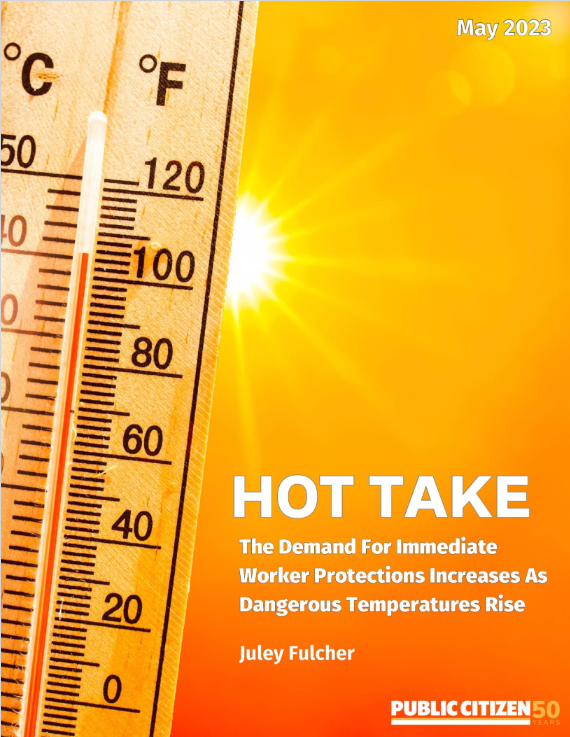
Hot Take: Urgent Heat Crisis For Workers
By Juley Fulcher - Public Citizen, May 25, 2023
 Key Findings
- Heat exposure is responsible for as many as 2,000 worker fatalities in the U.S. each year.
- Up to 170,000 workers in the U.S. are injured in heat stress related accidents annually. There is a 1% increase in workplace injuries for every increase of 1° Celsius.
- The failure of employers to implement simple heat safety measures costs the U.S. economy nearly $100 billion every year.
- The dangers of heat stress are overwhelmingly borne by low-income workers. The lowest-paid 20% of workers suffer five times as many heat-related injuries as the highest-paid 20%.
- Worker heat stress tragedies disproportionately strike workers who are low-income, Black or Brown.
- At least 50,000 injuries and illnesses could be avoided in the U.S. each year with an effective OSHA heat standard.
- Employers pay a substantial price for failing to mitigate workplace heat stress including the costs of absenteeism, turnover and overtime due to worker illness or injury, reduced worker productivity, damage to machinery and property from workplace accidents, increased workers’ comp premiums, law suits, and loss of public trust and customers.
- The physical and mental capacity of workers to function drops significantly as heat and humidity increase. Productivity of workers declines approximately 2.6% per degree Celsius above a Wet Bulb Globe Temperature (WBGT) of 24°C (75.2°F). The WBGT is a measure that combines temperature, relative humidity, radiant heat sources (like direct sunlight or heat-generating machinery) and wind speed.
- There are many simple ways employers can mitigate heat stress in the workplace, like access to cool drinking water and adequate “cool down” breaks in a shaded or air-conditioned space.
- It is essential that OSHA issue an interim rule to immediately prevent heat-related illness, injury and death in indoor and outdoor workers, both to protect workers and to reduce the clear burden on the economy.
The right to a safe workplace is a basic human right. Exposure to excessive heat is one of the most dangerous problems facing workers today. Tens of thousands of workers suffer heat illnesses, injuries and fatalities every year in the U.S. This is a toll disproportionately borne by Black and Brown workers, and low-income workers with limited options for safer employment. This is most clearly demonstrated by the plight of farmworkers, who have the highest rate of heat-related worker deaths, and are overwhelmingly immigrant workers with little power to demand workplace reforms from their employers.
Download a copy of this publication here (PDF).
Disclaimer: The views expressed here are not the official position of the IWW (or even the IWW’s EUC) and do not necessarily represent the views of anyone but the author.
The Fine Print I:
Disclaimer: The views expressed on this site are not the official position of the IWW (or even the IWW’s EUC) unless otherwise indicated and do not necessarily represent the views of anyone but the author’s, nor should it be assumed that any of these authors automatically support the IWW or endorse any of its positions.
Further: the inclusion of a link on our site (other than the link to the main IWW site) does not imply endorsement by or an alliance with the IWW. These sites have been chosen by our members due to their perceived relevance to the IWW EUC and are included here for informational purposes only. If you have any suggestions or comments on any of the links included (or not included) above, please contact us.
The Fine Print II:
Fair Use Notice: The material on this site is provided for educational and informational purposes. It may contain copyrighted material the use of which has not always been specifically authorized by the copyright owner. It is being made available in an effort to advance the understanding of scientific, environmental, economic, social justice and human rights issues etc.
It is believed that this constitutes a 'fair use' of any such copyrighted material as provided for in section 107 of the US Copyright Law. In accordance with Title 17 U.S.C. Section 107, the material on this site is distributed without profit to those who have an interest in using the included information for research and educational purposes. If you wish to use copyrighted material from this site for purposes of your own that go beyond 'fair use', you must obtain permission from the copyright owner. The information on this site does not constitute legal or technical advice.
 This site is not the official webpage of the Industrial Workers of the World.