You are here
News Feeds
NSW government’s delay on transition bill leaves coal workers exposed
A Hunter Valley community group is calling on the NSW Government to expedite its own draft legislation to impose workforce support obligations on the owners of closing coal mines, as 300 workers at the Ashton mine this week learned they will lose their jobs in the next 18 months.
Queenslanders could be left to pay for mine clean-up if Crisafulli weakens safeguards
Queenslanders could be left to pay for mine clean-ups if the Queensland government uses its review of the Financial Provisioning Scheme to weaken safeguards that ensure mines pay for rehabilitation.
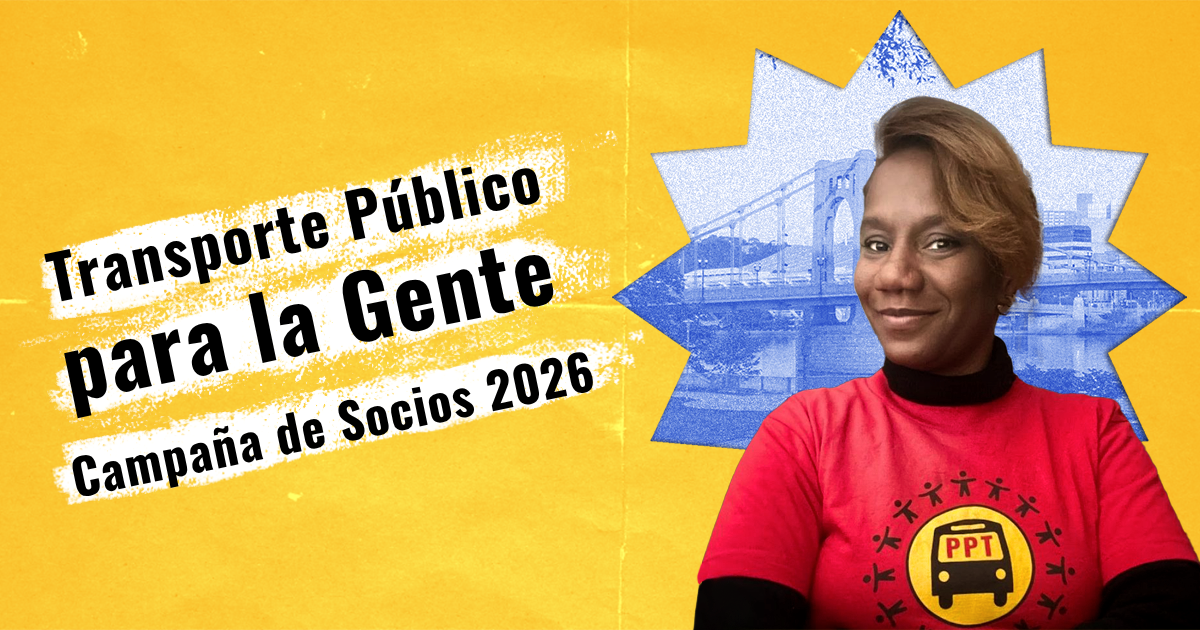
Transporte Público para la Gente: Únete a la campaña de Socios 2026
Me llamo Evelyn Ulysse Alcántara. Uso el transporte público a diario para ir al trabajo, al médico, actividades de ocio, reuniones, llevar a mi hijo al colegio— para todo.
Soy latina y mi inglés no es perfecto, así que cuando me mudé a Pittsburgh me costó usar el transporte público porque había muy poca información disponible en español. Por eso me ofrecí de voluntaria para ayudar como embajadora en los Recorridos de tránsito de PPT. Fue muy frustrante y aislante intentar aprender a usar el sistema de transporte público por mi cuenta. Sabía que si podía hacer algo para apoyar el aprendizaje de mi comunidad, ¡tenía que hacerlo!
Ser miembro de PPT no solo ha mejorado mis propias necesidades de transporte. Me abrió la puerta para ayudarme a marcar la diferencia.
Cuando hubo recortes en el transporte público en Beechview, hubo ocasiones en que el autobús o el Tren no venían—y no sabía la razón, porque los cambios sólo se comunicaban en inglés. Pero hoy, si vas a Steel Plaza o Wood Street Station, ¡escucharás anuncios en español! Y hay instrucciones paso a paso en español en la web de PRT. Esto se debe a que PPT y Casa San José se unieron para dar voz a mi comunidad, para que PRT pudiera entender el verdadero impacto que esto estaba teniendo en nosotros.
Este es el verdadero poder de PPT: realmente escuchan a la gente.
Cuando descubrí que PPT, me pedían testimonios sobre el papel que tiene el transporte público en la vida de las personas, para mostrar lo importante que sería un programa de media tarifa. Sabía que tenía que dar mi testimonio, porque necesitábamos actuar para mejorar el acceso. En aquel entonces solo era una idea y un proyecto, pero hoy es una realidad que lleva el servicio de transporte a la gente.
Me encanta el PPT porque sé de primera mano lo que podemos lograr juntos.
Solo en 2026:
- Llevamos a 120 miembros a Harrisburg para arrojar luz sobre la brecha presupuestaria de 80 millones de dólares y enfatizar la importancia de los servicios para tránsito y viajes compartidos para nuestros representantes.
- Compartimos habilidades y construimos poder con 170 personas de todo el país, compartimos habilidades y construyeron poder en nuestro Entrenamiento de Primavera 2026.
- Formamos a 13 becarios de organización comunitaria en toda la colina del barrio de PGH, y las regiones de Lancaster y Lehigh Valley en Pensilvania.
Por eso quería preguntar: ¿apoyarán el trabajo urgente de PPT haciéndote miembro que paga cuotas hoy?
Puedes apuntarte por solo 2,75 $, ¡el precio actual del billete de autobús del PRT! Ese dinero va directamente a la defensa de un presupuesto de transporte que mueve a TODOS los habitantes de Pensilvania. Todo el mundo merece acceso al transporte público.
¿Nos ayudarás a hacer realidad ese sueño?
The post Transporte Público para la Gente: Únete a la campaña de Socios 2026 appeared first on Pittsburghers for Public Transit.
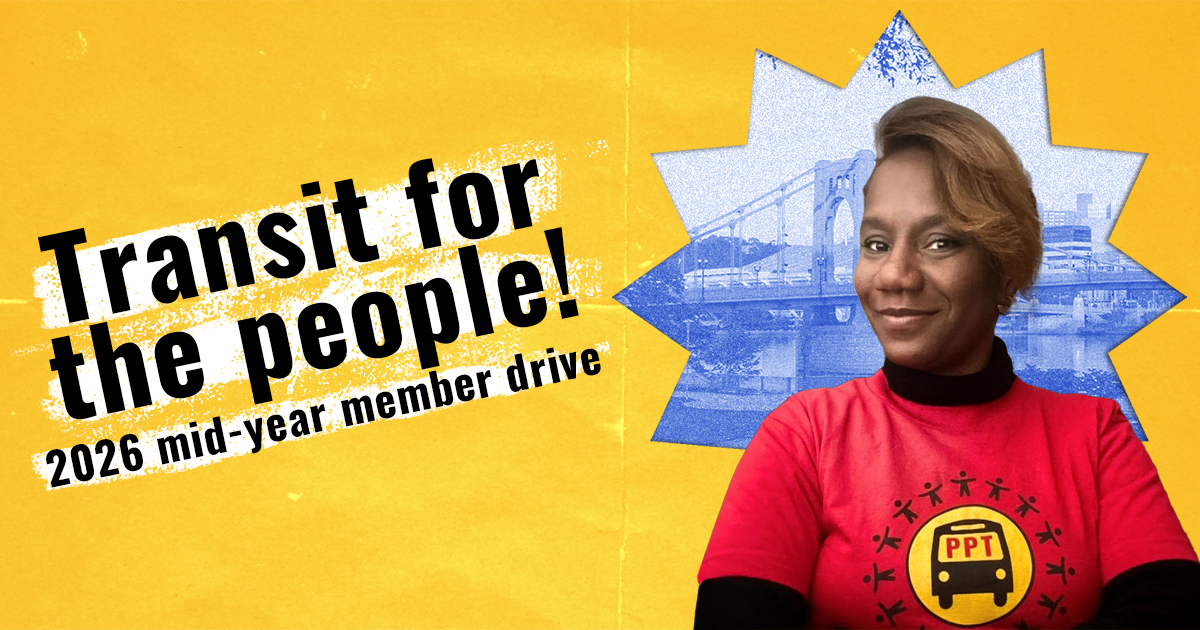
Transit for the People: Join the 2026 Member Drive
Image Description: Evelyn Ulysse Alcantara, a dark-skinned woman in a red PPT shirt, smiles in front of a collaged picture of Pittsburgh
I’m a mother and member of the Latino community fighting with PPT for a transit system that truly serves everyone. Will you join me by becoming a dues-paying member? Donate to become a PPT member!My name is Evelyn Ulysse Alcantara. I use public transportation daily for going to work, the doctor, leisure activities, meetings, bringing my son to school—everything.
I’m Latina and my English isn’t perfect, so when I first moved to Pittsburgh I struggled to use public transportation because there was so little information available in Spanish. This is why I volunteered to help be an ambassador for PPT’s Transit Tours. It was so frustrating and isolating to try and learn how to use the system by myself. I knew that if I could do something to support my community’s learning, I had to do it!
Being a PPT member hasn’t just improved my own transit needs. It opened the door to help me make a difference.
When there were cuts to transit in Beechview, there were times the bus or T didn’t come—and I didn’t know why because the changes were only communicated in English. But today, if you go to Steel Plaza or Wood Street Station, you’ll hear announcements in Spanish! And there are step by step instructions in Spanish on PRT’s website. This is because PPT and Casa San Jose came together to uplift my community’s voice, so that PRT could understand the true impact this was having on us.
This is PPT’s real power: they truly listen to the people.
When I first found out about PPT, they were asking for testimonies about the role transit has in people’s lives, to show how important a half-fare program would be. I knew I had to give my testimony, because we needed to take action to improve access. Back then it was just an idea, but today it’s a reality that brings transit service to the people!
I love PPT because I know firsthand what we can accomplish together.
In 2026 alone, we have:
- We brought 120 members to Harrisburg to shed light on the $80 million dollar transit budget gap, and emphasise the importance of paratransit and shared ride services to our representatives.
- We trained 13 community organizing fellows across the Hilltop neighborhood of PGH, and the Lancaster and Lehigh Valley regions of PA.
- Shared skills and built power with 170 people from across the country at our 2026 Spring Training.
That’s why I wanted to ask: will you support PPT’s urgent work by becoming a dues-paying member today?
You can join for just $2.75—the current cost of a PRT bus fare! That money goes directly towards advocacy for a transit budget that moves ALL Pennsylvanians. Everyone deserves access to public transportation. Will you help us make that dream a reality?
Donate now to join Evelyn as a member—and build transit for the people!The post Transit for the People: Join the 2026 Member Drive appeared first on Pittsburghers for Public Transit.
Breaking down how much Congress cut AML funds by state
In January Congress passed a “minibus” bill that raided $500 million in previously appropriated coal mine cleanup funds to pay for other federal programs. We’re now seeing the first results of that bill: $45.5 million less in mine cleanup funding every year for the next 11 years. Combined with growing inflation, this means fewer jobs will be supported cleaning up mines and more hazardous coal mining damage won’t be reclaimed in Appalachia and across the country.
When it passed in 2021, the Bipartisan Infrastructure Law provided about $10.9 billion for the reclamation of Abandoned Mine Land (AML) sites across the country in fifteen annual grants to states and tribes. The first four years’ worth of grants were awarded between 2022-2025. The minibus bill cuts $500 million from the total AML funding provided under the Bipartisan Infrastructure Law – but it was unclear at the time of passage if the $500 million would be cut entirely from the last (fifteenth) year of AML grants or equally across the remaining 11 years worth of annual funding. Now we have our answer.
The 2026 AML grants for states and tribes were announced in May and the cuts are here. According to the Office of Surface Mining Reclamation and Enforcement, the $500 million cut “will be applied equally to the remaining 11 grant distribution years, approximately $45.45 million per year.” The figure below shows the annual reduction in funds for each state and tribe, as well as the total cuts that will play out over the next 11 years. Pennsylvania and West Virginia have the largest cuts (by absolute value), at about $15 million and $9 million per year, respectively.
(function(){function e(){window.addEventListener(`message`,function(e){if(e.data[`datawrapper-height`]!==void 0){var t=document.querySelectorAll(`iframe`);for(var n in e.data[`datawrapper-height`])for(var r=0,i;i=t[r];r++)if(i.contentWindow===e.source){var a=e.data[`datawrapper-height`][n]+`px`;i.style.height=a}}})}e()})();
The cuts are reducing the amount of damage states and tribes can reclaim. Inflation – especially recent rises in fuel costs that can drive up the cost of operating construction equipment – is also lowering the spending power of reclamation dollars even from last year, further reducing the amount of reclamation states and tribes can accomplish in 2026.
States and tribes have a five-year window to spend their FY2026 AML grant, and those agencies will now begin planning for fewer dollars by taking steps like selecting fewer reclamation projects or reducing the scope of projects. In Pennsylvania, for example, the cuts are equivalent to the cost of two large abandoned mine drainage treatment systems.
As we explained in a previous post, the extent of AML damage that needs to be cleaned up is likely twice as large as the existing $10.9 billion in funding– even before $500 million was cut.
This is damage to land and water that has lingered since at least the 1970s, and now residents will have to wait even longer for cleanup. If this cut hadn’t occurred, $45 million per year in more mine cleanup would be put to use across the country in the next few years, removing hazards to the local population and supporting more jobs, such as in construction, doing reclamation work primarily in rural areas. Congress should reverse the $500 million reduction, and should protect the program from similar cuts in the future.
The post Breaking down how much Congress cut AML funds by state appeared first on Ohio River Valley Institute.
June 6, 2026 Read new San Francisco Gate story: US Navy finds radiological material in unauthorized storage in San Francisco
June 6, 2026
Read new San Francisco Gate story:
“US Navy finds radiological material in unauthorized storage in San Francisco”
June 2026: Bayview Hunters Point Community Call to Action and Demands issued by Greenaction and the Marie Harrison Community Foundation, Inc.
June 2026:
Bayview Hunters Point Community Call to Action and Demands issued by Greenaction and the Marie Harrison Community Foundation, Inc.
June 24th noon rally at San Francisco City Hall to support community demands for health, justice, and full cleanup of all contamination at the Hunters Point Naval Shipyard Superfund Site.
Statement on ACT NOW Clean Tech Initiative
FOR IMMEDIATE RELEASE
June 4, 2026
Statement on ACT NOW Clean Tech Initiative
ALLEGHENY COUNTY, Pa. — On June 4, Allegheny County Executive Sara Innamorato signed the Advancing Clean Technology for Neighborhood and Next-Generation Opportunity and Workforce (ACT NOW) Executive Order. In response, Ohio River Valley Institute Industrial Decarbonization Program Manager Justine Hackimer issued the following statement:
Clean technology and advanced manufacturing present a generational opportunity to strengthen Allegheny County’s economy, create high-quality jobs, and build on our region’s long history of industrial innovation.
For generations, southwestern Pennsylvania’s workers, manufacturers, and research institutions helped power economic growth across the country. As global markets increasingly demand cleaner technologies, our region is well-positioned to compete for the industries that will shape the next generation of manufacturing.
But realizing that opportunity requires more than individual projects. It takes coordination and smart policy like ACT NOW to ensure workers and local communities directly benefit from investments. We applaud County Executive Sara Innamorato’s leadership in shaping a clean tech future that works for all Pennsylvanians.
By investing in the industries of tomorrow while strengthening the systems that support workers and communities, the region can build a more diverse, resilient economy that creates opportunities for generations to come.
###
The post Statement on ACT NOW Clean Tech Initiative appeared first on Ohio River Valley Institute.
It’s Time for a Progressive Policy to Protect Agricultural Supply Chains
From remunicipalisation to the democracy of the commons
By Vanessa Mascia Turri
Naples became one of Europe’s most ambitious experiments in democratic water governance after Italy’s 2011 referendum against water privatisation. Yet bringing water back into public hands did not necessarily redistribute power over how water itself would be governed.
In 2011, after the Italian referendum against water privatisation, Naples became one of the most ambitious experiments in remunicipalised water governance in Europe. The city transformed its water utility into ABC Napoli (Acqua Bene Comune Napoli), a publicly owned entity presented not simply as a return to public management, but as an attempt to implement the “democracy of the commons” theorised by the Italian Forum of Water Movements.
Within this perspective, water was understood not only as a public service, but as a common good whose governance should involve the direct participation of citizens and social movements.
Over the following decade, Naples became a testing ground for a broader political question that has emerged across many remunicipalisation struggles: what happens when the language and practices of the commons enter public institutions? The Neapolitan experience shows that bringing water back into public hands does not automatically democratise its governance. Instead, participation became continuously negotiated and reshaped through political conflict, financial pressures and struggles over who should control public resources.
From water struggles to the democracy of the commonsSince the early 2000s, struggles against water privatisation have connected local mobilisations to broader debates around the commons. Struggles against water privatisation in Europe have often gone beyond opposition to market reforms and increasingly connected demands for public ownership with broader claims around the commons and direct democracy, as explored throughout the Reimagining, remembering and reclaiming water series. In many countries, water movements have challenged not only privatisation, but also the idea that essential services should be governed through technocratic and top-down forms of management, increasingly linking water struggles to broader claims around the commons and direct democracy, as discussed in Transforming capitalism? The role of the commons and direct democracy in struggles against water privatisation in Europe.
In Italy, these debates converged in the Italian Forum of Water Movements, one of the broadest water movements in Europe. As broader discussions around the commons in Italy have shown, these debates extended well beyond water itself and raised wider questions about collective resources, democracy and institutional change. Under the slogan “si scrive acqua, si legge democrazia” (“it is written water, it is read democracy”), the movement argued that remunicipalisation should involve not only public ownership, but also direct civic participation in water governance.
Naples became the most ambitious attempt to translate this political vision into institutional practice.
Poster from the 2011 Italian referendum campaign against water privatization reading “Water is not for sale.” Image courtesy of the Forum Italiano dei Movimenti per l’Acqua.
Naples became the most ambitious attempt to translate this political vision into institutional practice.
Yet public and academic debates on remunicipalisation have often focused on privatisation conflicts and legal transitions, paying far less attention to what happens afterwards. How are participatory mechanisms actually organised inside remunicipalised utilities? How much power are institutions willing to share with social movements and citizens once remunicipalisation has taken place?
My article From theory to practice: evaluating civic participation in Naples’ remunicipalised water service examines these questions through the case of ABC Napoli, reconstructing how participation was progressively organised, contested and reshaped during the decade following remunicipalisation.
Participation and the limits of the commonsAt the moment of remunicipalisation, Naples faced deteriorated infrastructures, chronic underinvestment and a massive municipal public debt. For many activists of the Neapolitan water movement, remunicipalisation was therefore not only about public ownership, but also about transforming the priorities of water governance through ecological restoration, infrastructural investment and more equitable access to water.
Over the following decade, ABC Napoli experimented with different forms of civic participation. Initially, the municipal government opened the board of directors to representatives linked to the Italian Forum of Water Movements and to environmental associations. Yet local activists who had led the mobilisation against privatisation were largely excluded from these arrangements, generating immediate tensions over who had the legitimacy to participate in the governance of the utility.
The most ambitious participatory experiment emerged with the creation of the Civic Council, a public assembly open to citizens, activists and ABC workers. Meetings were held directly inside the company and addressed issues such as tariffs, infrastructure maintenance, hiring policies and investment priorities. Delegates from the assemblies also participated in discussions with the board of directors, creating one of the most advanced attempts in Europe to institutionalise direct civic participation inside a remunicipalised water utility.
However, participation became far more conflictual once these assemblies started intervening in concrete political and economic questions. Members of the Civic Council promoted long-term infrastructural investments and the recruitment of specialised personnel while defending the financial stability of the utility. According to several interviewees, these priorities increasingly clashed with those of the municipal government, which was more focused on short-term employment policies and the management of public-sector jobs within a broader context marked by debt, unemployment and political pressures surrounding public employment.
These tensions ultimately led to the removal of the board of directors and to the progressive weakening of participatory governance. In the following years, participation increasingly shifted towards weak consultative mechanisms with limited influence over decision-making processes. Many activists gradually distanced themselves from the experiment, while severe financial constraints continued to limit investments in infrastructures and ecological renewal.
Rather than evolving towards deeper forms of democratic governance, the Neapolitan experience progressively revealed the difficulties of institutionalising the “democracy of the commons” within existing municipal structures and political priorities.
Remunicipalisation without democratisation?Poster from the Italian public water movement following the 2011 referendum campaign, emphasising water as a public right rather than a source of profit. Image courtesy of the Forum Italiano dei Movimenti per l’Acqua.
The experience of ABC Napoli complicates many celebratory narratives surrounding remunicipalisation. Bringing water back into public hands did not automatically redistribute power inside public governance. On the contrary, the Neapolitan case shows how quickly the language of the commons can become absorbed into existing institutional structures once participation starts challenging concrete political and economic interests.
The weakening of participatory governance inside ABC Napoli did not result from a lack of civic mobilisation or technical expertise. Quite the opposite: activists involved in the water movement developed increasingly detailed proposals on tariffs, infrastructures and long-term investments, becoming capable of intervening directly in the governance of the utility. Participation became problematic precisely when it stopped being symbolic and started questioning how public resources, infrastructures and employment should be managed.
In Naples, these tensions unfolded within a broader context marked by public debt, deteriorated infrastructures, unemployment and long-standing systems of political mediation surrounding public-sector employment. Under these conditions, the “democracy of the commons” increasingly collided with the political and administrative logics shaping municipal governance.
More broadly, the Neapolitan experience suggests that remunicipalisation alone cannot democratise essential services without a real willingness from public institutions to share decision-making power. Commons become politically difficult when they move beyond participation as consultation and start demanding participation as co-governance.
Rather than offering a linear model of democratic transformation, Naples reveals the unresolved tensions that emerge when social movements attempt to institutionalise the commons inside existing state structures. The question, then, is not simply whether remunicipalisation is possible, but whether public institutions are truly willing to democratise the power through which public resources are governed.
—
Featured image: Protest sign reading “Public water, public management. Clear?” during a demonstration of the Italian water movement. Photo courtesy of the Forum Italiano dei Movimenti per l’Acqua (acquabenecomune.org).
The post From remunicipalisation to the democracy of the commons appeared first on Undisciplined Environments.
Russian socialists: “Solidarity means accepting Ukrainians’ pain and suffering as our own”
Does Ontario Need New Nuclear to Keep its Lights on in 2050?
This factsheet shows that Ontario can easily accommodate enough solar and wind installations to meet the projected provincial demand for electricity in 2050. These options will be lower cost and faster to deploy than new nuclear. Read the factsheet
The post Does Ontario Need New Nuclear to Keep its Lights on in 2050? appeared first on Ontario Clean Air Alliance.
Organising action on climate and social justice: what next
Former Gavin Newsom aide picked as new California high-speed rail board chair
‘This cuts my commute cost in half’: New train connects Ventura, Santa Barbara counties
An Update on Contactless Fare Payment across Agencies in California
CENSORED NEWS: Shut Down Energy Fuels — Uranium Mining and Radioactive Dumping on Native People
Check out “Censored News” coverage of May 16
Protest in Utah against Energy Fuels uranium mines and mill
“CENSORED NEWS: Shut Down Energy Fuels — Uranium Mining and Radioactive Dumping on Native People”
NEW We the People Story Map
Backbone Intern Giacomo Moody's Story Map for We the People is now LIVE!.
The Story Map traces the journey of this Iconic image, from its 2007 debut at Seattle Center to its current deployments in pro-democracy protests around the country. Check out Giacomo's great work and the amazing fruits of our collective labors.
Learn more about joining us in DC or pitching in to support our team going to Washington, DC to mark the 250th Birthday of this country. We'll once again take the streets in a defiant and beautiful expression of common cause and our shared commitment to fulfilling mission of creating a more just, sustainable, and democratic nation, and a future we can be proud to hand our children.
Check out the We the People Story Map at BackboneCampaign.org/WeThePeople.
We the People on display at Folklife 2026!
We the People featured at NW Folklife Festival this weekend!
Two copies will be at Seattle Center this weekend at the NW Folklife Festival, one at the Mural Amphitheater Stage, near the Space Needle and another in the International Fountain Pavilion, with pens for signing. Use this chance to add your signature in time for it to be taken to DC this July 4th!
Over the last 19 years, Backbone's giant We the People banner has served as an icon of people power and our aspirations to fulfill the shared mission of creating a more perfect union. Adding two more Preamble sections has allowed it to appear in even more cities in the past year, collecting signatures and grabbing the attention of the press and public as a symbol of resistance and resilience.
How the Gutting of the Voting Rights Act Deepens Environmental Injustice
In April 2026, the Supreme Court’s 6-3 ruling in Louisiana v. Callais gutted a core protection of the Voting Rights Act of 1965 — the provision barring racial gerrymandering designed to dilutes the voting power of Black communities. The Trump administration called it a victory. For communities on the frontlines of pollution, climate change, and environmental injustice, it is one most deliberate act of erasure and as Dr. Beverly Wright of Deep South Center for Environmental Justice (DSCEJ) says, it is a “theft of our movement’s inheritance”.
This ruling did not arrive alone. It is part of a coordinated, multi-front strategy to remove impacted communities — particularly Black communities — from the rooms where decisions get made. Through the courts, through Executive Orders seizing control of elections, through the SAVE Act’s documentation barriers that would block more than 21 million Americans from voting, through a Department of Justice that has sued all 50 states to build a national voter surveillance database, and through the threat of criminal prosecution against election officials and civic organizations.
This administration’s goal is not election integrity. The goal is the permanent political marginalization of Black communities, Indigenous communities and communities of color.
The pattern is unmistakable when you see it whole. The Supreme Court’s ruling applies not just to Congressional districts, but also to state legislative districts and maps for county and municipal elections — determining who gets to serve on a school board, a city council, or in the judiciary.
Meanwhile, the administration has turned the Civil Rights Division of the Justice Department into an agency that violates the very definition of civil rights, redirecting it toward suppressing voting rather than protecting voting rights.
At the same time, another assault on voting rights is being advanced through Congress. If signed into law, the SAVE Act would require every American to produce a passport or certified birth certificate, in person, at an election office just to register to vote, eliminating online registration, mail registration, and most voter registration drives. For Black communities, this lands on a foundation of deliberate historical denial: many older Black Americans were never issued birth certificates by governments that refused to recognize their full humanity.
For Indigenous communities, the SAVE Act’s promise that Tribal IDs will suffice is a fiction, ignoring the fact that virtually no Tribal ID includes place of birth, another barrier buried in the bill’s text. And even with documents in hand, the nearest election office can be a hundred miles away across reservation land, or in Alaska, accessible only by plane.
These are not bureaucratic inconveniences; they are systemic barriers deeply rooted in this country’s history of racial segregation. They reflect the architecture of laws written around people who were never meant to be politically represented and applied to communities still fighting to be counted.
The same communities facing barriers to their rights to vote are bearing the greatest burden of air pollution, toxic contamination, extreme heat, and climate disasters. And the fact that these communities are overwhelmingly Black, Brown, Indigenous, and low-income, and this is not a coincidence. It is the predictable result of political exclusion and the enduring legacy of segregation.
When communities cannot elect representatives who share their priorities, when their votes are diluted through racial gerrymandering, the outcome is a petrochemical plant permitted next to an elementary school, a neighborhood left without clean water, or a community absorbing the full cost of an energy system it had no power to refuse.
A political system that makes voting harder perpetuates the very conditions that make environmental justice necessary.
This is also why the assault extends beyond the ballot. The same administration that is dismantling voting rights protections is also terrorizing immigrant communities — deportation threats, surveillance, and the weaponization of documentation status as a tool of political control.
What this administration is attacking, in every instance, is the fundamental democratic principle that the people most affected have a rightful voice in decision-making.
That principle does not begin and end at the voting booth. It lives in every planning meeting, every regulatory comment period, every public hearing, every coalition room where communities are fighting for their lives and their land. Undocumented neighbors, visa holders, green card holders, people who live and work and raise children in the same fenceline communities, who breathe the same air and drink the same water, carry knowledge and moral authority that no policy process can afford to exclude.
Voting is an essential mechanism through which communities exercise the most direct form of political power available to our communities, and its protection is non-negotiable. The fight for voting rights and the fight for full community participation are intrinsically linked because they are being waged against us by the same forces, for the same purpose: to ensure that the communities with the most at stake in our climate and environmental future have the least say in shaping it.
Our communities continue to show up, no matter the barriers put in our way: voters and non-voters, citizens and non-citizens, people who cast ballots, people who testify, and people who organize. No matter the injustices we face, environmental justice leaders know that our solidarity is unstoppable and our resolve to fight for true representation will never be broken by any court or politician.
Byron Ramos Gudiel is Executive Director of the Center for Earth, Energy & Democracy (CEED).
Sources:
https://www.brennancenter.org/our-work/analysis-opinion/save-act-and-election-power-grab
https://www.vote.org/save-act/
https://narf.org/wordpress/wp-content/uploads/2025/04/narf-save-act-native-voters.pdf
https://www.aclu.org/trump-on-voting-rights
https://www.brennancenter.org/our-work/research-reports/how-gerrymandering-tilts-2024-race-house
LCV – https://www.lcv.org/media-center/lcv-statement-on-scotus-decision-in-louisiana-v-callais/
Not NRDC Action Fund: https://www.nrdcactionfund.org/news/scotus-voting-rights-act-decision-hurts-our-democracy-and-the-court-itself/
Sierra Club: https://www.sierraclub.org/press-releases/2026/04/sierra-club-statement-supreme-court-ruling-gut-voting-rights-act
The post How the Gutting of the Voting Rights Act Deepens Environmental Injustice appeared first on CEED.
Pages
The Fine Print I:
Disclaimer: The views expressed on this site are not the official position of the IWW (or even the IWW’s EUC) unless otherwise indicated and do not necessarily represent the views of anyone but the author’s, nor should it be assumed that any of these authors automatically support the IWW or endorse any of its positions.
Further: the inclusion of a link on our site (other than the link to the main IWW site) does not imply endorsement by or an alliance with the IWW. These sites have been chosen by our members due to their perceived relevance to the IWW EUC and are included here for informational purposes only. If you have any suggestions or comments on any of the links included (or not included) above, please contact us.
The Fine Print II:
Fair Use Notice: The material on this site is provided for educational and informational purposes. It may contain copyrighted material the use of which has not always been specifically authorized by the copyright owner. It is being made available in an effort to advance the understanding of scientific, environmental, economic, social justice and human rights issues etc.
It is believed that this constitutes a 'fair use' of any such copyrighted material as provided for in section 107 of the US Copyright Law. In accordance with Title 17 U.S.C. Section 107, the material on this site is distributed without profit to those who have an interest in using the included information for research and educational purposes. If you wish to use copyrighted material from this site for purposes of your own that go beyond 'fair use', you must obtain permission from the copyright owner. The information on this site does not constitute legal or technical advice.
 This site is not the official webpage of the Industrial Workers of the World.