You are here
News Feeds
To fight wildfires and climate change, scientists say: Don’t burn debris, bury it.
When logging companies cut down trees to thin overcrowded forests, they are left with a costly headache: giant mounds of limbs and spindly trunks worth so little that it’s easier to burn them.
But they could turn this biomass trash into carbon-rich treasure, both making money and trapping much of the carbon dioxide that rises into the atmosphere from these blazing slash piles, according to new research.
In many parts of the arid western United States, companies could earn billions of dollars by simply burying the wood debris underground and selling carbon credits, according to research published today in Science Advances.
The new work shows that “pairing these two pathways together could enable more forest restoration as well as carbon storage,” said Sinéad Crotty, an ecologist and manager at the Carbon Containment Lab, a Connecticut-based nonprofit that studies ways to reduce greenhouse gas pollution.
The strategy is deceptively simple. Plants are the ultimate carbon capture device, sucking carbon dioxide from the atmosphere and storing it in wood and leaves. But the long-term fate of that carbon hinges on what happens when those plants are cut down or die.
Burn them, and much of it goes back into the atmosphere, where it contributes to global warming. Let them decay, and the same thing happens. But if you stick them underground and shield them from the air, much of that carbon should stay put. After all, that’s basically what happened with all that oil and coal we are now burning. It was once ancient vegetation buried under sediment.
.IRPP_ruby , .IRPP_ruby .postImageUrl , .IRPP_ruby .centered-text-area {height: auto;position: relative;}.IRPP_ruby , .IRPP_ruby:hover , .IRPP_ruby:visited , .IRPP_ruby:active {border:0!important;}.IRPP_ruby .clearfix:after {content: "";display: table;clear: both;}.IRPP_ruby {display: block;transition: background-color 250ms;webkit-transition: background-color 250ms;width: 100%;opacity: 1;transition: opacity 250ms;webkit-transition: opacity 250ms;background-color: #eaeaea;}.IRPP_ruby:active , .IRPP_ruby:hover {opacity: 1;transition: opacity 250ms;webkit-transition: opacity 250ms;background-color: inherit;}.IRPP_ruby .postImageUrl {background-position: center;background-size: cover;float: left;margin: 0;padding: 0;width: 31.59%;position: absolute;top: 0;bottom: 0;}.IRPP_ruby .centered-text-area {float: right;width: 65.65%;padding:0;margin:0;}.IRPP_ruby .centered-text {display: table;height: 130px;left: 0;top: 0;padding:0;margin:0;padding-top: 20px;padding-bottom: 20px;}.IRPP_ruby .IRPP_ruby-content {display: table-cell;margin: 0;padding: 0 74px 0 0px;position: relative;vertical-align: middle;width: 100%;}.IRPP_ruby .ctaText {border-bottom: 0 solid #fff;color: #0099cc;font-size: 14px;font-weight: bold;letter-spacing: normal;margin: 0;padding: 0;font-family:'Arial';}.IRPP_ruby .postTitle {color: #000000;font-size: 16px;font-weight: 600;letter-spacing: normal;margin: 0;padding: 0;font-family:'Arial';}.IRPP_ruby .ctaButton {background: url(https://www.anthropocenemagazine.org/wp-content/plugins/intelly-related-posts-pro/assets/images/next-arrow.png)no-repeat;background-color: #afb4b6;background-position: center;display: inline-block;height: 100%;width: 54px;margin-left: 10px;position: absolute;bottom:0;right: 0;top: 0;}.IRPP_ruby:after {content: "";display: block;clear: both;}Recommended Reading:The idea of burying wood to store carbon is so simple it almost sounds absurd. But is it?
While people are wrestling with the climate crisis, there is a simultaneous forest health emergency. Many western U.S. forests are overgrown and filled with flammable vegetation, thanks to a combination of dense forests that regrew after logging and decades of suppression of wildfire and Indigenous burning. Pair that with the current mega drought gripping much of the region and you have a recipe for the massive wildfires that blanket states in smoke this time of year.
Crotty and her collaborators wanted to see how viable it would be to tackle both the climate and forest problems by finding a revenue stream to help pay for forest thinning while simultaneously capturing some of the carbon inside the vegetation.
They compared the costs and carbon emissions from different scenarios: the conventional approach of burning the wood waste; burying it in a specially made landfill; burning it for energy and capturing the carbon rising from the smokestacks; letting it rot; or cooking it into a charcoal-like substance called biochar.
To make the calculations more realistic, the scientists considered factors that could affect the cost and effectiveness. They estimated the distance from forest thinning to sites where the wood could be buried or burned. They mapped variables such as rainfall that would influence how deep the wood needed to be buried to avoid rotting and emitting greenhouse gases.
The modeling revealed that in many cases, burying the vegetation made the most sense. Over a century, burning keeps just 4.5% of the carbon stored. Letting it rot is nearly as bad. Biochar stored 44% of the carbon. By contrast, burial in a special landfill captured 78% of the carbon, on par with the 81% from burning and carbon capture. With such carbon capture projects extremely rare, burial appears more realistic in the short term.
The financial math backed up these findings. Burning is the costliest, losing $49 for every ton of carbon dioxide due to expenses such as manpower and planning. If companies can sell carbon credits for $100 per metric ton—a common benchmark in the carbon credit world—burial would earn around $21 per ton, bioenergy would earn $12 and biochar would break even if the leftover char is sold.
With the federal government proposing to treat 3.5 million acres of forest this year, those cost differences add up. Rather than costing $3.1 billion to burn the leftovers, burial could store some 60 million tons of carbon dioxide and earn around $2 billion, the scientists found.
Some companies already see the possibility of spinning this wood waste into buried gold. One company, Graphyte, is turning wood into solid blocks, encasing them in plastic and burying them. It plans to open a plant in Arizona using wood from forest thinning. Colorado-based Woodcache is burying slash on a small scale, while Mast Reforestation is entombing dead trees left after wildfires.
Still, the researchers caution that burial won’t always be the right answer. Factors like soil conditions and rainfall can affect whether the carbon, once buried, will stay in the ground.
“In the wrong soil, digging a burial chamber can release more carbon than the wood could ever store,” cautioned Leah Clayton, the paper’s lead author and incoming Ph.D. student at Stanford University who previously worked at the carbon lab.
That puts a premium on detailed planning for individual sites.
“No single pathway is a silver bullet,” said Clayton. “But there are promising opportunities everywhere.”
Clayton, et. al. “Near-term, geospatial opportunity for biomass carbon storage to address the wildfire and climate crises.” Science Advances. Aug. 26, 2026.
Image: ©Anthropocene Magazine
Ford just changed who can get Ontario Works and ODSP.
The new rules shut more migrants out of basic financial and health supports. Here is who is affected, why it matters and why we need to speak up.
What are Ontario Works and ODSP?In Ontario, financial support is available to some people who need help paying for basic needs.
Ontario Works (OW) supports people with little or no income. The Ontario Disability Support Program (ODSP) supports low-income people who meet the program’s disability requirements.
These programs are already small and exclusionary. A single person on Ontario Works receives only $733 per month – nowhere near enough to pay rent, buy groceries and meet basic needs.
That amount has been frozen for eight years.
What did Ford change on August 13?On August 13, 2026 the Ford government changed Ontario’s OW and ODSP regulations to explicitly exclude people based on their immigration status.
The new rules say that people are not eligible if they:
- do not have authorization to remain in Canada; or
- are only authorized to remain temporarily, including people on work and study permits,
unless they fall within specific exceptions, including having made a refugee claim or certain applications for permanent residence.
The same new exclusion was added to ODSP.
The government also removed an existing protection for some people with enforceable removal orders who cannot leave Canada for reasons completely beyond their control.
The new rules Immigration situationBefore August 13: what the regulations saidSince August 13: what the regulations sayRefugee claimantsCould qualify for ODSP and OW. No change – remain eligible if they meet the other OW/ODSP requirementsPeople who have applied for permanent residenceCould qualify for ODSP and OW. No change – remain eligible if they meet the other OW/ODSP requirements.Migrant workers, international students and other work permit holdersThe regulations did not explicitly say that everyone with temporary status was ineligible. They excluded people categorized as “visitors” and “tourists”.Now explicitly excluded.Undocumented people without an enforceable removal orderCould qualify for ODSP and OW. Now explicitly excluded. People with an enforceable removal order who cannot leave Canada for reasons completely beyond their controlCould qualify for ODSP and OW. Now explicitly excluded.People with an enforceable removal order who have made an H&C application for permanent residenceCould qualify for ODSP and OW. No change – remain eligible if they meet the other OW/ODSP requirements.Before August 13, the regulations excluded “visitors” and “tourists,” but neither term was defined in the legislation or regulation.
The Ford government has now removed those words and replaced them with much broader language explicitly covering temporary immigration status and lack of immigration status.
Were migrants receiving OW and ODSP?Ontario had a longstanding unjust practice of caseworkers treating many people with work and study permits as “visitors.” As a result, many migrants were often denied OW or ODSP. Those who could, challenged those decisions at the Social Benefits Tribunal.
The regulations did not previously say that every person with temporary immigration status, or every person without immigration status, was automatically excluded, so hearings at the Tribunal were often successful.
The Ministry describes this as a “clarification” of its longstanding policy. But what it has actually done is put a much broader immigration-status exclusion directly into Ontario law.
Who will this hurt?These rules affect people who may have lived, worked and paid taxes in Ontario for years and then suddenly need help because of illness, unemployment, abuse or another crisis.
Patel: Patel is a 40-year-old man who came to Canada from Bangladesh after fleeing persecution because of his bisexuality. His immigration applications were denied, but he was afraid to return. He was later diagnosed with liver failure and cirrhosis. Because of his serious health condition, Canada cannot remove him. ODSP provides him with essential financial and medical support. Ford has now removed that protection. People in Patel’s situation can now be denied the basic financial and health supports they need to survive.
John: John is a 30-year-old seasonal agricultural worker from Jamaica who has been coming to Canada every year since 2020 to grow and harvest our food. He was diagnosed with cancer in 2024. He could not work while receiving chemotherapy and temporarily relied on Ontario Works. Today, John is in remission and back at work. Under Ford’s new regulation, most workers in John’s immigration situation are now explicitly excluded from Ontario Works.
Vanessa: Vanessa is a mother from Jamaica who worked as a home support worker caring for elderly people. During the pandemic, she fled abuse from her ex-partner with her children and entered the shelter system. After losing her job, she temporarily relied on Ontario Works while looking for work and child care. Her family later became permanent residents and she returned to care work. Under the new regulations, migrant women on temporary status in similar situations can be explicitly denied basic financial support while trying to escape violence or survive a crisis.
Why is the Ford government doing this?Meanwhile, Ontario’s Auditor General found that the Ford government spent a record $111.9 million on government advertising in 2024–25. Six of its ten largest advertising campaigns would not have passed Ontario’s former, stricter rules against partisan government advertising.
And while poor people and migrants struggle to pay rent and buy food, Premier Ford used taxpayer money to buy a $28.9 million dollar jet for his own private use. Members of Ford’s government have spent hundreds of thousands of public dollars on hotel rooms and fancy dinners.
The government announced these changes after media attention around a Social Benefits Tribunal case involving a man who had lived and worked in Canada for decades before losing his home. He challenged the denial of social assistance and won. Ford responded by changing the regulations.
No one should be denied food, housing, medicine or the means to survive because of the immigration documents they have or do not have.
At a time when rent and food prices are soaring and decent jobs are harder to find, blaming migrants will not make anyone’s life more affordable.
Taking $733 a month away from someone with cancer, someone escaping violence or someone who has lost their job will not lower the rent, raise wages or fix health care.
These changes are another attempt to pit migrants and poor people against each other while those responsible for the affordability crisis escape responsibility.
We must reject divide-and-rule and speak up together.
I’m a migrant and I’m worried. Where can I get support?Migrant Workers Alliance for Change is a group of current and former migrants. We come together to support each other and push back against unfair rules and laws like these.
If you live in the Greater Toronto Area, we offer free, confidential, in-person Migrant Support Clinics every second Thursday from 6 p.m. to 8 p.m.
You can share what is happening and work with other migrants to understand your options and find solutions.
Can’t come in person? Fill out the form anyway and we will get back to you.
The post Ford just changed who can get Ontario Works and ODSP. first appeared on Migrant Workers Alliance for Change.
The post Ford just changed who can get Ontario Works and ODSP. appeared first on Migrant Workers Alliance for Change.
Greenwashing: The Central Strategy of Next-Generation Industrialism with Max Wilbert
This was an international webinar for the People's Climate Summit held in Antalya, Turkey, parallel to COP31 in November, featuring Max Wilbert (CELDF's Co-coordinator of the Community Resistance & Resilience Program and author of Biocentric) as the main speaker.
The post Greenwashing: The Central Strategy of Next-Generation Industrialism with Max Wilbert appeared first on CELDF - Community Rights Pioneers - Protecting Nature and Communities.
Access to Urban Woodlands Linked With Lower Use of Antidepressants
A study from Scotland found that living near an accessible urban woodland significantly lowered the likelihood of being prescribed antidepressants.
Bomb Fishing Is Wreaking Havoc on Indonesia's Coral Reefs
Fishers operating off the coast of Sulawesi, Indonesia, are detonating more than 8,000 underwater explosives each year, researchers estimate. The practice is turning picturesque coral reefs to “rubble.”
When oil sets the price
This is a guest post by Camilo Sánchez, a communications strategist working for Greenpeace International.
We are living through a cost of living crisis that is being treated as if it were a mysterious, purely “economic” event, when in reality it has a clear, combustible cause: our dependence on coal, oil and gas. Across the United States, Europe and far beyond, the main driver of recent price surges has not been wages or “too much money” in the system, but repeated fossil fuel shocks feeding into everything from electricity bills to food prices. When we talk about inflation today, in many countries we are mostly talking about fossilflation, a price spiral rooted in the fossil fuel system itself.
War, chokepoints and the human cost of fossilflationThe US‑Israeli war on Iran is first and foremost a human catastrophe, with thousands of lives lost, families displaced and communities facing bombing, blackouts and water cuts across Iran and the wider Middle East. Those impacts are compounded by the environmental devastation of burning refineries, major oil spills, leaking pipelines and militarised shipping lanes, whose toxic fallout will last far beyond the nightly news cycle. At the same time, the decision to wage war in a region that carried a substantial share of the world’s oil and LNG has triggered what the International Energy Agency calls the worst energy crisis since the 1970s, sending fuel, food and transport prices soaring.
The closure and repeated disruption of the Strait of Hormuz, which controls around a fifth of global oil and gas shipping, has shown again how easily a single chokepoint can turn into a global economic weapon. Another fossil fuel chokepoint, the Bab al‑Mandeb strait, has become a flashpoint in a connected war over Red Sea shipping and Yemen, against the backdrop of the same energy shock. This strategically located transit route has enabled Saudi Arabia to boost its oil revenue during the crisis, even as missile threats and blockade politics deepen a humanitarian emergency and ripple into higher bills far from the frontline. As long as our energy system relies on oil and gas flowing through war‑prone chokepoints, war anywhere becomes a crisis everywhere.
The US‑Israeli war on Iran is not an isolated episode. Russia’s full‑scale invasion of Ukraine, earlier energy crises and repeated OPEC (Organization of the Petroleum Exporting Countries) supply squeezes have all followed a familiar pattern, fossil fuel prices surge, inflation jumps, whiteland households are left to absorb the shock through higher bills. Each time, governments and central banks talk about “temporary energy noise”, but the reality is that every fossil shock leaves a permanent mark on the price level, pushing people deeper into hardship even after headline inflation starts to fall again.
Governments are bailing out fossil fuels, not peopleAugust 06 2023, Canada, Alberta. Tar Sand Processing in Alberta near Fort McMurray. © Markus Mauthe / Greenpeace
Since fossilflation is driven by oil and gas, governments must cut down their countries’ dependence on fossil fuels as a response to energy shocks. But this is not what we are seeing. An analysis of seven EU countries’ responses to the US‑Israeli war on Iran shows that most emergency packages have been designed to protect fossil fuel consumption rather than to cut dependence on it. Across Europe, roughly 86% of crisis spending by governments is encouraging more fossil fuel use through fuel tax cuts, broad VAT reductions on energy (cutting sales tax on everyone’s gas and electricity bills) and untargeted subsidies (direct payments or price supports for fossil fuel costs for all consumers rather than prioritising support for the most vulnerable households.
Spain, Germany, and Ireland have spent the most on broad fossil fuel bailouts by cutting fuel taxes across the board. This brings prices down for now, but keeps these countries hooked on imported oil and gas.
The Spanish government’s energy relief €5 billion package is a mixed bag: it includes protection for people against rising energy costs and measures towards shifting to renewables but also a massive tax break for heavy industry, making it one of Europe’s strongest renewable energy commitments and one of its biggest fossil fuel lock-ins, at the same time.
Despite its bold climate rhetoric, Germany’s actual response to the energy price shock has been almost entirely fuel tax cuts and price caps, nothing that meaningfully reduces its fossil fuel dependence.
The Netherlands and Sweden have done better, putting more money into things like energy-efficient homes, heat pump incentives, and cheaper public transport. But even they still spend heavily on fossil fuel subsidies.
Overall, none of these seven EU countries has a plan that actually ends fossil fuel dependence, all are allocating more to fossil fuel bailouts than to structural solutions.
Such measures make fossil fuels cheaper to keep using, rather than helping people use less of them which is not only inconsistent with climate goals, it also deepens inequality. Broad tax cuts and general fuel untargeted subsidies tend to benefit higher‑income households and sectors with high fossil consumption, while leaving the poorest communities with only partial relief and no long‑term protection. Only a small share of the government spending is going towards reducing fossil fuel for good, or speeding up the transition to renewables.
Instead of using limited public budgets to insulate buildings, expand clean public transport, support agroecology and tax windfall fossil profits, many governments are effectively writing cheques to the fossil fuel industry, hoping that temporary discounts will buy social peace.
Fossilflation, inequality and peaceFossilflation is not just a technical issue for central bankers, it is a justice and peace issue. Every time oil and gas prices surge, it is ordinary households, especially in low‑income communities on the frontlines of climate impacts, that pay the price through rising bills and reduced public services. In the first 50 days of the US‑Israeli war on Iran, an estimated 150 billion dollars moved from households to oil and gas companies through higher energy prices alone, while governments worldwide are on track to spend around 1.1 trillion US dollars propping up the fossil fuel industry in 2026.
Meanwhile, the social and environmental costs of fossilflation are enormous too. Air pollution from burning coal, oil and gas is linked to roughly 8.7 million premature deaths a year worldwide, and climate‑driven disasters such as floods and heatwaves add hundreds of millions of euros to energy bills in countries like France and Germany on top of lives lost. When governments choose to preserve fossil fuel profits and military alliances over people’s wellbeing, they are effectively trading peace and stability for an economy built on volatile, violent energy sources.
May 01 2002, Germany, Ingolstadt. Esso Refinery. © Jens Küsters / Greenpeace
Dependence on fossil fuel chokepoints such as Hormuz and Bab al‑Mandeb also undermines peace directly. It gives armed actors leverage over global energy prices, incentivises military protection of shipping lanes, and turns entire regions into geopolitical battlegrounds where civilians pay in parts: first through war and destruction, then through the economic fallout and ultimately, through more extreme weather. Breaking this dependence is therefore imperative not only to the climate imperative but also to peace.
The way out: decentralised renewables and a fair response to fossilflationAugust 16 2023, Indonesia, Jakarta. Electric Bus in Jakarta.© Jurnasyanto Sukarno / Greenpeace
The evidence from the US, Europe and conflict zones points to a clear conclusion: tackling fossilflation means ending our dependence on oil and gas. There is no shortage of sunlight or wind threatening our energy security, what keeps our societies vulnerable is the decision to stick with fuels whose price and supply can be disrupted at any moment by Trump’s mood, a pipeline explosion or a war.
A coherent response needs four pillars.
- Decentralised, price‑stable renewables. Wind and solar have become the cheapest forms of new electricity generation in history, with solar costs falling by around 87% and battery storage by more than 90% since 2010, and they do not depend on shipping through war‑prone chokepoints. Scaling up local energy communities, rooftop solar, heat pumps, smart grids and green storage can turn households and communities from passive bill‑payers into active participants in a resilient energy system.
- Demand reduction and fair transport. Instead of subsidising fossil fuels for private cars, governments can introduce affordable climate tickets for public transport, strengthen rail networks and night trains, and support remote working and speed limits to cut oil demand. Fair transport policies reduce emissions and shield people from future oil price spikes.
June 10 2015, Japan, Kanagawa-ken. Neighbors Visiting at Farmer’s Market in Japan © Kayo Sawaguchi / Greenpeace
- Resilient food system. Large‑scale renovation of homes, phasing out gas from buildings, and investing in agroecology to break dependence on fossil‑based fertilisers can turn cities and rural areas into climate‑resilient spaces, while making heating and food more affordable in the long run.
- Tax justice and ending fossil fuel bailouts. Ending fossil fuel subsidies and broad tax cuts, introducing permanent taxes on super‑profits and on the ultra‑rich, and banning fossil fuel advertising can help fund solutions that can actually protect people from energy shocks while accelerating the transition.
February 24 2025, Germany, Nauen. Wind Farm. © Paul Langrock / Greenpeace
Breaking free from fossil fuels is not just climate policy, it is an anti-inflation policy, social policy and peace policy. As long as we remain locked into oil and gas, we will remain trapped in repeated cycles of fossilflation, war‑fuelled price shocks and widening inequality. Shifting to renewables, efficiency, fair taxation and justice‑based solutions, is both the opportunity and the precondition for real energy independence, economic stability and lasting peace.
What can you do?For us to fully tackle this situation, we have to look at both its causes and its solutions. You can start by calling it the right way: fossilflation, so that we put the light on the oil and gas addiction that is causing this crisis in the first place.
Together with that, you can also demand your government to tax those fossil fuel polluters that are reaping astronomical profits from the war. That money would fund the policies and measures that are needed to protect you and your community in this and the next crises, as well as to finance the shift towards the clean, stable and renewable energies that we so urgently need.
The post When oil sets the price appeared first on 350.
ACTION ALERT: Pittsburgh City Council Considers New Slush Fund for Downtown Developers—on our Dime
Developers are asking Pittsburgh City Council to vote on another major tax giveaway scheme – giving up to $200 million dollars to a handful of Downtown private real estate companies, without any requirements around public benefit. This vote to implement the Downtown Transit Revitalization Improvement District (TRID) will divert tax revenue from the Strip District, Downtown and the North Shore for the next 40 (!) years into the coffers of private corporations.
Right now, when working people and our public agencies are struggling to make ends meet, Pittsburgh City Council is being asked (via the Urban Redevelopment Authority) to hand the Golden Triangle yet another golden ticket.
Take Action: Tell Council to fund neighborhoods, not developers What is the TRID proposal?A TRID is a type of legislation intended to fund transit improvements—but this one won’t do that. Instead, here’s how this proposal would work:
- The City (i.e., taxpayers) would initially borrow $50 million to invest exclusively in the TRID area: the Strip District, parts of the North Shore, and Downtown. This money would effectively be a grant paid to wealthy developers, with the City gambling on future tax revenue to pay down the debt.
- Many Downtown developers are concurrently challenging their commercial property assessments, so that they could pay lower taxes in the future.
- Many Downtown developers are concurrently challenging their commercial property assessments, so that they could pay lower taxes in the future.
- Only 20% of this money would be invested in public infrastructure—but they’ve not named any particular public projects that would benefit. By contrast, the remaining 80% has been earmarked for specific, private, for-profit real estate developers.
- All future public tax dollars from Downtown, the Strip District, and the North Shore for the next 40 years would be diverted to a “Golden Triangle Reinvestment Fund”, exclusively financing development in a small pocket of Downtown. This fund would be controlled by the non-elected Urban Redevelopment Agency (URA)—not City Council, a public body that is accountable to the public.
Members of Pittsburgh City Council and the Mayor’s administration have said that we are facing a massive City budget crisis. So why are they fast-tracking a $200 million handout to Downtown developers, with almost no public process?
What’s at stakeWe have already given almost a billion dollars to Downtown developers in tax breaks over the past 5 years. Enough is enough.
Our communities deserve so much more: public transit infrastructure, affordable housing, local food initiatives, street and sidewalk repairs, childcare programs and more. These are critical investments for the well-being of our City—and we cannot fund them if our City Councilmembers signs away millions in tax dollars to private developers for the next four decades.
Transit riders must tell our elected officials to vote NO on implementing the Downtown Transit Revitalization Investment District (TRID). Public dollars – whether borrowed or generated from tax revenue – should be invested across all communities – from Fairywood to Fineview, Brookline to Bloomfield. Our resources should be allocated through the annual City budgeting process, with robust public input to ensure that our tax resources are distributed equitably and address the needs of the moment.
We say: no more handouts to Downtown corporations until our neighborhoods, our small businesses, our workers and our students are given their fair share!
Take Action NowAfter you send a letter, CALL your City Councilmember to urge them to vote NO (find your councilmember here):
- District 1 (Northside, Strip District, Parts of Downtown):
Bobby Wilson (412) 255-2135 - District 2 (West End, Sheraden, Elliott, Banksville):
Kim Salinetro (412) 255-8963 - District 3 (Oakland, Southside, Arlington, Allentown):
Bob Charland (412) 255-2130 - District 4 (Beechview, Brookline, Carrick, Overbrook):
Anthony Coghill (412) 255-2131 - District 5 (Greenfield, Hazelwood, Lincoln Pl, Swisshelm Park):
Barb Warwick (412) 255-8965 - District 6 (Manchester, Downtown, The Hill, Uptown, Perry Hilltop):
Danielle Lavelle (412) 255-2134 - District 7 (Bloomfield, Lawrenceville, Polish Hill, Stanton Heights) :
Deb Gross (412) 255-2140 - District 8 (Squirrel Hill, Shadyside, Oakland):
Erika Strassburger (412) 255-2133 - District 9 (East Liberty, Larimer, Homewood, Garfield):
Khari Mosley (412) 255-2137
The post ACTION ALERT: Pittsburgh City Council Considers New Slush Fund for Downtown Developers—on our Dime appeared first on Pittsburghers for Public Transit.
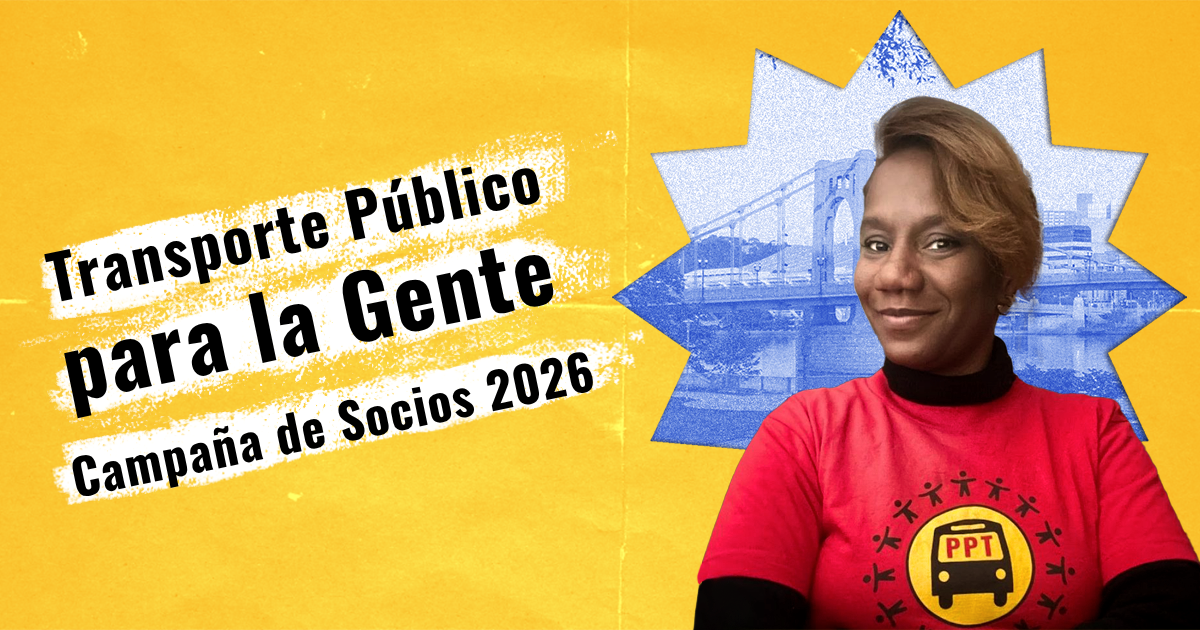
Transporte Público para la Gente: Únete a la campaña de Socios 2026
Me llamo Evelyn Ulysse Alcántara. Uso el transporte público a diario para ir al trabajo, al médico, actividades de ocio, reuniones, llevar a mi hijo al colegio— para todo.
Soy latina y mi inglés no es perfecto, así que cuando me mudé a Pittsburgh me costó usar el transporte público porque había muy poca información disponible en español. Por eso me ofrecí de voluntaria para ayudar como embajadora en los Recorridos de tránsito de PPT. Fue muy frustrante y aislante intentar aprender a usar el sistema de transporte público por mi cuenta. Sabía que si podía hacer algo para apoyar el aprendizaje de mi comunidad, ¡tenía que hacerlo!
Ser miembro de PPT no solo ha mejorado mis propias necesidades de transporte. Me abrió la puerta para ayudarme a marcar la diferencia.
Cuando hubo recortes en el transporte público en Beechview, hubo ocasiones en que el autobús o el Tren no venían—y no sabía la razón, porque los cambios sólo se comunicaban en inglés. Pero hoy, si vas a Steel Plaza o Wood Street Station, ¡escucharás anuncios en español! Y hay instrucciones paso a paso en español en la web de PRT. Esto se debe a que PPT y Casa San José se unieron para dar voz a mi comunidad, para que PRT pudiera entender el verdadero impacto que esto estaba teniendo en nosotros.
Este es el verdadero poder de PPT: realmente escuchan a la gente.
Cuando descubrí que PPT, me pedían testimonios sobre el papel que tiene el transporte público en la vida de las personas, para mostrar lo importante que sería un programa de media tarifa. Sabía que tenía que dar mi testimonio, porque necesitábamos actuar para mejorar el acceso. En aquel entonces solo era una idea y un proyecto, pero hoy es una realidad que lleva el servicio de transporte a la gente.
Me encanta el PPT porque sé de primera mano lo que podemos lograr juntos.
Solo en 2026:
- Llevamos a 120 miembros a Harrisburg para arrojar luz sobre la brecha presupuestaria de 80 millones de dólares y enfatizar la importancia de los servicios para tránsito y viajes compartidos para nuestros representantes.
- Compartimos habilidades y construimos poder con 170 personas de todo el país, compartimos habilidades y construyeron poder en nuestro Entrenamiento de Primavera 2026.
- Formamos a 13 becarios de organización comunitaria en toda la colina del barrio de PGH, y las regiones de Lancaster y Lehigh Valley en Pensilvania.
Por eso quería preguntar: ¿apoyarán el trabajo urgente de PPT haciéndote miembro que paga cuotas hoy?
Puedes apuntarte por solo 2,75 $, ¡el precio actual del billete de autobús del PRT! Ese dinero va directamente a la defensa de un presupuesto de transporte que mueve a TODOS los habitantes de Pensilvania. Todo el mundo merece acceso al transporte público.
¿Nos ayudarás a hacer realidad ese sueño?
The post Transporte Público para la Gente: Únete a la campaña de Socios 2026 appeared first on Pittsburghers for Public Transit.
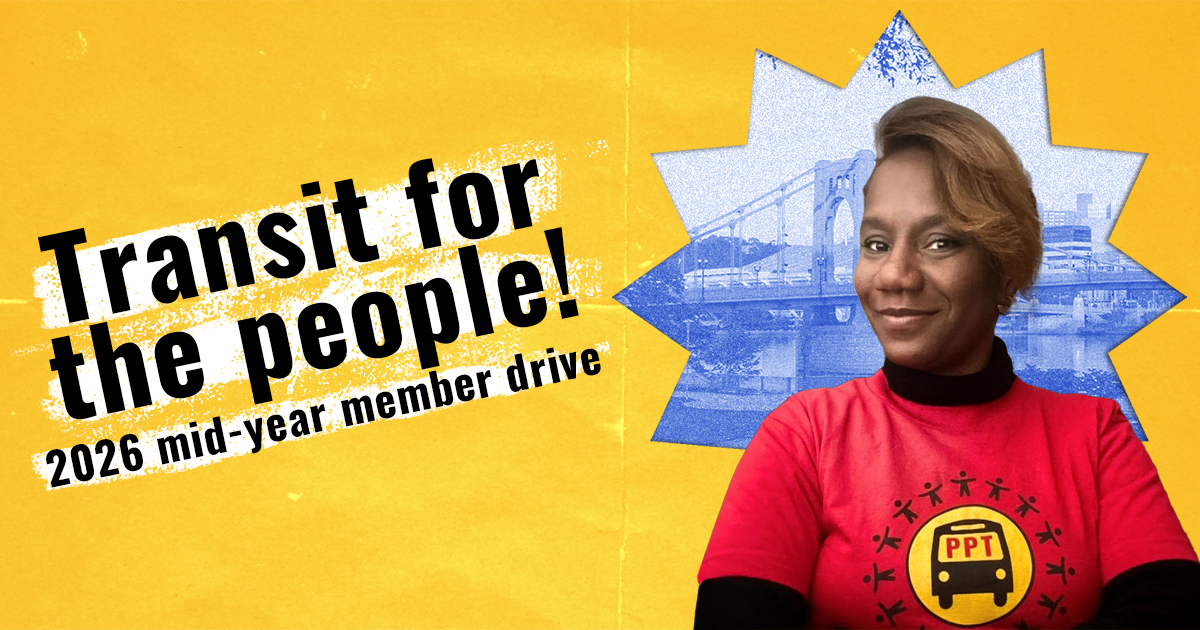
Transit for the People: Join the 2026 Member Drive
Image Description: Evelyn Ulysse Alcantara, a dark-skinned woman in a red PPT shirt, smiles in front of a collaged picture of Pittsburgh
I’m a mother and member of the Latino community fighting with PPT for a transit system that truly serves everyone. Will you join me by becoming a dues-paying member? Donate to become a PPT member!My name is Evelyn Ulysse Alcantara. I use public transportation daily for going to work, the doctor, leisure activities, meetings, bringing my son to school—everything.
I’m Latina and my English isn’t perfect, so when I first moved to Pittsburgh I struggled to use public transportation because there was so little information available in Spanish. This is why I volunteered to help be an ambassador for PPT’s Transit Tours. It was so frustrating and isolating to try and learn how to use the system by myself. I knew that if I could do something to support my community’s learning, I had to do it!
Being a PPT member hasn’t just improved my own transit needs. It opened the door to help me make a difference.
When there were cuts to transit in Beechview, there were times the bus or T didn’t come—and I didn’t know why because the changes were only communicated in English. But today, if you go to Steel Plaza or Wood Street Station, you’ll hear announcements in Spanish! And there are step by step instructions in Spanish on PRT’s website. This is because PPT and Casa San Jose came together to uplift my community’s voice, so that PRT could understand the true impact this was having on us.
This is PPT’s real power: they truly listen to the people.
When I first found out about PPT, they were asking for testimonies about the role transit has in people’s lives, to show how important a half-fare program would be. I knew I had to give my testimony, because we needed to take action to improve access. Back then it was just an idea, but today it’s a reality that brings transit service to the people!
I love PPT because I know firsthand what we can accomplish together.
In 2026 alone, we have:
- We brought 120 members to Harrisburg to shed light on the $80 million dollar transit budget gap, and emphasise the importance of paratransit and shared ride services to our representatives.
- We trained 13 community organizing fellows across the Hilltop neighborhood of PGH, and the Lancaster and Lehigh Valley regions of PA.
- Shared skills and built power with 170 people from across the country at our 2026 Spring Training.
That’s why I wanted to ask: will you support PPT’s urgent work by becoming a dues-paying member today?
You can join for just $2.75—the current cost of a PRT bus fare! That money goes directly towards advocacy for a transit budget that moves ALL Pennsylvanians. Everyone deserves access to public transportation. Will you help us make that dream a reality?
Donate now to join Evelyn as a member—and build transit for the people!The post Transit for the People: Join the 2026 Member Drive appeared first on Pittsburghers for Public Transit.
Breaking down how much Congress cut AML funds by state
In January Congress passed a “minibus” bill that raided $500 million in previously appropriated coal mine cleanup funds to pay for other federal programs. We’re now seeing the first results of that bill: $45.5 million less in mine cleanup funding every year for the next 11 years. Combined with growing inflation, this means fewer jobs will be supported cleaning up mines and more hazardous coal mining damage won’t be reclaimed in Appalachia and across the country.
When it passed in 2021, the Bipartisan Infrastructure Law provided about $10.9 billion for the reclamation of Abandoned Mine Land (AML) sites across the country in fifteen annual grants to states and tribes. The first four years’ worth of grants were awarded between 2022-2025. The minibus bill cuts $500 million from the total AML funding provided under the Bipartisan Infrastructure Law – but it was unclear at the time of passage if the $500 million would be cut entirely from the last (fifteenth) year of AML grants or equally across the remaining 11 years worth of annual funding. Now we have our answer.
The 2026 AML grants for states and tribes were announced in May and the cuts are here. According to the Office of Surface Mining Reclamation and Enforcement, the $500 million cut “will be applied equally to the remaining 11 grant distribution years, approximately $45.45 million per year.” The figure below shows the annual reduction in funds for each state and tribe, as well as the total cuts that will play out over the next 11 years. Pennsylvania and West Virginia have the largest cuts (by absolute value), at about $15 million and $9 million per year, respectively.
(function(){function e(){window.addEventListener(`message`,function(e){if(e.data[`datawrapper-height`]!==void 0){var t=document.querySelectorAll(`iframe`);for(var n in e.data[`datawrapper-height`])for(var r=0,i;i=t[r];r++)if(i.contentWindow===e.source){var a=e.data[`datawrapper-height`][n]+`px`;i.style.height=a}}})}e()})();
The cuts are reducing the amount of damage states and tribes can reclaim. Inflation – especially recent rises in fuel costs that can drive up the cost of operating construction equipment – is also lowering the spending power of reclamation dollars even from last year, further reducing the amount of reclamation states and tribes can accomplish in 2026.
States and tribes have a five-year window to spend their FY2026 AML grant, and those agencies will now begin planning for fewer dollars by taking steps like selecting fewer reclamation projects or reducing the scope of projects. In Pennsylvania, for example, the cuts are equivalent to the cost of two large abandoned mine drainage treatment systems.
As we explained in a previous post, the extent of AML damage that needs to be cleaned up is likely twice as large as the existing $10.9 billion in funding– even before $500 million was cut.
This is damage to land and water that has lingered since at least the 1970s, and now residents will have to wait even longer for cleanup. If this cut hadn’t occurred, $45 million per year in more mine cleanup would be put to use across the country in the next few years, removing hazards to the local population and supporting more jobs, such as in construction, doing reclamation work primarily in rural areas. Congress should reverse the $500 million reduction, and should protect the program from similar cuts in the future.
The post Breaking down how much Congress cut AML funds by state appeared first on Ohio River Valley Institute.
June 6, 2026 Read new San Francisco Gate story: US Navy finds radiological material in unauthorized storage in San Francisco
June 6, 2026
Read new San Francisco Gate story:
“US Navy finds radiological material in unauthorized storage in San Francisco”
June 2026: Bayview Hunters Point Community Call to Action and Demands issued by Greenaction and the Marie Harrison Community Foundation, Inc.
June 2026:
Bayview Hunters Point Community Call to Action and Demands issued by Greenaction and the Marie Harrison Community Foundation, Inc.
June 24th noon rally at San Francisco City Hall to support community demands for health, justice, and full cleanup of all contamination at the Hunters Point Naval Shipyard Superfund Site.
Statement on ACT NOW Clean Tech Initiative
FOR IMMEDIATE RELEASE
June 4, 2026
Statement on ACT NOW Clean Tech Initiative
ALLEGHENY COUNTY, Pa. — On June 4, Allegheny County Executive Sara Innamorato signed the Advancing Clean Technology for Neighborhood and Next-Generation Opportunity and Workforce (ACT NOW) Executive Order. In response, Ohio River Valley Institute Industrial Decarbonization Program Manager Justine Hackimer issued the following statement:
Clean technology and advanced manufacturing present a generational opportunity to strengthen Allegheny County’s economy, create high-quality jobs, and build on our region’s long history of industrial innovation.
For generations, southwestern Pennsylvania’s workers, manufacturers, and research institutions helped power economic growth across the country. As global markets increasingly demand cleaner technologies, our region is well-positioned to compete for the industries that will shape the next generation of manufacturing.
But realizing that opportunity requires more than individual projects. It takes coordination and smart policy like ACT NOW to ensure workers and local communities directly benefit from investments. We applaud County Executive Sara Innamorato’s leadership in shaping a clean tech future that works for all Pennsylvanians.
By investing in the industries of tomorrow while strengthening the systems that support workers and communities, the region can build a more diverse, resilient economy that creates opportunities for generations to come.
###
The post Statement on ACT NOW Clean Tech Initiative appeared first on Ohio River Valley Institute.
It’s Time for a Progressive Policy to Protect Agricultural Supply Chains
From remunicipalisation to the democracy of the commons
By Vanessa Mascia Turri
Naples became one of Europe’s most ambitious experiments in democratic water governance after Italy’s 2011 referendum against water privatisation. Yet bringing water back into public hands did not necessarily redistribute power over how water itself would be governed.
In 2011, after the Italian referendum against water privatisation, Naples became one of the most ambitious experiments in remunicipalised water governance in Europe. The city transformed its water utility into ABC Napoli (Acqua Bene Comune Napoli), a publicly owned entity presented not simply as a return to public management, but as an attempt to implement the “democracy of the commons” theorised by the Italian Forum of Water Movements.
Within this perspective, water was understood not only as a public service, but as a common good whose governance should involve the direct participation of citizens and social movements.
Over the following decade, Naples became a testing ground for a broader political question that has emerged across many remunicipalisation struggles: what happens when the language and practices of the commons enter public institutions? The Neapolitan experience shows that bringing water back into public hands does not automatically democratise its governance. Instead, participation became continuously negotiated and reshaped through political conflict, financial pressures and struggles over who should control public resources.
From water struggles to the democracy of the commonsSince the early 2000s, struggles against water privatisation have connected local mobilisations to broader debates around the commons. Struggles against water privatisation in Europe have often gone beyond opposition to market reforms and increasingly connected demands for public ownership with broader claims around the commons and direct democracy, as explored throughout the Reimagining, remembering and reclaiming water series. In many countries, water movements have challenged not only privatisation, but also the idea that essential services should be governed through technocratic and top-down forms of management, increasingly linking water struggles to broader claims around the commons and direct democracy, as discussed in Transforming capitalism? The role of the commons and direct democracy in struggles against water privatisation in Europe.
In Italy, these debates converged in the Italian Forum of Water Movements, one of the broadest water movements in Europe. As broader discussions around the commons in Italy have shown, these debates extended well beyond water itself and raised wider questions about collective resources, democracy and institutional change. Under the slogan “si scrive acqua, si legge democrazia” (“it is written water, it is read democracy”), the movement argued that remunicipalisation should involve not only public ownership, but also direct civic participation in water governance.
Naples became the most ambitious attempt to translate this political vision into institutional practice.
Poster from the 2011 Italian referendum campaign against water privatization reading “Water is not for sale.” Image courtesy of the Forum Italiano dei Movimenti per l’Acqua.
Naples became the most ambitious attempt to translate this political vision into institutional practice.
Yet public and academic debates on remunicipalisation have often focused on privatisation conflicts and legal transitions, paying far less attention to what happens afterwards. How are participatory mechanisms actually organised inside remunicipalised utilities? How much power are institutions willing to share with social movements and citizens once remunicipalisation has taken place?
My article From theory to practice: evaluating civic participation in Naples’ remunicipalised water service examines these questions through the case of ABC Napoli, reconstructing how participation was progressively organised, contested and reshaped during the decade following remunicipalisation.
Participation and the limits of the commonsAt the moment of remunicipalisation, Naples faced deteriorated infrastructures, chronic underinvestment and a massive municipal public debt. For many activists of the Neapolitan water movement, remunicipalisation was therefore not only about public ownership, but also about transforming the priorities of water governance through ecological restoration, infrastructural investment and more equitable access to water.
Over the following decade, ABC Napoli experimented with different forms of civic participation. Initially, the municipal government opened the board of directors to representatives linked to the Italian Forum of Water Movements and to environmental associations. Yet local activists who had led the mobilisation against privatisation were largely excluded from these arrangements, generating immediate tensions over who had the legitimacy to participate in the governance of the utility.
The most ambitious participatory experiment emerged with the creation of the Civic Council, a public assembly open to citizens, activists and ABC workers. Meetings were held directly inside the company and addressed issues such as tariffs, infrastructure maintenance, hiring policies and investment priorities. Delegates from the assemblies also participated in discussions with the board of directors, creating one of the most advanced attempts in Europe to institutionalise direct civic participation inside a remunicipalised water utility.
However, participation became far more conflictual once these assemblies started intervening in concrete political and economic questions. Members of the Civic Council promoted long-term infrastructural investments and the recruitment of specialised personnel while defending the financial stability of the utility. According to several interviewees, these priorities increasingly clashed with those of the municipal government, which was more focused on short-term employment policies and the management of public-sector jobs within a broader context marked by debt, unemployment and political pressures surrounding public employment.
These tensions ultimately led to the removal of the board of directors and to the progressive weakening of participatory governance. In the following years, participation increasingly shifted towards weak consultative mechanisms with limited influence over decision-making processes. Many activists gradually distanced themselves from the experiment, while severe financial constraints continued to limit investments in infrastructures and ecological renewal.
Rather than evolving towards deeper forms of democratic governance, the Neapolitan experience progressively revealed the difficulties of institutionalising the “democracy of the commons” within existing municipal structures and political priorities.
Remunicipalisation without democratisation?Poster from the Italian public water movement following the 2011 referendum campaign, emphasising water as a public right rather than a source of profit. Image courtesy of the Forum Italiano dei Movimenti per l’Acqua.
The experience of ABC Napoli complicates many celebratory narratives surrounding remunicipalisation. Bringing water back into public hands did not automatically redistribute power inside public governance. On the contrary, the Neapolitan case shows how quickly the language of the commons can become absorbed into existing institutional structures once participation starts challenging concrete political and economic interests.
The weakening of participatory governance inside ABC Napoli did not result from a lack of civic mobilisation or technical expertise. Quite the opposite: activists involved in the water movement developed increasingly detailed proposals on tariffs, infrastructures and long-term investments, becoming capable of intervening directly in the governance of the utility. Participation became problematic precisely when it stopped being symbolic and started questioning how public resources, infrastructures and employment should be managed.
In Naples, these tensions unfolded within a broader context marked by public debt, deteriorated infrastructures, unemployment and long-standing systems of political mediation surrounding public-sector employment. Under these conditions, the “democracy of the commons” increasingly collided with the political and administrative logics shaping municipal governance.
More broadly, the Neapolitan experience suggests that remunicipalisation alone cannot democratise essential services without a real willingness from public institutions to share decision-making power. Commons become politically difficult when they move beyond participation as consultation and start demanding participation as co-governance.
Rather than offering a linear model of democratic transformation, Naples reveals the unresolved tensions that emerge when social movements attempt to institutionalise the commons inside existing state structures. The question, then, is not simply whether remunicipalisation is possible, but whether public institutions are truly willing to democratise the power through which public resources are governed.
—
Featured image: Protest sign reading “Public water, public management. Clear?” during a demonstration of the Italian water movement. Photo courtesy of the Forum Italiano dei Movimenti per l’Acqua (acquabenecomune.org).
The post From remunicipalisation to the democracy of the commons appeared first on Undisciplined Environments.
Russian socialists: “Solidarity means accepting Ukrainians’ pain and suffering as our own”
Does Ontario Need New Nuclear to Keep its Lights on in 2050?
This factsheet shows that Ontario can easily accommodate enough solar and wind installations to meet the projected provincial demand for electricity in 2050. These options will be lower cost and faster to deploy than new nuclear. Read the factsheet
The post Does Ontario Need New Nuclear to Keep its Lights on in 2050? appeared first on Ontario Clean Air Alliance.
Organising action on climate and social justice: what next
CENSORED NEWS: Shut Down Energy Fuels — Uranium Mining and Radioactive Dumping on Native People
Check out “Censored News” coverage of May 16
Protest in Utah against Energy Fuels uranium mines and mill
“CENSORED NEWS: Shut Down Energy Fuels — Uranium Mining and Radioactive Dumping on Native People”
NEW We the People Story Map
Backbone Intern Giacomo Moody's Story Map for We the People is now LIVE!.
The Story Map traces the journey of this Iconic image, from its 2007 debut at Seattle Center to its current deployments in pro-democracy protests around the country. Check out Giacomo's great work and the amazing fruits of our collective labors.
Learn more about joining us in DC or pitching in to support our team going to Washington, DC to mark the 250th Birthday of this country. We'll once again take the streets in a defiant and beautiful expression of common cause and our shared commitment to fulfilling mission of creating a more just, sustainable, and democratic nation, and a future we can be proud to hand our children.
Check out the We the People Story Map at BackboneCampaign.org/WeThePeople.
Pages
The Fine Print I:
Disclaimer: The views expressed on this site are not the official position of the IWW (or even the IWW’s EUC) unless otherwise indicated and do not necessarily represent the views of anyone but the author’s, nor should it be assumed that any of these authors automatically support the IWW or endorse any of its positions.
Further: the inclusion of a link on our site (other than the link to the main IWW site) does not imply endorsement by or an alliance with the IWW. These sites have been chosen by our members due to their perceived relevance to the IWW EUC and are included here for informational purposes only. If you have any suggestions or comments on any of the links included (or not included) above, please contact us.
The Fine Print II:
Fair Use Notice: The material on this site is provided for educational and informational purposes. It may contain copyrighted material the use of which has not always been specifically authorized by the copyright owner. It is being made available in an effort to advance the understanding of scientific, environmental, economic, social justice and human rights issues etc.
It is believed that this constitutes a 'fair use' of any such copyrighted material as provided for in section 107 of the US Copyright Law. In accordance with Title 17 U.S.C. Section 107, the material on this site is distributed without profit to those who have an interest in using the included information for research and educational purposes. If you wish to use copyrighted material from this site for purposes of your own that go beyond 'fair use', you must obtain permission from the copyright owner. The information on this site does not constitute legal or technical advice.
 This site is not the official webpage of the Industrial Workers of the World.