

RWU to Co-Sponsor Railroad Conferences on the West Coast

Press Release - Railroad Workers United, December 1, 2014

Disclaimer: The views expressed here are not the official position of the IWW (or even the IWW’s EUC) and do not necessarily represent the views of anyone but the author’s.

This coming winter, RWU will co-sponsor two conferences, one in the Bay Area and one in the Pacific Northwest. Tentatively entitled “The Future of Railroads: Safety, Workers, Community and Environment”, Railroad Workers United is partnering with the Backbone Campaign and other citizens and environmental groups to organize these innovative and cutting edge conferences.

In recent months, public attention has focused on the railroad in a way that it has not been for decades. In the wake of Lac Megantic and other derailments and resulting fires and explosions, the public is alarmed about oil trains and the movement of trains in general through their communities.

Environmental activists are up-in-arms about the amounts of fossil fuels moving by rail. Farmers and other shippers are concerned about the congestion that has occurred in recent months, due in part to the oil boom. All of this attention gives railroad workers a golden opportunity to educate the general public about the railroad, its inherent efficiencies, its value to society, and its potential. It also give us an invaluable opportunity to inform non-railroad workers about the situation that we face on the job every day.

The public generally has no idea what goes on daily on America’s railroads. At this conference, we plan to talk about crew fatigue, single employee train crews, excessively long and heavy trains, draconian availability policies, short staffing, limited time off work and other concerns. These issues are of concern not just to railroaders, but are of concern to environmentalists, the community at large and society in general. Non-railroaders in attendance at the conference will come away with a deeper understanding of our workplace and a greater appreciation of the issues facing us. They will without a doubt, become valuable allies in our future fights with the rail carriers.

Climate Justice in Collision with Revenue-Neutral Carbon Policies?

By Patrick Mazza - Cascadia Planet, November 25, 2014

Disclaimer: The views expressed here are not the official position of the IWW (or even the IWW’s EUC) and do not necessarily represent the views of anyone but the author’s.

Plotting options for carbon policy in Washington state, Governor Jay Inslee’s Carbon Emissions Reduction Taskforce just issued its recommendations.  The report sets up a political collision between advocates for neutral carbon pricing systems and climate justice proponents.

The CERT sagely concluded that carbon reduction goals are not going be met by market-based solutions alone.It is not enough to put a price on carbon, or set a legal cap.It will take a “harmonized, comprehensive policy approach. ”By increasing the price of fossil fuel energy, market mechanisms provide an “economic infrastructure” that sends “a common price signal across all emissions sources and emissions reductions opportunities.” This signal must be accompanied by “a well harmonized set of complementary policies” and “targeted use” of carbon revenues.

“Particular attention needs to be given to the transportation sector as the largest source of carbon emissions in the state,” CERT noted. Complementary policies are needed to promote transit and transit-oriented development, and alternative fuels such as electricity.

This emphasis on transportation alternatives is spot on.  It is partly aimed at reducing the impact of increased fuel costs on economically stressed populations.  That’s smart because it is exactly among those populations where fossil fuel interests will seek to drive a political wedge into the unified progressive coalition needed to pass carbon policy. 

IWW Greece: Call for a General Strike on Nov. 27th

We call the entire working class for a
GENERAL STRIKE on 11/27/2014

Against austerity and predatory neoliberal policies
Against the terrorism of poverty and degradation
Against State’s authoritarianism and the policing of public spaces
Against the relentless onslaught of capitalist elites and their state-servant
The working class does not claim fraternal benefits and privileges
It fights for the liberation of all humanity from the tyranny of the capital
Our resistance will be unyielding until they are finally overthrown.

ΙWW Greece
iwwgreece@yahoo.gr

5 Unions Oppose Keystone XL Tar Sands Pipeline and Efforts to Force Its Approval

By National Nurses United, 1199 SEIU Health Care Workers East, Amalgamated Transit Union, New York State Nurses Association, and National Domestic Workers Alliance - November 18, 2014

Disclaimer: The views expressed here are not the official position of the IWW (or even the IWW’s EUC) and do not necessarily represent the views of anyone but the author’s.

We are five unions/workers organizations representing workers in nursing, health and domestic care, and public transport.
We are opposed to the proposed Keystone XL tar sands pipeline. If fully constructed, it will bring dirty tar sands oil through the United States and to the global oil market at a time when we should be drawing the line against the most carbon polluting fossil fuel in order to protect public health, defend the rights of farmers, ranchers and native communities, and avoid out of control levels of global warming and climate instability.

Climate change is already wreaking havoc in areas of the world - like the Caribbean, the Philippines and Central and South America - where many of our members have families and loved ones. The present drought in California, the wildfires across the Western and Central United States, and killer storms like Katrina and Sandy are enough to demonstrate that climate change is also affecting the United States.

From the ground to the pipe to the refineries, Keystone XL's tar sands oil, with its thick, dirty, corrosive properties, poses a clear and present danger to public health. Toxic contaminants in the massive water needed for extraction are infecting clean water supplies, with towns nearby in Alberta experiencing spikes in cancer deaths, renal failure, lupus, and hyperthyroidism. Huge pipeline spills near Marshall, MI and Mayflower, AR have led to respiratory ailments and other health ills. Pollutants from tar sands refineries are linked to heart and lung disease, asthma, and cancer. Federal policy should be guided by the precautionary principle and must uphold public health and safety above all else.

The Keystone XL jobs numbers claimed by the oil industry and its backers in Congress are not based on sound research. The southern leg of the pipeline has already been built, and yet the job numbers the oil industry and their political allies claim will be created by the project seem to keep on rising.

We are for jobs. There is no shortage of water and sewage pipelines that need to be fixed or replaced, bridges and tunnels that are in need of emergency repair, transportation infrastructure that needs to be renewed and developed. Many thousands of jobs could also be created in energy conservation, upgrading the grid, maintaining and expanding public transportation--jobs that can help us reduce air pollution, greenhouse gas emissions, and improve energy efficiency.

Congress is not set up to be a permitting authority, and this pipeline doesn't even have an approved route. The ongoing review process should continue, and the decades-long precedent of having the Executive Branch make decisions on cross-border projects should not be overturned.

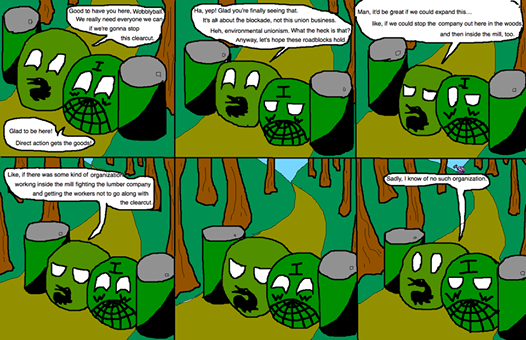
The Adventures of WobblyBall - Green Syndicalism, Part1

By Anonymous - Wobblyball, November 15, 2014

Disclaimer: The views expressed here are not the official position of the IWW (or even the IWW’s EUC) and do not necessarily represent the views of anyone but the author’s.

EUC Wobblyball encounters a critic of green syndicalism within the environmental movement, now with speech bubbles for legibility (any resemblance to real organizations or movements with problematic-as-hell gender politics is purely intentional).

'For a class struggle approach to climate change and energy transition'

By Karl Cloete - Links International Journal of Socialist Renewal, February 2012

Disclaimer: The views expressed here are not the official position of the IWW (or even the IWW’s EUC) and do not necessarily represent the views of anyone but the author’s.

The following paper was presented on October 10, 2012, at a conference at Cornell University. NUMSA is South Africa’s second-largest union, with almost 290,000 members in the smelting, manufacturing, auto and electricity generation industries.

Our starting point as NUMSA is that to effect an energy transition, we as the global union movement DO need a perspective to guide us as well as strategies to be utilised by the movement. While such a perspective and accompanying strategies will definitely not come fully formed and in one go, we HAVE to keep working on them through discussions, through struggles, through experimentation and through learning from experiences of those in the forefront of energy struggles (within and outside of the labour movement).

Those who were at our February 2012 International Conference on Building a Socially Owned Renewable Energy Sector will know that in our head office in Johannesburg, we have a huge banner with the words: No Revolutionary Theory, No Revolutionary Movement! The slogan on the banner captures how much we, as a union attach to having a perspective that acts as a compass to our daily work. Our message to this roundtable is simple: Without a solid perspective on how to effect an energy transition, there will be no transition.

Climate politics at a dead end – How to build a new road

By Patrick Mazza - Cascadia Planet, November 13, 2014

Disclaimer: The views expressed here are not the official position of the IWW (or even the IWW’s EUC) and do not necessarily represent the views of anyone but the author’s.

Climate politics is dead-ended. 

It may seem strange to make such a statement in the wake of the much-heralded U.S.-China climate deal announced November 12.  So let me clarify.

President Obama did announce the intent to reduce U.S. carbon emissions 26-28% by 2025, while China said it would peak carbon emissions and generate at least 20% of its energy from non-fossil sources by 2030. 

All well and good, but far from the 6% annual emissions cuts required to hold overall global warming under 2° Celsius, the minimal borderline between climate disruption that is merely severe and that which is utterly catastrophic (though many scientists believe the cutoff is more like 1.5°C). In other words, the U.S.-China agreement represents only a slower road to climate hell.

Okay, but it’s a start, right?

“The agreement with China is a good first step. But we hope it is but a first step because it is not enough to prevent significant climate change,” noted Kevin Trenberth, senior scientist at the National Center for Atmospheric Research.

Unfortunately, it may be the last step possible in the current political environment.  Republican election victories in the U.S. Senate and states around the country have put legislative progress on global warming into a deep freeze.

WHOLE FOODS CONCEDES TO IWW DEMANDS TO INCREASE WAGES! - Whole Foods Union Wins Raise for San Francisco Stores’ Lowest-Paid Employees

By Tim Maher - Whole Foods Workers Union, November 14, 2014

SAN FRANCISCO, CA - A fledgling union of workers at the South of Market Whole Foods in San Francisco used workplace actions to compel Whole Foods management to implement a $1.25 per hour wage increase for those employees at the lowest wage tier.

On November 6th, a delegation of 30 cooks, cashiers, stockers, and butchers at the store in the South of Market neighborhood initiated a brief work stoppage to deliver a petition to management demanding a $5 an hour wage increase for all employees, and no retaliation for organizing their union. Over 50 workers from the store signed the petition. In addition to demanding the $5 per hour wage increase, the petition raised issues about paid time off, hours and scheduling, safety and health, and a retirement plan.

Late last week, Whole Foods’ Northern California regional President Rob Twyman announced that starting January 1, 2015 all employees in San Francisco locations will make a minimum of $12.75 per hour - $1.25 above the current starting wage and $.50 higher than the new minimum wage of $12.25 called for by Proposition J. Mr. Twyman added that this change would be implemented four months before Proposition J’s minimum wage hikes take effect.

The $1.25 increase is nowhere near the $5 an hour the workers asked for, but workers at SOMA say it is still substantial, and that the timing of the raise is a sign that Whole Foods is taking the union’s wage demand seriously. “Whole Foods is rolling out the raise months before they even have to adjust to the new minimum wage. We’ve never seen that happen,” said beer and wine specialist Nick Theodosis who has worked at the SOMA store for 10 years.

“We’ll happily take it, but we will continue pursuing the full $5 for all workers currently working at the company as well as for those yet to come,” said a cashier who asked to be identified as Kristal Garcia. The workers have vowed to continue their fight for the full five dollar raise they asked for.

Whole Foods Workers Threaten Action Against The Store If They Aren’t Granted Higher Wages

By Joaquim Moreira Salles - Think Progress, November 14, 2014

Disclaimer: The views expressed here are not the official position of the IWW (or even the IWW’s EUC) and do not necessarily represent the views of anyone but the author’s.

Workers at a Whole Foods Market in San Francisco’s South of Market (SoMa) neighborhood are demanding higher wages and the right to collective bargaining without being reprimanded by management. Specific demands include a $5 wage increase, better working conditions, a comprehensive health plan with affordable premiums and deductibles, and no retaliation for forming a union. Whole Foods — a company that has long preached a philosophy of corporate benevolence — is the second-largest non-union food retailer in the country.

Today is the workers’ deadline for a response by the store, and they have pledged take “job actions” if their demands are not met, one of the movement’s organizers told ThinkProgress. If management doesn’t comply by the end of today, employees will respond by holding a rally and a press conference at Whole Foods’ California headquarters on Monday. They will also demand to speak to the company’s regional president.

The Fortune 300 company is known for its anti-union stance. CEO John Mackey once compared unions to herpes. “It doesn’t kill you,” he told a reporter, “but it’s unpleasant and inconvenient, and it stops a lot of people from becoming your lover.” Mackey seems to have maintained this belief as his company grew from a single store in Austin, Texas into an $11 billion dollar empire.

There has been one previous attempt to unionize at a Whole Foods by employees in Madison, Wisconsin. That attempt failed. Whole Foods refused to recognize the union and workers who had led the organizing effort began being fired for allegedly trivial offenses, one of the employees involved in the incident claims. When asked about the events in Madison during an ABC News interview, co-CEO Walter Robb said employees in Wisconsin had voluntarily changed their minds and opted not to unionize.

According to current and former employees, Whole Foods subjects their staff to a “routine anti-union curriculum”, as one worker told ThinkProgress. Other employees who have attended these meetings claim they are told, among other things, that unions are greedy third party institutions that interfere in the relationship between employer and employee, that workers risk losing their benefits if they choose to organize, and that laws protecting workers have eliminated the need for unions. These fear-mongering tactics have failed in SoMa, where workers are being organized by Industrial Workers of the World, one of the most radical labor unions out there.

Better than we know ourselves: a ruling class view of the trade unions

By Solidarity Federation - LibCom.org, July 14, 2012

Disclaimer: The views expressed here are not the official position of the IWW (or even the IWW’s EUC) and do not necessarily represent the views of anyone but the author’s.

If your only exposure to labour issues is through the torn and tattered pages of a greasy tabloid, you might be forgiven if you believe the TUC actually encourages workplace militancy. Full of contributions from beleaguered CEOs, scare-mongering columnists, condescending politicians and even tough-talking officials, you might even believe trade unions are an irrepressible engine of class struggle. For those us in trade unions, we know reality paints a far different picture. Far from encouraging and even organising industrial action, more often than not, trade unions leave militants feeling sold out, disempowered and sidelined.

Take striking for example. First, it's a struggle to get a ballot. When the ballot is secured, it passes, but the union does nothing to effectively prepare for what amounts to nothing more than a symbolic one-day strike. In fact, other unions in the same workplace send out notices instructing their members to work on the day of the strike. At the last minute the bosses challenge the ballot on technical grounds. The union caves and calls off the strike. Management then presents a marginally improved offer which the union accepts with little or no consultation from the membership. Any chance of actual struggle is squashed by the same leaders who are supposed to be looking after our interests. In the worst case scenario, the bosses and the union come after shop floor militants who agitate against the settlement or who push for independent action.

The question is simple: why is the scenario outlined above (and countless ones like it) repeated again and again in every country around the world throughout the history of the labour movement? Is it a case of conservative, or even corrupt, leaders who sell the movement? Or is it something deeper?

Pages

The Fine Print I:

Disclaimer: The views expressed on this site are not the official position of the IWW (or even the IWW’s EUC) unless otherwise indicated and do not necessarily represent the views of anyone but the author’s, nor should it be assumed that any of these authors automatically support the IWW or endorse any of its positions.

Further: the inclusion of a link on our site (other than the link to the main IWW site) does not imply endorsement by or an alliance with the IWW. These sites have been chosen by our members due to their perceived relevance to the IWW EUC and are included here for informational purposes only. If you have any suggestions or comments on any of the links included (or not included) above, please contact us.

The Fine Print II:

Fair Use Notice: The material on this site is provided for educational and informational purposes. It may contain copyrighted material the use of which has not always been specifically authorized by the copyright owner. It is being made available in an effort to advance the understanding of scientific, environmental, economic, social justice and human rights issues etc.

It is believed that this constitutes a 'fair use' of any such copyrighted material as provided for in section 107 of the US Copyright Law. In accordance with Title 17 U.S.C. Section 107, the material on this site is distributed without profit to those who have an interest in using the included information for research and educational purposes. If you wish to use copyrighted material from this site for purposes of your own that go beyond 'fair use', you must obtain permission from the copyright owner. The information on this site does not constitute legal or technical advice.
