Ten Points for a Trade Union Strategy Against Climate Change

By Asbjørn Wahl - The Bullet, September 24, 2014

Disclaimer: The views expressed here are not the official position of the IWW (or even the IWW’s EUC) and do not necessarily represent the views of anyone but the author’s.

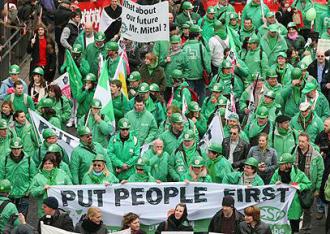
Since each of us gets only a few minutes for our contributions on such a large subject as climate change, I have chosen to put forward ten brief points for a trade union strategy against climate change. Firstly, I will establish some of the important factual basis on which we have to build our strategies and policies.

1. Climate change is not a threat of the future, it is already happening here and now, it is man-made, and the consequences can be catastrophic.

2. The climate threat will have widespread implications for social development – either as a result of climate change itself, or as a result of measures to prevent or mitigate climate change. The way we live and work will thus change considerably, whether we take action or not. Inaction, or postponing action, represents the greatest threat – with disastrous effects.

3. Because measures to combat climate change will require great changes in society, we face a major social struggle. Thus, the struggle against climate change is first and foremost a struggle for social power, a struggle on what kind of society we want. In the current situation, this means that the climate change struggle will have to be unified with the struggle against the effects of, and the driving forces behind, the economic crisis, the crisis of capitalism.

Beyond the People’s Climate March: What are We Willing to do for Climate Justice?

We are a Boston-based group of 17 young people who were arrested in #FloodWallStreet - Earth First! Newswire, September 26, 2014

Disclaimer: The views expressed here are not the official position of the IWW (or even the IWW’s EUC) and do not necessarily represent the views of anyone but the author’s.

We came to New York City to #FloodWallStreet. The Climate March was beautiful and historic, but it was also a target-less parade demanding vague “climate action” from bought-off world leaders. Along with many others who felt that the climate crisis demanded more, our heart was with #FloodWallStreet, a response to the Climate Justice Alliance’s call to take direct action beyond the march.

Recognizing this as a crucial moment in history, people, especially privileged youth, came in droves from across the country to the People’s Climate March. They were there to tell a story en masse: that change will come if enough of us demand climate action from our leaders. Yet when it came time to tell the more honest story, the story of how those at the root of this crisis are the corporations and Wall Street profiteers making fortunes off of the suffering of billions, we lost almost everyone. We went from 400,000 at the People’s Climate March to 3,000 at #FloodWallStreet. When it finally came time to stand our ground, to sit on Wall Street and put our bodies on the line, our numbers dwindled from 3,000 to 102.

We do not aim to devalue the good that came out of #FloodWallStreet. We have so much love and gratitude for the organizers that put tireless work into the action, and everyone that showed up. It was incredibly powerful to shut down a major intersection in the financial district for a day. But it’s too easy to walk away from this patting ourselves on the back and waiting for the next day of action to come around. So we want to share some honest reflections. This piece is not about making anyone feel guilty. Our intent is to push everyone, including ourselves, to think about what it will take to truly live up to Frederick Douglass’s oft-quoted words: “Power concedes nothing without a demand. It never has and it never will.”

We feel frustrated that #FloodWallStreet fell short of its potential to be a game-changing moment in the climate justice movement. We felt that it was a mistake for the organizers to declare the action a success a few hours after taking the street, telling folks they should “feel free to go home.” We understand that the organizers wanted to pass the action off to the direct democracy of the people, but about half of the participants left after they were told: “we did what we came to do.” The truth is we hadn’t — the action was about disrupting business as usual at the NY Stock Exchange. We never did that. Much like the People’s Climate March, folks were ready to call it a day after a couple of hours of fun in the street.

Wall Street is Fertile Ground for a Movement

By Dave Lindorf - CounterPunch, September 24, 2014

Disclaimer: The views expressed here are not the official position of the IWW (or even the IWW’s EUC) and do not necessarily represent the views of anyone but the author’s.

There were many extraordinary moments during both Sunday’s huge climate march through mid-Manhattan and Monday’s more militant protest in Lower Manhattan’s financial district, from the little boy marching with a tambourine that had “This Machine Kills Fascists” written around its edge to the bored policeman along the march route blowing a huge bubble from the gum he was chewing, but perhaps the most telling occurred in the early afternoon on Monday, when, as several thousand climate action protesters sat or milled around, penned into several blocks of Broadway by hundreds of linked-together metal police barricades, (MH) astride a pair of telephone booths began an impromptu IWW rant.

The day before, during the big march down Central Park West, Sixth Avenue and across 42nd Street, those phone booths had been favored vantage points for photographers, dancing young women and people just trying to get a better view of the march. Bored cops standing along the parade route would chat and joke with those perched above. But this time (MH), dressed in black and standing in sight of the big bronze Wall Street Bull sculpture, and just several blocks down Broadway from Wall Street and the New York Stock Exchange building, was shouting out a call for workers to unite, rise up and overthrow the capitalist system. It was just too much for the police who were guarding the barricades to segregate people so those on the street couldn’t leave and so supporters on the sidewalk couldn’t join the protest.

A dozen of the cops came over to the nine-foot-tall phone booths, surrounding them, and demanded that the (MH) come down. He ignored them, realizing that they couldn’t reach him, and went on to finish his speech, which was relayed phrase by phrase via the “human mic” technique perfected three years earlier by the Occupy Wall Street movement. When he was done, he paced around on his perch like a rooster, looking down at the surrounding cops, and then suddenly made his break.

Leaping over the cops and some of the surrounding protest supporters, he managed to land on his feet on the sidewalk and started running. Protesters closed ranks behind him, slowing down the cops who all began chasing after him.

At that point, all the police guarding the metal barriers took off after the young man too. Eventually this police horde caught up with (MH), and leapt on him like a rugby scrum. I don’t know what happened to him in the end. He was probably arrested and charged tautologically with resisting arrest, but for what violation I don’t know since, as the events of the day before proved that just standing on a phone booth was not illegal or cause for arrest; apparently only making a leftist speech from one is a “crime.”

But this anonymous orator’s escape attempt turned out to be an unintended act of liberation. As soon as the majority of police lit out after him, abandoning their posts for the opportunity to finally pummel someone, people on the sidewalk and in the street spontaneously, with no organized encouragement, began unhooking the gates separating them. On the west side of Broadway, people carried the gate segments around a corner and down a side street out of sight. On the east side of the street, the sections were piled in a heap on top of each other, after which protesters scaled them and sat down. The gates were never replaced by police, and the attempt to fence in the protest collapsed.

Unions and Crandon Mine

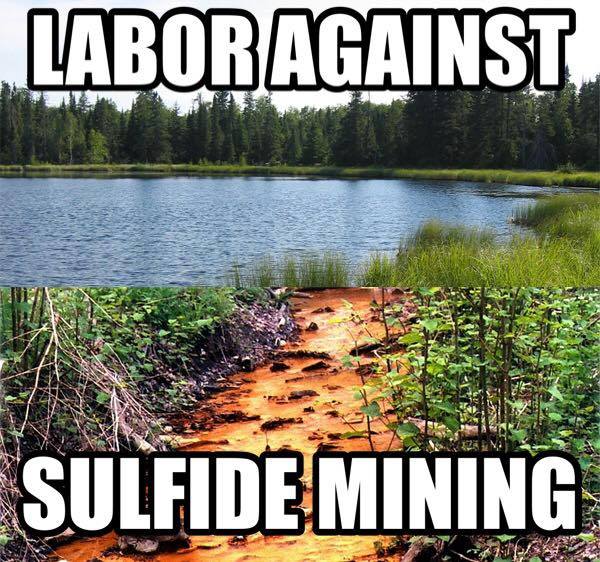
By the Committee of Labor Against Sulfide Pollution (CLASP) - May 1999

Disclaimer: The views expressed here are not the official position of the IWW (or even the IWW’s EUC) and do not necessarily represent the views of anyone but the author’s.

Ecology.iww.org editor's note: this article was published almost 15 years ago. We post it here to show an example of rank and file green unionism. There is now a Facebook Page for Labor Against Sulfide Mining.

To: State AFL-CIO, All Central Labor Councils in Wisconsin, USWA Sub-District 2, Milwaukee Labor Press, Racine Labor, Union Labor News, other labor publications and union bodies.

Brothers and Sisters of Wisconsin labor bodies,

The Canadian mining company Rio Algom has recently again attempted to enlist labor support for its metallic sulfide mine proposal near Crandon. A previous attempt by Rio Algom and its former partner Exxon in 1997 was countered by numerous resolutions by Central Labor Councils and locals against the mine, and in support of a sulfide mining moratorium...Early in 1998, Rio Algom bought out Exxon's 50% share in the project, and renamed its subsidiary the Nicolet Minerals Company (NMC); Exxon still retains rights to 3.75% of the royalties, and $5 million if production begins.

After a single NMC presentation, and without an opportunity to hear opposing views, presidents in attendance at a USWA Sub-District 2 (Wisc.) Presidents' Meeting recently adopted a resolution by a majority vote supporting NMC's proposed changes in the Crandon project. NMC also made a presentation to USWA Local 1527 in February, where NMC was acknowledged as the author of the resolution. NMC Spokesperson Dale Alberts tried to leave a strong impression that local citizens' and tribal concerns had been satisfied by the new mine proposals. Yet when informed of NMC's overtures to unions, and how his position had been misrepresented to union members, Menominee Tribal Chair Apesanahkwat issued a press release denouncing NMC's tactics. Since serious questions remained, opposing views were voiced at the Local's March meeting, when retired local CWA president Bob Schmitz and current Translators' Guild member Kira Henschel shed much light on sulfide mining, and Rio Algom's sordid history in the industry.

NMC's overtures are particularly ironic in light of the highly adversarial relationship between the USWA and Rio Algom:

  • The lung cancer deaths of many USWA miners at the Elliot Lake, Ontario, uranium mines in the 1950s-80s;
  • The recent layoffs of USWA Local 7619 members at the Highland Valley, British Columbia, mine;
  • Continuing layoffs of USWA Local 1114 members at Milwaukee's P&H Mining, a major supporter of the Crandon mine; According to a recent Associated Press article, NMC topped the list of highest-spending Wisconsin lobbyists in 1997 and 1998, with $1.5 million and 4,624 hours. The key NMC ally Wisconsin Manufacturers and Commerce-- no friend of unions--was third on the list with $1.1 million and 15,440 hours.

We see as a model the recent alliance between Steelworkers and environmentalists against the Maxxam Corp., which has decimated California redwoods and been virulently anti- union at its struck Kaiser Aluminum plants in the U.S.

CLASP would again like to thank the Central Labor Councils and local unions that have passed resolutions against the Crandon mine, and for the Sulfide Mining Moratorium Law:

  • Greater Green Bay Labor Council AFL-CIO,
  • Fox Valley Area Labor Council AFL-CIO,
  • La Crosse AFL-CIO Council ,
  • South-Central Federation of Labor AFL-CIO,
  • Wisconsin Federation of Teachers,
  • Green Bay Building and Construction Trades Council ,
  • Racine County AFL-CIO Central Labor Council,
  • USWA Local 1527 (Milwaukee),
  • UAW Local 72 (Kenosha),
  • CWA Locals 4603 (Milwaukee), 4620 (Green Bay), 4621 (Appleton), 4622 (Oshkosh), and 4623 (Fond du Lac);
  • AFSCME / WSEU--Local 82 AFL-CIO (Milwaukee),
  • AFT Local 3220 AFL-CIO (Madison), and others.

We do not know how widespread NMC's efforts to gain union approval have been, so we are both asking for your help in monitoring this activity, and also offering our help to provide another perspective to balance NMC's one-sided campaign of disinformation. We would appreciate any information that you or any affiliated labor bodies may have on NMC's labor-related activities...

Food Justice and Worker Organization: An Interview with Luigi Rinaldi, Industrial Workers of the World

Interview with Luigi Rinaldi - Theory in Action, Vol. 7, No. 4, October 2014, reposted by Providence IWW

Disclaimer: The views expressed here are not the official position of the IWW (or even the IWW’s EUC) and do not necessarily represent the views of anyone but the author’s.

Q: First off, thanks so much for taking the time to do this interview, Luigi. This issue of Theory in Action is centered on food justice and sustainability. For a lot of people, food justice cannot be coherently separated from the experiences of workers in the food industry and, I think, if we mean the term “sustainability” in its most widely applicable way, that also means looking at how people’s lives and livelihoods are made unsustainable by our dominant institutions. I know your union, the Industrial Workers of the World, over the last few years has had various campaigns in food service. Can you start by briefly outlining the economic situation of workers in the food industry? Why should people be concerned with the plight of food industry workers?

Luigi Rinaldi (LR): Thank you for the opportunity to talk about these issues! I would say that it is impossible to talk about food justice without touching on capitalism and, therefore, the class relation. Workers in the food industry, throughout the whole process – from farm to restaurant – are in a situation that leaves them extremely precarious. Now, I’m primarily going to focus on the food service end of things, because that’s the part of the industry I’ve worked in, but there’s a lot to be said for the production side and the supply chain as well. The work isn’t the same, but the conditions that it creates are similar.

What you have is a very precarious and low wage industry. You can expect to hold a job for less than a year and to earn less than ten dollars an hour. My previous workplace, a café and bakery, had about 90% turnover in a year… I would say that is low for most of the industry, especially when you get into fast food. Contrary to the popular image, most of these workers are not teenagers, but adults trying to eke out a living. They are fathers and mothers who often have to work two or three jobs, because in the food industry full time employment is rare, and even with full time employment the wages are too low to get by on. The work conditions are often unsanitary and you are subject to harsh and arbitrary discipline. There should be concern about this industry because it’s one of the fastest growing, at least here in the United States. It’s already one of the largest private sector employers and while job growth for the rest of the economy is around 1.5 or 2%, food service is growing at a rate nearly double that. The industry is expected to add 1.3 million jobs to the economy over the next decade. With the decline of many manufacturing and even professional jobs from our economy in the United States, look at where there’s job growth: that’s where you’ll be applying.

A Sea of Black Flags

By Max Perkins - Boston IWW, September 28, 2014

Disclaimer: The views expressed here are not the official position of the IWW (or even the IWW’s EUC) and do not necessarily represent the views of anyone but the author’s.

Truly the most amazing thing I have ever been a part of, the Peoples’ Climate March in New York City was beyond the biggest mass of activists I have ever seen. Have you ever seen 200-300 Anarchists before? WOW! From every part of the country and from all over the world. The day started with meeting up with our wonderful comrades from NY Black Rose / Rosa Negra Anarchist Federation, who did an amazing job organizing our Anti-Capitalist contingent. At 11:30 we started masking up, assembling our banners, unraveling our flags and meeting each other, then marched to meet 2-3 other groups that had been assembling between 90th St. and 87th St. by Central Park West. A beautiful day was in store. Never have I seen so many diverse groups: 350.org, Indigenous Rights activists, Vets for Peace, just to name a few. We assembled near the contingent from the Revolutionary Communist Party (Bob Avakian’s followers). This was at first very tense. A fight almost started when one of our comrades was explaining that a cult of personality is counter-revolutionary. However the issue was resolved peacefully.

Looking around me was stunning: A sea of black flags, red and black flags, also hundreds of folks of all ages and backgrounds — simply the most comrades I have ever seen in the US or in once place. Chanting, and singing a beautiful version of “Solidarity Forever,” the march began around 1-2 pm. It took hours for the first contingents to reach the end of the march, and even longer for us. The highlights included screaming up at the Banks, and most especially at Fake Fox News. So many people were asking, “Who are you?” And the reply was “We are Anarchists! Oh we need more of you! Yes we do!” The march was amazing and peaceful with much support for us, many people taking pictures and cheering us on. At one point a huge group of young POC on bikes saw us and there was a massive show of anti-police solidarity. Wonderful!

The march continued to Times Square, with wave upon wave of dedicated activists and no loss of energy. The changes never stopped and my voice was really gone. The follow up to this is that we made a huge statement, but received no press (not that we were seeking it, but to have so many of us (Anarchists) together, you would think that maybe someone would say something, but alas NO!). Coverage seemed, as is common, to focus on the “big” groups. Even Democracy Now did not mention the Anarchist involvement in the march. I feel that it means we have to work harder to bring the message to the people that this should not be a one-time thing, but a regular occurrence, for people forget all too quickly, and carry on with their lives as if nothing happened. Today I have been corresponding with Fellow Workers, including FW Maria, from the IWW’s Washington DC Branch, who like me wants to see better communication and solidarity actions that include many branches. Our struggle continues, and until we reach our goal of a world free from the shackles of Capitalist oppression we must carry on. For an Injury to One (planet) is truly an Injury to All! Solidarity Forever, and special thanks to Maria, DC IWW, NY Black Rose and Polish Anarchists, and any others who helped make this happen.

A Coal CEO Allegedly Coerced His Employees To Donate To Political Candidates. Here’s Who Benefited

By Emily Atkin - Think Progress, September 25, 2014

Disclaimer: The views expressed here are not the official position of the IWW (or even the IWW’s EUC) and do not necessarily represent the views of anyone but the author’s.

Earlier this month, the United States’ largest independent coal company was slapped with a lawsuit by a former employee, claiming she was illegally fired for refusing to give money to political candidates chosen by her boss. That boss, Murray Energy CEO Robert Murray, allegedly sent letters to his employees asking them to support pro-coal candidates for political office, keeping track of who made the requested contributions and who didn’t. Employees of Murray Energy and its subsidiary companies were aware that failing to contribute could impact their jobs, the lawsuit claimed.

This incident is not the first time Murray has been accused of pressuring his employees to give money to his preferred candidates and his political action committee, the Murray Energy PAC. “The pressure to give begins as soon as employees enter the company,” the New Republic’s Alec MacGillis reported in a 2012 investigative piece. “At the time of hiring, supervisors tell employees that they are expected to contribute to the company PAC by automatic payroll deduction — typically 1 percent of their salary, a level confirmed by a 2008 letter to employees from the PAC’s treasurer.”

Murray has adamantly denied the veracity of the allegations. In a statement to ThinkProgress, a spokesperson called the latest lawsuit “baseless,” “blatantly false,” and “totally concocted,” deeming it an “attempt to extort money from Murray Energy Corporation.” The claims that Murray knows which of his employees donates and who does not are “totally fabricated,” the spokesperson said, a fact that Murray has “repeatedly stated.”

Still, the allegations raise questions about the ethics and legality of Murray Energy employee donations. Federal Election Commission rules state that corporations can’t make their employees donate to specific candidates or parties “as a condition of employment.” If corporations do ask their employees to contribute to certain funds, they must inform the employee “of his right to refuse to so contribute without any reprisal.”

In the latest accusation of coercion against Murray, the former employee cited fundraising letters she received from Murray in late May of 2014. Those letters asked for contributions to four Republican candidates for U.S. Senate: Scott Brown from New Hampshire, Ed Gillespie from Virginia, Terri Lynn Land from Michigan, and Mike McFadden from Minnesota.

Climate, Coal and Confrontation

By Paul Messersmith-Glavin - The Portland Radicle, May 17, 2013

Disclaimer: The views expressed here are not the official position of the IWW (or even the IWW’s EUC) and do not necessarily represent the views of anyone but the author’s.

In a previous essay (Capital and Climate Catastrophe, November, 2012), I outlined how capitalism is responsible for the current climate crisis and how it is not capable of solving it. Here I talk about the local effects of climate change, the effort to export coal through the Pacific Northwest, and about bringing an anti-capitalist perspective to organizing against climate catastrophe.

More Rain, But Less Water

Over the last century, the average annual temperature has increased 1.5 degrees Fahrenheit, with increases in some areas up to 4 degrees. Changes in forest cover, stream flows, and snowpack are already occurring in our region and will continue. The average annual temperature is expected to increase up to 10 degrees by the time today’s infants enter old age. The winters here are likely to get wetter and the summers drier. Insultingly, people living in the Pacific Northwest are being asked to help further facilitate these devastating changes to our environment by allowing coal trains to export coal to Asia to accelerate global warming.

Much of the region’s water supply is stored in snowpack in the mountains. Snowpack melts in the late spring and summer, running into streams and rivers throughout the year, providing drinking water, a healthy environment for fish, and water for agriculture, and driving energy production through dams. Higher winter temperatures will cause more precipitation to fall as rain, rather than snow. The decreased snowpack, estimated to decline by 40% in only the next 30 years, would increase the incidence of drought in increasingly drier, hotter summers. Increased rain (rather than snow) at higher elevations in the winter would also increase the probability of winter flooding. Overall we’ll experience less availability of drinkable water.

Decreasing water availability would strain existing social relations, as people compete to use dwindling supplies for agricultural irrigation, hydropower, municipal drinking water, industrial uses, and the protection of endangered and threatened animal species. Seventy percent of electric power in the Northwest is supplied by hydropower. At the same time that rising temperatures will increase the demands for air conditioning and refrigeration, decreased summer water supplies will limit hydroelectricity. Salmon, already threatened, will become increasingly vulnerable, with at least a third of their habitat destroyed by century’s end.

Additionally, the impact on the region’s forests will be immense. We can expect increased damage due to proliferating insect attacks from the mountain pine beetle and others, slowed tree growth, and a bloom of forest fires.1

This will all be exasperated by the increased population demands, as people from regions even worse off come to the Pacific Northwest. In the next fifty years, the Portland metro area could grow to as many as 4 – 6 million, from the current level of just under a million. Increasing numbers of ‘climate refugees’ in the region will likely lead to more authoritarian police enforcement. Police play a role of ensuring race and class divisions, often through brutality and murder. This will likely increase with more desperate people.

On the coasts, ocean acidification accompanying climate change is already impacting oyster and other sea life populations and will continue to affect all marine life, as coastal erosion and sea levels increase.

North Portland is most vulnerable to flooding, as the Columbia River floods natural areas such as the Ridgefield National Wildlife Refuge, the airport, and potentially up to two miles of North Portland in the decades and centuries to come.2

As much as climate change will affect the ecological integrity of our region, it will continue to be much more devastating to people living in parts of the world not responsible for producing greenhouse gases. The largely white, European people of the so-called global North dominate and exploit the people of the South. It is primarily poor people of color, not contributing to global warming, who will endure its most devastating effects. It is mostly they who will continue to suffer and die. That’s the racist nature of climate change.

The Global Climate Strike: Why We Can't Wait

By Ben Manski and Jill Stein - Popular Resistance, September 24, 2014

Disclaimer: The views expressed here are not the official position of the IWW (or even the IWW’s EUC) and do not necessarily represent the views of anyone but the author’s.

The world’s capitals will not end the old economy or deliver the new one.  We can’t wait any longer because every day of waiting reduces our window for action. We need not wait because we already hold the knowledge needed for creating the new economy. And because a global climate strike can stop the machine responsible for creating the climate crisis, the most powerful person may be you.

You may think that Wall Street will change course and lead our economy in a new, climate-neutral direction. Or you may expect Washington D.C. — or Beijing, New Delhi, Brussels or Moscow — to decisively reduce greenhouse gas emissions and protect people and the planet.

If so, read no further.

But if you are unwilling to entrust your future to the money men and the political class, then consider this: Regardless of who you are, the person who holds the most power in the world to end the climate crisis may be you.

One way to guarantee an end to the climate crisis is to stop doing the things that are heating the planet. Stop  fossil fuel production and use. Stop greenhouse gas emissions. Stop rainforest devastation. And since the corporate and political capitals of the world are unwilling to stop themselves, we must stop them ourselves.

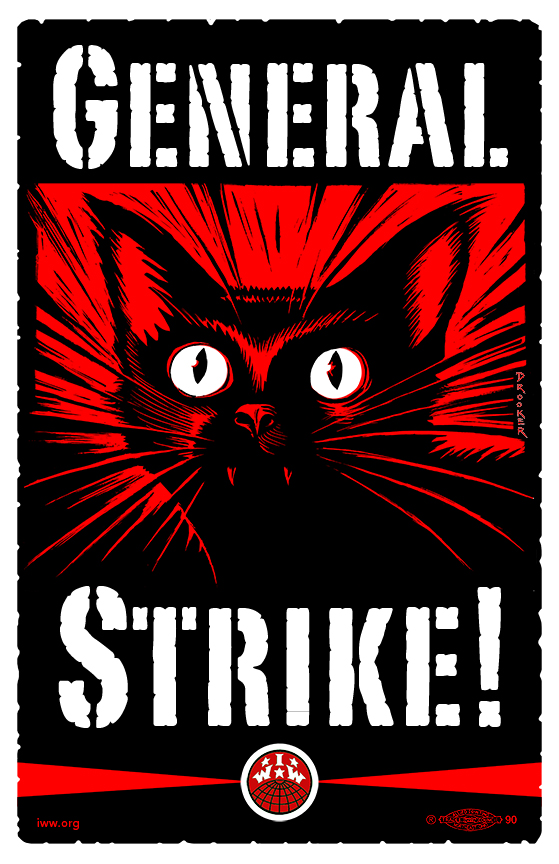
We can stop them by refusing our participation and cooperation. We can stop them by withholding our labor. By folding our arms we can halt the machine responsible for the climate crisis and create the space for the new, green economy to take root. We should go on strike.

Confronting Climate Catastrophe: Direct Action is the Antidote for Despair

By Anne Petermann - Climate Connections, September 20, 2014

Disclaimer: The views expressed here are not the official position of the IWW (or even the IWW’s EUC) and do not necessarily represent the views of anyone but the author’s.

Good evening everyone and thank you to Jill, Margaret and the other convergence organizers for the opportunity to speak to you tonight.

In four days time, UN Secretary General Ban Ki-moon will hold a UN Climate Summit–a closed door session where the world’s “leaders” will discuss “ambitions” for the upcoming climate conferences (or COPs as they are called) in Lima, Peru and Paris, France.

I was asked to put into context the reason for the march and actions this weekend–especially the problem of the corporate capture of the United Nations Climate Convention, which I have attended and organized around since 2004, when I attended my first UN Climate COP, in Buenos Aires, until 2011 when I was permanently banned from the UN Climate Conferences following a direct action occupation at the Climate COP in Durban, South Africa.

But I actually got involved with the UN Climate Conferences through the work I have dedicated myself to, which is stopping the dangerous genetic engineering of trees.

What happened was in 2003, the UN Climate Conference decided that GE trees could be used in carbon offset forestry plantations. Understanding that this was a potential social and ecological disaster, and being completely naïve about the UN process, we decided to go to the UN and explain to them why this was wrong, and to get them to reverse this bad decision.

But what we found out was that GE trees had been permitted in carbon offset forestry plantations because Norway had tried to get them banned. But Brazil and China were either already growing GE trees or planning to, so they blocked Norway’s proposal. As a result, GE trees were allowed simply because they could not be banned. The UN, we learned, does not reverse decisions, regardless of how ill-informed and destructive they are.

This is the dysfunction of the UN Climate Convention.

Pages

The Fine Print I:

Disclaimer: The views expressed on this site are not the official position of the IWW (or even the IWW’s EUC) unless otherwise indicated and do not necessarily represent the views of anyone but the author’s, nor should it be assumed that any of these authors automatically support the IWW or endorse any of its positions.

Further: the inclusion of a link on our site (other than the link to the main IWW site) does not imply endorsement by or an alliance with the IWW. These sites have been chosen by our members due to their perceived relevance to the IWW EUC and are included here for informational purposes only. If you have any suggestions or comments on any of the links included (or not included) above, please contact us.

The Fine Print II:

Fair Use Notice: The material on this site is provided for educational and informational purposes. It may contain copyrighted material the use of which has not always been specifically authorized by the copyright owner. It is being made available in an effort to advance the understanding of scientific, environmental, economic, social justice and human rights issues etc.

It is believed that this constitutes a 'fair use' of any such copyrighted material as provided for in section 107 of the US Copyright Law. In accordance with Title 17 U.S.C. Section 107, the material on this site is distributed without profit to those who have an interest in using the included information for research and educational purposes. If you wish to use copyrighted material from this site for purposes of your own that go beyond 'fair use', you must obtain permission from the copyright owner. The information on this site does not constitute legal or technical advice.