You are here
News Feeds
Footing the Bill
Calgary roundtable on electrification
The great American road trip is in peril
My husband, friends, and I sat huddled at a faux-marble-topped table in the lobby of our Utah hotel, looking down at a Google Maps route pulled up on my iPhone. We pinched and scrolled the screen as the breakfast buffet crowd hummed around us.
We were less than a week into a Great American Road trip — one that would take us 9,000 miles from coast to coast and border to border. Today’s agenda was to relocate from Moab, the gateway city for Arches and Canyonlands national parks, to our hotel near Bryce Canyon. But there was a problem:
Utah was on fire.
To the west of us, the Cottonwood Fire had burned through 94,000 acres of forest and mountain towns, making it the largest conflagration in the United States. To the east, the Jones Fire had just erupted near the ghost town Cisco, its smoke plume looming on the flat horizon, visible from our hotel room. In total, more than a dozen wildfires were burning across the state, closing roads and turning the skies an ominous orange. We had to find a safe way through.
“If we take Route 89, it takes us straight into the middle of the Cottonwood Fire,” said my childhood friend Jessie, who had joined us with her husband for the Utah leg of our trip.
“There’s Route 72 through Loa, but that isn’t much farther away,” my husband said.
We switched apps from Google Maps to Watch Duty, a real-time wildfire tracker, waiting for it to load our precise location. My kids shifted their attention from their stacks of chocolate chip pancakes to the screen, which was covered in fire symbols. My 12-year-old son looked at me, worried.
“The edge of the Cottonwood Fire is creeping toward Route 72, too,” I noted. We had to make a decision and get going.
More than a dozen wildfires broke out in Utah in late June, including the Jones Fire (right), visible from the horizon near the town of Moab. Katherine Bagley
We landed on a route that stuck to smaller state highways, even though it would add significant time to our driving. Anything to avoid the rapidly shifting edges of fire.
“You guys go get your bags and check out,” Jessie said. “I’ll go to the pharmacy and grab us some N-95 masks.”
Crisscrossing the United States by car has attained an almost rite-of-passage status in American society over the decades, its allure solidified in everything from On the Road to Thelma & Louise to the #TakeTheScenicRoute Instagram reels of today. It was that craving for wild landscapes and new cultures that had drawn my family out onto the road. My husband had just finished a year of cancer treatments, the kids were on summer break, and I was eligible for a sabbatical from my job as a climate journalist. So despite never having done anything like this before, we packed our hybrid Honda with duffle bags and camping gear and set out with a plan to visit 14 national parks.
I had expected to walk away with a better understanding of our public lands, a renewed sense of awe and adventure, and the opportunity to travel as a family in a way I never got to growing up — and the trip did give us those things in spades. What I hadn’t expected, however, was to also get a stark glimpse into how climate change is rapidly altering our nation.
Our kids spent the majority of the trip looking out the windows while listening to the full-cast Harry Potter audio books. Katherine BagleyAs a climate journalist, and scientist by training, I probably shouldn’t have been so surprised. For 20 years, I have documented the ever-growing impacts of a warming planet — and summer coincides with the annual period during which these impacts are on full display. A drumbeat of floods, fires, drought, and scorching heat put nearly every U.S. state in a vise from May to October. The season has become so synonymous with extreme weather that the nonprofit Union of Concerned Scientists launched a campaign in 2022 to dub it “danger season.”
But even knowing that, the scale of devastation underway outside our car windows was alarming. As the miles ticked by, disaster after disaster strung together in an alarming pattern of chaos. Freshly charred landscapes and orange skies in Utah. Bathtub rings on drought-stricken reservoirs in Arizona. Stands of dead trees killed by bark beetles in the Sierra Nevada mountains. Toxic dust blowing off the Great Salt Lake. Emergency alerts for flooding and evacuations in Glacier National Park. Extreme heat warnings in Grand Teton.
It felt like a near-constant assault, one disaster stacked on top of another. Travel a few miles, a few hours, and we’d encounter another mark climate change had made — or was actively making — on the American landscape.
It’s too early to say whether climate change was a factor in every brush fire, heat wave, storm, or flood we encountered. But there is compelling evidence that it’s making many forms of extreme weather more severe or frequent. From 1980 to 1989, the number of billion-dollar weather disasters in the United States averaged just 3.3 per year. In the decade between 2015 and 2024, that number had more than quintupled, averaging 19 billion-dollar disasters per year. Twenty-three billion-dollar disasters hit American communities in 2025, according to the research group Climate Central. By the time we hit the road in June 2026, 12 events from this year had already met that threshold.
As we left Moab toward Bryce Canyon, heavy-duty particulate masks stashed in the glove box, we got an alert from the National Park Service. It was closing a portion of Canyonlands National Park, where less than 24 hours prior we had peered out over the park’s plummeting red sandstone cliffs into the hollowed landscape where the Colorado and Green rivers converge. Intense wind gusts had blown the hats from our heads and sand into our eyes.
Overnight, those gusts gave the Babylon Fire power to grow from 300 acres to 16,000 acres. The landscape we had just admired was under siege.
Route 128 in southern Utah winds its way through towering red sandstone cliffs, following the Colorado River. A wildfire broke out near the byway just a day after we passed through. Katherine BagleyOver the next week on the road, my husband and I became experts at spotting the characteristic plumes of distant wildfires, locating the blazes on the Watch Duty app, and adjusting our driving route. In my travel journal, I jotted down notes: An ominous plume of smoke from the Pocket Fire seen on our way to the Grand Canyon. Feelings of gratitude after days where we encountered clear skies. We kept moving, even as I learned of flood evacuations in campgrounds further down our itinerary.
“Will our trip be derailed?” I wrote.
After stopping in Las Vegas for July Fourth, we headed farther west, through Bakersfield, California, en route to the Sierra Nevada mountains. We passed the scars of prescribed burns on ranchland, wind turbines, rows and rows of fruit trees, and a seemingly endless stream of oil pumpjacks, their arms turning rhythmically up and down, up and down.
Pumpjacks and drilling pads cover the landscape at the Kern River Oil Field in Bakersfield, California, on July 28, 2015.Mark Ralston / AFP via Getty Images
“What are they doing to the ground?” my 9-year-old daughter asked from the backseat.
“Those help to pull oil from underneath our feet to power things like cars and lights,” I replied, staring out at the edges of the Kern River Oil Field.
My kids already had a basic sense of climate change and its causes before we left on this trip. On our way west, we had stopped at a wind turbine-themed rest stop in Iowa celebrating the state’s commitment to renewable energy. We awed at the presence of electric vehicle chargers at the “world’s largest truck stop,” Iowa 80. And we cheered with every solar farm we saw. They were signs of progress, regardless of politics or climate beliefs or geography.
Our driving breaks in Iowa were marked by signs of climate action, from a wind energy-themed rest area to electric vehicle charging at the “world’s largest truck stop.” Katherine Bagley
That was the lens my kids had on climate change: It was bad, but there were ways to fix it. Then came the fires, and the smoke, and the flooding, and the heat warnings, and the drought. And now, here in Bakersfield, they were seeing for the first time what extracting fossil fuels looks like in practice, what it does to a landscape.
“I can’t believe they’re still working,” my son said quietly. “This place is littered with them.”
We rode the next few hours without speaking to each other, listening to Harry Potter audio books and staring out the windows, hoping to see another wind farm.
We stopped overnight in Three Rivers, California, before heading into Sequoia and Kings Canyon national parks. The road rose from the valley floor, switchbacking and climbing 5,000 feet in just 16 miles. The higher we went, the taller the trees got, towering above us. We opened our sunroof and windows, letting the cool mountain air rush over our outstretched arms. After weeks in the desert, the forest felt like a homecoming for us New Englanders.
We parked at the General Sherman tree, the world’s largest by volume, and set out on foot through what is known as the Giant Forest. Trunks stretched upward for what seemed an impossibly long time, disappearing into rings of thick branches. But despite the scale, the forest felt cozy. Dappled sunlight filtered through the scalelike needles, casting a shadowy, warm glow. As we walked along the Congress Trail, weaving between thousand-year-old sequoias, my kids hugged every tree they could. The red, spongy bark tickled their skin as they stretched their arms and legs around the trunks.
My husband and kids hugged every tree they could in Sequoia National Park, including this giant along the Congress Trail. Katherine BagleyAlong the trail, we came to a cross section of a felled sequoia. More than 2,200 years of growth rings radiated from its center, each a marker of the history the tree had lived through. The rings showed evidence of at least 80 fires strong enough to permanently mark the tree’s bark over its lifetime — averaging one fire every 28 years.
Even when they leave marks, fires don’t always spell disaster for these giants: Low-intensity blazes can clear the forest of underbrush, scorching the bottom of a tree but leaving its branches untouched, ultimately rejuvenating the forest’s nutrients. But these stands of ancient sequoias have experienced an unprecedented number of wildfires recently, including six large fires in six years. Scattered throughout the parks were large patches of burned-out trees, their blackened trunks like used matchsticks, stripped of all greenery.
According to the National Park Service, “More than 85 percent of all giant sequoia grove acreage across the Sierra Nevada has burned in wildfires between 2015 and 2021, compared to only one quarter in the preceding century.” The fires were so intense that they killed thousands of “large sequoias,” those measuring 4 feet or more in diameter. The KNP Complex and Windy fires in 2021 killed upward of 2,380 large sequoias alone.
Blazes in the Sierra Nevadas are often the result of lightning strikes, untamped camp fires, or power line sparks, among other causes, but their intensity and scale are fueled by the dry conditions and pest infestations brought on by climate change.
Sequoia and Kings Canyon national parks experienced six large wildfires in six years between 2015 and 2021, killing thousands of large sequoias. Katherine BagleyAs we drove down out of the sequoias, pointing out each new giant, we saw logging trucks and excavators parked on the side of the road. Dead branches sat in piles ready for controlled burns, part of a partnership between scientists, park managers, and environmental groups to reduce the severity of the next wildfire to rip through the region.
When it does, not if.
After visiting the sequoias and Yosemite, my family and I turned back east. Our days whiplashed between grandeur and crisis.
We passed the Great Salt Lake at sunset, reds and pinks mirrored in its vast, still waters. But as we drove, we could also see stretches of dry, cracked shoreline — the lake has lost an estimated 73 percent of its water and 60 percent of its surface area due to agricultural diversions and worsening drought. A decade ago, I visited Antelope Island with friends to see its iconic free-ranging bison, but the lake’s shrinking shores mean the landmass is no longer an island, but a peninsula.
In Salt Lake City, we visited the Natural History Museum of Utah. One of the first exhibits was an interactive Sim City-esque game where you have to make planning decisions — install solar panels, build an urban farm, tear down a coal plant — to try and stave off the worst impacts of climate change. My kids played it three times. Little did they know that across the museum’s parking lot stood a hillside charred by the Bonneville Fire just two weeks earlier.
We traveled north into Wyoming, greeted by road signs warning of extreme heat. Jackson Hole, outside of Grand Teton National Park, hit 94 degrees Fahrenheit on July 12, 13 degrees warmer than the average daily high for the month. The town of Worland, in central Wyoming, hit 110 degrees F. We drove to String Lake to cool off in its snow-fed waters and watched as a bald eagle dove to catch fish.
We took a boat ride on Jackson Lake to see the park’s iconic jagged peaks from a different perspective, and learned that the tour operator was shutting down operations weeks earlier than usual. Low water levels caused by the region’s dismally low snowpack were making it hard to navigate wide swaths of the reservoir. Our guide pulled up a photo on his phone from six years ago. “The peaks were covered, just covered, in snow at this time,” he said. “What we’re seeing right now in July, that’s what we would typically see in late August.”
Up near Yellowstone, we took the kids whitewater rafting in the town of Gardiner. They shouted with delight as we crested the rapids and dunked in the spray. But in moments of quiet on the river, our guide pointed to pipes, wires, and decks sticking out from eroded riverbank, all that remained of the houses swept away by a historic flood in 2022.
Katherine Bagley Katherine BagleyIconic scenes from Yellowstone National Park. Katherine Bagley
Katherine BagleyPark after park, the kids’ junior ranger books wove climate change and its impacts into their pages. Staff told us about the plight of the pikas, adorable mouselike mammals that are moving farther up mountains in search of cooler climes. We watched videos and read placards about how warming temperatures are making more areas suitable for white pine bark rust and destructive beetles.
I listened as my kids took their junior ranger pledge in every park we went to. Each oath differed slightly — some adding silly rhymes, others more serious — but they all included some variation of, “I promise to appreciate, respect, and protect all national park places.”
Our kids taking their junior ranger oath in Zion National Park. By the end of our trip, they had achieved ranger status in 14 national parks. Katherine BagleyAfter taking their junior ranger oath in Glacier National Park, my kids walked through the exhibits at the St. Mary Visitor Center on the east side of the park, bordering the Blackfeet Indian Reservation. In the center was a 3D rendering of the park. They hit a button and watched as tiny bulbs lit up the mountaintops, signifying the location of the 150 glaciers that existed back in 1850.
As the timeline moved from 1900 to 1950 to 1980 to 2000, the lights disappeared faster and faster. Today, the park is home to only 26 ice bodies. My children pressed the buttons over and over, as if trying to restore the glaciers, remembered only by the carved-out hillsides they left behind.
A national Gallup poll recently found that nearly 4 in 10 Americans say their community was damaged by extreme weather within the past year, but that they “feel powerless to shape their own future.” The impacts of climate change can feel overwhelming, but my family’s road trip made clear this is an issue that affects us all. Climate change is no longer a collection of isolated disasters, separated by headlines or distances. It touches everything, its imprints lasting and deep and inescapable.
After more than a month on the road, it was time to go home.
The evening sky at our lodging outside of Zion National Park. Katherine BagleyI wondered whether my kids will ever be able to take this same trip with their own families. If so, their experiences will likely be drastically different. Will they be able to explore the arches and sandstone cliffs of Utah? Will they be able to walk through the towering sequoias? Will they be able to see the ice?
I hoped so. There is so much to cherish, so much beauty, and still so much to fight for. We just need to rally to face a new foe.
This story was originally published by Grist with the headline The great American road trip is in peril on Aug 26, 2026.
The Worst of The Worst
Well damn, we sure feel safer knowing ICE pulled 5-year-old Liam Tadeo and his construction worker dad Victor off Austin's streets on their way to a soccer game before Liam could start kindergarten the next day; also that they were held at a family concentration camp, ICE refused to let Liam's mother take him, and both father and son will "self-deport" to not further sully our pristine white shores. Question: How do these sick fucks sleep at night?
Thanks to the obscene $200 billion-plus gifted to DHS and ICE by their evil overlords, arrests of undocumented or at least unwanted immigrants surged to nearly 50,000 largely innocent people in July, a 15% spike from a month earlier and the regime's highest monthly arrest total to date. So yes, the sadists are still at it, just more quietly than when a psychotic Noem and Bovino were blasting out histrionic videos of daredevil agents dropping from helicopters onto apartment rooftops to grab terrified families - images reportedly, inexplicably "provoking a lot of ordinary people." Wusses, all.
Many recent arrests come during "traffic stops," increasingly with the help of partnering state and local law enforcement lured by "generous financial incentives," especially in Texas and Florida; ICE is also arresting more Haitians whose protections have been stripped away. Among those detained are over 6,200 kids, 10 times more than during Biden's tenure, despite ongoing, fantastical DHS claims they're going after the "worst of the worst" murderers, drug traffickers, sex offenders - and despite ghastly data showing up to 85% of ICE thugs themselves have sex offenses on their records, most against children. New data, like old data, also shows less than a quarter of those arrested have any criminal convictions.
Elsewhere, ICE abuses go on apace. A sailor aboard the troubled USS Lincoln said ICE has taken his father, who had a work permit, into custody. “Having a family member in the military is not a free pass to violate our nation’s laws,” said a DHS statement "in the same support-our-troops spirit Trump is so famous for." In an interview, the mother, father and sister of Alex Pretti family said no officials have come forward in the last seven months to retract or apologize for the "disgusting" claims of "assassin" and "domestic terrorist" they made about Alex - "We still hear those words about our child,” said his mother Susan - nor have any criminal charges been filed against his killers.
Meanwhile, J.D. Vance just came to Maine to spew racist lies, flaunt his "trademark absence of charisma," and claim, "If you bring in millions and millions of illegal aliens and give them houses that ought to go by right to American citizens, it's going to increase the cost of housing for everybody else." He also dismissed ICE's killing of Colombian Johan Durán Guerrero, who had a social security card, two jobs, a wife and a three-year-old daughter. Worried residents, he said, should "have a little bit of perspective" to ensure "that poison stops coming into our country." Troy Jackson called J.D. "a dirtbag": "I mean, he had a life." As to Susan Collins, who declined to regret giving ICE "$70 billion more to pull this shit off": "I’m sick of your ‘concerns.’"
And on Aug. 16, brave ICE thugs stopped five-year-old Liam Tadeo - their second small Liam like the bunny-hat-wearing Liam Ramos in Minnesota - and his father Victor Martinez Nieto on their way to play soccer. Without bothering with the nicety of pretending it was a legit traffic stop, they asked Victor, originally from Mexico, if he had legal status. Candidly, he said no; in 2025, he'd been arrested by ICE, "voluntarily" left, then "criminally" reentered the U.S. to (horrors) be with his wife and son. Heart-rending video soon surfaced of Liam crying beside his father and trying to hold one of his hands, cuffed behind him, as Victor tried to console his tearful son, talking to him as they walked. It was the day before Liam was set to start kindergarten.
They were both taken to the for-profit Dilley concentration camp, which rights groups have repeatedly accused of medical neglect, poor living conditions and abuse. According to Kate Lincoln-Goldfinch, their family's attorney, Victor begged ICE to release Liam to his mother Maria, also not a legal citizen, at home, or another member of the family. ICE refused, though DHS proudly, routinely declaims ICE "will place the children with a safe person the parent designates," like how they also contend Dilley is "retrofitted for families, with access to teachers, classrooms, and curriculum booklets...generously funded by the U.S. taxpayer." Instead, they had Victor sign papers in English he didn't fully understand, and booked both father and son.Lincoln-Goldfinch says Maria is "desperate and distraught, separated from her child and worrying about his well-being." Back at their home, "It feels like when you go to someone’s house after a sudden death, and there’s a wake or a gathering. Everybody is just stunned." Maria released a statement: "Liam was supposed to start kindergarten this week. Instead he is (in) detention. He should be in school, playing soccer, and at home with his family." Saturday, CNN aired emotional video of her talking by phone to her five-year-old. “I love you so much and I miss you so much, my love,” she tearfully told Liam in Spanish. “Don’t despair, my love, okay?” Lacking options, Liam timidly responds, "Okay." One furious, horrified online comment: "Anyone!!??!!"
This week, Austin's KUT News reported Victor has decided to be deported to Mexico along with his son, rather than risk Liam being separated from him and placed in a dystopian regime's custody as an "unaccompanied migrant child.” Said Lincoln-Goldfinch, "His family did what any family would do: Agree." As Maria reportedly struggles to find a way to re-unite with her family - "My son is only five years old" - Americans fume about "sadistic barbarians harming humanity every single day." "How sick can these people be? I used to think merciless psychopathic villains were only found in movies and fiction," said one. Also, "America has concentration camps. I. Hate. It. Here." and, "That poor little boy, That poor family. I am so tired."
Meanwhile, Texas' Dem lawmakers have called for Liam to be released and for Dilley to be shut down. "I just sat with Liam's mother as she found out what it means to have your child held hostage by ICE. It was horrifying," wrote Rep. Greg Casar, who charged Liam's arrest showed Trump uses children “as bait and leverage to fuel his mass deportation machine.” "Liam should be starting kindergarten this week, and instead he's sitting in a trailer prison." Rep. Joaquin Castro said ICE denied his request to visit Liam at Dilley in what he called "shady stuff," and he vowed to return; he also cited human rights violations, privacy concerns, and untenable phone, video call and e-mail strictures: “I’m telling y’all, ICE is getting worse."Because this is ghoul-filled America in 2026, Liam's aunt Patricia Resendiz has begun a Gofundme to help with legal expenses and her sister Maria's household costs, as Victor was the sole provider. "If we manage to get Liam and his dad to go free, Liam will also need psychological support, as the detention has left him traumatized. These funds will be to mitigate all aspects of child detention," she wrote. "The detention of Liam and my brother-in-law was cruel. They are not criminals - they were simply on their way to a soccer match. Liam is a beautiful, intelligent, and big-hearted little boy. My sister is devastated, as are we. Liam was detained right in front of my son, his cousin. My son told me that ICE agents said to Liam, 'You can't escape.'"
We feel safer already.
Slot Gacor dan Perbincangan Seputar Pola Game
Malam mulai larut ketika sebuah pertanyaan sederhana muncul di tengah obrolan para pemain: “Kenapa game yang tadi terasa biasa saja, tiba-tiba ramai dibicarakan karena memberikan kemenangan besar?” Pertanyaan seperti itu kerap menjadi awal dari perbincangan panjang mengenai slot gacor dan pola game.
Di komunitas pemain, istilah “gacor” sering digunakan untuk menggambarkan permainan yang dianggap sedang memberikan hasil menarik. Dari sana, muncul berbagai dugaan mengenai pola tertentu, mulai dari perubahan ritme permainan, frekuensi simbol bonus, hingga pengalaman beberapa pemain yang merasa menemukan momentum tertentu.
Namun, apakah pola tersebut benar-benar bisa dijadikan patokan? Di sinilah pembahasannya menjadi lebih menarik.
Ketika Pola Game Mulai Menjadi PerbincanganBayangkan seorang pemain yang sedang memperhatikan jalannya permainan. Beberapa putaran pertama berjalan tanpa kejutan. Kemudian muncul simbol bonus, disusul kombinasi kemenangan dalam beberapa putaran berikutnya. Pengalaman seperti ini mudah membuat pemain berpikir bahwa permainan sedang memasuki fase tertentu.
Cerita tersebut kemudian dibagikan kepada teman atau komunitas. Pemain lain mencoba permainan yang sama dan mungkin mendapatkan pengalaman berbeda. Dari sinilah istilah seperti “lagi gacor”, “pola bagus”, atau “momentum panas” semakin sering muncul.
Perlu dipahami bahwa pola game yang dibicarakan pemain biasanya merupakan hasil pengamatan pribadi, bukan jaminan matematis. Setiap permainan berbasis RNG (random number generator) dirancang agar hasil putaran tidak dapat diprediksi secara pasti.
Mengapa Pemain Merasa Menemukan Pola?Ada alasan psikologis yang membuat manusia cenderung mencari pola. Ketika beberapa kejadian muncul berurutan, otak secara alami berusaha menghubungkannya.
Misalnya, seseorang melihat beberapa kemenangan terjadi setelah sejumlah putaran tertentu. Ia kemudian menganggap urutan tersebut sebagai pola. Padahal, rangkaian hasil sebelumnya tidak otomatis menentukan hasil berikutnya.
Hal ini dikenal sebagai kecenderungan melihat hubungan pada kejadian yang sebenarnya bisa terjadi secara acak. Karena itu, pengalaman satu pemain belum tentu berlaku bagi pemain lain.
Memahami RTP, Volatilitas, dan RNGDaripada hanya berpatokan pada istilah “gacor”, pembaca sebaiknya memahami beberapa konsep dasar dalam permainan slot.
RTP (Return to Player) merupakan persentase teoretis yang menggambarkan pengembalian kepada pemain dalam jangka panjang berdasarkan mekanisme permainan. Angka tersebut bukan berarti seorang pemain akan menerima persentase yang sama dalam satu sesi.
Sementara itu, volatilitas menggambarkan karakteristik distribusi kemenangan. Permainan dengan volatilitas tinggi umumnya dapat memiliki kemenangan yang lebih jarang tetapi berpotensi lebih besar, sedangkan volatilitas rendah cenderung menawarkan kemenangan yang lebih sering dengan nilai yang relatif lebih kecil.
Kemudian ada RNG, yaitu sistem yang digunakan untuk menghasilkan hasil permainan secara acak sesuai mekanisme yang ditetapkan. Kehadiran RNG menjadi alasan mengapa klaim mengenai urutan putaran yang pasti menghasilkan kemenangan perlu disikapi secara kritis.
Dari Cerita Komunitas Menjadi InformasiPerbincangan mengenai slot gacor sebenarnya tetap menarik jika ditempatkan pada konteks yang tepat. Pengalaman komunitas dapat menjadi bahan diskusi tentang karakter sebuah game, tampilan fitur, tingkat volatilitas, bonus, maupun mekanisme permainannya.
Yang perlu dihindari adalah menganggap pengalaman tersebut sebagai rumus kemenangan.
Seseorang mungkin merasa mendapatkan hasil bagus setelah mengikuti pola tertentu, sementara pemain lain mencoba langkah serupa dan memperoleh hasil berbeda. Perbedaan tersebut wajar karena hasil setiap putaran tidak dapat dipastikan hanya berdasarkan pengalaman sebelumnya.
Menjadi Pemain yang Lebih KritisPada akhirnya, pembahasan tentang slot gacor dan pola game bukan sekadar mencari “urutan rahasia”. Ada hal yang lebih penting, yaitu memahami cara permainan bekerja dan membedakan antara fakta dengan asumsi.
Sebelum memainkan sebuah game, perhatikan informasi seperti aturan, fitur bonus, RTP jika tersedia, serta volatilitasnya. Tentukan pula batas anggaran dan waktu sejak awal. Jangan mengejar kerugian dengan meningkatkan taruhan karena hasil sebelumnya tidak menjamin hasil berikutnya.
Cerita tentang game yang sedang “panas” memang mudah menarik perhatian. Akan tetapi, di balik setiap cerita kemenangan selalu ada faktor acak dan mekanisme permainan yang perlu dipahami.
Jadi, ketika perbincangan tentang pola game kembali ramai, mungkin pertanyaan terbaik bukan “pola mana yang pasti menang?”, melainkan “seberapa banyak dari pola tersebut yang benar-benar didukung fakta?” Dari pertanyaan sederhana itulah pemain dapat melihat dunia slot dengan sudut pandang yang lebih realistis, kritis, dan bertanggung jawab.
The Teacher Pay Penalty Remained High in 2025
Teachers earned 25.2 percent less than comparable college graduates in other professions in 2025, according to a new report from the Economic Policy Institute and the Center for Economic and Policy Research (CEPR).
The relative teacher pay penalty — which is adjusted for education, experience, and demographic characteristics — was a slight improvement from 2024’s record high of 26.9 percent, but still more than four times the 6.1 percent penalty recorded in 1996.
In other words, teachers earned on average 74.8 cents on the dollar in 2025 compared with other college graduates — much less than the relative 93.9 cents on the dollar that teachers earned in 1996. When broken down by gender, the relative teacher pay penalty was 34.5 percent for men and 20.0 percent for women.
Overall, simple inflation-adjusted weekly wages for public school teachers fell 6.2 percent over the last three decades, while wages for other college graduates rose 28.8 percent over the same period.
Teachers were paid less than other college graduates in every state, with relative teacher pay gaps ranging from 10.4 percent in Rhode Island to 40.7 percent in Colorado. The teacher pay penalty was at least 25 percent in 25 states.
While teachers typically receive better benefits packages than other professionals, this only partially offsets the growing wage penalty that teachers face. After accounting for the difference in benefits, teachers’ total compensation penalty was 14.5 percent in 2025.
As the report explains, providing teachers with competitive pay is necessary to retain and attract qualified workers. While there are many important factors impacting teacher retention and recruitment, pay consistently lands near the top of any list.
Reversing these trends will require targeted, sustained investment in public education at the local, state, and federal levels. It will also require stronger support for public-sector collective bargaining, which has long been a driver of better pay and job quality for teachers.
“The decades-long teacher pay penalty has taken a heavy toll on public education. Yet, policymakers have failed to make the needed investments to reverse course. That failure is especially troubling in a country as wealthy as the United States, with more than enough resources for its public schools to be the envy of the world,” said report author Sylvia Allegretto, who is a senior economist at CEPR and research associate at EPI.
California Legislature approves bill easing access to clean, affordable ‘balcony solar’
SACRAMENTO – The Environmental Working Group today applauds the California Legislature for passing a bill that will help Californians invest in clean energy while also tackling sky-high energy bills by making it easier to install small, affordable “balcony solar” systems.
Senate Bill 868, known as the Plug and Play Solar Act, would eliminate red tape that has kept these systems from being placed in apartments, condos and single-family homes. The legislation would also ensure the systems comply with strict safety standards.
The bill is authored by Sen. Scott Wiener (D-San Francisco) and sponsored by EWG and the Abundance Network. SB 868 heads to Gov. Gavin Newsom for his signature.
“This is the most exciting clean energy idea around,” said Bernadette Del Chiaro, EWG’s senior vice president for California. “With this bill, California is poised to fling its doors wide open to a real, tangible affordability solution for everyday consumers.
“Solar energy is a no-brainer for California and we applaud Sen. Wiener and his legislative colleagues for their hard work to put this critical clean energy solution on the governor’s desk,” she added.
Balcony solar is thriving in Europe – in Germany more than 4 million systems have been installed. Efforts to ease their deployment are gathering steam in other countries.
But in the U.S., regulatory barriers keep this technology out of reach for many. If enacted, SB 868 would remove those barriers while ensuring the systems meet safety standards.
Homeowners and renters could then buy portable balcony solar panels from retailers and plug them in without first having to get an interconnection agreement from their utility. The cost and time involved with getting that agreement has been a barrier to greater deployment of these systems.
The Assembly amended the bill with a provision sunsetting the interconnection exemption on Jan. 1, 2030 – language sought by the utilities – but SB 868 gives the market four years to take off and the Legislature has the opportunity to remove the sunset in the future.
Solving an urgent public health problemEWG this month released a report showing that California is experiencing more frequent and dangerous heat days, with extreme heat events up 55% statewide threatening public health and safety without access to cooling. But soaring utility bills mean millions of people can’t afford the air conditioning that could keep them safe.
Balcony solar is one solution, helping lower electricity costs and making it cheaper to run vital cooling. With 2027 shaping up to be the hottest year on record, it can’t come soon enough.
That’s why EWG is calling on policy makers to prioritize solutions like customer-sited solar energy that can drastically lower or eliminate annual utility costs for air conditioning. If it becomes law, SB 868 would help millions of families tackle air conditioning costs.
“These small, easy-to-use solar panels will give everyone, including renters, the relief they desperately need on our outrageous energy bills,” said Wiener. “Electricity costs have reached ridiculous levels here in California and the Plug and Play Solar Act provides a much-needed tool to provide relief. It’s time to put money back in the pockets of Californians.”
A single 400-watt balcony solar system can cover roughly 14% of the average apartment’s electricity usage, providing savings of about $250 per year. While the cost of balcony solar starts around $500 today, with broader adoption enabled by SB 868, EWG expects costs to fall, making solar even more accessible to renters and low-income households.
California electricity rates have nearly doubled over the past decade, leaving the state with the nation’s second-highest energy prices. SB 868 provides consumers with a straightforward way to take control of their energy bills.
And the systems are easy to use. “Installing balcony solar is as simple as plugging an appliance like a toaster into a standard wall outlet,” said Del Chiaro.
“At a time when many struggle to pay their energy bills, balcony solar is a powerful cost-cutting tool that also helps the state meet its clean energy goals,” she added.
SB 868 would also ensure these plug-and-play systems meet strict safety standards. All systems must be certified by UL, or Underwriters Laboratories, the global independent safety science company, or an equivalent national testing lab. To protect utility workers and prevent electrical hazards, systems must automatically shut off within seconds if the grid goes down.
System size is capped at 1,200 watts, enough to power everyday appliances such as fridges, lights, Wi-Fi routers and AC units.
California is not the first state to remove barriers to balcony solar. Utah became the first in 2025, and so far, eight other states have enacted laws to do the same.
With today’s vote, California joins New York as another state with a balcony solar bill sitting on the governor’s desk. Newsom has 30 days to take action on SB 868. The California Assembly and Senate both gave the bill strong bipartisan support, with over 90% approval in both chambers.
“California may not be the first out of the gates but we are the biggest prize,” said Del Chiaro. “If Gov. Newsom signs this bill into law, the size of our market will radically transform and accelerate the adoption of this brilliant new way to tackle both climate change and energy affordability.”
###
The Environmental Working Group is a nonprofit, non-partisan organization that empowers people to live healthier lives in a healthier environment. Through research, advocacy and unique education tools, EWG drives consumer choice and civic action.
Areas of Focus Energy Renewable Energy California SB 868 would end red tape blocking millions from utility bill savings Press Contact Alex Formuzis alex@ewg.org (202) 667-6982 August 25, 2026The fight to clean up the damage of US war in Laos
This article The fight to clean up the damage of US war in Laos was originally published by Waging Nonviolence.
In the city of Phonsavan in northern Laos, May Sinoun, a 107-year-old woman with a gentle smile, leaned forward on her chair. She tells how she survived one of the most intensive bombing campaigns in world history.
“During the war, if we stayed at home, we had to sleep in pits or holes,” she said. “At night, even a small light could be dangerous. One person died because the plane saw the light and dropped bombs. If we fell down, we would cover ourselves with grass to pretend to be dead.”
From 1964 to 1973 the U.S. led a massive bombing campaign along a supply route it called the Ho Chi Minh Trail. “Operation Barrel Roll,” as it was called, provided support to a CIA-led clandestine army in efforts to subdue the communist Pathet Lao and Northern Vietnamese fighters. The vast majority of victims, however, were civilians.
May Sinuon, 107, survived the US bombing of a school in Laos. (Brendan Maslauskas Dunn)May Sinoun survived the blast from a bomb dropped on a school she was in, but her friends were killed in front of her. She is reminded of the bombing daily. “I have wounds from that time,” she said as she squinted her eyes and contorted her body. She pointed to her arms, shoulders and back, where the pain is most intense. Shrapnel has worn down her muscles for over half a century.
Daily reminders of the war are ubiquitous in Sinoun’s province of Xieng Khouang. The ancient Plain of Jars is covered in bomb craters and a number of funerary jars thousands of years old cracked by the blasts. Defused bombs are scattered across the province, used as construction material, garden beds and as decoration in cafes. Spoons and chopsticks in restaurants are made by melting down aluminum from the bombs.
But the deadliest reminders of the war are hidden in the mountains, farms and villages of Laos. Millions of bombs never blew up. Most of them lie just beneath the surface in Xieng Khouang and surrounding northern provinces, and in the southern regions of Laos that border Vietnam. Finding and removing the bombs is a labor-intensive, slow, dangerous process. At the height of the antiwar movement, activists demanded the U.S. government come up with a long-term postwar plan to remove the bombs. Decades after the movement subsided, a small network of grassroots activists has continued to advance the demand under incredibly challenging circumstances.
#newsletter-block_dea3a91185a098f1d2bbe12880202bd1 { background: #ECECEC; color: #000000; } #newsletter-block_dea3a91185a098f1d2bbe12880202bd1 #mc_embed_signup_front input#mce-EMAIL { border-color:#000000 !important; color: #000000 !important; } Sign Up for our Newsletter The most bombed country in history“Laos is the most heavily bombed country per capita in history,” said Sera Koulabdara, who leads Legacies of War, an organization dedicated to finding solutions to the long-term impacts of the American war in Vietnam, Cambodia and Laos. “The U.S. dropped more than 2.5 million tons of ordnance across 580,000 bombing missions — equal to a planeload of bombs every eight minutes, 24 hours a day, for nine years.” In total, across the three countries, the U.S. military dropped some 13 million tons of ordnance.
Locals who survived the war say that “everything” was bombed — houses, ancient temples, hospitals, farms, schools, entire villages. The ancient city of Xieng Khouang was completely leveled by the U.S. bombing campaign, save for the crumbling remains of some old stupas, a temple and a few French colonial buildings.
One of the more devastating legacies of the war is the unexploded ordnance, or UXO, which still claims lives in Laos every month. It’s estimated that over 30% of the ordnance dropped during the war did not explode. “Today vast amounts of land remain contaminated with unexploded ordnance,” Koulabdara said. “It continues to pose a threat to citizens in all three countries, with many survivors permanently disabled and their families impoverished.”
A poster warns about the dangers of unexploded US ordnance, which has killed over 20,000 people in Laos since the war ended in 1975. (Brendan Maslauskas Dunn)On a backcountry road in Xieng Khouang, trucks filled with workers stir up clouds of dust as they navigate the crumbling asphalt. The workers will spend the next few weeks finding and defusing bombs in a remote mountain village. Thousands of government and NGO workers risk their lives daily in the nerve-wrecking hunt for UXO.
Koulabdara’s organization coordinates with a vast patchwork of NGOs, volunteers, grassroots organizations, activists and government workers who are dedicated to making Laos bomb-free. Koulabdara said the group brings together “veterans, members of the diaspora community, government officials, students, artists and supporters from across the globe.”
If the work continues at its current rate, however, it is projected to take 1,000 years to clear Laos of UXO. This is a fact that weighs heavily on the people that live and work among the bombs.
The rebellion of the 1960sDemands for the U.S. to make reparations and clean up the millions of bombs scattered all over Southeast Asia once emanated from the ranks of a mass antiwar movement in the U.S. and communist liberation movements in Southeast Asia.
At its peak, the U.S. antiwar movement was ablaze with resistance on many fronts. Students, workers, the Black Freedom struggle, the feminist movement and the broader New Left rose up in the political whirlwind of the time, not only calling for an end to the bloodshed, but at times openly declaring support for the communist movements in Southeast Asia. Organizations like Students for a Democratic Society swelled to nearly 100,000 members.
A nine-year bombing campaign by the US leveled entire towns in Laos and left massive craters, like this one in Xieng Khouang province. (Brendan Maslauskas Dunn)In May 1970, more than 4 million students launched a mass strike in response to the U.S. expansion of the war into Cambodia and Laos, and the FBI’s increased political repression of the Black Panther Party. Protests were held at over 700 U.S. colleges and universities. Occupations of buildings, mass teach-ins about the war and pitched battles with the authorities were common.
The strike turned deadly at Kent State University when the National Guard opened fire on demonstrators, killing four. Eleven days later, police killed two students at Jackson State University. In total, nearly 100 people were wounded by authorities across the U.S. during the May strike.
George Katsiaficas was deeply active in the antiwar movement and the New Left, struggles he has chronicled and theorized about in a host of books and articles. In 1972 he was invited to attend a conference in Versailles called the World Assembly for Peace and Independence of the Peoples of Indochina.
At the conference, he witnessed a deep and sincere form of solidarity in practice and was inspired by the speeches given by Vietnamese revolutionaries. It was there that he learned about cluster munitions — the kind that are still killing people in Laos today.
“The Vietnamese gave me a three-inch-high stack of photos about cluster bombs,” Katsiaficas said. He recalled being told, “we don’t think the American people know about this” and being urged to educate them when he returned home. Although there was some public knowledge of the U.S. using cluster bombs in Southeast Asia and even actions targeting their production, Katsiaficas said this was the first time he learned about them.
He was horrified. Cluster bombs are designed to open in midair and release smaller “bombies” over an area as large as five football fields. The bombies are filled with plastic and fiberglass shrapnel so they could not be detected by X-ray. They are specifically designed to kill and injure humans.
Previous Coverage“I was outraged at the U.S. government. I’m still outraged,” Katsiaficas said. He went back to the U.S. and gave the information on cluster munitions to other activists who created brochures and distributed them en masse. He and other activists drove across the U.S. in a speaking tour to mobilize local antiwar and activist groups to protest the 1972 Republican and Democratic national conventions. Education about cluster munitions became part of their presentation.
“People were genuinely shocked,” he said. “Outrage, I would say, was the main reaction that people had. Indignation, you know, digging their heels in to really fight against the war. It just made people more determined than ever that the United States was evil.”
As more people became aware of cluster bombs, more protests were organized against their use.
Sera Koulabdara said that over the years, this mass organizing, educational work and advocacy to pressure the U.S. government for reparations and cleanup has certainly helped her group and other NGOs secure U.S. funding to address these “legacies of war.”
The revolt of American soldiers who turned against the war was also at the heart of the movement.
Susan Schnall was a lieutenant and nurse in the Navy during the war, and now serves as president of Veterans for Peace. She made headlines in 1969 when she was dismissed from the Navy for wearing her uniform at a veterans antiwar march in San Francisco. She later launched a daring action with two other activists where they flew a plane over military bases in the Bay Area and dropped thousands of antiwar flyers. “When I look back on it, I think we were just very, very lucky that they didn’t shoot us down,” Schnall said. She organized alongside other GIs and healthcare professionals, joining the Medical Committee for Human Rights and the Medical Aid for Indochina, which sent medical supplies and aid directly to North Vietnam.
Map of U.S. bombing runs during the Vietnam War, with each black dot representing a 1,000‑pound bomb.As the war progressed, and as more Americans began to see what the U.S. military was doing in Southeast Asia as mistaken, futile or inhumane, GI resistance surged. Vietnam Veterans Against the War and other antiwar veterans groups formed, and GI coffeehouses and underground newspapers sprung up across the country to organize soldiers against the war. Increasingly, more soldiers went AWOL, refused orders or refused to fight. Morale broke down in the military. In 1970 alone, the Pentagon reported 209 fraggings (targeted killings of officers by soldiers). There were 65,643 desertions from the Army that same year. This was the largest form of soldier-led resistance to a war in the history of the United States.
The mass antiwar movement and GI resistance played a critical role in hastening the end of the war. The military conflict finally ended in 1975, but economic sanctions and political isolation became U.S. policy in the region for decades. Vietnam, Cambodia and Laos lay in ruins, UXO continued to kill and maim, and the U.S. reneged on the Paris Peace Accords agreement in its promise to give $3.25 billion in reconstruction aid to Vietnam. No similar aid was ever promised to Laos.
From national liberation to NGOsFifty years after the war’s end, the demands for reparations are now muted. The movement has long since faded away, and the communist forces in Southeast Asia became consumed by bureaucracy and state power, replacing the revolutionary language of Marxism and liberation with the capitalist language of development and finance.
With no mass antiwar movement using disruption and direct action to pressure the U.S. government to address the legacies of war, a small network of volunteers and grassroots activists have filled this void and turned toward raising public awareness, lobbying and directly assisting with UXO education and removal on the ground in Laos.
Workers from the Mines Advisory Group prepare for a three-week mission to find unexploded bombs in the mountains of Xieng Khouang. (Brendan Maslauskas Dunn)In the 1990s the U.S. started to change its policy towards Laos, Vietnam and Cambodia and work more closely with its former foes. As more money for international aid and development began to trickle in, NGOs became increasingly dominant in efforts to clear UXO. While these shifts have benefited people most at risk from UXO, they also come with strings attached.
Susan Hammond’s organization, the War Legacies Project, was once offered a $20,000 grant from a development consulting firm that she calls a “D.C. Beltway bandit for-profit corporation.” Her organization was slowed down by bureaucracy and constraints set by the donors. “I would never do it again,” she said. “A lot of the funding that’s going to Vietnam right now and Laos is going through these for-profit entities. NGOs are all having a really difficult time, and so they tend to not want to take on issues that might be sensitive.”
Funding to clean up UXO in Vietnam often comes from the Department of Defense and USAID, Hammond added. “They don’t do it for any kind of reparations, or even feel guilty by any means. It’s a way for them to get closer to the Vietnamese military.”
This also happened in Laos when President Barack Obama visited the country in 2016 and pledged over $90 million in aid to address UXO. The closer political relationship between both countries has been beneficial for American corporations as they vie to establish new markets, and for the U.S. military and government as they work more closely with Laos in a U.S.-led attempt to counter Chinese dominance in Southeast Asia.
Activists have to grapple with the ethics of getting funding from the U.S. government, and in particular from agencies like USAID, which was central to the war operation in Southeast Asia.
Susan Schnall said that Veterans for Peace had an opportunity to apply for a grant from USAID to assist survivors of the effects of Agent Orange. “We had major issues and disagreements, and some people … wouldn’t take the money. Then there were others of us that said we need to take care of these children. We need to clean up the land.” In the end, the money was not offered.
When President Trump froze funding to USAID and UXO programs in Laos in early 2025, the limitations of doing work contingent on funds from the U.S. government became painfully clear to people in Laos. Thousands of de-mining workers were taken out of the field, programs were shuttered and many NGOs heavily scaled back their operations or halted them altogether.
Legacies of War took a series of actions to reverse the funding freeze, Koulabdara said. “When many partners hesitated to go public, we stepped forward — using our voices, our credibility and decades of collective experience to reframe the national conversation on U.S. foreign aid and war legacy. We refused to allow the narrative to be so narrow.”
Legacies of War put pressure on the U.S. government through public education and delivered a letter signed by 17 former American ambassadors to Vietnam, Cambodia and Laos to Secretary of State Marco Rubio, urging him to continue funding UXO removal.
#support-block_e1b9ea31b4acc91e50a5f88fe830c67d { background: #000000; color: #ffffff; } Support UsWaging Nonviolence depends on reader support. Make a donation today!
DonateThe funding began to flow again after months of mounting public pressure and organizing, and a Supreme Court decision upholding a lower court’s ruling that the Trump administration must release over $2 billion in frozen funds.
What will it take ultimately to make Laos bomb-free? It’s a difficult question, but there is an acute sense from volunteers on the ground that it will take much more than increased education, awareness and funding.
Another mass movement could address the war legacies in Southeast Asia and also stop current wars, interventions and support for genocide. Until that day comes, the people of Laos must shoulder the bulk of the burden, clearing one bomb at a time.
This article The fight to clean up the damage of US war in Laos was originally published by Waging Nonviolence.
Questa Hydrogen Facility: Hollowing Out Our Water
Letter to the Editor By MARY ROSE
More water studies are not needed for The Hydrogen Facility in Questa, New Mexico.
The fact that the water source was switched at the last moment in the fall of 2025, after years of public relations meetings with KCEC [Kit Carson Electric Cooperative] and the Mayor of Questa who claimed it would be ‘reclaimed water from the former mine’—indicates a lack of transparency that has existed from the beginning.
It would be good to see in writing from Chevron why the water source changed from treated wastewater to well water.
The concerned public has been going to every single meeting: Questa Council meetings (although the Mayor of Questa has not allowed discussion of the Hydrogen Facility to be placed on the council agenda), KCEC Board meetings, Taos County Board of Commissioners meetings, and many other meetings to voice opposition to an extremely water-intensive, inefficient Hydrogen Facility.
The Hydrogen Facility cannot be built without hollowing out our water table to do it. Wells are already running dry, global warming is rapidly worsening, and New Mexico is in a historic megadrought with town after town declaring severe water shortages.
The cold, hard fact is that the climate in New Mexico has changed to aridification. Climate change is real.
In fact, in 2022, The New Mexico Water Policy and Infrastructure Task Force concluded that the state faces ‘a dire 750,000 acre-foot water shortage over the next 50 years due to climate change and higher temperatures.’
Given this statewide study—and the recognition of the lack of water New Mexico is facing—the Hydrogen Facility should never have been proposed in 2022.
The study goes on to say that, driven by rising temperatures, shrinking snowpack, and chronic over-pumping, the state’s renewable water supplies are projected to decline by 25% to 30%, threatening communities, agriculture, and ecosystems.
Temperatures across New Mexico are expected to rise 3 to 7 degrees higher than normal, severely reducing surface runoff and natural aquifer recharge. This is already happening.
In light of this new reality, the Questa Hydrogen Facility should not be constructed—it should be cancelled.
A responsible stewardship of the environment, and the future of the community, would recognize this new reality and make the right decisions not to go forward with the Hydrogen Facility–but instead–ensure that future generations in Questa will be protected and be given the opportunity to thrive.
New Jersey seeks 150 MW of behind-the-meter storage to support VPP
The comparatively modest maximum annual incentive of $200/kW over 10 years reflects the “private resilience value of residential energy storage systems,” state regulators said.
Bomb Fishing Is Wreaking Havoc on Indonesia's Coral Reefs
Fishers operating off the coast of Sulawesi, Indonesia, are detonating more than 8,000 underwater explosives each year, researchers estimate. The practice is turning picturesque coral reefs to “rubble.”
When oil sets the price
This is a guest post by Camilo Sánchez, a communications strategist working for Greenpeace International.
We are living through a cost of living crisis that is being treated as if it were a mysterious, purely “economic” event, when in reality it has a clear, combustible cause: our dependence on coal, oil and gas. Across the United States, Europe and far beyond, the main driver of recent price surges has not been wages or “too much money” in the system, but repeated fossil fuel shocks feeding into everything from electricity bills to food prices. When we talk about inflation today, in many countries we are mostly talking about fossilflation, a price spiral rooted in the fossil fuel system itself.
War, chokepoints and the human cost of fossilflationThe US‑Israeli war on Iran is first and foremost a human catastrophe, with thousands of lives lost, families displaced and communities facing bombing, blackouts and water cuts across Iran and the wider Middle East. Those impacts are compounded by the environmental devastation of burning refineries, major oil spills, leaking pipelines and militarised shipping lanes, whose toxic fallout will last far beyond the nightly news cycle. At the same time, the decision to wage war in a region that carried a substantial share of the world’s oil and LNG has triggered what the International Energy Agency calls the worst energy crisis since the 1970s, sending fuel, food and transport prices soaring.
The closure and repeated disruption of the Strait of Hormuz, which controls around a fifth of global oil and gas shipping, has shown again how easily a single chokepoint can turn into a global economic weapon. Another fossil fuel chokepoint, the Bab al‑Mandeb strait, has become a flashpoint in a connected war over Red Sea shipping and Yemen, against the backdrop of the same energy shock. This strategically located transit route has enabled Saudi Arabia to boost its oil revenue during the crisis, even as missile threats and blockade politics deepen a humanitarian emergency and ripple into higher bills far from the frontline. As long as our energy system relies on oil and gas flowing through war‑prone chokepoints, war anywhere becomes a crisis everywhere.
The US‑Israeli war on Iran is not an isolated episode. Russia’s full‑scale invasion of Ukraine, earlier energy crises and repeated OPEC (Organization of the Petroleum Exporting Countries) supply squeezes have all followed a familiar pattern, fossil fuel prices surge, inflation jumps, whiteland households are left to absorb the shock through higher bills. Each time, governments and central banks talk about “temporary energy noise”, but the reality is that every fossil shock leaves a permanent mark on the price level, pushing people deeper into hardship even after headline inflation starts to fall again.
Governments are bailing out fossil fuels, not peopleAugust 06 2023, Canada, Alberta. Tar Sand Processing in Alberta near Fort McMurray. © Markus Mauthe / Greenpeace
Since fossilflation is driven by oil and gas, governments must cut down their countries’ dependence on fossil fuels as a response to energy shocks. But this is not what we are seeing. An analysis of seven EU countries’ responses to the US‑Israeli war on Iran shows that most emergency packages have been designed to protect fossil fuel consumption rather than to cut dependence on it. Across Europe, roughly 86% of crisis spending by governments is encouraging more fossil fuel use through fuel tax cuts, broad VAT reductions on energy (cutting sales tax on everyone’s gas and electricity bills) and untargeted subsidies (direct payments or price supports for fossil fuel costs for all consumers rather than prioritising support for the most vulnerable households.
Spain, Germany, and Ireland have spent the most on broad fossil fuel bailouts by cutting fuel taxes across the board. This brings prices down for now, but keeps these countries hooked on imported oil and gas.
The Spanish government’s energy relief €5 billion package is a mixed bag: it includes protection for people against rising energy costs and measures towards shifting to renewables but also a massive tax break for heavy industry, making it one of Europe’s strongest renewable energy commitments and one of its biggest fossil fuel lock-ins, at the same time.
Despite its bold climate rhetoric, Germany’s actual response to the energy price shock has been almost entirely fuel tax cuts and price caps, nothing that meaningfully reduces its fossil fuel dependence.
The Netherlands and Sweden have done better, putting more money into things like energy-efficient homes, heat pump incentives, and cheaper public transport. But even they still spend heavily on fossil fuel subsidies.
Overall, none of these seven EU countries has a plan that actually ends fossil fuel dependence, all are allocating more to fossil fuel bailouts than to structural solutions.
Such measures make fossil fuels cheaper to keep using, rather than helping people use less of them which is not only inconsistent with climate goals, it also deepens inequality. Broad tax cuts and general fuel untargeted subsidies tend to benefit higher‑income households and sectors with high fossil consumption, while leaving the poorest communities with only partial relief and no long‑term protection. Only a small share of the government spending is going towards reducing fossil fuel for good, or speeding up the transition to renewables.
Instead of using limited public budgets to insulate buildings, expand clean public transport, support agroecology and tax windfall fossil profits, many governments are effectively writing cheques to the fossil fuel industry, hoping that temporary discounts will buy social peace.
Fossilflation, inequality and peaceFossilflation is not just a technical issue for central bankers, it is a justice and peace issue. Every time oil and gas prices surge, it is ordinary households, especially in low‑income communities on the frontlines of climate impacts, that pay the price through rising bills and reduced public services. In the first 50 days of the US‑Israeli war on Iran, an estimated 150 billion dollars moved from households to oil and gas companies through higher energy prices alone, while governments worldwide are on track to spend around 1.1 trillion US dollars propping up the fossil fuel industry in 2026.
Meanwhile, the social and environmental costs of fossilflation are enormous too. Air pollution from burning coal, oil and gas is linked to roughly 8.7 million premature deaths a year worldwide, and climate‑driven disasters such as floods and heatwaves add hundreds of millions of euros to energy bills in countries like France and Germany on top of lives lost. When governments choose to preserve fossil fuel profits and military alliances over people’s wellbeing, they are effectively trading peace and stability for an economy built on volatile, violent energy sources.
May 01 2002, Germany, Ingolstadt. Esso Refinery. © Jens Küsters / Greenpeace
Dependence on fossil fuel chokepoints such as Hormuz and Bab al‑Mandeb also undermines peace directly. It gives armed actors leverage over global energy prices, incentivises military protection of shipping lanes, and turns entire regions into geopolitical battlegrounds where civilians pay in parts: first through war and destruction, then through the economic fallout and ultimately, through more extreme weather. Breaking this dependence is therefore imperative not only to the climate imperative but also to peace.
The way out: decentralised renewables and a fair response to fossilflationAugust 16 2023, Indonesia, Jakarta. Electric Bus in Jakarta.© Jurnasyanto Sukarno / Greenpeace
The evidence from the US, Europe and conflict zones points to a clear conclusion: tackling fossilflation means ending our dependence on oil and gas. There is no shortage of sunlight or wind threatening our energy security, what keeps our societies vulnerable is the decision to stick with fuels whose price and supply can be disrupted at any moment by Trump’s mood, a pipeline explosion or a war.
A coherent response needs four pillars.
- Decentralised, price‑stable renewables. Wind and solar have become the cheapest forms of new electricity generation in history, with solar costs falling by around 87% and battery storage by more than 90% since 2010, and they do not depend on shipping through war‑prone chokepoints. Scaling up local energy communities, rooftop solar, heat pumps, smart grids and green storage can turn households and communities from passive bill‑payers into active participants in a resilient energy system.
- Demand reduction and fair transport. Instead of subsidising fossil fuels for private cars, governments can introduce affordable climate tickets for public transport, strengthen rail networks and night trains, and support remote working and speed limits to cut oil demand. Fair transport policies reduce emissions and shield people from future oil price spikes.
June 10 2015, Japan, Kanagawa-ken. Neighbors Visiting at Farmer’s Market in Japan © Kayo Sawaguchi / Greenpeace
- Resilient food system. Large‑scale renovation of homes, phasing out gas from buildings, and investing in agroecology to break dependence on fossil‑based fertilisers can turn cities and rural areas into climate‑resilient spaces, while making heating and food more affordable in the long run.
- Tax justice and ending fossil fuel bailouts. Ending fossil fuel subsidies and broad tax cuts, introducing permanent taxes on super‑profits and on the ultra‑rich, and banning fossil fuel advertising can help fund solutions that can actually protect people from energy shocks while accelerating the transition.
February 24 2025, Germany, Nauen. Wind Farm. © Paul Langrock / Greenpeace
Breaking free from fossil fuels is not just climate policy, it is an anti-inflation policy, social policy and peace policy. As long as we remain locked into oil and gas, we will remain trapped in repeated cycles of fossilflation, war‑fuelled price shocks and widening inequality. Shifting to renewables, efficiency, fair taxation and justice‑based solutions, is both the opportunity and the precondition for real energy independence, economic stability and lasting peace.
What can you do?For us to fully tackle this situation, we have to look at both its causes and its solutions. You can start by calling it the right way: fossilflation, so that we put the light on the oil and gas addiction that is causing this crisis in the first place.
Together with that, you can also demand your government to tax those fossil fuel polluters that are reaping astronomical profits from the war. That money would fund the policies and measures that are needed to protect you and your community in this and the next crises, as well as to finance the shift towards the clean, stable and renewable energies that we so urgently need.
The post When oil sets the price appeared first on 350.
ACTION ALERT: Pittsburgh City Council Considers New Slush Fund for Downtown Developers—on our Dime
Developers are asking Pittsburgh City Council to vote on another major tax giveaway scheme – giving up to $200 million dollars to a handful of Downtown private real estate companies, without any requirements around public benefit. This vote to implement the Downtown Transit Revitalization Improvement District (TRID) will divert tax revenue from the Strip District, Downtown and the North Shore for the next 40 (!) years into the coffers of private corporations.
Right now, when working people and our public agencies are struggling to make ends meet, Pittsburgh City Council is being asked (via the Urban Redevelopment Authority) to hand the Golden Triangle yet another golden ticket.
Take Action: Tell Council to fund neighborhoods, not developers What is the TRID proposal?A TRID is a type of legislation intended to fund transit improvements—but this one won’t do that. Instead, here’s how this proposal would work:
- The City (i.e., taxpayers) would initially borrow $50 million to invest exclusively in the TRID area: the Strip District, parts of the North Shore, and Downtown. This money would effectively be a grant paid to wealthy developers, with the City gambling on future tax revenue to pay down the debt.
- Many Downtown developers are concurrently challenging their commercial property assessments, so that they could pay lower taxes in the future.
- Many Downtown developers are concurrently challenging their commercial property assessments, so that they could pay lower taxes in the future.
- Only 20% of this money would be invested in public infrastructure—but they’ve not named any particular public projects that would benefit. By contrast, the remaining 80% has been earmarked for specific, private, for-profit real estate developers.
- All future public tax dollars from Downtown, the Strip District, and the North Shore for the next 40 years would be diverted to a “Golden Triangle Reinvestment Fund”, exclusively financing development in a small pocket of Downtown. This fund would be controlled by the non-elected Urban Redevelopment Agency (URA)—not City Council, a public body that is accountable to the public.
Members of Pittsburgh City Council and the Mayor’s administration have said that we are facing a massive City budget crisis. So why are they fast-tracking a $200 million handout to Downtown developers, with almost no public process?
What’s at stakeWe have already given almost a billion dollars to Downtown developers in tax breaks over the past 5 years. Enough is enough.
Our communities deserve so much more: public transit infrastructure, affordable housing, local food initiatives, street and sidewalk repairs, childcare programs and more. These are critical investments for the well-being of our City—and we cannot fund them if our City Councilmembers signs away millions in tax dollars to private developers for the next four decades.
Transit riders must tell our elected officials to vote NO on implementing the Downtown Transit Revitalization Investment District (TRID). Public dollars – whether borrowed or generated from tax revenue – should be invested across all communities – from Fairywood to Fineview, Brookline to Bloomfield. Our resources should be allocated through the annual City budgeting process, with robust public input to ensure that our tax resources are distributed equitably and address the needs of the moment.
We say: no more handouts to Downtown corporations until our neighborhoods, our small businesses, our workers and our students are given their fair share!
Take Action NowAfter you send a letter, CALL your City Councilmember to urge them to vote NO (find your councilmember here):
- District 1 (Northside, Strip District, Parts of Downtown):
Bobby Wilson (412) 255-2135 - District 2 (West End, Sheraden, Elliott, Banksville):
Kim Salinetro (412) 255-8963 - District 3 (Oakland, Southside, Arlington, Allentown):
Bob Charland (412) 255-2130 - District 4 (Beechview, Brookline, Carrick, Overbrook):
Anthony Coghill (412) 255-2131 - District 5 (Greenfield, Hazelwood, Lincoln Pl, Swisshelm Park):
Barb Warwick (412) 255-8965 - District 6 (Manchester, Downtown, The Hill, Uptown, Perry Hilltop):
Danielle Lavelle (412) 255-2134 - District 7 (Bloomfield, Lawrenceville, Polish Hill, Stanton Heights) :
Deb Gross (412) 255-2140 - District 8 (Squirrel Hill, Shadyside, Oakland):
Erika Strassburger (412) 255-2133 - District 9 (East Liberty, Larimer, Homewood, Garfield):
Khari Mosley (412) 255-2137
The post ACTION ALERT: Pittsburgh City Council Considers New Slush Fund for Downtown Developers—on our Dime appeared first on Pittsburghers for Public Transit.
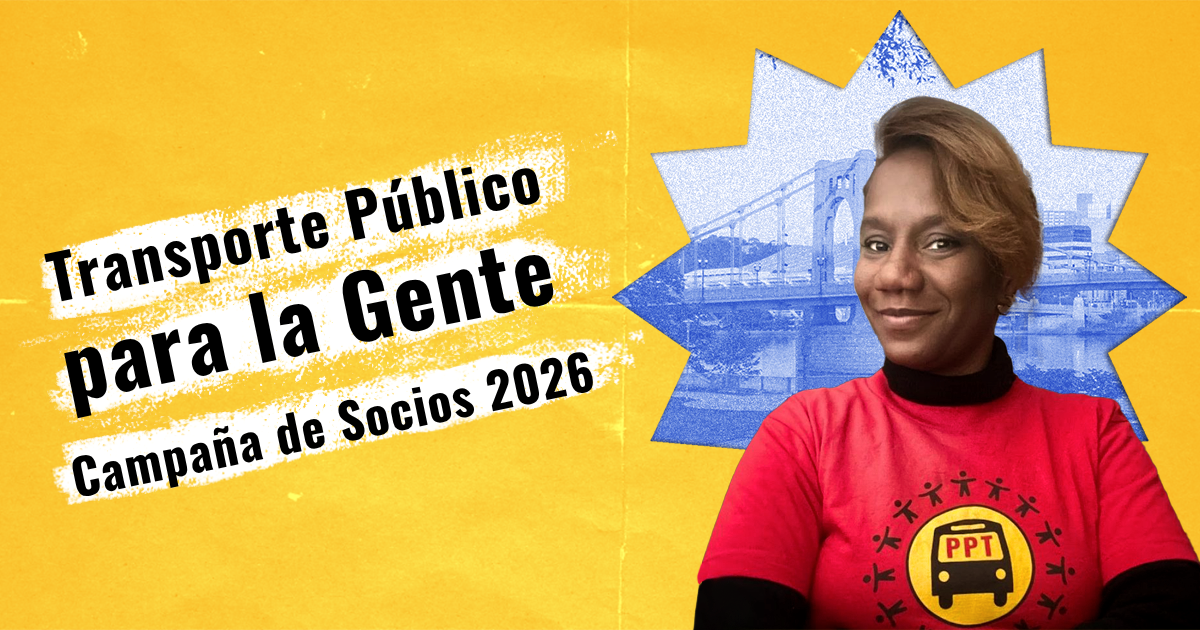
Transporte Público para la Gente: Únete a la campaña de Socios 2026
Me llamo Evelyn Ulysse Alcántara. Uso el transporte público a diario para ir al trabajo, al médico, actividades de ocio, reuniones, llevar a mi hijo al colegio— para todo.
Soy latina y mi inglés no es perfecto, así que cuando me mudé a Pittsburgh me costó usar el transporte público porque había muy poca información disponible en español. Por eso me ofrecí de voluntaria para ayudar como embajadora en los Recorridos de tránsito de PPT. Fue muy frustrante y aislante intentar aprender a usar el sistema de transporte público por mi cuenta. Sabía que si podía hacer algo para apoyar el aprendizaje de mi comunidad, ¡tenía que hacerlo!
Ser miembro de PPT no solo ha mejorado mis propias necesidades de transporte. Me abrió la puerta para ayudarme a marcar la diferencia.
Cuando hubo recortes en el transporte público en Beechview, hubo ocasiones en que el autobús o el Tren no venían—y no sabía la razón, porque los cambios sólo se comunicaban en inglés. Pero hoy, si vas a Steel Plaza o Wood Street Station, ¡escucharás anuncios en español! Y hay instrucciones paso a paso en español en la web de PRT. Esto se debe a que PPT y Casa San José se unieron para dar voz a mi comunidad, para que PRT pudiera entender el verdadero impacto que esto estaba teniendo en nosotros.
Este es el verdadero poder de PPT: realmente escuchan a la gente.
Cuando descubrí que PPT, me pedían testimonios sobre el papel que tiene el transporte público en la vida de las personas, para mostrar lo importante que sería un programa de media tarifa. Sabía que tenía que dar mi testimonio, porque necesitábamos actuar para mejorar el acceso. En aquel entonces solo era una idea y un proyecto, pero hoy es una realidad que lleva el servicio de transporte a la gente.
Me encanta el PPT porque sé de primera mano lo que podemos lograr juntos.
Solo en 2026:
- Llevamos a 120 miembros a Harrisburg para arrojar luz sobre la brecha presupuestaria de 80 millones de dólares y enfatizar la importancia de los servicios para tránsito y viajes compartidos para nuestros representantes.
- Compartimos habilidades y construimos poder con 170 personas de todo el país, compartimos habilidades y construyeron poder en nuestro Entrenamiento de Primavera 2026.
- Formamos a 13 becarios de organización comunitaria en toda la colina del barrio de PGH, y las regiones de Lancaster y Lehigh Valley en Pensilvania.
Por eso quería preguntar: ¿apoyarán el trabajo urgente de PPT haciéndote miembro que paga cuotas hoy?
Puedes apuntarte por solo 2,75 $, ¡el precio actual del billete de autobús del PRT! Ese dinero va directamente a la defensa de un presupuesto de transporte que mueve a TODOS los habitantes de Pensilvania. Todo el mundo merece acceso al transporte público.
¿Nos ayudarás a hacer realidad ese sueño?
The post Transporte Público para la Gente: Únete a la campaña de Socios 2026 appeared first on Pittsburghers for Public Transit.
Transit for the People: Join the 2026 Member Drive
Image Description: Evelyn Ulysse Alcantara, a dark-skinned woman in a red PPT shirt, smiles in front of a collaged picture of Pittsburgh
I’m a mother and member of the Latino community fighting with PPT for a transit system that truly serves everyone. Will you join me by becoming a dues-paying member? Donate to become a PPT member!My name is Evelyn Ulysse Alcantara. I use public transportation daily for going to work, the doctor, leisure activities, meetings, bringing my son to school—everything.
I’m Latina and my English isn’t perfect, so when I first moved to Pittsburgh I struggled to use public transportation because there was so little information available in Spanish. This is why I volunteered to help be an ambassador for PPT’s Transit Tours. It was so frustrating and isolating to try and learn how to use the system by myself. I knew that if I could do something to support my community’s learning, I had to do it!
Being a PPT member hasn’t just improved my own transit needs. It opened the door to help me make a difference.
When there were cuts to transit in Beechview, there were times the bus or T didn’t come—and I didn’t know why because the changes were only communicated in English. But today, if you go to Steel Plaza or Wood Street Station, you’ll hear announcements in Spanish! And there are step by step instructions in Spanish on PRT’s website. This is because PPT and Casa San Jose came together to uplift my community’s voice, so that PRT could understand the true impact this was having on us.
This is PPT’s real power: they truly listen to the people.
When I first found out about PPT, they were asking for testimonies about the role transit has in people’s lives, to show how important a half-fare program would be. I knew I had to give my testimony, because we needed to take action to improve access. Back then it was just an idea, but today it’s a reality that brings transit service to the people!
I love PPT because I know firsthand what we can accomplish together.
In 2026 alone, we have:
- We brought 120 members to Harrisburg to shed light on the $80 million dollar transit budget gap, and emphasise the importance of paratransit and shared ride services to our representatives.
- We trained 13 community organizing fellows across the Hilltop neighborhood of PGH, and the Lancaster and Lehigh Valley regions of PA.
- Shared skills and built power with 170 people from across the country at our 2026 Spring Training.
That’s why I wanted to ask: will you support PPT’s urgent work by becoming a dues-paying member today?
You can join for just $2.75—the current cost of a PRT bus fare! That money goes directly towards advocacy for a transit budget that moves ALL Pennsylvanians. Everyone deserves access to public transportation. Will you help us make that dream a reality?
Donate now to join Evelyn as a member—and build transit for the people!The post Transit for the People: Join the 2026 Member Drive appeared first on Pittsburghers for Public Transit.
Breaking down how much Congress cut AML funds by state
In January Congress passed a “minibus” bill that raided $500 million in previously appropriated coal mine cleanup funds to pay for other federal programs. We’re now seeing the first results of that bill: $45.5 million less in mine cleanup funding every year for the next 11 years. Combined with growing inflation, this means fewer jobs will be supported cleaning up mines and more hazardous coal mining damage won’t be reclaimed in Appalachia and across the country.
When it passed in 2021, the Bipartisan Infrastructure Law provided about $10.9 billion for the reclamation of Abandoned Mine Land (AML) sites across the country in fifteen annual grants to states and tribes. The first four years’ worth of grants were awarded between 2022-2025. The minibus bill cuts $500 million from the total AML funding provided under the Bipartisan Infrastructure Law – but it was unclear at the time of passage if the $500 million would be cut entirely from the last (fifteenth) year of AML grants or equally across the remaining 11 years worth of annual funding. Now we have our answer.
The 2026 AML grants for states and tribes were announced in May and the cuts are here. According to the Office of Surface Mining Reclamation and Enforcement, the $500 million cut “will be applied equally to the remaining 11 grant distribution years, approximately $45.45 million per year.” The figure below shows the annual reduction in funds for each state and tribe, as well as the total cuts that will play out over the next 11 years. Pennsylvania and West Virginia have the largest cuts (by absolute value), at about $15 million and $9 million per year, respectively.
(function(){function e(){window.addEventListener(`message`,function(e){if(e.data[`datawrapper-height`]!==void 0){var t=document.querySelectorAll(`iframe`);for(var n in e.data[`datawrapper-height`])for(var r=0,i;i=t[r];r++)if(i.contentWindow===e.source){var a=e.data[`datawrapper-height`][n]+`px`;i.style.height=a}}})}e()})();
The cuts are reducing the amount of damage states and tribes can reclaim. Inflation – especially recent rises in fuel costs that can drive up the cost of operating construction equipment – is also lowering the spending power of reclamation dollars even from last year, further reducing the amount of reclamation states and tribes can accomplish in 2026.
States and tribes have a five-year window to spend their FY2026 AML grant, and those agencies will now begin planning for fewer dollars by taking steps like selecting fewer reclamation projects or reducing the scope of projects. In Pennsylvania, for example, the cuts are equivalent to the cost of two large abandoned mine drainage treatment systems.
As we explained in a previous post, the extent of AML damage that needs to be cleaned up is likely twice as large as the existing $10.9 billion in funding– even before $500 million was cut.
This is damage to land and water that has lingered since at least the 1970s, and now residents will have to wait even longer for cleanup. If this cut hadn’t occurred, $45 million per year in more mine cleanup would be put to use across the country in the next few years, removing hazards to the local population and supporting more jobs, such as in construction, doing reclamation work primarily in rural areas. Congress should reverse the $500 million reduction, and should protect the program from similar cuts in the future.
The post Breaking down how much Congress cut AML funds by state appeared first on Ohio River Valley Institute.
June 6, 2026 Read new San Francisco Gate story: US Navy finds radiological material in unauthorized storage in San Francisco
June 6, 2026
Read new San Francisco Gate story:
“US Navy finds radiological material in unauthorized storage in San Francisco”
June 2026: Bayview Hunters Point Community Call to Action and Demands issued by Greenaction and the Marie Harrison Community Foundation, Inc.
June 2026:
Bayview Hunters Point Community Call to Action and Demands issued by Greenaction and the Marie Harrison Community Foundation, Inc.
June 24th noon rally at San Francisco City Hall to support community demands for health, justice, and full cleanup of all contamination at the Hunters Point Naval Shipyard Superfund Site.
Statement on ACT NOW Clean Tech Initiative
FOR IMMEDIATE RELEASE
June 4, 2026
Statement on ACT NOW Clean Tech Initiative
ALLEGHENY COUNTY, Pa. — On June 4, Allegheny County Executive Sara Innamorato signed the Advancing Clean Technology for Neighborhood and Next-Generation Opportunity and Workforce (ACT NOW) Executive Order. In response, Ohio River Valley Institute Industrial Decarbonization Program Manager Justine Hackimer issued the following statement:
Clean technology and advanced manufacturing present a generational opportunity to strengthen Allegheny County’s economy, create high-quality jobs, and build on our region’s long history of industrial innovation.
For generations, southwestern Pennsylvania’s workers, manufacturers, and research institutions helped power economic growth across the country. As global markets increasingly demand cleaner technologies, our region is well-positioned to compete for the industries that will shape the next generation of manufacturing.
But realizing that opportunity requires more than individual projects. It takes coordination and smart policy like ACT NOW to ensure workers and local communities directly benefit from investments. We applaud County Executive Sara Innamorato’s leadership in shaping a clean tech future that works for all Pennsylvanians.
By investing in the industries of tomorrow while strengthening the systems that support workers and communities, the region can build a more diverse, resilient economy that creates opportunities for generations to come.
###
The post Statement on ACT NOW Clean Tech Initiative appeared first on Ohio River Valley Institute.
It’s Time for a Progressive Policy to Protect Agricultural Supply Chains
Pages
The Fine Print I:
Disclaimer: The views expressed on this site are not the official position of the IWW (or even the IWW’s EUC) unless otherwise indicated and do not necessarily represent the views of anyone but the author’s, nor should it be assumed that any of these authors automatically support the IWW or endorse any of its positions.
Further: the inclusion of a link on our site (other than the link to the main IWW site) does not imply endorsement by or an alliance with the IWW. These sites have been chosen by our members due to their perceived relevance to the IWW EUC and are included here for informational purposes only. If you have any suggestions or comments on any of the links included (or not included) above, please contact us.
The Fine Print II:
Fair Use Notice: The material on this site is provided for educational and informational purposes. It may contain copyrighted material the use of which has not always been specifically authorized by the copyright owner. It is being made available in an effort to advance the understanding of scientific, environmental, economic, social justice and human rights issues etc.
It is believed that this constitutes a 'fair use' of any such copyrighted material as provided for in section 107 of the US Copyright Law. In accordance with Title 17 U.S.C. Section 107, the material on this site is distributed without profit to those who have an interest in using the included information for research and educational purposes. If you wish to use copyrighted material from this site for purposes of your own that go beyond 'fair use', you must obtain permission from the copyright owner. The information on this site does not constitute legal or technical advice.
 This site is not the official webpage of the Industrial Workers of the World.