You are here
News Feeds
The Sacramento Bee: California teachers union to sue state over $3.9 billion in Prop. 98 funds
September 15, 2026—Sacramento Bee reporter Chaewon Chung covers the California Teachers Association’s lawsuit against the state over $3.9 billion in delayed Proposition 98 funding—money guaranteed to K-12 schools and community colleges under the state constitution for nearly 40 years. Districts across California are already feeling the squeeze: Sacramento City Unified is confronting a $222 million structural deficit while banking on withheld Prop. 98 dollars just to stay solvent, and Los Angeles Unified has laid off hundreds of employees amid the shortfall. Public Advocates Managing Attorney John Affeldt helped unpack the legal ambiguity at the heart of the dispute and whether the state has flexibility to wait for final revenue numbers before setting school funding, or must budget off projections when the budget is adopted. As Affeldt put it: “Does the governor have the flexibility to wait and see what the final number is, or do they need to set the amount based on best projections at the time the budget’s adopted?—it’s a bit of a gray area.” With CTA’s suit now headed to court, that gray area is about to get tested.
The post The Sacramento Bee: California teachers union to sue state over $3.9 billion in Prop. 98 funds appeared first on Public Advocates.
Do Rural Residents Have the Power to Say No?
Mad River Union: Humboldt marks california transit month with advocacy, ride contests and a talk on transit and democracy
September 10, 2026—The Mad River Union has a rundown of North Coast activities for California Transit Month, including tonight’s talk by Public Advocates’ Senior Transportation Policy Advocate Laurel Paget-Seekins. Paget-Seekins will present “Protecting Transit’s Role in Multi-Racial Inclusive Democracy” at the McKinleyville Family Resource Center, examining public transit’s historic role in civil rights struggles and the creation of integrated public spaces—AND how the Trump administration’s policies are threatening transit access today. The piece also covers a coalition open letter to Gov. Newsom and gubernatorial candidates on state transit funding, a rider ride-logging contest, and rider ride-alongs with local decision-makers throughout the month.
The post Mad River Union: Humboldt marks california transit month with advocacy, ride contests and a talk on transit and democracy appeared first on Public Advocates.
Richmondside: Court-appointed former school superintendent to ensure WCCUSD hires qualified teachers
September 9, 2026—Richmondside reporter Jana Kadah covered the appointment of Carl Cohn, a former superintendent and state Board of Education member, to ensure West Contra Costa Unified complies with a requirement to staff its classrooms with qualified teachers. The appointment follows a March ruling from the California First District Court of Appeal in Cleare v. West Contra Costa Unified School District — a two-year legal battle brought by a Public Advocates representing WCCUSD parents and teachers—requiring the district to stop using 30- and 60-day substitutes beyond state time limits and to fill all teacher vacancies at Stege Elementary, Helms Middle, and Kennedy High School. Cohn, appointed by a Superior Court judge on August 27, will recommend compliance steps and mediate disputes going forward. The piece notes Cleare was the first lawsuit filed under the Williams Settlement Legislation, the 2004 agreement guaranteeing California students access to qualified teachers, adequate textbooks, and safe facilities—setting a statewide precedent that teacher shortages can’t justify long-term reliance on substitutes. The article also reports WCCUSD has cut teaching vacancies significantly this year, from over 100 two years ago to 34 at the start of this school year.
The post Richmondside: Court-appointed former school superintendent to ensure WCCUSD hires qualified teachers appeared first on Public Advocates.
Ohio Power Siting Board Denies Company Request to Block Expert Testimony Describing Potential Impacts of 800MW Gas Plant
ADVISORY
September 9th, 2026
Ohio Power Siting Board Denies Company Request to Block Expert Testimony Describing Potential Impacts of 800MW Gas Plant
PowerConneX Sought to Secure Approval with Limited Information
ASHVILLE, Oh. — Developer PowerConneX asked the Ohio Power Siting Board (OPSB) to block scheduled testimony from an Ohio River Valley Institute researcher, an environmental expert, and six local residents just days before they were scheduled to testify in front of OPSB staff. PowerConneX seeks approval of an 800MW behind-the-meter gas-fired power plant tied to a data center project in Ashville, Ohio.
Last week, PowerConneX asked the board to strike the testimony of experts drawing attention to the costs, questionable economic benefits, and environmental impacts of its proposed gas plant. The company then moved to block testimony from residents that would be impacted by this facility. Earlier today, the OPSB denied the company’s motion to block testimony from these experts and will later rule on the motion to block testimony for the remaining witnesses whose testimony was challenged by the company.
Four of the six residents plan to testify on behalf of Teays Valley Community Alliance (TVCA) on Thursday, September 10th. A researcher, an economist, and a research scientist will also be providing testimony on behalf of TVCA. A summary of the expert testimony is included below:
- An independent analysis indicates that the project’s economic impact could depend on various factors, including whether any stages of the project receive tax incentives. According to the testimony of Nick Messenger, Ph.D., Senior Economist with the Ohio River Valley Institute, the company potentially overstated the project’s contributions to local job growth and failed to initially disclose the data needed for independent verification of its analysis.
- As described, PowerConneX’s proposed plant would be highly inefficient and cost-ineffective relative to standard on-grid gas-fired power plants, requiring 32% more fuel and up to $200 million in additional operating costs annually. According to the testimony of Sean O’Leary, Senior Researcher with the Ohio River Valley Institute, excessive fuel costs and demand for skilled labor may result in inflationary impacts.
- The project’s human health impacts due to emissions of fine particulate matter, nitrogen oxides, and other air pollutants are estimated to cost from $83 million to $280 million. According to the testimony of John Bangsund, Ph.D., Director of Science & Technology at the Better Data Center Project, the pollutants expected from the facility’s operations are associated with numerous health impacts ranging from cardiovascular disease and respiratory illnesses to premature mortality.
Written testimony submitted by residents on behalf of TVCA can be found here, here, here, here, and here. The project has been met with staunch community opposition, including a resident-led referendum to repeal a municipal development supply agreement with PowerConneX.
WHO: Ohio Power Siting Board hearing on Case 26-0196-EL-BGN regarding PowerConneX, Inc.’s application for a behind-the-meter gas-fired generating station to fuel a data center project in Ashville, Ohio
WHAT: Testimony from residents and environmental and economic experts on behalf of Teays Valley Community Alliance.
WHEN: Thursday, September 10th, 9:00 AM ET
WHERE: Continental Office Building, Public Utilities Commission of Ohio, 180 East Broad Street, Columbus, Ohio 43215
###
The post Ohio Power Siting Board Denies Company Request to Block Expert Testimony Describing Potential Impacts of 800MW Gas Plant appeared first on Ohio River Valley Institute.
Beyond the Supermarket: What Thessaloniki’s Alternative Food Networks Teach Us About Degrowth
Eirini-Erifyli Tzekou
What if food systems were designed not to maximize sales and accumulation, but to meet needs fairly within ecological limits? In Thessaloniki, Greece, a range of grassroots food initiatives have emerged over the last fifteen years, shaped by …
Most Pennsylvanians Want Data Center Development Paused, Strongly Regulated, or Discouraged Altogether
Pennsylvania Governor Josh Shapiro shifted from aggressively courting tech investments, to signing an executive order on August 18, 2026 that embeds enforcement mechanisms into his previously announced voluntary standards for data center development. The Governor’s Responsible Infrastructure Development (GRID) Standards are a set of requirements around energy costs, transparency and community engagement, economic development, and environmental protection for new data center projects.
The week of the executive order, the Ohio River Valley Institute fielded a statewide representative survey of Pennsylvania adults. Many findings corroborate a growing body of research that shows the public is rapidly souring on data center development. This work further illuminates what Pennsylvanians want policymakers to do about it.
Top takeaways:- An overwhelming majority (94%) of Pennsylvanians say the state should pause, strongly regulate, or discourage data center development altogether.
- Pennsylvanians are split on Gov. Josh Shapiro’s executive order to regulate data center development: on first impression, some say it strikes the right balance (45%), while others say it doesn’t go far enough (40%). Just one in seven (15%) feels it goes too far.
- There’s strong opposition to building new gas plants specifically to meet the demand of data centers in Pennsylvania. 83% of respondents prefer either pursuing alternatives first, or not building new gas plants at all.
- Most Pennsylvanians believe data center development would raise energy costs (74%) and harm the environment (54%), though some (48%) anticipate job growth, as well.
- Before respondents were given any prompts or language about the issue, their initial associations with data centers were almost universally negative.
- Respondents referenced local opposition, energy use and costs, water use, and environmental impacts.
- Concerns appeared across political ideologies, urbanicities, and demographic groups.
(function(){function e(){window.addEventListener(`message`,function(e){if(e.data[`datawrapper-height`]!==void 0){var t=document.querySelectorAll(`iframe`);for(var n in e.data[`datawrapper-height`])for(var r=0,i;i=t[r];r++)if(i.contentWindow===e.source){var a=e.data[`datawrapper-height`][n]+`px`;i.style.height=a}}})}e()})();
Nearly 7 in 10 oppose data center construction in Pennsylvania, similar to the national rate.- 65% oppose the construction of data centers in Pennsylvania, (33% somewhat, 32% strongly).
- Women are slightly more likely to oppose.
- Open-ended responses surfaced anti-corporate sentiment and a sense that “we just don’t need it,” in addition to concerns about energy and water impacts.
(function(){function e(){window.addEventListener(`message`,function(e){if(e.data[`datawrapper-height`]!==void 0){var t=document.querySelectorAll(`iframe`);for(var n in e.data[`datawrapper-height`])for(var r=0,i;i=t[r];r++)if(i.contentWindow===e.source){var a=e.data[`datawrapper-height`][n]+`px`;i.style.height=a}}})}e()})();
Pennsylvanians expect higher energy costs and environmental harm—but also some job growth.When asked about the possible impacts of data center development:
- 7 in 10 said energy costs would go up.
- Half of respondents predicted jobs would increase some (38%) or a lot (13%)
- 54% said data centers would have a moderate (24%) to significant (30%) negative impact on the environment.
(function(){function e(){window.addEventListener(`message`,function(e){if(e.data[`datawrapper-height`]!==void 0){var t=document.querySelectorAll(`iframe`);for(var n in e.data[`datawrapper-height`])for(var r=0,i;i=t[r];r++)if(i.contentWindow===e.source){var a=e.data[`datawrapper-height`][n]+`px`;i.style.height=a}}})}e()})();
There is broad appetite for limiting developmentRespondents were split roughly three ways between preferring the state to pursue a full moratorium, stronger regulations, and discouraging development altogether, with the largest share (36%) preferring to discourage data center development in Pennsylvania.
- Demographic differences are relatively small, with men and women evenly split
- Views are relatively consistent across political ideology.
- Younger respondents are slightly more inclined to discourage development.
- Older respondents are more likely to favor stronger rules.
- Just 4% preferred to “encourage more development.”
(function(){function e(){window.addEventListener(`message`,function(e){if(e.data[`datawrapper-height`]!==void 0){var t=document.querySelectorAll(`iframe`);for(var n in e.data[`datawrapper-height`])for(var r=0,i;i=t[r];r++)if(i.contentWindow===e.source){var a=e.data[`datawrapper-height`][n]+`px`;i.style.height=a}}})}e()})();
Most Pennsylvanians believe that the ones who benefit from data centers most, are the companies developing them.(function(){function e(){window.addEventListener(`message`,function(e){if(e.data[`datawrapper-height`]!==void 0){var t=document.querySelectorAll(`iframe`);for(var n in e.data[`datawrapper-height`])for(var r=0,i;i=t[r];r++)if(i.contentWindow===e.source){var a=e.data[`datawrapper-height`][n]+`px`;i.style.height=a}}})}e()})();
There’s strong opposition to building new gas plants specifically to serve data centers.
- 83% favor either pursuing alternatives first or not building new gas plants at all. When asked how Pennsylvania should meet new energy demand from data centers,
- 59% said Pennsylvania should prioritize energy efficiency and renewable energy before building new gas plants.
- 24% said Pennsylvania should not build new gas plants to meet data center demand.
- 16% said building new gas plants should be allowed.
- A plurality of Pennsylvanians think the move, as described by the Governor, strikes the right balance
- After respondents were presented with facts about remaining challenges for local voice, and the tax break that remains available, there was an approximately 10-point shift away from “strikes the right balance” and toward “regulations don’t go far enough.”
- But some respondents are still questioning what compliance, accountability, and enforcement looks like.
(function(){function e(){window.addEventListener(`message`,function(e){if(e.data[`datawrapper-height`]!==void 0){var t=document.querySelectorAll(`iframe`);for(var n in e.data[`datawrapper-height`])for(var r=0,i;i=t[r];r++)if(i.contentWindow===e.source){var a=e.data[`datawrapper-height`][n]+`px`;i.style.height=a}}})}e()})();
Affordability is the clear priority for Pennsylvania’s economic future.- When respondents were asked to think more broadly about their priorities for Pennsylvania’s economic future in a multi-select question, 54% prioritized keeping energy, housing, and other household costs affordable, making it the single standout priority.
As we processed these results, we wanted to look beyond the topline numbers and consider how Pennsylvanians’ expectations compare with what ORVI’s own research tells us about data centers and economic development: that these projects are poor job creators and stand to raise costs across the board.
Much of what we found reinforces a growing body of public opinion research – people are deeply concerned about how these developments could impact their bills, their health, and their communities. And as is the case across the country, these concerns transcend any particular political ideology or demographic.
But several of our findings stood out – especially the strength of support for limiting development and related gas buildout, demand for local control, the way respondents weigh jobs against other costs, and the extent to which affordability and questions about who benefits seem to shape people’s views.
Opposition translates to appetite for limiting developmentAn open-ended question on data center development revealed serious concerns about data centers’ local impacts, like the thrumming noise pollution and round-the-clock security floodlights that have made headlines and driven pushback in host communities across the country. But even when asked about data center construction statewide, not necessarily in their own communities, the percentage of Pennsylvanians opposed to development outnumbers those in favor nearly two to one, our survey finds. Resistance to nearby data center development likely would have registered even higher. One only needs to look to the extreme building-related flooding in Mason County, WV to see the gap between the economic promises made during the proposal phase and the stark realities communities experience once construction begins.
In Pennsylvania, negative feelings towards data centers appear to translate into a pervasive desire for policymakers and leaders to do more to prevent harm. Respondents were roughly split between a preference to pause development, implement stronger regulations, or discourage development in the state altogether. Consequently, less than a fifth of respondents in the state feel that Governor Shapiro’s executive order “went too far.” And the more they learned, the more they desired even stronger protections.
Moratoriums and permitting pauses are already happening in municipalities across the state. While Governor Shapiro’s order falls short of a full moratorium – which our poll suggests is politically palatable at the statewide level – it does tie eligibility for the state’s generous sales tax exemption to compliance with his GRID regulatory standards, which are meant to protect energy affordability and encourage community engagement on data center projects. Across the country, there’s growing support for stronger regulations on data centers, including among MAGA voters and “AI-optimists” – people want robust policies that protect natural resources, increase transparency and accountability, and protect ratepayers from higher utility bills. And the Pennsylvania legislature has an opportunity to do even more on this front.
But voters appear to be increasingly skeptical of the old economic-development model where governments give large corporations tax breaks, subsidies or preferential rates in exchange for promises of jobs and investment. Across states and the country, there’s rising opposition to tax benefits for Big Tech and data center developers. And despite the Governor’s new order, one thing that stays on the table is the sales tax exemption for permitted data centers, the cost of which keeps ballooning, costing the state hundreds of millions of dollars per year.
When we clarified this to respondents, and told them that some communities are still worried about their ability to have a say in approving developments, we saw a ten-point increase in the belief that Shapiro’s order “doesn’t go far enough.”
Pennsylvanians may be more optimistic about data center jobs than the evidence warrants.Data centers have made a bad first impression.
Communities across the region are already experiencing the direct impact to air and water that can come with building large data centers, and the infrastructure to power them. Meanwhile, about half of the Pennsylvanians in our survey anticipated a negative environmental impact from data center development in the state. Nearly 75% of respondents believe data center development would impact utility costs, digging into the pocket books of everyday families. In Pennsylvania, residential electricity rates are already rising, driven largely by data center demand. Pennsylvania’s Independent Fiscal Office reported in July that the average electricity bill has already increased more than 20% since 2024.
About half of our respondents believed data center development would increase jobs in Pennsylvania at least somewhat. But research shows data centers are actually poor job creators in the long term. They require enormous amounts of capital, land, and electricity, but relatively few workers once construction is complete. The US economy’s “information” sector — driven largely by AI and data centers — has tripled its economic output since 2005 as the data center boom continues to inflate, our previous analysis shows. Yet, in the same period, jobs have actually shrunk. Meanwhile, data centers are driving up electricity bills, cutting into families’ disposable incomes and further negating the sector’s jobs impact. Our shale gas research tells a similar story. Pennsylvania has become one of the country’s largest natural gas producers, yet the counties responsible for much of that production have not experienced employment, wage, and population growth commensurate with the industry’s enormous output.
Pennsylvanians aren’t buying the case for new gas buildoutOne of our more surprising findings is how strongly Pennsylvanians reject the idea that rising electricity demand from data centers should automatically mean building more natural gas power plants.
That is striking in a state where natural gas has long occupied an outsized place in the political conversation. For nearly two decades, political and industry leaders have repeatedly portrayed shale gas as both an economic engine and an essential part of the state’s energy future. More recently, projected electricity demand from data centers has become part of the case for a new wave of highly polluting gas-fired power plants and related infrastructure.
When asked how Pennsylvania should meet new energy demand from data centers, 83% favored either pursuing alternatives first, or not building new gas plants at all. Nearly six in 10 (59%) said the state should prioritize energy efficiency and renewable energy before building new gas plants, while another 24% said Pennsylvania should not build new gas plants to serve data centers at all.
For years, Pennsylvania’s political debate has often treated expanding gas production and gas use as synonymous with expanding economic opportunity. Yet the economic reality is much more complicated —and previous ORVI polling has similarly found Pennsylvanians considerably more skeptical of fracking’s economic benefits than the state’s political narrative might suggest.
Data centers may therefore be exposing a larger shift worth watching. Pennsylvanians appear reluctant to commit to another major wave of fossil fuel infrastructure simply because a new industry is promising economic growth. Instead, most want the state to ask first whether that infrastructure is actually necessary—and whether there are less costly ways to meet the demand.
What is successful economic development?Our poll suggests that Pennsylvanians are thinking critically about the use of public money to lure and support development. They are concerned about development inflating household costs, failing to produce lasting jobs and meaningful benefits, and taking away their say in their community’s future.
Simply promising investment and jobs may no longer be enough. People appear increasingly interested in the other side of the ledger: what development costs, who pays those costs, who receives the benefits, who has a say, and whether the result actually leaves communities better off.
About this researchThis research was conducted using GrowProgress’ Pulse Survey, a rapid survey tool used to help understand public opinion around quickly developing events.
This survey polled 400 Pennsylvania adults between Friday, August 21, 2026 and Sunday, August 23, 2026. The margin of error ranged from 1.7% to 5.0%
GrowProgress gathers participants for rapid message tests, audience understanding surveys, and pulse surveys through partnerships with reputable online panel companies and marketplaces. These partners recruit participants through a diverse set of digital ads, loyalty or coupon programs, and other methods, collecting basic demographic information and utilizing weighting to ensure survey respondents are representative of the target population.
The post Most Pennsylvanians Want Data Center Development Paused, Strongly Regulated, or Discouraged Altogether appeared first on Ohio River Valley Institute.
Alstom to build new cars for VIA Rail Canada in Ca$4.7 billion deal
Q2 Appalachia Gas Outlook
This analysis is an expanded version of a presentation to the Ohio River Valley Institute.
Appalachia is poised for a renewed buildout of climate-killing infrastructure as gas companies, emboldened by sweeping regulatory rollbacks, double down on investments in gas-fired power plants, LNG export terminals, and the pipelines that connect them.
Regulatory rollbacksOn May 21, 2026, the Federal Energy Regulatory Commission (FERC) announced plans to advance a set of comprehensive reforms that would reduce regulatory hurdles and make it easier for developers to build new pipelines across the US. If enacted, the proposal would weaken project-specific oversight, waive environmental reviews, and limit public involvement for major expansion projects. The new rules are particularly alarming as gas companies, encouraged by surging energy demand from data centers and LNG exports, double down on an unprecedented buildout of new gas-fired power plants, storage facilities, and the pipelines that supply them.
At the center of the Notice of Proposed Rulemaking, which outlines the agency’s draft rule, are “blanket authorizations,” or the ability of pipeline companies with existing blanket certificates to undertake projects on their pipelines and related infrastructure without undergoing the full certificate process as required by the National Gas Act. Historically, blanket authorizations have allowed interstate pipeline companies to perform routine construction and facility upgrades without obtaining a specific, case-by-case certificate. The types of projects previously allowed were limited by scope and cost thresholds, which prevented significant increases in mainline capacity.
The draft rule proposes to more than double project cost limits, broadens the types of projects to which blanket authorizations can apply, and allows pipeline companies to finance projects by charging higher rates. One legal analyst described the proposal as “the most significant natural gas permitting reform in two decades–and its practical implications reach every segment of the industry.”
If it were its own country, Appalachia would be the third largest producer in the world, behind only Russia and the US. Still, Appalachian gas producers have been hamstrung by pipeline takeaway capacity limits for years, holding the region’s gas production steady between 34 and 36 billion cubic feet per day (Bcf/d). FERC’s rules could change that, unleashing a renewed buildout of pipelines across Appalachia that could connect the region’s producers to new gas-fired power plant additions and LNG export terminals expanding along the Gulf Coast.
Plans for pipeline expansionsNearly every major interstate gas pipeline system that crosses through Appalachia is now subject to expansion proposals. At least 14 pipeline projects originating in Pennsylvania, Ohio, West Virginia, or neighboring states could expand Appalachia’s takeaway capacity by as much as 8.3 Bcf/d. They would do so by installing looping (adding a parallel line to an existing pipeline), adding compression, and replacing existing pipelines. All would qualify for blanket authorizations under FERC’s proposed rule.
In May, Canada’s TC Energy announced plans for a massive, $1.5 billion expansion project along the Columbia Gas Transmission system, which runs through Kentucky, Maryland, Ohio, Pennsylvania, Virginia, and West Virginia. The so-called “Appalachia Supply Project” would add 0.8 Bcf/d of capacity for new gas-fired power generation driven by data centers, and would be scalable up to 2.0 Bcf/d through future expansions. According to the Canadian gas giant, gas demand in Ohio alone is projected to grow 30% over the next decade, driven by power generation and over 40 new data centers.
New pipelines target Pennsylvania
Further north, Enbridge is planning to expand the Algonquin Gas Transmission, a 1,130-mile, 3.1 Bcf/d pipeline that transports Appalachian gas from Pennsylvania to New England, through a series of upgrades that could be potentially sanctioned under FERC’s expanded blanket authorizations.
Revived pipelines expand takeaway capacity into New England
Meanwhile, Williams revived two major projects: the Northeast Supply Enhancement project, which would expand capacity along the Transco pipeline, and the Constitution Pipeline, a 125-mile greenfield pipeline that would run from northeast Pennsylvania to Schoharie County, New York.
Though still in early development, Boardwalk has expanded the scope of its proposed Borealis Pipeline, a 2 Bcf/d greenfield pipeline that would install 200 miles of new gas pipeline in Ohio and add another 265 miles of new pipeline along the Texas Gas Transmission system, a 6,000 mile interstate pipeline network that links the Midwest and Gulf Coast. The projects would increase the flow of Appalachian gas into southeastern Ohio and Indiana, states with significant behind-the-meter data center development, as well as link Appalachian gas producers with customers in the Southeast and Gulf Coast.
Pipelines to increase takeaway capacity to Midwest & Southwest
Global energy supply shocks boosts US LNGTo say the first half of 2026 has been rocky for global LNG markets would be an understatement. The US-Iran War and the extended closure of the Strait of Hormuz stranded significant volumes of LNG and crude oil, and temporarily took Qatari LNG offline, effectively reducing the global oil and gas supply by 20%. The conflict caused LNG prices to spike globally, and they have remained persistently high apart from a temporary cease-fire in June.
Despite the global volatility, Henry Hub prices–the benchmark price point for US natural gas–have remained largely insulated from the price fluctuations seen in Asia and Europe, making US LNG all the more attractive to international buyers.
LNG exports draw Appalachian gas southIn April, the Department of Energy authorized two LNG export terminals to increase export capacity to countries lacking free trade agreements. But US LNG facilities are already running at high utilization rates, and a significant increase in exports can only increase at the pace of terminal and pipeline buildout. Though nearly all of the planned capacity additions are concentrated along the Gulf Coast, a slew of pipeline expansions that connect Appalachian gas to Gulf LNG terminals is underway.
US LNG capacity expands, pulling Appalachia gas south
In its 2026 Annual Energy Outlook, the US Energy Information Administration confirmed that LNG exports continue to be the fastest-growing source of domestic natural gas demand. Seven LNG terminals will add 6.3 Bcf/d of export capacity through the end of 2027, in addition to capacity additions through 2030 that will increase overall capacity to 27.7 Bcf/d.
Proposed data centers drive up gas demand, pipelines followIt is becoming clear that gas industry buildout is closely aligned with data center development. As data center developers double down – prioritizing reliability and speed to market by sourcing natural gas-fired generation over renewables – gas companies are incentivized to undertake major expansion projects.
Earlier this year, TC Energy CEO Francois Poirier told investors, “Ohio’s projected natural gas demand growth of more than 30% over the next decade is the largest increase nationally outside of LNG-exporting states.” He added, “Growth is being driven by power generation, industrial expansion and grid reliability needs, including significant incremental load from more than 40 new data centers.”
For instance, SB Energy is proposing to build a 10 GW gas-fired power plant in Piketon, Ohio that would serve a neighboring data center. If built, the so-called PORTS Energy Center would be the largest operating gas plant in the country.
Map of TC Energy’s Columbia Gas Transmission system and planned data centers
These pipeline expansions could be accelerated and harder to fight if FERC’s proposed rule to expand blanket authorizations is adopted.
An RBN analysis indicates there could be a very large increase in gas demand for power generation, especially as existing power plants utilize more of their capacity. But the demand could be much greater if “behind-the-meter” (BTM) mega projects are constructed, such as the Shippingport Power Station in Beaver County, Pennsylvania or the Nscale Monarch data center in West Virginia. According to the analysis, just a handful of BTM facilities could trigger more than 1.2 Bcf/d of demand, if they achieve their planned capacity (which may be unlikely). Still, the projects identified in this analysis represent only a fraction of proposals under consideration for the region. Just as importantly, each of these massive BTM projects would necessitate a network of pipeline expansions within the Appalachian region, including the construction of new laterals to the new facilities.
Petrochemicals temporarily boosted by global conflictUS petrochemical companies saw a brief spike in profit margins following the closure of the Strait of Hormuz and the ensuing disruptions to global trade of refined oil and gas products. This marked a huge turnaround from baseline conditions in early 2026, which had been marked by oversupply and underwhelming demand growth.
The longer disruptions continue, the greater the likelihood of a renewed push to expand the petrochemical, plastics, and ammonia industries in the US.
Still, most experts believe the boost will be temporary. By early June, ethane cracker margins had come back down, driven by lower feedstock prices. Patrick Penfield, Professor of Supply Chain Management at Syracuse University, noted that “once the conflict ends and supply chains normalize, the industry will likely revert toward those pre-war dynamics rather than sustaining today’s elevated margins.”
Government forecasts for major production growth depend on pipeline buildoutGas production in Appalachia is expected to increase by just 1 Bcf/d between 2025 and 2027, according to the EIA. Looking ahead into the next decade, however, the picture looks much different. In this year’s Annual Energy Outlook, the EIA increased its long-term production forecasts for Appalachia. The agency predicts Appalachian gas production could reach 66 Bcf/d to 73 Bcf/d by 2050–doubling today’s volumes.
While rising demand from within Appalachia will support some of the projected production growth, the agency warns that “major growth can only occur if new pipelines are built to transport gas out of Appalachia.” And, FERC’s newest reforms could make it easier for developers to build them.
The post Q2 Appalachia Gas Outlook appeared first on Ohio River Valley Institute.
September 2, 2026 Read great news article about the August 28th town hall meeting in Hanford in California’s Central Valley to educate, unite and mobilize residents against proposed AI Data Centers! Join Greenaction in this fight!
September 2, 2026
Read great news article about the August 28th town hall meeting in Hanford in California’s Central Valley to educate, unite and mobilize residents against proposed AI Data Centers! Join Greenaction in this fight!From Hollowed-Out Communities to Resilient Local Economies
Di Maxwell
What happens when communities lose too much local capability? Di Maxwell shares the story of The Old Packhouse Market Project in the far north of Aotearoa (New Zealand), which began as an effort to secure and protect a …
Ford just changed who can get Ontario Works and ODSP.
The new rules shut more migrants out of basic financial and health supports. Here is who is affected, why it matters and why we need to speak up.
What are Ontario Works and ODSP?In Ontario, financial support is available to some people who need help paying for basic needs.
Ontario Works (OW) supports people with little or no income. The Ontario Disability Support Program (ODSP) supports low-income people who meet the program’s disability requirements.
These programs are already small and exclusionary. A single person on Ontario Works receives only $733 per month – nowhere near enough to pay rent, buy groceries and meet basic needs.
That amount has been frozen for eight years.
What did Ford change on August 13?On August 13, 2026 the Ford government changed Ontario’s OW and ODSP regulations to explicitly exclude people based on their immigration status.
The new rules say that people are not eligible if they:
- do not have authorization to remain in Canada; or
- are only authorized to remain temporarily, including people on work and study permits,
unless they fall within specific exceptions, including having made a refugee claim or certain applications for permanent residence.
The same new exclusion was added to ODSP.
The government also removed an existing protection for some people with enforceable removal orders who cannot leave Canada for reasons completely beyond their control.
The new rules Immigration situationBefore August 13: what the regulations saidSince August 13: what the regulations sayRefugee claimantsCould qualify for ODSP and OW. No change – remain eligible if they meet the other OW/ODSP requirementsPeople who have applied for permanent residenceCould qualify for ODSP and OW. No change – remain eligible if they meet the other OW/ODSP requirements.Migrant workers, international students and other work permit holdersThe regulations did not explicitly say that everyone with temporary status was ineligible. They excluded people categorized as “visitors” and “tourists”.Now explicitly excluded.Undocumented people without an enforceable removal orderCould qualify for ODSP and OW. Now explicitly excluded. People with an enforceable removal order who cannot leave Canada for reasons completely beyond their controlCould qualify for ODSP and OW. Now explicitly excluded.People with an enforceable removal order who have made an H&C application for permanent residenceCould qualify for ODSP and OW. No change – remain eligible if they meet the other OW/ODSP requirements.Before August 13, the regulations excluded “visitors” and “tourists,” but neither term was defined in the legislation or regulation.
The Ford government has now removed those words and replaced them with much broader language explicitly covering temporary immigration status and lack of immigration status.
Were migrants receiving OW and ODSP?Ontario had a longstanding unjust practice of caseworkers treating many people with work and study permits as “visitors.” As a result, many migrants were often denied OW or ODSP. Those who could, challenged those decisions at the Social Benefits Tribunal.
The regulations did not previously say that every person with temporary immigration status, or every person without immigration status, was automatically excluded, so hearings at the Tribunal were often successful.
The Ministry describes this as a “clarification” of its longstanding policy. But what it has actually done is put a much broader immigration-status exclusion directly into Ontario law.
Who will this hurt?These rules affect people who may have lived, worked and paid taxes in Ontario for years and then suddenly need help because of illness, unemployment, abuse or another crisis.
Patel: Patel is a 40-year-old man who came to Canada from Bangladesh after fleeing persecution because of his bisexuality. His immigration applications were denied, but he was afraid to return. He was later diagnosed with liver failure and cirrhosis. Because of his serious health condition, Canada cannot remove him. ODSP provides him with essential financial and medical support. Ford has now removed that protection. People in Patel’s situation can now be denied the basic financial and health supports they need to survive.
John: John is a 30-year-old seasonal agricultural worker from Jamaica who has been coming to Canada every year since 2020 to grow and harvest our food. He was diagnosed with cancer in 2024. He could not work while receiving chemotherapy and temporarily relied on Ontario Works. Today, John is in remission and back at work. Under Ford’s new regulation, most workers in John’s immigration situation are now explicitly excluded from Ontario Works.
Vanessa: Vanessa is a mother from Jamaica who worked as a home support worker caring for elderly people. During the pandemic, she fled abuse from her ex-partner with her children and entered the shelter system. After losing her job, she temporarily relied on Ontario Works while looking for work and child care. Her family later became permanent residents and she returned to care work. Under the new regulations, migrant women on temporary status in similar situations can be explicitly denied basic financial support while trying to escape violence or survive a crisis.
Why is the Ford government doing this?Meanwhile, Ontario’s Auditor General found that the Ford government spent a record $111.9 million on government advertising in 2024–25. Six of its ten largest advertising campaigns would not have passed Ontario’s former, stricter rules against partisan government advertising.
And while poor people and migrants struggle to pay rent and buy food, Premier Ford used taxpayer money to buy a $28.9 million dollar jet for his own private use. Members of Ford’s government have spent hundreds of thousands of public dollars on hotel rooms and fancy dinners.
The government announced these changes after media attention around a Social Benefits Tribunal case involving a man who had lived and worked in Canada for decades before losing his home. He challenged the denial of social assistance and won. Ford responded by changing the regulations.
No one should be denied food, housing, medicine or the means to survive because of the immigration documents they have or do not have.
At a time when rent and food prices are soaring and decent jobs are harder to find, blaming migrants will not make anyone’s life more affordable.
Taking $733 a month away from someone with cancer, someone escaping violence or someone who has lost their job will not lower the rent, raise wages or fix health care.
These changes are another attempt to pit migrants and poor people against each other while those responsible for the affordability crisis escape responsibility.
We must reject divide-and-rule and speak up together.
I’m a migrant and I’m worried. Where can I get support?Migrant Workers Alliance for Change is a group of current and former migrants. We come together to support each other and push back against unfair rules and laws like these.
If you live in the Greater Toronto Area, we offer free, confidential, in-person Migrant Support Clinics every second Thursday from 6 p.m. to 8 p.m.
You can share what is happening and work with other migrants to understand your options and find solutions.
Can’t come in person? Fill out the form anyway and we will get back to you.
The post Ford just changed who can get Ontario Works and ODSP. first appeared on Migrant Workers Alliance for Change.
The post Ford just changed who can get Ontario Works and ODSP. appeared first on Migrant Workers Alliance for Change.
Migrant Farm Worker Safety During Niagara Elections
A pledge for Niagara municipal candidates
Road Safety for AllEveryone deserves the freedom to move safely through their community. Migrant farm workers are asking candidates to commit to practical action so that every worker can get to work, reach essential services and return home safely.
See where candidates stand Read the commitments Candidate? Sign the pledge Sign the petitionFreedom of mobility
Road safety is about the freedom to live a full life.Freedom of mobility means being able to travel between work, home, grocery stores, health care, legal services and community without risking your life.
For many migrant farm workers, there is little or no public transit. Workers may have no choice but to walk or cycle on dark rural roads without safe shoulders, bike lanes, crossings or lighting to get privacy and access basic needs.
Essential Work. Invisible to public planning.Migrant workers have helped sustain Niagara’s farms and food economy for sixty years. Their labour is visible everywhere. Their safety, transportation needs and voices have too often been missing from road design, transit planning and government decisions.
They have names
These deaths and injuries are part of a pattern.At least seven migrant farm workers have been killed or seriously injured on Niagara roads since 2019. Behind that number are workers, neighbours, friends and family members.
2026 Sinhue GarciaSinhue was killed while cycling home on Concession 6 near Line 4 in Niagara-on-the-Lake. He was 39 years old and leaves behind his wife and two daughters in Mexico.
2019 ZenaidaZenaida, a Mexican farm worker and mother, was killed in a hit-and-run in Niagara-on-the-Lake.
2022 Fermin Soto Sanchez and two co-workersFermin was killed and two of his co-workers were seriously injured when they were struck near St. Catharines.
2022 Ceto ReidCeto, a Jamaican farm worker, was seriously injured while cycling home from a laundromat.
2023 OmarOmar, a migrant farm worker, was injured in a hit-and-run on Lakeshore Road.
Sinhue Garcia was a neighbour, a co-worker, a friend and a father. He deserved to get home safely. So does every migrant worker who comes to Niagara to work.
The Road Safety for All Pledge
Candidates who sign commit to:Working with migrant farm workers, community members, municipal staff and regional partners to advance the following actions.
-
Create and fund a migrant farm worker road safety plan
Support multi-year funding for improved lighting, protected shoulders or bike lanes, traffic calming, safer crossings and lower speeds on routes used by workers.
-
Complete a worker-led road safety audit and map
Ensure migrant farm workers directly identify dangerous roads, routes and destinations and help set priorities for action.
-
Put worker-identified routes into municipal and regional plans
Use transportation and master planning processes to prioritize routes identified by migrant workers.
-
Assign responsibility and report publicly on progress
Identify a lead Niagara Region staff person and provide at least two public reports to council each year: one before and one after the height of the agricultural season from May to September.
-
Ensure migrant worker housing is safe and dignified
Support proactive inspections through Niagara Region Public Health, including access to basic facilities, privacy, adequate space and protection from unsafe conditions.
-
Call for a coroner’s inquest
Publicly support a coroner’s inquest into migrant farm worker road deaths and serious injuries in Niagara.
-
Meet directly with migrant farm workers
Hold direct meetings with workers and release a public implementation plan during the first year of the new council.
For municipal candidates
Sign the pledgeAdd your name to publicly commit to the Road Safety for All Pledge and to working directly with migrant farm workers on implementation.
By signing, you commit to supporting all seven actions listed above.Your contact information will be used to confirm your response and communicate with you about the pledge. Only information you have agreed to make public should be published.
Candidate pledge formPlease complete the form below. We will follow up to confirm your response.
For everyone
Justice for Sinhue GarciaAdd your name to demand safer roads and real support for migrant workers in Niagara. Together, we can push municipal leaders to act so no one else is killed simply trying to get home.
Send a message now calling for safer roads, dignified housing and action with migrant workers at the table. Sign the petitionAdd your name and send your message to decision-makers.
The post Migrant Farm Worker Safety During Niagara Elections first appeared on Migrant Workers Alliance for Change.
The post Migrant Farm Worker Safety During Niagara Elections appeared first on Migrant Workers Alliance for Change.
Are you an Undocumented Care Worker in Toronto? Join Our Meeting.
Join a private and confidential meeting for undocumented care workers.
Request an invitation Meeting details
Saturday, August 8
3:00–5:00 p.m.
In person in Toronto
The location will be shared only with people who are invited and confirmed to attend.
Who is this meeting for?This meeting is for people who:
- Live in the City of Toronto
- Do not currently have valid immigration status in Canada
- Currently work or have previously worked in care
The criteria for this meeting were set by the City of Toronto, which is funding this project.
Space is limited. We will review responses and contact people who are invited.
People who are invited and attend the full two-hour meeting will receive:- A $50 gift card
- Food
- PRESTO fare
- Access to health care, housing, transit and other City services
- What support undocumented care workers need
- Problems at work, including low wages, unpaid wages, abuse or unfair treatment
- Immigration status, permits and access to permanent residency
- What needs to change in Toronto and across Canada
Your experiences will help us identify the changes, services and resources undocumented care workers need. We will also share information about services and support available in Toronto.
Need support or do not meet the criteria?Contact us for support , join us as a member or call 437-518-8662.
This is a private and confidential process. Your name, immigration status, employer information and other personal information will not be shared with the City of Toronto, immigration authorities or your employer. We will not contact your current or former employer. Request an invitationShare your information below. We will contact you if you are invited and send you the meeting location.
Request an invitation (function () { var registrationSection = document.getElementById("mwac-registration"); var stickyButton = document.getElementById( "mwac-mobile-register-button" ); if ( !registrationSection || !stickyButton || !("IntersectionObserver" in window) ) { return; } var observer = new IntersectionObserver( function (entries) { entries.forEach(function (entry) { if (entry.isIntersecting) { stickyButton.classList.add("is-hidden"); } else { stickyButton.classList.remove("is-hidden"); } }); }, { threshold: 0.08 } ); observer.observe(registrationSection); })();The post Are you an Undocumented Care Worker in Toronto? Join Our Meeting. first appeared on Migrant Workers Alliance for Change.
The post Are you an Undocumented Care Worker in Toronto? Join Our Meeting. appeared first on Migrant Workers Alliance for Change.
Petition: Justice for Sinhue Garcia. Safer roads and support for migrant workers now.
Sinhue Garcia, a migrant farmworker from Mexico, was killed while riding his bicycle in rural Niagara-on-the-Lake. He leaves behind a wife, two children, and many loved ones. He is not the first. At least six other migrant farmworkers have been killed or seriously injured on Niagara roads in recent years.
Send the email nowWe grieve with Sinhue’s family, friends, co-workers, and the migrant worker community. But his death is not an isolated tragedy.
Migrant farmworkers keep Niagara’s farms, greenhouses, wineries, restaurants, and food system running. Too many have no choice but to travel long rural roads by bike or on foot, often at night, without safe transportation, wide shoulders, bike lanes, proper lighting, or access to public transit.
This is a public safety crisis and reflects serious gaps in road infrastructure, housing, workplace protections, and political responsibility.
We are calling for action at every level of government.- Safer roads and transportation, including lighting, protected shoulders and bike lanes, lower speeds, and traffic calming.
- Worker-led road safety planning, with dangerous routes identified by workers, acted on, and publicly reported.
- Safe and dignified housing, with stronger standards and enforcement.
- More control over work schedules and protection from reprisals, so workers can make decisions about their own safety.
- A coroner’s inquest, compensation, and support for injured workers and families of workers who die in Canada.
- Permanent resident status so migrant workers can speak up, change jobs, and exercise their rights without fear.
Migrant workers are not disposable. They are our neighbours, co-workers, friends, and community members. They deserve to live with dignity.
Send an email now to Niagara-on-the-Lake, Niagara Region, Ontario, Canada, and election candidates.
This petition is co-hosted by Niagara Community Legal Clinic, Migrant Workers Alliance for Change and other local migrant worker organizations.
Send the emailAdd your name. You can edit the message before sending.
One message goes to all listed decision-makers. It takes less than two minutes. Every message increases public pressure. Migrant workers feed our communities, care for our families, and keep the economy running. Safe roads, safe work, support and permanent resident status cannot wait.The post Petition: Justice for Sinhue Garcia. Safer roads and support for migrant workers now. first appeared on Migrant Workers Alliance for Change.
The post Petition: Justice for Sinhue Garcia. Safer roads and support for migrant workers now. appeared first on Migrant Workers Alliance for Change.
ACTION ALERT: Pittsburgh City Council Considers New Slush Fund for Downtown Developers—on our Dime
In July, Pittsburgh City Council voted 6-3 to move this legislation forward. However, the campaign is not over! Supporters of public dollars for public good still have an opportunity to secure this victory, as the legislation still needs to be approved by the Pittsburgh Public School Board AND Allegheny County. You can take action here to support the campaign, and stay tuned to the Pittsburghers for Public Transit blog for next steps!
Developers are asking Pittsburgh City Council to vote on another major tax giveaway scheme – giving up to $200 million dollars to a handful of Downtown private real estate companies, without any requirements around public benefit. This vote to implement the Downtown Transit Revitalization Improvement District (TRID) will divert tax revenue from the Strip District, Downtown and the North Shore for the next 40 (!) years into the coffers of private corporations.
Right now, when working people and our public agencies are struggling to make ends meet, Pittsburgh City Council is being asked (via the Urban Redevelopment Authority) to hand the Golden Triangle yet another golden ticket.
Take Action: Tell Council to fund neighborhoods, not developers RSVP to join the 7/22 City Council Meeting What is the TRID proposal?A TRID is a type of legislation intended to fund transit improvements—but this one won’t do that. Instead, here’s how this proposal would work:
- The City (i.e., taxpayers) would initially borrow $50 million to invest exclusively in the TRID area: the Strip District, parts of the North Shore, and Downtown. This money would effectively be a grant paid to wealthy developers, with the City gambling on future tax revenue to pay down the debt.
- Many Downtown developers are concurrently challenging their commercial property assessments, so that they could pay lower taxes in the future.
- Many Downtown developers are concurrently challenging their commercial property assessments, so that they could pay lower taxes in the future.
- Only 20% of this money would be invested in public infrastructure—but they’ve not named any particular public projects that would benefit. By contrast, the remaining 80% has been earmarked for specific, private, for-profit real estate developers.
- All future public tax dollars from Downtown, the Strip District, and the North Shore for the next 40 years would be diverted to a “Golden Triangle Reinvestment Fund”, exclusively financing development in a small pocket of Downtown. This fund would be controlled by the non-elected Urban Redevelopment Agency (URA)—not City Council, a public body that is accountable to the public.
Members of Pittsburgh City Council and the Mayor’s administration have said that we are facing a massive City budget crisis. So why are they fast-tracking a $200 million handout to Downtown developers, with almost no public process?
What’s at stakeWe have already given almost a billion dollars to Downtown developers in tax breaks over the past 5 years. Enough is enough.
Our communities deserve so much more: public transit infrastructure, affordable housing, local food initiatives, street and sidewalk repairs, childcare programs and more. These are critical investments for the well-being of our City—and we cannot fund them if our City Councilmembers signs away millions in tax dollars to private developers for the next four decades.
Transit riders must tell our elected officials to vote NO on implementing the Downtown Transit Revitalization Investment District (TRID). Public dollars – whether borrowed or generated from tax revenue – should be invested across all communities – from Fairywood to Fineview, Brookline to Bloomfield. Our resources should be allocated through the annual City budgeting process, with robust public input to ensure that our tax resources are distributed equitably and address the needs of the moment.
Moreover, this process is proceeding in violation of the state law: In order to legally establish a TRID, a TRID planning study must take place per the Commonwealth of Pennsylvania law. However, the URA’s “planning study” appears to be entirely created using generative AI, and lacks any documentation of a public process. The Downtown TRID is anchored by PRT’s Bus Rapid Transit corridor (the forthcoming University Line) connecting Uptown and Oakland, but the value-capture boundary proposed in the URA’s plan extends into the Strip District (which will not receive any University Line BRT service). State law also specifies that TRIDs are supposed to be anchored by a transit stop or station, not an entire corridor.
We say: no more handouts to Downtown corporations until our neighborhoods, our small businesses, our workers and our students are given their fair share!
Take Action NowAfter you send a letter, CALL your City Councilmember to urge them to vote NO (find your councilmember here):
- District 1 (Northside, Strip District, Parts of Downtown):
Bobby Wilson (412) 255-2135 - District 2 (West End, Sheraden, Elliott, Banksville):
Kim Salinetro (412) 255-8963 - District 3 (Oakland, Southside, Arlington, Allentown):
Bob Charland (412) 255-2130 - District 4 (Beechview, Brookline, Carrick, Overbrook):
Anthony Coghill (412) 255-2131 - District 5 (Greenfield, Hazelwood, Lincoln Pl, Swisshelm Park):
Barb Warwick (412) 255-8965 - District 6 (Manchester, Downtown, The Hill, Uptown, Perry Hilltop):
Danielle Lavelle (412) 255-2134 - District 7 (Bloomfield, Lawrenceville, Polish Hill, Stanton Heights) :
Deb Gross (412) 255-2140 - District 8 (Squirrel Hill, Shadyside, Oakland):
Erika Strassburger (412) 255-2133 - District 9 (East Liberty, Larimer, Homewood, Garfield):
Khari Mosley (412) 255-2137
The post ACTION ALERT: Pittsburgh City Council Considers New Slush Fund for Downtown Developers—on our Dime appeared first on Pittsburghers for Public Transit.
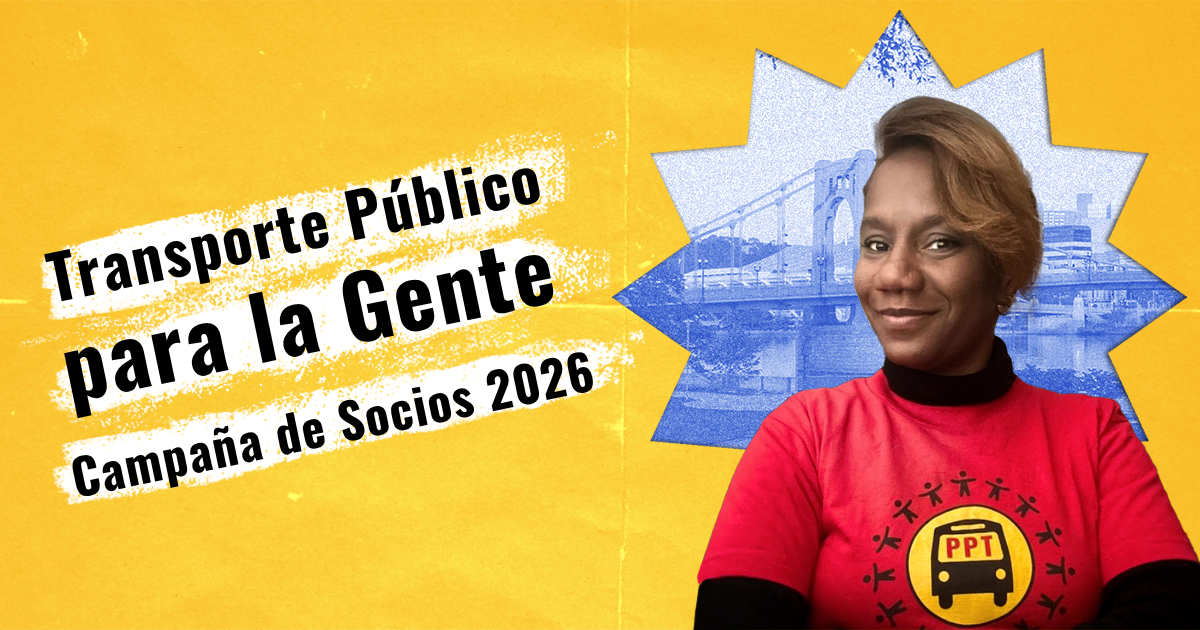
Transporte Público para la Gente: Únete a la campaña de Socios 2026
Me llamo Evelyn Ulysse Alcántara. Uso el transporte público a diario para ir al trabajo, al médico, actividades de ocio, reuniones, llevar a mi hijo al colegio— para todo.
Soy latina y mi inglés no es perfecto, así que cuando me mudé a Pittsburgh me costó usar el transporte público porque había muy poca información disponible en español. Por eso me ofrecí de voluntaria para ayudar como embajadora en los Recorridos de tránsito de PPT. Fue muy frustrante y aislante intentar aprender a usar el sistema de transporte público por mi cuenta. Sabía que si podía hacer algo para apoyar el aprendizaje de mi comunidad, ¡tenía que hacerlo!
Ser miembro de PPT no solo ha mejorado mis propias necesidades de transporte. Me abrió la puerta para ayudarme a marcar la diferencia.
Cuando hubo recortes en el transporte público en Beechview, hubo ocasiones en que el autobús o el Tren no venían—y no sabía la razón, porque los cambios sólo se comunicaban en inglés. Pero hoy, si vas a Steel Plaza o Wood Street Station, ¡escucharás anuncios en español! Y hay instrucciones paso a paso en español en la web de PRT. Esto se debe a que PPT y Casa San José se unieron para dar voz a mi comunidad, para que PRT pudiera entender el verdadero impacto que esto estaba teniendo en nosotros.
Este es el verdadero poder de PPT: realmente escuchan a la gente.
Cuando descubrí que PPT, me pedían testimonios sobre el papel que tiene el transporte público en la vida de las personas, para mostrar lo importante que sería un programa de media tarifa. Sabía que tenía que dar mi testimonio, porque necesitábamos actuar para mejorar el acceso. En aquel entonces solo era una idea y un proyecto, pero hoy es una realidad que lleva el servicio de transporte a la gente.
Me encanta el PPT porque sé de primera mano lo que podemos lograr juntos.
Solo en 2026:
- Llevamos a 120 miembros a Harrisburg para arrojar luz sobre la brecha presupuestaria de 80 millones de dólares y enfatizar la importancia de los servicios para tránsito y viajes compartidos para nuestros representantes.
- Compartimos habilidades y construimos poder con 170 personas de todo el país, compartimos habilidades y construyeron poder en nuestro Entrenamiento de Primavera 2026.
- Formamos a 13 becarios de organización comunitaria en toda la colina del barrio de PGH, y las regiones de Lancaster y Lehigh Valley en Pensilvania.
Por eso quería preguntar: ¿apoyarán el trabajo urgente de PPT haciéndote miembro que paga cuotas hoy?
Puedes apuntarte por solo 2,75 $, ¡el precio actual del billete de autobús del PRT! Ese dinero va directamente a la defensa de un presupuesto de transporte que mueve a TODOS los habitantes de Pensilvania. Todo el mundo merece acceso al transporte público.
¿Nos ayudarás a hacer realidad ese sueño?
The post Transporte Público para la Gente: Únete a la campaña de Socios 2026 appeared first on Pittsburghers for Public Transit.
From remunicipalisation to the democracy of the commons
By Vanessa Mascia Turri
Naples became one of Europe’s most ambitious experiments in democratic water governance after Italy’s 2011 referendum against water privatisation. Yet bringing water back into public hands did not necessarily redistribute power over how water itself would be governed.
In 2011, after the Italian referendum against water privatisation, Naples became one of the most ambitious experiments in remunicipalised water governance in Europe. The city transformed its water utility into ABC Napoli (Acqua Bene Comune Napoli), a publicly owned entity presented not simply as a return to public management, but as an attempt to implement the “democracy of the commons” theorised by the Italian Forum of Water Movements.
Within this perspective, water was understood not only as a public service, but as a common good whose governance should involve the direct participation of citizens and social movements.
Over the following decade, Naples became a testing ground for a broader political question that has emerged across many remunicipalisation struggles: what happens when the language and practices of the commons enter public institutions? The Neapolitan experience shows that bringing water back into public hands does not automatically democratise its governance. Instead, participation became continuously negotiated and reshaped through political conflict, financial pressures and struggles over who should control public resources.
From water struggles to the democracy of the commonsSince the early 2000s, struggles against water privatisation have connected local mobilisations to broader debates around the commons. Struggles against water privatisation in Europe have often gone beyond opposition to market reforms and increasingly connected demands for public ownership with broader claims around the commons and direct democracy, as explored throughout the Reimagining, remembering and reclaiming water series. In many countries, water movements have challenged not only privatisation, but also the idea that essential services should be governed through technocratic and top-down forms of management, increasingly linking water struggles to broader claims around the commons and direct democracy, as discussed in Transforming capitalism? The role of the commons and direct democracy in struggles against water privatisation in Europe.
In Italy, these debates converged in the Italian Forum of Water Movements, one of the broadest water movements in Europe. As broader discussions around the commons in Italy have shown, these debates extended well beyond water itself and raised wider questions about collective resources, democracy and institutional change. Under the slogan “si scrive acqua, si legge democrazia” (“it is written water, it is read democracy”), the movement argued that remunicipalisation should involve not only public ownership, but also direct civic participation in water governance.
Naples became the most ambitious attempt to translate this political vision into institutional practice.
Poster from the 2011 Italian referendum campaign against water privatization reading “Water is not for sale.” Image courtesy of the Forum Italiano dei Movimenti per l’Acqua.
Naples became the most ambitious attempt to translate this political vision into institutional practice.
Yet public and academic debates on remunicipalisation have often focused on privatisation conflicts and legal transitions, paying far less attention to what happens afterwards. How are participatory mechanisms actually organised inside remunicipalised utilities? How much power are institutions willing to share with social movements and citizens once remunicipalisation has taken place?
My article From theory to practice: evaluating civic participation in Naples’ remunicipalised water service examines these questions through the case of ABC Napoli, reconstructing how participation was progressively organised, contested and reshaped during the decade following remunicipalisation.
Participation and the limits of the commonsAt the moment of remunicipalisation, Naples faced deteriorated infrastructures, chronic underinvestment and a massive municipal public debt. For many activists of the Neapolitan water movement, remunicipalisation was therefore not only about public ownership, but also about transforming the priorities of water governance through ecological restoration, infrastructural investment and more equitable access to water.
Over the following decade, ABC Napoli experimented with different forms of civic participation. Initially, the municipal government opened the board of directors to representatives linked to the Italian Forum of Water Movements and to environmental associations. Yet local activists who had led the mobilisation against privatisation were largely excluded from these arrangements, generating immediate tensions over who had the legitimacy to participate in the governance of the utility.
The most ambitious participatory experiment emerged with the creation of the Civic Council, a public assembly open to citizens, activists and ABC workers. Meetings were held directly inside the company and addressed issues such as tariffs, infrastructure maintenance, hiring policies and investment priorities. Delegates from the assemblies also participated in discussions with the board of directors, creating one of the most advanced attempts in Europe to institutionalise direct civic participation inside a remunicipalised water utility.
However, participation became far more conflictual once these assemblies started intervening in concrete political and economic questions. Members of the Civic Council promoted long-term infrastructural investments and the recruitment of specialised personnel while defending the financial stability of the utility. According to several interviewees, these priorities increasingly clashed with those of the municipal government, which was more focused on short-term employment policies and the management of public-sector jobs within a broader context marked by debt, unemployment and political pressures surrounding public employment.
These tensions ultimately led to the removal of the board of directors and to the progressive weakening of participatory governance. In the following years, participation increasingly shifted towards weak consultative mechanisms with limited influence over decision-making processes. Many activists gradually distanced themselves from the experiment, while severe financial constraints continued to limit investments in infrastructures and ecological renewal.
Rather than evolving towards deeper forms of democratic governance, the Neapolitan experience progressively revealed the difficulties of institutionalising the “democracy of the commons” within existing municipal structures and political priorities.
Remunicipalisation without democratisation?Poster from the Italian public water movement following the 2011 referendum campaign, emphasising water as a public right rather than a source of profit. Image courtesy of the Forum Italiano dei Movimenti per l’Acqua.
The experience of ABC Napoli complicates many celebratory narratives surrounding remunicipalisation. Bringing water back into public hands did not automatically redistribute power inside public governance. On the contrary, the Neapolitan case shows how quickly the language of the commons can become absorbed into existing institutional structures once participation starts challenging concrete political and economic interests.
The weakening of participatory governance inside ABC Napoli did not result from a lack of civic mobilisation or technical expertise. Quite the opposite: activists involved in the water movement developed increasingly detailed proposals on tariffs, infrastructures and long-term investments, becoming capable of intervening directly in the governance of the utility. Participation became problematic precisely when it stopped being symbolic and started questioning how public resources, infrastructures and employment should be managed.
In Naples, these tensions unfolded within a broader context marked by public debt, deteriorated infrastructures, unemployment and long-standing systems of political mediation surrounding public-sector employment. Under these conditions, the “democracy of the commons” increasingly collided with the political and administrative logics shaping municipal governance.
More broadly, the Neapolitan experience suggests that remunicipalisation alone cannot democratise essential services without a real willingness from public institutions to share decision-making power. Commons become politically difficult when they move beyond participation as consultation and start demanding participation as co-governance.
Rather than offering a linear model of democratic transformation, Naples reveals the unresolved tensions that emerge when social movements attempt to institutionalise the commons inside existing state structures. The question, then, is not simply whether remunicipalisation is possible, but whether public institutions are truly willing to democratise the power through which public resources are governed.
—
Featured image: Protest sign reading “Public water, public management. Clear?” during a demonstration of the Italian water movement. Photo courtesy of the Forum Italiano dei Movimenti per l’Acqua (acquabenecomune.org).
The post From remunicipalisation to the democracy of the commons appeared first on Undisciplined Environments.
Russian socialists: “Solidarity means accepting Ukrainians’ pain and suffering as our own”
Organising action on climate and social justice: what next
Pages
The Fine Print I:
Disclaimer: The views expressed on this site are not the official position of the IWW (or even the IWW’s EUC) unless otherwise indicated and do not necessarily represent the views of anyone but the author’s, nor should it be assumed that any of these authors automatically support the IWW or endorse any of its positions.
Further: the inclusion of a link on our site (other than the link to the main IWW site) does not imply endorsement by or an alliance with the IWW. These sites have been chosen by our members due to their perceived relevance to the IWW EUC and are included here for informational purposes only. If you have any suggestions or comments on any of the links included (or not included) above, please contact us.
The Fine Print II:
Fair Use Notice: The material on this site is provided for educational and informational purposes. It may contain copyrighted material the use of which has not always been specifically authorized by the copyright owner. It is being made available in an effort to advance the understanding of scientific, environmental, economic, social justice and human rights issues etc.
It is believed that this constitutes a 'fair use' of any such copyrighted material as provided for in section 107 of the US Copyright Law. In accordance with Title 17 U.S.C. Section 107, the material on this site is distributed without profit to those who have an interest in using the included information for research and educational purposes. If you wish to use copyrighted material from this site for purposes of your own that go beyond 'fair use', you must obtain permission from the copyright owner. The information on this site does not constitute legal or technical advice.
 This site is not the official webpage of the Industrial Workers of the World.