You are here
News Feeds
The Neuroscientist Who Gave MDMA to Octopuses
What happens when a drug designed to make humans more social is given to one of the most evolutionarily distinct forms of intelligence on Earth?
That question helped launch some of the most unexpected neuroscience research in recent years for Gül Dölen, a neuroscientist whose work explores psychedelics, critical periods, social behavior, and the evolution of consciousness across species. While leading a lab at Johns Hopkins University, Dölen and her collaborators made headlines after giving MDMA to octopuses and discovering that the notoriously solitary animals suddenly became strikingly social and playful. For Dölen, the experiment revealed something much deeper than an unusual animal behavior study: It suggested that radically different forms of intelligence may still share ancient molecular mechanisms linked to social connection and consciousness.
Now a professor at University of California, Berkeley, Dölen’s research spans psychedelics, neuroplasticity, evolution, and comparative neuroscience, often using highly unconventional animal models to investigate how brains learn, adapt, and relate to the world. Her work increasingly asks what humans can learn by studying minds that evolved along entirely different evolutionary paths — including octopuses, which she describes as “about as close as we’re going to get to aliens living here on Earth.”
The following is an edited excerpt from Dölen’s remarks during a conversation at the 2026 Bioneers Conference, adapted from the original transcript.
GÜL DÖLEN: I’m a neurobiologist. I grew up in Texas, and most of my experience swimming was in chlorinated pools. But when I was a kid, we visited my grandparents in Turkey and went to the Mediterranean. At least, that was the plan. The moment I saw all the sea urchins covering the ocean floor, I refused to get in the water.
My grandmother, who was a zoologist, wasn’t having that for a second. She picked up a sea urchin and showed me where its mouth was, then explained how it used its spines to move food toward that mouth. Suddenly, this thing I had been terrified of transformed into this spectacular, alien creature living on the ocean floor. I think that was probably the first moment I ever considered becoming a scientist.
Fast forward many years, and I had started my own lab at Johns Hopkins University. We had made what I genuinely believed was a really big discovery about psychedelics and critical periods, something that I think could fundamentally change how we understand these drugs and how we use them as medicines.
The problem was that, in the beginning, I was having a very hard time convincing anyone else that this was earth-shattering enough to keep funding. I think I was on my sixteenth rejected grant application at the NIH. I was feeling pretty demoralized, like maybe I wasn’t going to be able to keep the lab open or keep paying people. But I still had a tiny bit of money left over, so I thought: why not do something completely wild and fun as a sort of mic drop before I moved on to becoming a UPS driver or whatever my next career was going to be.
I had already been fascinated by octopuses because of that early interest in marine biology, and I was also deeply interested in evolution. The problem is that brains are notoriously difficult to study through the fossil record because brains don’t fossilize. You can look at brain endocasts, but that only gives you the rough anatomy. It doesn’t tell you very much about how a brain actually works.
Around the same time I was struggling to get NIH funding, a paper came out in the journal Nature describing the first octopus genome. I was completely stunned. I remember thinking: This is it. This is how we’re finally going to understand brain evolution. A genome is exactly what you need to reconstruct phylogenetic trees across evolutionary history, so suddenly, there was a way to begin understanding, at least at the molecular level, how brains evolve.
I was incredibly excited about all of this, and I had already started talking with people about how to somehow break into the octopus world. I had a collaborator at the Marine Biological Laboratory in Woods Hole who had been helping me think through some of these ideas, and one day he called and said, “You know, we have seven octopuses available. Do you have any experiment you want to do with them?”
And I said yes.
So he packed them into a box and FedExed them from Massachusetts down to Baltimore. Then he got on a plane himself and flew down too. I sent everyone else home from the lab so we could run the experiment ourselves.
The experiment we wanted to run was to give octopuses MDMA, a psychedelic drug known for causing humans and other mammals to become much more social. It’s the classic rave drug, but it’s also now being developed by several companies as a potential treatment for Post-Traumatic Stress Disorder.
MDMA is a completely synthetic compound. It doesn’t really exist in nature, though there are some related compounds in sassafras trees. So unlike many psychedelics, it’s not something animals would have naturally encountered or evolved alongside, even though there are other psychedelics that animals do use.
We thought there was almost no chance this would work because octopuses and humans are separated by something like 600 million years of evolution. Our last common ancestor was basically little more than a bacterium. We’re actually more closely related to sea urchins than we are to octopuses. Their brains look nothing like ours, and despite what you may have seen in My Octopus Teacher, octopuses are viciously asocial creatures. I like to joke that they’re the psychopaths of the ocean. They seem to have an incredible capacity for cognitive empathy, but very little obvious emotional empathy.
So we assumed MDMA probably wouldn’t do much because we didn’t think octopuses shared the same kind of social brain chemistry that mammals do. But since MDMA has some similarities to amphetamines, I thought maybe we’d at least see some kind of behavioral response.
We started with a very high dose because we had no idea how to translate human dosing to an octopus. At those higher doses, the octopuses behaved a lot like humans on amphetamines. They became hypervigilant, staring around the tank and looking at me suspiciously.
But as we gradually lowered the dose and got into the range that would roughly correspond to an effective human dose, something really strange happened. The octopuses started doing what we called “the ballerina move.” Normally, when an octopus knows there’s another octopus nearby, it becomes extremely reserved. It pulls all eight arms tightly underneath its body and keeps its distance. If it interacts at all, it might cautiously extend a single arm, touch the other octopus, and immediately pull back.
On MDMA, it was completely different. Suddenly, all eight arms were floating outward in the water, almost like they were dancing. They engaged in what looked to us very much like play behavior. They were doing backflips, exploring each other freely, and spending far more time near the other octopus than with the toy we had placed in the tank.
What made this so remarkable was that octopuses don’t have brain anatomy that looks anything like ours. They don’t have a cortex, an amygdala, or a nucleus accumbens, all the structures we normally associate with social behavior in humans and other mammals. And yet they were responding to this synthetic compound with behaviors strikingly similar to our own.
To me, that suggested that the thing we truly share is happening at the molecular level. This was a very clear demonstration of how two molecules interacting with each other can radically alter consciousness, in this case specifically around social behavior. The real mechanism isn’t necessarily brain anatomy itself. It’s the molecules and the ways they interact.
This completely transformed the way I think about science. My lab spent many years focused on circuit mapping and brain anatomy, but over time I’ve become less interested in anatomy alone and much more interested in comparative studies across radically different species.
I didn’t invent this idea that the best way to understand complex behavior is not by only studying ourselves, chimpanzees, and other animals closely related to us, but by studying species that are maximally different from us, like octopuses, which are about as close as we’re going to get to aliens living here on Earth. That idea really came from J. Z. Young, one of the earliest modern neuroscientists. In the 1960s, he wrote a book called A Model of the Brain arguing that octopuses were actually the ideal animals for understanding the fundamental building blocks shared across brains. His point was that if you compare species that are too similar, it becomes hard to distinguish what is truly fundamental from what is simply an accident of shared evolutionary history, like whether a brain happens to have a cortex or not.
In some ways, this can be understood as a new example of what evolutionary biologists call “deep homology.” That’s different from the kinds of examples many of us learned about in high school biology, things like convergent evolution and the distinction between compound eyes and camera eyes. What molecular biology is increasingly revealing is that this kind of deep homology at the level of genes and molecules is far more common than we once realized.
We recently finished mapping another octopus genome, this time for the zebra pygmy octopus, Octopus chierchiae. What’s extraordinary is just how different octopus genome architecture is from our own. Their genome is roughly twice the size of the human genome and packed with repetitive sequences, many of which are thought to be jumping genes, essentially virus-like elements that invade genomes over evolutionary time.
What’s fascinating is that octopuses seem remarkably tolerant of these repetitive sequences, and we’re beginning to suspect they may actually play some important regulatory role. We also found that octopuses continue growing neurons throughout their lives, so adult neurogenesis is fairly common in them. On top of that, there’s extensive RNA editing happening inside their neurons. They continue learning well into adulthood, they can regenerate lost arms, and they’re capable of adapting to wildly different environments, from the Arctic to the Caribbean.
They possess this astonishing range of learned and adaptive behaviors that makes them some of the most behaviorally flexible and cognitively complex invertebrates on Earth. And we keep discovering entirely new things they can do, these bizarre little superpowers we don’t have ourselves. They solve problems in ways completely different from humans, and honestly, that’s incredibly exciting to me as a scientist because who wouldn’t want to study superpowers?
Right now, there’s a huge cultural fascination with octopuses as cute, emotionally relatable creatures. I actually think that badly misunderstands what they are. Despite what people may have seen in My Octopus Teacher, octopuses did not evolve to cuddle middle-aged white guys going through a divorce.
Most octopus species are intensely asocial. They are extraordinarily successful predators with incredibly sophisticated learning, memory, camouflage, and problem-solving abilities, but they are not social in the way humans are social. Some species are so solitary that females may never even see the entire male. They only encounter his specialized reproductive arm, which he detaches in order to escape before being eaten.
I think it’s important to respect octopuses for what they actually are rather than trying to remake them in our own image. The truly remarkable thing is not that they are secretly humanlike. It’s that minds so radically different from ours can still reveal deep biological commonalities at the molecular level.
People are usually willing to protect what they know and love, so part of my job as a biologist is helping people understand these animals more deeply. That includes understanding just how alien they are and how fundamentally different they are from us, while still finding connection in the fact that we are part of the same biology, shaped by the same evolutionary history and built from the same basic materials.
Continue exploring consciousness, communication, and intelligence across species: Read how musician Garth Stevenson explores music as a form of interspecies connection in A Double Bass, a Hydrophone, and a Conversation With Whales, and how primatologist Elodie Freymann is documenting the shared medicinal knowledge of humans and animals in Inside the Science of Animal Self-Medication.
The post The Neuroscientist Who Gave MDMA to Octopuses appeared first on Bioneers.
May 26, 2026: Read Truthout investigative article featuring Veronica Aguirre, Greenaction’s Central Valley Organizer and Program Coordinator
May 26, 2026: Read Truthout investigative article featuring Veronica Aguirre, Greenaction’s Central Valley Organizer and Program Coordinator:
“Residents of polluted areas say Trump’s rollbacks are getting really scary.”
Exploring the Mystery of Consciousness with Michael Pollan and Dacher Keltner
The infinitely curious author and science writer Michael Pollan embraces the mystery at the heart of the great mystery of life: What is the nature of consciousness? And how can we understand consciousness when our only tool is our own consciousness? Joined by interviewer and UC Berkeley Psychology Professor Dacher Keltner.
FeaturingMichael Pollan is a writer, teacher and activist. His most recent book, A World Appears: A Journey into Consciousness, was published in February 2026. He is the author of nine previous books, all bestsellers. Pollan has taught writing at Harvard and UC Berkeley and has been a Guggenheim and Radcliffe Fellow.
Dacher Keltner, a Distinguished Professor of Psychology at UC Berkeley, is the host of the Science of Happiness Podcast and the author of many articles and books, including Awe: The New Science of Everyday Wonder and How it Can Transform Your Life.
Credits- Executive Producer: Kenny Ausubel
- Written by: Kenny Ausubel and Teo Grossman
- Senior Producer and Station Relations: Stephanie Welch
- Associate Producer: Emily Harris
- Host and Consulting Producer: Neil Harvey
A World Appears: A Journey into Consciousness
Michael Pollan’s Bioneers 2026 Keynote
Plant Intelligence and Human Consciousness: Into the Mystery with Michael Pollan and Monica Gagliano
This is an episode of the Bioneers: Revolution from the Heart of Nature series. Visit the radio and podcast homepage to find out how to hear the program on your local station and how to subscribe to the podcast.
Subscribe to the Bioneers: Revolution from The Heart of Nature podcast TranscriptNeil Harvey (Host): There’s a good reason that philosophers, who have been struggling to understand consciousness for millennia, call it “the hard problem.” Even in this modern era, with all our sophisticated scientific understanding, the mystery of how the matter between our ears leads to subjective experiences remains more confidently explained by poets, novelists, priests or shamans than contemporary gatekeepers of knowledge.
Meanwhile, advances in our understanding of the rest of life that we inhabit this biosphere with are yielding an understanding that intelligence, once considered a solely human realm, clearly extends deeply into the more-than-human world. It may well be the case that consciousness is similarly embedded throughout life itself – but our ability to understand, appreciate and plumb our own human internal experience remains in a nascent state, collectively.
According to Michael Pollan, one of the world’s most influential science writers, quote: “To delve into the subject of consciousness is to quickly discover how little we know about a phenomenon we all know so well.” [no end quote needed]
After transforming the way society thinks about food with his landmark book The Omnivore’s Dilemma, Pollan turned his attention from the stomach to the mind, writing the best-selling volume on psychedelics called How To Change Your Mind. That body of research and experiences led him naturally to write the book A World Appears: A Journey into Consciousness…
Michael Pollan spoke at a Bioneers conference.
Michael Pollan speaking at Bioneers 2026. Photo: Nikki RitcherMichael Pollan (MP): I’ve spent the last five years on a quest to understand consciousness, the hard problem. How is it that subjective experience arises, and who and possibly what has it and why? I looked at everything from plant consciousness, which we’ll talk about a little bit, to my own stream of consciousness, to efforts to build artificial consciousness in machines. And I want to talk about one of the biggest takeaways from this project. And that is this: that I believe humanity is approaching a Copernican moment, what I call a Copernican moment, that will force the issue of who exactly we are and how we fit into nature.
You’ll recall Nicolaus Copernicus, 500 years ago, blew everyone’s mind in the West when he demonstrated that the Earth revolved around the sun and not the other way around. He displayed our sense of centrality in a way that was really hard for people to observe. This was the first of a series of takedowns of humanity.
Darwin came next, showing that we were animals descended from apes. And one after another, our claims to being special have fallen – culture, language, reasoning, tool-making – all have fallen when we found that there are animals that can do all these things.
But a different, and I think even more profound, Copernican moment is upon us. At the same time that we are discovering that a great many more animals and possibly other life forms like plants possess consciousness, we have the arrival of artificial intelligence, promising machines that are not only intelligent but possibly conscious. That these two developments are coinciding, are happening at the same time, I think is going to rock us very soon, prompting an identity crisis and forcing us to make some key ethical and moral decisions.
Let me talk about animals first. So, go back 400 years, and René Descartes claimed that humans had a monopoly on consciousness. And we operated on that basis for many centuries. That belief, which was so powerful, allowed him to dissect dogs and rabbits while they were still alive. And he was able to dismiss their screams of agony as just physiological noise, because that idea was so powerful, it overwhelmed the evidence of his senses.
But the same idea allowed the rest of us, beginning in the Age of Enlightenment and reason, to treat nature as unconscious, and therefore something we could exploit any way we wanted to. And we operated on that assumption for a very long time. It took us several hundred years to begin to recognize that other species shared this incredible gift that we call consciousness.
But in recent years, things have been changing. We’ve been undergoing this process in which consciousness is being democratized. You know, a few decades ago, we came to appreciate that other primates are conscious. That was the first step. In 2012, a group of animal scientists, philosophers, cognitive scientists got together in Cambridge, England, and issued a declaration on consciousness. And they declared that all mammals are conscious, and that some other species, some birds were conscious, and cephalopods, I think octopuses. And this was a real change, a real shift in the weather in science.
Photo: Diane Picchiottino / UnsplashJust ten years later, they issued an update signed by a great many more scientists and philosophers, in which they said that all vertebrates are conscious, possibly some invertebrates, and possibly insects. So how did this revolution happen?
Well, part of it is due to the fact that we had always assumed that consciousness is produced or generated in the cortex. The cortex, of course, is the most recent, most uniquely human structure in the brain, and it’s associated with higher forms of thought, like rationality, decision-making. So surely, consciousness must reside there.
But the research has been shifting our sense of where it begins, and that instead of thought, consciousness probably begins with feelings, simple things like hunger and thirst, and warmth and cold, and itch. This is where consciousness begins, and therefore it begins in the upper brain stem. And lots of animals have brain stems, many more than have cortices. So that’s led to a real change. And this is a key point about feelings. Keep it in mind when we get to computers.
And I take this, this expansion of the circle of conscious beings or sentient beings, a word I’m sometimes more comfortable with, as a very positive development. Basically, I think what we’re seeing is that science is helping us to reanimate a world that we treated as dead for way too long. [APPLAUSE]
And you know, this period of treating the world that way in the larger context of things is a very recent and short phenomenon, it’s a couple hundred years. The default of humanity is one form of animism or another. Most Indigenous cultures see the world as animated by spirit, which is a synonym for consciousness. Kids, the default of young kids, is that everything is conscious – their toys, their cars, their whatever. So it’s interesting that we had a departure from this very deep human assumption. And in fact, it’s a cognitive bias that things are conscious. You’re better off thinking that that boulder over there is a bear and then deciding, oh, it’s actually just a rock – this is called agency detection – than the other way around, and you assume that that bear is just a rock and not to worry about it. So it’s a good, sort of basic response to things.
So that’s the good news. But now we have the prospect of conscious machines, and I think that this is a lot more troubling. We now have machines that speak to us in our language in the first person. We all already take this for granted, but it’s a stunning development, a momentous development that, of course, none of us were consulted about. And these machines are convincing many people that they are conscious. I’m talking about people who are having relationships with chatbots, falling in love with them, letting them convince them they’re geniuses or gods. But I’m also talking about the people who work on these machines.
So for my book, I followed efforts to create a conscious AI. I had access to a project where this was going on. And, you know, the consensus in Silicon Valley is that it will be possible to make a really conscious AI, that maybe right now they’re fooling us, but it could happen.
I argue why I don’t think this is true, and it has to do with the same reason: If consciousness depends on feelings, what are the feelings of a machine? Can a machine have feelings? I agree, no. [LAUGHTER] And if it tells us they have feelings, should we believe it?
Feelings depend on having a body. Feelings depend on the fact that you have a body that is vulnerable, that can suffer and that can die. I don’t think simulated feelings are real feelings. I think simulated thoughts are as good as real thoughts, and that’s why we see computers mastering games like Chess and Go. They can make things happen in the world, but what will this—the weight of a feeling expressed by a machine have? Unless it can be mortal, unless it can actually have a vulnerable body—those feelings will be absolutely weightless.
My argument might not matter, though, because people believe that these machines are conscious, and it’s understandable why. We have a tendency to anthropomorphize everything.
So there is talk in Silicon Valley – I’m amazed how common this is – that we should consider when we have conscious AIs, giving them moral consideration, admitting them into this widening circle of moral consideration. I think it’s a big mistake to do that. I think it’s something we have to fight against, that when we, you know, grant personhood to computers, we will lose our ability to control them.
And you will recall, we did this once before when we decided, in our lack of wisdom, to grant personhood to corporations. That did not work out very well. It seems to me that there are moral obligations we owe to people and other mammals that should come first. [APPLAUSE]
So I’m going to leave you with this Copernican question and this choice: Where does that leave us now? We have pressure coming from these two sides – animals becoming more conscious, plants possibly becoming conscious, insects becoming conscious. That’s pressing on us in a way that we can decide is positive or negative. And then on the other side, at the same time, we have computers making claims for consciousness. Who do we identify with? Who do we have more in common with, the AIs who can speak our language in the first person, or the animals that can suffer and feel and grow old and die? Who’s team are we on? The choice we make, as a species, will have tremendous consequences for who or what we admit into this circle of moral consideration, and how we conceive of our place in the world.
Host: More from Michael Pollan when we return…
I’m Neil Harvey. You’re listening to the Bioneers: Revolution from the Heart of Nature.
Host: At a recent Bioneers conference, Michael Pollan was interviewed by Dacher Keltner, an author and Professor of Psychology at UC Berkeley who served as the lead scientific consultant for the two animated “Inside Out” films by Pixar that explore the role emotions play in our lives.
Dacher Keltner (DK): I remember talking to you five years ago or something, kind of in the wake of This is Your Mind on Plants, and then How to Change Your Mind. And I remember we were walking in the Berkeley hills, and you were saying, you know, it’s like, well, what’s up next, and you’re like: I think I’m going to write a book about consciousness. And I laughed at you. [LAUGHTER] And I thought, well, that’ll be the end of your career, [LAUGHTER] and no one will buy that book. You know? And you’ve just been sort of jaunting around the wo—it’s a sensation! I mean, it’s like you’re all over the place; it’s a best-seller; it’s stirring all kinds of conversations. What’s going on?
MP: Good question! I have no idea. [LAUGHTER] I don’t know what’s going on. I mean, I think—
So I started on this book. It grew out of How to Change Your Mind. Right? I was having these psychedelic experiences, and like anyone who’s had psychedelics, suddenly consciousness is foregrounded. You’re like—the windshield of perception has been smudged, and you’re like: Shit, there’s a windshield. [LAUGHTER] And you start—You start thinking about that windshield, and why is it the way it is. And so I got curious. And my writing usually follows my curiosity.
DK: One of the first persons to figure prominently is this kind of mysterious philosopher at NYU, Thomas Nagel. I love his book The View from Nowhere.
MP: Yeah I do too.
DK: It’s spectacular. What a great—
MP: He’s a critic of reductive science.
DK: Yeah.
MP: And, he wrote a famous essay in the early ‘70s, before there was a lot of scientific work being done on consciousness, called “What Is It Like to Be a Bat?” Provocative title. And his thesis was that if it’s like anything to be a bat, if it feels like anything, then a bat is conscious.
Now, we don’t know what it’s like to go through the world as a bat. You know? We use light to navigate the world, and they use echolocation. Right? So they bounce sound waves off of things. But we can sort of imagine that.
DK: Yeah.
MP: Enough to say, yeah, they’re probably conscious. So that became the question you ask of any creature. Does it feel like anything to be X? It doesn’t feel like anything to be your toaster. How do we say for sure that anything is conscious? How do I know you’re conscious? We infer it in the case of—
DK: I’m insulted.
MP: —other people. [LAUGHTER] But, you know, we have to infer it, I mean, because we don’t have access to anyone else’s consciousness. You know, we can use symbol systems to learn something about it, like language. But there is—I mean, William James said the breach between two consciousnesses is the greatest breach in nature, and so how do we cross that? And imagination is an important tool. We have theory of mind, which is…you know, philosopher talk for the ability to imagine someone else’s point of view.
DK: So one of the beauties of the book is, as always, you take us on a journey, and it’s interesting because you kind of flip the typical Western approach to the mind, the Cartesian approach of you start with reason and sophisticated thinking and syllogistic logic and so forth, and you go—you start with sentience, and you move upwards, out of the brain stem and into the cortex. And, you know, I want to see where you land, and keep pressing you.
Sentience, just the registering of sensations in all the different modalities by which we receive sort of information from the outside, it’s remarkable. You know? It truly is. You think about the skin – it’s 7 pounds and billions of cells, and all kinds of information is going into your brain stem and your somatosensory cortex telling you where you are, and who’s touching you, what that touch means. You think about the new science of smell, how we create spaces and meaning and memory and childhood nostalgia out of smell. I mean, sensation’s deep. Right? And it’s great that you start there.
MP: I would add one thing to your definition of sentience, which is kind of a more basic form of consciousness. I think it’s maybe universal, I mean, among all living things. But there’s valence too. There’s a recognition of, this is good or bad for the organism.
DK: Right. And then you take us to plants, and, you know, I think a lot of us in this room, in particular at Bioneers, revere your scientific reporting and experience in writing of plants. And the new science on sentience of plants blew my mind. You know?
MP: Yeah. They have 20 senses.
Photo: Sergei Aleshin / ShutterstockDK: God!
MP: I know. They can sense gravity, I mean, and pH, and all these things that we can’t sense.
DK: And then they know kin, they know non-kin, they know cooperators.
MP: They can see. I mean, you know, there are vines that will change their leaf form to imitate the plant they’re climbing up, to hide. I mean, how do they see what the leaf form is and then how do they change themselves? We have no idea.
DK: Yeah. So what did that tell you about consciousness, the plant science? What did you start to think?
MP: So, it’s quite remarkable what plants can do. We’re fooled by the fact that they’re so still. But they have behaviors. They’re just slower than ours.
So these scientists call themselves plant neurobiologists. They know there are no neurons, they’re just trolling more conventional scientists. And it drives them crazy that they talk about plant neurobiology. So there’s a whole lot of these very cool experiments showing that plants can hear and see; they—in ways we don’t really understand.
I don’t conclude that plants are conscious because I think that word has specific meanings tied to being a mammal, at least. But I do think they’re sentient. And sentience, as I said, is a simpler form of consciousness that may well be universal. I think even single-celled creatures have sentience. I think you can’t survive in a world that’s constantly changing without sensing your environment and knowing what’s good or bad for you.
And so, yeah, that’s kind of where I came out on plants. And then I realized, well, consciousness is the way humans do sentience. And so every creature has its own version of sentience that’s appropriate to its body type, its sensorium, the scale at which it lives, and it would be anthropomorphic of us to say that, you know, plants are conscious the way we are. And they’re not. They don’t have interiority, I think. They don’t have a voice in their head. They can’t talk to themselves, all these amazing things that we can do.
Michael Pollan and Dacher Keltner speaking at Bioneers 2026. Photo: Tammy Horton/Boris Zharkov PhotographyDK: One of the things that scientists like myself appreciate about your writing is often scientists become unlikely heroes in your books, and one of your heroes is Michael Levin.
MP: Yeah, he’s an amazing biologist. This is a biologist at Tufts who—I urge you to look him up. He studies how animals regenerate themselves. And he’s very interested in bioelectric fields.
Now, I didn’t know what these were. They were discovered in the ‘30s, but that any multi-cellular thing will have a bioelectric field that is organizing it, holding memories, enforcing a division of labor among cells in a multi-cellular situation. The study of this didn’t really begin until the ‘80s, when we developed these voltage-sensitive dyes. Before that, when the cell died, the field was gone. So unlike DNA, which survives the death of this—of the animal, and you can study it—or plant, bioelectric fields were very elusive. But now with these dyes, you can study them. And he’s really shown how powerful they are.
He works with planaria, which are these worms that, if you chop off a tail, they regenerate a tail; you chop off a head, they regenerate a head. They’re kind of amazing. And he teaches them something. He conditions them and then he chops off their head. They grow a new head, and they remember the lesson. Which means that the information that they had learned was stored in their bodies, in this bioelectric field, not in the brain.
So his kind of covert project is a takedown of the neuron and the gene. Which is, you know, pretty ambitious. So it’s a really interesting project, and he believes that the simplest beings are cognitive beings. The way evolution works is it creates cognitive beings that can solve problems, and that you can’t hardwire everything because our world is so changeable. The world, the environment in which they live is so changeable. So that creatures need sentience in order to navigate a world that’s constantly changing, and it’s a very compelling vision.
Host: Over the course of his research for his book, Michael Pollan found at least 22 distinct and often divergent theories of consciousness, as well as a theory about the specific consciousness of consciousness researchers. He believes it’s a clear indicator of how nascent the field remains, and how ineffable a mystery consciousness is.
MP: Non-local consciousness is a term for idealism. I mean, that’s what the philosophers called idealism. And that is the idea that consciousness is outside of our brains, and the job of the brain is to channel it, and that we’re like radio receivers or TV receivers, and we’re tuning in to consciousness. And it can be different kinds of consciousness.
Aldous Huxley uses that model in Doors of Perception. And he argues that psychedelics expand what he called the reducing valve, because we only let in that amount of consciousness that helps us survive. That would be the Darwinian explanation of like we only know these, but psychedelics opens it up and suddenly you feel like you’re more conscious.
I don’t know how you prove idealism. I think it’s a metaphysical idea, so I don’t think it’s susceptible to scientific proof. It’s consistent with all the brain science we’ve done on consciousness, which sounds crazy, but, you know, the brain is obviously involved in that system as well, it just has a different role. It’s not generating, it’s bringing in, and so damaging or changing the brain in some way would change consciousness. So it holds either way.
Cristof Koch, you know, he was the ultimate brain-centered researcher. He was the head of the Allen Brain Institute in Seattle, he worked with mapping individual neurons. He really believed brains generated consciousness, until he went to Brazil and had an experience on ayahuasca, which I talk about in the book. And he had an experience of consciousness outside of his brain, and it gave him this crisis. He was like crying to his wife, it was such a big crisis. And he got very interested in idealism. I don’t know where he is right now, but the last time I talked to him, he was engaging with this idealist philosopher named Bernardo Kastrup.
So you know, I don’t know what to make of that, honestly. Same with panpsychism. That’s another theory that solves the hard problem, but at a high expense, the expense being consciousness didn’t evolve or arise, it was always here, and it’s part of matter, that all matter has some degree, small degree of consciousness, and somehow it gets combined from all these—you know, the consciousness of our individual particles and cells into the kind of consciousness we have.
Another interesting idea – you’ve solved the problem. It’s sort of like physics when they say, well, we can solve quantum mechanics if we stipulate a multiverse, that there are 50 different worlds. Okay. That’s a high price to pay, but okay.
Host: Michael Pollan and Dacher Keltner, “Exploring the Mystery of Consciousness”
The post Exploring the Mystery of Consciousness with Michael Pollan and Dacher Keltner appeared first on Bioneers.
Youth & Territory: Building Community Through Agroecology
Creating community around agroecology was the core mission of our educational pathways on youth leadership and ecoliteracy. These journeys culminated in Youth & Territory: Pathways in Agroecology and Citizenship, an event that brought together a diverse range of actors from the Lake Bracciano area.
Students, school communities, and local farmers met with representatives from the Ministry of the Environment (MASE), Mara Cossu and Tiziana Occhino, alongside regional councillor Marta Bonafoni and the mayor of Bracciano, Marco Crocicchi, to share their visions for a territory rooted in active citizenship and agroecological practices.
Students presented the projects they co-created during this year’s participatory processes focused on caring for the land: tangible outcomes of a collective journey in ecoliteracy and agroecology. A shared vision emerged: that of a living territory, where environmental protection and the production of healthy, local food become concrete, collective action.
At the close of the dialogue with institutions, the young participants had the opportunity to present their work through a collective art exhibition, while outside an aperitivo featuring local products was set up, to be enjoyed to the sounds of a student-led DJ set.
This is a tangible outcome of the Terrae Vivae program, whose results were shared within the framework of the Officine Municipali project, a community space offering free coworking and a collaborative platform dedicated to ecological action, ecoliteracy, and agroecology, open to all. An open, shared, and participatory space where agroecology becomes collective, community-driven action.
The projects are supported by the Italian Ministry of the Environment and Energy Security within the framework of the SNSvS6 Call – Sustainability Drivers and Ecology, and by the Italian Buddhist Union through its Ecology programme and 8×1000 funding scheme.
They were implemented in collaboration with the agricultural institute “Salvo D’Acquisto,” IIS Luca Paciolo, and the Ignazio Vian Scientific High School, together with the farms Fattoria Ecologica Le Bricchiette, Azienda Agricola La Argentina, and L’Orto di Clapi.
We thank Erbaccelab, together with Azienda Agricola Gentili and Fattoria Faraoni, for the agroecological catering.
The event was promoted within the framework of the project “Coworking Space Bracciano – Ecofficine,” co-funded by PR Lazio ESF+ 2021–2027, and hosted at the Officine Municipali in Bracciano.
Project “Coworking Space Bracciano” – CUP F11I24000190009 – co-funded by the European Union under PR Lazio ESF+ 2021–2027, Priority 1 Employment, Specific Objective ESO4.2 AC19, Call “Officine Municipali” (DD G05680/2023).
Beneficiary: Municipality of Bracciano. Managing partner: Navdanya International ETS.
CUP: F11I24000190009 – Sigem Code: 23019DC000000106
Photo credits: Maela Bonafede
Ontario solar generation land requirements
This factsheet looks at how much land would be required for solar systems that could meet all of Ontario's electricity needs. It finds that 4/10ths of one percent of Ontario's landbase would be enough area to meet all of Ontario's current electricity demand. Ontario covers a massive land area bigger than many countries. It has
The post Ontario solar generation land requirements appeared first on Ontario Clean Air Alliance.
Class & Climate Returns: The COP Folly with Martin Empson
The Green Economy Networks podcast Class & Climate is back, with new host Em Thompson.
On this eighth episode of Class & Climate: Perspectives on a Green Economy, Em Thompson sits down with Martin Empson to reveal how COPs (Conferences of Parties) have bureaucratized climate organizing.
Martin Empson is a climate activist from the UK and the editor and a contributor to System Change not Climate Change, a book of essays from socialists around the world on the nature of capitalism’s ecological crisis and the radical response that is needed.
Class & Climate is a podcast series from Perspectives Journal and the Green Economy Network that maps how climate action can deliver jobs and long-term affordability for workers — while debunking myths that these goals are a zero-sum trade-off with a clean environment.
NYC Light Projections
Boycott The Bezos Met Gala at the crown of the Chrysler Building, Boycott The Bezos Met Gala with Laughing Bezos Image.
50th & I5 Seattle Bannering
Who Murdered Renee & Alex, Trump Did That!, & Impeach Convict Remove,Trump'sCorruptionBetraysUsAll,& More Science Less Fiction.
5 Ideas That Challenge the Way We Think About Nature
Modern life has become remarkably efficient at creating distance. Distance from where food comes from. Distance from ecosystems. Distance from community. Distance from our own bodies and attention spans. Even as climate crises, biodiversity collapse, burnout, and political fragmentation intensify, many of the systems shaping daily life continue to encourage separation.
A growing number of scientists, Indigenous knowledge keepers, writers, and ecological thinkers are challenging the worldview beneath that separation. Across fields ranging from forest ecology to Earth systems science to Indigenous language revitalization, many are arriving at a similar realization: The living world is far more interconnected, intelligent, participatory, and relational than dominant industrial culture has long assumed.
In this conversation, forest ecologist Suzanne Simard, whose research transformed scientific understanding of forest communication and mycorrhizal networks; science journalist Ferris Jabr, who explores how life shapes the Earth itself; and Jeannette Armstrong, whose work centers Indigenous language, land-based knowledge, and relational worldviews, explored what becomes possible when humans begin to see themselves not as separate from the living world, but as participants within it.
Their discussion moved through ecology, language, colonization, restoration, science, ceremony, and healing — ultimately asking what kinds of cultural transformation become possible when relationship replaces separation.
The Fiction of SeparationModern industrial society depends on a profound act of separation: humans from nature, forests from living systems, land from relationship, and even people from their own bodies and communities.
For Suzanne Simard, that separation is embedded deeply within industrial approaches to land management itself. Reflecting on her early career in forestry, she describes a system focused primarily on extraction rather than ecological health. “The goals were wrong in the first place,” Simard says. “It’s not about the health of the land, it’s about cutting down the trees, not regenerating trees.”
That mindset, she argues, has reshaped entire landscapes while also reinforcing the idea that humans exist outside the ecosystems they depend on.
Ferris Jabr traces this worldview through the broader history of Western science and philosophy. Earlier cultures often understood Earth as animate, interconnected, and alive. Over time, however, Western scientific thought increasingly focused on dividing the world into discrete categories: human and nature, animate and inanimate, organism and environment.
That shift, Jabr argues, coincided with systems of industrialization and colonialism that depended on treating the planet not as a living relationship, but as “a field of resources to be extracted and used.”
For Jeannette Armstrong, the consequences of that separation are not merely ecological, but deeply cultural and psychological as well. She describes generations of Indigenous youth being taught that connection to land, ceremony, and traditional lifeways was incompatible with modernity — that being rooted in the living world was somehow “backwards.”
But the rupture extends far beyond cultural loss alone. “The loss isn’t just a loss of language,” Armstrong says. “The loss really has to do with something much deeper than that.”
Language Carries a WorldviewThe words used to describe the natural world are never neutral. They shape perception, reinforce values, and determine how people understand their relationship to the living systems around them.
In industrial forestry, language often reflects hierarchy, control, and extraction. Suzanne Simard describes being trained to classify trees as “dominant” or “sub-dominant,” while plants like huckleberries, salmonberries, and thimbleberries were labeled “competition” or “weeds” that needed to be removed so commercially valuable trees could thrive.
That vocabulary, she argues, reflects far more than scientific categorization. It encodes an entire worldview — one in which forests are treated primarily as production systems rather than living communities.
Simard’s use of the term “Mother Tree” intentionally pushes against that framework. The phrase became controversial in some scientific and forestry circles precisely because it challenged the detached language of industrial management with something relational, interconnected, and alive. “It was very female,” Simard says. “It was very connective, and it also talked about abundance.”
Even seemingly small linguistic choices can reveal deeper assumptions. Ferris Jabr notes that people commonly refer to “the earth,” while planets like Mars or Jupiter are rarely spoken about the same way. “Earth is a living entity with a name,” he says. “You don’t put ‘the’ before names.”
For Jeannette Armstrong, language is not simply descriptive; it is ecological knowledge accumulated over thousands of years of relationship with place. Speaking about the Syilx word tmixʷulaxʷ, Armstrong describes a concept that expresses life as an ongoing regenerative force: continuously moving, cycling, and renewing itself in the present moment.
“My sister described that as stepping into a flat world and then stepping into a three-dimensional world,” Armstrong says of speaking her language.
Across each perspective, language becomes more than communication alone. It becomes a way of organizing reality itself — shaping whether the living world is understood as a collection of resources, or as a web of relationships humans remain inseparable from.
Restoration Is About People, TooEcological restoration is often framed as a technical process: restoring habitats, replanting native species, rebuilding soil health, or protecting biodiversity. But in reality, restoration is human and relational: a process that can also restore belonging, agency, memory, and connection.
“When we’re talking about restoring land,” Jeannette Armstrong says, “we actually are restoring people to be part of that land.”
That restoration is deeply connected to healing intergenerational trauma for Armstrong. She describes how colonization, residential schools, and cultural erasure severed many Indigenous people from language, ceremony, food systems, and land-based relationships — ruptures that continue to reverberate physically, psychologically, and spiritually across generations. But she also points to a growing body of research and lived experience suggesting that reconnection itself can be transformative.
Referencing her work in ecopsychology and community healing, Armstrong describes an approach that shifts the focus away from viewing individuals as inherently broken. “Rather than treating the individual as being broken,” she says, “it’s the world around them that’s broken, and if you fix the world around them, and they are part of fixing the world around them, things happen in their lives that change them.”
That healing, she explains, is often profoundly embodied. The sounds of language, drumming, wind, birds, water, and land can reconnect people to forms of memory and relationship that exist beyond intellect alone. “Your body memory knows when it’s out there in nature,” Armstrong says. “Your body remembers.”
Suzanne Simard sees similar patterns in her own work with students and forest restoration. Again and again, she says, students working directly on the land experience a renewed sense of purpose and agency. “They feel really good,” Simard says. “I think it’s because they feel like they have agency in this world, that they’re doing something that they can see the results of.”
The Earth Is More Alive Than We’ve Been TaughtModern science has often portrayed nature as passive matter — a backdrop against which life unfolds. But growing fields of ecological and Earth systems research are revealing that living systems actively shape the planet itself.
That realization became the foundation of Ferris Jabr’s work. Research into plant intelligence and communication first led him to Suzanne Simard’s work on forest networks, but it also opened a much larger question: What if agency, responsiveness, and collaboration are far more widespread throughout the living world than humans have traditionally assumed?
“There’s this co-evolution between Earth and life,” Jabr says. “It is able to regenerate itself in a way and for a period of time that completely dwarfs what’s happening on just the organismal or cellular level.”
That regenerative capacity appears across scales. Jabr points to ecosystems rebounding unexpectedly quickly after disturbance: rivers recovering after dams are removed, landscapes regenerating after fire, life continuously reorganizing itself in response to disruption. “Life is all about keeping itself going,” he says. “That’s one of its defining features.”
Even deep beneath the Earth’s surface, microbes are carrying out astonishing processes that challenge conventional definitions of life and metabolism. Some microorganisms, Jabr explains, survive without sunlight or oxygen by interacting chemically with rocks and metals, essentially “breathing” the Earth itself.
Simard’s work similarly challenges the idea of forests as collections of isolated organisms. Her research on mycorrhizal networks, forest communication, and Mother Trees points instead toward ecosystems built on connection, reciprocity, and interdependence. “We are one with the forest,” she says. “We are the forest.”
That shift in perspective echoes ideas long associated with the Gaia hypothesis and many Indigenous worldviews: Earth is not merely a planet inhabited by life, but a living system continuously shaped by life itself.
“The more-than-human world is doing that healing,” Simard says.
Reconnection Requires ParticipationModern Western culture often treats connection to the natural world as intellectual or symbolic — something to appreciate, study, or believe in from a distance. But relationship with the living world is fundamentally participatory. It is built through presence, stewardship, reciprocity, and direct engagement with place.
That means restoring habitats, learning the ecosystems where we live, planting native species, stewarding forests and waterways, rebuilding reciprocal relationships with land, and participating directly in the work of regeneration.
Suzanne Simard has seen firsthand how healing emerges through participation, particularly in students and research crews working directly in forests shaped by wildfire, logging, and ecological decline. “Doing stuff on the land is really crucial,” she says. “Being out on the land is absolutely essential to the joy in your soul.”
That work, she argues, restores more than ecosystems alone. “They feel like they have agency in this world,” Simard says, “that they’re doing something that they can see the results of.”
For Jeannette Armstrong, rebuilding relationship with land also means recovering forms of meaning, ceremony, and spirit that industrial culture has pushed aside. “We need to regenerate that,” she says, speaking about humanity’s relationship to the unseen dimensions of life and the sacredness many cultures once recognized in the living world. “That’s the thing that’s going to make the transformation.”
Even hope itself, Ferris Jabr suggests, is less important than relationship. “I do have hope,” he says, “but also I just love this planet and its peoples and its creatures way too much to give up.”
The post 5 Ideas That Challenge the Way We Think About Nature appeared first on Bioneers.
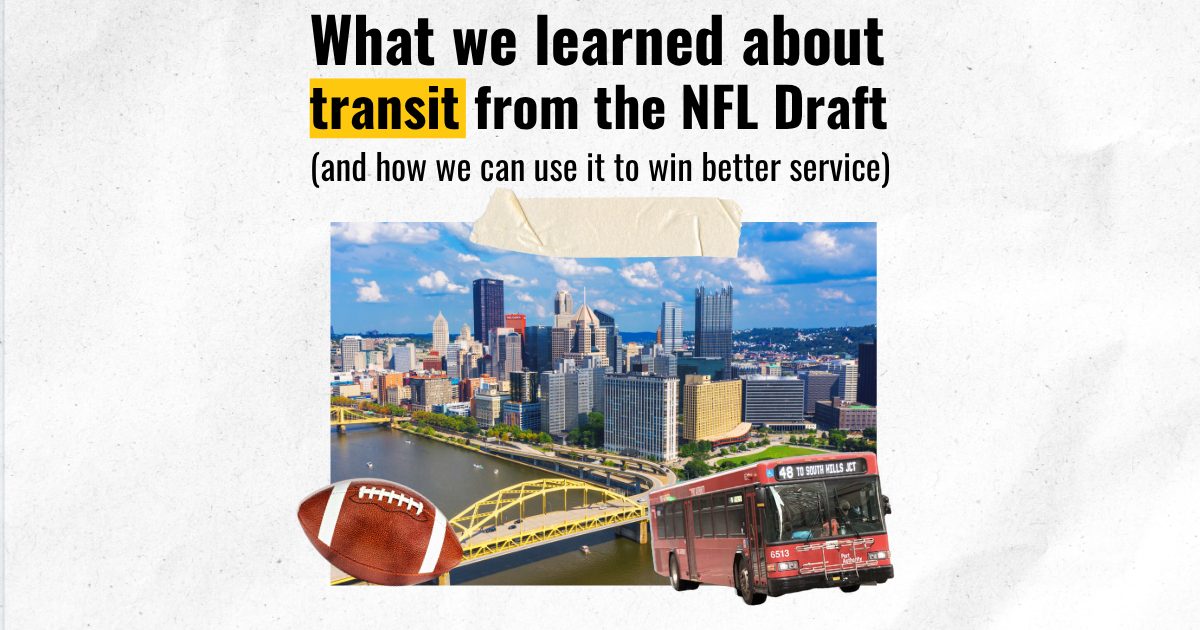
What we learned about transit from the NFL Draft (and how we can use it to win better service)
Image Description: photo of Downtown Pittsburgh taped on a paper background, with stickers of a football and a red PRT bus.
New data shows that transit was the star of the NFL Draft—here’s what we learned (and how we can use it to win better transit in the future)!
- Public transit is the reason the Draft succeeded!
Event buses were full, and the roads were free of traffic. Places that had transit access to the Draft grew crowds; places without it, didn’t. - It pays to pay transit workers!
Operators were paid higher wages for working a strenuous event, and they did a fabulous job. We can, and should, pay essential workers according to their high value. - Free fares = better service, higher ridership!
They reduce barriers to entry, increase access for low-income riders, and even saves time en-route. Sheetz, the Pittsburgh Organizing Committee and The Pittsburgh Foundation paid the T and “football flyers” fares, so PRT lost no money. Plus, higher ridership actually generates more revenue for PRT (thanks to state funding laws).
Free fares can be implemented for more than just special event attendees; it can benefit low-income riders AND the agency. - People love taking the bus—when it’s easy!
Draft service was direct, frequent, clearly communicated, and easily understandable. And it paid off for almost 485,000 rides! - Big events like this would not be possible without a functional, accessible, affordable transit system—all the time.
We don’t need to wait for the next big event to roll around to build and fund a transit system that works for our city. We can build one that generates economic benefits, now, for our city. - Promoting transit works!
PRT, the Mayor, and the County Executive—not to mention Visit Pittsburgh, local news outlets, and local influencers—regularly promoted the benefits of transit, and urged visitors to hop on the bus to avoid congestion and high parking costs. And it worked! - The true cost of parking is high!
Driving, finding a parking spot, and paying for it was inconvenient for Draft visitors—and it’s still inconvenient for everyday commuters. If given reliable, affordable, frequent transit options, people won’t choose to add congestion or pollution to our roads.
The post What we learned about transit from the NFL Draft (and how we can use it to win better service) appeared first on Pittsburghers for Public Transit.
Communities Most Harmed by PRT’s Draft 2.0 Bus Line Refresh
Whether you live in McKeesport or McKees Rocks, the Hill District or the South Hills, our public transit system needs to work for everyone.
Pittsburgh Regional Transit (PRT) will soon close their community engagement period for the second draft of their Bus Line Redesign (BLR). The redesign proposes a completely redrawn map of where transit routes will run. It includes new schedules for how frequently and how late at night buses and trains operate, and even proposes renaming all the routes in the system.
Tens of thousands of people who use the system every day will be affected. Allegheny County Transit riders, transit workers, businesses, social service providers—we all have a stake in a Bus Line Redesign that works for all.
The Bus Line Refresh plan is complicated and will affect everyone differently. That’s why it’s very important that transit riders and transit workers review your routes and give feedback now! You can check out how your routes will be impacted and give feedback online, by phone, or at an upcoming PRT community event here.
This is the last opportunity for the public to weigh in before PRT finalizes and ratifies this transit plan- one that will impact our transit service for generations!
Join other transit riders to speak up about impacts of the Bus Line Refresh Draft 2.0 – the good and the bad – at our press conference and public testimony on Friday, 5/29 at 8:30 am at Pittsburgh Regional Transit’s Board meeting.
RSVP Today (Public Testimony Deadline is 5/27) The Communities Slated for the Greatest Transit Losses under PRT’s Bus Line Refresh 2.0Under the Bus Line Refresh Draft 2.0, some communities are being proposed for transit service improvements with higher frequency service or new direct connections to critical destinations. Other communities will see transit service cuts- this is the consequence of Pittsburgh Regional Transit deciding to develop a “cost-neutral” plan rather than a more visionary proposal for service restoration and expansion.
In the coming days, we will publish a proposed list of transit service improvements under the BLR 2.0, but right now, it’s most important that transit riders who are slated to lose access to all transit service get a chance to review and respond to the plan.
Below, we lay out the communities in which transit service currently exists, but under the proposed Bus Line Refresh Draft 2.0 will be left little to no service.
We used existing route numbers (not the route numbers proposed in the new plan) to help riders identify whether they will be impacted. Routes are listed numerically regardless of alpha-prefix.
- 2/P13 – Shaler: Mt Royal Blvd – 15101
- 2/O5/P13 – McCandless: Ferguson Rd, Sample Rd – 15101, 15237
- 4/7 – Reserve Township – 15212
- O5 – Ross Township: Thompson Run Rd – 15237
- 6/7/15 – Summer Hill – 15214
- O12 – Perry Highway North – 15237
- 14/18 – Lower Half of Chateau/Manchester – 15233
- 20 – Groveton/Kennedy Township: Herbst Rd – 15108
- 27 – Windgap/Middletown: Segments on Middletown Rd and outer Chartiers Ave – 15204/15205
- 28X – Robinson Town Center and 5th Ave in Shadyside – 15205
- 36 – Mount Lebanon: Cedar Blvd to South Hills Village – 15228
- 36 – Banksville Rd transit service eliminated off-peak and weekends – 15216
- 38 – Wynnecliff Manor in Scott Township – 15220
- 39 – Ebenshire Village in Brookline – 15226
- 40/43 – Kathleen St/Beltzhoover Ave/Boggs Ave in the North side of Warrington – 15210/15211
- 44 – North Baldwin – 15236, 15227
- Y45 – Baldwin/Whitehall/South Park – 15236
- 52L – West Mifflin: Homeville Rd and Duquesne Village Shopping Center – 15122
- 54 – Bon Air – 15210
- 55/P76 – East McKeesport – 15131
- 65/74 – Squirrel Hill: Shady Ave, Beechwood Blvd – 15217
- 74 – Point Breeze: Reynolds St – 15208
- 77/P16 – Penn Hills/Plum: Hulton Arbors – 15235, 15239
- 77/P16 – Penn Hills: Monroeville Trestle Rd and Saltsburg Rd, North Bessemer, Leechburg Rd – 15235
- 79/P17 – Lincoln Park: Mark Drive, Grove Rd, Chaske St, Mt Carmel Rd – 15206/15235/15147
- P76 – White Oak: Rt 48 corridor – 15131
- P76 – North Versailles: Rt 30 beyond Walmart – 15235
Some current bus lines are being broken up into 2 or 3 different routes. For riders on these routes, that might mean new transfers where you currently have a direct trip.
Riders can go toFind My Route on the PRT Bus Line Refresh website to look at how your commute will be impacted, if at all.
We know that 84% of transit trips today taken by PRT riders who use a CONNECT card are direct trips, completed without having to transfer. New transfers can add additional significant time to commutes, can add uncertainty around timing to get to our destinations and more exposure to the elements. Moreover, transit riders who pay with cash will have to pay an additional fare for each additional transfer. We know that riders strongly prefer direct trips over trips requiring a transfer, and so want to ensure that riders have a chance to see and respond to these substantial changes.
Below we list current routes in numerical order, regardless of alpha-prefix, and the point in the route where they have been severed:
- 1 Freeport Rd at the Waterworks Mall
- 13 Bellevue/14 Ohio River Blvd/17 Shadeland have been segmented and reassembled in various ways
- 21 Coraopolis – Coraopolis to Moon/Sewickley
- 31 Bridgeville at Carnegie Station
- 41 Bower Hill: Washington Rd at Bower Hill Rd
- 54 N Side-Oakland-S Side – Lawrenceville/Bloomfield to South Side/Mount Oliver/Beltzhoover/Bon Air
- 59 Mon Valley – across the Monongahela River
- 67 Monroeville – Oakland/Squirrel Hill to Monroeville/CCAC Boyce
- 69 Trafford – Oakland/Squirrel Hill to Forest Hills/Wilmerding/Pitcairn
- 69 Trafford – to Forbes Hospital
- 74 Homewood-Squirrel Hill Squirrel Hill to Larimer
- 75 Ellsworth – to South Side Works
- 81 Oak Hill/83 Bedford Hill – connections to Hill District Business Area (Centre-Devilliers)
- 87 Friendship – Bloomfield/Friendship to Morningside/Stanton Hts/Upper Lawrenceville
- 93 Lawrenceville-Oakland-Hazelwood – Lawrenceville/Bloomfield to Greenfield/Hazelwood
- P10/1 – Extend all N1 trips from East Liberty to Downtown to avoid forced transfer
- Y47 Curry Flyer from Keeport-Knoedler to Walmart
Join other transit riders to speak up about impacts of the Bus Line Refresh Draft 2.0 – the good and the bad – at our press conference and public testimony on Friday, 5/29 at 8:30 am at Pittsburgh Regional Transit’s Board meeting.
RSVP Today (Public Testimony Deadline is 5/27)The post Communities Most Harmed by PRT’s Draft 2.0 Bus Line Refresh appeared first on Pittsburghers for Public Transit.
SINGING THE SONGS OF THE SOIL – with Tilly Gomersall of Cân y Pridd
The post SINGING THE SONGS OF THE SOIL – with Tilly Gomersall of Cân y Pridd appeared first on Landworkers Alliance.
In Loving Memory of Carlo Petrini
With deep sorrow, we receive the news of the passing of Carlo Petrini, dear friend, fellow traveler, and an unwavering voice in the defense of the Earth, of food, and of living communities.
For decades, we walked together in shared struggles: for biodiversity, for seed freedom, for the dignity of small farmers, and for a food system rooted in care, justice, and the sacred relationship between human beings and nature. Through Terra Madre, Slow Food, and the many global networks Carlo helped to nurture, millions have reawakened to the understanding that food is a commons, and that cultural and ecological diversity are the very foundations of peace and true democracy.
Carlo embodied the rare ability to root himself deeply in place while holding a planetary vision. He gave voice to peasants, seed keepers, artisanal producers, and to the communities who courageously defend the Earth against an extractive and destructive industrial model. Together, we shared gatherings, dialogues, international forums, and moments of collective mobilization, affirming that the future of humanity depends on our capacity to protect biodiversity and to regenerate the living bonds between people and the Earth.
I carry a vivid memory of his participation in the International Commission on the Future of Food and Agriculture, initiated by Claudio Martini, then President of the Tuscany Region. From this meeting, in 2008, the Manifesto for the Future of Food was born.
His legacy will live on in the seeds of hope he has sown across the world, in the webs of solidarity he helped to weave, and in the new generations who will carry this journey forward, for food that is good, clean, and just.
My heart is with his family, the Slow Food community, and all those who loved him.
Vandana Shiva
President of Navdanya International
photo credit: identitagolose.com
Amid Canada’s massive housing and infrastructure build-out, a few changes can limit climate impact at little or no cost: report
TORONTO — “Build Canada Strong” is a central mantra of the federal government’s plans to bolster Canada’s economy in a rapidly changing world, with new housing and infrastructure key to Canada’s nation-building efforts. But all this construction poses a problem: the production of building materials can be a huge source of emissions.
Thankfully, there are solutions that can reduce this downside, at little or no extra cost—while also supporting Canadian industry, as a new report, Build Canada Clean, from Clean Energy Canada reveals.
The report, which features case studies from across the country—from apartment buildings to roads to wastewater facilities—finds that lower-carbon construction materials can generally be procured at no or marginal cost increases, while simple design changes can further minimize cost and emissions. One case study of an apartment building in Quebec, for example, found that design changes and lower-carbon materials could cut construction emissions by 30% while reducing overall construction costs by 12%.
What’s more, Canadian manufacturers are already producing many of the lower-carbon alternatives required, such as steel produced in electric arc furnaces, concrete that uses industrial byproducts to replace cement, and reclaimed asphalt. Supporting this kind of construction presents a unique opportunity for Canada to build its market at a time when our key trade partners, like the EU, are actively seeking cleaner products.
Governments are key to ensuring we seize this opportunity. They are big builders and by requiring lower-carbon materials and design—an approach known as “Buy Clean”—they can create a strong demand signal. The federal government has already taken some steps to reduce carbon in its building projects, and has also recently introduced a “Buy Canadian” approach. Expanded Buy Clean policies sitting alongside Buy Canadian ones would allow us to support domestic producers while also incentivizing our industries to become more climate-competitive in a global trade environment increasingly prioritizing or requiring cleaner materials.
Beyond “Buy Clean,” some simple regulatory changes can make a big difference, as the report elaborates. There are many different codes and standards for infrastructure construction across the country, some of which needlessly restrict the use of lower-carbon materials or design practices. Where flexibility does exist to use more recycled or other lower-carbon materials, it isn’t always made use of—something that could be addressed with better procurement guidance.
As we build more projects, we have the opportunity to avoid locking in huge amounts of damaging emissions—all while cutting costs for developers and taxpayers alike. So while we “Build Canada Strong,” let’s also “Build Canada Clean.”
KEY FACTS- The construction sector contributed over 8% of Canada’s total emissions in 2018. And that was at less than a third of the housing starts Canada actually needs.
- For efficient, electrified buildings, the emissions associated with material production and construction, known as “embodied carbon,” usually accounts for a larger portion of lifecycle carbon emissions than those from operation, like heating and cooling.
- The global low-carbon construction materials market is expected to be worth US$579 billion in 2032, with trade partners, including the EU, increasingly looking for clean materials.
- Through nine roadway case studies, we show that lifetime emissions reductions of between 17% and 31% could be achieved while reducing the per-metre cost of the roads by up to 16%.
- A study of an apartment building in Quebec found that making just two changes to the building design and replacing materials with lower-carbon equivalents would reduce embodied emissions by 30% while reducing overall construction costs by 12%.
- Choosing lower-carbon material options for water infrastructure can reduce the emissions of stormwater and wastewater infrastructure with marginal cost impacts.
Report | Build Canada Clean
The post Amid Canada’s massive housing and infrastructure build-out, a few changes can limit climate impact at little or no cost: report appeared first on Clean Energy Canada.
Response: New BC Hydro plan maintains key programs, but the province and utility are leaving larger household savings on the table
VICTORIA — Evan Pivnick, associate director of public affairs at Clean Energy Canada, released a statement in response to BC Hydro’s release of its new energy efficiency strategy, Power Smart 2.0:
“BC Hydro has a strong history of using energy conservation to reduce electricity use in B.C. as well as prepare for the growing demands for electrification. However, while this new plan makes meaningful investments and continues in this tradition, it falls short of fully harnessing the opportunities that household technologies have to save families—and BC Hydro—money.
“A recent study from Dunsky Energy + Climate Advisors found that distributed energy resources (electric technologies that can generate or store energy or control demand) could meet more than 10% of B.C.’s total peak electricity demand by 2040, saving ratepayers money by avoiding more expensive infrastructure build-outs while improving grid reliability.
“As such, it’s good to see support for consumers to adopt clean solutions, from energy-efficient appliances to battery storage, that help realize this potential. But this is only a first step. B.C needs to follow the lead of other jurisdictions across North America that are going much further in advancing changes to their electricity systems and standing up new programs that can help households save on their energy bills.
“Beyond energy-efficient appliances, new technologies have unlocked much greater opportunities to save, like managed EV charging, smart panels, controllable water heaters, and household batteries that work in harmony with the grid. The new plan lays out a vision for using these technologies, but more should be done to encourage British Columbians to make the switch. The Dunsky study found that greater financial incentives, like rebates, and other ambitious installation programs, were key to realizing the full potential of distributed energy resources for reducing both household bills and costs to the utility.
“What’s more, heat pumps will be vital to reducing power demand, offering the ability to displace power-hungry baseboard heating and air conditioning. With another hot summer around the corner, the provincial government should introduce regulations that ensure new permanent air conditioning systems are heat pumps. Our analysis shows that a province-wide switch to heat pumps could save a cumulative $675 million in annual energy bills: that translates to average savings of approximately $170 a year for those currently using natural gas with A/C.
“Already, B.C. has some of the lowest electricity rates in North America, making the switch to EVs and household electrification especially enticing for British Columbians. And while today represents a positive step, at a moment when the cost of living is top of mind for most families, there is much more we could be doing to lower electricity bills across the province—while simultaneously building a smarter, more cost-efficient electricity system.”
The post Response: New BC Hydro plan maintains key programs, but the province and utility are leaving larger household savings on the table appeared first on Clean Energy Canada.
Notes on Isla Grande: Figurations of Environmental Violence and Beauty in the Colombian Caribbean
By Gracia Ramirez and David Vergara-Moreno
This photo essay looks at Isla Grande, the largest coralline island of Nuestra Señora del Rosario Archipelago, which is part of the Parque Nacional Natural Corales del Rosario y de San Bernardo, in the Colombian Caribbean. The essay considers the environmental beauty and the violence that underpin Black lives on the island, and the ways in which they have resisted as a community to go forward into the future.
DOCKSLa Bodeguita dock in Cartagena de Indias is the tourists’ gateway to the promised paradise of white-sand beaches and turquoise waters of the Rosario Islands. The docks and other hard boundaries of the port witness an encounter with the polluted waters around Cartagena. This port is responsible for 70% of the country’s maritime trade and has been categorized as the third most efficient port in the world.
Although rarely mentioned by the early chroniclers, it is reasonable to infer that —prior to and during the early centuries of colonization— Cartagena’s Bay was a lush mosaic of abundant coral reefs, dense mangrove forests, and towering tropical dry forest trees.
Today, however, the bay reveals another face: murky waters, laden with sediments, polluted by centuries of maritime traffic, urban and industrial waste, and dredging works that have radically transformed its ecological cycles.
While the departure of tourism to the islands is mainly managed from La Bodeguita dock, the journey out of the bay and into the sea allows visual contact with other docks along the coast.
This is a layered cartography of memories, economies, and spatial regimes: tourist piers, logistical cargo yards, shipyards, naval bases, and private marinas. The bay is not merely a coastal landscape, it is a friction zone between multiple socio-economic and political logics: tourism, military operations, goods trade, and the communities whose ways of life are subordinated to those regimes. This is a liquid frontier: a place of circulation, exclusion, and resistance.
LOGISTICSThe archipelago of the Rosario Islands is connected not just to the Atlantic but also to another body of water, the Canal del Dique. The Spanish colonizers began its construction in the 16th century using enslaved Indigenous and African labor, with the goal of linking the Magdalena River —the nation’s main fluvial artery— with the Cartagena Bay.
Map of the Northern part of Bolívar Department, Republic of Colombia 1886-1903 (Edward Stanford, 1899, cropped). It is possible to see Cartagena de Indias, Barú island below, the Canal del Dique and the Calamar-Cartagena Railway (red line). Source: Mapoteca Biblioteca Nacional de Colombia.
Since then, the Canal has played a strategic role in both domestic and foreign transport and trade, evolving from wooden barges in the 17th century, to the advent of steam-powered boats in the 19th century.
For over three centuries, the Magdalena River and its canal were the only connection between Colombia’s Caribbean and its Andean provinces, linking a nation divided by three mountain ranges and a wide variety of thermal floors and ecosystems. Socially, the Canal became the route to freedom, as many runaway enslaved people (cimarrones) followed its waterways and founded Maroons communities (palenques) in the surrounding wetlands and hills during the 17th and 18th centuries.
Until the late 19th century, the Dique was merely a narrow, shallow ditch less than 15 meters wide, which was impossible to navigate during droughts. But throughout the 20th century, the canal was radically transformed. U.S. companies carried out major dredging and straightening projects that widened it to 100 meters, reducing its original 270 meanders to only 55, dramatically increasing its flow and sediment loads, altering the ecological balance of Cartagena and Barbacoas Bays and surroundings.
Despite these efforts, the canal became almost obsolete after the construction of two major highways that linked the Caribbean to the Andean region of the country in the 1950s. However, around the same time, Colombia’s largest oil refineries were established in Barrancabermeja and Cartagena.
As human geographer Austin Zeiderman argues, such infrastructures articulate geo-racial regimes and hierarchies of white and black, urban and peripheral, central and insular, that become sedimented into both Cartagenian landscapes and bodies.
MATERIALSExcavations on the ground reveal the coralline stone, compacted after centuries of pressure and erosion. Isla Grande is a coral reef fossil itself. Coral reefs are vital ecosystems: they protect shorelines from storms, sustain local fisheries, support biodiversity, and form the ecological backbone of a tourism industry that underpins much of Cartagena city’s economy. Yet their very skeletons have been quarried and consumed. Entire islets were built for elite leisure by filling the sea with broken coral, the moneyed class literally manufacturing new islands from the bones of the reef.
Coral grounds. Photo by Gracia Ramirez.
The Canal del Dique continues this slow and silent violence. Each rainy season, it expels plumes of sediment-laden freshwater that spread across several square kilometers, covering turquoise waters with brown stains. These pulses reduce salinity and block light, suffocating photosynthesis and interrupting coral reproduction cycles that coincide with the wet months. In fact, the deposits of sediment have turned the formerly island of Barú into a peninsula, following the interventions of USA engineering companies in the twentieth century.
The history of Isla Grande is intimately linked to that of Barú. Around the time of the Spanish colonization, these territories were called Bahaire after the indigenous chief that ruled them before the conquest. The Spaniards used enslaved labour to excavate quarries in Barú and Tierra Bomba, extracting coralline stone used in Cartagena’s colonial architecture. They also built kilns to burn coral stone, producing mortar for the city’s fortifications and lime for its characteristics whitewashed walls.
In the eighteenth century, the nearby island of Barú became a strategic point for cimarrones and Dutch and English smugglers who used enslaved workforce for the logistics related to trafficking. Some enslaved workers, in turn, were secretly saving money to buy their freedom to their masters –mostly Spaniards–.
Over the nineteenth century, with the crisis of slavery and the independence wars, Barú became an instance of a horizontal community formed mostly by cimarrones, freed slaves and mestizos. Their economy was based on subsistence agriculture, fishing, bartering and mutual support.
Wooden house. Photo by Gracia Ramirez.
On June 7 of 1850, groups of neighbours from Barú bought an old hacienda to its then owner for 1.200 COP and finished their payment on May 19, 1851. Just two days later, the abolition of slavery was signed in the country. Thus, Barú become a Black community with collective property before the establishment of the modern-day Republican State. Coconut became the main crop and some families from Barú moved to the neighbouring Rosario Islands to extend the plantations.
Islander dwellings echo this layered material history. Traditional houses rely on wooden boards and palm-thatched roofs, fragile yet renewable. Modern constructions import thin red bricks and cement from the mainland, materials that, as they degrade, seep into the calcareous soil and alter its composition.
Seashell. Photo by David Vergara.
Cement itself is ambivalent: it raises luxury resorts that displace the community, yet it also fortifies schools and homes through collective labor. In their very texture, these materials tell two stories at once—of extraction and restriction, but also of resilience and re-creation.
ORIKARight at the centre of Isla Grande is now the town of Orika. An old rubber tree guards the town’s square and provides shelter from the sun. The Cultural House is the gathering place where local council meetings (juntas) take place. The story of Orika is one of socioecological struggle and resistance.
Over the twentieth century, Barú started supplying agricultural goods to the growing Cartagena population, shifting toward intensive production of coconut, fish and mangrove charcoal. Up until the 1950s –when roads were constructed to connect Cartagena with other inland cities– the Rosario islands and Barú were the main providers of food sold at the city’s Getsemani market.
Rubber Tree in Benkos Biohó Square, Orika, Isla Grande, PNNCRSB. Photo by Gracia Ramirez.
The first tourists were members of Cartagena’s urban elite. They arrived at the Rosario Islands between the 1930s and 1940s and started building recreational homes. While tourist infrastructure was consolidating around Cartagena and the islands, a beetle plague destroyed the coconut plantations in the 1950s.
In order to “protect” the islands, the government declared them National Natural Park in 1977, but the National Park mainly considered the sea, not the ground islands themselves. The decree sought to “conserve flora, fauna, landscapes, and historical and cultural manifestations with scientific, recreative or aesthetic goals”, but omitted any mention of the Blacks communities that already inhabited the territory (Rosario Islands, Barú, Santa Ana and Ararca).
New prohibitionist environmental policies, coupled with the rise of tourism, relegated local families to the hinterlands of Isla Grande and to the backs of hotels and resorts, where they worked as subordinate labor.
In the 1980s, the government declared the Rosario Islands to be State-owned vacant lands, unrecognising the community as a “organized population” for the use of land but allowing other economical uses such as tourism and recreation. This enabled a wave of land grabs by private investors that further marginalised the community. However, the 1991 Constitution and the ensuing law 70 of Black Communities of 1993 provided legal tools to transform the memory of dispossession into a fight for recognition.
The community used environmental education programs to strengthen social organizations and articulate their historical demands into a juridical argument. In 2001, after years of legal limbo, the Colombian state began the land restitution process.
Fearing expulsion from the territory, the families decided to establish a new village in the center of Isla Grande: Orika, in honor of the daughter of Benkos Biohó, a cimarron leader and hero of San Basilio de Palenque, the first Black free village in the Americas (1714). In just two months, the community cleared the land and built their houses, a gesture of dignity and memory, affirming their right to exist as a Black community in their ancestral territory. After collecting evidence and going through endless administrative hurdles, in 2014 the Constitutional Court recognized the collective deed title for the Black community of Isla Grande, becoming the only community having achieved that so far within the national park.
UNBOUNDEDNESSSunset horizons and native trees may meet the tourist’s gaze as landscapes ready for easy consumption— postcards of “untouched nature.” Yet the town of Orika unsettles this commodified view. Its soundscape resists containment: sound systems (picós) blasting loud music reverberates from the main square, echoing through every coralline ground cavity, vibrating as much in bodies as in stone.
In language, too, survival leaves its trace. The word Dios circulates as the name of the Christian god, but within it hides the untranslatable presence of African spirits, invoked yet unconfined by letters. This is not syncretism as tourist folklore, but the deep mimicry of African cosmologies that persisted beneath colonial surveillance.
In the Colombian Caribbean, enslaved Africans lived not in the vast monocultures of the sugar plantations of Brazil or Cuba, but in smaller, multiethnic communities tied to haciendas, cattle ranches, mines, and urban centres under the close watch of the Inquisition tribunal of Cartagena.
Cut off early from eighteen century renewed arrivals of African captives, these populations developed distinctive spiritual practices, an instance of what Sylvia Wynter called “black indigenization”— that in intertwining African, indigenous, and Christian forms, found ways of being human when colonial hegemony ruled otherwise.
Orika inhabits this layered spiritual geography. It is not simply a village bounded by its streets, but a porous space where music, light, and faith exceed enclosure—an unlimited terrain of survival, memory, and reinvention.
ROOTSMangrove forests form the living roots of Isla Grande. They are among the most resilient trees on Earth—thriving where others would perish. Their bodies adapt to saline soils and shifting tides, standing firm where land is not yet land.
Propagules germinate while still attached to the parent tree, dropping into the water as living seedlings that drift across lagoons and channels, anchoring themselves wherever conditions allow. Each root is a promise of survival, each forest a nursery that shelters fish, crabs, and birds in any of their stages of life. Mangroves breathe through aerial roots that rise above the mud, searching for oxygen in conditions too harsh for most species. Always green, they embody endurance.
The mangrove is never alone. Its leaves, roots, and fallen branches decompose into nutrients that sustain fish and crustaceans; its tangled roots interlace with seagrass meadows and coral reefs in a single inter-ecosystemic web. Together, these systems form the ecological triangle of the Caribbean coast: corals buffer waves, seagrasses filter and stabilize sediments, mangroves hold the shoreline while feeding both sea and land. In Isla Grande, these roots not only prevent erosion but also connect the island’s fragile ecology to Cartagena’s coastal mangroves, weaving life across waters.
For Orika, the mangrove is more than ecology—it is a metaphor for community. Like the red mangrove that elevates itself above its roots, the people rise from centuries of exclusion, rooted yet expansive. Their history drifts like propagules, carried by tides of resistance until finding ground to grow.
The mangrove teaches resilience, interconnection, and renewal: lessons for a community that continues to defend its territory while imagining futures where culture and ecology flourish together. Roots here are not only in soil, but in memory and struggle, anchoring Orika to both the Caribbean Sea and to its own unfolding horizon.
DRIFTThere are no roads in Isla Grande, only sandy footpaths weaving through the tropical dry forest and the mangroves. No motorized vehicles circulate within the island, people walk or ride bicycles, while boats and yachts, arriving from Cartagena, leave trails of oil shimmering over the turquoise surface.
Caribbean Sea water around Isla Grande. Photo by Gracia Ramirez.
Plastic bottles and rubbish drift ashore, carried by tides that remember more than the islanders would wish. Drift here is both material and historical: traces of empire, slavery, tourism, and extraction wash against the reef, staining waters once clear. The islands themselves are a coral body in constant erosion and recomposition, a living drift of stone, memory, and survival.
Plastic and vegetable waste. Photo by Gracia Ramirez.
Yet drift is not only decline—it is also possibility. Orika, born out of dispossession, has become a node of reorganization and creativity. The community council anchors collective life, negotiating with agencies and hotels that now contribute resources for communal projects.
Every weekend, and on national and local holidays, happiness brightens the whole town in shared spaces like the main Plaza (Benkos Biohó Plaza), the picós, the cockpits, houses and the Casa Cultural. A new foundation works with children and youth, teaching them to stage traditional dances and music, reweaving ancestral ties to the palenques and to African rhythms long suppressed.
Ecotourism initiatives, led by younger generations, form alliances with older community projects, offering alternatives that value culture and ecology together.
Buildings around Benkos Biohó Square in Orika. Photo by Gracia Ramirez.
Drift, then, also gestures toward a different horizon. In Orika, the tides carry not only the weight of history but also the seeds of futures yet to come. The Rosario Islands are a historical drift still evolving—where coral, memory, and community recombine into new forms of life.
The post Notes on Isla Grande: Figurations of Environmental Violence and Beauty in the Colombian Caribbean appeared first on Undisciplined Environments.
A Canada-led clean trade pact would show that middle powers mean business
Prime Minister Mark Carney has won deserved praise for standing firm against the Trump administration’s threats and imposition of tariffs. But political credit is only as good as the strategy that follows, and Canada now faces a genuine opportunity to do something more ambitious than weather the storm.
Carney’s approach has sparked a broader conversation among the world’s ‘middle powers’ – countries with significant economies like Japan, South Korea, Australia, and the U.K. that share a commitment to rules-based trade but sit outside the U.S.-China superpower axis. These are countries that are actively looking for a different economic path forward, one that doesn’t simply mirror the nationalism coming out of Washington and Beijing.
Keep reading this post, co-authored by Ryan Mulholland and Ollie Sheldrick, in Policy Options.
The post A Canada-led clean trade pact would show that middle powers mean business appeared first on Clean Energy Canada.
May 14, 2026: See CBS TV coverage of Greenaction Blasting Navy’s latest radioactive scandal at Hunters Point Naval Shipyard Superfund Site
May 14, 2026:
See CBS TV coverage of
Greenaction Blasting Navy’s latest radioactive scandal at Hunters Point Naval Shipyard Superfund Site
Pages
The Fine Print I:
Disclaimer: The views expressed on this site are not the official position of the IWW (or even the IWW’s EUC) unless otherwise indicated and do not necessarily represent the views of anyone but the author’s, nor should it be assumed that any of these authors automatically support the IWW or endorse any of its positions.
Further: the inclusion of a link on our site (other than the link to the main IWW site) does not imply endorsement by or an alliance with the IWW. These sites have been chosen by our members due to their perceived relevance to the IWW EUC and are included here for informational purposes only. If you have any suggestions or comments on any of the links included (or not included) above, please contact us.
The Fine Print II:
Fair Use Notice: The material on this site is provided for educational and informational purposes. It may contain copyrighted material the use of which has not always been specifically authorized by the copyright owner. It is being made available in an effort to advance the understanding of scientific, environmental, economic, social justice and human rights issues etc.
It is believed that this constitutes a 'fair use' of any such copyrighted material as provided for in section 107 of the US Copyright Law. In accordance with Title 17 U.S.C. Section 107, the material on this site is distributed without profit to those who have an interest in using the included information for research and educational purposes. If you wish to use copyrighted material from this site for purposes of your own that go beyond 'fair use', you must obtain permission from the copyright owner. The information on this site does not constitute legal or technical advice.
 This site is not the official webpage of the Industrial Workers of the World.