You are here
News Feeds
“Alligator Alcatraz” officially closing
Florida officials announced the closure of “Alligator Alcatraz” on June 25, 2026.
The federal government, with the support of the State of Florida, constructed and operated Alligator Alcatraz in violation of the sovereign rights of the Miccosukee Tribe, who took the government to court for illegally constructing the center without their consultation or consent.
As Native peoples, we have a sacred obligation passed down from our ancestors to care for the land and everyone who depends on it. The construction of the detention center in Florida was on the ancestral lands of the Miccosukee Tribe. The buildings endangered delicate and protected ecosystems. Alligator Alcatraz put thousands of immigrants at risk. The reported filthy and unsafe conditions were a violation of the human rights of immigrants and their families.
The administration’s violent crackdown on migrant communities is an affront to all we stand for as Native peoples. We are opposed to any government operation that violates the human rights of our neighbors and all who reside on this land. As we saw in Minneapolis earlier this year, ICE operations operate with little to no oversight or safeguards, acting illegally in many cases. Multiple people, including babies, have died in, or as a result of, ICE custody. This must end.
The closure of Alligator Alcatraz is a victory for human rights and Tribal Sovereignty, but we want to see an end to all inhumane and unlawful detention of our neighbors who are simply trying to live, work, and raise their families.
This story was originally published in Native News Online.
The post “Alligator Alcatraz” officially closing appeared first on Native Organizers Alliance.
Court Upholds Life-Saving National Soot Air Quality Standard
Today, the U.S. Court of Appeals for the D.C. Circuit upheld the national, health-based limit on fine particulate matter (PM2.5), also known as soot, that the Environmental Protection Agency (EPA) strengthened in 2024.
Soot, made up of tiny toxic particles that lodge deep in the lungs, results in severe health harms, including premature death, and comes from sources like vehicle exhaust pipes, power plants, and factories.
The National Ambient Air Quality Standards (NAAQS) for PM2.5 set baseline national air quality standards to reduce the harms of this deadly air pollutant for communities across the country. Last year, in an unprecedented move, Trump’s EPA gave up defending the strengthened standard against challenges from industry and aligned states and asked the court to strike it down on narrow legal grounds, without ever disputing the science underlying the standard. Health, environmental, and community groups, along with a coalition of states led by California, continued to defend the standard.
“Clean air is not a luxury. We are thrilled these vital air quality standards have been upheld by a federal court,” said Patrice Simms, vice president of Healthy Communities at Earthjustice. “The 2024 soot standard is a critical advancement for public health, projected to save thousands of lives every year. Lee Zeldin’s EPA must stop catering to polluters and must instead fulfill its mission to protect public health. The time for implementing the 2024 soot standard is now.”
“Fine particulate matter standards provide critical public health protections. The court correctly rejected EPA’s about-face on the need for a stronger standard,” said Shaun Goho, senior director, Legal Advocacy at Clean Air Task Force. “The science is clear that soot has many serious health impacts, particularly for children, the elderly, and those with asthma. By EPA’s own estimate, implementing the 2024 soot standard will prevent 800,000 cases of asthma symptoms, 2,000 hospital visits, and 4,500 premature deaths in 2032. Today marks an important step in the right direction, but EPA must now implement the 2024 standard without delay.”
“The federal court’s decision to uphold the 2024 strengthened particle pollution standard is a win for public health,” said Katie Huffling, DNP, RN, CNM, FAAN, executive director, Alliance of Nurses for Healthy Environments. “Every day in practice, nurses witness and treat conditions made worse by soot pollution. From asthma exacerbations and chronic obstructive pulmonary disease to heart disease and preterm birth, nurses see the real-world health implications of toxic air pollution. The science shows stronger limits to reduce dangerous soot pollution provide significant health benefits for Americans, especially for those most vulnerable and those exposed to higher levels of particulate matter pollution. We now urge EPA to fully implement the strengthened standard to ensure those health benefits are realized.”
“Today’s federal court decision is good news for clean air in America and for the millions of people harmed by deadly soot,” said Noha Haggag, senior attorney for Environmental Defense Fund. “Soot can cause asthma attacks, lung cancer, and premature deaths. The court’s rejection of the Trump administration’s attempt to eliminate our national health standards for soot will mean healthier, longer lives for people across the country.”
“While the Trump EPA has dragged its heels, millions of Americans have kept breathing unhealthy air,” said Vijay Limaye, climate and health scientist at NRDC. Every day of delay means more premature deaths, more asthma attacks, and more hospitalizations. This decision removes any remaining doubt: the science has long been clear, and now the law is too. The Trump EPA must stop stalling and deliver the healthier air the science and the law demand.”
“The court did the right thing today by standing up for our health and safety,” said Rachel Briggs, Conservation Law Foundation staff attorney. “We should never put the polluting status-quo over people, especially when it fuels chronic respiratory and cardiac illnesses. We’ll never compromise when it comes to the safety of our neighbors, communities, and the low-income and Black and Brown families that continue to shoulder the worst of these toxins.”
BackgroundSoot is a lethal combination of metals, organic chemicals, and acidic substances so tiny that they can be easily inhaled into our lungs and delivered directly into our bloodstream. It threatens our health and environment — posing especially heightened risks for children, seniors and people with chronic illnesses. Among the health harms it is linked to are death, cardiovascular harms, new and exacerbated asthma cases, lung cancer, and serious neurological harms, like Alzheimer’s disease.
Under the Clean Air Act, the EPA has for decades set baseline national air quality standards for six harmful pollutants, including soot. In 2024 the agency strengthened the soot standard from 12 to 9 micrograms per cubic meter,
According to the EPA, the strengthened soot standard will result in significant public health net benefits that could be as high as $46 billion by 2032. The EPA’s estimate of costs is an order of magnitude less. Polluters’ exaggerated claims about costs have been repeatedly debunked.
After the agency strengthened the soot standard, corporations and attorneys general in allied states sued. Earthjustice, its clients and partners intervened to defend the strengthened soot standard. Earthjustice clients are Alliance of Nurses for Healthy Environments, American Lung Association, Environmental Defense Fund, NRDC (Natural Resources Defense Council), Northeast Ohio Community Resilience Centre (formerly the Northeast Ohio Black Health Coalition), Rio Grande International Study Center, and Sierra Club. Clean Air Task Force represents Citizens for Pennsylvania’s Future and Conservation Law Foundation.
A recent white paper found that 75 million people live in counties whose air quality violates the standard. The Clean Air Act mandated that the EPA formally identify the areas that violate the standard by Feb. 6, 2026. When EPA failed to meet that deadline, a group of health, environmental, and community groups, and a state coalition, sued to require it to obey the law. That key step will require pollution reductions in those areas, to bring them into compliance with the 2024 NAAQS.
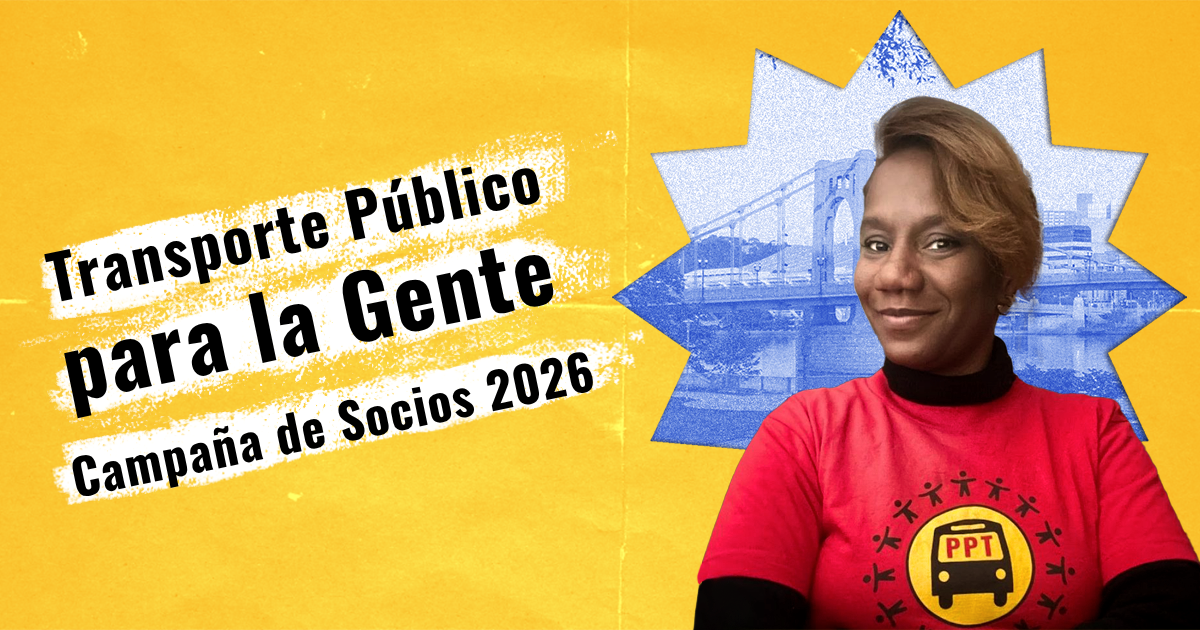
Transporte Público para la Gente: Únete a la campaña de Socios 2026
Me llamo Evelyn Ulysse Alcántara. Uso el transporte público a diario para ir al trabajo, al médico, actividades de ocio, reuniones, llevar a mi hijo al colegio— para todo.
Soy latina y mi inglés no es perfecto, así que cuando me mudé a Pittsburgh me costó usar el transporte público porque había muy poca información disponible en español. Por eso me ofrecí de voluntaria para ayudar como embajadora en los Recorridos de tránsito de PPT. Fue muy frustrante y aislante intentar aprender a usar el sistema de transporte público por mi cuenta. Sabía que si podía hacer algo para apoyar el aprendizaje de mi comunidad, ¡tenía que hacerlo!
Ser miembro de PPT no solo ha mejorado mis propias necesidades de transporte. Me abrió la puerta para ayudarme a marcar la diferencia.
Cuando hubo recortes en el transporte público en Beechview, hubo ocasiones en que el autobús o el Tren no venían—y no sabía la razón, porque los cambios sólo se comunicaban en inglés. Pero hoy, si vas a Steel Plaza o Wood Street Station, ¡escucharás anuncios en español! Y hay instrucciones paso a paso en español en la web de PRT. Esto se debe a que PPT y Casa San José se unieron para dar voz a mi comunidad, para que PRT pudiera entender el verdadero impacto que esto estaba teniendo en nosotros.
Este es el verdadero poder de PPT: realmente escuchan a la gente.
Cuando descubrí que PPT, me pedían testimonios sobre el papel que tiene el transporte público en la vida de las personas, para mostrar lo importante que sería un programa de media tarifa. Sabía que tenía que dar mi testimonio, porque necesitábamos actuar para mejorar el acceso. En aquel entonces solo era una idea y un proyecto, pero hoy es una realidad que lleva el servicio de transporte a la gente.
Me encanta el PPT porque sé de primera mano lo que podemos lograr juntos.
Solo en 2026:
- Llevamos a 120 miembros a Harrisburg para arrojar luz sobre la brecha presupuestaria de 80 millones de dólares y enfatizar la importancia de los servicios para tránsito y viajes compartidos para nuestros representantes.
- Compartimos habilidades y construimos poder con 170 personas de todo el país, compartimos habilidades y construyeron poder en nuestro Entrenamiento de Primavera 2026.
- Formamos a 13 becarios de organización comunitaria en toda la colina del barrio de PGH, y las regiones de Lancaster y Lehigh Valley en Pensilvania.
Por eso quería preguntar: ¿apoyarán el trabajo urgente de PPT haciéndote miembro que paga cuotas hoy?
Puedes apuntarte por solo 2,75 $, ¡el precio actual del billete de autobús del PRT! Ese dinero va directamente a la defensa de un presupuesto de transporte que mueve a TODOS los habitantes de Pensilvania. Todo el mundo merece acceso al transporte público.
¿Nos ayudarás a hacer realidad ese sueño?
The post Transporte Público para la Gente: Únete a la campaña de Socios 2026 appeared first on Pittsburghers for Public Transit.
How Trump and Burgum hijacked the Park Service and America’s birthday party
Kate and Aaron talk to Jayson O’Neill, a longtime public lands watchdog and Montanan who previously led the Western Values Project and now heads up a campaign called Save Our Parks. Jayson explains how the Trump administration is using the National Park Service to funnel money into Trump’s vanity projects in DC, as well as how President Donald Trump and Interior Secretary Doug Burgum subverted America250, an organization chartered by Congress to celebrate America’s upcoming 250th birthday.
News- National Park Entrance Fees Are Funding Trump’s D.C. Projects – New York Times
- Americans’ national parks passes will pay for Trump’s July 4 plans, documents show – Washington Post
- Mike Lee’s fast-track attempt to scrap this national monument’s management plan has failed – Salt Lake Tribune
- Judge orders Trump administration to restore signs changed at national parks – CNN
- Save Our Parks website
- Analysis: Reporting signs that “disparage” American history – CWP
- Watch this episode on YouTube
Produced by Aaron Weiss, Lauren Bogard, Kate Groetzinger, and Lilly Bock-Brownstein
Feedback: podcast@westernpriorities.org
Music: Purple Planet
Featured image: Photo of the Lincoln Memorial Reflecting Pool filled with algae; Source: Ali Khan/Wikimedia
The post How Trump and Burgum hijacked the Park Service and America’s birthday party appeared first on Center for Western Priorities.
Judge orders Trump officials to reinstall signs about history, climate in national parks
On Friday, a federal judge ordered the Trump administration to reinstall exhibits and signs that were removed as part of the administration’s efforts to silence American history in national parks.
The preliminary injunction comes as a result of efforts by a coalition of conservation advocates, which filed a challenge earlier this year to a U.S. Department of the Interior policy that is actively erasing history and science from national parks. The policy seeks to remove any signage that “disparages Americans,” but in practice, the administration removed signs that mentioned topics like slavery, Indigenous history, or climate change.
As part of the administration’s efforts, QR codes were put up at national parks across the country, directing visitors to report any signs that are “negative” about past or living Americans. A recent analysis from the Center for Western Priorities found that 99.9 percent of the comments defended historical accuracy, expressed support for the National Park Service, or pushed back against the order, while only 0.1 percent flagged a specific sign or supported sign removal.
According to U.S. District Judge Angel Kelley, removing these signs not only undermines “the integrity of the National Parks; it sets a dangerous precedent of censorship and sanitization.”
Mike Lee fails to scrap Grand Staircase-Escalante management planThe U.S. Senate missed the 60-day window that would have allowed lawmakers to scrap the management plan for Grand Staircase-Escalante National Monument in Utah. The effort, led by Senator Mike Lee and Representative Celeste Maloy, would have used the Congressional Review Act to reverse a management plan that took years of collaboration among Tribes, state and local governments, stakeholders, and the public.
“This is a major victory for the millions of Americans who care deeply about the Grand Staircase and for everyone who supports our nation’s wildest public lands and want to see them protected,” said Scott Braden, executive director of the Southern Utah Wilderness Alliance.
Quick hits Algae resurfaces in reflecting pool after multimillion-dollar fixes Judge orders Trump officials to re-install signs and exhibits at national parks on topics like slavery and climate changeAssociated Press | CNN | New York Times | NBC News | PBS News | CBS News | SFGATE | Los Angeles Times | Reuters
Feds to open tens of thousands of acres of Colorado wilderness to oil drilling Trump concedes a battle in his war against wind energy AI scans for wildfires, but in Arizona, humans are still on watch Senator Mike Lee says there should be consequences for states that sue over the Colorado River Trump leans on MAGA organizer to revive coal Do chainsaws belong in designated wilderness? Quote of the dayOften referred to as ‘America’s largest classroom,’ National Parks serve in that spirit by telling the stories both of those who write history and those who go unheard.”
—U.S. District Judge Angel Kelley
Picture This @goldengatecanyoncpwBaby moose are 90% legs and 10% vibes.
Remember, a baby moose often means mom is close by, and she’s not looking for new friends. Give moose plenty of space, leash your dogs, and admire from a distance.
: CPW/ Park Maintenance Brian
(Featured image: Metate Arch in Grand Staircase-Escalante National Monument near Escalante, Utah. Photo by John Fowler, Wikimedia Commons)
The post Judge orders Trump officials to reinstall signs about history, climate in national parks appeared first on Center for Western Priorities.
Interior lays the groundwork for attacks on wilderness and wildlands
DENVER—The Interior department announced Thursday that it is beginning the process of updating its policies regarding designated wilderness, wilderness study areas, and lands with wilderness characteristics.
Interior “is seeking recommendations on potential improvements to wilderness study area and lands with wilderness characteristics policies used by the Bureau of Land Management, U.S. Fish and Wildlife Service, and National Park Service,” according to an Interior department press release.
The review will “help determine whether existing policy documents should be updated or clarified to improve consistency, increase transparency and ensure public lands continue to be managed effectively in accordance with applicable laws,” according to the release. Wilderness designations are conferred through acts of Congress that land management agencies must implement as directed, and the degree to which this review will infringe on or undermine congressional authority is unclear.
The Interior department published previews of three separate notices related to this review in the Federal Register on Friday:
The notices will be officially published in the Federal Register on Monday, kicking off 60-day public comment periods for each review.
The New York Times reported earlier this month that the Agriculture department has drafted an order allowing off-road vehicles on millions of acres of wilderness study areas inside national forests. Interior is also updating its wilderness policies in accordance with the EXPLORE Act’s directive on fixed anchor climbing within wilderness, via a separate review.
The Center for Western Priorities released the following statement from Communications Director Kate Groetzinger:
“The Trump administration is laying the groundwork for an attack on America’s wilderness with these reviews. While the notices themselves don’t tell us much about the administration’s intentions, we know President Trump and Interior Secretary Burgum aren’t interested in increasing protections for America’s public lands.
“Wilderness designations are the most powerful tool we have to protect sensitive and ecologically important public lands. We’ll be watching closely for any attempt by the Trump administration to undercut existing or future protections for America’s wildlands.”
Learn more:
-
Interior puts wilderness study areas under scrutiny as “war on wildlands” widens – The Wilderness Society
-
Wilderness Designation FAQs – The Wilderness Society
Feature image: Kiger Gorge at Steens Mountain, Oregon; Source: Masako Metz/@mypubliclands
The post Interior lays the groundwork for attacks on wilderness and wildlands appeared first on Center for Western Priorities.
Red tape isn’t the problem
Cutting environmental red tape to speed up mining in America has become a popular talking point across party lines. On the right, the Trump administration has made expediting mineral production a signature effort; on the left, the “abundance” movement argues that faster permitting is essential to building a clean energy future. But both arguments rest on a flawed premise.
Research and real-world examples show that “permitting reform” targets the wrong problem, and the proposed solutions from both sides increase delays and opposition to projects, not reduce them.
As former Interior department official Steve Feldgus explained in a recent episode of the Center for Western Priorities podcast, The Landscape, and as University of Utah researcher Jamie Pleune lays out in a forthcoming article titled “Red tape is a red herring,” the real obstacles to responsible mining lie elsewhere: misleading industry claims, financing and market dynamics, inadequate agency staffing, and a loss of public trust.
Much of the problem starts with flawed statistics that purport to pinpoint singular bottlenecks in the process of developing a mine. For example, mining industry advocates frequently claim that it takes between seven and ten years to permit a mine in the United States, citing a report that was funded by, among others, the National Mining Association. However, as both Feldgus and Pleune point out, this industry-funded report notes that its authors did not do independent research to arrive at this statistic, and that it relied on data provided by “third parties,” including the National Mining Association.
Statistics on mine development timelines are also inconsistent regarding when the clock starts and what parts of the process are included. Most mines begin with exploration, where individuals or companies search for minerals, assess whether mining those minerals would be profitable, and seek investors to finance development of a mine. As Pleune notes, exploration that disturbs five acres or less of public land does not require a mining plan—the person or company just has to notify the Bureau of Land Management—and for exploration that disturbs more than five acres and requires an exploration plan, those approvals are usually granted in six months or less. So permitting does not delay exploration, and yet exploration is often included in mine development timelines that blame permitting for how long mine development takes.
The Mountain Pass rare earths mine in California, Tmy350 via Wikimedia Commons, CC BY-SA 4.0
Pleune also points out that in some cases, a smaller mining company may start exploration and then negotiate with a larger company to take over development of an actual mine. Negotiating these deals adds to the timeline, and permitting is not responsible for causing delays at this stage. Arranging financing for mine development is another large and complex hurdle that extends mine development timelines. As Pleune explains, investors prefer projects that offer predictable returns on short timeframes with manageable risks; most mining projects check none of these boxes, making financing challenging to secure. Global minerals markets and geopolitical dynamics introduce even more complexity into mine development. A company might complete its permitting process, but decide to wait for more favorable market or geopolitical conditions before it begins operations—again, dragging out the timeline and blaming permitting when it’s actually other factors driving production decisions.
Feldgus points to the Thacker Pass lithium mine in Nevada as a recent example of a misleading timeline. Lithium was discovered there in the 1970s, but no effort was made to develop a mine until much more recently when demand for lithium had skyrocketed—yet advocates for permitting reform claim that the Thacker Pass mine has taken 40 years to develop and blame permitting for the delay.
Aerial view of the Thacker Pass lithium mine in Nevada, U.S. Geological Survey
Other legitimate examples do exist of mines that have genuinely taken decades to permit, but in those cases, as Feldgus points out, “There’s a reason it takes that long. You’re trying to build a mine next to a wilderness area or in a very sensitive fishery. These are mines where people get very worked up and very concerned, and there’s a lot of political pushback. Mines can take a long time, but that’s not the NEPA process doing that.” In other words, this is the National Environmental Policy Act working as intended to ensure projects undergo rigorous review so the government and communities are aware of likely environmental damage.
For the most part, though, once the Bureau of Land Management or the U.S. Forest Service has received a proposed mine plan, the process of reviewing the plan, seeking and reviewing public comment, and eventually approving the mine plan takes three to four years, even for the largest mines. However, both Feldgus and Pleune emphasize that mine plan approval is a small piece of a much longer process which includes exploration, technical and economic analysis, securing investors, and building trust with neighboring communities. In other words, Feldgus says, artificially limiting the environmental review process to two years (as was recently mandated by the Fiscal Responsibility Act passed in 2023) isn’t all that meaningful in the grand scheme of taking a mine from exploration to production. On the contrary, rushed environmental reviews can actually introduce more delays if they are flawed and can’t withstand legal challenges, or if they drive opposition to the project by creating a perception in the community that the project is being rushed and corners are being cut. A mining company may save a year in the NEPA process, but add five years in litigation or overcoming public opposition to the project.
Currently, Feldgus notes, “Congress is very fixated on the idea of speeding up the back end of things. ‘How do we get NEPA done as fast as possible? How do we cut off lawsuits so that these things don’t go through the courts for years and years?’ It’s all on the back end, basically.” A more helpful approach, according to Feldgus, would be to do more on the front end, in the form of early coordination between the mining company, the land management agency, and the local community. He mentioned the BLM in Nevada as an example of a state office that has successfully reduced timelines, without increasing conflict, by doing more and better early coordination.
Gypsum mining in Wyoming, BLM Wyoming
“What we have found, what mining companies find, what academic researchers find, is the best way to ensure better permitting is to do more early on. Talk to people early, engage with them, find out what their concerns are,” Feldgus says. “And the earlier and the more meaningful you make that engagement, the better the permitting process works, because you’re removing sources of conflict that are what causes things to take a long time on the back end.” Feldgus also notes that it’s up to the mining industry to do more of this front-end work to secure local support for projects. Building relationships and trust over time isn’t something that can be legislated or regulated by the government, and attempts to do so turn into empty box-checking exercises.
So what role should the federal government be playing? Both Feldgus and Pleune point to policy proposals that would address some of the issues that are delaying responsible mining projects. Many of these are outlined in a September 2023 Interagency Working Group report on potential mining reforms, which offered 65 recommendations. In Feldgus’s view, the biggest change that would address many issues at once would be to shift mining to a leasing system, similar to what currently exists for other resources such as oil and gas, and to make mining subject to land management planning the way other resources already are. These changes would bring mining into long-term landscape-scale planning processes that would identify and address conflicts and concerns at the outset, develop a plan to address them, and provide greater certainty for both the mining industry and other stakeholders over the years or decades that a land management plan remains in place. However, Feldgus doesn’t believe a shift to a leasing system is realistic anytime soon.
Pleune also emphasizes the need for sufficient experienced staff to review mine plans, citing a body of research that identifies agency budgets, staffing, and coordination as significant challenges that actually delay permitting but that lawmakers are less interested in addressing. “Without adequate staff that have the necessary expertise, an efficient, productive regulatory regime is highly unlikely, regardless of statutory reforms,” Pleune writes. She also points out that permits, while maligned by the mining industry, are tools used to implement laws and regulations that were passed by Americans’ democratically-elected representatives. In other words, permits protect the values and protections that Americans want to see protected. Weakening or eliminating permitting systems will reduce the public’s trust in the regulatory environment, which will in turn increase public suspicion of the mining industry and opposition to mining projects. In other words, if the public doesn’t trust the process, they will reject the outcome. For this reason, deregulation is an unsound long-term strategy for the mining industry and could destroy the public support that projects need to move forward.
Featured image: Oak Flat in Arizona, near the site of a proposed copper mine; Elias Butler/CC BY-SA 4.0
The post Red tape isn’t the problem appeared first on Center for Western Priorities.
Trump’s new drilling rules encourage leasing where there’s no oil
Nearly 320,000 acres of public land in northwest Arizona have been nominated for oil and gas leasing since January 2025, despite geologists saying the region has little to no known oil or gas reserves.
The nominations came from Zonaco, LLC, a shell company traced by the Arizona Republic to Rodney Ratheal, a Utah man who settled a 2012 SEC civil action alleging he raised more than $4 million from roughly 100 investors for an oil and gas scheme on the same stretch of federal land, then spent about $3 million of it on himself. Ratheal confirmed his identity to Arizona Republic reporters who showed up at his house. He told them he’s still working out how to finance the effort, targeting older investors who “understand this may be the last time they see their money.”
That opportunity for Ratheal to do this exists because of changes to the federal leasing process. The One Big Beautiful Bill eliminated the $5-per-acre nomination fee, required BLM to hold quarterly lease sales regardless of market demand, and opened nominations to essentially any bidder. Nominating 318,000 acres under the new rules cost Ratheal approximately nothing, but prior to the new rules, it would have cost about $1.59 million. About 80,000 of the nominated acres are now scheduled for auction in December.
The BLM is not equipped to screen out nominations like these. Arizona lost 24 percent of its BLM workforce in 2025, and the Arizona Strip Field Office is processing this leasing surge without a staff geologist. “The BLM just doesn’t have the people to do this correctly,” said Center for Western Priorities Executive Director Aaron Weiss. “Because now the law says the BLM has to offer anything that’s a valid nomination.”
Burgum doubles down on support for selling off public land, cuts partnerships to get Americans outdoorsInterior Secretary Doug Burgum joined RFK Jr. in Grand Junction, Colorado to promote public lands as a public health resource. The next day, the Interior department announced it was cutting 43 partnerships with groups that help get Americans outdoors, including internship programs, conservation initiatives, and recreational access partnerships. Burgum also used the appearance to defend Senator Mike Lee’s failed proposal to sell off 2-3 million acres of public land, telling the Grand Junction Daily Sentinel that “in America, you can do two things at the same time.”
Quick hits Trump opens up Pacific marine national monuments to commercial fishingThe Hill | Seattle Times | Hawaii News Now | PBS | Newsweek
Senate committee passes Mike Lee’s Roadless Rule repeal amendmentSalt Lake Tribune | MeatEater | Source NM | Outdoor Life | Missoula Current | More Than Just Parks | Cowboy State Daily
Inside America’s ugly birthday battle At least five states are bowing out of Trump’s ‘Great American State Fair’ At this New Mexico park, mountain bikers pedal amid hundreds of oil wells Interior puts wilderness study areas under scrutinyNational Parks Traveler | Sierra Sun Times
$103M in federal contracts flows to Freedom 250 events American Prairie, conservation groups appeal bison grazing decision Quote of the dayThe administration is saying one thing and doing another—touting the outdoors as crucial for physical and mental health while cutting programs that increase access to outdoor recreation.”
—Kate Groetzinger, Communications Director for the Center for Western Priorities
Picture This @nationalparkserviceMe: I hate drama. I stay out of it.
Also me at the first sign of it:
The Cooper’s Hawk (Accipiter cooperii), a year-round resident across much of the continental U.S., is the ultimate drama chaser. This bird is lightning fast and highly agile when pursuing prey through forests or even suburban neighborhoods: Speeds can exceed 50 mph (80 km/h) during a chase or when they fly over to the neighborhood Facebook page after hearing a loud noise outside. Fun fact: unlike falcons, which rely on high-speed dives, Cooper’s Hawks are masters of agility and acceleration, weaving between trees with jaw-dropping precision. Their long tail acts like a rudder, enabling sharp turns to snatch birds such as doves, robins, and starlings. The drama!
Image: Cooper’s Hawk peeking over the fort’s wall @castillonps in Florida.
Featured photo: Paiute Wilderness, in the northwest portion of the Arizona Strip. Bob Wick/BLM
The post Trump’s new drilling rules encourage leasing where there’s no oil appeared first on Center for Western Priorities.
Contracting firm run by Trump donor is building the border wall through Big Bend
A Montana-based engineering firm whose leadership donated more than $1 million to President Donald Trump’s campaigns has been awarded more than $7 billion in federal border wall contracts. That includes nearly $2 billion to build over a hundred miles of wall through the Big Bend region in Texas.
High Country News reported that Barnard Construction and its affiliates have received more than $5.6 billion in border construction contracts in Trump’s second term. Records show chairman Tim Barnard and his wife donated $1 million to a Trump campaign fundraising committee in 2024. Barnard’s largest single award, a $1.6 billion contract for 112.5 miles of wall in eastern New Mexico, was granted without competitive bidding, citing “urgency” as the justification. “What was so urgent that they couldn’t bid it to other contractors that are already on the pre-approved list?” said Scott Amey, a lawyer who investigates federal contracts for the Project On Government Oversight.
In May, a competing contractor sued the Trump administration after CBP sent roughly 73% of new Texas border wall contracts to just two firms, Barnard and North Dakota-based Fisher Sand & Gravel, arguing the process lacked competitive opportunities. Barnard did not respond to requests for comment from High Country News.
Border wall construction in the Big Bend region has drawn widespread, bipartisan opposition. The region accounts for just 1.6% of southern border apprehensions this fiscal year, and DHS has waived dozens of environmental and cultural regulations to fast-track construction there. In March, five Texas county sheriffs urged the federal government to reconsider, warning the infrastructure would “permanently alter one of the most remote and ecologically significant border landscapes in the United States.”
Report: The 119th Congress’ Anti-parks CaucusA new report from the Center for American Progress identifies 25 members of Congress as the driving force behind 65 of the 81 anti-conservation bills introduced in the 119th Congress. The Trump administration has already implemented several Antiparks Caucus proposals, including rescinding the BLM Public Lands Rule and revoking the Chaco withdrawal.
Quick hits What will change at Utah’s ‘Little Grand Canyon’ after state and BLM sign landmark management agreement Senators demand answers on Trump’s use of national park feesThe Hill | E&E News | Washington Post
2027 may be a disaster for public lands if this funding bill passes Lawsuit filed against USFWS over proposed wildlife refuge land swap with SpaceX Trump officials lay out aggressive timeline to build triumphal archWashington Post | Associated Press
Opinion: A land deal that is failing the people who live on the land Federal parks program gets good news after an uncertain year Trump administration asks judge to reject bid to halt White House UFC event Quote of the dayThe lack of transparency around awards for these beautification projects, as well as the loss in revenue meant for the maintenance and betterment of our national parks threatens the public’s trust and the long-term integrity of our nation’s most beloved public lands.”
—Letter to Interior secretary Doug Burgum, signed by 11 U.S. senators
Picture This @whitesandsnpsWhat’s Bloomin’?
The pale evening primrose (Oenothera pallida ssp. Runcinata) is thriving along our Backcountry Loop Trail! This beautiful white flower, with its showy yellow pistils, provides both food and shelter to a variety of pollinators in the park.
As always, when viewing the flowers in the park, please be sure to take only pictures and leave the plants intact for others to enjoy!
Photo: NPS/Paige G.
Featured photo: Big Bend National Park, Texas. Ralf Kiepert/CC BY-SA 3.0
The post Contracting firm run by Trump donor is building the border wall through Big Bend appeared first on Center for Western Priorities.
Burgum doubles down on support for selling off public land, cuts partnerships to get Americans outdoors
DENVER—Interior Secretary Doug Burgum, Secretary of Health and Human Services Robert F. Kennedy Jr., and Bureau of Land Management Director Steve Pearce were in Grand Junction on Wednesday for a “roundtable with community outdoor recreation and health figures in promotion of the departments’ collaboration on the intersection of public land access, physical activity and public health outcomes,” according to the Grand Junction Daily Sentinel.
According to the Sentinel, Burgum was asked about public land selloff and downplayed the significance of selling off 2-3 million acres of public land:
Burgum was asked about his previous advocacy for selling off two to three million acres of BLM and Forest Service land and how this contrasts with current efforts to expand public land access. He responded that, in America, “you can do two things at the same time,” noting that the few million acres mentioned are a small portion of the approximately 525 million acres of Forest Service, BLM and National Park Service lands.
The Center for Western Priorities released the following statement from Communications Director Kate Groetzinger:
“It’s shocking that Secretary Burgum is still defending Mike Lee’s failed public land sell-off attempt. The entire country—including hunters, anglers, and conservative lawmakers—adamantly rejected Lee’s attempt to sell off national public lands last year. We know that Burgum’s office helped Lee write talking points for his failed gambit to privatize public lands, and the fact that Burgum is still pushing it shows the fight is not over. Clearly Doug Burgum still wants to sell off our public lands.”
Also at the roundtable Wednesday, Secretary of Health and Human Services Robert F. Kennedy Jr. touted the power of nature to improve Americans’ health. The Sentinel wrote:
“Burgum said in a press conference after the roundtable that some participating physicians suggested that the government adopt language that it’s ‘prescribing’ Americans with ‘vitamin N’ for ‘nature’ to get them active outside.
“‘We need to get kids outdoors. Particularly, we need to connect them to the wilderness. The wilderness is a seminal experience for American kids and has been since our nation was founded,’ Kennedy said.”
Despite this acknowledgement, the Interior department announced today via Fox News that it is cutting 43 partnerships with outside groups it says no longer align with the Trump administration’s priorities. These include internship programs, conservation initiatives, research projects, and cooperative partnerships to get Americans outside.
The Center for Western Priorities released the following statement from Communications Director Kate Groetzinger:
“Cutting partnerships that help get Americans outdoors during Great Outdoors Month is shameful and cruel. The administration is saying one thing and doing another—touting the outdoors as crucial for physical and mental health while cutting programs that increase access to outdoor recreation. Doug Burgum should put his money where his mouth is and expand federal partnerships that help Americans get outside, not cut them.”
Learn more:- The Secretary of the Interior has a Yellowstone Club problem – Westwise
- Trump’s Interior Dept. Crafted Talking Points For Mike Lee’s Public Land Sell-Off Scheme – Public Domain
- 2026 Conservation in the West poll – Colorado College State of the Rockies Project
Featured image: @SecretaryBurgum
The post Burgum doubles down on support for selling off public land, cuts partnerships to get Americans outdoors appeared first on Center for Western Priorities.
Senator pushed to cut firefighting aircraft inspections as his company’s aircraft failed one
A new investigation from ProPublica and Re:Public reveals that Sen. Tim Sheehy of Montana was pushing to eliminate Forest Service airworthiness inspections for firefighting aircraft at the same time his former company, Bridger Aerospace, was failing one.
In April 2025, a Forest Service inspector found a crack in the wing of a Bridger scooper the company had presented as ready for fire season. That same month, a draft executive order eliminating the inspection program leaked from Sheehy’s Senate office. Metadata on the document showed it had been edited by one of Sheehy’s policy advisers and a lobbyist for Bridger. At the time, Sheehy held between $13 and $15 million in Bridger stock. The Forest Service has paid Bridger more than $235 million for scooper contracts since 2021.
The crack discovered by the inspection could have been catastrophic had it not been discovered. In fact, the Forest Service’s modern inspection program, which Sheehy proposed to eliminate, was built in response to two fatal tanker crashes in 2002 that were caused by similar undetected wing cracks. Current and former Forest Service officials told reporters that Bridger has resisted the agency’s inspections. A Sheehy spokesperson called the inspection program “a relic of a bygone era and an unnecessary barrier to asset availability.”
The draft executive order was also shaped by the United Aerial Firefighters Association, an industry group Sheehy helped found in 2022. When Sheehy moved his Bridger stock into blind trusts earlier this year, he entrusted them to executives at an energy infrastructure company formerly run by his brother, also a significant Bridger investor. Cynthia Brown, senior ethics counsel at Citizens for Responsibility and Ethics in Washington, told ProPublica that selecting a family member’s company “appears to do that exact thing that the rules mean to prohibit.”
Quick hits National park visitors rebuffed Burgum’s pitch to police historyE&E News | National Parks Traveler | Associated Press
Political reviews are causing a huge grant backlog at the National Park Service Lawmakers inquire about Forest Service spraying roundup on public lands White House to tap California water expert for Bureau of ReclamationE&E News | Las Vegas Review-Journal
Opinion: The US government is pillaging our national forests from within Proposed Trump rule targets ‘woke’ federal grants for public lands, health, science Senators demand answers on Trump’s use of national park fees The last working pay phone in Yellowstone National Park is dead Quote of the dayThis is a dangerous arena to get into, where the forever business of NASA, NOAA or NPS are all now on the whims of political appointees and the shifting political tides. This is not how things were intended to be done.”
—Jesse Chakrin, executive director of Fund for People in Parks, KQED
Picture This @interiorInterior be like “I know a spot,” and then take you somewhere that looks like another planet.
Moonscape Overlook in Utah sits high above a maze of colorful badlands, ridges, and winding desert terrain managed by @mypubliclands. It’s the kind of place that reminds you just how wild and vast America’s public lands really are.
We manage millions of acres of public lands across the country, including places that still feel completely untamed. Some are famous. Others are hidden at the end of dusty backroads somewhere out in the middle of the desert. Those are usually the spots worth remembering.
Photo by Susan Hartman
Featured photo: Scooper plane dumps water on wildfire, Washington DNR
The post Senator pushed to cut firefighting aircraft inspections as his company’s aircraft failed one appeared first on Center for Western Priorities.
Transit for the People: Join the 2026 Member Drive
Image Description: Evelyn Ulysse Alcantara, a dark-skinned woman in a red PPT shirt, smiles in front of a collaged picture of Pittsburgh
I’m a mother and member of the Latino community fighting with PPT for a transit system that truly serves everyone. Will you join me by becoming a dues-paying member? Donate to become a PPT member!My name is Evelyn Ulysse Alcantara. I use public transportation daily for going to work, the doctor, leisure activities, meetings, bringing my son to school—everything.
I’m Latina and my English isn’t perfect, so when I first moved to Pittsburgh I struggled to use public transportation because there was so little information available in Spanish. This is why I volunteered to help be an ambassador for PPT’s Transit Tours. It was so frustrating and isolating to try and learn how to use the system by myself. I knew that if I could do something to support my community’s learning, I had to do it!
Being a PPT member hasn’t just improved my own transit needs. It opened the door to help me make a difference.
When there were cuts to transit in Beechview, there were times the bus or T didn’t come—and I didn’t know why because the changes were only communicated in English. But today, if you go to Steel Plaza or Wood Street Station, you’ll hear announcements in Spanish! And there are step by step instructions in Spanish on PRT’s website. This is because PPT and Casa San Jose came together to uplift my community’s voice, so that PRT could understand the true impact this was having on us.
This is PPT’s real power: they truly listen to the people.
When I first found out about PPT, they were asking for testimonies about the role transit has in people’s lives, to show how important a half-fare program would be. I knew I had to give my testimony, because we needed to take action to improve access. Back then it was just an idea, but today it’s a reality that brings transit service to the people!
I love PPT because I know firsthand what we can accomplish together.
In 2026 alone, we have:
- We brought 120 members to Harrisburg to shed light on the $80 million dollar transit budget gap, and emphasise the importance of paratransit and shared ride services to our representatives.
- We trained 13 community organizing fellows across the Hilltop neighborhood of PGH, and the Lancaster and Lehigh Valley regions of PA.
- Shared skills and built power with 170 people from across the country at our 2026 Spring Training.
That’s why I wanted to ask: will you support PPT’s urgent work by becoming a dues-paying member today?
You can join for just $2.75—the current cost of a PRT bus fare! That money goes directly towards advocacy for a transit budget that moves ALL Pennsylvanians. Everyone deserves access to public transportation. Will you help us make that dream a reality?
Donate now to join Evelyn as a member—and build transit for the people!The post Transit for the People: Join the 2026 Member Drive appeared first on Pittsburghers for Public Transit.
Trump effort to solicit negative feedback on national park signage backfires
A new report from the Center for Western Priorities found that less than one percent of 35,700 comments submitted to the National Park Service in response to signage asking the public to report negative depictions of American history in parks actually used the comment form as intended. The comments were received via a QR code sign that Interior Secretary Doug Burgum ordered to be posted at national park sites. The sign asked park visitors to report “any signs or other information that are negative about either past or living Americans or that fail to emphasize the beauty, grandeur, and abundance of landscapes and other natural features.”
The Center for Western Priorities analyzed 35,700 comments submitted across 475 national park units between June 2025 and January 2026, organizing the comments into categories based on content and sentiment. The vast majority of comments expressed opposition to the order, support for national parks, the importance of telling a complete history, criticism of the Trump administration generally, as well as a number of jokes and off-topic responses. However, a negligible number of comments actually flagged signage or supported removal, with only 47 comments, or 0.1 percent of the total comments submitted.
“These comments pass the vibe check with flying colors. Americans support our parks and the stories they tell, and they aren’t happy about the Trump administration’s efforts to rewrite history,” said Lilly Bock-Brownstein, Center for Western Priorities Creative Content and Policy Manager. “Instead of helping Trump censor our national parks, visitors used the comment form to tell the Trump administration to respect our parks or get lost.”
A former Interior department official explains what’s wrong with mining on public landOn a new episode of The Landscape, Kate and Aaron are joined by Dr. Steve Feldgus, an independent consultant who served as Principal Deputy Assistant Secretary for Land and Minerals Management at the Interior department under President Biden. Dr. Feldgus talks about how to improve mine permitting in the U.S., a topic he worked on while at Interior.
Quick hits Effort to get national park visitors to snitch on signs backfiresCenter for Western Priorities [report] | KOAA | Source NM | West Central Tribune | Salt Lake Tribune
New BLM grazing rules eliminate Tribal bison from public landsInside Climate News | Public Domain | Idaho Statesman [opinion]
BLM and Utah Lt. Governor sign co-management agreement for San Rafael SwellABC4 | Salt Lake Tribune | Deseret News
Elk herd habitat near Dinosaur National Monument to open for drillingHigh Country News | International Business Times
Forest Service admits cabin project in Alaska was cancelled due to mining interests, after previously denying it Trump administration waives environmental laws to allow border wall in Big Bend National ParkNational Parks Traveler | Common Dreams
Opinion: Federal policies put public lands elk habitat on the chopping block Once underwater, Colorado River canyon country reemerges as drought-stricken Lake Powell’s levels drop Quote of the dayFolks need to understand the long-term impacts of a rush to lease so much public land. Once those leases are issued they are very hard to get rid of — they stay on the land for a long time, even if they aren’t developed.”
—Peter Hart, legal director of the Wilderness Workshop, High Country News
Picture This @u.s.forestserviceThe rings on the shells of wood turtles reveal their age — giving them something in common with the trees in the forests they live in.
Forest Service scientists’ partner with land managers across the Midwest, finding ways to care for wood turtles threatened by habitat loss, stream pollution, disease, and poaching.
Data from long-term monitoring shows that protecting nests and constructing roadside barriers help turtles survive to adulthood and ensure the next generation of hatchlings.
(Forest Service photo by Donald Brown)
Featured photo: Lower Delicate Arch viewpoint, Arches National Park. NPS/Chris Wonderly
The post Trump effort to solicit negative feedback on national park signage backfires appeared first on Center for Western Priorities.
A former Interior department official explains what’s wrong with mining on public land
Kate and Aaron are joined by Dr. Steve Feldgus, an independent consultant who served as Principal Deputy Assistant Secretary for Land and Minerals Management at the Interior Department under President Biden. Dr. Feldgus talks about how to improve mine permitting in the US, a topic he worked on while at Interior.
News- Falling behind: Forest Service fuel treatment gap puts communities at risk – Center for Western Priorities
- Americans’ national parks passes will pay for Trump’s July 4 plans, documents show – Washington Post
- Wyoming’s ‘Path of the Pronghorn’ is a signature away from protections fought over for a quarter century – WyoFile
- Red Tape is a Red Herring: Deregulation Will Not Speed Critical Mineral Development
- Watch this episode on YouTube
Produced by Aaron Weiss, Lauren Bogard, Kate Groetzinger, and Lilly Bock-Brownstein
Feedback: podcast@westernpriorities.org
Music: Purple Planet
Featured image: Construction equipment at a bentonite mine on BLM land near Greybull, Wyoming; Source: Photo by Gretchen Hurley, Geologist, BLM Cody Field Office
The post A former Interior department official explains what’s wrong with mining on public land appeared first on Center for Western Priorities.
New analysis finds Trump effort to solicit negative feedback on national park signage completely fails
DENVER—A new report from the Center for Western Priorities found that less than one percent of 35,700 comments submitted to the National Park Service in response to signage asking the public to report negative depictions of American history in parks actually used the comment form as intended.
The analysis looked at 35,700 comments submitted across 475 national park units between June 2025 and January 2026, organizing the comments into seven distinct categories based on content and sentiment. The largest category was “General opposition to the order,” which accounted for nearly 10,000 responses. This was followed by “Defend historical accuracy” (over 5,000 responses) and “General pro-parks support” (over 4,000 responses).
Other notable categories of public feedback included comments on the “Park visit experience,” “Trump / Burgum criticism,” and a number of “Off-topic / jokes / spam” submissions. In contrast, only 47 comments, or 0.1 percent of the total comments submitted, “Flagged signage or supported removal.”
Background: In March of 2025, President Trump issued Executive Order 14253, “Restoring Truth and Sanity to American History.” In response, Interior Secretary Doug Burgum ordered national park staff to put up signs asking park visitors to report “any signs or other information that are negative about either past or living Americans or that fail to emphasize the beauty, grandeur, and abundance of landscapes and other natural features.”
Methodology: In May 2026, the Department of the Interior released 35,700 comments submitted through a QR code system in response to a FOIA request by KOAA News 5 and others. The Center for Western Priorities sorted the full dataset into categories based on content and sentiment through a combination of pattern-based classification and a manual verification/refinement process. More information on methodology is available in the full report.
The Center for Western Priorities released the following quote from Creative Content and Policy Manager Lilly Bock-Brownstein, who conducted the analysis and authored the report:
“These comments pass the vibe check with flying colors. Americans support our parks and the stories they tell, and they aren’t happy about the Trump administration’s efforts to rewrite history. Instead of helping Trump censor our national parks, visitors used the comment form to tell the Trump administration to respect our parks or get lost.”
Learn more:-
‘Censorship:’ See the National Park visitor responses after Trump requested help deleting ‘negative’ signage – Government Executive
-
The National Park Service race to rewrite history becomes a slog – Politico
-
America’s 250th anniversary and why history matters in our parks – The Landscape (Center for Western Priorities’ podcast)
- Confidential database reveals which items NPS thinks may ‘disparage’ America – Washington Post
The post New analysis finds Trump effort to solicit negative feedback on national park signage completely fails appeared first on Center for Western Priorities.
Oil industry largely passes on Alaska lease sale
The Trump administration’s lease sale in the Arctic National Wildlife Refuge on Friday drew little interest from the oil and gas industry. It netted just $3.7 million, a low result following two prior sales with similarly poor returns. Only two bidders showed up for the auction: HEX Energy, a small Alaska-based natural gas company, and the Alaska Industrial Development and Export Authority (AIDEA), a state-owned public corporation. Of roughly 60 tracts offered, only five received bids, covering 72,000 of the 689,000 acres on offer.
The ANWR lease sale was the first of four required by 2035 under the One Big Beautiful Bill Act, which the Congressional Budget Office estimated would generate $452 million in federal revenue over a decade, but the recent pattern of lease sales shows that may be unrealistic. The 2021 sale netted $16.5 million, less than one percent of the $1.1 billion Congress originally projected, and the two private companies that bid later relinquished their leases. The 2025 sale received no bids at all. According to Taxpayers for Common Sense, every tract that received a bid Friday had already been offered in 2021, and either got no bids at the time or was later relinquished.
The lack of industry interest is due to the difficulty of developing in the area. “Arctic projects are high-cost, they take decades to get into production; once they’re in production, it takes decades to earn a revenue back to make up for the cost of development,” saidAndy Moderow, senior director of policy for the Alaska Wilderness League.
Wildfire experts say Trump’s attacks on public land agencies will make this summer wildfire season worseA new Westwise blog post from Center for Western Priorities Deputy Director Lauren Bogard reveals how wildland fire managers and former federal officials are reacting to the Trump administration’s dismantling of public land agencies during what forecasters expect to be a severe season. More than 2.4 million acres have already burned across the country in 2026, nearly double the ten-year average.
Quick hits Trump auctions off rights to drill in Alaska wildlife refuge, but gets few biddersThe Hill | E&E News | Washington Post | Taxpayers for Common Sense
U.S. Forest Service to open millions of acres to off-road vehiclesNew York Times | MeatEater | Field & Stream
The Colorado River’s largest reservoirs are heading toward a ‘system crash,’ experts warnSalt Lake Tribune | Fox13 | National Parks Traveler | Las Vegas Review-Journal
Park Service orders removal of ‘woke’ quotes at Boston’s Bunker Hill monumentWashington Post | WBUR | NBC Boston
Chuck Sams: The Trump administration wants to kill a rule that protects millions of acres of national forests The Forest Service wants to close research hubs to save money. That could be costly As park fees go to DC, Yellowstone, Grand Teton face $1.5B backlog Lawsuit filed to stop UFC fight on White House lawnNational Parks Traveler | Associated Press | Variety | NBC
Quote of the dayAnyone who thinks this is a fight between red and blue is deeply mistaken. Few things unite the people of this country like their love of the land. Hunters, anglers, hikers, campers, families of every stripe support the national treasures that are our wild places. We all want a relationship with our land.”
—Chuck Sams, former National Park Service director, The Guardian
Picture This @yosemitenpsThe Sierra lupine is bursting into bloom at Yosemite National Park!
When driving through Yosemite Valley, visitors might come across a blanket of purple flowers and green herbage carpeting the forest floor. That is Lupinus grayi, otherwise known as the Sierra lupine. It’s one of 26 documented species of lupine seen throughout the park. Warm weather, open sunlight, and a healthy forest floor make the perfect grounds for these flowers to stretch into the sky.
Please do not trample on, touch, or pick any wildflowers you see. While lupine is common in the park, it remains part of Yosemite’s delicate ecosystem and plays an important role in supporting pollinators and improving soil health. Help preserve and protect the wildflowers of Yosemite so they can grow back just as happily as this for years to come.
Featured photo: Caribou and Brooks Range, Arctic NWR, USFWS
The post Oil industry largely passes on Alaska lease sale appeared first on Center for Western Priorities.
Breaking down how much Congress cut AML funds by state
In January Congress passed a “minibus” bill that raided $500 million in previously appropriated coal mine cleanup funds to pay for other federal programs. We’re now seeing the first results of that bill: $45.5 million less in mine cleanup funding every year for the next 11 years. Combined with growing inflation, this means fewer jobs will be supported cleaning up mines and more hazardous coal mining damage won’t be reclaimed in Appalachia and across the country.
When it passed in 2021, the Bipartisan Infrastructure Law provided about $10.9 billion for the reclamation of Abandoned Mine Land (AML) sites across the country in fifteen annual grants to states and tribes. The first four years’ worth of grants were awarded between 2022-2025. The minibus bill cuts $500 million from the total AML funding provided under the Bipartisan Infrastructure Law – but it was unclear at the time of passage if the $500 million would be cut entirely from the last (fifteenth) year of AML grants or equally across the remaining 11 years worth of annual funding. Now we have our answer.
The 2026 AML grants for states and tribes were announced in May and the cuts are here. According to the Office of Surface Mining Reclamation and Enforcement, the $500 million cut “will be applied equally to the remaining 11 grant distribution years, approximately $45.45 million per year.” The figure below shows the annual reduction in funds for each state and tribe, as well as the total cuts that will play out over the next 11 years. Pennsylvania and West Virginia have the largest cuts (by absolute value), at about $15 million and $9 million per year, respectively.
(function(){function e(){window.addEventListener(`message`,function(e){if(e.data[`datawrapper-height`]!==void 0){var t=document.querySelectorAll(`iframe`);for(var n in e.data[`datawrapper-height`])for(var r=0,i;i=t[r];r++)if(i.contentWindow===e.source){var a=e.data[`datawrapper-height`][n]+`px`;i.style.height=a}}})}e()})();
The cuts are reducing the amount of damage states and tribes can reclaim. Inflation – especially recent rises in fuel costs that can drive up the cost of operating construction equipment – is also lowering the spending power of reclamation dollars even from last year, further reducing the amount of reclamation states and tribes can accomplish in 2026.
States and tribes have a five-year window to spend their FY2026 AML grant, and those agencies will now begin planning for fewer dollars by taking steps like selecting fewer reclamation projects or reducing the scope of projects. In Pennsylvania, for example, the cuts are equivalent to the cost of two large abandoned mine drainage treatment systems.
As we explained in a previous post, the extent of AML damage that needs to be cleaned up is likely twice as large as the existing $10.9 billion in funding– even before $500 million was cut.
This is damage to land and water that has lingered since at least the 1970s, and now residents will have to wait even longer for cleanup. If this cut hadn’t occurred, $45 million per year in more mine cleanup would be put to use across the country in the next few years, removing hazards to the local population and supporting more jobs, such as in construction, doing reclamation work primarily in rural areas. Congress should reverse the $500 million reduction, and should protect the program from similar cuts in the future.
The post Breaking down how much Congress cut AML funds by state appeared first on Ohio River Valley Institute.
June 6, 2026 Read new San Francisco Gate story: US Navy finds radiological material in unauthorized storage in San Francisco
June 6, 2026
Read new San Francisco Gate story:
“US Navy finds radiological material in unauthorized storage in San Francisco”
June 2026: Bayview Hunters Point Community Call to Action and Demands issued by Greenaction and the Marie Harrison Community Foundation, Inc.
June 2026:
Bayview Hunters Point Community Call to Action and Demands issued by Greenaction and the Marie Harrison Community Foundation, Inc.
June 24th noon rally at San Francisco City Hall to support community demands for health, justice, and full cleanup of all contamination at the Hunters Point Naval Shipyard Superfund Site.
The Secretary of the Interior has a Yellowstone Club problem
Interior Secretary Doug Burgum’s ties to the Yellowstone Club stretch back nearly two decades, Center for Western Priorities Communications Director Kate Groetzinger writes in a new Westwise post, and raise questions about whether he represents the best interests of the public.
The Yellowstone Club, which sits on land that was once public, and its owners are notorious in Montana for locking up public lands through land swaps with the federal government. The club’s member list includes celebrities and tech titans, like Justin Timberlake and Bill Gates. Financial disclosure and property records show that Burgum owns a condominium inside the club valued at $22 million as well as an ownership stake in the club, generating annual income from both.
Burgum’s financial stake in a resort with a long history of disputes over public-land access, land swaps, and development raises serious ethical concerns. Former White House ethics lawyer Richard Painter said Burgum should not be involved in decisions affecting residential development on public lands while retaining an ownership stake in the Yellowstone Club.
And while Burgum’s office says he has complied with federal ethics requirements, legal compliance is beside the point: the man charged with stewarding America’s public lands should not have significant financial interests tied to a luxury resort that has repeatedly benefited from locking the public out of public lands.
Quick hits Why is Brooke Rollins dead set on saving a failing California dam? Cuts trigger scientific brain drain as Trump reshapes government Forest Service offers separation incentives to employees ahead of relocations New bill would block public lands layoffs until 2030 Forest Service and state of South Dakota sign agreement to work together on forest management Federal firefighting change-ups and this summer’s forecast are a bad mix, advocates say Opinion: Why we are suing Montana Fish, Wildlife, and Parks At Delta Lake, AI mogging TikTok Quote of the dayEvery public acre locked away from public access is an acre lost to the next generation of Montana hunters and anglers… So we’re asking the court to provide what FWP would not: clarity, accountability, and a path back to the public land that belongs to everyone. Now—and for all who come after us.”
—Montana Backcountry Hunters & Anglers and Public Land/Water Access Association, Billings Gazette
Picture ThisThe NBA Finals have Wemby.
America’s public lands have these giants.
Feature image: A condo at the Yellowstone Club that was listed for sale for $22 million in 2020. Source: Mountain Living
The post The Secretary of the Interior has a Yellowstone Club problem appeared first on Center for Western Priorities.
Pages
The Fine Print I:
Disclaimer: The views expressed on this site are not the official position of the IWW (or even the IWW’s EUC) unless otherwise indicated and do not necessarily represent the views of anyone but the author’s, nor should it be assumed that any of these authors automatically support the IWW or endorse any of its positions.
Further: the inclusion of a link on our site (other than the link to the main IWW site) does not imply endorsement by or an alliance with the IWW. These sites have been chosen by our members due to their perceived relevance to the IWW EUC and are included here for informational purposes only. If you have any suggestions or comments on any of the links included (or not included) above, please contact us.
The Fine Print II:
Fair Use Notice: The material on this site is provided for educational and informational purposes. It may contain copyrighted material the use of which has not always been specifically authorized by the copyright owner. It is being made available in an effort to advance the understanding of scientific, environmental, economic, social justice and human rights issues etc.
It is believed that this constitutes a 'fair use' of any such copyrighted material as provided for in section 107 of the US Copyright Law. In accordance with Title 17 U.S.C. Section 107, the material on this site is distributed without profit to those who have an interest in using the included information for research and educational purposes. If you wish to use copyrighted material from this site for purposes of your own that go beyond 'fair use', you must obtain permission from the copyright owner. The information on this site does not constitute legal or technical advice.
 This site is not the official webpage of the Industrial Workers of the World.