You are here
News Feeds
What we learned about transit from the NFL Draft (and how we can use it to win better service)
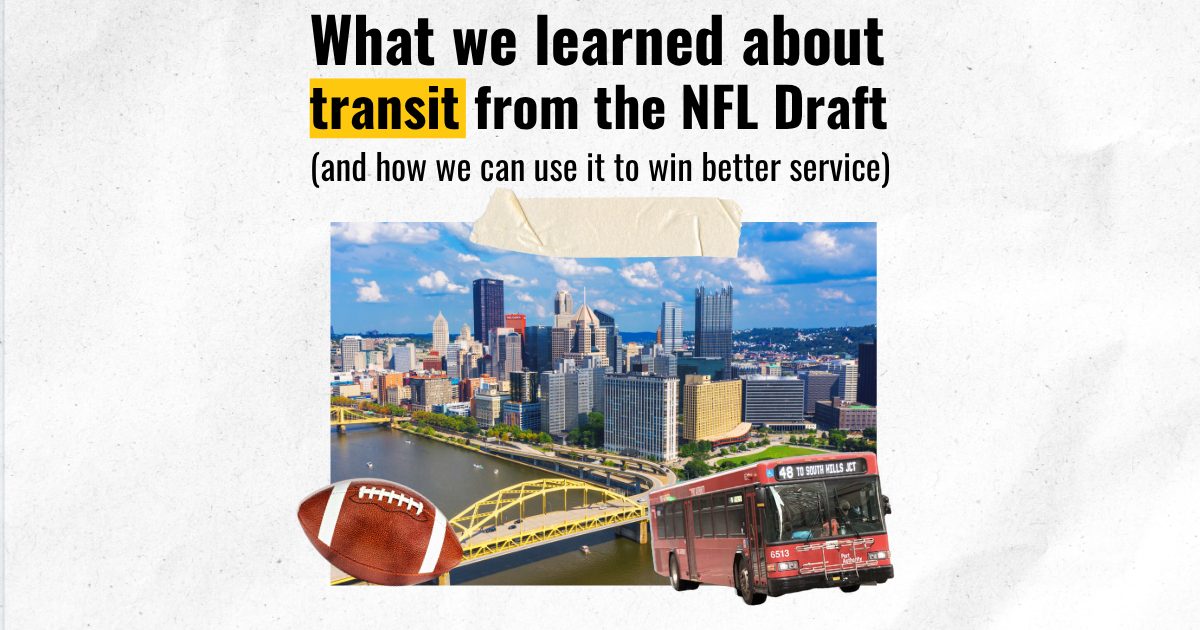
Image Description: photo of Downtown Pittsburgh taped on a paper background, with stickers of a football and a red PRT bus.
New data shows that transit was the star of the NFL Draft—here’s what we learned (and how we can use it to win better transit in the future)!
- Public transit is the reason the Draft succeeded!
Event buses were full, and the roads were free of traffic. Places that had transit access to the Draft grew crowds; places without it, didn’t. - It pays to pay transit workers!
Operators were paid higher wages for working a strenuous event, and they did a fabulous job. We can, and should, pay essential workers according to their high value. - Free fares = better service, higher ridership!
They reduce barriers to entry, increase access for low-income riders, and even saves time en-route. Sheetz, the Pittsburgh Organizing Committee and The Pittsburgh Foundation paid the T and “football flyers” fares, so PRT lost no money. Plus, higher ridership actually generates more revenue for PRT (thanks to state funding laws).
Free fares can be implemented for more than just special event attendees; it can benefit low-income riders AND the agency. - People love taking the bus—when it’s easy!
Draft service was direct, frequent, clearly communicated, and easily understandable. And it paid off for almost 485,000 rides! - Big events like this would not be possible without a functional, accessible, affordable transit system—all the time.
We don’t need to wait for the next big event to roll around to build and fund a transit system that works for our city. We can build one that generates economic benefits, now, for our city. - Promoting transit works!
PRT, the Mayor, and the County Executive—not to mention Visit Pittsburgh, local news outlets, and local influencers—regularly promoted the benefits of transit, and urged visitors to hop on the bus to avoid congestion and high parking costs. And it worked! - The true cost of parking is high!
Driving, finding a parking spot, and paying for it was inconvenient for Draft visitors—and it’s still inconvenient for everyday commuters. If given reliable, affordable, frequent transit options, people won’t choose to add congestion or pollution to our roads.
The post What we learned about transit from the NFL Draft (and how we can use it to win better service) appeared first on Pittsburghers for Public Transit.
Communities Most Harmed by PRT’s Draft 2.0 Bus Line Refresh
Whether you live in McKeesport or McKees Rocks, the Hill District or the South Hills, our public transit system needs to work for everyone.
Pittsburgh Regional Transit (PRT) will soon close their community engagement period for the second draft of their Bus Line Redesign (BLR). The redesign proposes a completely redrawn map of where transit routes will run. It includes new schedules for how frequently and how late at night buses and trains operate, and even proposes renaming all the routes in the system.
Tens of thousands of people who use the system every day will be affected. Allegheny County Transit riders, transit workers, businesses, social service providers—we all have a stake in a Bus Line Redesign that works for all.
The Bus Line Refresh plan is complicated and will affect everyone differently. That’s why it’s very important that transit riders and transit workers review your routes and give feedback now! You can check out how your routes will be impacted and give feedback online, by phone, or at an upcoming PRT community event here.
This is the last opportunity for the public to weigh in before PRT finalizes and ratifies this transit plan- one that will impact our transit service for generations!
Join other transit riders to speak up about impacts of the Bus Line Refresh Draft 2.0 – the good and the bad – at our press conference and public testimony on Friday, 5/29 at 8:30 am at Pittsburgh Regional Transit’s Board meeting.
RSVP Today (Public Testimony Deadline is 5/27) The Communities Slated for the Greatest Transit Losses under PRT’s Bus Line Refresh 2.0Under the Bus Line Refresh Draft 2.0, some communities are being proposed for transit service improvements with higher frequency service or new direct connections to critical destinations. Other communities will see transit service cuts- this is the consequence of Pittsburgh Regional Transit deciding to develop a “cost-neutral” plan rather than a more visionary proposal for service restoration and expansion.
In the coming days, we will publish a proposed list of transit service improvements under the BLR 2.0, but right now, it’s most important that transit riders who are slated to lose access to all transit service get a chance to review and respond to the plan.
Below, we lay out the communities in which transit service currently exists, but under the proposed Bus Line Refresh Draft 2.0 will be left little to no service.
We used existing route numbers (not the route numbers proposed in the new plan) to help riders identify whether they will be impacted. Routes are listed numerically regardless of alpha-prefix.
- 2/P13 – Shaler: Mt Royal Blvd – 15101
- 2/O5/P13 – McCandless: Ferguson Rd, Sample Rd – 15101, 15237
- 4/7 – Reserve Township – 15212
- O5 – Ross Township: Thompson Run Rd – 15237
- 6/7/15 – Summer Hill – 15214
- O12 – Perry Highway North – 15237
- 14/18 – Lower Half of Chateau/Manchester – 15233
- 20 – Groveton/Kennedy Township: Herbst Rd – 15108
- 27 – Windgap/Middletown: Segments on Middletown Rd and outer Chartiers Ave – 15204/15205
- 28X – Robinson Town Center and 5th Ave in Shadyside – 15205
- 36 – Mount Lebanon: Cedar Blvd to South Hills Village – 15228
- 36 – Banksville Rd transit service eliminated off-peak and weekends – 15216
- 38 – Wynnecliff Manor in Scott Township – 15220
- 39 – Ebenshire Village in Brookline – 15226
- 40/43 – Kathleen St/Beltzhoover Ave/Boggs Ave in the North side of Warrington – 15210/15211
- 44 – North Baldwin – 15236, 15227
- Y45 – Baldwin/Whitehall/South Park – 15236
- 52L – West Mifflin: Homeville Rd and Duquesne Village Shopping Center – 15122
- 54 – Bon Air – 15210
- 55/P76 – East McKeesport – 15131
- 65/74 – Squirrel Hill: Shady Ave, Beechwood Blvd – 15217
- 74 – Point Breeze: Reynolds St – 15208
- 77/P16 – Penn Hills/Plum: Hulton Arbors – 15235, 15239
- 77/P16 – Penn Hills: Monroeville Trestle Rd and Saltsburg Rd, North Bessemer, Leechburg Rd – 15235
- 79/P17 – Lincoln Park: Mark Drive, Grove Rd, Chaske St, Mt Carmel Rd – 15206/15235/15147
- P76 – White Oak: Rt 48 corridor – 15131
- P76 – North Versailles: Rt 30 beyond Walmart – 15235
Some current bus lines are being broken up into 2 or 3 different routes. For riders on these routes, that might mean new transfers where you currently have a direct trip.
Riders can go toFind My Route on the PRT Bus Line Refresh website to look at how your commute will be impacted, if at all.
We know that 84% of transit trips today taken by PRT riders who use a CONNECT card are direct trips, completed without having to transfer. New transfers can add additional significant time to commutes, can add uncertainty around timing to get to our destinations and more exposure to the elements. Moreover, transit riders who pay with cash will have to pay an additional fare for each additional transfer. We know that riders strongly prefer direct trips over trips requiring a transfer, and so want to ensure that riders have a chance to see and respond to these substantial changes.
Below we list current routes in numerical order, regardless of alpha-prefix, and the point in the route where they have been severed:
- 1 Freeport Rd at the Waterworks Mall
- 13 Bellevue/14 Ohio River Blvd/17 Shadeland have been segmented and reassembled in various ways
- 21 Coraopolis – Coraopolis to Moon/Sewickley
- 31 Bridgeville at Carnegie Station
- 41 Bower Hill: Washington Rd at Bower Hill Rd
- 54 N Side-Oakland-S Side – Lawrenceville/Bloomfield to South Side/Mount Oliver/Beltzhoover/Bon Air
- 59 Mon Valley – across the Monongahela River
- 67 Monroeville – Oakland/Squirrel Hill to Monroeville/CCAC Boyce
- 69 Trafford – Oakland/Squirrel Hill to Forest Hills/Wilmerding/Pitcairn
- 69 Trafford – to Forbes Hospital
- 74 Homewood-Squirrel Hill Squirrel Hill to Larimer
- 75 Ellsworth – to South Side Works
- 81 Oak Hill/83 Bedford Hill – connections to Hill District Business Area (Centre-Devilliers)
- 87 Friendship – Bloomfield/Friendship to Morningside/Stanton Hts/Upper Lawrenceville
- 93 Lawrenceville-Oakland-Hazelwood – Lawrenceville/Bloomfield to Greenfield/Hazelwood
- P10/1 – Extend all N1 trips from East Liberty to Downtown to avoid forced transfer
- Y47 Curry Flyer from Keeport-Knoedler to Walmart
Join other transit riders to speak up about impacts of the Bus Line Refresh Draft 2.0 – the good and the bad – at our press conference and public testimony on Friday, 5/29 at 8:30 am at Pittsburgh Regional Transit’s Board meeting.
RSVP Today (Public Testimony Deadline is 5/27)The post Communities Most Harmed by PRT’s Draft 2.0 Bus Line Refresh appeared first on Pittsburghers for Public Transit.
SINGING THE SONGS OF THE SOIL – with Tilly Gomersall of Cân y Pridd
The post SINGING THE SONGS OF THE SOIL – with Tilly Gomersall of Cân y Pridd appeared first on Landworkers Alliance.
In Loving Memory of Carlo Petrini
With deep sorrow, we receive the news of the passing of Carlo Petrini, dear friend, fellow traveler, and an unwavering voice in the defense of the Earth, of food, and of living communities.
For decades, we walked together in shared struggles: for biodiversity, for seed freedom, for the dignity of small farmers, and for a food system rooted in care, justice, and the sacred relationship between human beings and nature. Through Terra Madre, Slow Food, and the many global networks Carlo helped to nurture, millions have reawakened to the understanding that food is a commons, and that cultural and ecological diversity are the very foundations of peace and true democracy.
Carlo embodied the rare ability to root himself deeply in place while holding a planetary vision. He gave voice to peasants, seed keepers, artisanal producers, and to the communities who courageously defend the Earth against an extractive and destructive industrial model. Together, we shared gatherings, dialogues, international forums, and moments of collective mobilization, affirming that the future of humanity depends on our capacity to protect biodiversity and to regenerate the living bonds between people and the Earth.
I carry a vivid memory of his participation in the International Commission on the Future of Food and Agriculture, initiated by Claudio Martini, then President of the Tuscany Region. From this meeting, in 2008, the Manifesto for the Future of Food was born.
His legacy will live on in the seeds of hope he has sown across the world, in the webs of solidarity he helped to weave, and in the new generations who will carry this journey forward, for food that is good, clean, and just.
My heart is with his family, the Slow Food community, and all those who loved him.
Vandana Shiva
President of Navdanya International
photo credit: identitagolose.com
The fiscal cliff is real for transit — and it’s time to act!
Beach Access and a Threatened Track
The Rise of the Airport Railway Station
Open access under pressure: Europe’s competitive rail model starts to fragment
Amid Canada’s massive housing and infrastructure build-out, a few changes can limit climate impact at little or no cost: report
TORONTO — “Build Canada Strong” is a central mantra of the federal government’s plans to bolster Canada’s economy in a rapidly changing world, with new housing and infrastructure key to Canada’s nation-building efforts. But all this construction poses a problem: the production of building materials can be a huge source of emissions.
Thankfully, there are solutions that can reduce this downside, at little or no extra cost—while also supporting Canadian industry, as a new report, Build Canada Clean, from Clean Energy Canada reveals.
The report, which features case studies from across the country—from apartment buildings to roads to wastewater facilities—finds that lower-carbon construction materials can generally be procured at no or marginal cost increases, while simple design changes can further minimize cost and emissions. One case study of an apartment building in Quebec, for example, found that design changes and lower-carbon materials could cut construction emissions by 30% while reducing overall construction costs by 12%.
What’s more, Canadian manufacturers are already producing many of the lower-carbon alternatives required, such as steel produced in electric arc furnaces, concrete that uses industrial byproducts to replace cement, and reclaimed asphalt. Supporting this kind of construction presents a unique opportunity for Canada to build its market at a time when our key trade partners, like the EU, are actively seeking cleaner products.
Governments are key to ensuring we seize this opportunity. They are big builders and by requiring lower-carbon materials and design—an approach known as “Buy Clean”—they can create a strong demand signal. The federal government has already taken some steps to reduce carbon in its building projects, and has also recently introduced a “Buy Canadian” approach. Expanded Buy Clean policies sitting alongside Buy Canadian ones would allow us to support domestic producers while also incentivizing our industries to become more climate-competitive in a global trade environment increasingly prioritizing or requiring cleaner materials.
Beyond “Buy Clean,” some simple regulatory changes can make a big difference, as the report elaborates. There are many different codes and standards for infrastructure construction across the country, some of which needlessly restrict the use of lower-carbon materials or design practices. Where flexibility does exist to use more recycled or other lower-carbon materials, it isn’t always made use of—something that could be addressed with better procurement guidance.
As we build more projects, we have the opportunity to avoid locking in huge amounts of damaging emissions—all while cutting costs for developers and taxpayers alike. So while we “Build Canada Strong,” let’s also “Build Canada Clean.”
KEY FACTS- The construction sector contributed over 8% of Canada’s total emissions in 2018. And that was at less than a third of the housing starts Canada actually needs.
- For efficient, electrified buildings, the emissions associated with material production and construction, known as “embodied carbon,” usually accounts for a larger portion of lifecycle carbon emissions than those from operation, like heating and cooling.
- The global low-carbon construction materials market is expected to be worth US$579 billion in 2032, with trade partners, including the EU, increasingly looking for clean materials.
- Through nine roadway case studies, we show that lifetime emissions reductions of between 17% and 31% could be achieved while reducing the per-metre cost of the roads by up to 16%.
- A study of an apartment building in Quebec found that making just two changes to the building design and replacing materials with lower-carbon equivalents would reduce embodied emissions by 30% while reducing overall construction costs by 12%.
- Choosing lower-carbon material options for water infrastructure can reduce the emissions of stormwater and wastewater infrastructure with marginal cost impacts.
Report | Build Canada Clean
The post Amid Canada’s massive housing and infrastructure build-out, a few changes can limit climate impact at little or no cost: report appeared first on Clean Energy Canada.
On World Bee Day Meet Our Native Bees
Response: New BC Hydro plan maintains key programs, but the province and utility are leaving larger household savings on the table
VICTORIA — Evan Pivnick, associate director of public affairs at Clean Energy Canada, released a statement in response to BC Hydro’s release of its new energy efficiency strategy, Power Smart 2.0:
“BC Hydro has a strong history of using energy conservation to reduce electricity use in B.C. as well as prepare for the growing demands for electrification. However, while this new plan makes meaningful investments and continues in this tradition, it falls short of fully harnessing the opportunities that household technologies have to save families—and BC Hydro—money.
“A recent study from Dunsky Energy + Climate Advisors found that distributed energy resources (electric technologies that can generate or store energy or control demand) could meet more than 10% of B.C.’s total peak electricity demand by 2040, saving ratepayers money by avoiding more expensive infrastructure build-outs while improving grid reliability.
“As such, it’s good to see support for consumers to adopt clean solutions, from energy-efficient appliances to battery storage, that help realize this potential. But this is only a first step. B.C needs to follow the lead of other jurisdictions across North America that are going much further in advancing changes to their electricity systems and standing up new programs that can help households save on their energy bills.
“Beyond energy-efficient appliances, new technologies have unlocked much greater opportunities to save, like managed EV charging, smart panels, controllable water heaters, and household batteries that work in harmony with the grid. The new plan lays out a vision for using these technologies, but more should be done to encourage British Columbians to make the switch. The Dunsky study found that greater financial incentives, like rebates, and other ambitious installation programs, were key to realizing the full potential of distributed energy resources for reducing both household bills and costs to the utility.
“What’s more, heat pumps will be vital to reducing power demand, offering the ability to displace power-hungry baseboard heating and air conditioning. With another hot summer around the corner, the provincial government should introduce regulations that ensure new permanent air conditioning systems are heat pumps. Our analysis shows that a province-wide switch to heat pumps could save a cumulative $675 million in annual energy bills: that translates to average savings of approximately $170 a year for those currently using natural gas with A/C.
“Already, B.C. has some of the lowest electricity rates in North America, making the switch to EVs and household electrification especially enticing for British Columbians. And while today represents a positive step, at a moment when the cost of living is top of mind for most families, there is much more we could be doing to lower electricity bills across the province—while simultaneously building a smarter, more cost-efficient electricity system.”
The post Response: New BC Hydro plan maintains key programs, but the province and utility are leaving larger household savings on the table appeared first on Clean Energy Canada.
Notes on Isla Grande: Figurations of Environmental Violence and Beauty in the Colombian Caribbean
By Gracia Ramirez and David Vergara-Moreno
This photo essay looks at Isla Grande, the largest coralline island of Nuestra Señora del Rosario Archipelago, which is part of the Parque Nacional Natural Corales del Rosario y de San Bernardo, in the Colombian Caribbean. The essay considers the environmental beauty and the violence that underpin Black lives on the island, and the ways in which they have resisted as a community to go forward into the future.
DOCKSLa Bodeguita dock in Cartagena de Indias is the tourists’ gateway to the promised paradise of white-sand beaches and turquoise waters of the Rosario Islands. The docks and other hard boundaries of the port witness an encounter with the polluted waters around Cartagena. This port is responsible for 70% of the country’s maritime trade and has been categorized as the third most efficient port in the world.
Although rarely mentioned by the early chroniclers, it is reasonable to infer that —prior to and during the early centuries of colonization— Cartagena’s Bay was a lush mosaic of abundant coral reefs, dense mangrove forests, and towering tropical dry forest trees.
Today, however, the bay reveals another face: murky waters, laden with sediments, polluted by centuries of maritime traffic, urban and industrial waste, and dredging works that have radically transformed its ecological cycles.
While the departure of tourism to the islands is mainly managed from La Bodeguita dock, the journey out of the bay and into the sea allows visual contact with other docks along the coast.
This is a layered cartography of memories, economies, and spatial regimes: tourist piers, logistical cargo yards, shipyards, naval bases, and private marinas. The bay is not merely a coastal landscape, it is a friction zone between multiple socio-economic and political logics: tourism, military operations, goods trade, and the communities whose ways of life are subordinated to those regimes. This is a liquid frontier: a place of circulation, exclusion, and resistance.
LOGISTICSThe archipelago of the Rosario Islands is connected not just to the Atlantic but also to another body of water, the Canal del Dique. The Spanish colonizers began its construction in the 16th century using enslaved Indigenous and African labor, with the goal of linking the Magdalena River —the nation’s main fluvial artery— with the Cartagena Bay.
Map of the Northern part of Bolívar Department, Republic of Colombia 1886-1903 (Edward Stanford, 1899, cropped). It is possible to see Cartagena de Indias, Barú island below, the Canal del Dique and the Calamar-Cartagena Railway (red line). Source: Mapoteca Biblioteca Nacional de Colombia.
Since then, the Canal has played a strategic role in both domestic and foreign transport and trade, evolving from wooden barges in the 17th century, to the advent of steam-powered boats in the 19th century.
For over three centuries, the Magdalena River and its canal were the only connection between Colombia’s Caribbean and its Andean provinces, linking a nation divided by three mountain ranges and a wide variety of thermal floors and ecosystems. Socially, the Canal became the route to freedom, as many runaway enslaved people (cimarrones) followed its waterways and founded Maroons communities (palenques) in the surrounding wetlands and hills during the 17th and 18th centuries.
Until the late 19th century, the Dique was merely a narrow, shallow ditch less than 15 meters wide, which was impossible to navigate during droughts. But throughout the 20th century, the canal was radically transformed. U.S. companies carried out major dredging and straightening projects that widened it to 100 meters, reducing its original 270 meanders to only 55, dramatically increasing its flow and sediment loads, altering the ecological balance of Cartagena and Barbacoas Bays and surroundings.
Despite these efforts, the canal became almost obsolete after the construction of two major highways that linked the Caribbean to the Andean region of the country in the 1950s. However, around the same time, Colombia’s largest oil refineries were established in Barrancabermeja and Cartagena.
As human geographer Austin Zeiderman argues, such infrastructures articulate geo-racial regimes and hierarchies of white and black, urban and peripheral, central and insular, that become sedimented into both Cartagenian landscapes and bodies.
MATERIALSExcavations on the ground reveal the coralline stone, compacted after centuries of pressure and erosion. Isla Grande is a coral reef fossil itself. Coral reefs are vital ecosystems: they protect shorelines from storms, sustain local fisheries, support biodiversity, and form the ecological backbone of a tourism industry that underpins much of Cartagena city’s economy. Yet their very skeletons have been quarried and consumed. Entire islets were built for elite leisure by filling the sea with broken coral, the moneyed class literally manufacturing new islands from the bones of the reef.
Coral grounds. Photo by Gracia Ramirez.
The Canal del Dique continues this slow and silent violence. Each rainy season, it expels plumes of sediment-laden freshwater that spread across several square kilometers, covering turquoise waters with brown stains. These pulses reduce salinity and block light, suffocating photosynthesis and interrupting coral reproduction cycles that coincide with the wet months. In fact, the deposits of sediment have turned the formerly island of Barú into a peninsula, following the interventions of USA engineering companies in the twentieth century.
The history of Isla Grande is intimately linked to that of Barú. Around the time of the Spanish colonization, these territories were called Bahaire after the indigenous chief that ruled them before the conquest. The Spaniards used enslaved labour to excavate quarries in Barú and Tierra Bomba, extracting coralline stone used in Cartagena’s colonial architecture. They also built kilns to burn coral stone, producing mortar for the city’s fortifications and lime for its characteristics whitewashed walls.
In the eighteenth century, the nearby island of Barú became a strategic point for cimarrones and Dutch and English smugglers who used enslaved workforce for the logistics related to trafficking. Some enslaved workers, in turn, were secretly saving money to buy their freedom to their masters –mostly Spaniards–.
Over the nineteenth century, with the crisis of slavery and the independence wars, Barú became an instance of a horizontal community formed mostly by cimarrones, freed slaves and mestizos. Their economy was based on subsistence agriculture, fishing, bartering and mutual support.
Wooden house. Photo by Gracia Ramirez.
On June 7 of 1850, groups of neighbours from Barú bought an old hacienda to its then owner for 1.200 COP and finished their payment on May 19, 1851. Just two days later, the abolition of slavery was signed in the country. Thus, Barú become a Black community with collective property before the establishment of the modern-day Republican State. Coconut became the main crop and some families from Barú moved to the neighbouring Rosario Islands to extend the plantations.
Islander dwellings echo this layered material history. Traditional houses rely on wooden boards and palm-thatched roofs, fragile yet renewable. Modern constructions import thin red bricks and cement from the mainland, materials that, as they degrade, seep into the calcareous soil and alter its composition.
Seashell. Photo by David Vergara.
Cement itself is ambivalent: it raises luxury resorts that displace the community, yet it also fortifies schools and homes through collective labor. In their very texture, these materials tell two stories at once—of extraction and restriction, but also of resilience and re-creation.
ORIKARight at the centre of Isla Grande is now the town of Orika. An old rubber tree guards the town’s square and provides shelter from the sun. The Cultural House is the gathering place where local council meetings (juntas) take place. The story of Orika is one of socioecological struggle and resistance.
Over the twentieth century, Barú started supplying agricultural goods to the growing Cartagena population, shifting toward intensive production of coconut, fish and mangrove charcoal. Up until the 1950s –when roads were constructed to connect Cartagena with other inland cities– the Rosario islands and Barú were the main providers of food sold at the city’s Getsemani market.
Rubber Tree in Benkos Biohó Square, Orika, Isla Grande, PNNCRSB. Photo by Gracia Ramirez.
The first tourists were members of Cartagena’s urban elite. They arrived at the Rosario Islands between the 1930s and 1940s and started building recreational homes. While tourist infrastructure was consolidating around Cartagena and the islands, a beetle plague destroyed the coconut plantations in the 1950s.
In order to “protect” the islands, the government declared them National Natural Park in 1977, but the National Park mainly considered the sea, not the ground islands themselves. The decree sought to “conserve flora, fauna, landscapes, and historical and cultural manifestations with scientific, recreative or aesthetic goals”, but omitted any mention of the Blacks communities that already inhabited the territory (Rosario Islands, Barú, Santa Ana and Ararca).
New prohibitionist environmental policies, coupled with the rise of tourism, relegated local families to the hinterlands of Isla Grande and to the backs of hotels and resorts, where they worked as subordinate labor.
In the 1980s, the government declared the Rosario Islands to be State-owned vacant lands, unrecognising the community as a “organized population” for the use of land but allowing other economical uses such as tourism and recreation. This enabled a wave of land grabs by private investors that further marginalised the community. However, the 1991 Constitution and the ensuing law 70 of Black Communities of 1993 provided legal tools to transform the memory of dispossession into a fight for recognition.
The community used environmental education programs to strengthen social organizations and articulate their historical demands into a juridical argument. In 2001, after years of legal limbo, the Colombian state began the land restitution process.
Fearing expulsion from the territory, the families decided to establish a new village in the center of Isla Grande: Orika, in honor of the daughter of Benkos Biohó, a cimarron leader and hero of San Basilio de Palenque, the first Black free village in the Americas (1714). In just two months, the community cleared the land and built their houses, a gesture of dignity and memory, affirming their right to exist as a Black community in their ancestral territory. After collecting evidence and going through endless administrative hurdles, in 2014 the Constitutional Court recognized the collective deed title for the Black community of Isla Grande, becoming the only community having achieved that so far within the national park.
UNBOUNDEDNESSSunset horizons and native trees may meet the tourist’s gaze as landscapes ready for easy consumption— postcards of “untouched nature.” Yet the town of Orika unsettles this commodified view. Its soundscape resists containment: sound systems (picós) blasting loud music reverberates from the main square, echoing through every coralline ground cavity, vibrating as much in bodies as in stone.
In language, too, survival leaves its trace. The word Dios circulates as the name of the Christian god, but within it hides the untranslatable presence of African spirits, invoked yet unconfined by letters. This is not syncretism as tourist folklore, but the deep mimicry of African cosmologies that persisted beneath colonial surveillance.
In the Colombian Caribbean, enslaved Africans lived not in the vast monocultures of the sugar plantations of Brazil or Cuba, but in smaller, multiethnic communities tied to haciendas, cattle ranches, mines, and urban centres under the close watch of the Inquisition tribunal of Cartagena.
Cut off early from eighteen century renewed arrivals of African captives, these populations developed distinctive spiritual practices, an instance of what Sylvia Wynter called “black indigenization”— that in intertwining African, indigenous, and Christian forms, found ways of being human when colonial hegemony ruled otherwise.
Orika inhabits this layered spiritual geography. It is not simply a village bounded by its streets, but a porous space where music, light, and faith exceed enclosure—an unlimited terrain of survival, memory, and reinvention.
ROOTSMangrove forests form the living roots of Isla Grande. They are among the most resilient trees on Earth—thriving where others would perish. Their bodies adapt to saline soils and shifting tides, standing firm where land is not yet land.
Propagules germinate while still attached to the parent tree, dropping into the water as living seedlings that drift across lagoons and channels, anchoring themselves wherever conditions allow. Each root is a promise of survival, each forest a nursery that shelters fish, crabs, and birds in any of their stages of life. Mangroves breathe through aerial roots that rise above the mud, searching for oxygen in conditions too harsh for most species. Always green, they embody endurance.
The mangrove is never alone. Its leaves, roots, and fallen branches decompose into nutrients that sustain fish and crustaceans; its tangled roots interlace with seagrass meadows and coral reefs in a single inter-ecosystemic web. Together, these systems form the ecological triangle of the Caribbean coast: corals buffer waves, seagrasses filter and stabilize sediments, mangroves hold the shoreline while feeding both sea and land. In Isla Grande, these roots not only prevent erosion but also connect the island’s fragile ecology to Cartagena’s coastal mangroves, weaving life across waters.
For Orika, the mangrove is more than ecology—it is a metaphor for community. Like the red mangrove that elevates itself above its roots, the people rise from centuries of exclusion, rooted yet expansive. Their history drifts like propagules, carried by tides of resistance until finding ground to grow.
The mangrove teaches resilience, interconnection, and renewal: lessons for a community that continues to defend its territory while imagining futures where culture and ecology flourish together. Roots here are not only in soil, but in memory and struggle, anchoring Orika to both the Caribbean Sea and to its own unfolding horizon.
DRIFTThere are no roads in Isla Grande, only sandy footpaths weaving through the tropical dry forest and the mangroves. No motorized vehicles circulate within the island, people walk or ride bicycles, while boats and yachts, arriving from Cartagena, leave trails of oil shimmering over the turquoise surface.
Caribbean Sea water around Isla Grande. Photo by Gracia Ramirez.
Plastic bottles and rubbish drift ashore, carried by tides that remember more than the islanders would wish. Drift here is both material and historical: traces of empire, slavery, tourism, and extraction wash against the reef, staining waters once clear. The islands themselves are a coral body in constant erosion and recomposition, a living drift of stone, memory, and survival.
Plastic and vegetable waste. Photo by Gracia Ramirez.
Yet drift is not only decline—it is also possibility. Orika, born out of dispossession, has become a node of reorganization and creativity. The community council anchors collective life, negotiating with agencies and hotels that now contribute resources for communal projects.
Every weekend, and on national and local holidays, happiness brightens the whole town in shared spaces like the main Plaza (Benkos Biohó Plaza), the picós, the cockpits, houses and the Casa Cultural. A new foundation works with children and youth, teaching them to stage traditional dances and music, reweaving ancestral ties to the palenques and to African rhythms long suppressed.
Ecotourism initiatives, led by younger generations, form alliances with older community projects, offering alternatives that value culture and ecology together.
Buildings around Benkos Biohó Square in Orika. Photo by Gracia Ramirez.
Drift, then, also gestures toward a different horizon. In Orika, the tides carry not only the weight of history but also the seeds of futures yet to come. The Rosario Islands are a historical drift still evolving—where coral, memory, and community recombine into new forms of life.
The post Notes on Isla Grande: Figurations of Environmental Violence and Beauty in the Colombian Caribbean appeared first on Undisciplined Environments.
A Canada-led clean trade pact would show that middle powers mean business
Prime Minister Mark Carney has won deserved praise for standing firm against the Trump administration’s threats and imposition of tariffs. But political credit is only as good as the strategy that follows, and Canada now faces a genuine opportunity to do something more ambitious than weather the storm.
Carney’s approach has sparked a broader conversation among the world’s ‘middle powers’ – countries with significant economies like Japan, South Korea, Australia, and the U.K. that share a commitment to rules-based trade but sit outside the U.S.-China superpower axis. These are countries that are actively looking for a different economic path forward, one that doesn’t simply mirror the nationalism coming out of Washington and Beijing.
Keep reading this post, co-authored by Ryan Mulholland and Ollie Sheldrick, in Policy Options.
The post A Canada-led clean trade pact would show that middle powers mean business appeared first on Clean Energy Canada.
May 14, 2026: See CBS TV coverage of Greenaction Blasting Navy’s latest radioactive scandal at Hunters Point Naval Shipyard Superfund Site
May 14, 2026:
See CBS TV coverage of
Greenaction Blasting Navy’s latest radioactive scandal at Hunters Point Naval Shipyard Superfund Site
Politico Pro: Newsom sticks with controversial funding deferral in mixed-bag schools budget
May 14, 2026—Politico’s Eric He reports on Gov. Newsom’s May Revise budget proposal, which calls for deferring $3.9 billion in Proposition 98 school funding despite revenues coming in $16.5 billion above projections. The move has drawn swift condemnation from teachers unions, school boards, and Democratic lawmakers who argue the constitutionally-guaranteed funding is urgently needed — including by Los Angeles Unified, which is counting on state dollars to honor $1.2 billion in new union contracts. On the positive side for education advocates, the governor preserved $1 billion for community schools expansion. Public Advocates Managing Attorney John Affeldt weighed in on the deferral, saying that while restraints are warranted, it’s “not a crazy maneuver given the volatility of our revenue picture.”
The post Politico Pro: Newsom sticks with controversial funding deferral in mixed-bag schools budget appeared first on Public Advocates.
Russia’s anti-war prisoners: Outcasts in their own country
Red Stone Movement Goes Public: Tribal Nations Demand Protection of Sacred Pipestone Site
May 15, 2026 Read the story on MSN.com Greenaction blasts the Navy over continued botched “cleanup” at the Hunters Point Naval Shipyard Superfund Site
Pages
The Fine Print I:
Disclaimer: The views expressed on this site are not the official position of the IWW (or even the IWW’s EUC) unless otherwise indicated and do not necessarily represent the views of anyone but the author’s, nor should it be assumed that any of these authors automatically support the IWW or endorse any of its positions.
Further: the inclusion of a link on our site (other than the link to the main IWW site) does not imply endorsement by or an alliance with the IWW. These sites have been chosen by our members due to their perceived relevance to the IWW EUC and are included here for informational purposes only. If you have any suggestions or comments on any of the links included (or not included) above, please contact us.
The Fine Print II:
Fair Use Notice: The material on this site is provided for educational and informational purposes. It may contain copyrighted material the use of which has not always been specifically authorized by the copyright owner. It is being made available in an effort to advance the understanding of scientific, environmental, economic, social justice and human rights issues etc.
It is believed that this constitutes a 'fair use' of any such copyrighted material as provided for in section 107 of the US Copyright Law. In accordance with Title 17 U.S.C. Section 107, the material on this site is distributed without profit to those who have an interest in using the included information for research and educational purposes. If you wish to use copyrighted material from this site for purposes of your own that go beyond 'fair use', you must obtain permission from the copyright owner. The information on this site does not constitute legal or technical advice.
 This site is not the official webpage of the Industrial Workers of the World.