You are here
News Feeds
Forest Service plan would cut the public out of Maroon Bells management decision
Update: On Friday, September 18, the U.S. Forest Service announced that it will conduct a 15-day comment period before signing off on a special use permit for Pitkin County to manage operations at the Maroon Bells Scenic Area. The Forest Service has not yet released a map or an acreage number for what the permit would cover.
The Maroon Bells Scenic Area draws more than 200,000 visitors a year and is the gateway to the Maroon Bells-Snowmass Wilderness, one of Colorado’s original wilderness areas. In May of this year, Pitkin County applied for a special use permit to take over day-to-day management of Maroon Bells, starting with the 2027 season. The White River National Forest says it can no longer cover a roughly $300,000 annual shortfall at the site and has told the county to finalize an agreement by fall or it will turn to a private concessionaire instead.
To authorize the management change, the U.S. Forest Service plans to use a categorical exclusion: a legal shortcut that lets federal agencies skip the environmental review and public comment process required by the National Environmental Policy Act (NEPA) on decisions the government has already determined won’t significantly affect the environment. The rules governing that shortcut were rewritten last year to remove the public notice step that it previously included, meaning this management change could occur with no opportunity for public input.
Pitkin County has partnered with the Forest Service at the Maroon Bells for decades, and it’s stepping in because the federal government says it can no longer afford to manage the site at a $300,000 loss. The county, which is home to Aspen, undoubtedly has the knowledge, ability, and resources to manage the area responsibly for recreation and conservation, but the process still deserves scrutiny. The use of a categorical exclusion to bypass the NEPA process means the federal government is handing off management of a major recreation area to a local entity without thoroughly examining the potential environmental and social impacts and without providing the public that owns the land with a chance to share their concerns about the plan.
What even is a categorical exclusion? As outlined in NEPA, categorical exclusions can be used for categories of activities when the government has determined that there would be “no significant impact” to the environment from the proposed activity covered by the categorical exclusion. Agencies can also adopt each other’s categorical exclusions. Previous administrations from both political parties have used both of these approaches for a variety of purposes.But the second Trump administration is broadening the use of categorical exclusions, in many cases trying to use them as blanket exemptions from following the law at all, or greatly expanding the acreage to which they apply. To lay the groundwork for this approach, the White House Council on Environmental Quality (CEQ) repealed its implementing regulations for NEPA via a rule that was finalized in January 2026. Among other things, this repeal included removing the 30-day public comment period for proposed categorical exclusions. Essentially, the public will have to take the government at its word that the activities covered by the proposed categorical exclusion will have no significant impact on the environment and will have no opportunity to raise concerns or offer evidence that the activity would, in fact, have an impact on the environment.
In April 2026, following the rule repeal, CEQ issued new guidance on the use of categorical exclusions, framing its approach as “CE-first” and promoting categorical exclusions as “a core feature of NEPA” rather than a process to create defined and limited exceptions. CEQ chair Katherine Scarlett described the guidance as intended to “help agencies identify an off-ramp from unnecessary levels of environmental review” during the permitting process.
Following these policy changes, the Trump administration has wasted no time putting it into practice. For example, in August, the Bureau of Land Management finalized an exclusion for forest and woodland density management that raised the area covered from 70 acres to 5,000.
The exclusion the Forest Service intends to use at the Maroon Bells, USDA-29c-USFS, covers the “issuance of a new authorization or amendment of an existing authorization for recreation special uses that occur on existing roads or trails, in existing facilities, in existing recreation sites, or in areas where such activities are allowed.” The examples written into the rule are all small permits or contracts, including mountain bike permits on trails already open to bikes, backcountry ski guiding, a one-time event at an existing facility, and a concession contract to run a campground that was already operating. None of the examples include full management of one of the West’s most popular and iconic recreation areas.
Shuttle to Maroon Bells Trailhead, Tony Webster
Until last year, the Forest Service’s NEPA procedures put two checks on that shortcut: The agency had to notify the public before deciding an exclusion applied; scoping, its regulations said, “is required for all Forest Service proposed actions, including those that would appear to be categorically excluded.” And before using an exclusion, officials had to weigh a list of resource conditions that specifically named congressionally designated wilderness. In July 2025, the U.S. Department of Agriculture (USDA, the agency that houses the U.S. Forest Service) removed those procedures entirely, folding what survived into a single department-wide rule finalized this April. Whether a sensitive resource is enough to disqualify a project from the shortcut is now left to the responsible official’s sole discretion on a case-by-case basis.
Why this is wrong for Maroon BellsThe Maroon Bells agreement is wider-reaching than the permits that the categorical exclusion option was written for. The county’s ordinance authorizing the agreement says the Forest Service “has proposed issuing a Special Use Permit to authorize Pitkin County to assume responsibility for day-to-day operations, maintenance, visitor staffing, and natural resource stewardship at the Maroon Bells Scenic Area, while the federal government retains ultimate ownership and overarching regulatory oversight of the land.” The draft permit does not include an acreage number.
A concession contract to run a campground covers one campground, but this agreement covers operations, staffing, and resource stewardship seemingly across the entire scenic area. Professor Mark Squillace, who teaches natural resources law at the University of Colorado, made the same point in comments to the county and the Forest Service, saying that the exclusion “does not allow the wholesale transfer of management responsibility over the entire Maroon Bells Scenic Area.”
In 2024, the Forest Service proposed handing management of Sweetwater Lake, an 832-acre recreation area also within White River National Forest, to Colorado Parks and Wildlife. But for that transfer, the Forest Service announced it would prepare a full environmental impact statement, the most thorough review NEPA provides, and it ran a formal scoping process with public meetings and a comment period. That review is still underway. Sweetwater Lake received the most rigorous analysis available, while Maroon Bells would receive none.
Hiking above Sweetwater Lake, Matt Tomlinson
The risk of this approach may land back on Pitkin County. The Forest Service is not required to produce any NEPA documentation for this category, so there will be no federal record explaining the decision. If the permit and lack of environmental review are challenged, the county’s operating plan, reservation system, and new fee structure would sit in limbo while challenges play out in court.
Pitkin County’s commissioners and Open Space department have been careful stewards and clearly want what is best for the Maroon Bells. But a public process protects everyone’s stake in the site regardless of who holds office in the county. And the implications for this type of shortcut carry far beyond one county.
Beyond Pitkin CountyThe entire reason for this management change is money. Years of budget and staffing shortfalls have left the Forest Service unable to keep up the restrooms, trails, campgrounds, and visitor services at the site. The remedy for this issue should be to properly fund the Forest Service. National public lands belong to all Americans, and it should not be up to local governments to decide how they operate and who can visit them, as CWP noted in a previous blog post about this issue.
Pitkin County has the third-highest per capita income in the United States and an open space program funded by a dedicated property tax through 2040. It is close to a best-case scenario for this kind of arrangement with the federal government. But the precedent it sets will not be limited to counties with the resources and political will to properly manage areas like Maroon Bells. If a categorical exclusion can alter the management of a landscape this prominent with no public process, the same shortcut is available at any underfunded site, in counties with fewer resources, less capacity to run an operation at this scale, and less commitment to managing it for recreation and conservation. If the first question for managing public lands is “does it turn a profit?” then counties may quickly turn to logging, mining, and drilling rather than responsible stewardship.
West Maroon Creek, Steven dosRemedios
The Forest Service should complete an environmental analysis and open a public comment period before any permit is signed. Waiting for an environmental review is a smaller price than years of legal uncertainty at the Maroon Bells, and the next underfunded Forest Service site may not have a wealthy county willing to step up and take care of it.
The Maroon Bells belong to everyone, and the public has a right to be part of the decision about how it is managed.
The post Forest Service plan would cut the public out of Maroon Bells management decision appeared first on Center for Western Priorities.
Berkeley Passes Resolution Against Toxic Coal Threat
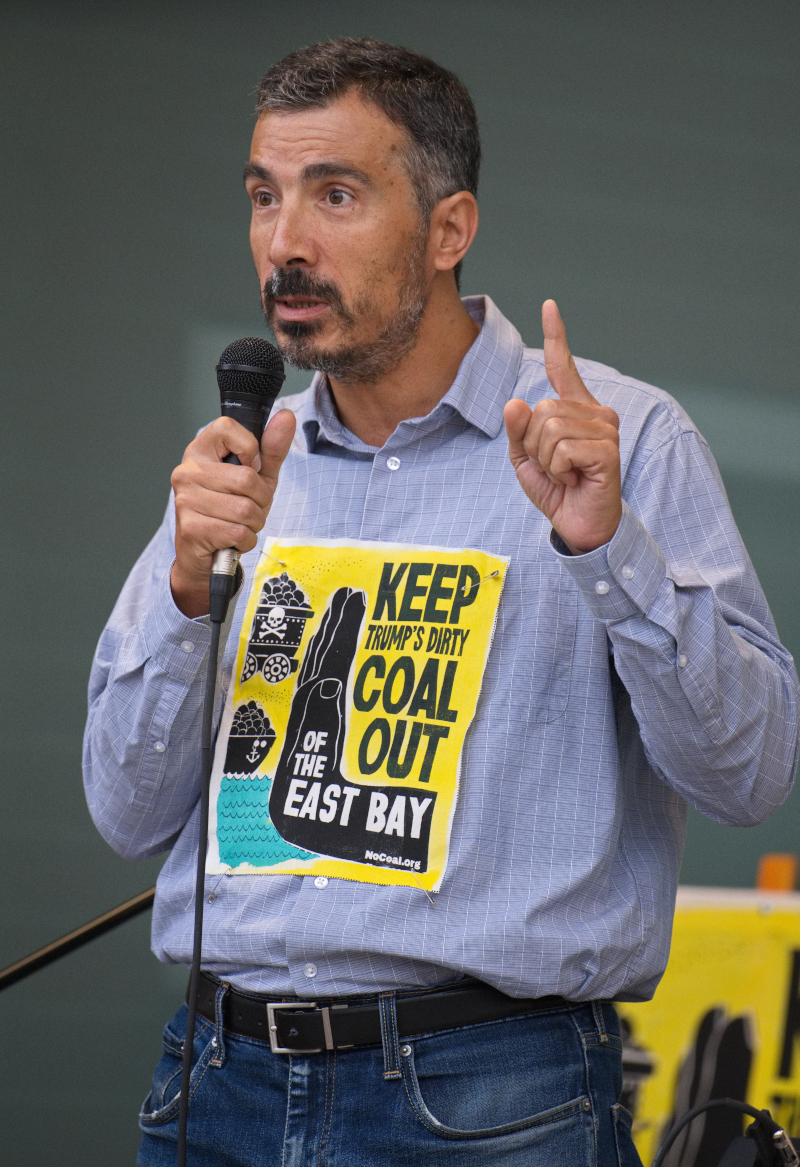
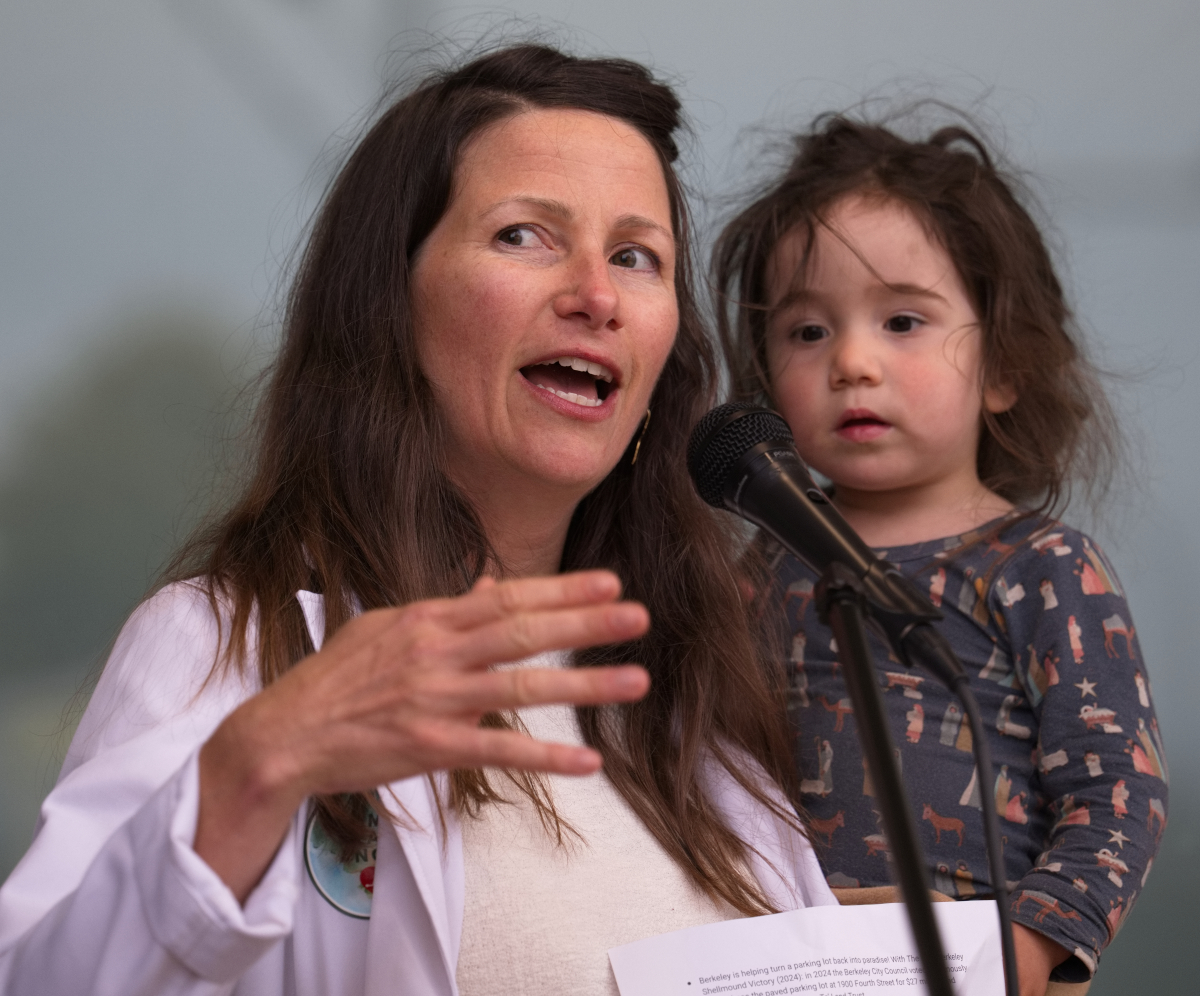
Last night, over 125 people rallied outside Berkeley City Council in support of a resolution opposing coal handling, storage, and transport in the Bay Area while dozens of No Coal advocates made their support known to the City Council with signs and comments.
The Berkeley City Council passed the resolution unanimously.
The resolution is a response to the deadly Trump-funded coal terminal planned in West Oakland. The resolution also calls for the Bay Area Air District to strictly regulate coal facilities, and affirms the City’s support of Assembly Bill 40, which requires environmental review for large coal projects. The resolution was sponsored by Council members Igor Tregub (Author), Rashi Kesarwani (Co-sponsor), and Terry Taplin (Co-sponsor) as well as by Berkeley mayor Adena Ishii.
“We live in the flatlands near the railroad tracks, freeways, refinery, and airport, constantly exposed to various pollutants,” said Ms. Margaret Gordon, a longtime environmental justice advocate and resident of West Oakland. “This proposed coal terminal is one more burden we should not have to suffer under. Homes along the tracks lack indoor air filtration and air conditioning to block out coal dust, posing a direct threat to our health.
“Our health is just as important as corporate profits. Unhoused individuals are especially vulnerable and exposed to pollutants, as they do not have a home to protect their lungs,” said Ms. Margaret. “No coal in the Bay Area!”
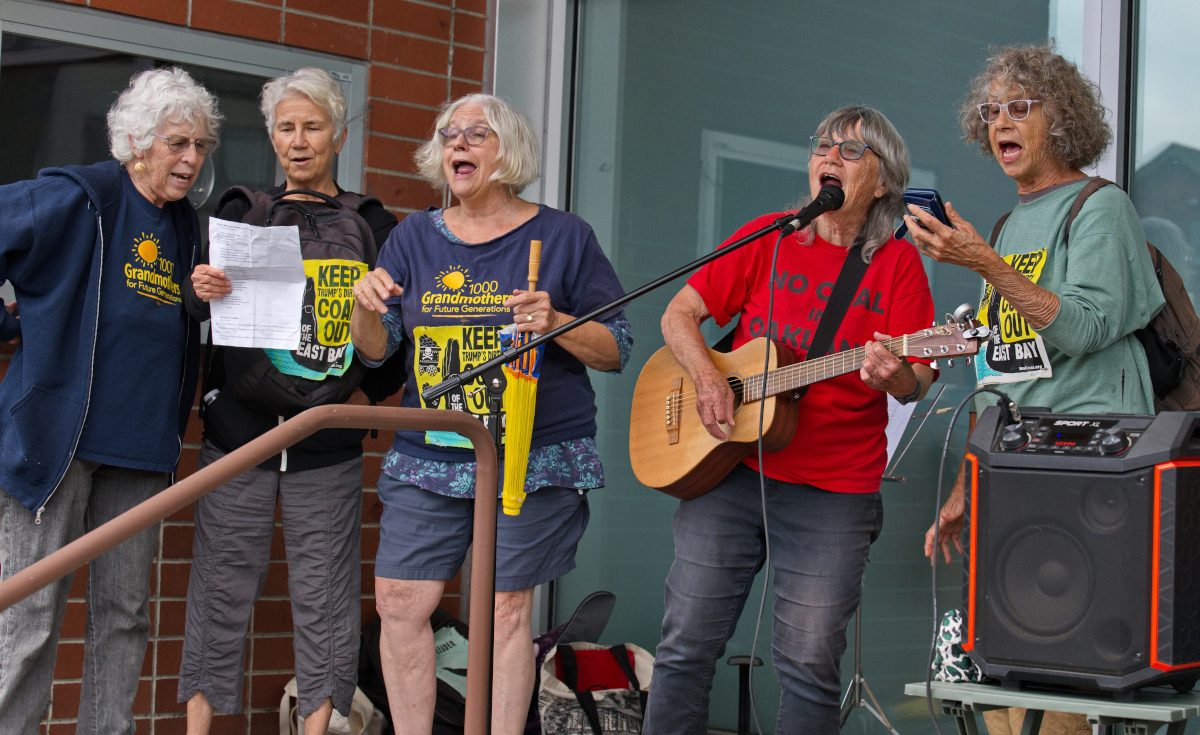
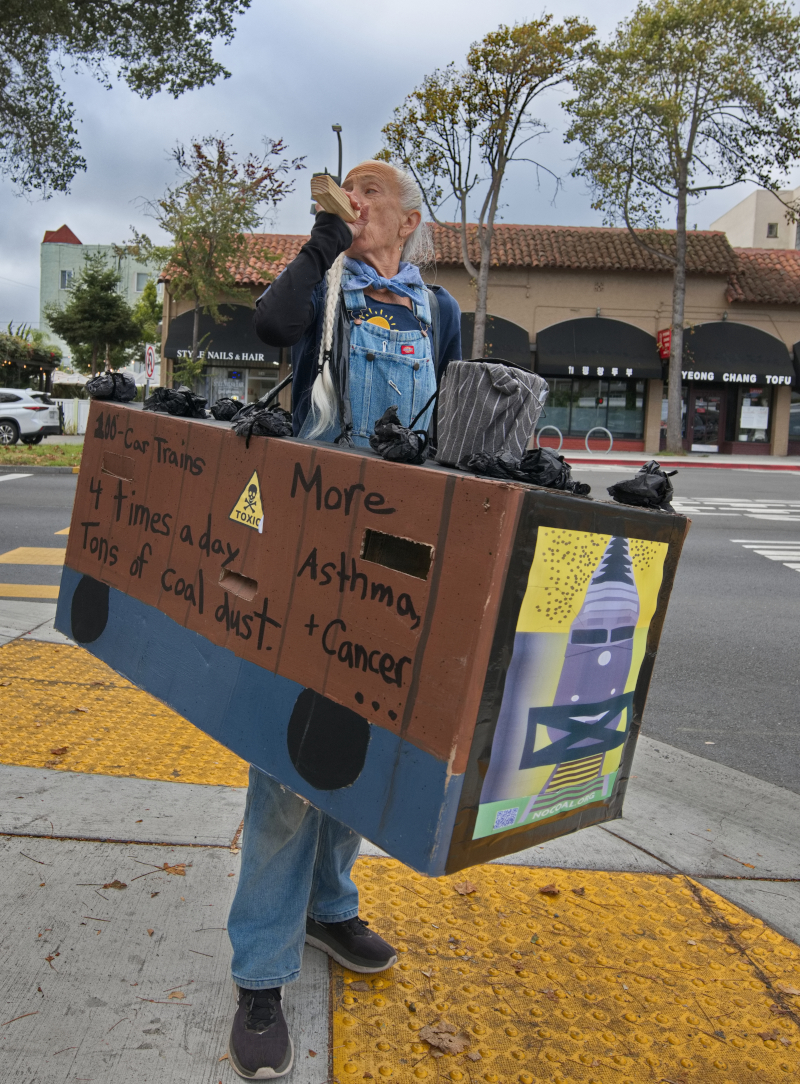
The rally was lively, defiant, and hopeful, with street theater performances including larger-than-life puppets blocking mock coal trains, chants and songs lead by Singing Resistance, and banners created at a community art build organized by “artivist” David Solnit.
“Living in Oakland, I am sick and tired of my community being ground zero for toxic pollution and environmental injustice,” said Berkeley Youth Vs. Apocalypse member Ashley Jahja. “Our health, our lives are not disposable. The fight against the coal terminal started in West Oakland but with recent mapping, is going to impact the entire Bay Area. Our fight is your fight, and we have to do whatever it takes to prevent the coal terminal from happening.”
“Berkeleyans are not about to let the East Bay become a ‘sacrifice zone’ so developers and the coal mining industry can poison the planet while they get even richer,” said Steve Masover, Berkeley resident and No Coal in Oakland organizer. “We’re here tonight because we’re determined to stop this calamity.”
“As a primary care physician, mom and community organizer who lives in West Berkeley, I could not be more opposed to the efforts to build a dirty coal terminal by the Bay Bridge,” said Ashley McClure, MD, the Executive Director of Climate Health Now. “My patients are already dealing with asthma, heart disease and dementia – all of which scientific evidence assures us would be made worse by the dirty soot of toxic coal dust (primarily fine particulate matter, or PM2.5) from coal trains smothering our communities. We care too much about the health of our families and communities to let the selfish profit motives of the billionaire class hawking dirty fossil energy move this ludicrous plan forward. This misanthropic dirty energy plan stops here.”
“These coal trains will pass a few hundred feet from places where my kids play soccer or attend summer arts camp,” said Megan Wachspress, Berkeley parent. “My kids will breathe the dust off these railcars while they’re moving, and kids in West Oakland will breath even more dust while the cars sit and are unloaded. I have a responsibility to my kids and to all the kids and families along these tracks to stop toxic coal dust from entering the East Bay.”
The resolution was proposed in response to the massively unpopular coal terminal planned in Oakland, which would flood Berkeley and other Bay Area cities with toxic coal pollution from mile-long coal trains. In June of this year, President Trump announced $75 million in funding for the terminal. Developer Phil Tagami aims to build a terminal to export coal carried by rail from Utah to Martinez to West Oakland, where he plans to load coal onto ships bound for Asian markets.
This resolution is part of a growing wave of resistance throughout the East Bay and statewide: The City of Richmond passed a similar resolution in July. Coalition members are organizing in other cities along the East Bay portion of the rail route to pass their own resolutions. The California State Legislature passed Assembly Member Mia Bonta’s AB40 last month. Governor Newsom is being urged by dozens of labor, faith, and environmental organizations, Supervisor Nikki Fortunato Bas, and countless Californians to sign it into law.
Rosa Parks Elementary School contingent, Photo Credit Leon Kunstenaar.
Singing Resistance, Photo Credit Leon Kunstenaar.
Labor speaker Cihan Tugal, Photo Credit Leon Kunstenaar.
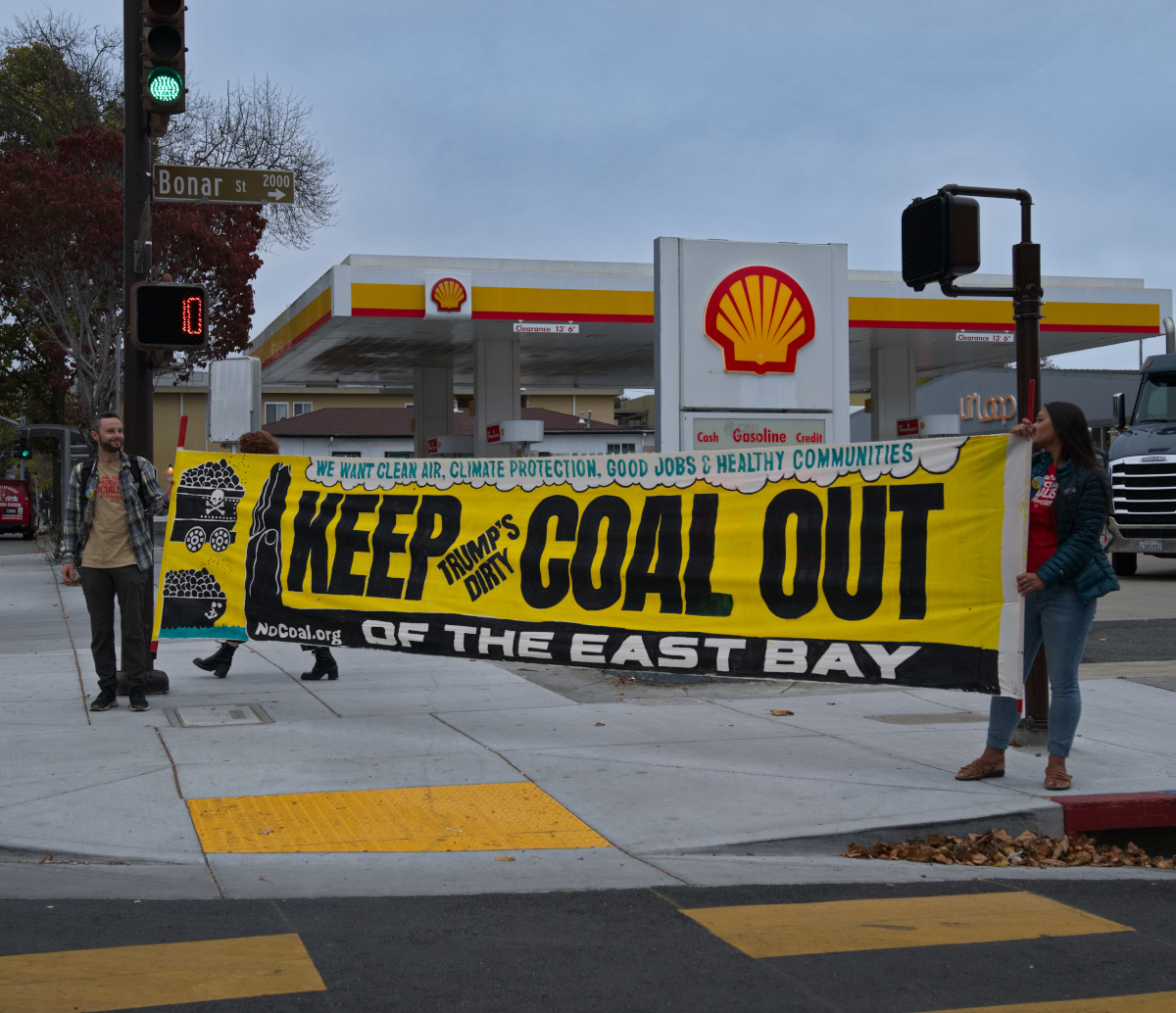
Banner, Photo Credit Leon Kunstenaar.
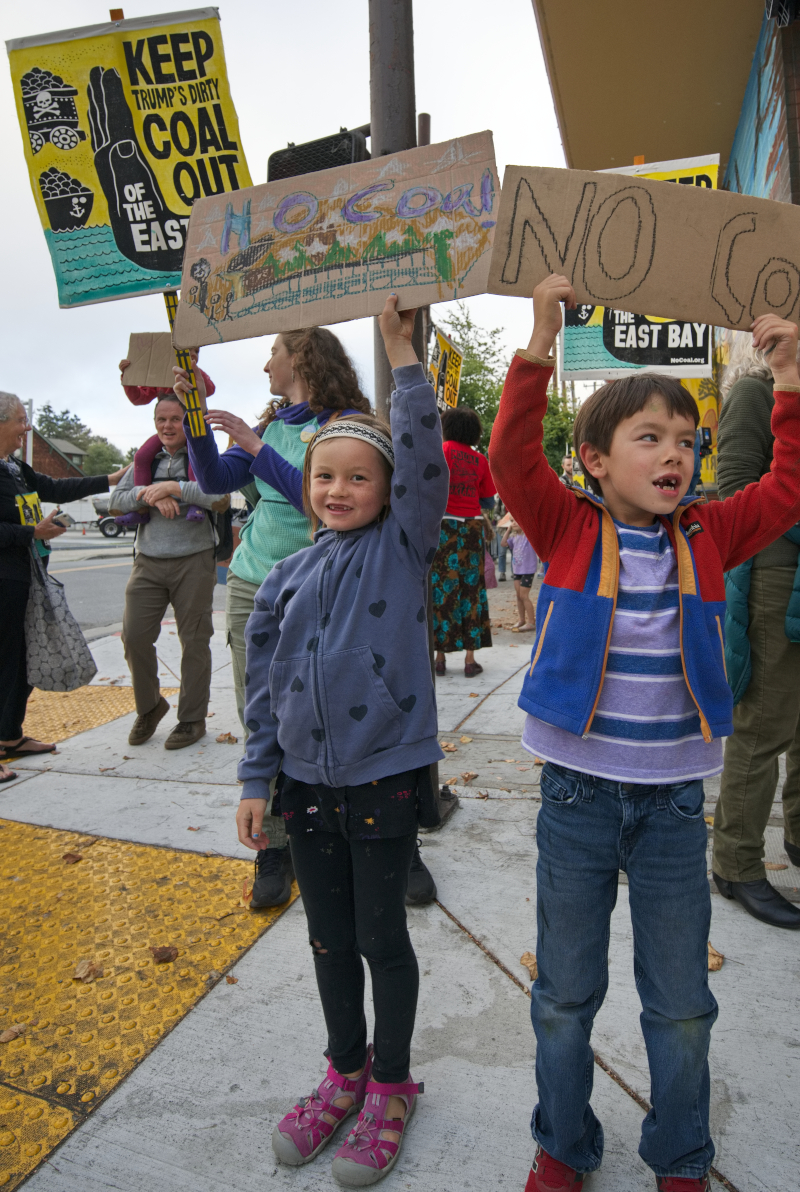
Kids against Coal, Photo Credit Leon Kunstenaar.
Berkeley Parent Sarah Berg at the mic, Photo Credit Leon Kunstenaar.
Coal Train (1000 Grandmothers), Photo Credit Leon Kunstenaar.
Images credit: Leon Kunstenaar
Recommending Stronger Safeguards for Proposed Drilling in Chequamegon-Nicolet National Forest
Educating the Future: AmeriCorps Help Build the Next Generation of Conservationist at Ohio Centers
A Pink Feather in Miami-Dade County's Cap
It’s time to phase out glyphosate to protect America’s wildlife
Nearly Half of U.S. Bird Migration Hotspots Are in Cities—Here's Why That Matters
Cities Matter More to Bird Migration Than We Thought
From 106 Known Spills to an Entire Polluted Region: Shell Faces a Much Broader Nigeria Trial in 2027
High Court ruling allows Bille community to argue that Shell is responsible for all relevant oil pollution in the region — including pollution that cannot be traced to one of 106 individually identified spills
A major new dimension has emerged in the long-running litigation over Shell-related oil pollution in Nigeria’s Niger Delta.
On 10 September 2026, Mrs Justice Lambert handed down judgment in Alame & Ors v Shell Plc & Anor [2026] EWHC 2332 (KB).
Much attention has understandably focused on another part of the ruling: allegations that Shell witnesses knowingly relied upon false or misleading factual assertions during the company’s earlier jurisdiction challenge are now to be dealt with as the litigation moves towards trial.
That development was examined in our earlier article, “Shell Nigeria Case Takes a Dramatic Turn: High Court Allows Allegations of Misleading Evidence to Be Tried.”
But the same judgment contains another ruling which may ultimately prove just as significant.
The High Court has rejected Shell’s attempt to prevent the Bille community from advancing what the judgment describes as its “primary” or “all-spills” case.
In simple terms, the claimants will be permitted to argue at the 2027 trial that Shell and its former Nigerian subsidiary are responsible not merely for pollution attributable to 106 specifically identified spills, but for all relevant oil pollution in the Bille region during the period covered by the claims.
That does not mean that the court has decided that Shell is responsible for all such pollution.
It emphatically has not.
What the court has decided is that the claimants are entitled to try to prove that case.
That distinction is crucial.
The case has moved far beyond 106 spillsThe Bille litigation concerns oil pollution associated with pipelines, wellheads and other infrastructure in the Niger Delta between 2011 and 2013.
Following earlier procedural battles, the claimants were required to particularise their case in much greater detail.
The resulting pleadings identify 106 individual spills.
But there is a striking detail in the judgment.
Of those 106 spills, 60 had been identified by the defendants and given incident numbers.
A further 46 spills had not been identified by the defendants and were instead identified by the claimants during the forensic process.
Mrs Justice Lambert recorded that the claimants had produced individual annexes dealing with each of the 106 spills and setting out the systemic failures alleged to have caused or contributed to them.
Those alleged failures include matters concerning:
- pipeline and infrastructure integrity;
- leak detection;
- maintenance and repair;
- protection against third-party interference and illegal bunkering;
- spill containment;
- remediation and clean-up.
These remain allegations which Shell is entitled to contest at trial.
But the claimants’ case does not stop with the 106 spills.
The “all-spills” argumentThe claimants contend that evidence concerning those identified spills may permit the court to draw wider inferences about pollution in Bille that cannot be attributed to any individually identified incident.
In other words, if contamination is found in an area and cannot be traced to one of the 106 specifically pleaded spills, the claimants want to be able to argue that it nevertheless resulted from another unidentified spill for which the defendants were responsible.
Shell opposed that approach.
The defendants argued that the claimants should be confined to the 106 identified spills and to damage which could be traced back to those specific events.
Had Shell succeeded, pollution that could not be connected to an individually identified spill would potentially have fallen outside the claimants’ case.
Mrs Justice Lambert rejected that restriction.
The claimants are therefore entitled to advance their broader case.
Doughty Street Chambers, whose Joshua Jackson acts for the claimants, summarised the effect of the ruling on 14 September:
the Bille community may argue that Shell is responsible for all oil pollution in the relevant region even where residents cannot identify every individual spill which produced that pollution.
That is a substantial development.
What the judge did — and did not — decideThe ruling should not be misunderstood.
Mrs Justice Lambert has not found that Shell caused every spill in Bille.
She has not found that every area of pollution came from Shell-operated infrastructure.
She has not decided whether sabotage, theft, illegal refining or other third-party activities caused particular spills.
Those are matters for evidence and trial.
The judgment instead deals with whether the claimants are legally and procedurally entitled to put their broader causation case before the court.
The judge concluded that they are.
Her reasoning illustrates why the eventual evidence will matter so much.
If, hypothetically, the evidence relating to the 106 identified spills showed that the defendants were responsible for virtually all of them and there were no credible competing sources for the remaining pollution, that evidence could potentially support an inference concerning unidentified spills.
If, on the other hand, the evidence presented a substantially mixed picture involving different causes and different responsible parties, drawing such a broad inference could become much more difficult.
The claimants therefore have permission to make the argument.
They still have to prove it.
Almost 300,000 documentsThere is another important part of the chronology.
According to Doughty Street Chambers, an earlier High Court disclosure order resulted in Shell providing the claimants with almost 300,000 documents by January 2026.
After that disclosure exercise, the claimants were required to provide detailed particulars concerning parent-company liability, fault and causation.
Their expanded pleadings followed.
That sequence matters.
This is no longer a case being argued principally from general assertions about pollution in the Niger Delta.
The approaching trial will take place after a very large disclosure exercise and after years of forensic examination of the underlying events.
The identification by the claimants of 46 additional spills which had apparently not previously been given incident numbers by the defendants provides one indication of what that forensic process has produced.
A second explosive issue sits alongside the pollution caseThe same September judgment also dealt with the claimants’ application concerning aggravated damages.
The claimants allege, among other matters, that Shell knowingly relied upon false or misleading factual assertions from witnesses during the jurisdiction proceedings that occupied the English courts between 2016 and 2021.
Shell had been arguing during those proceedings that its Nigerian subsidiary operated independently of the London-based parent company.
The jurisdiction dispute ultimately reached the UK Supreme Court, which in 2021 allowed the Nigerian communities’ claims against Royal Dutch Shell plc — now Shell plc — to proceed in England.
The current claimants now allege that evidence presented during that jurisdiction battle was false or misleading.
They also make allegations concerning the deletion or destruction of relevant evidence.
Again, these are allegations.
There has been no judicial finding that Shell, any Shell witness, or any lawyer deliberately misled a court or improperly destroyed evidence.
Shell contests the allegations.
But Mrs Justice Lambert rejecte
From 106 Known Spills to an Entire Polluted Region: Shell Faces a Much Broader Nigeria Trial in 2027 was first posted on September 16, 2026 at 7:01 pm.©2018 "Royal Dutch Shell Plc .com". Use of this feed is for personal non-commercial use only. If you are not reading this article in your feed reader, then the site is guilty of copyright infringement. Please contact me at john@shellnews.net
EWG statement on EPA rollback of PFAS water permit discharge guidance
WASHINGTON – The Environmental Protection Agency has rescinded critical guidance that helped states use the Clean Water Act National Pollutant Discharge Elimination System, or NPDES, to monitor and limit toxic PFAS “forever chemicals” discharges into wastewater.
The move undermines an important tool for preventing PFAS pollution from reaching the nation’s waterways, where it can persist for decades and become a costly, long-term contamination problem.
For wastewater treatment plants, industrial facilities and state permitting authorities, the change raises questions about whether and how PFAS monitoring and discharge limits will be maintained in NPDES permits.
The agency claims its rollback is an effort to address “confusion” and “inconsistent application” across states. But it creates a glaring contradiction in federal policy: If the EPA continues to defend PFAS monitoring requirements in individual permits, including in a recent settlement involving a Massachusetts wastewater treatment plant, why is it withdrawing guidance that helped states implement those protections?
That question matters because PFAS are exceptionally persistent and difficult to remove once they enter the environment. PFAS have been linked to kidney, liver, pancreatic and testicular cancers; as well as immune system suppression, thyroid disease, reduced vaccine efficacy, reproductive and developmental harm, low birth weight, increased cholesterol, weight gain in children and dieting adults, and a growing list of serious health effects.
Preventing these chemicals from entering waterways in the first place is critical to reducing exposure and avoiding the long-term costs of contamination and cleanup.
The following is a statement from Melanie Benesh, Environmental Working Group vice president for government affairs.
Let’s call this what it is: The EPA is doing corporate polluters’ dirty work at the expense of public health.
The EPA has abandoned its mission, choosing to protect industrial polluters rather than the families forced to drink companies’ toxic runoff.
By stripping away Clean Water Act guidance for PFAS discharges, the agency is deliberately blinding state regulators and giving chemical manufacturers permission to pollute without fear of oversight. The EPA is actively tearing down the guardrails that keep PFAS out of our drinking water.
Hiding behind bureaucratic excuses about “process” and “confusion” is insultingly weak. If the EPA was genuinely concerned about procedure, they would finalize binding, enforceable standards today, not erase the only thin line of defense that communities have left.
Families living downstream don’t get a polite administrative memo when cancer-causing chemicals poison their drinking water. They just get the contamination, the medical bills and decades of forever chemicals in their blood.
At a moment when the science on PFAS harm has never been clearer, the EPA is signaling loud and clear to industry that corporate convenience matters more than clean water.
That’s not regulatory housekeeping. That’s putting industry profits over public health.
###
The Environmental Working Group (EWG) is a nonprofit, non-partisan organization that empowers people to live healthier lives in a healthier environment. Through research, advocacy and unique education tools, EWG drives consumer choice and civic action.
Areas of Focus Water Toxic Chemicals Chemical Policy PFAS Chemicals Agency removes critical tool for limiting ‘forever chemicals’ pollution Press Contact Monica Amarelo monica@ewg.org (202) 939-9140 September 16, 2026On Continuing the Work while the World Burns Around Us
New ACLU and AFL-CIO Report Shows Deportations Lower Wages and Raise Costs for America’s Workers
The American Civil Liberties Union and the American Federation of Labor and Congress of Industrial Organizations (AFL-CIO) today released a new report, Citizenship and the Affordability Agenda: A Path to Better Jobs, Higher Wages, and Prosperity for All, detailing how the mass deportation agenda is exacerbating the affordability crisis by disrupting critical industries, eliminating jobs, weakening workplace protections, and driving up costs for working families. The findings come as communities continue to suffer the impact of mass de-legalization, record levels of immigration arrests and rebound from the economic toll of militarized enforcement operations like Minnesota’s “Operation Metro Surge."
The report finds that a broad path to citizenship would stabilize jobs and prices across the construction, hospitality, and care industries that families depend on while raising wages for all American workers. It also examines how Congress has committed at least $240 billion to immigration enforcement, while cutting funding for programs that help families afford food and health care, including SNAP, Medicaid, and Affordable Care Act subsidies — and in some cases allowing them to expire.
“Deportations make workers poorer and more vulnerable to exploitation by employers,” said Naureen Shah, director of government affairs, equality division at the ACLU. “When ICE continuously raids a community, everyone pays for it – in lost jobs higher prices and damaged businesses. The only immigration agenda that actually improves affordability is one that creates a broad path to citizenship.”
“Working people are paying the price for an immigration system that is destabilizing entire industries and communities and making it easier to exploit workers,” said AFL-CIO President Liz Shuler. “As this report demonstrates, a broad pathway to citizenship for all would raise wages, create more and better jobs, and strengthen our economy in ways that help all of us. It’s past time to give millions of working people and their families the stability they deserve, and we call on Congress to make citizenship a top priority. Working people know that it’s not an immigrant that stands between them and a good job—it’s the billionaires—and it’s time our laws reflect that.
- Among the report’s key findings: Immigration enforcement enables workplace exploitation. The federal government now spends 91 times more on immigration enforcement than on labor-standards enforcement, which leaves workplaces more dangerous and enables employers to violate wage, safety, and overtime laws while crushing worker organizing. More than a quarter of workers in low-wage industries report minimum-wage violations. While these abuses are highest among immigrant workers, they are widespread enough to suppress pay and standards for all workers in those industries, regardless of immigration status.
- Immigration raids stunt business activity and revenue creation. Immigration raids and enforcement surges have terrified people from going to work, shopping, dining out, and participating in their communities. The report cites an estimated 8.1 billion fewer visits to businesses and between $3 billion and $14 billion in lost annual spending. For example, Minnesota businesses lost $10–$20 million a week during and after “Operation Metro Surge.”
- Mass deportation eliminates jobs held by U.S. citizens. The Economic Policy Institute projects continued pursuit of the administration’s deportation agenda could eliminate nearly 6 million jobs, almost half of which are currently held by U.S. citizens.
- Stripping workers’ legal immigration status is worsening the affordability crisis. The Trump administration’s mass “de-documentation” campaign has stopped work authorization from nearly 2 million people, disrupting key industries like construction and hospitality.
- A broad path to citizenship would create jobs and raise wages. Creating a path to citizenship would create hundreds of thousands of new jobs and substantially raise wages for every American worker= by removing immigration status as a tool employers use to suppress pay and silence workers.
This report, published in partnership with the AFL-CIO, is the third in the ACLU’s affirmative vision series, in which policy and legal experts explore how the Trump administration’s immigration agenda has harmed communities nationwide, undermined our democracy, and wreaked havoc on key industries and weakened the American workforce. The series will also outline steps that members of Congress, as well as state and local policymakers, can take to reform the U.S. immigration system and inoculate against future attacks on our rights and safety.
You can read the full report here: https://www.aclu.org/publications/citizenship-and-the-affordability-agenda-a-path-to-better-jobs-higher-wages-and-prosperity-for-all
Happy National Wilderness Month
First Mining Claims Filed in Lands Cut from Bears Ears National Monument – 9.16.26
FOR IMMEDIATE RELEASE
September 16, 2026
Contacts:
Grant Stevens, Communications Director, Southern Utah Wilderness Alliance (SUWA); (319) 427-0260; grant@suwa.org
Keri Gilliland, The Wilderness Society, (KGilliland@tws.org)
Chaitna Sinha, Conservation Codirector and Staff Attorney, Grand Canyon Trust; (970) 399-9565 (csinha@grandcanyontrust.org)
Amy Dominguez, Sierra Club, amy.dominguez@sierraclub.org, (385) 355-4631
Kris Deutschman, Conservation Lands Foundation, kris@conservationlands.org, (505) 498-0212
Andrew Scibetta, NRDC, (202) 289-2421, ascibetta@nrdc.org
Daniel Hernandez, National Parks Conservation Association, dhernandez@npca.org, (202) 573-2201
SAN JUAN COUNTY, UT – 16 new mining claims (see map) have been filed in previously protected land in Bears Ears National Monument. These lands became subject to mining claims on Friday, September 11 – 60 days after President Trump decimated Bears Ears and Grand Staircase-Escalante by shrinking these national monuments by over 90%. All 16 claims were recorded on September 11 by noon; it took until Tuesday, September 15 for them to appear in the San Juan County Recorder’s Office’s online system.
The new mining claims (see map) are in two general areas: Lockhart Basin & near the Easy Peasy Mine (the mine has been re-buried). Three Claims were filed by George W. Schultz in the Lockhart Basin area. 13 claims were filed by Kimmerle Mining; two of these claims are adjustments to the Easy Peasy claims first filed after Trump’s 2017 reduction of Bears Ears and 11 are new claims nearby. Kyle Kimmerle (a Managing Member of Kimmerle Mining) was also a plaintiff in one of the cases filed challenging President Biden’s 2021 restoration of the Bears Ears and Grand Staircase-Escalante national monuments. On July 14, 2026, Kimmerle Mining illegally attempted to file seven mining claims prior to the Sept. 11 deadline. Additional information appears below, along with quotes from Tribal leaders and conservation groups.
“This rush to locate new mining claims in Bears Ears National Monument reinforces the need to be vigilant over the next several years while we work to undo Trump’s illegal actions and restore both Grand Staircase-Escalante and Bears Ears National Monuments.“said Hanna Larsen, Staff Attorney at the Southern Utah Wilderness Alliance (SUWA). “As evidenced by the Easy Peasy Mine, claims like these often lead to real and long-lasting damage to the very qualities that make these monuments so special.”
“Immediately after the mining ban was lifted, 16 claims were filed on the lands removed from Bears Ears National Monument,” said Charlie Luke, Utah state director at The Wilderness Society. “This is not a hypothetical threat, it’s the reality of what happens when national monument protections are gutted. We cannot allow special interests to turn a profit on Bears Ears at the expense of future generations.”
“The speed with which the mining industry moved to stake claims following the dismantling of the Grand Staircase-Escalante and Bears Ears National Monuments demonstrates the real-world consequences of stripping protections from some of America’s most important landscapes,” said Bobby McEnaney, Senior Lands Analyst at the Natural Resources Defense Council (NRDC). “This sequence of events underscores exactly why Bears Ears was originally established and why this landscape deserves lasting protection. These mining claims amount to a virtual giveaway of public lands.”
“The administration put some of America’s greatest heritage at risk when it opened up Bears Ears and Grand Staircase-Escalante for mining,” said Chaitna Sinha, Staff Attorney and Conservation Codirector for the Grand Canyon Trust. “The 16 new mining claims in Bears Ears follow a poll in which the vast majority of Utahns said protections should be restored to all of Bears Ears and Grand Staircase-Escalante, including 52% of Republicans. 82% of those polled said that Native American tribes should have a strong role in managing lands they hold sacred. It’s a shame our elected officials aren’t listening to the people who elected them. Most Utah voters want these monuments restored to their original boundaries and want tribes to be partners in their management.”
“Within days of the illegal reduction of these treasured public lands, industry interests are already lining up to exploit them,” said Franque Bains, Chapter Director of the Sierra Club in Utah. “This rush makes clear the consequences of the Trump administration illegally stripping protections from Bears Ears and Grand Staircase-Escalante: Irreplaceable cultural landscapes and public lands are being put at risk for corporate profit. We will continue working alongside Tribal nations, local communities, and our partners to defend these landscapes and restore the protections they deserve.”
“Sixteen new mining claims within days of the deadline is proof that this was never about public access — it’s about clearing the way for extraction,” said Chris Hill, CEO of the Conservation Lands Foundation. “BLM Director Pearce and Governor Cox like to talk about keeping lands open for the public, but when mining companies raced to stake claims on sacred and treasured landscapes, they gave them the green light. This tells you who they’re really working for. A recent Grand Canyon Trust poll found that 52% of Utah Republicans want protections restored to all of Bears Ears and Grand Staircase-Escalante, and 82% say tribes should have a strong role in managing the lands they hold sacred. Utahns have made themselves clear — it’s their leaders who refuse to listen. We’re going to keep fighting, in court and in communities, until these monuments and the integrity of the entire public lands system are restored.”
“The arguments about access in Bears Ears were clearly about energy extraction, and mining companies have wasted no time staking new claims,” said Sara Cawley, Energy Director at the National Parks Conservation Association. “Three of the claims are located in the Lockhart Basin, a spectacular landscape that contains numerous cultural and archaeological sites and sits next to Canyonlands National Park’s eastern boundary. National park units and their surrounding landscapes are no place for energy development, but outdated laws elevate mining above all other uses on these lands. We will continue to fight to prevent these special places, surrounding communities, and sovereign tribes from being undermined and exploited.”
Background Information on other Mining claims:
Under President Trump’s proclamations decimating Bears Ears and Grand Staircase-Escalante by over 90%, mining claims could not be staked until 60 days after the date of the proclamation: Friday, Sept. 11, 2026. Despite this, on July 14, 2026, Kimmerle Mining filed 7 mining claims (see map) with the San Juan County (Utah) Recorder’s Office. Kimmerle Mining previously filed mining claims after Trump’s 2017 reduction of Bears Ears and excavated a partially reclaimed mine shaft on one of the claims – the so-called Easy Peasy claim (this mine has been re-buried); Kyle Kimmerle (a Managing Member of Kimmerle Mining) was also a plaintiff in one of the cases filed in the District of Utah challenging President Biden’s 2021 restoration of the Bears Ears and Grand Staircase-Escalante national monuments.
Two mining claims were also filed in Grand Staircase-Escalante, less than one month after Trump’s attack. On August 6, 2026, Craig Rosequist filed two mining claims (see map) with the Kane County (Utah) Recorder’s Office in areas cut out of the monument by the Trump proclamations. According to public records, Rosequist previously located several mining claims in neighboring Washington County, Utah. The Bureau of Land Management should reject claims filed in both national monuments prior to Sept. 11.
- Map of 2026 claims in Bear Ears, showing the 2021 and 2026 Monument Boundaries and noting the location of the Easy Peasy Mine, created by the Southern Utah Wilderness Alliance (SUWA)
- Map of 2026 Claims in Grand Staircase-Escalante, created by SUWA
- Photo and video assets of Kimmerle’s Easy Peasy Mine and surrounding claims, please credit Tim Peterson.
Background information about the national monument reductions:
- Statements from Bears Ears and Grand Staircase-Escalante Inter-Tribal coalitions
- SUWA Statement on Trump’s Illegal Reductions of Grand Staircase-Escalante & Bears Ears National Monuments
- Full Statement and Quotes Tracking
- Maps of the reductions
- Reporter Background Memo on National Monuments
###
The Southern Utah Wilderness Alliance (SUWA) is a nonprofit organization with members and supporters from around the country dedicated to protecting America’s redrock wilderness. From offices in Moab, Salt Lake City, and Washington, DC, our team of professionals defends the redrock, organizes support for America’s Red Rock Wilderness Act, and stewards a world-renowned landscape. Learn more at www.suwa.org.
The post First Mining Claims Filed in Lands Cut from Bears Ears National Monument – 9.16.26 appeared first on Southern Utah Wilderness Alliance.
roasting-caribou-as-land-defense-photo-of-the-week
What You Missed in the Transportation Reauthorization This Summer
If you took a break or simply lost track of Congress’s efforts to craft America’s massive new federal transportation law this summer … well, so did we. And with the Infrastructure Investment and Jobs Act set to expire in just a few months, it’s more important than ever that advocates rally together to make our next core infrastructure bill the best it can be.
We sat down with Beth Osborne of Transportation for America to catch up on what we missed, and help us all plug back in to the fight for a better reauthorization. Here are the highlights from our conversation.
Recommended Everything You Want to Know About the Next Surface Transportation Reauthorization But Were Afraid To Ask Kea Wilson July 22, 2025 The big picture on where things standBack in the spring, a lot of members of congress swore up and down that this was finally the year they would deliver America a shiny new national infrastructure bill on the day the old one expires — despite the fact that no congress has ever reauthorized America’s core national transportation programs on schedule.
The House Transportation and Infrastructure Committee took its first stab at a accomplishing that ambitious goal in late May with the Build America 250 Act … which was roundly panned by advocates as even more expensive, highway-focused, and unlikely to accomplish its goals than the (also car-centric and deficit-fueled) megabill we have now, the Infrastructure Investment and Jobs Act.
Build America 250 would place a new fee on electric vehicles — but organizations like the Bipartisan Policy Center warn it wouldn’t be anywhere near enough to bridge the gulf, especially since the Trump administration is doing everything it can to “end the EV mandate” and get Americans into gas-powered cars.
“There’s not enough money coming in through [funding streams like] the gas tax and diesel tax and tire taxes to cover the cost of maintaining the program where it is,” Osborne said. “In fact, there’s not enough to cover just the highway formula funds. We haven’t even gotten to that part of the conversation yet — and that’s always the most painful part.”
Rather than explain to election-year voters why they were burying the country in even deeper debt, Congress was forced to pass a temporary extension of the IIJA until December 11, to keep America’s mobility funding flowing and punt sticky questions about future funding until after the midterms.
That “extension”, though, used some budgetary tricks to work in a 20 percent cut to public transit compared to fiscal year 2026, and a staggering 83 percent cut to passenger rail — and the money for the latter wouldn’t even be guaranteed. Highway programs remained untouched.
Worse, Build America 250 isn’t dead — and the pressure is on from the Trump administration to deliver a bill like it that “prioritizes motor vehicle travel over bicycle lanes” no matter what it costs, as Secretary Sean Duffy wrote in a July letter to Congress.
“Apparently making it safe for a kid to bike to school is somehow weird left-wing propaganda now,” added Osborne. “I thought it was traditional, and something that we all aspired to go back to – but [according to the Trump administration,] apparently not. [They think] bike lanes are horrible. Slowing down traffic to the actual posted speed by using design? That’s horrible [to them], too.”
Recommended The Last Straw: Duffy Asks Senate To ‘Restrict’ Funding For Bike Lanes Dave Colon July 23, 2026 Why extending the IIJA is probably our best bet — even if it sucksOf course, pushing backwards ideas about bike lanes isn’t the only way that the Trump administration is interfering in our country’s transportation future — or its present.
Osborne notes that the executive branch has strained the limits of the current transportation law by freezing, rescinding, running out the clock on and otherwise slashing money for programs and projects it simply doesn’t like, all because they supposedly “violate” broad executive orders against vaguely-defined concepts like “sustainability” and “equity.” Communities struggling to build things, meanwhile, don’t exactly have the money they need to fight those decisions in court, even if they think they’re illegal.
Congress, though, happily passed a new government funding bill earlier this month without any significant provisions to restore transportation funding to communities that lost it — or any new guardrails to prevent Trump from stomping on the spirit of the IIJA going forward.
“I think the real issue is the fact that this administration has not only felt comfortable, but has actually been left to implement the last surface transportation program any way it wanted to — whether it was connected to the law or not,” Osborne added. “And in response to that, the House passed a bill giving them more money … Why wouldn’t [Trump] just continue violating the law?”
Recommended Dems Push for Guardrails to Shield Federal Transportation Grants From Trump Meddling David Meyer June 23, 2026That’s why Osborne says advocates should call on Congress to extend the IIJA for at least a year, until Trump and his ilk prove they can follow the law for any meaningful period of time — even if the IIJA is making our communities worse.
“I mean, if you if you ask me, the IIJA was not a good authorization at all,” Osborne said. “It didn’t make our roads safer. It didn’t focus on bringing our infrastructure into state of repair. It didn’t make it easier for people to get to work or other destinations. It didn’t lower emissions. It accomplished zero of its goals … I wish we lived in a world where someone [in Congress] would engage in that conversation with us.”
Why electing more Democrats probably won’t set America up for a better bill (and what will)With the mid-terms coming up fast, Osborne knows some advocates might be tempted to think that simply electing more ostensibly climate-focused Democrats is our best bet to pass a better transportation law.
She warns, though, that even the deeply harmful Build America 250 passed the House transportation committee with broad bipartisan support — and getting a better bill across the finish line will take a full court-press on both sides of the aisle.
“If anyone is under the impression that that if Democrats take control of the House that they will get a better bill, let me disabuse you of that now,” she added. “What will happen is the Democrats will take up the bill they negotiated this Congress, point out that it was passed through a committee almost unanimously, and so why wouldn’t we just copy and paste that sucker and move forward? That’s where we are.”
Advocates’ real challenge now, Osborne argues, is a fundamental one: to get elected officials on both sides of the aisle to realize about just how thoroughly auto-centric policies are failing to achieve any of the goals they might have for our transportation system.
And then we have to get them to care about it — and refuse to fund the endless construction of harmful highways just for the sake of notching an easy bipartisan win.
“What often happens is [advocates] get to Capitol Hill, and they are told by their leadership … that [transportation funding] is bipartisan, and anything is good,” Osborne added. “And if there’s a problem with the program, it’s lack of funding — and there is absolutely nothing we need to do on policy, we just need to spend, spend, spend. I think it’s important … to say no: actually, the problem is we have been spending gobs and gobs of money, and not getting the results promised.”
To have an impact, Osborne argues that advocates need to make noise to their legislators about the failings of the IIJA, and why doubling down on the same car-focused strategies in Build America 250 is a terrible bet.
“People in Congress do not understand what is not working in the transportation program,” she added. “Advocates need to speak up and let them know where their concerns are — and how that is different than just pouring more money down the same rabbit hole.”
Climavision offers expanded weather forecasting to data centers
The company says it can help large loads better respond to changing weather conditions as data centers are asked to play a more active role in grid management.
Communities, Audubon Create Resilience Road Map in Cape Romain
Latino Conservation Week highlights attacks on public lands
Latino Conservation Week kicked off this week at Ironwood Forest National Monument near Tucson—one of six national monuments the Trump administration has identified as candidates for size reduction to open the way for mining and drilling.
Ironwood Forest protects 129,000 acres of Sonoran Desert habitat and has served as a buffer against mining expansion since its 2000 designation. ASARCO’s Silver Bell mine has pursued a years-long push to expand into the monument to boost copper production.
“Public lands belong to all of us, not special interests,” said Rebecca Perez, Arizona conservation manager for The Wilderness Society. “Yet this summer, the Trump administration virtually eliminated Utah’s Grand Staircase-Escalante and Bears Ears National Monuments, making them vulnerable to mining and drilling.”
The threats to public lands extend beyond monument boundaries. The Center for Western Priorities’ Keep Parks Public campaign was in Tucson last month for a live podcast recording about damage to cultural sites and fragmentation of wildlife habitat caused by border wall construction. You can listen to the podcast here.
“We all must join together and understand that this is our land,” said Christine Flanagan, president of Friends of Ironwood Forest. “And as public land owners, we need to start acting together like we own this land.”
Events across the United States are being held through Sunday, September 20. Find an event near you.
Quick hits Tohono O’odham fight border wall on sacred, sovereign lands California lawmakers join together in a bipartisan push against proposed Yosemite land transfer Latino Conservation Week launches with call to protect public lands Studies link New Mexico drilling to radiation, air pollution, health risks Yellowstone National Park visits decline for 3rd month Drought leads to ‘unprecedented’ black bear conflicts in Wyoming Opinion: Wildfire strategy doesn’t need a winner Major Forest Service policies could be changing. Here’s what’s at stake Quote of the dayWe will not let this destroy our sacred sites, our burial sites, our holy places, the places of our ancestors. We will not let it destroy our environment. We will not let it further divide our people. We will not let it divide our reservation.”
—Tohono O’odham Chairman Verlon Jose, High Country News
Picture This @yellowstonenpsIt’s migration time! But not all birds leave Yellowstone – several bird species stay in the park a bit longer and approximately 50 species reside here year-round.
Osprey usually stay through November. These birds are known for their excellent fishing skills – they dive into the water to catch fish with their sharp talons. Barbed pads on the soles of their feet help them grip slippery fish that can weigh up to 50% of their body weight!
Planning to go birding during your Yellowstone visit? Download our bird checklist from our website at: go.nps.gov/YELLbirds (link available in our bio)
(Featured image: Ironwood Forest National Monument near Tucson, Arizona. Photo by Bob Wick, BLM California. Flickr)
The post Latino Conservation Week highlights attacks on public lands appeared first on Center for Western Priorities.
Utility costs could put pressure on cities’ finances, S&P experts warn
Rates are high compared to household income in many places, and over time, this could reduce flexibility for public finance entities, say S&P Global analysts. This isn’t currently leading to significant bond rating actions, but it’s a “simmering risk.”
Pages
The Fine Print I:
Disclaimer: The views expressed on this site are not the official position of the IWW (or even the IWW’s EUC) unless otherwise indicated and do not necessarily represent the views of anyone but the author’s, nor should it be assumed that any of these authors automatically support the IWW or endorse any of its positions.
Further: the inclusion of a link on our site (other than the link to the main IWW site) does not imply endorsement by or an alliance with the IWW. These sites have been chosen by our members due to their perceived relevance to the IWW EUC and are included here for informational purposes only. If you have any suggestions or comments on any of the links included (or not included) above, please contact us.
The Fine Print II:
Fair Use Notice: The material on this site is provided for educational and informational purposes. It may contain copyrighted material the use of which has not always been specifically authorized by the copyright owner. It is being made available in an effort to advance the understanding of scientific, environmental, economic, social justice and human rights issues etc.
It is believed that this constitutes a 'fair use' of any such copyrighted material as provided for in section 107 of the US Copyright Law. In accordance with Title 17 U.S.C. Section 107, the material on this site is distributed without profit to those who have an interest in using the included information for research and educational purposes. If you wish to use copyrighted material from this site for purposes of your own that go beyond 'fair use', you must obtain permission from the copyright owner. The information on this site does not constitute legal or technical advice.
 This site is not the official webpage of the Industrial Workers of the World.