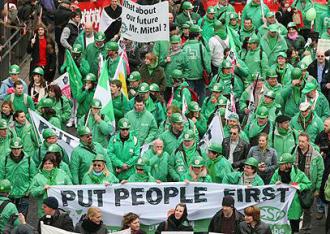
On cyber syndicalism: From Hacktivism to Workers’ Control

By Jeff Shantz - Workers Control, January 1, 2016

Alternative globalization movements in the global North, from their high point in the Quebec City mobilizations against the Free Trade Area of the Americas in 2001 to the present, have been faced with the challenge of rebuilding and finding new ground on which to re-mobilize since the political reaction set in following the 9/11 attacks which derailed momentum and caused many mainstream elements (especially labor unions) to disengage and demobilize (where not playing to the forces of “law and order” reaction). One effect of the post-9/11 freeze (it has been more than a chill) has been the drift away from grounded community (it was never much involved in workplace organizing), outside of some important cases such as indigenous land struggles, as in Ontario and British Columbia, and some direct action anti-poverty movements (like the Ontario Coalition Against Poverty). Instead much organizing has followed certain lines of flight — crucial in the formation of alternative globalization movements from the Seattle protests against the World Trade Organization in 1999 — to online activism (in indymedia, hacking, social media, and so on).

In some ways radicalism has continued and developed more consistently, or even fully, online than it has offline in community organizing. Partly, this is an effect of the surveillance apparatus and protest policing that has aggressively targeted “on the ground” movements.

The cyber sphere has provided some spaces for maneuver not available in the streets or in the hood. On the one hand, movement commentators have noted the decline of movements in the period after 9/11 up to the moment of brief resurgence manifested in the Occupy encampments. On the other hand, the cyber disobedients have offered some inspiration and reason for hope. Indeed, the networks of the web have been perhaps uniquely important in allowing for some ongoing activity connecting social movement organizers during the period of decline and dissipation of struggles. Indeed, this is always an important task — maintaining movements through inevitable low periods of struggle and sustaining some capacity for collective re-emergence and revival as possibilities for an uptick of struggles open up.  This was perhaps more difficult in periods prior to the development of the web when opportunities for communication, skill sharing, and resource circulation were more limited or localized and when demoralization within face-to-face circles could finish a movement.

The future potential of movements in struggle will rely in part on the growing convergence, even symbiosis, of the cyber disobedients and the direct actionists of the streets. Even more important will be the grounding of this action and organizing in specific workplaces and neighborhoods in ways that challenge fundamentally relations and structures of ownership, control, and exploitation.

One Million Climate Jobs: A Challenge for Canadians

By Jonathan Neale - One Million Climate Jobs, January 5, 2016

In Canada, an alliance of unions, with environment, youth, public interest, faith-based organizations and First Nations are working together through the Green Economy Network to put these principles to practice, by calling for “one million climate jobs” in Canada within the next five years.

The Canadian Labour Congress (CLC) has recently adopted its COP21 Statement, emphasizing that climate change is already affecting production and consumption patterns in many sectors of our economy.

The warnings by the United Nations’ Intergovernmental Panel on Climate Change (IPCC) that the current pace of emissions is already consuming the entire global carbon budget is a clear indication that market forces on their own are not in a position to provide the kind of transition that will prevent catastrophic climate change.

Governments must step up to the plate by working and providing leadership for the common good and public interest. With a new government in Ottawa, Canada is now in a position to commit ambitious, achievable, science-based targets to significantly reduce greenhouse gas emissions.

At the 2009 COP15 in Copenhagen, Canada pledged with other G8 countries to cut its carbon emissions by 80 percent by 2050. Such a target implies emission cuts by 2030 of no less than 38 percent of 2005 levels. Now, at COP21, we urge the federal government to recommit to at least this target.

As have Germany and Australia with their coal industries, there is a need to be proactive in regulating the petroleum industry in Canada and curbing expansion of the oil sands, which remains the fastest growing sector of the economy for greenhouse gas emissions, despite the falling oil prices.

This calls for significant industrial transformation toward a new low-to-zero carbon economy. A transformation that will eliminate or transform existing jobs, likely bringing about resistance to change, which could undermine a much needed social consensus in Canada for a way forward.

To address this resistance, a just transition strategy that is supported by workers, employers and governments is needed, with a focus on creating new jobs and incorporating training and education for displaced workers. The strategy must embody social support, re-employment and compensation measures, and be devised with the participation of workers and their representatives.

These measures must also go hand in hand with efforts to deal with unemployment overall, as rising CO2 levels and job losses are the products of the same economic model. A commitment to Decent Work, as understood by the International Labour Organization (ILO), can pave the way to an economic model that addresses social injustice, poverty and inequality at the same time. In 2013, the Canadian government, employers and unions agreed, along with those of other countries, to a set of guiding principles that can do just that. Now is the time to apply these principles for dealing with climate change in Canada.

In Canada, an alliance of unions, with environment, youth, public interest, faith-based organizations and First Nations are working together through the Green Economy Network to put these principles to practice, by calling for “one million climate jobs” in Canada within the next five years.[1] Similarly, the Blue Green Canada also brings together unions and environmental groups to tackle these issues.

Well, if You Ask Me: California! Stop with the massive gas leak already!

By Dano T Bob - IWW Environmental Unionism Caucus, January 7, 2016

So, if you’ve been in a cave the last week, or on holidays time, or only follow corporate media (Washington Post did cover this), there is a massive gas leak going on in southern California right now that no one seems to know how to stop, especially the company responsible. Pretty bad, right? Yeah, really bad. Here’s the basic details:

Methane gas, a HUGE contributor to climate change as a Greenhouse Gas, is currently leaking from from a facility at Aliso Canyon(Orange County, below Los Angeles) at rate of 110,000 pounds per hour, all day everyday. Somewhere around 2,000 some odd homes have been evacuated thus far, and building moratorium has been proposed for the area near the leak. Residents are also gearing up to sue the hell out of the owners of the facility, the Southern California Gas Company(feel free to contact them).

I first learned of this leak (and I currently live in California!) on the day after Christmas via this super informative article from VICE, “Why Engineers Can’t Stop Los Angeles’ Enormous Methane Leak.” Cheery title and timing, eh?

This article does on to discuss how the EDF, Environmental Defense Fund, found out about the leak a week or so earlier via an infrared heat camera, calling it “one of the biggest leaks we’ve ever seen reported” and “absolutely uncontained.”

The leak originally sprung in mid-October (!) and currently “accounts for a quarter of the state’s entire methane emissions.” Another juicy tid bit from this read:

Methane, the main component of natural gas, is 25 times more potent than carbon dioxide when it comes to climate change impact. About one-fourth of the anthropogenic global warming we’re experiencing today is due to methane emissions, according to the Environmental Defense Fund. Leaks like the current one in California, it turns out, are a major contributor. In Pasadena, for instance, just 35 miles from the leak in Aliso, investigators found one leak for every four miles.”

It goes on to say,”So far, over 150 million pounds of methane have been released by the leak, which connects to an enormous underground containment system. Silva says that the cause of the leak is still unknown, but research by EDF has also revealed that more than 38 percent of the pipes in Southern California Gas Company’s territory are more than 50 years old, and 16 percent are made from corrosion- and leak-prone materials.”

Full Disclosure : In Resolution Form

By J.P. Wright - RailroadMusic.Org, January 1, 2016

Whereas:
2015 kicked my ass. I got way to involved in too many things. I burned out and now I am standing in the center of the highest point in my life. I would have to thank all that put up with me this year. To all that I put up with, I also thank. My family and the life that gives me is something that I cherish. I care, and that is a problem – for me …. It is the ultimate calling.

Whereas:
I spend hours at the throttle of my trains pondering how I can be of assistance. Dreaming of a way to get involved. Strategizing new ways to lend my voice to the struggle. I have done some amazing things and met some amazing people in 2015. When I say that, I am far from boasting. I was taught to share. To teach. To explore impossibilities as possible. I was raised like that. I must move, at all times.

Whereas:
My mind sometimes, in on fire – from a deep feeling that comes from my heart., I have Vision. I think deeply and sometimes get myself into very dark places. Sometimes, when I am playing music with the right people, i see things. I hear voices. I do not suggest anything by mentioning this, except what comes with the territory. This is the training, that comes from the job I do as a Djembefola. I accept it and have learned how to learn from it.

So be it resolved that:
In 2016, as that last page of my Chapbook suggests … I am closing shop. My training is over. I will be 46 years of age in January. I will never master this life. We are not supposed to, and any master you meet will always suggest that they are not, if they suggest that they are, they are not.

So be it further resolved that:
Many times, the answer really is, I do not know. That is the sign of a mastery of exploration. Follow a person who does not know and you will probably find your bliss. Your bliss is always following you, shadowing you as a possibility. I plan to turn around in 2016. I plan to focus. I make resolution to be.

So be it EVEN FURTHER resolved that:
I will never give up! This life requires it and my mother told me, I can be whatever I want to be – So Be It !!

Unify Fights Against Austerity and Climate Change

By Asbjørn Wahl - Social Europe, December 18, 2015

The Climate Summit in Paris has once again reminded us of how vulnerable we are on planet earth. However, humanity is faced with a number of deep and challenging crises: economic, social, political, over food – and, of course, over climate change, which is threatening the very existence of millions of people. These crises have many of the same root causes, going to the core of our economic system.

Strong vested interests are involved. It is thus an interest-based struggle we are facing. All over the world, people are organizing and fighting against the effects of the crises. Trade unions are heavily involved in many of these struggles, and so are many other movements – single-issue as well as broader social movements. Increasingly, our entire social model, the way we produce and consume, is under question. The way out of these crises requires a system change and this can only be achieved if we are able considerably to shift the balance of power in society. This leaves us with the challenge of unifying movements and continuing struggles – particularly to bring anti-austerity together with the struggle against climate change.

Agreement, But No Solution

At the recent Paris Summit (COP21), the first ever truly global agreement to fight the climate crisis was concluded. Governments have been negotiating for more than 20 years (more or less since the Rio Summit in 1992) in order to achieve that. During this period, however, greenhouse gas (GHG) emissions have not been cut. Quite the opposite. Emissions have increased immensely, by more than 60 per cent. Transport emissions have increased 120 per cent over the last 30 years, and they are still rising all over the world – even at a rate that outweighs cuts in other economic sectors.

The stated aim of the Paris agreement is ambitious. The target of keeping global warming below 2oC was strengthened, so that governments should now “pursue efforts” to limit the temperature increase to 1.5oC above pre-industrial levels. The weakness of the agreement is that there is a huge gap between this aim and the measures agreed upon to reach it. Based on the voluntary pledges (so-called Intended Nationally Determined Contributions – INDCs) from all countries on how much they are prepared to cut their emissions, we are so far on course for a temperature increase of 3-4oC. This means climate catastrophe.

Marius Mason calls for an International Day of Trans Prisoner Support on January 22nd

Press Release - IWW Incarcerated Workers Organizing Committee, January 1, 2016

Long time IWW member and Green Scare prisoner, Marius Mason, hopes that on January 22nd outside supporters will honor his request for an International Day of Trans Prisoner Support.

Marius is a well known champion of the environment, animal rights, housing rights, and prisoner support, and now, even while imprisoned, he seeks justice and fair treatment for trans prisoners.

As of December 6th, 2015 supporters in San Francisco, Austin, Kansas City, Detroit, New York, and multiple cities in Australia and New Zealand have begun preparing events and actions to start raising awareness about the uniquely horrific conditions trans people face in prison.

Any sort of events are appreciated though core organizers do encourage people to focus more on education in 2016 and then work toward taking action in future years. Education before action is appreciated. For more information, you may contact the Kansas City Incarcerated Workers Organizing Committee at gkciww@gmail.com or 816-866-3808.

From Marius mason in a letter dated 08-18-15, "I want to ask you all if you would be willing to host an event on January 22nd, 2016 to support trans prisoners. I want to do something to support other trans folk in prison (especially trans women of color who seem to suffer the most abuse statistically). There are a number of groups who are already doing prisoner support who are willing to host an event this coming year to draw attention to a group of prisoners who could really use some more public attention to their situation. There should be a call out soon both on my site and others but I'd like to ask you personally. It's ok if it's small. It's just the first year we're trying to do it. We get you Black and Pink Newsletters and addresses for people to write to. Not sure if some local queer LGBT space might be willing to donate space for something big like a drag show (friends in Israel did one on June 11th but anything would be awesome). [Friends] are helping to coordinate this and I'll touch back with you if you would be ok with working on it. Well thanks no matter what you decide to do on the event. It's great that you're out there educating and agitating for change and supporting lots of prisoners on the inside of the system like me. Thank you for being there, for you work, and for the encouragement that keeps me going. Write when you can. I'm always thinking about Detroit, my hometown. Until all are free, Marius Mason."

Floods, climate change and job cuts

By Martin Empson - One Million Climate Jobs, December 28, 2015

In 2015 Britain has seen repeated flooding causing large-scale damage. Tens of thousands of people have had to evacuate their homes, suffered days without power and seen their homes and businesses destroyed as storms repeatedly hit the country. In the latest bout of flooding, thousands of people in Manchester, Leeds and York have been hit, sometimes with the worst floods ever, as rivers broke banks.

Trade unions that represent workers in the emergency services have repeatedly warned of the impacts of austerity measures on their ability to deal with flooding and other severe weather.

Unison, for instance, which represents workers at the Environment Agency, reported how cuts would reduce its ability to prevent and respond to flooding and tidal surges. In 2012/13 the grant was £124 million less than in 2009/10.

Staff numbers at the Agency have been reduced by around 1000. The November 2015 autumn statement pledged that the Agency would have its funding for flood defences “preserved”, but the rest of its budget would decrease by 15%. The government claims that it is protecting front line services that respond to emergencies and help prevent flooding, but cutting behind the scenes staff and resources hit the ability of workers to deal with crises, and the ability to make long term plans for future, worsening, weather.

The Fire Brigades Union (FBU) has also highlighted the way that cuts will affect its ability to respond to emergencies such as flooding. In response to the most recent floods the FBU said that “threats posed by such large scale floods are beyond the capacity of local services to cope. The impact of massive cuts to funding of the country’s fire and rescue service is being felt by all firefighters, including those who are aiding flood rescue.”

Simon Hickman, Manchester FBU Brigade Organiser, whose members were on the front line dealing with floods in Salford said, “We’re stretched to the limit with the lack of resources due to the cuts, and we’ve just been told that £15.8 million is to be cut locally. It is bad enough this time but it will be far worse next time. We had 56 fire engines available, the majority were committed to incidents. Yet we are told we may be cut down to as few as 30 at night time, which will remove any resilience in the future”.

Even Coastguard services have been cut back.

Prime Minister David Cameron has expressed sympathy with victims, and celebrated the work of the emergency workers. But his government’s policies have made the situation far worse. Back in 2011, the then Tory-Liberal coalition government announced an 8 percent cut (£540 million) in spending on flood defences. Government policies that favour the fossil fuel industry, such as fracking, will only increase emissions leading to further climate change and more frequent floods.

The government is well aware of the increased risks of flooding because of climate change.  Almost a decade ago, in 2006, Nicolas Stern wrote an extensive report into the economic impacts of climate change for the then Labour government which warned that “Infrastructure damage from flooding and storms is expected to increase substantially” unless there were flood management policies that could avoid this. In purely economic terms, Stern saw the situation as getting far worse as global warming increased, warning that

“The costs of flooding in Europe are likely to increase, unless flood management is strengthened in line with the rising risk. In the UK, annual flood losses could increase from around 0.1% of GDP today to 0.2 – 0.4% of GDP once global temperature increases reach 3 to 4°C.”

These floods are not “unprecedented” they are the new norm. Climate change means that we are going to see more frequent and more extreme flooding. In order to protect lives, homes and businesses we need to reverse the cuts to emergency services and the Environmental Agency and increase funding.

We also need investment that can reduce the impact of climate change. Writing in The Guardian, environmental campaigner George Monbiot has shown that planting trees can help the soil absorb water. Rather than cuts, we should be creating jobs that can save lives, protect property and reduce the impact of climate change.

But we also need to drastically reduce emissions of greenhouse gases that cause climate change. This is why the Campaign against Climate Change, with seven national trade unions, and the National Union of Students are calling for One Million Climate Jobs. The creation of such jobs, through investment in renewable energy, insulation schemes, public transport and energy reduction could reduce emissions from the UK by 86% in twenty years. The trade union movement recognises that climate change is no longer an abstract discussion, but a reality. Dealing with it can help create jobs and improve society.

In 2014 David Cameron told flooded communities in the South-West that “money was no object” in helping them recover from that year’s floods. In 2016 we must hold him to that statement and demand the sort of investment that can prevent future disasters.

Monkeywrenching the Misogynists in our Movements: A historical exploration of call-outs and anti-feminist backlash in Cascadia

By Kiera Loki Anderson - Earth First! Journal, December 20, 2015

There has been some attention paid within Earth First! circles about how to challenge white supremacy and patriarchy in recent years. I aim here to shed some light on the widespread misogyny present within overlapping anarchist and environmental communities. I am specifically looking at responses to interpersonal violence and misogyny in primarily white and male-dominated activist groups in Cascadia, but I also want to draw from and contribute to an understanding of how racism, classism, and ableism maintain oppression within the larger movement and society.

I spent the last two years doing interviews and archival research into feminist call-outs in the Pacific Northwest from 2000-‘05. During that period, eco-anarchist groups In Eugene, Portland, and Olympia had to expend huge amounts of energy if they wanted to keep activists safe from interpersonal abuse. These efforts were made infinitely harder by the lack of awareness straight, white activist men displayed about privilege and oppression.

I initially wanted to hear “all sides” of these call-outs. I interviewed a wide range of activists and put together a comprehensive archive of articles, zines, and web pages. I initially planned to create a healing, empowering space in which forest defenders and anarcha-feminists could hear differing experiences of that time – a calling-in of sorts – that could encourage healthier models of accountability in our movement to emerge.

However, my research challenged many of my assumptions. I’ve begun to understand the impact that widespread anti-feminist “counter-offensives” had on attempts to call out and organize against interlocking forms of oppression. The backlash also had impacts on individual survivors. In the last few years, debates about “call-out culture” have also become common in eco-anarchist circles. Although much of this writing from activist circles focuses on how call-outs are used to challenge oppressive language or actions more broadly, criticisms of “call-out culture” are often linked to criticisms of “punitive” approaches to accountability.[1]

In my own work, I’ve come across many examples of why direct action-style tactics like call-outs are necessary to challenge the entrenched and widespread oppression that marginalized activists face in supposedly “radical” activist communities. The activism of the early 2000’s, in places like Eugene or Portland, offers an exploration of how organizations and communities can either be complicit in misogyny and interpersonal abuse or actively try to challenge it. Misogyny underpins “cultures of abuse” that enable violence against marginalized women and trans people, and protects abusers and misogynists.[2]

Paris climate agreement: a terror attack on Africa

By Patrick Bond - Climate and Capitalism, December 17, 2015

Patrick Bond is director of the Centre for Civil Society at the University of KwaZulu-Natal in Durban, South Africa

Paris witnessed both explicit terrorism by religious extremists on November 13 and a month later, implicit terrorism by carbon addicts negotiating a world treaty that guarantees catastrophic climate change. The first incident left more than 130 people dead in just one evening’s mayhem; the second lasted a fortnight but over the next century can be expected to kill hundreds of millions, especially in Africa.

But because the latest version of the annual United Nations climate talks has three kinds of spin-doctors, the extent of damage may not be well understood. The 21st Conference of the Parties (COP21) to the UN Framework Convention on Climate Change (UNFCCC) generated reactions ranging from smug denialism to righteous fury. The first reaction is ‘from above’ (the Establishment) and is self-satisfied; the second is from the middle (‘Climate Action’) and is semi-satisfied; the third, from below (‘Climate Justice’), is justifiably outraged.

Guzzling French champagne last Saturday, the Establishment quickly proclaimed, in essence, “The Paris climate glass is nearly full – so why not get drunk on planet-saving rhetoric?” The New York Times reported with a straight face, “President Obama said the historic agreement is a tribute to American climate change leadership” (and in a criminally-negligent way, this is not untrue).

Since 2009, US State Department chief negotiator Todd Stern successfully drove the negotiations away from four essential principles: ensuring emissions-cut commitments would be sufficient to halt runaway climate change; making the cuts legally binding with accountability mechanisms; distributing the burden of cuts fairly based on responsibility for causing the crisis; and making financial transfers to repair weather-related loss and damage following directly from that historic liability. Washington elites always prefer ‘market mechanisms’ like carbon trading instead of paying their climate debt even though the US national carbon market fatally crashed in 2010.

In part because the Durban COP17 in 2011 provided lubrication and – with South Africa’s blessing – empowered Stern to wreck the idea of Common But Differentiated Responsibility while giving “a Viagra shot to flailing carbon markets” (as a male Bank of America official cheerfully celebrated), Paris witnessed the demise of these essential principles. And again, “South Africa played a key role negotiating on behalf of the developing countries of the world,” according to Pretoria’s environment minister Edna Molewa, who proclaimed from Paris “an ambitious, fair and effective legally-binding outcome.”

Arrogant fibbery. The collective Intended Nationally Determined Contributions (INDCs) – i.e. voluntary cuts – will put the temperature rise at above 3 degrees. From coal-based South Africa, the word ambitious loses meaning given Molewa’s weak INDCs – ranked by Climate Action Tracker as amongst the world’s most “inadequate” – and given that South Africa hosts the world’s two largest coal-fired power stations now under construction, with no objection by Molewa. She regularly approves increased (highly-subsidized) coal burning and exports, vast fracking, offshore-oil drilling, exemptions from pollution regulation, emissions-intensive corporate farming and fast-worsening suburban sprawl.

A second narrative comes from large NGOs that mobilized over the past six months to provide mild-mannered pressure points on negotiators. Their line is, essentially, “The Paris glass is partly full – so sip up and enjoy!”

This line derives not merely from the predictable back-slapping associated with petit-bourgeois vanity, gazing upwards to power for validation, such as one finds at the Worldwide Fund for Nature and Climate Action Network, what with their corporate sponsorships. All of us reading this are often tempted in this direction, aren’t we, because such unnatural twisting of the neck is a permanent occupational hazard in this line of work.

And such opportunism was to be expected from Paris, especially after Avaaz and Greenpeace endorsed G7 leadership posturing in June, when at their meeting in Germany the Establishment made a meaningless commitment to a decarbonized economy – in the year 2100, at least fifty years too late.

Perhaps worse than their upward gaze, though, the lead NGOs suffered a hyper-reaction to the 2009 Copenhagen Syndrome. Having hyped the COP15 Establishment negotiators as “Seal the Deal!” planet-saviours, NGOs mourned the devastating Copenhagen Accord signed in secret by leaders from Washington, Brasilia, Beijing, New Delhi and Pretoria. This was soon followed by a collapse of climate consciousness and mobilization. Such alienation is often attributed to activist heart-break: a roller-coaster of raised NGO expectations and plummeting Establishment performance.

Possessing only an incremental theory of social change, NGOs toasting the Paris deal now feel the need to confirm that they did as best they could, and that they have grounds to continue along the same lines in future. To be sure, insider-oriented persuasion tactics pursued by the 42-million member clicktivist group Avaaz are certainly impressive in their breadth and scope. Yet for Avaaz, “most importantly, [the Paris deal] sends a clear message to investors everywhere: sinking money into fossil fuels is a dead bet. Renewables are the profit centre. Technology to bring us to 100% clean energy is the money-maker of the future.”

Once again, Avaaz validates the COP process, the Establishment’s negotiators and the overall incentive structure of capitalism that are the proximate causes of the crisis.

The third narrative is actually the most realistic: “The Paris glass is full of toxic fairy dust – don’t dare even sniff!” The traditional Climate Justice (CJ) stance is to delegitimize the Establishment and return the focus of activism to grassroots sites of struggle, in future radically changing the balance of forces locally, nationally and then globally. But until that change in power is achieved, the UNFCCC COPs are just Conferences of Polluters.

Via Campesina was clearest: “There is nothing binding for states, national contributions lead us towards a global warming of over 3°C and multinationals are the main beneficiaries. It was essentially a media circus.”

Asad Rehman coordinates climate advocacy at the world’s leading North-South CJ organization, Friends of the Earth International: “The reviews [of whether INDCs are adhered to and then need strengthening] are too weak and too late. The political number mentioned for finance has no bearing on the scale of need. It’s empty. The iceberg has struck, the ship is going down and the band is still playing to warm applause.”

After Paris: A Global Movement for Climate Jobs

By Jonathan Neale - Global Climate Jobs, December 18, 2015

This post looks at the results of the Paris climate talks, and says what the climate movement and the social movements need to do next, how climate jobs fit into that, and what you can do to help build a campaign for climate jobs in your country.

The Paris Climate Talks

Many have hailed the result of the UN climate talks as a breakthrough, for two reasons. One: all of the countries of the world signed an agreement about climate change. Two: there are some good abstract hopes in that agreement.

But there are also concrete promises about emissions. Some countries have promised to cut emissions by a little in the next fifteen years. They may, or may not, keep their promises. Many more countries, with more emissions, have promised to increase their emissions by a lot. Taken together, these are promises to increase emissions every year between now and 2030. That’s the bottom line. (For the details, see our earlier post, Paris: World Promises to Increase Emissions.)

What We Need to do Now

The good news is that we have a growing and increasingly radical global climate movement. And the organisations who think the agreement is a breakthrough also think it is only a beginning. In addition most people in the climate movement saw the result of Paris coming, so we do not have a demoralised movement.

As we return from Paris, it is clear that the leaders of all the countries in the world have failed us. They did so because nowhere did we have the political and social power to make them take decisive action on climate. So now we have to build that power, country by country. The only force we have on our side is seven billion people. We have to mobilise them.

This will not be an easy or quick task. We all know that. After all, we need cuts of 80% in global emissions, as soon as possible. That means deep changes in energy use and society.

Two kinds of campaigns will be central. One is fighting to leave the coal, gas and oil in the soil. There will be a global day of action against fossil fuels in May; national campaigns; local resistance to pipelines, new mines, new drilling, new power stations, extreme energy, fossil few sponsorship, and investments in fossil fuels.

The other kind of campaign will be to build an alternative. If we are to leave the fossil fuels in the ground, we have to do four things. We need to replace fossil fuels almost entirely with renewable energy. To do that we need renewable energy for all our electricity. We need a switch from cars to public transport, and almost all transport run on renewable electricity. We need conversions of all homes and buildings to save energy, and then to heat and cool all buildings with renewable electricity. And we need to protect and extend the great forests.

We need to do thousands of other things, but those four things will make most of the difference. All that will take a lot of work – we estimate at least 120 million new jobs worldwide each year for 20 years. This is what we mean by ‘climate jobs’ – jobs that have a direct effect in cutting greenhouse gas emissions.

(For more detailed explanation in English, French or Spanish, see our booklet on Global Climate Jobs here.)

Moreover, we want government climate jobs programs to ensure a retraining and a permanent job to anyone who loses a high carbon job during the transition. That is only fair, and if we don’t do it we will split unions and communities.

Pages

The Fine Print I:

Disclaimer: The views expressed on this site are not the official position of the IWW (or even the IWW’s EUC) unless otherwise indicated and do not necessarily represent the views of anyone but the author’s, nor should it be assumed that any of these authors automatically support the IWW or endorse any of its positions.

Further: the inclusion of a link on our site (other than the link to the main IWW site) does not imply endorsement by or an alliance with the IWW. These sites have been chosen by our members due to their perceived relevance to the IWW EUC and are included here for informational purposes only. If you have any suggestions or comments on any of the links included (or not included) above, please contact us.

The Fine Print II:

Fair Use Notice: The material on this site is provided for educational and informational purposes. It may contain copyrighted material the use of which has not always been specifically authorized by the copyright owner. It is being made available in an effort to advance the understanding of scientific, environmental, economic, social justice and human rights issues etc.

It is believed that this constitutes a 'fair use' of any such copyrighted material as provided for in section 107 of the US Copyright Law. In accordance with Title 17 U.S.C. Section 107, the material on this site is distributed without profit to those who have an interest in using the included information for research and educational purposes. If you wish to use copyrighted material from this site for purposes of your own that go beyond 'fair use', you must obtain permission from the copyright owner. The information on this site does not constitute legal or technical advice.