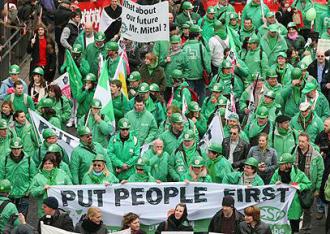
‘We need social ownership and democratic control of energy’

By Tabby Spence - New Internationalist, December 16, 2015

The dust has settled in Paris, where hundreds of thousands of delegates, journalists and activists spent the last two weeks buzzing around on little sleep and carrying heavy agendas. Despite the news of a ‘historic, world-saving agreement’ flooding the airwaves, tens of thousands flooded the streets on Saturday to express grief, despair, anger, defiance, and a commitment to continue strengthening the climate justice movement. According to the activists, who were literally drawing massive red lines through central Paris (and in other places around the world), the Paris Agreement permits governments to cross many important red lines representing the basic requirements for a just and liveable planet (you can see more detailed analysis on just how bad the deal really is here).

Given the decades of international meetings not yielding any cuts in greenhouse gas emissions (but rather growth by 63%), most of the civil-society groups were prepared for another epic failure at COP21. Yet many of these groups are developing strategies to drive scientifically adequate and historically fair transformations at local and national scales. A diversity of groups are working to remove the social licence of polluting corporations, the legality of company fiduciary duty over human lives and ecological systems, and the political and economic incentives granted to climate-warming industries.

While some of these groups have gained notoriety on social media for their creative actions, trade union groups and allies have been working quietly and diligently in their own locales to develop rapid phase-out plans for fossil fuel-emitting industries and vamping up renewables, as well as increasing energy efficiency in buildings, and reducing emissions in transport, food production and other important areas.

Jonathan Neale of the One Million Climate Jobs campaign in the UK explains, ‘These plans aim for a just transition – with the public creation of the climate jobs needed, a training programme for people leaving fossil sectors and moving into the new industries, and guaranteed work with decent pay for working people.’

Members of the Global Climate Jobs campaigns active in South Africa, Norway, Canada, the Philippines, the UK, New York State, and Mauritius held a number of workshops over the duration of the two weeks in Paris to explain how the existing campaigns in particular national contexts were developed, and to offer support for people who want to begin climate-jobs campaigns in their own countries. New campaigns are being launched in countries all over the world as a result of these discussions.

Trade Unions for Energy Democracy (TUED), like many of the climate jobs campaigns, emphasize the need for the jobs created to be public-sector jobs, and for the carbon-free energy, transportation and housing to be affordable and accessible for all.

The way forward is with ‘social ownership and democratic control of energy’, Sean Sweeney, founder of the Global Labor Institute, said at a sold-out event in Paris, titled ‘Now is not the time for small steps: solutions to the climate crisis and the role of trade unions’. Clara Paillard, who is the National Executive Secretary of the UK-based Public and Commercial Services Union, elaborated, emphasizing that addressing climate change is too important to be left to the market, and that the transition needs to be managed across scales by the public, not for short-term, private gains.

Leader of the British Labour Party Jeremy Corbyn and renowned writer and activist Naomi Klein joined for the lively conversation of the crucial link between the imperatives for social, economic and political transformation in the context of a warming climate. One of the panellists, leading trade unionist Josua Mata of Sentro (Philippines), posed one of the most salient and challenging questions: ‘If the deal is going to be so bad, why don’t we just reject it? Isn’t no deal better than a bad deal?’ Naomi Klein’s response was that, even if we want to, we don’t get to reject it.

The lack of democracy and the hold of powerful countries and interests over the international processes means that the local and national scales are the actual planes at which we can operate to bring about large-scale changes.

Many of the climate-jobs campaigns are gaining traction and, thanks to the tireless work of trade unionists, allies and other organizers for social justice, it looks like we may see large-scale 'operationalization of the first climate-jobs campaign in Canada within the year. The strategy of developing transitional blueprints on national or local scales, with an aim to put power back into the hands of the public, may be the best bet we have to massively rejig the world as quickly and democratically as possible.

Collapsing the levels, Consolidating Our efforts

By SN Nappalos - Recomposition, December 11, 2015

Recomposition Introduction: Approximately 5 years ago work began on something called the intermediate analysis. A few members of the Recomposition editorial group contributed pieces, worked in groups, and tried to shape their work around the issues raised in the analysis. Between 2010 and today stand a lot of changes and a different landscape for radical action. The maturing of the world financial crisis, series of popular protest movements, and conservative responses have shifted the field from where we stood just a short time ago. Today we present a piece by Scott Nicholas Nappalos exploring what was useful and harmful in the intermediate analysis, and what lessons can be drawn for revolutionary unionists in North America specifically and for the libertarian left more generally. 

The intermediate level first confronted me after the 2004 bicoastal wildcat strike where the Industrial Workers of the World (IWW) had attempted to organize a national coordination of the various autonomous local groups of truckers who have come together. That followed a series of debates within the Portland IWW branch, where I was a member, over the role of revolutionaries in building a union. I began a draft on the intermediate analysis during the period of 2004-2006, but returned to it more seriously a few years later in Miami when things had calmed down and in dialogue with other comrades there. In 2010-2011, I contributed to a series of pieces on the intermediate level as part of group discussions within Miami Autonomy & Solidarity, an anarchist communist political organization I was a member of. These reflections came out of years of rumblings, discussions, and experiments by anarchists trying to find ways to apply their ideas to workplace and community organizing in the North American . Nearly as soon as the words hit the page a series of struggles began to test our ideas; first the Madison protests, then Occupy, and later others.

The three or so years that followed the publishing of pieces on the intermediate level led to more discussion and distribution than anyone likely imagined. In a couple cases other groups consciously adopted the terminology and the debate spread outside North American circles through libertarian networks. In today’s environment of unstable quietness, many are looking around, taking stock, and picking up old debates to help sort out the events of the past years beginning with the crisis in 2008. It’s obvious that there’s been a spate of protests that set the decade apart from the past 30 years, though they’ve remained short-lived and largely localized so far. Vast changes are afoot with sections of the public more open to our politics than any time in recent history, though that hasn’t yet translated into any real sustained advances. Some years and modest experiments behind us, it is a good opportunity to re-evaluate the strategy and analysis.

There is no need to beat the drum and reiterate the arguments bit by bit here, but instead interested folks can look to pieces I wrote: Defining Practice: the intermediate level of organization and struggle[1], the three-part piece called Towards a Theory of Political Organization for our Time[2], and also somewhat related the co-authored article with Adam Weaver Fighting for the Future: The necessity and possibility of national political organization for our time.[3] The quick summary is that there are two frames to the analysis. The first, the intermediate level, is a tool for looking at the social world and categorizing different types of activity to understand them better. The mass level is an idealized space where all the struggles of all the social actors take place like giant unions or community organizations that encompass entire classes. The political level takes place where specific ideologies, strategies, and politics are coordinated in that larger field. The intermediate level is where people come together based on shared strategy and experiences to coordinate their activity within struggles; more broad than the ideological unity of the political level, and more narrow than the mass level it is working within.

The second framing of the analysis deals specifically with intermediate organizations, which is to say organizations that occupied the space roughly between unions and political parties/organizations. Intermediate organizations are ones constructed with distinct tasks from mass or political ones, and unlike the first aspect of the analysis are physically and actively separate. In the first we are talking about activities that can co-exist alongside others in a variety of formats, the second is specific organizations that imperfectly reflect those activities.

The simplest examples of intermediate organizations are tendencies within social movements. These groups organize militants around a shared platform of various sorts to take action within an organization such as a union or community group. This spans from relatively ideologically broad such as Soldiers of Solidarity[4] in the UAW, to groups for action with broader political orientation such as the communist party’s Trade Union Education League and later Trade Union Unity League’s unions[5] or the Unemployed Councils of the Great Depression[6], and overtly political tendencies such as the Federacion Estudiantil Libertaria[7] in Chile today which organizes anarchists on specific proposals for action and demands within the student unions. Many organizing projects however tend to act as intermediate organizations of militants without having another overarching social organization they work within.

Controversially I’d argue that projects of the anarcho-syndicalist variety in fact act like intermediate organizations. Really there’s two ways to look at it: our concept of unions is too narrow, or revolutionary unions/projects represent something altogether different from parties and unions. One way to come at the intermediate level is to question all of this, and say the idea of non-political mass organizations is utopian, they’re inherently involving all levels of activity: political, mass, and intermediate. In one sense the dominant idea of what unions and organizing projects are (for left thinkers anyway) has become incredibly narrow; essentially apolitical groups that try to win demands for the whole of the class or some section of the class.

This scenario is far from universal in fact, because historically it was rarely if ever the case. It has been common for unions to fight around a range of issues from housing, immigration, and the oppression of ethnicities and women with examples in the IWW, FORA, CNT, and FAU but also reformist unions.[8] The meaning of union is interpreted as about the workplace narrowly defined. However in South America, to take an example, unions came out of resistance societies which were unions of workers and proletarians organized around a variety of different collective needs and projects. Resistance societies were a militant off shoot of mutual aid networks that included things like women’s issues, housing, workplace, and political issues that affected the class like militarism, anti-clericalism, immigration, and health. [9][10] This was perhaps always the norm for revolutionary unions, but not unheard of for reformist unions growing out of the environment of working class communities of past generations. Lately SEIU and other recuperative unions have started funding non-workplace organizing with non-members often with the goal of electoral victories, begging the question.

The focus of unions only narrowed in the US with their institutionalization after the NLRA when they became more fully integrated into capitalism. Political and social struggles overlapped with workplace activities, and unions were often grouped around political outlook. Outside the US, most of the world has a parliamentary system for unions where workers choose between them based on their political ideology. Moreover American unions and non-profits are largely ideological organs of the Democratic Party in terms of their activity, funding, and vision. So even today the idea of neutral mass organizations is a bit utopian.

Another way to think about these projects is that certain groups play a special role. They are different from run-of-the-mill unions, community groups, etc. While it’s true all groups are political in some sense, anarcho-syndicalist unions, revolutionary community groups, and solidarity networks have a unique relationship between their ideas and practices. They all use activity to build movement and have a connection between their goals, ideals, and actions in a way that political organizations and more broad unions don’t. In this way maybe they don’t fit neatly into any of the levels and occupy space between them all. Whether we widen the concept of mass organization, or we alter how we understand groups like the IWW, CNT, Solidarity Networks, or other such projects, the outcome is the same in practice. Intermediate organization tried to capture some of that nuance.

Towards a New Anti-Capitalist Politics

By Jerome Roos - ROARMag, December 15, 2015

Humanity finds itself at an inflexion point. On the one hand, global capitalism is producing and aggravating a series of existential crises that may well undermine the very preconditions for a dignified human life—or any form of human life—on this planet. On the other, the only political force that could possibly do something to counter this inexorable drive towards catastrophe—the international left—has long since been run into the ground by a four-decade neoliberal offensive, leaving its social base fragmented and atomized, its organizational structures in tatters.

In the wake of this world-historic defeat, we are confronted on a daily basis with the devastating consequences of our contemporary powerlessness. Far from retreating in the wake of the global financial crisis of 2008-‘09, neoliberalism has intensified its war on democracy and doubled down on the structural violence of austerity and dispossession. Meanwhile, we look on helplessly as wealth and power continue to be concentrated in ever fewer hands, while common goods and public services are mercilessly sacrificed at the altar of the marketplace.

We stand defenseless as high finance and big business mount an all-out offensive against the last-remaining vestiges of the welfare state, while mass surveillance and state control are expanded across the board. We are powerless as barriers to capital are knocked down in secretive trade deals while national borders are militarized and new walls erected everywhere to keep out the unwanted other. We feel paralyzed as families are evicted from their homes, protesters brutalized by police, and the bodies of refugees continue to wash up on our shores.

Amidst the growing uncertainty of a hyper-competitive 24/7 information economy, in which indebtedness, unemployment and precarity are rapidly becoming the generalized conditions of life for the majority, we are overcome by exhaustion, depression and anxiety. At the same time, a sense of existential gloom is settling in as global temperatures and sea levels continue their seemingly unstoppable rise, while planetary life-support systems are being destroyed at a truly terrifying pace.

From Hollywood blockbusters to best-selling books, late-capitalist culture knows all too well how to wax poetics about the collapse of civilization—yet its critics seem to have lost all capacity to imagine even the most moderate reforms to prevent this dystopian fiction from becoming reality.

We may continue to speak of a crisis of capital, but what really confronts us is a crisis of the left.

For all its tragedies and failures, at least the old left was once driven by hopes and visions of a better future. Today, all such aspirations seem to have been abandoned. As Franco ‘Bifo’ Berardi has astutely put it, the future has been cancelled—and the left, unmoored from its post-capitalist imaginary, has been cast hopelessly adrift in the process. In this conjuncture, we may continue to speak of a crisis of capital, but what really confronts us is a crisis of the left.

How labor is working on climate justice

By Sean Petty - Socialist Worker, December 14, 2015

Many political leaders and the mainstream media are hailing the agreement signed by nearly 200 countries at the United Nations climate summit in Paris as "groundbreaking." But for the many thousands of people and hundreds of organizations struggling for climate justice, the deal struck at COP 21 doesn't go far enough--and not nearly fast enough.

Sean Petty, a pediatric ER nurse in New York City and member of the New York State Nurses Association, traveled to Paris during the two weeks of COP 21 to be part of protests and discussions organized by climate justice organizations. Here, he answered SW's questions about the presence of unions during the summit and what lies ahead for labor and the struggle to save the planet:

WHY WERE people from your union present at the climate talks?

FOR A number of reasons. Especially after Superstorm Sandy in 2012 caused heavy damage in large parts of New York City, including several public hospitals where our members care for patients, we have become very active in the movement to stop climate change.

We opposed the Keystone XL pipeline, we opposed fracking in our state, and we helped mobilize for the People's Climate March in September 2014. We also developed lunchtime educational meetings in our hospitals around climate change and are organizing a Climate Justice committee, which is something we hope other unions emulate.

We wanted to come to Paris to relate these experiences and join with other unions in sending a clear message that we have to keep global temperature rise below 2 degrees Celsius, and that the necessary transition to renewable energy has to happen on a world-historic scale, has to involve the creation of good, union jobs, and has to happen through a massive expansion of public investment in energy, infrastructure and transportation.

HOW WAS the union presence organized during the COP 21?

THE MAIN global federation of unions is the International Trade Union Congress (ITUC), and it is the official voice of unions within negotiations. The ITUC also organized a two-day series of workshops called the "Trade Union Forum on Climate and Jobs," where a number of unions contributed to panel discussions around different aspects of the climate crisis.

The ITUC also held workshops at the broader assembly of climate justice organizations called the "Sommet citoyen pour le climat" (People's Climate Summit), which took place in Motreuil, a close suburb of Paris, over the weekend of December 5-6.

The ITUC's main objective in the talks over the last decade or so was to fight for two words to be included in any final agreement: "just transition." This language was included in drafts leading up to the COP 21, but was dropped pretty early on during negotiations.

This triggered a significant action on December 10, where as many as 400 members of the union delegation and their allies staged a sit-in for several hours in the social space adjacent to the talks. This was a somewhat bold move, as the French ban on protests, imposed following the November 13 terrorist attacks in Paris, was still in effect. The French authorities chose not to have a confrontation and allowed to action to proceed without incident.

The protest gained attention for this issue. But the strategy of focusing on getting vague language into a nonbinding agreement as the primary focus of international trade union action has to be questioned. The stakes are way too high for such low expectations.

Solidarity is the new I love you

By Dano T Bob - IWW Environmental Unionism Caucus, December 15, 2015

Hey Kentucky, I’ve got good news for ya! The death of coal companies has been largely exaggerated, it turns out your coal companies are fine, they are just busy destroying Utah and Oakland now. Oh, and New Mexico and Colorado, too, just as they have destroyed the health and environment of Appalachia for decades. Now, after destroying Kentucky’s economy and abandoning communities via a vanishing act, and leaving that mess behind, we’ve figured out where they are and what they are up to, well at least one of them.

Bowie Resource Partners, a decidedly non union company, based in Louisville, Kentucky, has recently popped up in Oakland, California, with a plan to ship in their Utah coal via rail through working class communities of color in West Oakland to a proposed coal export terminal to be built for shipping coal to China, India, etc. Far from going out business, Bowie is currently expanding and buying new mines out west, while coal field communities in Appalachia are suffering devastating economic times.

I’ve previously blogged about this for OVEC back during the last Oakland City Council hearing, which was jam packed with hundreds of residents waiting hours to speak. It turns out that hot button environmental justice issues will do that. Yeah, it turns out that the health and environmental impacts of breathing toxic coal dust has a lot of West Oaklanders pretty damn pissed off. These same communities fighting against police violence to let the world know that #blacklivesmatter, now need to tell Bowie Natural Resource to respect black lives, black health and black neighborhoods as well. West Oakland was the birthplace of the Black Panther party, afterall.

Louisville, Kentucky, with the largest black population in the state, with many historically living in West Louisville, is no stranger to environmental injustice as well. The West End is not only home to most of the environmental hotspots in the city, there is also currently “a campaign to block recycling food waste into methane at a facility in western Louisville.” So, black lives are being disrespected in a lot of the same ways by similar corporate assholes from Louisville all the way to Oakland, and this has to stop.

Report on Oil Train Response 2015 Crude Awakening Network Founding Conference

By Fritz Edler - Railroad Workers United, November 16, 2015

I attended the Oil Train Response Conference in Pittsburgh as a representative of RWU under assignment from the RWU Steering Committee.  I was the only railroader present.  The conference was pulled together primarily by Forestethics and Frac Tracker.  The goal was to create the first continent wide network coordinating opposition to the shipment of volitile oil  shipments by rail, although they were never too careful to distinquish between volitile and non volitile shipments.  There were about 250 attendees, and a broad representation of organizations including a fair representation from Canada.

The conference was mostly in the Wyndham Pittsburgh University Center, except for the Saturday evening Keynote presentation. 

The first day was hosted by the Heinz Endowments and entitled "Community Risks Solutions Conference.  It consisted mainly of panels of recognized experts and activists (program is appended).

The next two days were "Training" for "Oil Train" activists.  I was able to present a railroader perspective in a breakout section, although it was as minimal a participation as we could have been allowed without having no presentation at all.  The presentation was well received.  More on that below.

There were pros and cons for railroad workers at the conference.  On balance, it's a good thing and an opportunity.

It is clear that across the continent, there are people actively working to prevent unsafe shipments of oil by rail.  Many of them are doing very good work.  It is equally clear that there are many things most of them do not understand about railroads and our role on them as workers.

RWU had many friends in attendance at this conference.  It was solely due to the hard work of RWU members in working with these folks and others in regional safety conferences that the job of winning them over to understanding the importance of an alliance with railroad workers has a chance.  I would like to think that that work has now been furthered.

Coming out of the Conference, there is now a continentwide network of activists on this issue that will coordinate and cooperate and probably meet again regularly.  They have hit the ground running by coordinating continentwide phone conferences beginning on December 4, 2015.

Community Hosts Teach-In on Environmental Justice as Oakland City Council Delays Action on Coal Exports

By April Thomas and Virginia Reinhart - Sierra Club Press Release, December 10, 2015; video by Labor Video Project, December 9, 2015

Video: ILWU Local 10 Business Agent Derrick Muhammad spoke in Berkeley, California on December 6 about the role of the ILWU in opposed a coal terminal in the part of Oakland, California. This presentation was made on December 6, 2015.

Oakland, Calif. - Activists and community leaders from groups including No Coal in Oakland, Fight for 15 and Black Lives Matter rallied today at Oakland City Hall. Along with SEIU Local 1021 they hosted a teach-in on the alignment of the campaign to block coal exports with struggles for social, economic, and racial justice. At its September hearing on the health and safety impacts of a proposal to export millions of tons of Utah coal through a new terminal at the former Army Base, the Oakland City Council committed to acting by December 8th. They have since delayed their action to February. Activists gathered at City Hall nonetheless, to make their voices heard and gather for a community teach-in that brought together a broad intersection of Oakland’s progressive activists.

“If Oakland Bulk and Oversized Terminal is allowed to store coal on City of Oakland-owned land, it will greatly impact the lives and lungs of people in the Oakland flatlands, who are the most vulnerable members of our community,” said Margaret Gordon, co-founder of West Oakland Environmental Indicators Project. “The developer never proposed coal as a commodity until after agreements were signed with the City. Even now, the developer doesn’t have the funding together to make this terminal a reality without the cooperation of state and local government. The City of Oakland should take the strongest possible stance in opposing the storage of coal at the Oakland Bulk and Oversized Terminal.”

"Low-income communities of color disproportionately overburdened by pollution are on the front lines of potential train derailment in West and East Oakland,” said Ernesto Arevalo, East Oakland environmental justice and housing advocate. “The transportation of coal is another burden to these communities that are already facing other environmental risks and displacement."

"What does social justice look like?" said Shonda Roberts, activist with Fight for 15. "To me it looks like a livable wage, a clean environment and safe communities. The only way that would be attainable is
solidarity."

"We believe it is so important that there be no coal in Oakland because of profound health concerns of residents," said Dominic Ware and Chris Higgenbotham of Black Lives Matter Bay Area. "We've already seen the impacts of gentrification in West Oakland. Now we're being exploited in another way by coal companies who want to pollute our communities."

"Oakland should not be involved in shipping coal overseas, since this fossil fuel is the major contributor to climate change,” said Margaret Rossoff of the Sunflower Alliance. “Coal needs to be left in ground and replaced with renewable resources." 

“The City Council can delay all they like, but we’re not going anywhere,” said Brittany King of the SF Bay Chapter of the Sierra Club. “So much is at stake here, from our global climate to the health of the West Oakland community. Today concerned Oaklanders from many different struggles came together to speak with one voice: We say no to coal exports in Oakland.”
Background: A portion of the former Oakland Army Base is being developed as a bulk export facility, known as the Oakland Bulk and Oversized Terminal (OBOT). CCIG, the developer, promised not include coal as a commodity handled by the terminal, but is now soliciting a partnership with four Utah counties that could allow the terminal to export up to 10 million tons of coal from their mines each year. A Utah funding body approved $53 million to buy space at Oakland Bulk Terminal for these exports. This deal is being conducted behind the backs of the Oakland City Council and the Port, both of which oppose coal as a commodity for shipping in Oakland. While the Mayor, members of the council and residents have demanded a stop to this backroom deal, the developer has yet to abandon the plans.

Those opposing the plan to export coal through Oakland have voiced concerns over how this decision will affect the community’s safety, the environment, and public health. According to a national train company, each open-top rail car of coal can lose up to one ton of dust between the mines and the port, resulting in the release of 60,000 pounds of toxic fine particulate matter in communities near the rails. Additionally, this deal will stifle California’s strong commitment to cutting carbon pollution, especially as the state continues to suffer from extreme drought, forest fires, and other signs of climate disruption.

Well, if You Ask Me: No Justice, No Peace

By Dano T Bob - IWW Environmental Unionism Caucus, December 12, 2015

So, after more than a week of deliberation and the threat of a hung jury, the Blankenship verdict is in….and well, it is uh, well, kinda disheartening to say the least. He was kinda sorta convicted of something, Conspiracy…misdemeanor Conspiracy. Yep, with a max jail term of, get this, one year! Jesus. Not that I think jail solves everything or well even begins to make him pay back the families of the 29 dead miners of Upper Big Branch, whose blood is on his hands. But, jesus. As my former co-worker and communications extraordinaire, Vivian Stockman from OVEC tweeted from reporter Taylor,

“Taylor Kuykendall @taykuy tweet sums it up

Max time ‪#‎Blankenship‬ faces same as max time one would do for excessive littering in West Virginia.http://www.legis.state.wv.us/wvcode/ChapterEntire.cfm… …

WV Code 4

(2) It is unlawful for any person to place, deposit, dump, throw or cause to be placed, deposited, dumped or thrown any litter from a motor vehicle or other conveyance or to perform any act which constitutes a violation of the motor vehicle laws contained in section fourteen, article fourteen, chapt…

LEGIS.STATE.WV.US

Let that sink in. This man helmed a company that violated workplace safety laws regularly for years, leading to one of the worst mining disasters in U.S. history at Upper Big Branch and now faces what amounts to a penalty for littering.

This is not justice. And this is why we, as activists and humans, should not rely on courts for justice. It is a false path, a neo liberal institution bought and paid for with the same capital Blankenship has used to buy past judicial favor, capital that was created off of the backs of working people, including the working people who died so that Don Blankenship might make more profit.

And speaking of his filthy profit, the two charges that Blankenship was not convicted of (both felonies) were as follows:

“Knowingly and willfully making or causing to be made a materially false, fictitious, or fraudulent statement related to a material matter within the jurisdiction of the Securities and Exchange Commission; and acquitted on count three — willfully, knowingly, and with the intent to defraud making or causing to be made untrue statements of material fact or omissions of material fact in connection with the sale or purchase of securities.”

Financial crimes, crimes of money, not crimes of ending human life. So, we see here what is most important to the courts and to the law. Run an unsafe operation and let people die? Slap on the wrist. Lie to the SEC or investors? Never! That carries a 30 year jail term.

As OVEC founder and friend Dianne Bady stated in a press release, “For those of us who’ve been fighting the power of Big Money for decades, this is a painful reminder that in the “official” view, lying to the powers of Big Money is a much bigger offense than is conspiring to essentially make it possible for miners to be killed.”

So, how do we get justice, or at least try? People power and organizing, same as always, no shortcuts. We take back our courts, our government and our economy from men like Don Blankenship.

After the verdict was announced, Blankenship said to the press, “I feel fine.” It is our job to make sure that this does not remain the case. Because the families of the miners killed at Upper Big Branch and those in the communities that knew them most certainly do not feel fine.

There are no jobs on a dead planet

By John Evans - Trade Union Advisory Committee to the OECD (TUAC), December 6, 2015

A structural shift to a low-carbon economy will entail gains in jobs, but also losses, and the first jobs to be lost are not those that you think. A just energy transition will be needed, but how? 

Climate action is a trade union issue. That is why the international trade union movement under the umbrella of the International Trade Union Confederation (ITUC), working closely with us at TUAC, is prioritising our advocacy on climate issues. From the protection of jobs and livelihoods that are in the front lines of climate change impacts, to organising new quality jobs in the emerging green economy, to fighting for what we refer to as a “just transition”, so that workers gain and are not left behind when their sectors move to achieve a zero-carbon world. Climate change is clearly an immense challenge for workers and their families globally, but so is the transition. Practical policy solutions and targets that reinforce and go beyond COP21 will be needed.

Make no mistake: climate catastrophes and extreme weather conditions, including cyclones, floods, drought, fires, melting glaciers, season changes, threats to agriculture and more, are increasing and impacting working people everywhere.

In the United States, Hurricane Sandy left 150 000 workers displaced and employment was overall reduced by 11 000 workers in New Jersey alone in 2012. In Bangladesh, Cyclone Sidr disrupted several thousand small businesses and adversely affected 567 000 jobs in 2007. Typhoon Haiyan that hit the Philippines in November 2013 affected around 800 000 workers, with their source of livelihood damaged or displaced overnight. The effects of these weather events rippled through international supply chains, affecting workers in other countries.

Over the next 10-15 years, we will face ever more serious impacts across the board, which will destroy whole communities and their jobs, if not their lives. The disruption will be socially and economically destabilising across whole regions, and will be worse than anything we have witnessed so far. That’s what catastrophic climate change means, and unless we prevent it, then decent work, social protection and rights for all will remain an illusion, particularly for the most vulnerable.

Much has been said about the potential for climate action to deliver on job creation. The trade union movement has strongly supported this enthusiastic view. We will certainly see jobs created in renewable energy, energy efficiency, public transport and organic agriculture among others. They may even outnumber those which might be lost in sectors that are not compatible with fighting climate change. The question of their quality (in terms of wages, benefits and working conditions, unions have launched a dedicated organising strategy to ensure that the jobs we consider critical for the future bring gender impact, etc.) remains to be assessed. Still, trade unions have launched a dedicated organising strategy to ensure that the jobs we consider critical for the future bring together the social and environmental dimensions of sustainability.

Leave no one behind

All economic sectors must change. But if there is something we can learn from past economic transitions since the Industrial Revolution, it is that they have been far from fair in terms of social justice. Some might think: then there is no need to do things differently and all should just stay the same. This is a false and dangerous assumption. Governments face opposition to climate action. Often it is from actors with vested interests. Sometimes opposition comes from working people who are afraid of losing their jobs or part of their income. It is an understandable fear. However, it can be addressed and resolved. Trade unions are convinced that a proactive, fair approach to this transition can accelerate change and keep us on course to stay below the 2°C limit. We want to see the transition happen on the ground with investment in skills and lifelong learning, income protection and other social protection measures for workers in sectors hit by climate policies. We believe that dialogue and participation have to be ensured to secure workers’ involvement in the design of future jobs and adequate funding for transforming local economies and communities.

And COP21 in all of this? For the ITUC and TUAC, COP21 must respond adequately to these challenges. An agreement in Paris needs to ensure that country commitments are reviewed through an effective process so that the gap in emission reductions is absorbed fairly and quickly.

COP21 needs to make clear that financing commitments to the most vulnerable countries are not being given away as charity, but are the logical and considered international response to climate change and how it risks both undermining the development progress these countries have made in the last 20 years and hampering their ongoing efforts to achieve prosperity and decent work for all. Finally, COP21 needs to send a political message to workers: not only will governments commit to achieving a zero-carbon world, but they will also commit to a “just transition” for all workers concerned.

These three policy imperatives are still on the negotiating table. The way in which they will be addressed in December will be a crucial indicator in judging the final outcome.

For the labour movement, climate change is a challenge that puts everything we care about at risk. Workers must be fully involved in shaping that “just transition”, in which their rights and prosperity are paramount and where they are able to build and decide their own future. Workers need strong policies on climate. Low climate ambitions would be a social progress killer.

The French government told us a big lie, and we believed it

By Jonathan Neale - Global Climate Jobs, December 8, 2015

After the killings in Paris, the government immediately banned all public demonstrations under a state of emergency. They told the climate coalition we could not march. That seemed to make a sort of sense to most people in the climate movement. Isn’t it terrible, we said. But most people in Paris thought they understood why the French government was doing it.

Except, when the Charlie Hebdo killings happened earlier this year, the French government called for a massive demonstration. No one – not one person in the world – suggested that demonstration interfered with security.

And I have been in Paris for a week. This is not a city under martial law, or a state of emergency. Police presence is light – hardly noticeable in most walks of life. In reality only one thing is forbidden in Paris – protesting to save the world’s climate.

The French government did not want a march of 500,000 in Paris on November 29. They saw their chance. They forbade the march. They used the deaths of all those people to stop us trying to save hundreds of millions more. Most of us were sick at heart, and shaken, and some of us were afraid. So they fooled us.

Why did they do that? Because this COP will end with an agreement that will make sure that global emissions rise next year, and in 2017, and in 2018, and in every year until 2030. At the end of the COP on Saturday the French government, the American, the Chinese, and all the rest, plan to trumpet that disaster in triumph across the world. To do that, they had to make sure we were not heard.

The French government have also ordered us not to demonstrate on Saturday at the end of the COP. But we have decided: we will protest together on Saturday in Paris. We hope you will protest or hold vigils – whatever you can do – across the world, to say this is not the end of the planet, we will fight on, in the living hope that we will win.

There will be trade unionists on that demonstration too, for many reasons. But one of them is that the right to free assembly, the right to meet in groups of more than two, the right to protest, is bedrock for trade unionism. Without those rights, working people cannot defend themselves.

Please join us.

Pages

The Fine Print I:

Disclaimer: The views expressed on this site are not the official position of the IWW (or even the IWW’s EUC) unless otherwise indicated and do not necessarily represent the views of anyone but the author’s, nor should it be assumed that any of these authors automatically support the IWW or endorse any of its positions.

Further: the inclusion of a link on our site (other than the link to the main IWW site) does not imply endorsement by or an alliance with the IWW. These sites have been chosen by our members due to their perceived relevance to the IWW EUC and are included here for informational purposes only. If you have any suggestions or comments on any of the links included (or not included) above, please contact us.

The Fine Print II:

Fair Use Notice: The material on this site is provided for educational and informational purposes. It may contain copyrighted material the use of which has not always been specifically authorized by the copyright owner. It is being made available in an effort to advance the understanding of scientific, environmental, economic, social justice and human rights issues etc.

It is believed that this constitutes a 'fair use' of any such copyrighted material as provided for in section 107 of the US Copyright Law. In accordance with Title 17 U.S.C. Section 107, the material on this site is distributed without profit to those who have an interest in using the included information for research and educational purposes. If you wish to use copyrighted material from this site for purposes of your own that go beyond 'fair use', you must obtain permission from the copyright owner. The information on this site does not constitute legal or technical advice.