Teleseminar Transcript: "Just Transition" with Mateo Nube of Movement Generation

By Mateo Nube - Movement Generation, November 4, 2015

Marissa Mommaerts: I’m so happy this teleseminar is happening, because personally I believe that making social justice more explicit in our work is not only the right thing to do, it’s also the only way our movement is going to become powerful enough to rise to the challenges of our time. And I’m very excited to welcome a friend and mentor, someone I deeply respect and admire, Mateo Nube of Movement Generation, to lead today’s call.

Mateo is one of the co-founders of the Movement Generation Justice & Ecology Project. He was born and grew up in La Paz, Bolivia. Since moving to the San Francisco Bay Area, he has worked in the labor, environmental justice and international solidarity movements. Mateo has spent the last two decade integrating concepts of popular education into his movement work. He is also a member of the Latin rock band Los Nadies.

We’re grateful Mateo has agreed to lead today’s teleseminar, because we respect and appreciate the work of Movement Generation and the other organizations he will be talking about - and because we recognize the need for more conversations on the link between Transition and social justice.

Our team at Transition US has begun exploring the connections between race, class, and ecology, as have a number of local initiatives and regional hubs in the US and around the world. And in doing this work, we’ve learned that it can bring up a lot of assumptions. So I to get the most out of today’s call, I invite us all to participate with an open mind and heart, in the spirit of reflection and collaboration.

And with that, I will turn it over to Mateo:

Mateo Nube: Thank you Marissa and Carolyne. I’m excited and humbled and flattered to be having this conversation with folks from – if I gather correctly – not just the United States but also a few folks calling in from around the world. I have a lot of admiration for the work of the Transition Towns movement, and a special respect for both Marissa and Carolyne for the work of Transition US. And as has been expressed, what I will be talking about today is the concept of a “Just Transition.” I will both speak to it conceptually and give examples. As you may hear in the background, the garbage truck is passing by our office. It makes it real – I will be talking about zero waste among other concepts – it’s the Ecology Center truck from Berkeley, California where our office is located.*

I will start by stating what I think is obvious and will serve as a platform of sorts for the conversation we will be having today, which is that Transition is inevitable. It’s upon us, and it’s why those of us who are on this call are compelled to be doing the work we’re already doing: because we’re living at a highly pivotal moment in our planetary history, or human history as it relates to human impact on the planet.

So Transition is inevitable, but justice is not. And that’s what the conversation today is meant to really focus on: how is it that we ensure that the lens we’re bringing to the work we’re doing, that is so important and pivotal, is really centered around this concept of a Just Transition.

A New Wave of Climate Insurgents Defines Itself as Law-Enforcers

By Jeremy Brecher - CounterPunch, March 2, 2016

One in six Americans say they would personally engage in nonviolent civil disobedience against corporate or government activities that make global warming worse. That’s about 40 million adults. The fate of the earth may depend on them — and others around the world — doing so.

Such actions are about to take a quantum leap both in numbers and in global coordination. From May 7-15, 350.org, Greenpeace and many other organizations — notably grassroots movement organizations from every continent — will hold a global week of action called Break Free From Fossil Fuels. They envision tens of thousands of people mobilizing worldwide to demand a rapid transition to renewable energy. Events will include nonviolent direct actions targeting extraction sites or infrastructure; pressure on political targets to shift policies around fossil fuel development; and support for clean energy alternatives. Mass actions in Australia, Brazil, Canada, Germany, Indonesia, Israel/Palestine, Nigeria, the Philippines, South Africa, Spain, Turkey, and the United States will target fossil fuel projects and support ambitious solutions. Before and during the week of action, additional, locally-initiated actions are expected in many other locations around the globe.

In the United States there will be actions in California, the Northwest, the Mountain West, the Midwest, Washington, D.C., and the Northeast. They will include support for a moratorium on the auction of public land for fossil fuel development; mass trespass at fracking sites; land and flotilla blockades of refineries; actions at the facilities of pipeline companies; and blockades of trains carrying fracked oil. In each case the partners include not only national and international environmental organizations but dozens of community, indigenous, climate justice, labor, religious, citizen action and other groups that have long been campaigning locally against these targets.

Reflections on Sentencing

By The Heathrow 13 - Plane Stupid, February 29, 2016

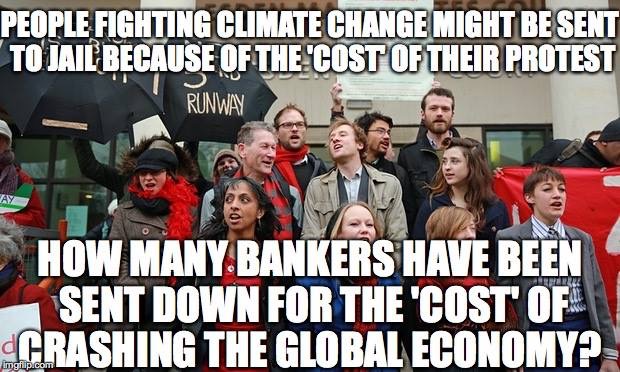
On the 24th of February, we - the Heathrow 13 - were sentenced to 6 weeks in prison, suspended for 12 months, with an additional 120 to 180 hours community service on top. Whilst we are happy to not be in prison right now, this is far from a complete victory.

As our barrister  QC Kirsty Brimelow, so eloquently argued, there is a long tradition of direct action in the UK, and a convention for sentencing within the legal system. In fact Lord Hoffman, in an influential ruling, went as far as to say that it is the mark of a civilised society to accommodate this, and that the legal convention is for sentences such as a conditional discharge or community service. In this light, our barristers argued that our action clearly did not cross the custodial threshold – i.e. our sentence should not be imprisonment, immediate or suspended. The fact that Judge Wright chose to give us a suspended sentence marks a shift in the way protesters are treated, going against the normal convention. 

Experts have suggested that if magistrates impose custody for minor offences, that produces an incentive for activists to commit more serious offences. This is because more serious crimes are dealt with by a jury, who are more likely to be understanding of the issues. Whilst more radical actions are welcome, and in fact are necessary to tackle the scale of climate change, repression from the judicial system is not.

As we went into court on the 24th, all of us were prepared for the possibility for prison. We all experienced a rollercoaster of emotions, from fear and stress to defiance and pride. The support and love we were shown by family, friends and the wider movement made us feel all the more ready to deal with a potential prison sentence. Had we gone to prison, we would have depended on this support network around us. We all feel so grateful for this.

Yet, we should reflect on this as a form of privilege. There are over 85,000 people in prison in the UK, not including immigration detention centres, secure children's homes or those detained under the Mental Health Act. Those imprisoned are disproportionately from poor, minority backgrounds and are likely to have suffered various forms of abuse in their lives. Vulnerable people are the ones being targeted by the judicial system. These people are highly unlikely to be able to gain the same kind of support a high profile privileged group such as ours could.

If You Care About Railroad Safety You Must Defend Tom Harding

Editorial - Railroad Workers United, Highball, Winter 2016

Practically every North American railroader now knows about the tragic train wreck in the town of Lac-Mégantic, Quebec in July, 2013. With its tremendous loss of life and destruction, the disaster made headlines around the world. In the aftermath of that accident, as we discussed it amongst ourselves, details became known. One of those details was that within days of the wreck the locomotive engineer of the runaway train, Tom Harding, was arrested and ultimately charged. He and his Dispatcher face the possibility of life in prison if found guilty as charged. No company official of the Montreal, Maine & Atlantic (MM&A) – the railroad upon which the wreck took place - nor the company itself have faced criminal charges.

To this day, there is confusion and disinformation circulated about that matter. For those of us in the fight for rail safety, it is imperative that we know the facts. This is key not just to prevent a grave injustice, but to prevent future repetitions of that incident and to stop the dangerous push by the rail carriers to deflect all liability for the consequences of their policy decisions and simply blame-the-worker every and any time there is an accident or injury, fatality or disaster.

Some railroaders – even a few known as safety conscious can get this issue wrong. Because conscientious trainmen and engineers take safety on the job so seriously, taking personal responsibility comes as second nature to us. No one wants to be seen as making excuses for a co-worker who doesn't take his/her job or their co-workers' safety seriously. As a result, some raise arguments that perhaps Tom Harding is guilty of something, that maybe he deserves to be charged. Therefore, it is crucial that we examine the facts.

When Railroad Carriers Threaten to Strike, the State Cowers

Editorial - Railroad Workers United, Highball, Winter 2016

Back in the fall of 2008, in the face of yet another horrendous and preventable catastrophic train wreck, the US Congress passed the Railroad Safety Improvement Act (RSIA). Among its many provisions, it mandated that the railroad carriers implement Positive Train Control (PTC), a technology that ensures train separation and can enforce safety despite possible mistakes and/or oversights by the train’s operating crew. The deadline for its installation was set for December 31, 2015, allowing the carriers more than seven years within which to comply. With that deadline looming, and most carriers not even close to implementation, on October 27th, 2015, Congress passed legislation that allows the railroads another three years (and now it looks more like five) to meet the new deadline.

Whether this is the fault of the federal government, the railroad corporations, the FCC, or whoever, we will not argue the point here. What we do want to take issue with is this: Once the U.S. rail carriers claimed that they could not possibly meet the deadline, they basically stated their collective intentions to severely restrict the movement of both freight and passengers, in effect, holding the country hostage. Their actions – had they been effected on January 1st – certainly would have induced a major recession if not outright collapse of the U.S. economy, possibly leading to a worldwide depression. Without any debate whatsoever, the U.S. Congress swiftly moved into action. Without a whimper of dissent, they did their corporate masters’ bidding and granted the carte blanche PTC extension.

Just as Congress bailed out the big banks and major corporations back in 2008 who were “too big to fail”, they were quick to view the unfolding scenario as one that could be catastrophic to the economy and the American people. And they were right. Had the major rail carriers made good on their threat, and embargoed freight and passengers as promised (all in the name of safety, of course), the consequences for all of us would have been dire. But these two choices – extension and relief on one hand, or no extension and ensuing chaos on the other -- were not necessarily the only two options available.

Why I Choose Optimism Over Despair: An Interview With Noam Chomsky (excerpt)

Noam Chomsky interviewed by C.J. Polychroniou - Truthout, February 14, 2016

...You have defined your political philosophy as libertarian socialism/anarchism, but refuse to accept the view that anarchism as a vision of social order flows naturally from your views on language. Is the link then purely coincidental?

It's more than coincidental, but much less than deductive. At a sufficient level of abstraction, there is a common element - which was sometimes recognized, or at least glimpsed, in the Enlightenment and Romantic eras. In both domains, we can perceive, or at least hope, that at the core of human nature is what [Russian anarchist Mikhail] Bakunin called "an instinct for freedom," which reveals itself both in the creative aspect of normal language use and in the recognition that no form of domination, authority, hierarchy is self-justifying: Each must justify itself, and if it cannot, which is usually the case, then it should be dismantled in favor of greater freedom and justice. That seems to me the core idea of anarchism, deriving from its classical liberal roots and deeper perceptions - or beliefs, or hopes - about essential human nature. Libertarian socialism moves further to bring in ideas about sympathy, solidarity, mutual aid, also with Enlightenment roots and conceptions of human nature.

Both the anarchist and the Marxist vision have failed to gain ground in our own time, and in fact it could be argued that the prospects for the historical overcoming of capitalism appear to have been brighter in the past than they do today. If you do agree with this assessment, what factors can explain the frustrating setback for the realization of an alternative social order, i.e., one beyond capitalism and exploitation?

Prevailing systems are particular forms of state capitalism. In the past generation, these have been distorted by neoliberal doctrines into an assault on human dignity and even the "animal needs" of ordinary human life. More ominously, unless reversed, implementation of these doctrines will destroy the possibility of decent human existence, and not in the distant future. But there is no reason to suppose that these dangerous tendencies are graven in stone. They are the product of particular circumstances and specific human decisions that have been well studied elsewhere and that I cannot review here. These can be reversed, and there is ample evidence of resistance to them, which can grow, and indeed must grow to a powerful force if there is to be hope for our species and the world that it largely rules.

While economic inequality, lack of growth and new jobs, and declining standards of living have become key features of contemporary advanced societies, the climate change challenge appears to pose a real threat to the planet on the whole. Are you optimistic that we can find the right formula to address economic problems while averting an environmental catastrophe?

There are two grim shadows that loom over everything that we consider: environmental catastrophe and nuclear war, the latter threat much underestimated, in my view. In the case of nuclear weapons, we at least know the answer: get rid of them, like smallpox, with adequate measures, which are technically feasible, to ensure that this curse does not arise again. In the case of environmental catastrophe, there still appears to be time to avert the worst consequences, but that will require measures well beyond those being undertaken now, and there are serious impediments to overcome, not least in the most powerful state in the world, the one power with a claim to be hegemonic.

In the extensive reporting of the recent Paris conference on the climate, the most important sentences were those pointing out that the binding treaty that negotiators hoped to achieve was off the agenda, because it would be "dead on arrival" when it reached the Republican-controlled US Congress. It is a shocking fact that every Republican presidential contender is either an outright climate denier or a skeptic who opposes government action. Congress celebrated the Paris conference by cutting back [President] Obama's limited efforts to avert disaster.

The Republican majority (with a minority of the popular vote) proudly announced funding cuts for the Environmental Protection Agency - one of the few brakes on destruction - in order to rein in what House Appropriations Committee Chairman Hal Rogers called an "unnecessary, job-killing regulatory agenda" - or in plain English, one of the few brakes on destruction. It should be borne in mind that in contemporary newspeak, the word "jobs" is a euphemism for the unpronounceable seven-letter word "pr---ts."...

Read the rest of the interview, here.

Why I've no regrets about going to prison for shutting down Heathrow airport

By Ella Gilbert MSc - Mashable, February 23, 2016

Editors Note: Ella Gilbert MSc (as well as several other members of the #Heathrow13) are dues paying members of the IWW. for more details about the struggle, please visit Plane Stupid.

Update from the Guardian:

Six women and seven men have avoided jail for trespassing at Heathrow, following a protest against the possible expansion of the airport.

The activists, dubbed the Heathrow 13, were given sentences of six weeks suspended for 12 months, meaning they would not have to go to prison immediately.

They had been found guilty in January of aggravated trespass and entering a security-restricted area of an aerodrome. They had been warned by district judge Deborah Wright to expect a custodial sentence.

Read more...

For more on the sentencing of the Heathrow 13, see also:

LONDON — Today I’ve been packing my bag for prison.

That sentence never gets less weird. It’s a task that most people will never have to do, or even think about doing, so it’s been a learning curve. Take this for example: you can’t take black clothes into prison. This is a serious problem for someone whose entire wardrobe is black.

If you’re wondering why I’m having to do this, here’s why: on Wednesday, myself and 12 others from direct action network Plane Stupid will be sentenced to “almost inevitable” (in the words of the judge) custodial sentences for our part in a direct action that happened last year.

In July, the #Heathrow13 occupied one of Heathrow’s runways for six hours: the longest airport occupation in the UK to date, and the most high profile. We managed to stop 25 planes and in so doing prevented the emission of hundreds, if not thousands, of tonnes of greenhouse gases into the atmosphere.

Aircraft are hugely polluting machines. They spew out air pollutants like particulate matter and nitrogen oxides that cause serious health effects for wildlife and for people living in the local area, as well as climate-damaging greenhouse gases. I’m sure I don’t need to explain that greenhouse gases cause climate change by trapping heat in the atmosphere, causing temperatures to rise and altering the way the climate functions. Carbon dioxide is the most obvious of these warming gases, but many others are also emitted by plane exhausts, such as oxides of nitrogen, which trigger the formation of ozone when emitted at altitude, and water vapour. All of these have a significant warming effect, especially when emitted at aircraft cruising altitude, several kilometres above the ground.

One of the major problems with aviation is that it cannot really be decarbonised. It takes a lot of energy to fly a heavy metal object full of people at hundreds of miles an hour across the world. Unfortunately, the technology is not yet there to allow planes to fly using hydrogen or electric fuel cells, which means that for now at least, jet fuel is very much fossil fuel based. Although efficiency improvements can reduce some of its impact, demand for aviation is enormous and any efficiency improvements are vastly outstripped by the rapid growth in passenger volumes. Many airlines, incl. United, are experimenting with biofuel blends as a possible transition fuel of sorts. But most biofuels are no better for the climate than oil. It’s not a serious solution.

What this means is that aviation is still a heavily polluting industry and will probably continue to be so for many years to come. However, action needs to be taken to combat climate change – something recognised in law by the UK’s 2008 Climate Change Act. This stipulates that UK emissions must be reduced by 80% from 2005 levels before 2050. That’s a big cut, but it might be possible if every sector in the UK economy makes aggressive and sustained reductions in their emissions.

However, aviation is being given something of a free ride – a proposed third runway at Heathrow, which would emit another 9 million tonnes or so of CO2 per year (emissions on a par with the whole of Kenya). We cannot build new runways if we are to prevent climate change –- and doing so undermines all of our other efforts to reduce emissions across the board.

Who Wins From “Climate Apartheid”?: African Climate Justice Narratives About the Paris COP21

By Patrick Bond - New Politics, Winter 2006

The billion residents of Africa are amongst the most vulnerable to climate change in coming decades, and of special concern are high-density sites of geopolitical and resource-related conflicts: the copper belt of the Democratic Republic of the Congo and mineral-rich African Great Lakes stretching into northern Uganda, western Ethiopia (bordering the Sudanese war zone), Madagascar and smaller Indian Ocean islands, and the northern-most strip of Africa and West Africa including Liberia and Sierra Leone (recent sites of diamond-related civil war and then Ebola epidemics). In other words, the African terrains hardest hit by war and economic looting are going to be sites of climate stress and socio-political unrest, according to the University of Texas project researching vulnerability for the U.S. Pentagon (Busby et al 2013).

The lost opportunity to change this map at the United Nations Framework Convention on Climate Change (UNFCCC) summit in Paris, December 2015, is tragic. In the 2015 Pew Research world public opinion survey, a near majority of those surveyed—46 percent—identified climate as a threat about which they were “very concerned,” the highest score of any issue in the poll (economic crisis was second). But where it counts most, in the top two polluting countries, the percentage of people who name climate as a major threat is just 42 in the United States and 19 in China (Carle 2015). And even if consciousness rises faster from below, global elites apparently remain too paralyzed to take necessary actions to keep temperature increases below 1.5 degrees Celsius, the point at which runaway, catastrophic climate change is likely to take off (Bond 2012, Klein 2014). Going into the Paris UNFCC Conference of the Parties (the 21st, COP21), the French hosts estimated that the combined declarations of voluntary commitments would warm the planet by 3 degrees Celsius this century, but this is a vast understatement given the likelihood of runaway climate change once a 2-degree tipping point is reached.

The annual UNFCCC Conference of the Parties (COP) has been held in Africa thrice: in 2001 in Marrakech, 2006 in Nairobi, and 2011 in Durban. But the critical moment that defined Africa’s future climate crisis was in December 2009 in Copenhagen. The negotiations at COP15 were diverted one night into a room where five leaders—from the United States and the group of Brazil, South Africa, India, and China (BASIC)—agreed on a side deal, the Copenhagen Accord. That was the source of Africa’s major problems in climate negotiations for years thereafter, including at the Paris COP21.

The fortnight-long COP talk-shops are typically sabotaged by U.S. State Department negotiators, recently joined by brethren governments in Australia and Japan, with Canada a loyal co-polluter prior to the October 2015 election (and probably long after, given the national elites’ commitment to exploiting the Alberta tar sands). Initial hopes that the Brazil-Russia-India-China-South Africa (BRICS) bloc might make a difference in world climate policy as well as address undemocratic global financial governance have since been dashed, not only because of BASIC’s 2009 alliance with Barack Obama (Bond and Garcia 2015). Individually, they are each failing to grapple with new responsibilities to decarbonize their economies.

The world’s largest single emitter is China, even if in per capita terms it is far lower than the Northern countries. Beijing claims to have recently reduced coal consumption are dubious given notorious undercounting (probably by 15 percent). The Communist Party leadership decided upon an upward trajectory of greenhouse gas emissions at least through the 2020s. The Chinese standpoint that they need more emissions to “develop” is contradicted by a stark reality: Recent U.S. and European claims to be slowing their emissions rely upon their corporations and consumers outsourcing large amounts of emissions to new production sites, mostly in East Asia. According to the Intergovernmental Panel on Climate Change, “A growing share of CO2 emissions from fossil fuel combustion in developing countries is released in the production of goods and services exported, notably from upper-middle-income countries to high-income countries” (Hawkins 2014). In the case of China, the amounts of such outsourcing are vast, having risen from 404 million tons of CO2 in 2000 to 1.561 billion tons in 2012.

Moreover, BRICS leaders have all endorsed carbon markets, the capitalist strategy for offsetting local emissions by buying someone else’s carbon allowances. Initially, from 2005-2012, these took the form of United Nations “Clean Development Mechanism” (CDM) opportunities to sell often-corrupt and gimmick-ridden “emissions credits” as contributing to emissions mitigation (Bond, Dada and Erion 2009). 

In recent years, after the BRICS no longer qualified for CDMs, seven Chinese cities started their own carbon markets, with Brazil and South Africa likely to follow in a few years. Moreover, China’s attempts to control emissions in future appear certain to foster faith in dangerous techniques such as nuclear energy, hydropower, and untested carbon-capture-and-storage technology.

The strongest efforts to address climate change from the North are in Europe, where in October 2014 a new goal of 40 percent greenhouse gas reduction from 1990 levels by 2030 (not including the carbon outsourcing of hundreds of millions of tons per year) was sought—far too low according to most scientists, but far ahead of goals set by other historic pollution sites. In a late-2014 deal between China and the United States, the latter’s goal was only 15 percent reduction by 2025 (from 1990 levels).

In short, very little reason for hope on climate or other aspects of environmental stewardship can be found in any of the major countries’ governments. There is, of course, the exception of Cuba, which by compulsion began a strong decarbonization strategy once Russian-subsidized oil became unavailable after 1990. But the good examples that were anticipated in 2008-2011 from left-leaning Latin American countries—Bolivia, Ecuador, and even oil-rich Venezuela—subsequently soured, as each turned to more intense hydrocarbon “extractivism,” albeit with nationalist redistributive ends instead of multinational corporate profiteering. 

When the September 2014 United Nations special leadership summit on climate was preceded by a march of 400,000 people with strong messages of anger about elite procrastination, nothing more than vague promises were offered. The array of global and national power appears as difficult to affect as ever, what with unprecedented corporate influence—including of fossil fuel companies—over policymakers, and with further awareness that major restructuring of vast industries will be needed. 

Going back to 2009, the US+BASIC meeting in Copenhagen not only “blew up the UN,” as Bill McKibben (2009) of 350.org put it, in terms of evading the more democratic process. The Copenhagen Accord also promised only inadequate and voluntary emissions cuts. Japan, Russia, Canada, and Australia subsequently announced they would withdraw earlier commitments made under the Kyoto Protocol. 

By November 2015, the (voluntary) Intended Nationally Determined Contribution (INDC) statement of the G20 countries confirmed huge barriers to reaching the required emissions cuts. According to Climate Action Tracker (2015), “None of the G20 INDCs are in line with holding warming below 2°C, or 1.5°C.” The agency rated the following contributions as “inadequate”: Argentina, Australia, Canada, Indonesia, Japan, South Korea, Russia, Saudi Arabia, South Africa, and Turkey, with the INDCs of another set—Brazil, China, India, the EU, Mexico, and the United States—also “not consistent with limiting warming to below 2°C either, unless other countries make much deeper reductions and comparably greater effort.” 

Railroad Shop Workers Vote No on Merging Jobs

By Jon Flanders - Labor Notes, February 18, 2016

Image, right: A boilermaker works on a locomotive plow, a part that often gets damaged in operation. Railroad workers recently voted down a concessionary deal that would have blended machinists' and pipefitters' jobs together. Photo by the author.

Union members have become used to a certain pattern: threats of plant closings and layoffs, followed by a vote to reopen the contract and make concessions to “save jobs.”

In the railroad shops of the CSX corporation, this pattern has been broken.

Last fall CSX made an offer to its machinists and pipefitters—backed by their unions, the Machinists (IAM) and SMART. The tentative agreement would merge the two crafts into a single job, “Master Mechanic.” For instance, the master mechanic would install both power assemblies (previously machinists’ work) and radiators (previously pipefitters’ work).

Management painted the concessionary deal in glowing terms. But in December, workers in both crafts bucked the threat and overwhelmingly voted no.

FIXING ENGINES

Nationally there are around 8,000 railroad machinists. They rebuild locomotives from the ground up and do preventative maintenance such as replacing power assemblies, turbos, traction motors, and other mechanical items.

Pipefitters work on the extensive pipe systems on locomotives: air, fuel, and oil.

Collectively, these railroad shop workers maintain the locomotive fleet for all the major railroads in the U.S.

The critical role they play got front-page attention after a defective locomotive led to a 2013 disaster in the town of Lac Mégantic, Quebec. A runaway train carrying crude oil exploded, killing 47 people.

MORE WORK, SAME PAY

CSX Chief Administrative Officer Lisa Mancini claimed in a September press release that the contract deal reflected the unions’ and company’s “collective commitment to finding innovative ways to support our employees while driving long-term efficiency.”

Needless to say, the affected workers saw things a little differently. It looked to them like more work for the same pay.

Machinists and pipefitters would have to learn each other’s jobs. Previously, if a job called for both piping and mechanical, the two crafts might have worked together on a team. Now the whole job might be done by whoever was at hand—leading to job losses all around.

CSX was promising to guarantee jobs for two years, but not many thought the guarantee would last much longer.

The agreement would have given up not only traditional job jurisdictions, but also seniority and employee-protection agreements, where laid-off machinists are paid a percentage of their wages for a period of time based on years of service.

Layoffs are a particular concern for these workers—who might otherwise be forced to move rather than spend time looking for another job near home.

RAUCOUS MEETINGS

The initial proposal met with resistance; meetings reportedly went very badly. Workers who’d always been quiet before were making ominous-sounding threats against union officers.

Next CSX closed the 100-year-old Corbin locomotive shop in Kentucky and the Erwin railyard in Tennessee, citing the decline in coal shipments.

Many machinists and pipefitters lost jobs in these shops. Layoffs of other crafts, such as the boilermakers, followed. Obviously management hoped this would bring pressure to bear.

In reality, despite the decline in coal shipments, CSX has yet to go in the red. Last summer, while it was negotiating the concessions, the company announced its profits had risen 4.5 percent in the second quarter and it had beaten its own expectations for earnings. In the full year 2015, the company made $3.6 billion in operating profit.

The Poisoning of Flint: Capitalism and Environmental Sabotage

By Mike Kolhoff - Ideas and Action, February 18, 2016

Cruel disregard of human life have been part of the capitalist package from the very beginning. To the ruling class our lives are important only to the degree that we produce profit they can exploit. In its latest neo-liberal incarnation, capitalism seems to have embraced its murderous impulses on a grand scale. The frustrations of extracting profits from an exhausted planet and its people have compelled the “job creators” to commit ever more shocking crimes. The poisoning of Flint stands as grim testimony to the complete contempt such people feel for the rest of us. To them, we are not quite human.

The tragedy initially received regional media attention 2014, shortly after the Republican-imposed Emergency Financial Manager switched Flint’s water supply from the Detroit supply system to a local system using the nearby Flint River. EPA and state reports indicating the poisonous content of the Flint River, a river thoroughly polluted by General Motors and others [i], were willfully ignored.

The excuse given at the time was that it was a money-saving measure in a city teetering on the edge of bankruptcy. Recent revelations have shown that even this poor excuse was an outright lie. [ii].  The question then is why did the Republican-appointed Emergency Manager make a decision that was so obviously sure to poison thousands of people?

One allegation is that it was a move to direct money away from Detroit, which at the time was in bankruptcy and being vigorously looted by every sort of shady speculator, including the selling of huge amounts of city real estate at what amounted to garage sale prices. The Detroit Water and Sewage Department made efforts to keep Flint from switching to the filthy water of the Flint River. They even offered their water at a reduced rate, one which negated any savings the City of Flint would make by switching. Flint would have actually SAVED money by staying with Detroit Water and Sewage. This was at a time when the Emergency Manager in Detroit was ordering that their own residents face water cut-offs if they couldn’t pay their bills.[iii]But the rightwing program of ethnic cleansing called for the complete destruction of Detroit, so the people of Flint were poisoned instead.

The cause of the mass-poisoning of the residents of Flint can also be laid at the feet of that innovation in capitalist extraction that has emerged in the last 25 years: Disaster Capitalism. It had nothing to do with saving 15 cents on the dollar, and it wasn’t mainly about diverting income from Detroit, it was about putting MILLIONS of dollars in public funds into the hands of private, rightwing capitalists. These are the people who financed the political campaigns that put the current gang of liars and murderers in power, and they were just looking for their payback – At least $12 million dollars worth of payback in fact. That’s what it was estimated it would cost to switch back to the Detroit water supply in October of 2015.[iv]

Who took that money? Contractors, the biggest an engineering firm from Texas ($4 million), with the help of the rightwing politicians who greased the way for them; many of whom can be seen in this photo of the all-white group surrounding the governor as he approves the aid package for Flint. [v]

Snyder has tried to blame the Flint City Council for the poisoning, but the facts tell a different story. In 2013 the Council voted to help build a new pipeline that would allow them to terminate their contract with the Detroit Water and Sewage Department, but the decision to stop taking Detroit water and start using the Flint River was made much later and by the Emergency Manager, at a time when the Council had no say in city decision-making.

“Snyder said that Detroit, after being informed of the Flint council vote, sent a “letter of termination” of water service. Detroit sent a letter giving Flint one year on its existing contract, but that didn’t mean Flint couldn’t get water from Detroit after that date. In fact, there was a flurry of negotiations between Detroit and Flint to sign a new contract that would carry Flint through until it could connect to the under-construction pipeline.”[vi]

The Flint water crisis is an illustration of the essential criminality of capitalism, with “disaster capitalism” taking the next step into open criminality. Those involved conspired to create a disaster, then reaped huge profits from its implementation, and are now reaping even greater profits from fixing the mess they made.

The greed-based, anti-human social and economic system we live in caused the poisoning of the people of Flint. This does not in any way absolve the individual politicians and capitalists who facilitated the disaster (they should all hang), but only places them in perspective. The system didn’t fail in Flint; it failed to protect the people of Flint, but that’s not what it was designed for. The system functioned exactly as it was supposed to: the ruling class was able to stuff it’s pockets with money, the politicians were able to pay-off their debts to them, and things are comfortably rolling on to the next election cycle.[vii]

Pages

The Fine Print I:

Disclaimer: The views expressed on this site are not the official position of the IWW (or even the IWW’s EUC) unless otherwise indicated and do not necessarily represent the views of anyone but the author’s, nor should it be assumed that any of these authors automatically support the IWW or endorse any of its positions.

Further: the inclusion of a link on our site (other than the link to the main IWW site) does not imply endorsement by or an alliance with the IWW. These sites have been chosen by our members due to their perceived relevance to the IWW EUC and are included here for informational purposes only. If you have any suggestions or comments on any of the links included (or not included) above, please contact us.

The Fine Print II:

Fair Use Notice: The material on this site is provided for educational and informational purposes. It may contain copyrighted material the use of which has not always been specifically authorized by the copyright owner. It is being made available in an effort to advance the understanding of scientific, environmental, economic, social justice and human rights issues etc.

It is believed that this constitutes a 'fair use' of any such copyrighted material as provided for in section 107 of the US Copyright Law. In accordance with Title 17 U.S.C. Section 107, the material on this site is distributed without profit to those who have an interest in using the included information for research and educational purposes. If you wish to use copyrighted material from this site for purposes of your own that go beyond 'fair use', you must obtain permission from the copyright owner. The information on this site does not constitute legal or technical advice.