You are here

fracking

Pennsylvania Instructed Its Employees To Ignore Residents Sickened By Drilling

By Andrew Breiner - Think Progress, June 20, 2014

Disclaimer: The views expressed here are not the official position of the IWW (or even the IWW’s EUC) and do not necessarily represent the views of anyone but the author’s.

The Pennsylvania Department of Health instructed its employees never to talk to residents who complained of negative health effects from fracking, StateImpact Pennsylvania reported Thursday. Two retired employees of the department detailed restrictions on attending meetings, lists of topics they could not discuss, and a general departmental hostility to the idea of health problems linked to shale gas drilling. The state’s governor, Tom Corbett, declined to comment for StateImpact Pennsylvania’s story.

Pennsylvania has had more than 6,000 hydraulic fracturing wells drilled within the last six years, and zero state studies on their health impacts. In Pennsylvania, and near fracking operations across the country, people have won settlements from fossil fuel companies after being sickened. In many cases the drilling company imposes a gag order to prevent sickened people from spreading the word about what caused their illness and building the case that fracking has negative health effects.

In 2011 Pennsylvania’s Marcellus Shale Advisory Commission recommended a registry to collect health data from people living near fracking operations. Three years later, it still doesn’t exist. Across the country in Colorado, legislators tried to commission a study on the health effects of living near drilling, but fossil fuel advocates ensured its demise. Doctors want more data on health effects of fracking, but the interests of the drillers usually win out.

Former Pennsylvania Health Employees Say Bosses Enforced Silence on Shale Drilling

By Brandon Baker - EcoWatch, June 19, 2014 (reposted with permission from EcoWatch)

Disclaimer: The views expressed here are not the official position of the IWW (or even the IWW’s EUC) and do not necessarily represent the views of anyone but the author’s.

A shocking investigative report revealed Thursday that Pennsylvania state health employees may have compounded the danger of Marcellus Shale drilling by systematically refusing to respond to residents’ concerns about it.

A former Department of Health employee said she was told not to return phone calls from residents who expressed concerns about natural gas drilling, NPR reported in its State Impact series.

“We were absolutely not allowed to talk to them,” said Tammi Stuck, who worked as a Fayette County community health nurse for nearly four decades.

Another department retiree, Marshall P. Deasy III, confirmed Stuck’s accusation. He said that drilling was the only public health issue he remembers officials enforcing silence on during his 20 years with the department.

Tar Sands on the Tracks: Railbit, Dilbit and U.S. Export Terminals

By Ben Jervey - DeSmog Blog, June 17, 2014

Disclaimer: The views expressed here are not the official position of the IWW (or even the IWW’s EUC) and do not necessarily represent the views of anyone but the author’s.

Last December, the first full train carrying tar sands crude left the Canexus Bruderheim terminal outside of Edmonton, Alberta, bound for an unloading terminal somewhere in the United States.

Canadian heavy crude, as the tar sands is labeled for market purposes, had ridden the rails in very limited capacity in years previous — loaded into tank cars and bundled with other products as part of so-called “manifest” shipments. But to the best of industry analysts’ knowledge, never before had a full 100-plus car train (called a “unit train”) been shipped entirely full of tar sands crude.

Because unit trains travel more quickly, carry higher volumes of crude and cost the shipper less per barrel to operate than the manifest alternative, this first shipment from the Canexus Bruderheim terminal signaled the start of yet another crude-by-rail era — an echo of the sudden rise of oil train transport ushered in by the Bakken boom, on a much smaller scale (for now).

This overall spike in North American crude-by-rail over the past few years has been well documented, and last month Oil Change International released a comprehensive report about the trend. As explained in Runaway Train: The Reckless Expansion of Crude-by-Rail in North America (and in past coverage in DeSmogBlog), much of the oil train growth has been driven by the Bakken shale oil boom. Without sufficient pipeline capacity in the area, drillers have been loading up much more versatile trains to cart the light, sweet tight crude to refineries in the Gulf, and on both coasts.

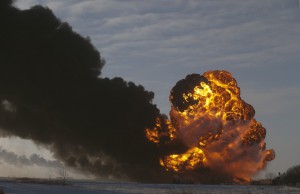
Unfortunately, some of these “bomb trains” never make it to their destination, derailing, spilling, exploding and taking lives.

Workers of the World, Divest! (Otherwise we could lose everything!)

By That Green Union Guy - IWW Environmental Unionism Caucus, June 20, 2014

Disclaimer: The views expressed here are not the official position of the IWW (or even the IWW’s EUC) and do not necessarily represent the views of anyone but the author’s.

Fellow Workers:

It's time for us to demand that our unions divest our pension funds from fossil fuels, dirty energy, and strip mining.

It's time to divest from mountaintop coal removal, offshore oil drilling, natural gas (and oil) fracking, tar sands and shale mining, coal seam gas, so-called "clean" coal, and all other forms of "extreme" energy.

Why We Need to Do This

Fossil fuels and dirty energy are the past, not the future:

Global Warming is real and caused by human (mostly corporate and military) activity. The root causes of global warming are the burning of fossil fuels and deforestation. The scientific consensus on this issue is solid and well researched. All of the claims to the contrary are nonsense, unscientific, and largely funded by those industries that profit from the activities that cause global warming

The atmospheric concentration of CO2, the most abundant greenhouse gas (GHG) has surpassed 400 ppm, well above the 280 ppm level that has been consistent throughout human history. Most climate scientists agree that the upper tolerable limit of CO2 in the atmosphere is 350 ppm, which would still result in a 2-degrees C increase in global average temperature by 2100. To return to a level below 350 ppm, the world needs to transition away from fossil fuels as rapidly as possible.

Because of this need, at least 80% of the known carbon / fossil fuels must remain unextracted, in the ground. Unfortunately, investors have banked on 100% of those fuels being extracted. That means that these "assets" are overvalued, and there is a rush on to extract them as quickly as possible, which explains the push to "drill-baby-drill", mine, and frack to the extreme. When this "Carbon Bubble" bursts and these assets are stranded, the investments in them will be essentially worthless. There are even signs that we've reached this point already!

The driving forces behind the rush to extract include the Koch Brothers. They are also a major financial supporter of the climate change denial machine, the efforts to thwart the deployment of clean energy (no doubt because these alternative technologies threaten the Koch Brothers' monopoly), and the anti-union National Right to Work Foundation.

Meeting Logs: Obama White House Quietly Coddling Big Oil on “Bomb Trains” Regulations

By Justin Mikulka and Steve Horn - DeSmog Blog, June 15, 2014

Disclaimer: The views expressed here are not the official position of the IWW (or even the IWW’s EUC) and do not necessarily represent the views of anyone but the author’s.

When Richard Revesz, Dean Emeritus of New York University Law School, introduced Howard Shelanski at his only public appearance so far during his tenure as Administrator of the White House Office of Information and Regulatory Affairs (OIRA), Revesz described Shelanski as, “from our perspective, close to the most important official in the federal government.”

OIRA has recently reared its head in a big way because it is currently reviewing the newly-proposed oil-by-rail safety regulations rolled out by the Department of Transportation (DOT) and Pipeline and Hazardous Materials Safety Administration (PHMSA).   

During his presentation at NYU, Shelanski spoke at length about how OIRA must use “cost-benefit analysis” with regards to regulations, stating, “Cost-benefit analysis is an essential tool for regulatory policy.”

But during his confirmation hearings, Shelanski made sure to state his position on how cost-benefit analysis should be used in practice. Shelanski let corporate interests know he was well aware of their position on the cost of regulations and what they stood to lose from stringent regulations. 

“Regulatory objectives should be achieved at no higher cost than is absolutely necessary,” Shelanski said at the hearing.

With the “cost-benefit analysis” regarding environmental and safety issues for oil-by-rail in OIRA’s hands, it appears both the oil and rail industries will have their voices heard loudly and clearly by the White House. 

The Inevitable Demise of the Fossil Fuel Empire: Rocketing production costs, proliferating write-downs, stranded assets pave the way for renewable renaissance

By Nafeez Mosaddeq Ahmed, originally published by Guardian Earth Insight blog, June 10, 2014

Disclaimer: The views expressed here are not the official position of the IWW (or even the IWW’s EUC) and do not necessarily represent the views of anyone but the author’s.

The latest data from the International Energy Agency (IEA) and other sources proves that the oil and gas majors are in deep trouble.

Over the last decade, rising oil prices have been driven primarily by rising production costs. After the release of the IEA's World Energy Outlook last November, Deutsche Bank's former head of energy research Mark Lewis noted that massive levels of investment have corresponded to an ever declining rate of oil supply increase:

"Over the past decade, the oil and gas industry's upstream investments have registered an astronomical increase, but these ever higher levels of capital expenditure have yielded ever smaller increases in the global oil supply. Even these have only been made possible by record high oil prices. This should be a reality check for those now hyping a new age of global oil abundance."

Since 2000, the oil industry's investments have risen by 180% - a threefold increase - but this has translated into a global oil supply increase of just 14%. Two-thirds of this increase has been made-up by unconventional oil and gas. In other words, the primary driver of the cost explosion is the shift to expensive and difficult-to-extract unconventionals due to the peak and plateau in conventional oil production since 2005.

4 Worker Fatalities Linked to Used Fracking Fluid Exposure

By Cliff Weathers - Alternet, May 28, 2014

Disclaimer: The views expressed here are not the official position of the IWW (or even the IWW’s EUC) and do not necessarily represent the views of anyone but the author’s. 

Field studies conducted by the U.S. Government have revealed that hydrofracking fluids are responsible for the deaths of four field workers since 2010. 

The report, recently released by the National Institute for Occupational Safety, suggests that workers could be exposed to hazardous levels of toxic volatile hydrocarbons found in waste fracking fluids.

“According to our information, at least four workers have died since 2010 from what appears to be acute chemical exposures during flow back operations at well sites in the Williston Basin (North Dakota and Montana),” government researchers wrote. “While not all of these investigations are complete, available information suggests that these cases involved workers who were gauging flow back or production tanks or involved in transferring flow back fluids at the well site.”

The institute is also assessing worker exposure to other chemicals mixed into fluids that are injected into the earth during fracking. Those findings will be detailed in later publications, according to Max Kiefer, a NIOSH spokesperson. 

(Working Paper #1) Global Shale Gas and the Anti-Fracking Movement

By Sean Sweeney and Lara Skinner - Trade Unions for Energy Democracy, June 2014

This paper has been prepared to assist unions and their close allies who wish to better understand the impacts of shale gas drilling, or “fracking,” and want to develop a position or approach to fracking that protects workers, communities, and the environment. It begins with a summary of the shale gas industry’s global expansion, and then looks at the opposition to fracking that has emerged in a number of key countries. A preliminary profile of the anti-fracking movement highlights the goals and characteristics of this movement as well as the issues that lie at the heart of the resistance.

The paper concludes by attempting to bring together the available information on unions’ perspectives and positions on this increasingly important issue. It also raises for discussion the prospect of unions giving support to a global moratorium on fracking based either on the precautionary principle (the health and environmental effects are not fully understood or have still to be adequately addressed) or on the more definitive assessment that fracking can never be sufficiently safe in terms of its impact on health and the environment and should therefore be stopped altogether.

Read the report (PDF).

Well Worker Safety and Statistics

By Samantha Malone, MPH, CPH – Manager of Science and Communications, FracTracker Alliance, May 14, 2014

Disclaimer: The views expressed here are not the official position of the IWW (or even the IWW’s EUC) and do not necessarily represent the views of anyone but the author’s. 

The population most at risk from accidents and incidents near unconventional drilling operations are the drillers and contractors within the industry. While that statement may seem quite obvious, let’s explore some of the numbers behind how often these workers are in harm’s way and why.

O&G Risks

Oil and Gas Worker Fatalities over Time

Fig. 1. Number of oil and gas worker fatalities over time
Data Source: U.S. Bureau of Labor Statistics, U.S. Department of Labor, 2014

Drilling operations, whether conventional or unconventional (aka fracking), run 24 hours a day, 7 days a week. Workers may be on site for several hours or even days at a time. Simply the amount of time spent on the job inherently increases one’s chances of health and safety concerns. Working in the extraction field is traditionally risky business. In 2012, mining, quarrying, and oil and gas extraction jobs experienced an overall 15.9 deaths for every 100,000 workers, the second highest rate among American businesses. (Only Agriculture, forestry, fishing and hunting jobs had a higher rate.)

According to the Quarterly Census of Employment and Wages of the U.S. Bureau of Labor Statistics, the oil and gas industry employed 188,003 workers in 2012 in the U.S., a jump from 120,328 in 2003. Preliminary data indicate that the upward employment trend continued in 2013. However, between 2003 and 2012, a total of 1,077 oil and gas extraction workers were killed on the job (Fig. 1).

Causes of Injuries and Fatalities in Oil and Gas Field

Reasons for O&G Fatalities 2003-12. Aggregated from Table 1.

Fig. 2. Reasons for O&G Fatalities 2003-12. Aggregated from Table 1.

Like many industrial operations, here are some of the reasons why oil and gas workers may be hurt or killed according to OSHA:

  • Vehicle Accidents
  • Struck-By/ Caught-In/ Caught-Between Equipment
  • Explosions and Fires
  • Falls
  • Confined Spaces
  • Chemical Exposures

Associated Pennsylvania State College and University Faculties (APSCUF) Position Statement on Hydraulic Fracturing (Fracking)

Disclaimer: The views expressed here are not the official position of the IWW (or even the IWW’s EUC) and do not necessarily represent the views of anyone but the author’s.

The ad hoc committee, by majority, supports the position that PASSHE (Pennsylvania State System of Higher Education) campuses are not appropriate locations for hydraulic fracturing (fracking), that given the environmental and health hazards of the fracking process, including all of its infrastructure and associated enterprises, its presence on PASSHE campuses is inconsistent and potentially deleterious to the PASSHE educational mission as well as to the health and welfare of PASSHE community members. 

A growing body of research is beginning to quantify and characterize the negative environmental, societal, economic, and ecological impacts on those close to such activities. Local impacts include but are not limited to gas migration, air pollution, and surface and near-surface water quality degradation as well as potential chronic impacts to air, water, landscapes, habitat, and ecosystems. Shale gas development in the United States) states, “Having one of these sites near a home, school or business can be distracting, inconvenient, annoying, and disruptive” (Soeder (2012).

Moreover, APSCUF opposes SB 367--the Indigenous Mineral Resources Development Act--as inconsistent with the PASSHE education mission for the same reasons and because it effectively pits some PASSHE campuses against others for revenue which could accrue to the permitting of fracking operations on PASSHE lands.  Such potential competition, or implementation of SB 367 in any form, could accelerate the presence of such operations--including pipeline construction, compressor infrastructure, waste management, heavy industrial truck traffic, and thereby increase exposure to pollution and hazards for members of PASSHE communities. 

Lastly, APSCUF takes a position against a PASSHE contribution to climate change, as induced by increased greenhouse gas emissions, as this is also inconsistent with a mission committed to the educations and welfare of future citizens of the Commonwealth.

Pages

The Fine Print I:

Disclaimer: The views expressed on this site are not the official position of the IWW (or even the IWW’s EUC) unless otherwise indicated and do not necessarily represent the views of anyone but the author’s, nor should it be assumed that any of these authors automatically support the IWW or endorse any of its positions.

Further: the inclusion of a link on our site (other than the link to the main IWW site) does not imply endorsement by or an alliance with the IWW. These sites have been chosen by our members due to their perceived relevance to the IWW EUC and are included here for informational purposes only. If you have any suggestions or comments on any of the links included (or not included) above, please contact us.

The Fine Print II:

Fair Use Notice: The material on this site is provided for educational and informational purposes. It may contain copyrighted material the use of which has not always been specifically authorized by the copyright owner. It is being made available in an effort to advance the understanding of scientific, environmental, economic, social justice and human rights issues etc.

It is believed that this constitutes a 'fair use' of any such copyrighted material as provided for in section 107 of the US Copyright Law. In accordance with Title 17 U.S.C. Section 107, the material on this site is distributed without profit to those who have an interest in using the included information for research and educational purposes. If you wish to use copyrighted material from this site for purposes of your own that go beyond 'fair use', you must obtain permission from the copyright owner. The information on this site does not constitute legal or technical advice.