You are here

disaster capitalism

Hurricane Harvey, Climate Change Denialists and the Wrath of the Right

By Joshua Frank - CounterPunch, August 31, 2017

Natural disasters that are exacerbated by industrialization really bring out the best in people. Especially climate change denialists.

As the Texas-Louisiana Gulf coast drowned in the floods of Hurricane Harvey, Donald Trump pardoned Sheriff Joe in hopes of capturing higher ratings and Ann Coulter, who needs no introduction, took to her Twitter account to express sympathy for the victims. Okay, of course she didn’t, instead the Queen of Darkness blasted out that God’s hatred of homosexuality is more credible than climate science.

What does Coulter believe then? That Harvey is nothing new? Actually, it is, no matter what Coulter tweets. Harvey is now the heaviest rainstorm in US history and was made worse by our warming climate. There’s little scientific doubt about it. As climate scientist Katharine Hayhoe and many others point out, as the world warms, evaporation of water increases, which means there is more water vapor in storms and more rain to dump compared to 70 years ago. In basic terms, warmer air is able to hold more water and hence more rainfall is likely to occur. Hurricane intensity in the future is predicted to increase as our climate warms.

The Gulf of Mexico’s surface temp increased almost 5 degrees Fahrenheit as Harvey was building last week. These waters, one of the warmest ocean surfaces on the planet at the time, along with warmer air temps, allowed Harvey to turn from a tropical storm into a cat 4 hurricane almost overnight. Even Coulter’s God couldn’t stop it.

Coulter and her fans probably wouldn’t want the floods to dry up anyway, because when crisis hits there is money to be made and victims to rip off. As Ken Klippenstein first reported, a Best Buy in Cypress, an unincorporated suburb of Houston in Harris County, began selling packs of bottled water for $42.96. Best Buy later apologized in response to the report, but the Texas AG’s office as of August 29 had received over 550 consumer complaints of price gouging. It’s safe to say Best Buy is just the tip of the iceberg.

Unfortunately, disaster capitalism is the least of concerns for many Houston residents that are losing everything. Survival is their most pressing struggle. As the flood waters recede, far more deaths will likely be recorded — more victims of capitalism and carbon. Sadly it’s a trend that’s going to continue.

No doubt the worse is yet to come for Houston and the surrounding area, even when the rains end. ExxonMobil admits that Harvey has caused damage to two of its massive Houston refineries, releasing hazardous pollutants. The company’s Beaumont refinery, which is the second largest in the country, released at least 1,312.84 pounds of sulfur dioxide after Harvey hit. Many other chemicals also leaked when the sites were forced to shut down. These refineries sit in largely poor, minority neighborhoods that have long been victims of environmental racism — injustices that will continue unabated if Donald Trump has his way and destroys what’s left of the EPA’s Environmental Justice Program.

“Any release of carcinogens (like benzene, 1,3-butadiene) adds to the increased cancer risk for those living near these plants,” said Luke Metzger, director of the group Environment Texas. “[Nitrogen oxides or sulfur dioxide] and other respiratory irritants adds to the respiratory problems people in the area suffer from at high rates.”

In short, Harvey is bad for Houston’s air too, especially for those that reside near these refineries.

Harvey-Texas-Louisiana: Capitalism's Addiction to Profit is to Blame!

By Sean O'Torain - Facts for Working People, August 31, 2017

Catastrophic flooding is now hitting Texas and Louisiana. the area affected is home to 11 million people and includes over 300 smaller cities and towns.  This catastrophe is not an "act of god" or some unfortunate accident. It is the result of policies carried out by the US and international capitalist class. This is what, this is who is to blame.

Climate Change/Global Warming has increased the temperature of the world's oceans. The result is increased rain and storms. It is a world wide problem. The United nations says that 41 million people have been directly affected by flooding and landslides in South Asia, with homes and crops destroyed. Floods from heavy rainfall have also tore across Britain, Ireland, Sudan and Uganda. In one day, August 14th, floods swept through Freetown, the capital of Sierra Leone and left 1,000 people dead or missing.

Climate change/global warming is causing massive flooding in some parts of the planet and drought in other parts. The international capitalist class know this. But they are addicted to their profits and so will not change their ways. And so the future of life on earth as we know it is under threat. Capitalism is to blame, the capitalist class and in the case of Texas and Louisiana the US capitalist class and their two political parties the Republicans and Democrats are to blame. And of course the predator in chief in the White House leads the charge. Pulling the US out of the albeit weak world climate change agreement is one example of this. The profits of the fossil fuel industry capitalists must not be touched. They must be allowed to carry on polluting and heating up the planet. Please do not miss who is to blame for the Texas and Louisiana flooding. It is the US and world capitalist class and their mad addiction to profit.

Harvey ravages Houston: A glimpse of future disasters?

By Michael Schreiber - Socialist Action, September 1, 2017

After swamping Houston and the Galveston Bay region, Tropical Storm Harvey wheeled into eastern Texas, Louisiana, and Mississippi. Residents of Tyler County, Texas, were told by authorities, “Get out or die!” Over two feet of water was dumped on cities and towns that were still rebuilding from the legendary Hurricane Katrina in 2005.

Tennessee, Arkansas, and Kentucky lie in the storm’s path, and are bracing for heavy rains and flash floods. The area hit by Harvey exceeds that affected by either Katrina or Superstorm Sandy in 2012.

Although Houston dodged the full brunt of Harvey when it was at hurricane strength, the nation’s fourth largest city was battered by disastrous flooding. The Houston Chronicle headlined: “Epic flooding shows no mercy,” as the downpour continued for five days. Rain gauges showed that as much as 52 inches had fallen—the heaviest rain total to have fallen in any tropical cyclone in the continental United States since records began in 1950.

As the storm shifted to the east, much of the city was left underwater, with higher sections reduced to soggy islands. Over 40,000 houses were damaged in the region and over 7000 completely destroyed—with much of the damage in poorer and working-class neighborhoods where people lack flood insurance.

The Rev. James Caldwell, a community advocate who lives and grew up in the Black community of the Fifth Ward, spoke to The Texas Tribune: “This is the first time that I’m aware of in years that this area actually flooded into homes. It floods—the streets turn into rivers, and all that — but the homes themselves are generally safe. This time, it hit homes.”

Brian Gage, an advisor for the Houston Housing Authority, told The Texas Tribune that hundreds of families have been displaced from city-owned public housing complexes that were flooded. “Rebuilding will be a long and painful process for people with so few resources.”

At least 32,000 people in the Houston area sought emergency housing in public shelters; 32 people have been confirmed dead, but the casualties are still being tallied.

Government first-responders were supplemented by legions of civilian volunteers who carried thousands of people to safety. Three truck drivers gained media attention for driving 200 miles to the Houston area, where they rescued over 1000 people. Several hundred members of the Cajun Navy (Louisiana “bad asses who save lives,” who first got together because of government inaction following Katrina) and many others used boats, canoes, and hand-to-hand human chains to pull victims out of the oil and sewage-laced floodwaters.

There’s nothing ‘natural’ about a natural disaster

By David Harvey - Red Pepper, August 29, 2017

Here is the Wikipedia entry for Hurricane Mitch, which ravaged Central America in 1998:

‘From October 29 to November 3, Hurricane Mitch dropped historic amounts of rainfall in Honduras, Guatemala, and Nicaragua, with unofficial reports of up to 75 inches… Nearly 11,000 people were killed with over 11,000 left missing by the end of 1998. Additionally, roughly 2.7 million were left homeless.’

Hurricane Harvey is likewise turning into a mainly rainfall event for Houston and its environs, but at this time the death toll in the face of extensive and massive flooding and precipitation close to that of Mitch stands at 10. Even if that increases disproportionately, nothing will take it anywhere near the 11,000 death toll from Mitch.

Current estimates (probably low) are that 30,000 will be left homeless by Harvey compared to the 2.7 million by Mitch. (On the other hand, the property damage from Harvey will be far, far greater than that from Mitch. Hope the insurance companies can manage.)

While no two hurricanes are exactly alike, these differences are largely due to economic, political and infrastructural conditions. The wealthier the economy and the more sophisticated the physical and social infrastructures and the information streams, the better protected populations are from traumatic human losses, even when the property damage is far greater.

Natural disasters are social and class events.

How Houston was left to drown under Harvey

By Seth Uzman - Socialist Worker, August 30, 2017

STORMS ARE natural, but what happens in response to them is not. Flooding in the wake of Hurricane Harvey, which smashed into the Gulf Coast on August 25, has left at least nine people dead, thousands in need of rescue on rooftops or in boats, hundreds of thousands more without power and tens of thousands in need of shelter.

Yet characterizations of the carnage by the National Weather Service as "historic," "unprecedented" or "beyond anything experienced" should not be conflated with the spurious claim that the devastation wrought by Harvey is "unpreventable" or "unexpected."

The outcry by advocates, experts and activists against the unplanned, for-profit development of cities like Houston has been consistently ignored by city officials, leaving millions--especially the poor and people of color--in the fourth-largest city in the U.S. in a death trap.

"Houston is the fourth-largest city, but it's the only city that does not have zoning," Dr. Robert Bullard, a Houston resident and a professor who studies environmental racism, told Democracy Now! on August 29. "[As a result], communities of color and poor communities have been unofficially zoned as compatible with pollution...We call that environmental injustice and environmental racism. It is that plain, and it's just that simple."

The image of elderly people in a nursing home sitting in waist-deep water is a shocking illustration of how the most vulnerable segments of the population are struggling to deal with the effects of Harvey. Thankfully, all of those people have been rescued and brought to safety.

But, as Dr. Bullard points out, the nightmare for tens of thousands of the city's poorest residents living in close proximity to Houston's vast petrochemical industry is just beginning. They are literally being gassed by and steeped in the toxic materials unleashed by the floodwaters that have damaged the oil refineries and chemical manufacturers that surround their homes and neighborhoods.

The choices facing people in these neighborhoods are gut-wrenching. Should you and your family stay as toxic floodwaters rise all around you? If you decide to go, where do you go?

Houston’s “Unrestrained Capitalism” Made Harvey “Catastrophe Waiting to Happen”

Dr. Robert Bullard interviewed by Amy Goodman and Juan González - Democracy Now, August 29, 2017

AMY GOODMAN: This is Democracy Now!, Democracynow.org, The War and Peace Report. I’m Amy Goodman.

JUAN GONZÁLEZ: And I’m Juan González. Welcome to all of our listeners and viewers around the country and around the world. The death toll is rising as massive amounts of rain from Hurricane Harvey continue to flood Houston and other parts of Texas and Louisiana. The Houston police and Coast Guard have rescued over 6,000 people from their homes, but many remain stranded. Meteorologists forecast another foot of rain could fall on the region in the coming days. Harvey, which is now a tropical storm, is heading back to the Gulf of Mexico and is expected to make landfall again on Wednesday.

AMY GOODMAN: So much rain has already fallen that the National Weather Service has had to add two new colors to its maps to indicate rainfall levels. Parts of Texas are expected to top 50 inches of rain. And the rivers keep rising. Southwest of Houston in Richmond, the Brazos River reached flood stage overnight at 45 feet, and the National Weather Service forecasts it will peak at 59 feet on Friday and remain over 50 feet through Sunday. Houston’s KHOU described the epic amount of rain fall.

KHOU REPORTER: I want to show you what a meteorologist has done. There it is. The meteorologist calculates by the end of Wednesday, Harvey will have saturated all of Southeast Texas with enough water to fill all the NFL and college stadiums, all of those stadiums, more than 100 times. Think about that. More than 100 times. So so far, the meteorologist is saying 15 trillion gallons of rain has fallen on a large area and another 5 trillion or 6 trillion gallons forecast by the end of Wednesday.

JUAN GONZÁLEZ: The official death toll is 14, but authorities warn it could rise dramatically once the floodwaters recede. Six people from one family died after their van was swept away by floodwaters. Emergency shelters are approaching capacity.

RESIDENT: …crowded. But all they said that we are getting 800 more people. And it’s like, what? Where are they going to put us all? You know, what about us from Corpus? What are we going to do? And FEMA is here right now, but the line is enormous. Yesterday we were in line for three hours and couldn’t even see FEMA. So, I don’t know what’s going to happen. Buses just keep rolling in. And we need everybody’s help.

JUAN GONZÁLEZ: Concern is also growing over the environmental impact of the storm. The Houston area is home to more than a dozen oil refineries. The group Air Alliance Houston is warning the shutdown of the petrochemical plants will send more than one million pounds of harmful pollution into the air. Residents of Houston’s industrial communities are already reporting unbearable chemical-like smells coming from the many plants nearby. According to Bryan Parras, an activist at the environmental justice group t.e.j.a.s., "Fenceline communities can’t leave or evacuate, so they are literally getting gassed by these chemicals." The communities closest to these sites in Houston are disproportionately low income and minority.

Meanwhile, on Saturday, a massive fuel storage tank at Kinder Morgan’s Pasadena terminal began spilling after being toppled in the storm. The tank held 6.3 million gallons of gasoline, but it is unclear how much of that leaked. And in the city of La Porte, residents were asked to go to the nearest shelter, close doors and windows after a chemical spill was reported last night.

Is Capitalism in Crisis? Latest Trends of a System Run Amok

By C.J. Polychroniou - Truthout, August 4, 2017

Having survived the financial meltdown of 2008, corporate capitalism and the financial masters of the universe have made a triumphant return to their "business as usual" approach: They are now savoring a new era of wealth, even as the rest of the population continues to struggle with income stagnation, job insecurity and unemployment.

This travesty was made possible in large part by the massive US government bailout plan that essentially rescued major banks and financial institutions from bankruptcy with taxpayer money (the total commitment on the part of the government to the bank bailout plan was over $16 trillion). In the meantime, corporate capitalism has continued running recklessly to the precipice with regard to the environment, as profits take precedence not only over people but over the sustainability of the planet itself.

Capitalism has always been a highly irrational socioeconomic system, but the constant drive for accumulation has especially run amok in the age of high finance, privatization and globalization.

Today, the question that should haunt progressive-minded and radical scholars and activists alike is whether capitalism itself is in crisis, given that the latest trends in the system are working perfectly well for global corporations and the rich, producing new levels of wealth and increasing inequality. For insights into the above questions, I interviewed David M. Kotz, professor of economics at the University of Massachusetts at Amherst and author of The Rise and Fall of Neoliberal Capitalism (Harvard University Press, 2015).

Scuttle the Shuttle: Lyft, strikes and blockades

By staff - LibCom.Org, June 22, 2017

Saying "It's just a bus but without the regulation/without unions/only for people with smartphones" is very incomplete as well, and it's worth unpacking why.

Firstly, regulations and working conditions are all the eventual product of years of struggle and strike action: from the ‘Great Upheaval’ of 1877 and the 1894 Pullman railway strikes all the way to the transit strikes which hit Philly last year, strikes in the transportation of goods and people have been a staple of US labour relations.

Yet to say "That’s because workers organised into unions" also doesn't explain why transport is so prone to strike action. There are a few reasons why strikes (and unions) are so much more common in transport than they are in other sectors in the American labour market.

The first reason is this: stop mass transit and tens of thousands of other workplaces are disrupted when their employees turn up late (if they turn up at all) or their customers decide not to come out and spend money to avoid transport hassle. This creates an extra pressure on bosses to keep the service running.

The second reason: transit is mostly immune from spatial fixes. While bosses can move a car or garment factory to China, doing the same with a bus or train route obviously isn't viable. Thus, while factory workers in the US were mostly decimated in the 1970s, transit/distribution have kept going to some extent until now.

For the genesis of Lyft Shuttle, a good place to start would be the 2009 deregulation of the UK post service. This followed the massive 2006-7 strike wave in the postal service, where staggered official strikes were backed up by work-to-rules and the refusal of other postal workers to cross picket lines, leading to disciplinary action which then led to further wildcat strikes. Post just did not get delivered for weeks at a time in some cases.

The response was to allow private companies to handle some deliveries, piggy-backing off Royal Mail's central infrastructure. Firms were then able to shift postal provider if affected by strike action, weakening leverage of workers: disruption was disrupted.

Fast-forward ten years and the gig economy starts to see industrial strife as Deliveroo workers go on wildcat strike in London. The atomisation of the workforce is clearly still not entirely successful as collection points still afford places for riders to meet and discuss issues, swap contacts and organise their strike via WhatsApp. Still harder than it used to be at Royal Mail depots though.

#Flint to #GrenfellTower: The Elite Only Want to ‘Manage the Disaster’

By staff - It's Going Down, June 22, 2017

Last Friday, thousands of people flooded into the streets of London to protest government cause and response to the recent fire which engulfed the Grenfell Tower, home to hundreds of working-class residents in an upscale part of the city. Angry crowds marched on Kensington Hall, where council officials barricaded themselves inside the building and attempted to keep residents locked out. Even Prime Minister Theresa May was forced to remain inside a church and then was chased away while the angry crowd chanted, “Shame on you!” Between 100 to 150 residents are estimated to have perished in the fire, all in one of the richest neighborhoods in one of the most wealthy cities in the world.

What has happened in London is disgusting, and it is caused by a system of neoliberalism which has sought to cut costs at every corner for the sake of transferring wealth away from workers and the poor and into the hands of the super-rich. Moreover, the over 100 people that died most horrifically in the fire could have been saved if basic precautions would have been implemented and complaints from residents for repairs would have been listened too. Instead, the Conservative Council and the property management firm that ran Grenfell, refused to listen to requests from people who referred to the tower as a literal “death trap.”

The same horrorshow repeats itself across the Atlantic Ocean, where in the United States poverty and the wealth gap grows, living standards are attacked, and despite presenting itself as a force against ‘globalism,’ the Trump administration attacks workers, the poor, and the environment in order to make America great again for the billionaire class which it serves. Just today, the Republicans released their newly updated version of a health care plan that calls for the slashing of medicaid and basic safety nets and programs. 

In Flint, Michigan, which has been gutted, abandoned, and left behind by large corporations, thousands of residents face potential home foreclosure and still have to rely on bottled water, as elected officials which created the current water crisis are only now starting to face legal reprimand.

Meanwhile, in St. Paul, Minnesota, a police officer is let free without any charges after murdering Philando Castile, a young African-American man who was pulled over in a traffic stop because the officer thought his nose resembled that of a possible robbery suspect. During the stop, Castile told the officer he was legally licensed to carry a concealed weapon and as he was reaching into his pockets, police officer Yanez shot him 7 times as Castile’s girlfriend recorded the entire incident. Before his death, Castile worked as a nutrition supervisor at a local school, and was reportedly pulled over by police 52 times.

'No Is Not Enough': Naomi Klein Writing Anti-Trump Blueprint for 'Shock Resistance'

By Andrea Germanos - Common Dreams, April 05, 2017
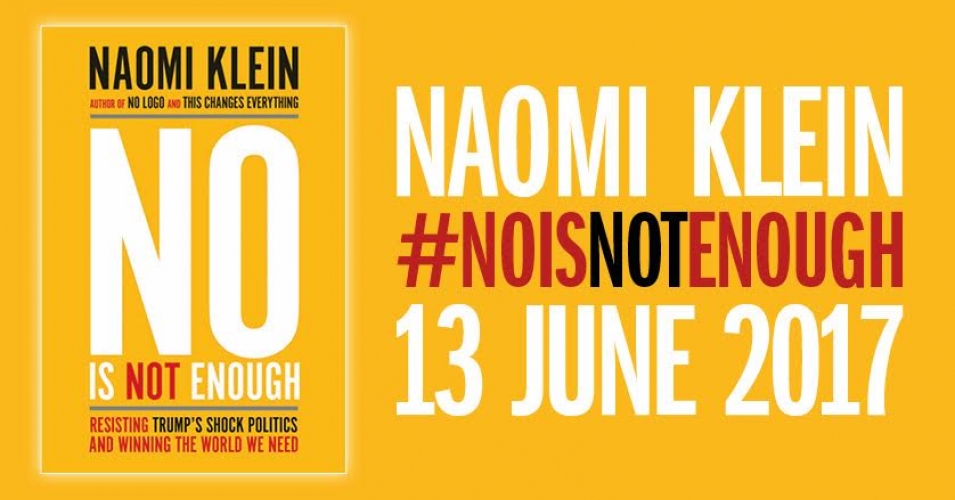
How did a man like Donald J. Trump get to be president? And how on earth can his dangerous agenda be fought?

For those burning questions, a forthcoming book described as "the toolkit for shock resistance" could well be an indispensable resource.

Authored by award-winning author and investigative journalist Naomi Klein, the book, No Is Not Enough: Resisting Trump's Shock Politics and Winning the World We Need, will publish in the U.S. on June 13, 2017.

"Trump is extreme, but he's not a Martian," writes Klein. "On the contrary, he is the logical conclusion to many of the most dangerous trends of the past half century. He is the personification of the merger of humans and corporations—a one-man megabrand, with wife and children as spin-off brands."

A website for No Is Not Enough says the book

reveals, among other things, how Trump's election was not a peaceful transition, but a corporate takeover, one using deliberate shock tactics to generate wave after wave of crises and force through radical policies that will destroy people, the environment, the economy, and national security. This book is the toolkit for shock resistance, showing all of us how we can break Trump's spell and win the world we need.

In the wake of Trump's election, Klein, while accepting the 2016 Sydney Peace Prize, also offered her thoughts on the factors that paved the way for the real estate mogul's rise to power and the strategies needed for a movement to rise against Trump (as well as other Trump-esque figures).

"If there is a single overarching lesson in the Trump victory, perhaps it is this: Never, ever underestimate the power of hate, of direct appeals to power over the 'other'...especially during times of economic hardship," she said.

Another takeaway, she continued, is that "four decades of corporate, neoliberal policies and privatization, deregulation, free trade, and austerity" have ensured ongoing economic pain and in turn, enabled the rise of faux-populists like Trump.

An additional lesson is that "only a bold and genuinely re-distributive agenda has a hope of speaking to that pain and directing it where it belongs—the politician-purchasing elites who benefited so extravagantly from the auctioning off of public wealth, the looting of our land, water, and air, and the deregulation of our financial system."

"If we want to defend against the likes of Donald Trump—and every country has their own Trump—we must urgently confront and battle racism and misogyny in our culture, in our movements, and in ourselves. This cannot be an afterthought, it cannot be an add-on. It is central to how someone like Trump can rise to power."

Klein, whose other works include No Logo, This Changes Everything, and The Shock Doctrine, also recently joined The Intercept as a senior correspondent. There, she is tasked with monitoring the "shocks of the Trump era." Days after Trump's inauguration, she wrote that his administration

can be counted on to generate a tsunami of crises and shocks: economic shocks, as market bubbles burst; security shocks, as blowback from foreign belligerence comes home; weather shocks, as our climate is further destabilized; and industrial shocks, as oil pipelines spill and rigs collapse, which they tend to do, especially when enjoying light-touch regulation.

All this is dangerous enough. What's even worse is the way the Trump administration can be counted on to exploit these shocks politically and economically.

This is the first time one of Klein's books will be published by the independent, Chicago-based Haymarket Books, which has delivered works by esteemed authors including Noam Chomksy, Howard Zinn, Keeanga-Yamahtta Taylor, and Winona LaDuke.

Pages

The Fine Print I:

Disclaimer: The views expressed on this site are not the official position of the IWW (or even the IWW’s EUC) unless otherwise indicated and do not necessarily represent the views of anyone but the author’s, nor should it be assumed that any of these authors automatically support the IWW or endorse any of its positions.

Further: the inclusion of a link on our site (other than the link to the main IWW site) does not imply endorsement by or an alliance with the IWW. These sites have been chosen by our members due to their perceived relevance to the IWW EUC and are included here for informational purposes only. If you have any suggestions or comments on any of the links included (or not included) above, please contact us.

The Fine Print II:

Fair Use Notice: The material on this site is provided for educational and informational purposes. It may contain copyrighted material the use of which has not always been specifically authorized by the copyright owner. It is being made available in an effort to advance the understanding of scientific, environmental, economic, social justice and human rights issues etc.

It is believed that this constitutes a 'fair use' of any such copyrighted material as provided for in section 107 of the US Copyright Law. In accordance with Title 17 U.S.C. Section 107, the material on this site is distributed without profit to those who have an interest in using the included information for research and educational purposes. If you wish to use copyrighted material from this site for purposes of your own that go beyond 'fair use', you must obtain permission from the copyright owner. The information on this site does not constitute legal or technical advice.


