You are here

agriculture

The agricultural policy must serve the people

By Geneviève Savigny - La Via Campesina, March 30, 2017

Where have the consistency between the objectives and tools that prevailed in 1957 gone, when we signed the Treaty of Rome A radical shift in policy is necessary in the European Union.

Agriculture, a source of food and of numerous useful products for human life, concerns the whole of society. There was surely a sort of consensus between the agricultural world, policy makers and society on the role played by farmers and the objectives of an agricultural policy, when the Treaty of Rome, signed in 1957, laid the foundations for the first Common Agricultural Policy. It was first necessary to guarantee food security for people, and thereby produce more, modernize farms but also equip the houses of peasant families where several generations often lived together with the comfort already found in cities. The initial objectives and tools were consistent; increase agricultural productivity, ensure a fair standard of living for the agricultural population, stabilise markets, guarantee security of supply, and ensure reasonable prices for consumers. Cheap food would enable keeping low wages and foster Europe’s industrial development. 

Opposition rises to planned agricultural mega-mergers

By Friends of the Earth Europe, European Federation of Food, Agriculture and Tourism Trade Unions, European Coordination of Via Campesina - La Via Campesina, April 3, 2017

More than 200 organisations have called on the European Commission and Competition Commissioner Margrethe Vestager to block the planned mergers of six giant agriculture corporations. 

The farmer, farmworker, beekeeper, religious, international development, and environmental groups claim that the three resulting companies will concentrate market power and “exacerbate the problems caused by industrial farming – with negative consequences for the public, farmers and farm workers, consumers, the environment, and food security” in an open letter

The European and national organisations – together representing millions of members – state that the proposed mergers of Dow Chemical with DuPont, Monsanto with Bayer AG, and Syngenta with ChemChina will lead to an unacceptable monopoly, with three companies controlling around 70% of the world’s agro-chemicals and more than 60% of commercial seeds

Ramona Duminicioiu, peasant seed producer of the farmer organization European Coordination Via Campesina said: “Approving these mergers works completely against the rights of peasants, with far reaching effects in our society. When the Commission says that small family farms are the back bone of European agriculture does it honestly believe that or is it just lip service? The already fragile rights of peasants regarding seeds, land and markets risks being obliterated by these mega-corporations and our Food Sovereignty abducted. The Commission should say no to these mergers!” 

Adrian Bebb of Friends of the Earth Europe said: “Europe’s food and farming system is broken and if giant firms, like Monsanto and Bayer, are allowed to merge they will have an even tighter toxic grip on our food. The mergers are a marriage made in hell and should be blocked by regulators. We need to build a fairer and greener food system out of corporate control.” 

Arnd Spahn from the European trade unions of agricultural workers EFFAT said: “Workers, as well as the environment and all society, are victims of the use of pesticides. We are fighting for health and safety on work places and we need partners for our ideas. Today the producers of pesticides are big, but after such a merger they will be too big for anybody to bring them on a path to worker and environmental protection. How shall we stop Glyphosate if we have such strong opponents?” 

Isabelle Brachet of CONCORD Europe said: “Ending hunger implies addressing power imbalances in our food systems. A small number of multinational corporations dominate internationally traded food systems and get most of the knowledge, benefits and access to decision makers. Corporate power in our food must be restrained – not further extended by mega-mergers. The main investors in agriculture in developing countries are farmers themselves and it is they who must be at the centre of agriculture development policies.”[3] 

The organisations have called on the European Commission to reject the mergers, prevent the damage caused by these corporations, and urgently take steps to support just and sustainable food systems less dependent on agri-business. 

Moving towards a UN Declaration on the Rights of Peasants and other People Working in Rural Areas

By Elizabeth Mpofu - La Via Campesina, March 9, 2017

The need for a UN Declaration on the Rights of Peasants and other People Working in Rural Areas is all the more urgent and evident in the 21st century. Despite years of campaigning for a better recognition and protection of the rights of peasants, displacements and criminalization continue affecting hundreds of thousands of peasants globally.

Hunger and malnutrition, unemployment and poverty all have something in common; they are more prevalent in rural areas and the countryside. Because of this, most people coming from the countryside, have been exploited (policies forced upon them with limited consultation and participation), dispossessed, displaced, criminalized, brutally treated by those in power and the rich, sometimes taken to court and/or killed for defending their rights related to natural resources, values and culture. Such injustices in most cases have gone unpunished or reported. Laws or political concepts have been made to sanitize and sanctify social injustices. The future UN declaration on the rights of peasants and other people working in rural areas will contribute to solve these problems by recognizing rights to land, water, seeds and other natural resources and stressing the importance of improving access to productive resources and investment in appropriate rural development. This will be a milestone for peasants and rural people all over the world.

Agro-fuels, GMOs, climate smart agriculture are put on the table as a solution to the current climate, food and economic crisis. It opens further the doors for the expansion of industrial agriculture and the exclusion of peasants. The primary role of agriculture is to produce food, not agro-fuels and commodities. Our struggle is for the recognition and acknowledgement of Peasants’ Rights, to achieve both equity and equality, socially, economically and ecologically.

Globally, millions of peasants have been illegally evicted from their lands to make way for “modern agriculture”, agro-fuels, forests (REDD+ for carbon trading) and other natural resources (water), and many other fictitious commodities created for profits by transnational corporations and elites. This has not only affected peasants but also many indigenous peoples. In Africa we see an increase in the erosion of peasants’ rights to seeds and land and access to water in general. These were initiated following the global food crisis by various actors, such as the G8 New Alliance for Food Security and Nutrition in Africa (NAFSN), the harmonization of seed regulatory systems by Common Markets for Eastern and Southern Africa (COMESA) and Southern Africa Development Community (SADC) and the Alliance for Green Revolution in Africa (AGRA). There has been visible widespread land grabbing by foreign interests in many African countries which led to dispossession and displacement of hundreds of thousands of rural peasants. The less visible is the on-going reforms of Seeds Acts and policies to align them to the International Union for the Protection of New Varieties of Plants (UPOV) 1991 to promote big seed industries and to move towards criminalizing peasant saved systems, undermining the rights of peasants.

The rising influence of TNCs in global politics is affecting many of the rights held by peasants: rights to participation and information, safety and health, work, decent incomes and livelihoods, access to justice, life, liberty, physical and personal security and free movement. States must respect, protect and fulfil the rights of peasants and other people working in rural areas. In this particular aspect, we need States to be present both in their territories and also extra-territorial. We need our government to protect peasants and other people working in rural areas- so that individuals, organizations, TNCs and other businesses do not negate our rights.

We see the capture of public policies and the promotion of Free Trade Agreements (TTIP, CETA, TTP, EPAs, RECPs) as the attempt to dominate and monopolize new markets for profits. Neither nature nor humanity are respected but rather are destroyed and exploited for profit maximization. Last year criminalization in the form of continued threats, abductions, torture, persecution, illegal evictions and killings in a number of countries such as Honduras, Colombia, and Brazil, among others, were prevalent. Thus, millions of affected people leave their territories and migrate to developed industrial countries.

We promote a model based on Food Sovereignty and support for agroecological peasant agriculture as a solution to food, climate and social crisis. Why is big capital investing billions of dollars in technologies (toxic agro-chemicals and fertilizers) which we all know cause harm to humanity and the planet? Why are land and natural resources from peasants taken away to produce for export? Such violations are mainly led by capitalist interests. Transnational companies keep violating basic rights with impunity while people struggling to defend the rights of their communities continue to be criminalized, at times killed. We as La Vía Campesina, together with allies, continue to engage and lobby our respective governments and the UN to ensure that such violations receive urgent attention.

The stage we have reached is a critical milestone in the long road towards the creation of an international legal instrument protecting peasants’ rights. After discussing it internally for several years, La Vía Campesina submitted a first proposal in 2008 to the UN Human Rights Council (UN HRC) so that the rights of peasants- men and women- are formally recognized. This includes the right to life and adequate standards of living, the right to land and territory, to seeds, to information, justice and equality between men and women. Using the UN human right mechanisms is seen by the international peasant movement as a strategy to legitimize the peasant’s struggle and to support local struggles everywhere in the world. The UN Declaration on the Rights of Peasants and other People Working in Rural Areas will provide a new tool for peasants to defend their lives and their land. We also need to mobilize support for the UN Declaration on peasant rights process to achieve some of these desired goals. The Declaration will ensure and reinforce the interpretation of the implementation of human rights in relation to peasants whose specific rights are insufficient and inadequate in existing legal instruments. Today, March 8th, peasant women are also mobilizing all over the world to stop violence on our bodies and on our territories and for the recognition of our rights. Peasant women are the main producers in the world and therefore this declaration is especially important for us.

The plight for further protection of the rights of peasants has been a movement-driven process, with La Via Campesina and peasants, fisher folk, indigenous, pastoralists, rural workers, women, and youth organizations at the forefront. This is a demand from people all over the world. In achieving this, we hope to solve current realities, from hunger, malnutrition to rural development. In championing the rights of peasants and other people working in rural areas, humanity also wins.

Unite against the FFA for the future of agriculture!

By various - La Via Campesina, April 3, 2017

A call from civil society 

The 10th edition of the Forum for the Future of Agriculture (FFA) was held in Brussels on the 28th of March. Its organisers, Syngenta (a multinational chemicals and agrifood firm) and ELO (an organisation that lobbies for large European landowners) presented their brand of agriculture, which they claim will meet food and environmental challenges. A coalition of farmers’ organisations (members of La Via Campesina), civil society organisations and citizens have denounced these false agribusiness solutions and are issuing this appeal to send a firm message to the organisers and attendees of this forum: this agriculture has no future! 

False solutions to the wrong problems 

With its winning tagline, “where agriculture and environment meet”, the forum brings together a prestigious panel of speakers (EU, OECD, UN, etc.) alongside nature conservation NGOs and intellectuals. But this façade of open debate conceals a costly exercise in political lobbying. At a time when the reform of the European Union’s Common Agricultural Policy (CAP) and the regulation of certain pesticides are under discussion, agribusiness players need to act now to protect their interests. So they present themselves as champions in the fight against global hunger and as leaders in environmental conservation ; yet the solutions that they advocate are false solutions. Their answer to current and future food challenges is an unchanging litany : increase the productivity of farmland through technology and further reduce barriers to free trade. 

By asking the question, “how to feed 9 billion people by 2050”, the FFA organisers are perpetuating the myth that we do not produce enough today to feed the human race. But according to the FAO we already produce enough food for 12 billion people ! The causes of hunger and malnutrition are rather to be found in extreme poverty (especially in rural areas, where about 70% of hungry people live), food waste (30% of global production is wasted, according to the FAO) and the conversion of agricultural land to biofuel production and livestock rearing (feed and pasture). 

Lobbies and multinationals sell what they call “smart agriculture”, which uses robotics, chemicals, biotechnology and specialisation. Yet it does nothing to feed those who are starving ; instead it makes producers even more dependent on agribusiness multinationals. As well as their negative impact on health and the environment, these technologies are driving small farmers into debt and putting them out of business. 

And there’s more. The way that we class food as a simple commodity for trading on the free market is one of the main causes of rural impoverishment and loss of biodiversity. Both in the North and the South, competition between farmers favours large farms at the expense of small farmers, who bear the brunt of the disastrous consequences of this model : falling incomes, unemployment, the disappearance of farms, massive debt, speculation on agricultural land and foodstuffs, etc. Over the last 30 years, Belgium has lost 63% of its farms – 43 every week. It is mostly small farms that are affected. 

Greenwashing dealers in death 

The agriculture of machines, chemicals and international shipping cannot continue to exist without fossil fuels. Yet Syngenta claims to champion environmental causes. At FFA 2016, cuddly bees were distributed amongst attendees to promote initiatives that were far from transparent. The company probably wanted to deflect their attention away from its aggressive lobbying to overturn the ban on neonicotinoids – singled out by the scientific community for their disastrous consequences for natural pollinators such as bees and bumblebees.

On its website, the company claims that opposing the use of GMOs, chemical fertilisers and pesticides means using more water and land. This is proof of its bad faith as it pretends to ignore solutions that have already been proven to be effective. 

Solutions do exist : agroecology and food sovereignty 

The agriculture that agribusiness offers us is nothing new. It merely follows the same path that has brought about the destruction of our soils, the deterioration of biodiversity, the pollution of our waters and the disappearance of our farms. Truly smart agriculture, the agriculture of the future, should be modelled on natural ecosystems. A publication of the UN’s Special Rapporteur on the Right to Food states that agroecology could double food production in 10 years, mitigating climate change, protecting water resources and creating new jobs in the rural sector. 

Rather than surrendering agricultural production to the free market and the dictates of agribusiness, it is the people themselves who should determine agricultural and food systems. Only this way will they be able to have a healthy diet, tailored to their needs, locally produced and sustainable. That is why we believe it is essential to commit to food sovereignty.
We do not want arms dealers calling the shots in times of peace ; nor do we want dealers in poison to decide what we eat. They are only interested in making money. Their brand of agriculture is sounding the death knell for small farmers, consumers, and the environment. It represents the past. 

We want to send a clear message to European and international policymakers. They must curtail the influence of agribusiness and private interests and commit to the agroecological transition. 

We call on as many organisations and movements as possible to sign this appeal   

Unite for our future ! 

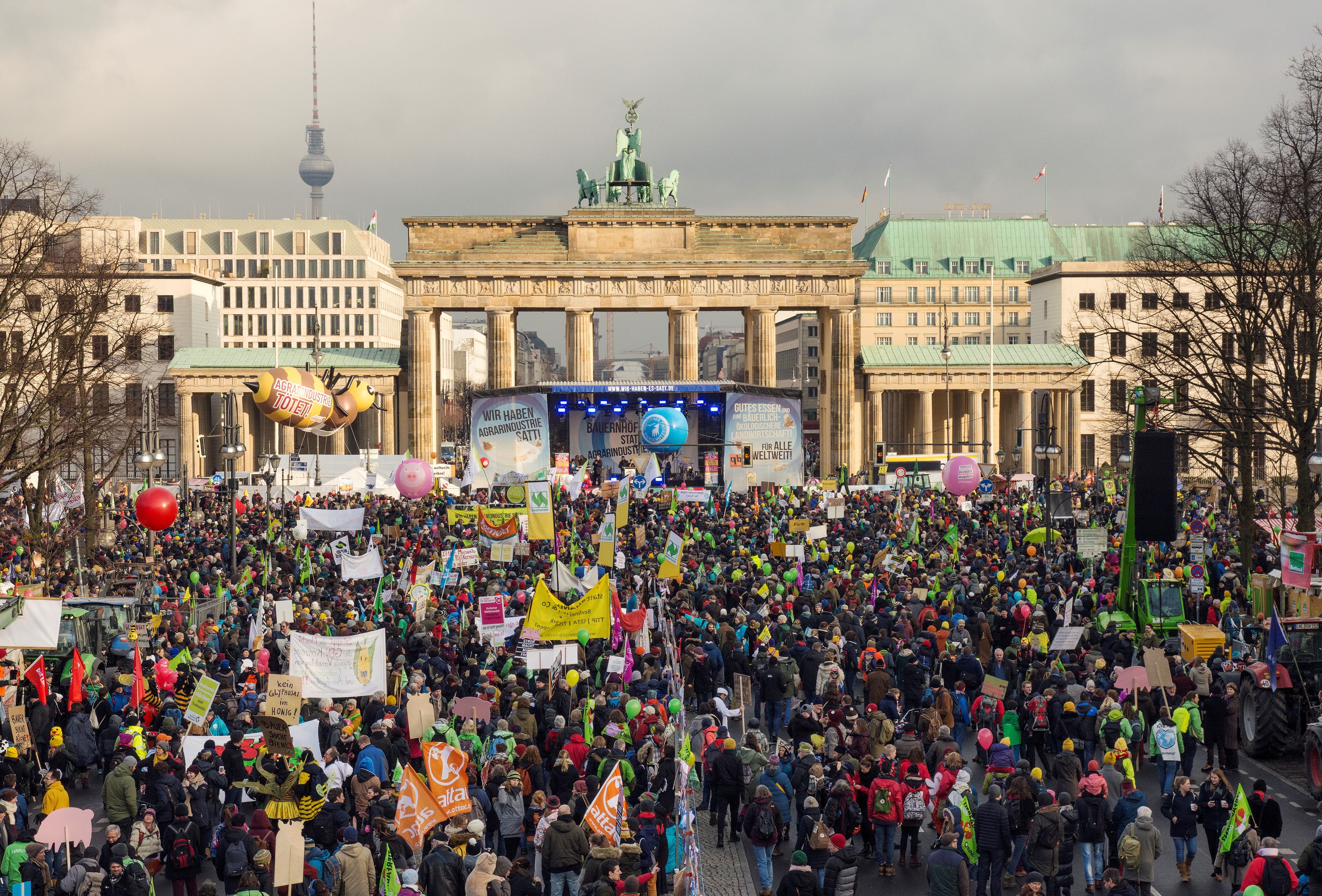
“Food is political!” 33,000 demand quicker change of our agricultural and food systems

By - La Via Campesina, January 30, 2018

Excerpts from the joint press release of German civil society organizations participating last weekend in Berlin’s “We’re fed up with it” demonstration. For the complete text (German only) please click here

With a deafening cooking-pot concert, 33,000 people at the “We’re fed up!” demonstration at the start of the Green Week in Berlin called on the next German government to come up with a new agricultural policy. ‘Industrial agriculture and food industry is causing local and global problems for farmers, climate, animals and the environment,’ says Jochen Fritz – spokesperson of “We´re fed up!” – on behalf of the more than 100 organisations that called for this demonstration. He adds: ‘The transition to an environmentally friendly, animal-friendly and climate-friendly agriculture in which farmers can live justly from their work must not be postponed by politicians.’

Demonstrators beat their pans in front of the Agriculture Ministers’ Summit gathered in the German Finance Ministry. They demanded respect for human rights, fair trade conditions and more support for the rural population worldwide. Already in the morning the 160 farmers who led the demonstration with their tractors handed over a protest note to the 70 ministers from all over the world present in the Summit. ‘We want to get out of the fatality of export agendas and land concentration, which have tied a noose on the neck of farmers here and around the world,’ says Fritz about the consequences of agricultural policies. ‘In the last 12 years, one third of all farms in Germany had to close their doors.’

Alliance spokesman Fritz continues: ‘Food is political, more and more people are recognizing this. But our policies are feeding the agricultural industry and produce at the expense of the environment, climate and animals. So that we don’t have all to pay for it in the long term, the big coalition (GroKo – CDU/CSU-SPD) must now turn the tables*. Those who produce and eat sustainably must be rewarded.’

Concrete projects in the next legislative period must be – in addition to glyphosate phase-out and proper transformation of livestock stables and pens – the obligation to label animal foodstuffs, prohibiting last-resort antibiotics in animal husbandry and fair market rules for the protection of farms. Furthermore, the payment of EU agricultural subsidies to non-agricultural investors, who are grabbing more and more farmland, must be stopped immediately.

‘We need a fundamental reform of European agricultural policy. Those who cultivate crops in an environmental and climate friendly way and raise animals in an appropriate manner must be supported by direct payments, not those who own the most land. Farmers are ready, but politicians must create the framework. Rural areas are in particular need of small and medium-size farms’, says Georg Janßen, Head of Office of the Arbeitsgemeinschaft bäuerliche Landwirtschaft (AbL).

* at the moment, the three biggest political parties in Germany (CDU/CSU-SPD) are negotiating the formation of the next government

The impacts of the actions of TNCs on peasant communities

By Federico Pacheco - La Via Campesina, October 25, 2016

At the ongoing negotiations in Geneva, of the Open Ended Inter Governmental Working Group (OEIWG) at United Nations, Federico Pacheco of the Union of Land Workers of Andalusia intervened to denounce the actions of transnationals pushing a model of industrial agriculture that pollutes the environment, monopolizes and privatizes the commons, and exploits workers and producers. Here is the full text of the speech. 

La Vía Campesina expresses support to the setup of a Binding Treaty. La Via Campesina, as an international organization of peasants and rural workers, has defended for more than two decades the survival of agriculture and rural livestock worldwide and small-scale fisheries, indigenous communities and sustainability in the use of natural and energy resources.

We have been suffering since the middle of last century of a progressive disappearance of small farms in favor of an agro-industrial system based on large-scale production and distribution, pollution of nature, energy waste and global warming, as well as labor exploitation of workers. The dismantling and destruction of the rural world brings about unemployment, poverty, hunger, and displacement and forced migration around the globe.

The role of Transnational Corporations has been and is decisive in this process. Since the green revolution, in which chemical fertilizers and pesticides began to poison the land, water and people, along with the production of enormous benefits for large international companies, and more than two hundred million hectares grabbed in the last years by pension funds and multinational corporations. We saw as well an unstoppable process of concentration, in which very few corporations control the global markets for seeds, pesticides and agrochemicals among others, as well as price setting. 

The Free Trade Agreements have come to further facilitate their actions to limit and cancel any public policy that harms their interests. The imposition of the opening of borders, tax havens and arbitration tribunals, creates a legal and political framework that guarantees their impunity and makes it impossible to seek reparations against environmental and social disasters that occur.

Even in this difficult situation we find that most of the world's population live in rural areas and peasant agriculture through local distribution, provides most of the food to the populations, creating jobs and protecting biodiversity. 

As La Via Campesina and many other organizations, we have been committed to the primacy of human rights of peoples and individuals, over the interests and profits of big business. In that sense, we are promoting  the framework of the United Nations the Declaration of Peasant Rights, to ensure defend and promote the rights to food sovereignty, access to natural and productive resources, local markets, income and services worthy to farmers and rural workers in general.

However, neither this Declaration nor the major international regulatory achievements related to human rights will have any effectiveness if the activities of the transnational companies are not regulated in a binding way and sovereignty and self-determination to the states and peoples is not regained, as well as the respect for the principles of multilateralism and supremacy of human rights. 

Peasants around the world are suffering under these companies that contaminate our seeds, dispossess us of land, deprive and poison our populations and criminalise and murder our leaders who oppose them. Yet, these transnational companies are operating with impunity.

And this is because these corporations, with more power than many states, effectively use all mechanisms to prevent enforcement of laws, including court judgments at national and international level. 

We have also seen how voluntary, social and environmental commitments made by these big companies are nothing more than a marketing ploy and an attempt at whitewashing their violations, sometimes even to avoid losses.

We urgently need an instrument, specific for transnational corporations, binding and enforceable, which allow states and the United Nations to control them, regulate them and make them respect human rights.  

As Via Campesina, we encourage states to retake the spirit of the United Nations Charter and defend the interests and rights of their populations, including those of the rural world, beyond the pressures and interests of large corporations.

Largest-ever European food sovereignty gathering kicks off in Romania

By staff - La Via Campesina, October 25, 2016

Cluj-Napoca, October 25th – the largest-ever European meeting on food sovereignty starts today, as over 500 people from over 40 countries gather to discuss how to reclaim our ever-more corporate-controlled food and farming system. [1]

The second European Nyéléni Forum for Food Sovereignty runs from October 26-30, and brings together farmers, fisherfolk, pastoralists, gardeners, food and agricultural workers, researchers, activists and many more.

For Jyoti Fernandes, peasant farmer from the UK and coordination committee member for the European Coordination Via Campesina, « the convergence here in Cluj of so many sectors and constituencies of society is essential in transforming and strengthening our food systems in Europe, based on agroecology. From the farm to the plate, the economic, environmental, social and public health stakes of food production must mobilize all levels of society – local, national and international. Here, in Nyéléni Europe, this is happening.»

 Stanka Becheva, food and farming campaigner at Friends of the Earth Europe said: “The food fight is on against agribusiness mega-mergers, which would rubber-stamp industrial farming. The diversity and size of the movement assembled here this week shows the strength of the food sovereignty movement, and how it is ready to push for better farming for people and planet.”

The forum features a “peasants’ market”, film screenings, and site visits to local peasants demonstrating sustainable local farming methods and environmental justice struggles including the highly controversial proposed gold mine at Roșia Montană.

Themes discussed at the forum include models of food production and consumption, food distribution, the right to natural resources and the commons, and how to improve work and social conditions in food and agricultural systems.

Spokespeople from a variety of professions and backgrounds are available for interview in person or on the phone in English, Romanian, French, German, Turkish, Spanish, Dutch etc.

List of spokespeople: https://docs.google.com/document/d/1KIbHCiXgkwY5eKUYkX5sVweaFDsM3IxxZ_21abhxOBI/edit?usp=sharing

"We want to come out stronger and have our rights respected"

By staff - La Via Campesina, February 22, 2017

Speaking with Inmaculada Ibáñez Vargas from Vía Campesina Europe, just months before the International Peasant Movement's Seventh Conference.

As part of the preparatory process for Vía Campesina's International Conference, which will take place in July in the Basque Country, the women's articulation group from Vía Campesina held a meeting at the organisation ANTA in El Salvador. 

Andalusian Inmaculada Ibáñez, member of the women's articulation group and leader of the women's faction of the Coordinadora Agricultores Ganaderos (a major farmer organisation in Spain), spoke with Radio Mundo Real about the main topics that will be covered by the event. These will be angled from a peasant and popular feminism perspective.

She stressed, in particular, the lack of rights she witnessed granted to peasants in El Salvador and the negative impact this can have. Her visit to El Salvador was her first visit to Latin America. She also mentioned that as part of its Seventh Conference, Vía Campesina sets out to make the role of female peasants more visibile in food production.

In the interview, Inmaculada said that what is often called the "primary sector is extremely important because we are talking about food production".

When asked about the situation faced by migrants who are attempting to get to Europe and the obstacles they encounter when trying to reach the EU, Inmaculada recalled that both Spain and Brussels have signed a series of agreements that allow migrants to gain access to their territories.

"We want to come out stronger and have our rights respected", said Inmaculada in her conversation in El Salvador, where she was speaking about the desired outcome of the peasant conference in the Basque Country.

Inmaculada said that the lack of protection rights and social security enjoyed by peasant men and women in Central America constituted one of the starker contrasts between European peasants and their American counterparts.

She concluded by saying: "when people like us who work in the fields have rights, this doesn't just improve our life quality but also the life quality of the population as a whole, because we are feeding the world and this is extremely important".

“WTO, Out! Building Alternatives”: La Via Campesina to organise Peoples’ Summit during WTO’s XI Ministerial Conference in Argentina

By staff - La Via Campesina, November 17, 2017

15 November 2017: La Via Campesina is calling upon social movements and civil society organisations of the world to mobilise and organise our resistances against the World Trade Organisation (WTO) and Free Trade Agreements (FTAs), build solidarity alliances and to participate in the People’s Summit “WTO, Out! Building alternatives”, from the 10-13 December coinciding with the XI WTO Ministerial in Buenos Aires, Argentina.

A preliminary agenda of the summit is available here. As you may note, this is currently only available in Spanish. We will make the English version available shortly.

For the first time since its inception, the World Trade Organization (WTO) is planning to meet in Latin America. From the 10th to the 13th of December, Mauricio Macri’s government will host the WTO’s 11th Ministerial Conference in Buenos Aires, Argentina. Entrepreneurs, ministers, chancellors, and even presidents will be there. To do what? To demand more “freedom” for their companies, more “ease of doing business” for exploiting workers, peasants, indigenous people, and taking over land and territories. In other words, less “restrictions” on transnational wastage.

Since its beginnings in 1995 as derivative of General Agreement on Tariff and Trade (GATTs), the World Trade Organization has promoted the most brutal form of capitalism, better known as trade liberalization. At successive Ministerial Conferences, the WTO has set out to globalise the liberalisation of national markets, promising economic prosperity at the cost of sovereignty. In more or less the same terms, by its “liberalization, deregulation and privatization”, which is called Package of Neoliberalism, WTO has encouraged the multiplication of free trade agreements (FTAs) between countries and regional blocs, etc. On this basis and by making use of governments that have been co-opted, the world’s largest transnational corporations (TNCs) are seeking to undermine democracy and all of the institutional instruments for defending the lives, the territories, and the food and agricultural ecosystems of the world’s peoples.

In the previous Ministerial Conference (MC) in Nairobi in 2015, WTO had made six decisions on agriculture, cotton and issues related to LDCs. The agricultural decisions cover commitment to abolish export subsidies for farm exports, public stock-holding for food security purposes, a special safeguard mechanism for developing countries, and measures related to cotton. Decisions were also made regarding preferential treatment for least developed countries (LDCs) in the area of services and the criteria for determining whether exports from LDCs may benefit from trade preferences.

This year, with Macri Inc. in the Casa Rosada (Government House in Argentina), the coup leader Michel Temer in the Palacio del Planalto (the official workplace of the president of Brazil), and Brazilian Roberto Azevedo as its Director General, the WTO wants to return to the subject of agriculture, to put an end to small-scale fishing, and to make progress with multilateral agreements such as the misnamed General Agreement on Trade in Services (GATS). Notwithstanding the misleading protectionist statements coming from Washington and London, the WTO will meet again to try to impose the interests of capital at the cost of Planet Earth, of the democratic aspirations of the world’s peoples, and of life itself.

Via Campesina, Bali Declaration: World Bank and IMF represent the interests of agribusiness, they should GO!

By La Via Campesina - La Via Campesina, October 11, 2018

We, the peasant women and men of La Via Campesina – a global movement comprising 182 peasant organisations from 81 countries – who have assembled in Bali this week and representing peasant and indigenous peoples of Asia, Africa, Europe and Americas, are unanimously and emphatically denouncing the ongoing Annual Meeting of World Bank and IMF.

Pages

The Fine Print I:

Disclaimer: The views expressed on this site are not the official position of the IWW (or even the IWW’s EUC) unless otherwise indicated and do not necessarily represent the views of anyone but the author’s, nor should it be assumed that any of these authors automatically support the IWW or endorse any of its positions.

Further: the inclusion of a link on our site (other than the link to the main IWW site) does not imply endorsement by or an alliance with the IWW. These sites have been chosen by our members due to their perceived relevance to the IWW EUC and are included here for informational purposes only. If you have any suggestions or comments on any of the links included (or not included) above, please contact us.

The Fine Print II:

Fair Use Notice: The material on this site is provided for educational and informational purposes. It may contain copyrighted material the use of which has not always been specifically authorized by the copyright owner. It is being made available in an effort to advance the understanding of scientific, environmental, economic, social justice and human rights issues etc.

It is believed that this constitutes a 'fair use' of any such copyrighted material as provided for in section 107 of the US Copyright Law. In accordance with Title 17 U.S.C. Section 107, the material on this site is distributed without profit to those who have an interest in using the included information for research and educational purposes. If you wish to use copyrighted material from this site for purposes of your own that go beyond 'fair use', you must obtain permission from the copyright owner. The information on this site does not constitute legal or technical advice.