You are here

agriculture

Hoodwinked in the Hothouse: Examining False Corporate Schemes advanced through the Paris Agreement

Global Free Trade is on its deathbed. Globalized Solidarity and Localized Agriculture will bring food sovereignty: Korean Peasants’ League

By Lee Kyung Hae - La Via Campesina, September 10, 2021

In a statement issued to commemorate the International Day of Action against WTO and FTAs, the South East and East Asian members of La Via Campesina have issued a statement reminding that free-market economy has failed the world and food sovereignty is our future. Read the full statement below.

“WTO Kills Farmers!”—it is what Lee Kyung Hae, who took his own life during a protest against WTO in Cancun, Mexico, shouted out on September 10, 2003. The world was outraged by his death. Peasants from the world once again strengthened their will to fight against WTO at the global peasant funeral for Lee. The anniversary of Lee’s death has been designated as the International Day of Action against WTO and FTA.

18 years have passed since Lee’s death. For 18 years—even before Lee’s death, free trade with an arsenal of FTA, mainly led by WTO, has threatened the lives of the people all over the world, including peasants; it has influenced all parts of the world—from cities’ dense buildings, jungle and grasslands to deserts.

Over the past 30 years, free trade has only satisfied global capital’s appetite by emptying out people’s money and depriving freedom to peasants in smaller nations. And its result has been disastrous. Under different names, free trade has brought poverty, starvation, deprivation of resources, and destruction of environment; degrading food producers to food importers; privatizing water resources and public service; obliterating native seeds; and destroying a traditional mode of agriculture. Then, a nation has lost their own sovereignty, while multinational capital replacing for its place.

However, we are facing the end of free trade now. Every country has taken its leave of free trade, for national borders are closed with a movement restricted among nations due to COVID-19, and for the world is confronted with a new kind of food crisis from climate change. Those who used to insist free trade, claim protectionism now; agriculture is no exception. In the midst of this crisis, the world is struggling to secure foods to provide their people. The opportunity to achieve food sovereignty is right ahead of us.

Due to unjust capital and policies, free trade threatening lives of peasants and the people all over the world, has almost drawn its last breath; globalized solidarity and localized agriculture will fill in for it. Finishing free trade, peasants and the people will pave, on their own, the way toward a new era of food sovereignty.

Korea Peasant League resolves to lead this way, requesting as follows:

  • Against free trade threatening peasants’ right to live in the pursuit of the benefits of capital!
  • Against free trade bringing debt, poverty, hunger, and death!
  • Against free trade expelling peasants from the community!
  • Let’s build a new trade order based on peasants’ dignity, self-supply, and solidarity!

Mexico’s Only Independent Farmworker Union Struggles On Despite Obstacles

By James Daria - Labor Notes, August 30, 2021

In 2015, tens of thousands of poor, mostly indigenous migrant farmworkers (or jornaleros) went on strike in Mexico, blockading the transpeninsular highway that connects agricultural production in the valley of San Quintín, Baja California, with distributors across the border in the United States. These workers produce crops including tomatoes, cucumbers, and berries for U.S. and world markets—under conditions they decry as “modern slavery.”

The federal recognition of the National Independent Democratic Union of Agricultural Workers (Sindicato Independiente Nacional Democrático de Jornaleros Agrícolas, or SINDJA) was one of the few concrete achievements of negotiations between workers, growers, and state and federal governments.

The union—Mexico’s only independent farmworker union—has carried on in the years since, though it’s fighting an uphill battle. SINDJA has yet to achieve a collective bargaining agreement with the local growers and multinational corporations that operate in the valley.

This July, SINDJA elected a new executive committee, which could mark an important turning point for farmworkers in Mexico. Abelina Ramírez Ruiz, the new general secretary, began her involvement with the union by organizing around the multiple forms of violence suffered by migrant farmworker women. This includes issues of gender inequality, harassment, and sexual assault in the fields as well as domestic violence in the home.

Even as the migrant farmworker workforce becomes increasingly female, women continue to struggle to gain equality in both migrant and labor justice movements. Local social movements, community groups, and labor organizations have been largely male-dominated spaces where the voices of women are marginalized. The farmworker strike of 2015 was a watershed moment as female leaders emerged to challenge the gender hierarchies inherent in previous organizing efforts.

In another hopeful development, the Mexican government has agreed to work towards more transparent and democratic labor relations. Recent labor reforms stipulate that all collective bargaining agreements must be renegotiated by 2023 by means of democratic elections where workers decide their union representation. That’s thanks to reforms implemented by Mexico’s current president, Andrés Manuel López Obrador, as well as pressure by U.S.-based unions in negotiating important labor provisions into the United States-Mexico-Canada Agreement (USMCA), the successor to NAFTA. This could potentially offer unions like SINDJA a more favorable environment for organizing.

Thousands mobilize to call for food systems that empower people, not companies

By Staff - La Via Campesina, August 5, 2021

UN Food Systems Pre-Summit falls short on climate, hunger crisis, COVID-19, and food systems transformation, say counter-mobilization participants, totalling almost 9,000 people.

3 August 2021. Rome, Italy. Between 25-28 July 2021, some 9,000 people gathered for a mostly virtual counter-mobilization to oppose the United Nations Food Systems (UNFSS) Pre-Summit. The alternative forum was hailed a huge success, as it drew together a wide variety of attendees and was able to catalyze and amplify a counter-narrative to the official proceedings. With critical articles and pieces published in major media outlets such as the BBC, Al Jazeera and Italian state TV Rai, and several thousands of #FoodSystems4People posts on social media seen by potentially 10 million users, the counter-mobilization succeeded in reaching a broad public with its vision for genuine transformation of unsustainable food systems.

The “People’s counter-mobilization to transform corporate food systems” kicked off with an 8-hour long global virtual rally. This massively-attended event featured messages from offline communities, declarations, artistic performances and live mobilizations by hundreds of individuals and organizations from all continents, representing smallholder farmers, pastoralists, fisherfolks, indigenous peoples, agricultural and food workers, landless peoples, women, youth, consumers, the urban food insecure, NGOs and academics.

The counter-mobilization provided a space for dialogue about the threats posed by increasingly corporate-controlled and globalized food systems, and the already existing viable solutions to overcome them. An opening declaration summarizing the demands of the People’s Autonomous Response to the UNFSS – a platform of 330 organizations who took part in the counter-mobilization – was officially released. This civil society group are urging that policy discussions and decisions be made in the UN Committee on World Food Security, the only multilateral space with established inclusivity and accountability.

Food Sovereignty: 25 years in the making

By Jaime Amorim - La Via Campesina, July 28, 2021

Food sovereignty is intrinsically linked to the debate over what we envision for rural areas and what type of development should be applied, as well as what type of food to produce. And why do we want to produce?”

In the same year that La Via Campesina celebrates 25 years of defining, building, and fighting for “food sovereignty,” the United Nations (UN) will convene a summit for heads of state, members of large businesses and private corporations, multinationals and agribusiness representatives to discuss food systems processes.

The UN Food Systems Summit, or FFS, will take place in September of 2021 during the week of the High-Level panel of the United Nations’ General Assembly. Before the Summit, a pre-Summit will take place in Rome at the end of June.

I will take advantage of this space to debate(discuss?) the two subjects which complement each other in two separate articles. In this first one, I will discuss the 25th anniversary of the debate for food sovereignty. In the second will concern the contradictions surrounding the realization of the Summit on food systems, which will be convened by the Secretary General of the United Nations. This is the decade in which the UN and its member states must accomplish the activities and actions to which they committed by 2030, the objectives defined in order to reach their goals for building Sustainable Development.

The Summit on Food Systems will be held just as the world is experiencing a pandemic that has taken the lives of more than four million people worldwide, victims of COVID-19. At the same time, we see, as a consequence of the crises, the rise in the number of people who suffer hunger worldwide, as well as an increase in unemployment, poverty and violence.

Combatting Climate Change, Reversing Inequality: A Climate Jobs Program for Texas

By Lara R. Skinner, J. Mijin Cha, Hunter Moskowitz, and Matt Phillips - ILR Worker Institute, Cornell, July 26, 2021

Texas is currently confronted by three major, intersecting crises: the COVID-19 public health pandemic and ensuing economic crisis; a growing crisis of inequality of income, wealth, race and power; and the worsening climate crisis, which continues to take its toll on Texans through hurricanes, major flood events, wildfires, debilitating heat waves and the significant economic cost of these extreme weather events. These crises both expose and deepen existing inequalities, disproportionately impacting working families, women, Black, Indigenous and people of color (BIPOC) communities, immigrants, and the most vulnerable in our society.

A well-designed recovery from the COVID-19 global health pandemic, however, can simultaneously tackle these intersecting crises. We can put people to work in high-quality, family- and community-sustaining careers, and we can build the 21st century infrastructure we need to tackle the climate crisis and drastically reduce greenhouse gas emissions and pollution. Indeed, in order to avoid the worst impacts of the climate crisis, it is essential that our economic recovery focus on developing a climate-friendly economy. Moreover, there are significant jobs and economic development opportunities related to building a clean energy economy. One study shows that 25 million jobs will be created in the U.S. over the next three decades by electrifying our building and transportation sectors, manufacturing electric vehicles and other low-carbon products, installing solar, wind and other renewables, making our homes and buildings highly-efficient, massively expanding and improving public transit, and much more.

Conversely, a clean, low-carbon economy built with low-wage, low-quality jobs will only exacerbate our current crisis of inequality. The new clean energy economy can support good jobs with good benefits and a pipeline for historically disadvantaged communities to high-quality, paid on-the-job training programs that lead to career advancement. Currently, the vast majority of energy efficiency, solar and wind work is non-union, and the work can be low-wage and low-quality, even as the safety requirements of solar electrical systems, for example, necesitate well-trained, highly-skilled workers.

Read the text (PDF).

Position Document on the Common Agricultural Policy (CAP) Reform

By Pier Francesco Pandolfi de Rinaldis, Berthe Darras, Jean-Matthieu Thévenot - European Coordination Via Campesina, July 13, 2021

Today the Youth Articulation of ECVC has released a Position Document on the reform of the Common Agricultural Policy (CAP). Following the latest agreement between the EU Commission, EU Parliament and European Council, the young members of ECVC want to express their opinions, concerns and proposals for the reformed CAP and its application at the national level.

“We fear that the reformed CAP will continue to neglect the real needs of young farmers, and in particular small, agroecological farmers. Moreover, we expect that the CAP will continue to miss one of its main objectives: facilitating the entrance of new farmers (…). The CAP policies significantly affect us, yet we have no say in its reform process. It is not sufficient that the role of young farmers is acknowledged on paper, we want effective policies to support us and the right to participate in decision-making. As there can be no future for EU agriculture without young farmers.”

Read the text (PDF).

What Might an Ecosocialist Society Look Like?

By David Klein - System Change not Climate Change, June 27, 2021
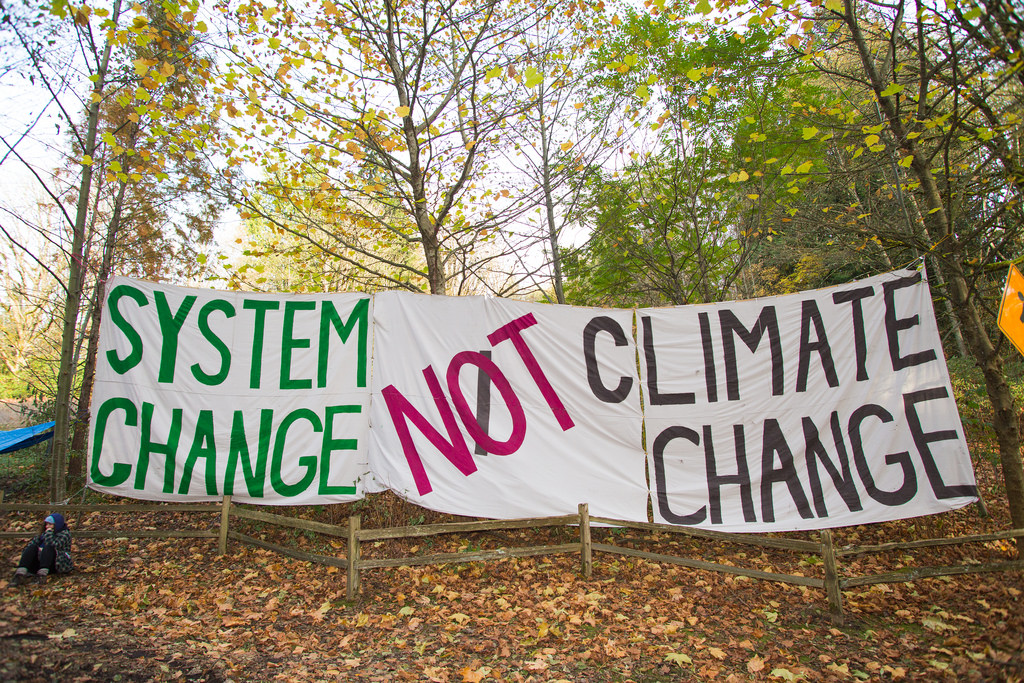
Why can’t the problems that ecosocialism would solve also be remedied within the current global capitalist system?

Before describing possible features of a future ecosocialism, it is worthwhile to consider why such a system is even needed. Why can’t the problems that ecosocialism would solve also be remedied within the current global capitalist system? Part I of this essay addresses that question by summarizing recent scientific reports on the state of the climate and extent of the ecological crisis; reviewing available methods and technologies that could be used to address the climate and ecological crises; and briefly describing capitalism’s structural inability to provide solutions at the scale of the crises. Part II then takes up the subject of the title, ecosocialism, along with strategies to move in that direction. 

Part I: Context and Background

The threat to life on Earth posed by the climate and ecological crises can hardly be overstated. A 2019 Nature article warned that up to a million species of plants and animals are on the verge of extinction, and a United Nations study the same year identified global warming as a major driver of wildlife decline. Much of the devastation to date was catalogued in the 2020 WWF Living Planet report, which recorded a 68 percent decline in the population of vertebrates around the world, in just the past five decades. More succinctly, scientists report that Earth is experiencing a sixth mass extinction. (The previous mass extinction, 66 million years ago, ended the dinosaurs).

The scale of the environmental crisis is unprecedented in human history. At stake are human civilization and billions of lives. An article last year in Proceedings of the National Academy of Sciences predicted that for every additional 1̊C rise beyond the 2019 global average, a billion people will be forced to abandon their locations or endure insufferable heat. The paper warns that under a scenario of increasing emissions, areas now home to a third of the world’s population could experience the same temperatures as the hottest parts of the Sahara within 50 years. 

Summing up the findings of some 150 scientific studies, a 2021 paper authored by 17 scientists warned that the “scale of the threats to the biosphere and all its life forms –- including humanity –- is in fact so great that it is difficult to grasp even for well-informed experts.” Adding further urgency, 101 Nobel laureates released an open letter in April 2021 in which they wrote, “We are seized by the great moral issue of our time: the climate crisis and commensurate destruction of nature.” The laureates called for a worldwide fossil fuel non-proliferation treaty

Global heating is driven by greenhouse gases in the atmosphere, and yet emissions continue at high levels despite the chorus of promises by “climate leaders” in governments. In 2020 global emissions decreased by a meager 5.8 percent due to Covid-19 lockdowns, but they were already on the rebound by the end of the year. For the current year, 2021, the International Energy Agency (IEA) forecasts the second largest annual increase in history of greenhouse gas emissions, as global economies recover from the Covid-19 recession. In May 2021 a record-breaking monthly average concentration of 419 parts per million (ppm) of CO2 was measured in Mauna Loa, Hawaii, breaking the previous May 2020 record of 417 ppm. 

The drivers of ecocide, more generally, include not only climate change, but also habitat destruction, toxic dumping, plastic pollution in the oceans, radiation poisoning, and other customary byproducts of the global capitalist economy. All of this destruction continues unabated despite the flood of warnings from scientists, lobbying by environmental activists, and even warnings from institutions deeply rooted in the capitalist economy. 

Consider, for example, that in May 2021 the IEA released an unprecedented call to the world to rapidly reach zero emissions in its report, Net Zero by 2050: A Roadmap for the Global Energy Sector. Widespread news coverage and expressions of optimism followed. Yet from February to the end of April 2021, the Biden administration approved nearly 1200 drilling permits on federal lands, along with more than 200 offshore permits, and defended in court the ConocoPhillips Willow project in Alaska, which is expected to emit 260 million metric tons of CO2 during the next 30 years, the equivalent of 66 coal-fired plants. And Biden is far from alone among world leaders in his support of fossil fuel expansions.

All Hands on Deck: An assessment of provincial, territorial and federal readiness to deliver a safe climate

By Nichole Dusyk, Isabelle Turcotte, Thomas Gunton, Josha MacNab, Sarah McBain, Noe Penney, Julianne Pickrell-Barr, and Myfannwy Pope - Pembina Institute, July 22, 2021

Unlocking a prosperous future for all will require bold, ambitious action on climate from governments across Canada.

To measure readiness to act on climate, Pembina Institute in collaboration with Simon Fraser University’s School of Resource and Environmental Management assessed the performance of provinces, territories, and the federal government on 24 policy indicators across 11 categories. The indicators represent foundational climate policies and measures to reduce emissions in key sectors of the economy. Governments were invited to review the accuracy and completeness of the data and summary for their region prior to publication.

The assessment shows that there have been important examples of climate leadership and success across the country. Yet, progress made — for example with economy-wide carbon pricing and the phase-out of coal-fired electricity — has been offset by emissions increases elsewhere. In particular, emissions from transportation and oil and gas production have been on a steady upward trajectory since 2005. As a result, Canada’s overall greenhouse gas (GHG) emissions have dropped by only 1% between 2005 and 2019. Modelling that includes the federal climate policy published in December 2020 shows a national emissions reduction of 36% below 2005 levels by 2030 — still short of the federal government’s commitment to reduce emissions by 40-45% by 2030.

Read the Report (PDF).

Why we need a UK Food Sovereignty Movement

By Staff - Land Workers Alliance, June 16, 2021

“Food sovereignty” as a term and a movement has become more prominent in the last few decades, but its reception by governments and institutions in wealthier countries, including the UK, has been unenthusiastic, to say the least.

What is food sovereignty?

“Food sovereignty” is a relatively new way of describing and unifying longstanding aims and methods of the work of peasants, indigenous people, and communities as well as that of various food justice campaigns and organisations. Its six unifying principles are providing food for people; valuing food providers; localising food systems; centring local control; building knowledge and skills; and working with nature. By centring these 6 key principles, the food sovereignty movement seeks to guarantee and protect people’s space, ability and right to define their own models of food production, distribution and consumption.

Where has it grown from?

In 2007, more than 500 people gathered at the Nyéléni forum in Mali, so-called after a Malian peasant farmer who developed crops to feed her people. This forum brought together many diverse groups and individuals working on food issues, and united them under the Declaration of Nyeleni. The food sovereignty movement transformed from being disparate and lacking in visibility into being an interconnected movement, with strong underlying principles, coordination and solidarity between countries, communities and activists working together towards a common goal.

Pages

The Fine Print I:

Disclaimer: The views expressed on this site are not the official position of the IWW (or even the IWW’s EUC) unless otherwise indicated and do not necessarily represent the views of anyone but the author’s, nor should it be assumed that any of these authors automatically support the IWW or endorse any of its positions.

Further: the inclusion of a link on our site (other than the link to the main IWW site) does not imply endorsement by or an alliance with the IWW. These sites have been chosen by our members due to their perceived relevance to the IWW EUC and are included here for informational purposes only. If you have any suggestions or comments on any of the links included (or not included) above, please contact us.

The Fine Print II:

Fair Use Notice: The material on this site is provided for educational and informational purposes. It may contain copyrighted material the use of which has not always been specifically authorized by the copyright owner. It is being made available in an effort to advance the understanding of scientific, environmental, economic, social justice and human rights issues etc.

It is believed that this constitutes a 'fair use' of any such copyrighted material as provided for in section 107 of the US Copyright Law. In accordance with Title 17 U.S.C. Section 107, the material on this site is distributed without profit to those who have an interest in using the included information for research and educational purposes. If you wish to use copyrighted material from this site for purposes of your own that go beyond 'fair use', you must obtain permission from the copyright owner. The information on this site does not constitute legal or technical advice.

