You are here

biocentrism

Coming out of the Shadows: Human Rights and Animal Welfare in the Industrial Model of Agriculture

By Nancy L. Utesch - Organic Consumers Association, September 3, 2014

Disclaimer: The views expressed here are not the official position of the IWW (or even the IWW’s EUC) and do not necessarily represent the views of anyone but the author’s.
The burgeoning problems that the industrial model of farming present warrant the necessity to bring these issues out into the spotlight for discussion.  These problems have been brought to our communities, not problems citizenry has gone looking for.  These issues, super sized, along with the mega farms, have reached a tipping point in communities that can no longer shoulder the burden of this industry, evolving from the mom and pop farms of 20, 50 or 100 cows-and growing in numbers in the thousands-3, 5, 10,000 animals in the last decade.

The social implications for placing huge animal factories amid the rural populous with huge cesspools of untreated waste, also spread in those communities, is devastating.  The touting of progress and innovation, often voiced by this industry and its promoters, seems to be lost in the dark abyss of manure pits now containing as much as 82 million gallons of untreated lagoon slurry at a single site, displacing families from their homes and leaving those remaining with plunging property values, quality of life issues, and contaminated air and water.

While there are many issues to discuss on this model of food production, there are a few that others will warn you not to broach.  The first time I heard the term "third rail politics" was while speaking to one of the agencies designed to protect citizenry and the environment in the state.  It was the first, of what would become many times, that I would be warned to stay away!  The third rail "used to power trains, carries hundreds of volts of electricity, likely resulting in death by electrocution for anyone who comes into direct contact with it".  While a political term, the hazards of the rail are not limited to the political arena. The controversial "shock" of the third rail is warning enough. Don't Touch!   Safe to bet, most stay away from the hazards of the third rail. 

Two of the issues that that ride the rails include immigrant workers and animal welfare.   There are vast land mines that exist while dancing amongst these two topics, including the political forces that reign, and the potential social stigma of taking a stand on these two controversial topics.

Capital Blight - The Root of the Problem

By x344543 – October 8, 2013

Disclaimer: The views expressed here are not the official position of the IWW (or even the IWW’s EUC) and do not necessarily represent the views of anyone but the author’s.

I really would rather not be writing this; I honestly wish that I didn’t feel that it was necessary. However, some things simply cannot be left unaddressed.

As one of the half dozen or so charter members of the IWW’s Environmental Unionism Caucus, I comb through a good deal of class struggle and/or environmental news sources, since one of our goals is raising awareness. These sources come from a variety of directions, including syndicalist, socialist, anarchist, progressive environmentalist, and deep green (though not Deep Green Resistance, because of the latter’s transphobia and rigid primativist tendencies). Naturally, one of the most logical sources for this last tendency is Earth First!. Rarely is any source 100% in line with what I and my fellow “Green Wobblies” think represents our position (loosely defined though that may be), and Earth First! is no exception. That which doesn’t fit is generally ignored, and we “stand aside” as they say in the language of modified consensus process. Sometimes, however, our sources will publish something so egregiously wrong, in our opinion, that we feel compelled to respond.

Saturday, October 5, 2013, Earth First! re-published just such a story, called Thanks A Lot, Nebraska, by the Tucson chapter of Root Force (TURF).

What is Root Force you ask? Here’s their mission statement:

Root Force (Fuerza Raíz) is a campaign that recognizes the fundamental connection between the oppression of the Earth and the oppression of its people. The precursor to ecocide and genocide is the separation of people from the land so that both can be exploited. Thus Root Force is a biocentric campaign, asserting that no oppression can be overcome without addressing the relationship a society has with the Earth. To achieve either social or ecological justice, we must achieve both.

Therefore, Root Force aims to help dismantle the system that is killing and enslaving our planet and its people. This will be achieved by (1) identifying the system’s strategic weak points, and (2) targeting those points, thus providing an offensive component to existing ecodefense, international solidarity, and anti-colonialist efforts.

One strategic weak point is the U.S. dependence on the resources of Latin America. The exploitation of these resources is dependent on transportation, energy, and communications infrastructure. Hence this U.S.-based campaign focuses its efforts on opposing infrastructure expansion projects in Latin America, such as Plan Puebla Panama (PPP) and the South American Regional Infrastructure Integration Initiative (IIRSA).

The campaign provides a framework for people to take effective action in solidarity with local resistance to these projects without traveling to Latin America. It is structured to allow for a diversity of tactics, to be undertaken by a wide network of autonomous individuals and groups.

This seems reasonable enough; in fact, I cannot find any really objectionable position in this mission statement at all. Much of it could easily mesh with the Preamble to the IWW Constitution, so having established that, I find the content of the article itself to be quite disturbing.

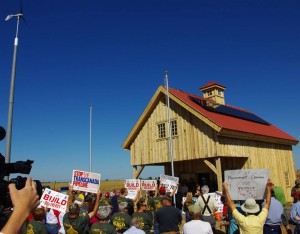
Essentially, TURF is miffed that a coalition including Nebraska ranchers and farmers, the Nebraska Farmer’s Union, Bold Nebraska, 350.org, Sierra Club, Credo, and billionaire Tom Steyer are protesting the impending construction of the controversial Keystone XL Pipeline by constructing a wind- and solar- powered barn in its projected pathway.

Granted there are many criticisms one could make of this action, such as the fact that a great many of these folks are capitalists or enablers of capitalists, the fact that Keystone XL is not the only pipeline we need to worry about, or the obvious fact that Keystone could simply build the pipeline somewhere else (there are enough rural counties sufficiently beholden to corporate fossil fuel interests to ram through the permits barn or no barn), but in spite of these shortcomings, there are lot of good things that could be said about the project as well, including—in my opinion at least—the advocacy of renewable energy, such as wind and solar which could allow a state such as Nebraska which has a fairly good abundance of both to potentially generate all of its own electricity and perhaps even export a bit.

No doubt doing so would lessen that state’s reliance on fossil fuels, and though some of those are extracted and refined locally, the impact of those on the environment effects us globally in ways that greatly outweigh any significant impact from wind and solar. Certainly that would seem to fit the mission of Root Force would it not? Evidently the answer is a resounding “no”. Root Force is overwhelmingly opposed to renewable energy arguing that it simply props up the existing system and perpetuates the destruction of the Earth (and to be certain, the Earth First! Journal published Root Force's position paper on renewables in February 2009).

Revolutionary Ecology, Biocentrism, and Deep Ecology

By Judi Bari - 1995 | [PDF File Available]

I was a social justice activist for many years before I ever heard of Earth First!. So it came as a surprise to me, when I joined Earth First! in the 1980s, to find that the radical environmental movement paid little attention to the social causes of ecological destruction. Similarly, the urban-based social justice movement seems to have a hard time admitting the importance of biological issues, often dismissing all but "environmental racism" as trivial. Yet in order to effectively respond to the crises of today, I believe we must merge these two issues.

Starting from the very reasonable, but unfortunately revolutionary concept that social practices which threaten the continuation of life on Earth must be changed, we need a theory of revolutionary ecology that will encompass social and biological issues, class struggle, and a recognition of the role of global corporate capitalism in the oppression of peoples and the destruction of nature.

I believe we already have such a theory. It's called deep ecology, and it is the core belief of the radical environmental movement. The problem is that, in the early stages of this debate, deep ecology was falsely associated with such right wing notions as sealing the borders, applauding AIDS as a population control mechanism, and encouraging Ethiopians to starve. This sent the social ecologists justifiably scurrying to disassociate. And I believe it has muddied the waters of our movement's attempt to define itself behind a common philosophy.

So in this article, I will try to explain, from my perspective as an unabashed leftist, why I think deep ecology is a revolutionary world view. I am not trying to proclaim that my ideas are Absolute Truth, or even that they represent a finished thought process in my own mind. These are just some ideas I have on the subject, and I hope that by airing them, it will spark more debate and advance the discussion.

The Feminization of Earth First!

By Judi Bari - Ms Magazine, May 1992

It is impossible to live in the redwood region of Northern California without being profoundly affected by the destruction of this once magnificent ecosystem. Miles and miles of clearcuts cover our bleeding hillsides. Ancient forests are being strip-logged to pay off corporate junk bonds. And bee-lines of log trucks fill our roads, heading to the sawmills with loads ranging from 1,000-year old redwoods, one tree trunk filling an entire logging truck, to six-inch diameter baby trees that are chipped for pulp. Less than 5% of the old growth redwood is left, and the ecosystem is disappearing even faster than the more widely known tropical rainforest.

So it is not surprising that I, a lifetime activist, would become an environmentalist. What is surprising is that I, a feminist, single mother and blue-collar worker, would end up in Earth First!, a “no compromise” direct action group with the reputation of being macho, beer-drinking eco-dudes. Little did I know that by combining the more feminine elements of collectivism and non-violence with the spunk and outrageousness of Earth First!, we would spark a mass movement. And little did I know that I would pay for our success by being bombed and nearly killed, and subjected to a campaign of hatred and misogyny.

I was attracted to Earth First! because they were the only ones willing to put their bodies in front of the bulldozers and chainsaws to save the trees. They were also funny, irreverent, and they played music. But it was the philosophy of Earth First! that ultimately won me over. This philosophy, known as biocentrism or deep ecology, states that the Earth is not just here for human consumption. All species have a right to exist for their own sake, and humans must learn to live in balance with the needs of nature, instead of trying to mold nature to fit the wants of humans.

I see no contradiction between deep ecology and eco-feminism. But Earth First! was founded by five men, and its principle spokespeople have all been male. As in all such groups, there have always been competent women doing the real work behind the scenes. But they have been virtually invisible behind the public Earth First! persona of “big man goes into big wilderness to save big trees.” I certainly objected to this. Yet despite the image, the structure of Earth First! was decentralized and non-hierarchical, so we had the leeway to develop any way we wanted in our local Northern California group.

Earth First! came on the scene in redwood country around 1986, when corporate raider Charles Hurwitz of Maxxam took over a local lumber company, then nearly tripled the cut of old growth redwood to pay off his junk bonds. Earth First! had been protesting around public land issues in other parts of the West since 1981, but this was such an outrage that it brought the group to its first “private” lands campaign.

Earth First! The Underbelly Exposed

By Chris Shillock - Libertarian Labor Review (Anarcho Syndicalist Review) #6, Winter 1989

Several years ago the activist community was fired by news of a group of militant ecologists who called themselves Earth First!. Anarchists particularly felt a kinship. Earth First!’s uncompromising defense of the environment and their rejection of government stewardship of the wilderness echoed our own experience of the futility of working within the system. Their use of direct action was taken from our own history. Their full-blooded all-out enthusiasm for nature promised a robust, holistic radicalism.

Lately, as people learned more about the group, some truly disturbing facets of Earth First!’s ideology have come to light. By now it is clear that not only is Earth First! hostile to any meaningful social analysis, but it is freighted with so much nationalist and racist baggage as to make them obnoxious to any worker.

Earth First!’s philosophy, also known as Deep Ecology, is set out in a book of that name by Bill Devall and George Sessions (Peregrine Smith, Salt Lake City, 1985). It borrows from Zen Buddhism, Native American religions and from Heidegger, but is based on an immediate intuition of the “wilderness experience.” They urge us to go into the woods, to just feel. The result will be that feeling of the oneness of all creation which we have probably all known when we find ourselves alone under the stars.

Deep Ecologists go on to reason that “The well-being and flourishing of human and nonhuman Life on Earth have value in themselves…These values are independent of the usefulness of the non-human world for human purposes.” Deep Ecologists condemn other social and scientific views as “anthropocentric” in contrast to their “biocentric” outlook. This epithet is hurled throughout the pages of their journal, Earth First!, to clinch a point or to dismiss opponents.

So far, okay, aside from a few quibbles in logic. Earth First! has the potential to be a noble and passionate worldview. Instead their concept of “biocentric egalitarianism” turns the corner into a Malthusian blind alley shadowed with dark visions of a vengeful Earth lashing back at the species that uses her. Malthusianism has always been a pseudoscience serving the need of right wing ideology. In the Nineteenth Century, Social Darwinists used Malthus’ simplistic predictions of a dwindling food supply to justify doing nothing to alleviate the misery of the poor. Variations of this philosophy have been used in the Twentieth Century to buttress everything from eugenics to Third World starvation.

Pages

The Fine Print I:

Disclaimer: The views expressed on this site are not the official position of the IWW (or even the IWW’s EUC) unless otherwise indicated and do not necessarily represent the views of anyone but the author’s, nor should it be assumed that any of these authors automatically support the IWW or endorse any of its positions.

Further: the inclusion of a link on our site (other than the link to the main IWW site) does not imply endorsement by or an alliance with the IWW. These sites have been chosen by our members due to their perceived relevance to the IWW EUC and are included here for informational purposes only. If you have any suggestions or comments on any of the links included (or not included) above, please contact us.

The Fine Print II:

Fair Use Notice: The material on this site is provided for educational and informational purposes. It may contain copyrighted material the use of which has not always been specifically authorized by the copyright owner. It is being made available in an effort to advance the understanding of scientific, environmental, economic, social justice and human rights issues etc.

It is believed that this constitutes a 'fair use' of any such copyrighted material as provided for in section 107 of the US Copyright Law. In accordance with Title 17 U.S.C. Section 107, the material on this site is distributed without profit to those who have an interest in using the included information for research and educational purposes. If you wish to use copyrighted material from this site for purposes of your own that go beyond 'fair use', you must obtain permission from the copyright owner. The information on this site does not constitute legal or technical advice.


