







 American Capitalism in Decline
On December 30, 1917 Seymour Melman was born in New York City. The 100th anniversary of his birth helps bring his intellectual legacy into focus. Melman was the most significant reconstructionist thinker of the 20th Century, championing alternatives to militarism, capitalism, and social decay by advancing a systematic counter-planning program for disarmament and economic democracy. His legacy remains of critical importance because today the United States is currently a society in which the economic, political and cultural systems are spiraling into an abyss. Economic and social reconstruction is the idea that planned alternatives to the incumbent mechanisms for organizing economic, political and cultural power exist in alternative institutional designs and matching systems to extend these designs.
The economic realities are well-known, defined by an economic system in which the richest 1% of the population controlled 38.6% of the nation’s wealth in 2016 according to the Federal Reserve. The bottom 90% controlled only 22.8% of the wealth. This wealth concentration is well-known and is linked to financialization of the U.S. economy which is matched by deindustrialization and the decline of the “real economy.” Melman analyzed this problem tied to Wall Street hegemony and managerial attacks on worker’s power in his classic 1983 study Profits without Production. Here Melman illustrated how profits –and thus power—could be accumulated despite the decline of industrial work and manufacturing. In fact, the rise in administrative overheads associated with the over-extension of managerial power actually helped reduce both the competiveness and competence of U.S. firms.
In politics, the Republican Party has emerged as a Trojan Horse society, helping to defund the welfare state and advancing the aims of the predatory warfare state. The 2018 defense bill signed by President Trump allotted about $634 billion for core Pentagon operations and allotted an addition $66 billion for military operations in Afghanistan, Iraq, Syria and elsewhere. More money was available for troops, jet fighters, ships and other weapons, even though there are millions of U.S. citizens living in poverty (40.6 million in 2016). Melman addressed the problem of the enduring post-war militarism of the U.S. in perhaps his most famous book, The Permanent War Economy, first published in 1974. The subheading of that book was “American Capitalism in Decline.” This economy emerged as way to consolidate the military largess bestowed on aerospace, communications, electronics and other war-serving industries, not to mention universities, military bases and associated institutions serving the military economy. This corporatist system, linking the state, corporations, trade unions and other actors was described by Melman in Pentagon Capitalism: The Political Economy of War, a 1971 book which showed how the state was the top manager who used its procurement and managerial power to direct these various “sub-managements.”
In culture, we see the reign of post-truth politics, in which politicians knowingly lie in order to advance political objectives and ideology makes facts irrelevant. A report by David Leonhardt and colleagues in The New York Times found that “in his first 10 months, Trump told nearly six times as many falsehoods as Obama did during his entire presidency.” The problem, however, is that the underlying system of U.S. governance has been based on many bipartisan myths. Melman’s career was based on trying to uncover such myths.
One such myth embraced by both the Republican and Democratic Parties was the idea that military power can be used without any limits. In Vietnam, Iraq and Afghanistan, the U.S. tried to defeat guerilla operations in which the opposing military was embedded in civilian zones. Attacking such areas deflated the U.S. military’s legitimacy with the projection of military power undermining U.S. political power in the region being attacked. In Vietnam, the U.S. lost politically and a backlash against that war triggered a domestic revolt. In Iraq, the toppling of Hussein pushed Iraq into the Iranian orbit, a country which is nominally a principal adversary of U.S. elites. In Afghanistan, the U.S. continues to fight its longest war with thousands dead and “no end in sight.” When it comes to terrorism, Melman saw terrorist actions as tied to alienation, individuals cut off and remote from social integration. Clearly social inclusion could remedy such a situation, but economic decline and an absence of solidarity simply compounded terrorist threats (whatever the diverse origins).
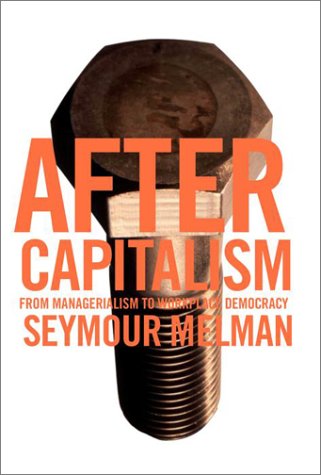
Another key myth was the ability to organize and sustain a “post-industrial society.” A report in Industry Week (August 21, 2014) noted that between 2001 and 2010, the U.S. economy shed 33% of its manufacturing jobs (about 5.8 million), which represented a 42% decline when controlling for the increase in the workforce. After controlling for increased in the working-age population during this period, Germany lost only 11% of its manufacturing jobs. While scholars debate whether trade or automation and productivity is more significant in causing such job loss, automation in a nation state serving to protect the domestic organization of work will clearly preserve more manufacturing jobs than others. In fact, the integration of automation and cooperative workforces can preserve jobs, a point made by Melman in his last great work, After Capitalism: From Managerialism to Workplace Democracy. Melman’s support for the domestic anchoring of jobs through proactive investments in civilian infrastructure including sustainable forms of alternative energy and mass transportation also belied the associated myths of globalization and free markets—both of which failed to automatically yield a proactive welfare state responsive to maintaining full and sustainable employment.
 The critique of energy sits between two fields that condition the present — environmental catastrophe and capitalist crisis. Marx wrote that the past “weighs like a nightmare” on the living.1 With global warming and the interminable crisis of capital, it is not just the past but the future, too, which strikes fear into the human mind. During the ongoing industrialization of the planet under capitalism, fossil fuels have been the dominant source of energy to power economic expansion and political domination.2 The very fabric of today’s climate crisis is knit from the exhaust of intensive and extensive waves of capital accumulation. Typically framed as a consequence of bad consumer habits, the environmental problem of energy is and always has been deeply bound to the material origins of the commodity form — what it takes to make a thing and what it takes to move it.
 How can ecosocialism respond to the operation of power in capitalist accumulation and reproduction? Does ecosocialism help provide answers to struggles taking place in the local state and in sites of contest?
 Unlike other ecosocialists, I have long argued that the path to radical social transformation called for the formation of the most inventive social movement the world has ever seen. But as a scholar of
  Review: The Bleeding Edge: why technology turns toxic in an unequal world by Bob Hughes (Oxford: New Internationalist, 2016)
 Aside from the stipulation that nature follows certain laws, no idea was more central to the scientific revolution of the seventeenth century, and to the subsequent development of what came to be known as modern science, than that of the conquest, mastery, and domination of nature. Up until the rise of the ecological movement in the late twentieth century, the conquest of nature was a universal trope, often equated with progress under capitalism (and sometimes socialism). To be sure, the notion, as utilized in science, was a complex one. As Francis Bacon, the idea’s leading early proponent, put it, “nature is only overcome by obeying her.” Only by following nature’s laws, therefore, was it possible to conquer her.
 A Redder Shade of Green: Intersections of Science & Socialism
 This site is not the official webpage of the Industrial Workers of the World.