You are here
News Feeds
When will CA High-Speed Rail road construction end in Fresno? Here’s the timeline
Despite Ceasefires, Israel Continues the “Gaza-ification” of Lebanon w/ Journalist Hanady Salman
Tren Platform Digital dengan Deposit Kecil yang Banyak Diminati
Judi Online Deposit Kecil Terpercaya Dicari karena Akses Lebih Terjangkau
Judi online deposit kecil terpercaya menjadi topik yang sering dicari karena banyak pengguna menginginkan akses yang lebih terjangkau. Dengan nominal yang relatif rendah, pengguna dapat mencoba layanan tanpa harus mengeluarkan biaya besar. Oleh karena itu, tren ini terus berkembang di berbagai platform digital.
Judi Online Deposit Kecil Terpercaya Dipengaruhi Kemudahan Transaksi Digital
Kemajuan teknologi pembayaran digital turut mendorong pertumbuhan judi online deposit kecil terpercaya. Dompet digital dan transfer instan memungkinkan transaksi berlangsung dengan cepat dan efisien. Dengan demikian, pengguna semakin mudah mengakses layanan tanpa proses yang rumit.
Judi Online Deposit Kecil Terpercaya Harus Diperhatikan dari Segi Keamanan
Di sisi lain, keamanan tetap menjadi perhatian utama dalam memilih judi online deposit kecil terpercaya. Tidak semua layanan memiliki sistem perlindungan yang baik. Oleh sebab itu, pengguna perlu memastikan platform memiliki reputasi yang jelas dan sistem keamanan yang memadai.
Judi Online Deposit Kecil Terpercaya Berkaitan dengan Risiko dan Regulasi
Selain kemudahan, terdapat risiko yang perlu diperhatikan dalam judi online deposit kecil terpercaya. Regulasi di berbagai wilayah sering membatasi aktivitas tersebut. Oleh karena itu, pemahaman terhadap aturan yang berlaku menjadi hal penting sebelum terlibat lebih jauh.
Judi Online Deposit Kecil Terpercaya Membutuhkan Kontrol dan Kesadaran Pengguna
Pada akhirnya, kontrol diri menjadi faktor kunci dalam menggunakan layanan judi online deposit kecil terpercaya. Pengguna perlu mengatur anggaran dan menghindari keputusan impulsif. Dengan pendekatan yang rasional, risiko kerugian dapat ditekan seminimal mungkin.
SUWA Statement on Passage of Legislation Attacking Boundary Waters Canoe Area Wilderness Using the CRA – 4.16.26
April 16, 2026 – FOR IMMEDIATE RELEASE
SUWA Statement on Passage of Legislation Attacking Boundary Waters Canoe Area Wilderness using the Congressional Review Act (CRA) – 4.16.26 Threat remains to Grand Staircase-Escalante National MonumentContacts:
Grant Stevens, Communications Director, Southern Utah Wilderness Alliance (SUWA); (319) 427-0260; grant@suwa.org
Washington, DC – Today, the U.S. Senate voted 50-49, passing H.J. Res. 140, which overturns the 20-year mining ban in the headwaters of the Boundary Waters Canoe Area Wilderness in Northern Minnesota, the most visited wilderness area in America. Another iconic landscape – Grand Staircase-Escalante National Monument in Southern Utah – faces a similar threat (undoing of the Monument Management Plan) using the same nefarious legislative tool: the Congressional Review Act (CRA). Below is a statement from SUWA Executive Director Scott Braden:
“Today is a tragic day for the Boundary Waters and all who care about stewarding public lands and wilderness. Using the Congressional Review Act to undo protections is a short-sighted mistake – whether it’s the Boundary Waters or Grand Staircase-Escalante National Monument,” said Scott Braden, Executive Director of the Southern Utah Wilderness Alliance (SUWA). “Congress should stop attacking cherished public lands.”
Additional information re: H.J. Res 140 and the Boundary Waters Canoe Area Wilderness can be found here. There is widespread and growing opposition to this outrageous use of the Congressional Review Act (CRA) to attack Grand Staircase-Escalante National Monument. A compilation can be found here.
About Grand Staircase-Escalante National Monument & the Monument Management Plan
Since its establishment, heightened protections for the Monument’s geology, paleontology, wildlife, plant communities, and ancestral sites have succeeded in preserving these unique values for generations to come, and local communities on the Monument’s doorstep have benefited as well. Nearly 30 years later, the numerous benefits of protecting Grand Staircase-Escalante are clear: the Monument preserves a remarkable ecosystem at the landscape level and sets the stage for future discovery about human, paleontological, and geological history on the Colorado Plateau.
On December 4, 2017, President Trump ignored millions of public comments and unlawfully eliminated large swaths of the Monument, slashing it by 47 percent – roughly 900,000 acres. Thankfully, on October 8, 2021, President Biden signed a proclamation restoring Grand Staircase-Escalante National Monument to its full, original boundaries. In 2023, BLM began developing a new management plan for the full Monument. As a part of that work, the BLM engaged in extensive outreach to Tribal Nations, the State of Utah, local governments, stakeholders (including outfitters and guides, ranchers, local utilities), and the public. During the planning process, BLM received overwhelming support from throughout Utah and the nation for a holistic, conservation-based management plan worthy of this remarkable place.
In August 2023, a Federal District Court Judge in Utah dismissed lawsuits brought by the state of Utah and others challenging President Biden’s use of the Antiquities Act to restore the boundaries of Grand Staircase-Escalante and Bears Ears National Monuments. The state and other plaintiffs quickly appealed that decision to the Tenth Circuit Court of Appeals, which held oral argument on September 26, 2024, and may issue a decision at any time. Conservation organizations intervened on behalf of the United States to defend President Biden’s restoration of the Monuments, as have four Tribal nations.
National monuments are overwhelmingly popular. Seventy-five percent of Utah voters support the President’s ability to protect public lands as national monuments. Three in four Utah voters, including a majority of Republicans, want to keep Grand Staircase-Escalante as a national monument.
About the Congressional Review Act (CRA)
The CRA is a federal statute enacted in March 1996 that requires federal agencies to submit “rules” to Congress for a mandatory review period “before they may take effect.” If Congress votes to overturn, or “disapprove,” the rule, it “may not be reissued in substantially the same form. . . .” The BLM has long maintained that its land management plans are not “rules” subject to the CRA. Other federal land management agencies, including the U.S. Forest Service and National Park Service, have similarly not submitted their land management plans to Congress under the CRA.
However, emboldened by a series of non-binding Government Accountability Office (GAO) opinions, Republican members of Congress have embraced the novel theory that federal land management plans are in fact “rules” subject to the CRA. This year, Congress has passed six CRA resolutions overturning previously finalized land management plans or other types of public lands management decisions. The GAO issued an opinion regarding the Grand Staircase-Escalante Monument Management Plan on January 15, 2026.
- While overturning the Grand Staircase-Escalante Monument management plan would not change the boundaries of the monument or alter President Biden’s proclamation establishing the monument, it is a serious threat with potential implications for all national monuments.
- Monument management plans set expectations for how the land will be managed for wildlife, outdoor access, dark night skies, grazing, and other uses. The Utah delegation’s gambit threatens that certainty. Using the CRA to overturn the Grand Staircase-Escalante management plan disregards years of public input on how these lands are managed for the public, including hunters, hikers, scientists, ranchers, and others who hold permits to use public lands inside the monument.
- Congress is ignoring Tribal Nations. Multiple Native American Tribes are connected to Grand Staircase-Escalante National Monument. The Grand Staircase-Escalante Inter-Tribal Coalition advocates for the conservation of their ancestral lands and for the continued protection and preservation of the cultural and environmental resources found within the monument. Tribes provide deeply valuable perspectives related to the management of Monument lands and cultural resources that tell the story of their peoples, and are integral to the history of the United States, and should be consulted before any changes are made to the Monument’s management plan.
Additional Information
- March 4, 2026 Press Release – Senator Lee, Rep. Maloy Introduce Joint Resolution to Undo Grand Staircase-Escalante National Monument Management Plan
- February 26, 2026 Press Release – Senator Lee formally begins process to fast-track the destruction of Grand Staircase-Escalante National Monument in Utah
- The Grand Staircase-Escalante National Monument Inter-tribal Coalition who have spoken against using the CRA on the Monument Management Plan
- Additional quotes can be found here.
###
The Southern Utah Wilderness Alliance (SUWA) is a nonprofit organization with members and supporters from around the country dedicated to protecting America’s redrock wilderness. From offices in Moab, Salt Lake City, and Washington, DC, our team of professionals defends the redrock, organizes support for America’s Red Rock Wilderness Act, and stewards a world-renowned landscape. Learn more at www.suwa.org
The post SUWA Statement on Passage of Legislation Attacking Boundary Waters Canoe Area Wilderness Using the CRA – 4.16.26 appeared first on Southern Utah Wilderness Alliance.
Radical Visions Reconnecting Academia and Nature: A Community Truth, Reckoning and Right Relationship
We invite you to watch this short “teaser” video of "Radical Visions Reconnecting Academia and Nature: A Community Truth, Reckoning and Right Relationship" from a two-day event in March 2026.
The post Radical Visions Reconnecting Academia and Nature: A Community Truth, Reckoning and Right Relationship appeared first on CELDF - Community Rights Pioneers - Protecting Nature and Communities.
UNPFII Side Event
ICYMI: Experts warn faster snowmelt could strain water supplies, urgency for storage solutions
California’s snowpack is melting faster and earlier than usual, driven by a recent heat wave and the long-term impacts of climate change.
The concern comes at a critical moment, as the state works to finalize the new environmental plan for the Sacramento-San Joaquin Delta and San Francisco Bay. With extreme weather becoming more common, experts say that maintaining adequate water flows is essential to protect key species, ecosystems, and the communities that rely on these resources.
Morgen Snyder, Director of Policy and Programs at Restore the Delta, told ABC 7 that salmon, white sturgeon, and delta smelt are among the growing number of endangered species in the Delta. She emphasized the need for consistent, cold flows to support them. “Cold storage is going to be important to determine how we can adequately ensure flows to the system,” Snyder said. “And that is the really tricky part with this faster-than-usual snowmelt.”
Read more from ABC 7 here or watch the full story starting at minute 33:30 here.
###
Suggested Reading: Tales From the Inner City
"Tales from the Inner City" by Shaun Tan is a collection of incredibly original stories, rich with feeling, strangely moving, almost numinous.
The post Suggested Reading: Tales From the Inner City appeared first on CELDF - Community Rights Pioneers - Protecting Nature and Communities.
This bill would open the door to thousands of wolves being slaughtered
GAIA URGES PETROCHEMICAL PHASE DOWN AS ESSENTIAL CLIMATE SOLUTION AT SANTA MARTA CONFERENCE
FOR IMMEDIATE RELEASE: April 15, 2026
New York, NY– Representatives from the Global Alliance for Incinerator Alternatives (GAIA) will be on-the-ground at the upcoming First International Conference for Transitioning Away from Fossil Fuels 28–29 April 2026 in Santa Marta, Colombia, as well as the related Global Science and Policy Conference on Transitioning Away from Fossil Fuels (April 24-25).
The conference, co-organized by Colombia and The Netherlands, aims to bring together countries that recognize the need for climate action to discuss pathways for a fossil fuel phase down. This is the first of a series of conferences that will develop a roadmap for this phase down.
GAIA and the Center for International Environmental Law (CIEL) are co-convening a group of experts to develop recommendations for the phase down of petrochemicals as part of the roadmap, to inform government discussions at the conference.
When developing strategies for a fossil fuel phase down, countries at Santa Marta cannot let petrochemicals fly under the radar. Petrochemicals are created from fossil fuels, and, and the IEA projects that the chemicals sector will increase energy demand by 2035 by more than any other industrial sector. Plastics alone are on track to take up a third of the global carbon budget by 2050. Without setting a target phase down for the petrochemical industry, world leaders will fatally undermine their own progress in reducing fossil fuel extraction and use.
The wars in the Middle East have also exposed the fragility of the fossil fuel/petrochemical supply chain prone to escalating conflicts, showing once again that relying on these industries is a risky business.
The development of this conference also signals that a critical mass of countries are willing to find common ground outside of the dysfunctional climate negotiations space. This could provide lessons for other multinational policy fora– particularly the plastics treaty talks, which have fallen prone to the same strategies that have stymied the climate talks, namely a small handful of fossil fuel-producing countries blocking meaningful action.
GAIA’s policy experts, (Ana Rocha, Global Plastics Policy Director and Dr. Neil Tangri, Science and Policy Director) will be at the conference, and are available for comment on this topic in the lead-up as well as during and after the proceedings.
Press contacts:
Claire Arkin, Global Communications Lead
claire@no-burn.org | +1 973 444 4869
###
GAIA is a worldwide alliance of more than 1,000 grassroots groups, non-governmental organizations, and individuals in over 100 countries. With our work we aim to catalyze a global shift towards environmental justice by strengthening grassroots social movements that advance solutions to waste and pollution. We envision a just, zero waste world built on respect for ecological limits and community rights, where people are free from the burden of toxic pollution, and resources are sustainably conserved, not burned or dumped.
The post GAIA URGES PETROCHEMICAL PHASE DOWN AS ESSENTIAL CLIMATE SOLUTION AT SANTA MARTA CONFERENCE first appeared on GAIA.
Comment les socialistes peuvent aider à bâtir un mouvement anti-guerre
Les années 2020 ont été marquées par une montée spectaculaire des conflits armés à travers le monde : le génocide à Gaza, l’invasion en cours...
The post Comment les socialistes peuvent aider à bâtir un mouvement anti-guerre first appeared on Spring.
They Profit, We Pay. It’s Time to Fix It.
As world leaders gather in Washington this week (April 13–18) for the IMF and World Bank Spring Meetings to discuss debt and economies, a global coalition of 130+ organisations has a clear message for them: the system is failing ordinary people and it needs to change now.
While people in Iran, Lebanon, and across the region are being killed, while families struggle to heat their homes and put food on the table, fossil fuel companies and arms corporations are posting record profits. This is a system working exactly as designed. For them, not for us.
From Bangladesh to Brazil, Zimbabwe to Japan, we are all watching the same thing unfold and but we’re also letting our representatives know through an open letter: enough is enough.
We stand unwavering in our demandsIn just one month of war, over $100 billion was extracted from ordinary people through soaring energy prices. That same money could have powered 150 million homes with renewable energy. Instead, it padded the wallets of fossil fuel executives and weapons manufacturers.
The letter calls for four urgent actions:
- a complete and permanent end to the war
- windfall taxes on the corporations cashing in on the crisis
- investment in food security and homegrown renewable energy
- and cancellation of the crushing debt that leaves Global South countries with nothing left to protect their own people.
Ceasefires are not enough. Temporary pauses don’t rebuild homes, bring back the dead, or lower energy bills. The war must end and those who profited from it must be made to pay. Learn more here.
Why this moment mattersThis represents a genuinely global movement. From trade unions to climate groups, from faith organizations to youth activists — the breadth of voices shows this is not a fringe position. It is the growing consensus of people worldwide who are tired of paying the price for a crisis they didn’t cause.
The connection between war, fossil fuels, debt, and inequality is not abstract. It shows up in your energy bill. In the price of bread. In the public services disappearing around you.
What you can do right nowSimple: share this letter.
Post it on Facebook. Send it on WhatsApp. Put it on Bluesky. The more people who see these demands, the harder they become for governments to ignore. Every share builds the pressure.
This war is their business. Our pain. Our movement.
Share now and help make these demands impossible to ignore.
Share on Facebook
Share on WhatsApp
The post They Profit, We Pay. It’s Time to Fix It. appeared first on 350.
Red Rosa’s “Reform or Revolution”
“What do you mean ‘or’ revolution? Surely we want to have both?” The Spring Toronto West branch book club just finished reading Rosa Luxemburg’s Reform...
The post Red Rosa’s “Reform or Revolution” first appeared on Spring.
Expression of Interest: Social Media Consultancy for AFSA Campaigns & Podcast
The Alliance for Food Sovereignty in Africa (AFSA) is inviting expressions of interest from qualified, Africa-based firms to provide social media consultancy services for a period of 12 months, renewable based on performance.
AFSA is Africa’s largest civil society network, uniting 48 member organisations across 50 countries and advancing agroecology and food sovereignty for over 200 million people across the continent. As we scale our digital presence, we are seeking a creative, experienced, and mission-aligned social media partner to help amplify our work.
The consultancy covers two key areas. The first is the promotion and digital campaign management of AFSA’s four major Pan-African flagship campaigns — My Food Is African, Agroecology4Climate Action, Seed Is Life, and Defend Our Land, Restore Our Soil. The selected firm will be expected to develop campaign strategies, produce short-form videos, design visual assets, manage content across platforms, and deliver regular performance reports.
The second area covers the production and promotion of AFSA’s newly launched podcast, The Battle for African Agriculture, hosted by AFSA General Coordinator Dr. Million Belay. The consultancy will manage end-to-end weekly episode recording, professional audio and video editing, multi-platform promotion across YouTube, Spotify, Apple Podcasts, Facebook, Instagram, LinkedIn, and TikTok, as well as audience growth and analytics reporting.
Interested firms are required to submit a company profile, portfolio evidence of previous campaigns and podcast production experience, team and influencer profiles, a pilot social media plan, and a detailed budget proposal.
Proposals must be submitted to afsa@afsafrica.org by 27 April 2026 at 23:59 East Africa Time, with the subject line: EOI – Social Media Consultancy for AFSA Campaigns & Podcast. For technical inquiries, please contact kirubel.tadele@afsafrica.org.
For full details on the scope of work, submission requirements, and evaluation criteria, please refer to the Terms of Reference (TOR) attached.
Download the TOR Télécharger les Termes de RéférenceTransitioning to Organic: Lessons from TendWell Farm
Getting your farm certified as USDA Organic takes time, investment, and careful planning — but can bring big payoffs for your farm. Danielle Hutchinson of TendWell Farms, the largest organic farm in Western NC, shares some lessons learned about organic certification.
The post Transitioning to Organic: Lessons from TendWell Farm appeared first on RAFI.
Out of Pocket: the real cost of fossil fuels on our water
This is a guest blog by Lucia Simmons, Marketing & Communications Lead at the Carbon Literacy Project. The Carbon Literacy Project is an UN-recognised global initiative, delivered by UK charity The Carbon Literacy Trust, providing a day’s worth of accredited climate action training and certification. Over 155,000 people and 14,000 organisations across 47 nations are certified Carbon Literate. Find out more at www.carbonliteracy.com.
Imagine waking up to find no water running from your taps. No water to drink. To flush the toilet. Wash your clothes. Your body. Your plates. That was the reality for Zofia, and thousands of other local home and business owners in the South of England in January this year, with no warning from the water company over supply failures.
Water is part of our daily lives. We drink it, cook with it, clean with it, and grow food with it. We expect it to be there when we need it with a twist of a tap. Unfortunately, that won’t be our reality forever if we continue as we are. For many, it already isn’t.
A UN report released at the start of this year declared that we’re now living in an era of ‘global water bankruptcy’. What does this mean?
Around the world, reservoirs and lakes are shrinking, floods and droughts are intensifying, and water supply is becoming less reliable. This isn’t random. Our burning of fossil fuels is heating the planet and disrupting the systems that keep water flowing. We are already paying the price.
How are water supply and fossil fuels connected?Water systems depend on a naturally balanced cycle of evaporation, rainfall, and replenishment, and global heating driven by burning fossil fuels is breaking that delicate balance.
Burning fossil fuels releases greenhouse gas emissions, which in turn increase global temperatures. Hotter air pulls more moisture from land and water. This speeds up evaporation and dries out rivers, lakes, and reservoirs.
Rainfall also becomes less predictable as the planet heats. Some places face longer droughts. Others see heavier downpours that overwhelm drains and flood homes, roads and green spaces. The same community can face both within a year. Nearly 1 in 4 people experienced drought conditions between 2022 and 2023 alone. The number of people exposed to floods around the world has risen by 25% from 1970 to 2020.
Low water levels in Woodhead Reservoir, Derbyshire, England, in June 2025, following the driest spring in England since 1893. Image credit: Alastair Johnstone-Hack / Climate Visuals
Rising global temperatures are melting glaciers and increasing flood risks in the short term. Around 2 billion people rely on water from mountains and glaciers for drinking water, farming, and energy generation. As glaciers shrink and disappear, so does their water supply. Communities from the Himalayas in Asia to the Andes in South America are already living with severe water shortages.
Fossil fuel extraction also directly harms the local water. Mining and drilling pollute rivers and groundwater, leaving local communities without safe water and forcing costly treatment or replacement.
Who pays the price for water losses?When water supply becomes less reliable, everyday costs rise for all of us. Here are just a few ways how:
- Household bills creep up: Water companies have to do more, already energy-intensive work to treat and supply water, as climate change disrupts water sources. But, to preserve profits, they pass on those costs to consumers, showing up in our household bills. In New Orleans, US, water bills now average $115 a month, more than twice that of comparable Southern cities. This is partly because ageing infrastructure must treat drinking water from the Mississippi River for pollutants and saltwater intrusion linked to sea level rise.
- Food gets more expensive: When drought reduces crop yields, food prices increase. Intense drought in Southern Europe from 2022 to 2023 severely reduced olive production, causing a 50% price increase in olive oil across the EU from January 2023 to January 2024. Agriculture uses around 70% of global water, so any disruption hits food systems quickly.
- Energy becomes less stable — and pricier: Water is needed to cool power plants and data servers. Power plant cooling is responsible for 43% of total freshwater withdrawals in Europe and nearly 50% in the USA. When water levels fall, energy supply becomes less stable and more expensive. Heatwaves in 2022 forced French Energy supplier EDF to reduce power output as high water temperatures and low river levels threatened cooling systems. The projected water and electricity demand from the many new AI data centres being built by big tech firms worldwide will make this even worse.
- Flooding caused by unpredictable rainfall patterns, as well as sea level rise, sends costs spiralling: Homes are damaged. Insurance premiums rise or become unavailable. Taxes are spent on repairs. We are paying for all of this through bills, taxes, and lost income. Initial costs of the devastating floods in Valencia in 2024 were estimated at €31.4 billion.
Extensive flooding submerges agricultural land in Somerset, England. Image credit: Alastair Johnstone-Hack / Climate Visuals
The good news though? People are already aware and taking action.
Across the world, Carbon Literacy training is helping people to understand these connections and take action to reduce these costs.
An international cruise operator has reviewed water use across its fleet and identified ways to reduce consumption by 12% each year, with associated cost savings. At a beach resort in Kenya, staff are working to cut water use per guest by up to 15%. This reduces pressure on local water supplies and lowers operating costs.
In Britain, a ballet company is installing water butts to collect rainwater for green spaces. This reduces reliance on mains water and cuts bills. Meanwhile, a racecourse grounds team is learning how to harvest and store rainwater. This helps manage dry periods and reduces both water costs and emissions linked to mains supply.
It’s not a fair shareNot everyone experiences this crisis in the same way. In wealthier areas, people can adapt more easily. The cost of higher bills might not be crippling; installation costs for new water-saving systems can be fronted.
Lower-income communities don’t have the same options. Around four billion people experience severe water scarcity for at least one month each year. When supplies become unreliable, the impacts are immediate. Crops fail. Jobs are lost. Health risks increase.
Communities in the Global South, which have contributed least to climate change, are facing the highest costs. Many depend directly on natural water systems for farming and daily life. When those systems change, there is little to buffer the impacts.
Water contamination also hits hardest where regulation is weaker. Communities living near extraction sites often face polluted water without the resources to fix it. For example, decades of oil spills and illegal oil leaks by fossil fuel giant Shell have contaminated the primary drinking water sources for the Agore and Bele communities in Nigeria, leading to poison levels 90 times higher than elsewhere in the country. This has rendered water unsafe for consumption and washing, forcing residents to buy water they cannot afford.
Who has the control?Governments continue to support fossil fuels through subsidies and incentives. At the same time, water infrastructure is often underfunded and unprepared for a changing climate. So fossil fuel conglomerates and private water companies keep the profits while communities pay the price.
But we’re not powerless. We can all use our unique roles to drive change. In Wales, after completing Carbon Literacy training, one specialist advisor is requiring water companies to report on expected emissions linked to infrastructure proposals. This helps shift responsibility back to those driving the problem.
Meanwhile, one Carbon Literate project manager is working to clean up water pollution from historic mining sites and bring low-carbon design and carbon management into all construction projects. This not only improves water quality in the short term but also reduces long-term costs for communities.
With more awareness, we can hold those responsible to account, and share knowledge and best practice, so the burden does not fall solely on individual households or businesses.
Action builds resilienceAcross sectors, through Carbon Literacy training action plans, people are building solutions that make water systems more resilient.
Throughout Britain, local authorities that have embedded Carbon Literacy are working to improve drainage and reduce flood risk. Many projects focus on sustainable urban drainage systems (SuDS) that slow water flow and reduce pressure on infrastructure.
The Grey to Green Development in Sheffield, England, is the UK’s largest retrofit sustainable urban draining scheme (SuDs). Planting beds take rain and surface water back into Sheffield’s rivers. Image credit: Alastair Johnstone / Climate Visuals
One Carbon Literate engineer at a local council is designing developments with features like overland flow routes and water recycling systems. These reduce flood risk and make better use of available water.
One county council planning team is mandating that new planning applications include drainage systems that support biodiversity and community wellbeing alongside flood protection.
One district council enterprise team is creating short videos to show how local businesses are reducing operational costs through water-saving strategies, creating models that other businesses can adopt.
Such actions are some practical solutions that protect homes and local businesses, reduce damage costs, and strengthen communities. Born from Carbon Literate people gaining the understanding, motivation and confidence to apply specialist skills they already have.
Scaling up solutionsBut more permanent solutions to protect our water already exist. What is needed is speed, scale and support for those bearing the brunt of the costs.
- The most obvious one is switching to clean, renewable energy that reduces the emissions that are putting water under threat. More stable temperatures mean more predictable water systems. That means lower costs for households, businesses, and governments.
- Ending fossil fuel subsidies would free up resources to invest in water systems that can cope with a changing climate.
- Holding polluters accountable would reduce the financial burden on the public.
We are all paying for fossil fuels through higher bills, damaged homes, and growing uncertainty. But we all have agency and a voice to demand more action from our governments and big corporations. Together, we are harder to ignore than any of us alone.
The post Out of Pocket: the real cost of fossil fuels on our water appeared first on 350.
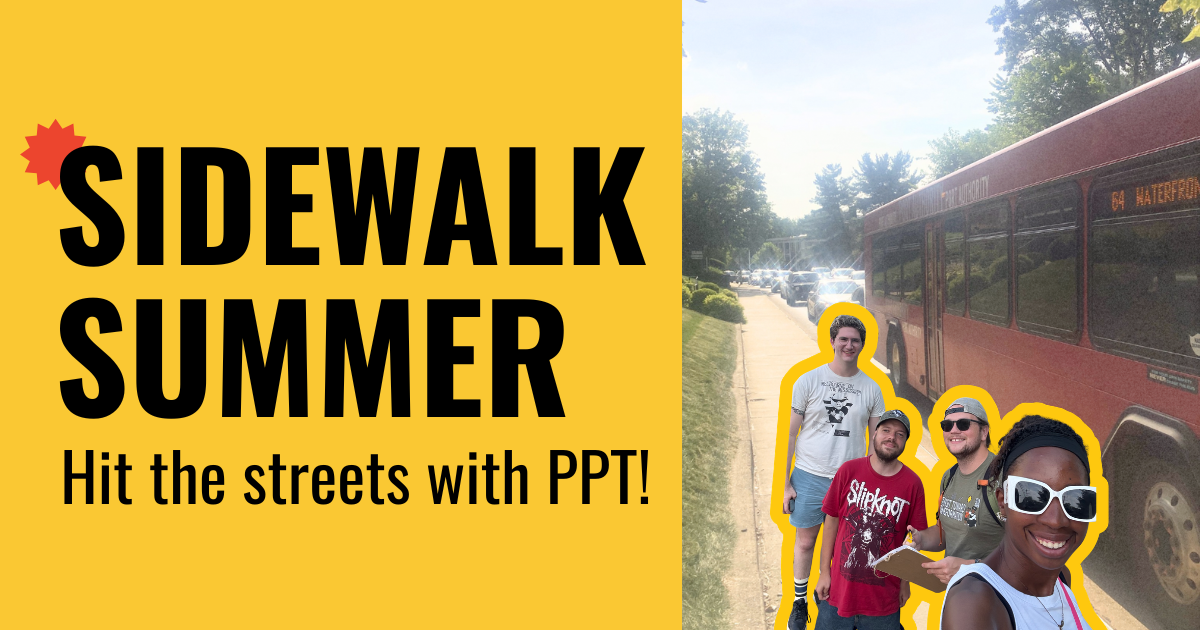
Sidewalk summer is back: hit the streets with PPT for sidewalk audits
Image Description: PPT members highlighted in yellow, on a glowy background of a bus stop on a summer day.
Bust out those cell phones and lace up those sneakers!Transit riders in Pittsburgh want more bus shelters, better bus stop amenities and connected sidewalks that take us to and from where we need to go! Our biggest takeaway from two years of bus shelter audits is that we cannot have bus shelters, benches and other amenities installed at our bus stops if our sidewalks are in poor or nonexistent condition.
Following the lead of our friends Pittsburgh Walks, PPT will host a series of sidewalk audits this spring and summer focusing on neighborhoods with high rider bus stops and busy transit corridors.
We will assess the quality of sidewalks in Pittsburgh and record findings via a mobile survey developed by the City of Pittsburgh. The collected data helps the City identify where sidewalks need to be improved or built, prioritize pedestrian infrastructure projects, and make the case for sidewalk funding.
The goal of these sidewalk audits is for participants to learn how to use this new tool and go on to gather data independently. Ultimately we aim to collect information about sidewalks (or where they’re missing) for every street in the City. This is a group effort and WE NEED YOU!
Audit Dates & Registration:Saturday May 16th 10am – 12pm, Sheraden
Saturday June 27th 10am-12pm, Hazelwood
Saturday August 29th 10am -12pm, Hill District
- Before the event, participants must watch this 15 minute video.
- Have a lesson on what makes sidewalks safe and accessible, how to use the web application.
- Pair up to walk several blocks of neighborhood streets, and record our observations using an online survey on our cell phones.
- Must have charged cell phone that can reach the internet and take photos.
- Must be able to navigate web browsers and privacy settings on cell phone.
- Pittsburgh weather can be unpredictable this time of year! Come dressed for the elements (good walking shoes, winter coats, hats, gloves, etc.). We will be outside for about an hour.
- We cannot guarantee the accessibility or safety of these walks as some of the terrain may have broken to no sidewalks. Some regions may be hilly and harder to walk on.
- Blind and low vision people will not be able to use the mobile survey application, but your input is of great value. You will be paired with a sighted person so that you can access the survey.
- If you have individual accessibility questions, or to request ASL interpretation, please reach out to Nicole@pittsburghforpublictransit.org.
- ASL interpretation must be requested at least 2 weeks in advance.
You can attend on your own, or bring a group of neighbors, friends, family, or coworkers! This is a great way to get your steps in, meet fellow community members, and help make our streets safe, accessible, and enjoyable for everyone!
The post Sidewalk summer is back: hit the streets with PPT for sidewalk audits appeared first on Pittsburghers for Public Transit.
AFSA Newsletter | January – March, 2026
This first quarter 2026 edition of the AFSA Newsletter captures a period of intense reflection, sharpened advocacy, and strategic action across Africa and beyond. From Lilongwe to Dakar, Garuga to Cartagena, AFSA and its members engaged critical questions shaping the future of African food systems, including school meals, land justice, seed sovereignty, public agricultural finance, cross border agroecological trade, territorial markets, and citizen mobilisation. Across these interventions, one message stands out clearly: the struggle for food sovereignty is not only about production, but also about power, policy, markets, culture, and the right of African people to define their own food futures.
In these pages, readers will see how AFSA continued to link grassroots realities with continental and global advocacy. This edition highlights the adoption of the Lilongwe Declaration on agroecology based school and college meals, AFSA’s participation in ICARRD+20 in Colombia, the launch of a major report on the African Development Bank’s role in reshaping African agriculture, renewed calls to centre farmers in regional seed policy processes, and important internal moments of alignment through the AFSA staff retreat, the Citizens Working Group on Agroecology meeting, and the TAFS annual review workshop. It also documents growing momentum in public campaigns and movement spaces, including the #MyFoodMyIdentity online campaign and continued efforts to strengthen agroecological trade, territorial markets, and African food cultures.
What this edition reflects most of all is AFSA’s continued commitment to building a food systems movement rooted in justice, resilience, dignity, and African knowledge. Whether confronting corporate capture, defending land and seed rights, supporting local markets, or reshaping public narratives around food, AFSA’s work remains anchored in the conviction that Africa’s food future must be led by its farmers, communities, women, youth, and social movements. We invite you to read, reflect, and continue walking with us as we strengthen the movement for agroecology and food sovereignty across the continent.
Download the newsletter herePages
The Fine Print I:
Disclaimer: The views expressed on this site are not the official position of the IWW (or even the IWW’s EUC) unless otherwise indicated and do not necessarily represent the views of anyone but the author’s, nor should it be assumed that any of these authors automatically support the IWW or endorse any of its positions.
Further: the inclusion of a link on our site (other than the link to the main IWW site) does not imply endorsement by or an alliance with the IWW. These sites have been chosen by our members due to their perceived relevance to the IWW EUC and are included here for informational purposes only. If you have any suggestions or comments on any of the links included (or not included) above, please contact us.
The Fine Print II:
Fair Use Notice: The material on this site is provided for educational and informational purposes. It may contain copyrighted material the use of which has not always been specifically authorized by the copyright owner. It is being made available in an effort to advance the understanding of scientific, environmental, economic, social justice and human rights issues etc.
It is believed that this constitutes a 'fair use' of any such copyrighted material as provided for in section 107 of the US Copyright Law. In accordance with Title 17 U.S.C. Section 107, the material on this site is distributed without profit to those who have an interest in using the included information for research and educational purposes. If you wish to use copyrighted material from this site for purposes of your own that go beyond 'fair use', you must obtain permission from the copyright owner. The information on this site does not constitute legal or technical advice.
 This site is not the official webpage of the Industrial Workers of the World.