You are here
News Feeds
Lucky Neko Saat Ini Sedang Naik Daun
Lucky Neko menjadi salah satu permainan bertema keberuntungan yang paling sering diperbincangkan oleh para penggemar game digital. Bukan hanya karena tampilannya yang penuh warna, tetapi juga berkat konsep unik yang mengusung ikon kucing pembawa keberuntungan khas budaya Jepang. Popularitasnya terus meningkat di berbagai komunitas, mulai dari media sosial hingga forum diskusi, sehingga tidak mengherankan jika banyak orang penasaran dengan daya tarik yang dimilikinya.
Lalu, apa sebenarnya yang membuat Lucky Neko saat ini sedang naik daun? Mari kita bahas dengan santai.
Desain Menarik yang Mudah DisukaiHal pertama yang langsung mencuri perhatian adalah desain visualnya. Lucky Neko menghadirkan nuansa cerah dengan dominasi warna emas, merah, dan putih. Ikon kucing yang mengangkat satu tangan atau dikenal sebagai Maneki Neko dipercaya dalam budaya Jepang sebagai simbol keberuntungan dan kemakmuran.
Bagi banyak pemain, tampilan seperti ini memberikan pengalaman yang terasa lebih menyenangkan dibandingkan desain permainan yang terlalu gelap atau rumit. Animasi yang halus serta efek suara yang ringan juga membuat suasana bermain terasa lebih hidup tanpa berlebihan.
Gameplay yang Mudah DipahamiTidak semua orang menyukai permainan dengan aturan yang rumit. Di sinilah Lucky Neko memiliki keunggulan. Mekanisme permainannya relatif sederhana sehingga pemain baru pun dapat memahami cara kerjanya dalam waktu singkat.
Kesederhanaan tersebut justru menjadi nilai tambah. Pemain tidak perlu menghabiskan waktu lama untuk mempelajari berbagai fitur sebelum mulai menikmati permainannya. Hal ini membuat Lucky Neko mampu menjangkau berbagai kalangan, baik pemain berpengalaman maupun pemula.
Ramai Dibahas oleh KomunitasPopularitas sebuah permainan biasanya tidak lepas dari peran komunitas. Saat ini, Lucky Neko cukup sering menjadi topik pembahasan di berbagai platform digital. Banyak pengguna berbagi pengalaman, membahas fitur permainan, hingga memberikan tips berdasarkan pengalaman pribadi mereka.
Fenomena ini menunjukkan bahwa sebuah permainan tidak hanya dinilai dari tampilannya saja, tetapi juga dari seberapa aktif komunitas yang mendukungnya. Semakin banyak orang membicarakannya, rasa penasaran calon pemain pun ikut meningkat.
Namun, penting untuk diingat bahwa setiap pengalaman bermain dapat berbeda. Informasi dari komunitas sebaiknya dijadikan referensi, bukan sebagai jaminan hasil tertentu.
Tema Budaya yang Memberikan Nilai TambahLucky Neko tidak sekadar mengandalkan visual menarik. Permainan ini juga mengangkat unsur budaya yang cukup dikenal secara internasional. Maneki Neko telah lama menjadi simbol keberuntungan dalam tradisi Jepang dan sering ditemukan di toko, restoran, maupun tempat usaha.
Penggunaan simbol tersebut memberikan identitas yang kuat sehingga Lucky Neko lebih mudah dikenali dibandingkan banyak permainan lain dengan tema umum. Kombinasi budaya tradisional dan teknologi modern menciptakan pengalaman yang terasa unik sekaligus familiar.
Mengapa Banyak Orang Mencobanya?Ada beberapa alasan yang membuat Lucky Neko semakin populer saat ini. Pertama, tampilannya menarik sehingga mudah memikat perhatian sejak awal. Kedua, mekanisme permainannya sederhana sehingga tidak membuat pemain merasa kesulitan. Ketiga, banyaknya pembahasan di komunitas digital ikut mendorong rasa ingin tahu masyarakat.
Selain itu, perkembangan industri hiburan digital membuat pemain semakin terbuka untuk mencoba berbagai tema baru. Lucky Neko berhasil memanfaatkan momentum tersebut dengan menghadirkan konsep yang ringan namun tetap memiliki karakter kuat.
Dari sudut pandang pengalaman pengguna, permainan yang mudah dipahami dan memiliki identitas visual yang jelas memang cenderung lebih cepat mendapatkan perhatian. Hal ini juga sejalan dengan tren industri game yang mengutamakan aksesibilitas dan pengalaman bermain yang nyaman.
KesimpulanLucky Neko saat ini memang sedang naik daun berkat perpaduan antara desain yang menarik, gameplay yang sederhana, tema budaya yang ikonik, serta dukungan komunitas yang aktif. Popularitasnya bukan muncul secara kebetulan, melainkan karena mampu menghadirkan pengalaman hiburan yang mudah dinikmati oleh berbagai kalangan.
Meski demikian, setiap orang tentu memiliki preferensi yang berbeda dalam memilih permainan. Karena itu, pendekatan terbaik adalah menikmati Lucky Neko sebagai bentuk hiburan digital secara bijak dan tetap memiliki ekspektasi yang realistis. Dengan cara tersebut, pengalaman bermain akan terasa lebih menyenangkan sekaligus bertanggung jawab.
Gene editing regulations ruled unlawful
And Brush Therein: The Losingest Loser At Work or Play
In "almost Shakespearean grotesquery," our cringe Buffoon-In-Chief just thrust himself into the World Cup final only to be unceremoniously booed, snubbed and cropped out of team photos. Then he again assailed Canada for smoke from their wildfires, though ours are much worse and they've often helped us with them. Still, our ever-gracious northern neighbor launched a new initiative to dutifully sweep the Rockies, vacuum the forests, hand-rake pine needles. Its acronym: F.U.C.K.O.F.F.
The headlines for Trump's Sunday gatecrash of another major sports event that really, really didn't want him there tells the vainglorious and mortifying tale: "Most Universally Hated President In History Mercilessly Booed," "Crowd Boos, Player Snub and Failed Photobomb: Trump's Big World Cup Day Out," and "Confused Old Fuckwit Imagines He's Won the World Cup." The Guardian also wins a Snark of the Year Award for the caption to its photo of FIFA's Infantino deep in conversation with a clueless Trump, both men standing under a blizzard of confetti, after he literally had to drag him off-stage: "Gianni Infantino carefully explains to Donald Trump he is not part of the Spanish team."
Some of the over 82,000 fans at New Jersey's Met-Life Stadium, where Spain trounced a listless, chaotic, often-thuggish Argentina 1-0, had earlier made their feelings clear when video briefly showed Trump ensconced in his glass-encased VIP digs and scattered boos rang out. By the time he finally lumbered and waddled stoop-shouldered onto the field at the end, it sounded like all 82,000-plus had reconsidered and joined in to jeer. Trailing behind him, looking like hostages trying to keep a safe distance to not catch any cooties, were Mexico's and Canada's leaders, the tournament's purported, far-less-despised hosts. Implausibly given....everything, but thanks to Infantino's long gross obsequiousness, Trump got to hand out awards.
And he did, though not without some drama: Several players hesitated, recoiled or refused to shake his hand. Then it was time to hand out the (seductively gold) World Cup. Little needy Donnie, a malignant narcissistic lump, swooped in to awkwardly “help” Infantino carry it like a five-year-old hungry for the feckin' ice-cream cone his dad is holding, “a lonely, grasping figure refusing to release a trophy he didn’t win.” Once they handed it to Spain’s captain Rodri, Trump, “malice wrapped in vanity,” painfully lingered in the limelight - camera! also person, woman, man TV - as Infantino struggled to yank him away for the iconic team hoist photo: "OK, grandpa, time to get back to your chocolate pudding." In the end, a patient Rodri gently nudged him out of the shot, but cringingly not off the stage, where he stood dazed and wobbling, our national farce and tragedy.
Steve Schmidt noted the clumsy resulting image's era-defining power, its display of the "breathtaking psychological fragility" of a "President Norma Desmond...incapable of understanding that the greatest office in the world confers responsibility, not ownership." "The character has been devoured by the caricature," he wrote of "self-parody made flesh," the small man so consumed by the need for adulation that, "Every trophy is his trophy. Every triumph is his triumph. Every stage is his stage." Later, in photos released both by FIFA and the Spanish team, Trump had mercifully, miraculously disappeared from both shots, because this is why God and Al Gore invented photoshop.
The awkward bit of theater with Spain came, lest we forget, in the wake of Trump's weeks of vilifying the nation and their prime minister Pedro Sánchez - first, for their refusal to allow the U.S. military to use Spanish bases to help illegally bomb Iran, then for the alleged failure of "bad" and "hopeless" Spanish people to pay enough for NATO defense spending. Despite Trump's ugly threats to "cut off all trade" with a longtime ally unforgivably following the law, it all suddenly vanished before the cameras, where Trump congratulated "a great team," even though they speak Spanish, and claimed there was "no tension" with the country’s leadership. Actually, he smirked, "I have no tension with anybody."
Tell it to Canada, which Trump has been moronically berating for "Willful Negligence," aka inexplicably allowing smoke from over 800 wildfires raging across some of Canada's 347 million acres to drift over our pristine shores. A few days earlier, joined by equally stupid MAGA lackeys, he raged the U.S. "is being unnecessarily invaded by filthy, polluted, and unhealthy air" at an "incalculable" (a big word he probs didn't write) cost, and "maybe they should pay us some damages" or billions more in tariffs, and he'd call Carney "to find out what they are going to do about it." "We are holding Canada responsible," he thundered, "for the fact that they are not properly maintaining their Forests, and Brush therein."
Like his long-ago claim during California wildfires that Finland's president told him they rake their forests and have no such problems - Finland when asked: "WTF" - this is an idiot's fever dream. Facts owe: This year, America has seen over 40,000 fires burn roughly 3.9 million acres, 157% its ten-year average. There are now over 70 uncontained U.S. fires being fought by nearly 18,000 people, with much of the Northwest - Colorado, Oregon, Washington - at National Preparedness Level 5, the highest, and up to 58 new fires a day. Air quality alerts affecting a million Americans are due to those fires, to blazes across 70,000-plus acres in Minnesota, and to 3,600 fires across 1.8 million acres, below the five-year average, in Canada.
In the face of politely unnamed U.S. pols mindlessly "chirping away," notes Ontario Premier Doug Ford, he has already asked for firefighters or "anything they can send" to help fight nearly 200 fires, some of which have crossed into Canada from Minnesota, that have forced entire First Nations to evacuate and many residents to sleep in their cars. Rather than complain maybe send help, he adds, "because we have done the same thing for our American friends," again and again. Even as Canadian officials issue air quality warnings from U.S. fires drifting north, a 56-year-old Canadian helicopter pilot from B.C. just died in a crash battling a fire in Colorado, the fourth firefighter death there this summer.
Meanwhile, a mindless, science-denying MAGA has ended support for dozens of climate initiatives, dismantled our largest climate research center and pushed for more fossil fuel carnage. On Sunday, with much of his country visibly on fire, Trump attacked the National Academy of Sciences - chartered by Abe Lincoln mid-Civil War "because even a nation shooting at itself understood it needed scientists" - because it's "run by Radical Left Dumocrats” who published costly, "fraudulent," “totally discredited” climate change manuals, which he ordered "Suspension and Debarment" officials to review. Also - cue dumbest timeline ever - Repubs jumped in to decry DEI-loving advocates who (gasp) may have tried to stop blessed oil and gas projects.
Still, Canada is a tolerant, peace-loving nation that tries to accommodate all comers, even a malevolent asshole who's never gotten any closer to a "forest" than Central Park, if even there. It also values its natural resources, including a 270-million-acre boreal forest, much of it roadless, whose vast ecosystem serves as a global carbon sink to purify air and water, regulate climate and offer a safe breeding ground to billions of birds. And if some random asshole neighbor to the north chides its inadequate forest management, Canada seeks to rise to the occasion - to, as it were, Be Better. Thus was born a bold new initiative from its Department of Forest Tidiness, which is now "pleased to confirm the message has been received loud and clear."
Canada's Forest Undergrowth Clearing & Kindling Operation for Foreign Friends, aka F.U.C.K.O.F.F., renders every able-bodied person ages 16 to 65 responsible for removing leaves, twigs, moss, bark, sticks, branches, pine needles, deadfall and shrubs deemed "insufficiently tidy by Congressional observers." After receiving government-issued rakes, gloves and safety vests, they must arrange all debris "into neat bilingual piles," to be painstakingly inspected by forestry officials. Further actions may include sweeping the Rocky Mountains, power-washing the Canadian Shield, vacuuming deserts, raking California, installing smoke-detectors across the Yukon and mandating that all fires contain and respect clearly marked provincial borders.
In Ontario, workers will be assigned 6.7 acres (40 NHL hockey rinks) of dense untracked country and a 26-hour work week; elsewhere, shifts surge to a hefty 18.3 acres (110 rinks) and 70 hours a week. Morning commutes start with a three-day canoe trip and 15-km hike through swamp; on-site, workers will hand-groom 300 billion trees, hand-rake an infinity of pine needles, make local beavers submit environmental impact reports and dodge grizzlies as needed. Finally, it notes, "Canada thanks Congress for sharing their extensive knowledge of forestry, wildfire behavior, climate science, geography and upkeep of a country containing 9% of the world's forests, and looks forward to receiving further practical advice from Washington."
Online, many Americans, after reportedly snorting their coffee through their noses, thanked Canada "for being great neighbors and allies," and apologized for - hands held hopelessly wide - "all this." "We are so, so sorry," said one. Another: "We're so incredibly sorry." Canadians joined in: "I'm in Alberta - I'll send water," "In B.C., have to get my mountaineering gear first. Sorry. eh?" and a generous offer to add a new organization, Canadian Undergrowth, Nature, and Tree Services: "I believe that with your cooperation, F.U.C.K.O.F.F plus C.U.N.T.S could really show Americans we take their health and well-being seriously." Organizers estimate their work will be completed "somewhere between Thursday afternoon and the collapse of human civilization," which should be any day now.
Catastrophic Climates and Consequences: A Dive into the Museum of Unnatural Disasters
“Remember normal?” This is a question that resonates with many, especially those who’ve lost homes or been misplaced due to climate-related extreme weather disasters. The Museum of Unnatural Disasters pop-up exhibit, a project of the Climate Action Campaign in partnership with the Center for American Progress, Climate Power, and Extreme Weather Survivors, shares stories from families across the United States whose homes were ravaged by extreme weather events. The exhibit highlights a common recurring motif as a reason for worsening disasters, and one that environmental health researchers and scientists have been warning people about for years: Climate change is making extreme weather worse, leading to more damaging and costly disasters.
The Museum of Unnatural Disasters opened in Constitution Gardens on the National Mall from June 3rd-10th, 2026. Images on display in the pop-up museum paint a picture that people across the country are all too familiar with: the emotional and deadly toll that extreme weather events have on communities. The exhibit showcases items collected from individuals in communities ravaged by climate-related disasters, many weathered and torn apart, including street signs, asthma inhalers, and clothing pieces. Whether it be fatal flash floods in central Kansas, harrowing hurricanes on the Florida coast, or withering wildfires across California and Northern Michigan, these show the human toll that headlines often miss.
Pictured: Children’s artwork and notes after Hurricane Sandy in New Jersey.The name of the pop-up exhibit, The Museum of Unnatural Disasters, calls attention to natural disasters and their unnatural causes. As climate change worsens year by year through global warming and extreme weather events, it’s becoming more stark the impact that fossil fuel emissions have on our deteriorating environment. According to the United Nations, fossil fuel emissions account for 68 percent of greenhouse gas emissions and 90 percent of carbon dioxide emissions, directly contributing to a warming planet and worsening extreme weather patterns.
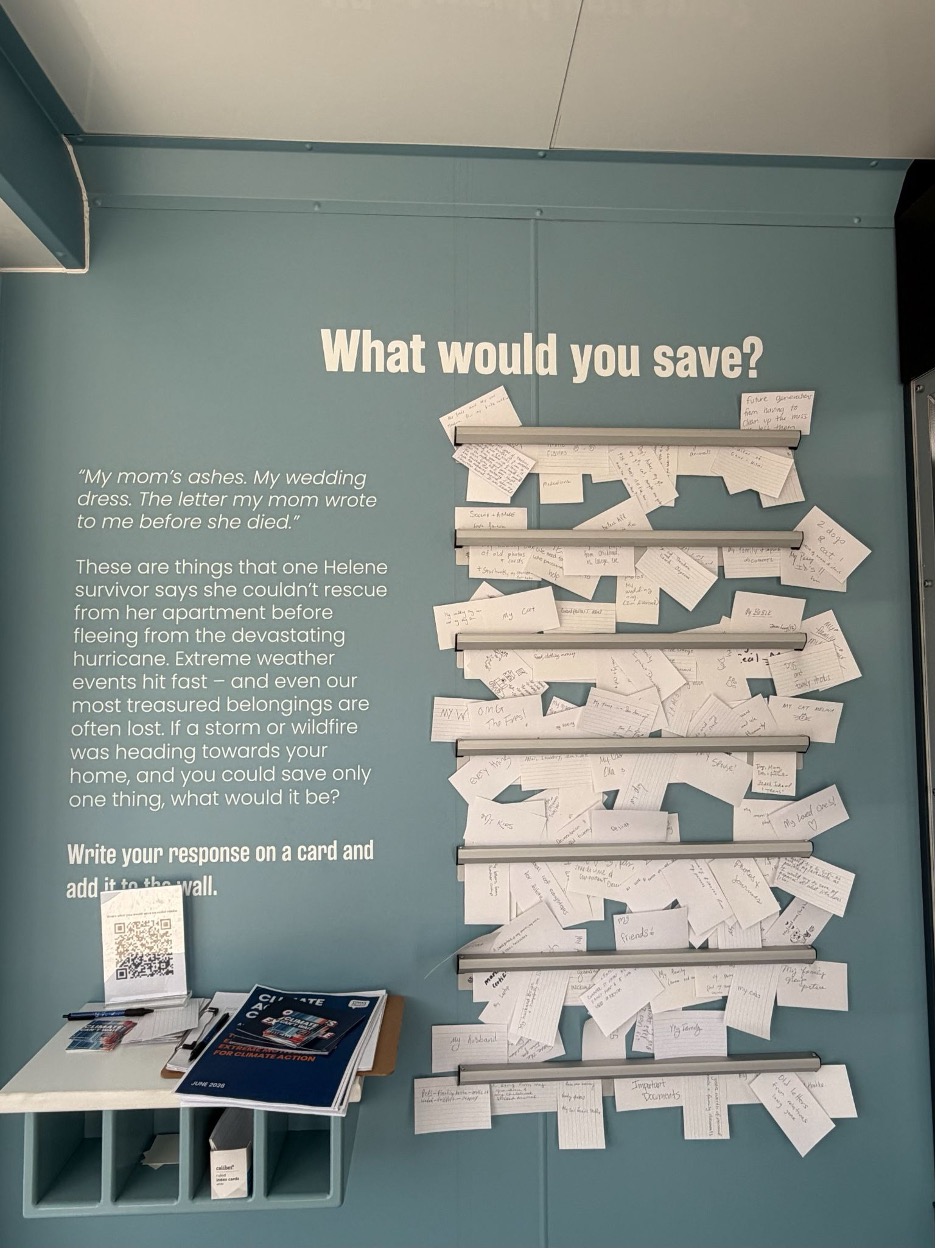
At the end of the exhibit, museum guests were urged to reflect on one thing they would save if a disaster hit their home today. Many responses included pets, family photo albums, or people in the home with them. To have to even reflect on such a tragic question underscores the unfortunate reality of how every region within the United States and the world is at risk.
Pictured: Wall at end of exhibit asking guests to take a card and answer one question: What would you save in the event of a natural disaster?The Museum of Unnatural Disasters inspired museum guests to take action for a better climate. A main goal of the exhibit was to bring attention to and urge action against practices that actively harm our environment, such as continued burning of fossil fuels for energy. One action that can be taken right now is signing on to a petition to members of Congress, demanding they take urgent action to address climate change. Sign the petition here.
Author: Lauren Baldwin is a junior at the University of Central Florida majoring in Health Sciences, and is an Environmental Health undergraduate intern at ANHE.
The post Catastrophic Climates and Consequences: A Dive into the Museum of Unnatural Disasters appeared first on ANHE.
Update on EWG-sponsored California bills to boost consumer safety, choice and transparency
California, the world’s fourth-largest economy, could soon prove – once again – its status as a leader in environmental and public health policy that helps reshape the U.S. marketplace.
When Sacramento lawmakers return from recess next month, they’ll consider four EWG-sponsored bills that address key issues: energy affordability, “forever chemicals” pesticides, toxic chemicals in diapers and ultra-processed foods, or UPF.
If enacted, these bills would help consumers lead cleaner, healthier lives through transparency, commonsense safety regulations and choice. They face further votes in the Legislature in August before being sent to Gov. Gavin Newsom for his signature.
1. Using solar to lower sky-high electricity bills (Senate Bill 868)The average California ratepayer faces electricity bills higher than those of most Americans. “Balcony solar” could help.
SB 868 would make it easier for everyone, including renters, apartment and condo dwellers, as well as owners of single-family homes, to plug into the sun using balcony solar systems – small, portable solar panels that can easily be set up on a patio or balcony and taken along when the owner moves.
The systems are inexpensive enough that ratepayers can recoup their investment within a couple of years, putting solar – and savings – within reach of more people. And the costs should decline as the market grows.
But complex rules make accessing balcony solar unnecessarily hard, if not impossible for many.
That’s why EWG is sponsoring this bill, known as the Plug and Play Solar Act, authored by state Sen. Scott Wiener (D-San Francisco). If enacted, it would ensure that balcony solar systems meet strict safety standards and remove hurdles for Californians who want to take more ownership over their utility bills.
SB 868 passed in the California Senate in May, and through the Assembly Utilities and Energy Committee in June. No major amendments have been added to this bill and the next step in the process is review by the Assembly Appropriations Committee.
2. Widespread use of PFAS pesticides (Assembly Bill 1603)This bill would address the use of the toxic “forever chemicals” known as PFAS that are currently being allowed to be used as pesticides in California.
Over 2.5 million pounds of these chemicals are applied to crops each year within the state, contaminating not just produce but soil and water too.
The bill follows EWG research showing state test results finding PFAS pesticides on nine in 10 California-grown samples of peaches, nectarines and plums. It’s critical to address this source of toxic pollution in the state that grows about half the country’s produce.
Our interactive map shows the California fields where PFAS pesticides are applied.
As introduced, AB 1603, by Assemblymember Nick Schultz (D-Burbank), would have banned the use, sale and manufacture of PFAS pesticides statewide beginning in 2035. It would have also immediately paused state approvals, phased out by 2030 the PFAS pesticides not allowed in Europe, and required public disclosure of PFAS pesticide uses.
AB 1603 passed the Assembly in May and went on to pass through two Senate policy committees in June, Environmental Quality and Agriculture, where it was heavily amended. The Senate Appropriations Committee will next review the bill, followed by a full Senate vote.
The bill has been modified to no longer prohibit the sale or use of PFAS pesticides. It requires disclosure only. Still, that’s an important first step in addressing the use of these chemicals.
AB 1603 also maintains a categorical approach – viewing PFAS as a class of chemicals, rather than regulating them one at a time.
3. Baby diapers made of mystery chemicals (Assembly Bill 1901)Many categories of personal care products are a virtual black box, their ingredients a mystery.
That’s especially true for baby diapers, since infants and toddlers wear them constantly for at least a couple years. Their developing bodies make them particularly vulnerable to toxic chemical exposure.
AB 1901, by Assemblymember Marc Berman (D-Menlo Park), would require manufacturers of children’s diapers sold, distributed or manufactured in California to fully disclose their ingredients on product packaging and online.
Recent tests have found diapers may contain phthalates, linked to hormone disruption, bleaching agents associated with skin and respiratory irritation, and volatile organic compounds, including hazardous air pollutants like toluene and xylene.
Parents and caregivers deserve to know what chemicals sit for years on their child’s body 24/7.
AB 1901 passed the California State Assembly and the Senate Environmental Quality Committee. In August, the bill heads, with no major changes, to the Senate Appropriations Committee for review.
4. What is and isn’t ultra-processed food (Assembly Bill 2244)UPF make up more than two-thirds of children’s diets and more than half of the typical adult diet in the U.S.
AB 2244 addresses the confusion shoppers face in distinguishing ultra-processed from less processed food, with the intent of helping to rein in skyrocketing and harmful UPF consumption.
If enacted, the bill would establish a system for certifying qualifying foods as free from the additives, emulsifiers, food dyes and flavors that often characterize UPF. It would tie that system to California’s first-in-the-nation definition of UPF, which was adopted last year as the result of an earlier bill, also intended to stem the consumption of UPF.
Assemblymember Jesse Gabriel (D-Encino) is the lawmaker behind this bill and several other pioneering laws addressing food safety, especially for kids. His work has helped galvanize a national movement to address food chemicals.
AB 2244 passed the Assembly in May, when it was revised to give grocers more flexibility in how they display products sporting the UPF label. The Senate health and judiciary committees have passed the bill, and the Senate appropriations panel will consider it next.
Protein powder bill falls shortEWG also sponsored a fifth bill, which aimed to require manufacturers of protein powder and shakes to disclose levels of heavy metals in their products.
Millions supplement their protein intake in various forms every day. But they have no way to know whether the shakes, powders and bars they consume contain concerning levels of harmful contaminants: lead, cadmium, mercury and arsenic. One recent study showed about half the products tested exceeded at least one state or federal safety limit for these contaminants.
The fifth bill, SB 1033, would have required manufacturers to disclose levels of heavy metals in their products. Its author, state Sen. Steve Padilla (D-San Diego), sought to make manufacturers accountable for a product that is under-regulated by federal standards.
This bill would have brought greater transparency to protein products, much like an earlier law, which holds producers of baby food to a safety standard for heavy metal. But the legislation did not advance out of the Senate.
Areas of Focus Ultra-Processed Foods Children’s Health Toxic Chemicals Pesticides PFAS Chemicals California July 23, 2026Antimining Barricade Torn Down In Palawam – But Indigenous People Resistance Will Not Be Silenced
Antimining Barricade Torn Down In Palawam - But Indigenous People Resistance Will Not Be Silenced
Palawan — long celebrated as the Philippines’ last ecological frontier — is now ground zero for a disturbing pattern: mining incursions advancing with impunity, and Indigenous Peoples’ rights being trampled by the very institutions mandated to protect them.
On March 26, in Sitio Linao, Barangay Ipilan, Brooke’s Point, Pala’wan communities watched in shock as two backhoes belonging to Calmia Nickel Inc. (CNI) crossed the invisible boundary that has safeguarded their upland ancestral domain for generations. For the first time, heavy machinery penetrated a landscape where selfsufficiency still thrives: forests rich with wildlife, upland rice and cassava fields, and dozens of freshwater springs sustaining entire communities.
Support the Pala’wanWhat you can do: to support this struggle, please sign and send this email letter to Hon. Cesareo Benedito Jr., Mayor of Brooke’s Point, including also the other electronic addresses in Cc.
/* Contenedor */ .palawan-actions { width: 100%; padding: 30px 20px; box-sizing: border-box; } .palawan-actions-desktop, .palawan-actions-mobile { align-items: center; justify-content: center; flex-wrap: wrap; gap: 14px; } /* Botones */ .palawan-actions .palawan-button { position: static !important; display: inline-flex !important; align-items: center; justify-content: center; float: none !important; width: auto !important; min-height: 48px; margin: 0 !important; padding: 12px 22px !important; background: #94164f !important; color: #ffffff !important; border: 2px solid #94164f !important; border-radius: 4px !important; font-family: inherit; font-size: 16px !important; font-weight: 700 !important; line-height: 1.2 !important; letter-spacing: 0 !important; text-align: center; text-decoration: none !important; white-space: nowrap; cursor: pointer; box-shadow: 0 3px 8px rgba(0, 0, 0, 0.14); transition: background-color 0.2s ease, color 0.2s ease, border-color 0.2s ease, transform 0.2s ease; } /* Evita el ícono y el desplazamiento automático de Divi */ .palawan-actions .palawan-button::before, .palawan-actions .palawan-button::after { display: none !important; content: none !important; } .palawan-actions .palawan-button:hover, .palawan-actions .palawan-button:focus { padding: 12px 22px !important; background: #ffffff !important; color: #94164f !important; border-color: #ffffff !important; transform: translateY(-2px); } .palawan-actions .palawan-button:focus-visible { outline: 3px solid rgba(255, 255, 255, 0.6); outline-offset: 3px; } /* Escritorio */ .palawan-actions-desktop { display: flex; } .palawan-actions-mobile { display: none; } /* Tablet y celular */ @media only screen and (max-width: 980px) { .palawan-actions { padding: 24px 20px; } .palawan-actions-desktop { display: none !important; } .palawan-actions-mobile { display: flex !important; } } /* Celular */ @media only screen and (max-width: 480px) { .palawan-actions-mobile { flex-direction: column; gap: 12px; } .palawan-actions .palawan-button { width: 100% !important; max-width: 280px; white-space: normal; } } Send with Gmail Send with Outlook Copy letter Open email app Copy letter function getPalawanActionSubject() { if (!window.palawanSelectedSubject) { const subjects = [ "Protect Brooke's Point and Palawan's Indigenous communities", "Stand with the Indigenous communities of Palawan", "Urgent action needed to protect Brooke's Point", "Defend Palawan's forests and Indigenous rights", "Stop mining expansion in Brooke's Point", "Protect Palawan's Last Ecological Frontier", "Respect Indigenous rights in Brooke's Point", "Appeal to protect Brooke's Point from mining" ]; window.palawanSelectedSubject = subjects[Math.floor(Math.random() * subjects.length)]; } return window.palawanSelectedSubject; } function getActionEmailData() { return { to: 'brookespointmayorsoffice@gmail.com', cc: [ 'mabuhay@palawan.gov.ph', 'tjsmatta@gmail.com', 'oed@pcsd.gov.ph', 'ohea@denr.gov.ph', 'region4b@ncip.gov.ph', 'jenmarcantonjos@gmail.com', 'ich@unesco.org', 'comite.liaison.ong@unesco.org' ].join(','), subject: getPalawanActionSubject(), body: `Dear Mayor Benedito, With each passing month, I continue to receive deeply troubling reports regarding the accelerating intrusion of mining operations within Palawan, a UNESCO Man and Biosphere Reserve. Along with many concerned individuals worldwide, I am particularly alarmed by developments in the Municipality of Brooke's Point, where the mining tenements of companies such as Ipilan Nickel Corporation (INC) and Calmia-MacroAsia overlap with the Mount Mantalingahan Protected Landscape (MMPL), an area of both national and international ecological significance. Allowing further degradation in these zones risks irreversible consequences for the island's sustainable future. Public records reveal that at least 218,854 trees have already been targeted under "Special Tree Cutting and EarthBalling Permits" for mining operations in Palawan. This number is staggering - not only because of the trees themselves, but because each permit threatens watersheds, biodiversity, soil stability and the entire ecological system that sustains life on the island. It is disheartening to learn of the Municipal Government's recent endorsement of the business permit renewal for Ipilan Nickel Corporation - an action that would authorize the cutting of approximately 32,000 trees in primary forest. I sincerely hope that this decision, supported by nine members of the Sangguniang Bayan, can still be reconsidered and ultimately reversed in the interest of long-term environmental stewardship. I am equally concerned about the situation in Sitio Linao, where the barricade erected by Indigenous residents to stop Calmia's heavy equipment was dismantled on 29 June. This community has safeguarded and sustainably managed its environment for generations, and their grievances merit urgent attention and meaningful action. They are not alone in facing the impacts of mining; the livelihoods of farmers and fisherfolk across Brooke's Point are already being undermined, as seen in the experience of barangay Maasin proper. This pattern of harm cannot be allowed to continue. I respectfully urge your office not to endorse a business permit to Calmia Nickel Inc. and to ensure that existing operations - particularly those of INC - are not permitted to expand, and ideally are halted altogether. While the recent provincial moratorium on new mining applications is a welcome step, it is discouraging to learn that several officials are circumventing it with increasing ease and impunity. Please be assured that the international network of civil society organizations is closely monitoring the situation in Palawan and remains committed to supporting efforts to protect what has long been recognized as the "Philippines' Last Ecological Frontier." As Mayor, you hold the authority and responsibility to ensure that Brooke's Point remains one of the greenest and most beautiful municipalities in Palawan. I earnestly hope that you will use your mandate to safeguard the forests that Indigenous peoples have protected for centuries, so that future generations may inherit a landscape that remains intact, vibrant, and life-sustaining. Respectfully, [Your Name]` }; } function openActionEmail(type) { const data = getActionEmailData(); if (type === 'gmail') { window.open( 'https://mail.google.com/mail/?view=cm&fs=1' + '&to=' + encodeURIComponent(data.to) + '&cc=' + encodeURIComponent(data.cc) + '&su=' + encodeURIComponent(data.subject) + '&body=' + encodeURIComponent(data.body), '_blank' ); } if (type === 'outlook') { window.open( 'https://outlook.office.com/mail/deeplink/compose?' + 'to=' + encodeURIComponent(data.to) + '&cc=' + encodeURIComponent(data.cc) + '&subject=' + encodeURIComponent(data.subject) + '&body=' + encodeURIComponent(data.body), '_blank' ); } if (type === 'mailto') { window.location.href = 'mailto:' + data.to + '?cc=' + encodeURIComponent(data.cc) + '&subject=' + encodeURIComponent(data.subject) + '&body=' + encodeURIComponent(data.body); } } function copyPalawanLetter(button) { const data = getActionEmailData(); const completeText = 'TO: brookespointmayorsoffice@gmail.com\n' + 'CC: mabuhay@palawan.gov.ph, tjsmatta@gmail.com, oed@pcsd.gov.ph, ohea@denr.gov.ph, region4b@ncip.gov.ph, jenmarcantonjos@gmail.com, ich@unesco.org, comite.liaison.ong@unesco.org\n\n' + data.body; const textArea = document.createElement('textarea'); textArea.value = completeText; textArea.setAttribute('readonly', ''); textArea.style.position = 'fixed'; textArea.style.top = '0'; textArea.style.left = '0'; textArea.style.width = '1px'; textArea.style.height = '1px'; textArea.style.padding = '0'; textArea.style.border = '0'; textArea.style.fontSize = '16px'; textArea.style.opacity = '0.01'; document.body.appendChild(textArea); textArea.focus(); textArea.select(); textArea.setSelectionRange(0, completeText.length); let copied = false; try { copied = document.execCommand('copy'); } catch (error) { copied = false; } document.body.removeChild(textArea); if (copied) { showCopyConfirmation(button); return; } /* Segundo intento para navegadores compatibles */ if (navigator.clipboard && window.isSecureContext) { navigator.clipboard.writeText(completeText) .then(function () { showCopyConfirmation(button); }) .catch(function () { showManualCopy(completeText); }); } else { showManualCopy(completeText); } } function showCopyConfirmation(button) { const originalText = button.textContent; button.textContent = 'Letter copied!'; setTimeout(function () { button.textContent = originalText; }, 2000); } function showManualCopy(text) { window.prompt( 'Press and hold the text, then select Copy:', text ); }According to tribal leader Panglima Celso Paida,
“The company entered our ancestral domain without consulting us at all. We had no choice but to act immediately and set up a community barricade to stop further intrusions. In spite of this, they’re leveling an area where they, supposedly, plan to put up their building.”
For nearly three months, indigenous residents guarded the barricade day and night. It became a living symbol of resistance – a collective assertion of ancestral rights and a civil society defense of Brooke’s Point’s watersheds, which sustain upland communities, farmers, and fisherfolk downstream.
A Brutal Dismantling — Backed by State AgenciesOn June 29, this outpost of Indigenous selfdetermination was dismantled. The operation was carried out with coordination and support from the National Commission on Indigenous Peoples (NCIP), Palawan National Police (PNP), the Department of Environment and Natural Resources (DENR), the Mining and Geoscience Bureau (MGB) and other agencies.
The order to dismantle the barricade was executed under NCIP Memorandum Order No. 1562026, based on a resolution issued by IPDOBICAMM, an organization whose legitimacy is widely contested by true Pala’wan leaders. In a striking display of bias, NCIP Provincial Director Atty. Jansen Jontilla personally served the dismantling order while wearing a mining helmet — a visual confirmation of where NCIP’s loyalties lie, and a betrayal of the very communities the agency is legally mandated to protect.
Illegitimate Leaders Elevated, True Custodians IgnoredIPDOBICAMM President Julhadi Titte, a key figure behind the dismantling, claimed the barricade violated prior agreements and breached IP rights under the Indigenous Peoples Rights Act (IPRA). But Pala’wan leaders reject this narrative outright. One of them argues: “Titte is not a legitimate Indigenous leader, he does not belong to the Pala’wan tribes and IPDOBICAMM does not represent the true custodians of the ancestral domain, across the six ‘barangays’ (administrative units)”. Yet NCIP continues to elevate such figures – a pattern that conveniently aligns with mining interests.
“IPDOBICAMM was created through collusion between mining companies and NCIP. Our legitimate leaders are reorganizing through PEKP (traditional leaders), supported by MKE (women’s groups) and SAMAKA (youth opposing mining).”
A respected Pala’wan representativeA Flawed FPIC Process — Manipulated to Favor Mining
The agreements cited by IPDOBICAMM are deeply questionable. According to legitimate Pala’wan leaders, the Free, Prior, and Informed Consent (FPIC) process was manipulated by NCIP officials. One leader explains: “NCIP validated mining approval through dubious ‘majority’ votes rather than genuine consensus, as required by IPRA.”
An indigenous woman advocate corroborates:
“Several of those consulted are not truly indigenous. They collaborate with mining companies for personal gain. They speak in our name without our consent — and NCIP validates them instead of us.”
Mining Agreements Built on Fraud and ViolationsThe Mineral Production Sharing Agreement (MPSA) of MacroAsia Mining Corp., implemented by Calmia Nickel Inc., allegedly received community support leading to NCIP’s issuance of a Certification Precondition (CP). But the consultations involved illegitimate leaders, not the true custodians recognized by local communities.
Indigenous leaders are now demanding an investigation into how the Memorandum of Agreement (MOA) was secured – and how mining approvals were pushed through despite widespread opposition.
“Why does NCIP follow the orders of IPDOBICAMM - a group that manages mining royalties - instead of the indigenous community who actually live within the ancestral lands to be mined?”Victor Colili – Former Brooke’s Point Councillor and Indigenous Peoples’ leader
“NCIP was created to protect Indigenous Peoples, not undermine them. When decisions affecting ancestral domains disregard the voices of those who have long protected these lands, public trust in the institution collapses.”Mary Jean Feliciano – Vice Mayor of Brooke’s Point
Legal Violations, Broken Promises, and a Threat to a UNESCO LandscapeMacroAsia/Calmia promised nine programs for IPs in the MOA — none have been fulfilled. Their mining tenement overlaps with the Mount Mantalingahan Protected Landscape (MMPL), a UNESCOrecognized biodiversity hotspot feeding 33 rivers and providing ecosystem services valued at US$5.5 billion, supporting 200,000 people.
The project also lacks a business permit from the Brooke’s Point Mayor and should not be allowed to push through, given the Provincial Ordinance No. 3646, which imposes a 50year mining moratorium. Yet enforcement agencies continue to ignore these violations. This reflects a familiar pattern in Philippine resource governance: corruption, clientelism, and impunity, undermining Palawan’s status as a UNESCO Man & Biosphere Reserve and threatening one of the country’s last intact forests.
IPRA Under Attack — A Dangerous Legislative ShiftThe Philippines has some of Asia’s strongest Indigenous rights laws. Yet corruption hollow them out. Even the landmark Indigenous Peoples’ Rights Act (IPRA) is now under threat. Proposed laws such as House Bill 9608 and House Bill 621 seek to transfer IPRA functions from NCIP to DENR — the same agency whose Mines and Geosciences Bureau grants mining permits. If passed, Indigenous rights would fall under the authority of those who profit from their erosion. This would mark the death of IPRA.
“The destruction of the barricade will not stop us. It will only make us more determined to defend our forest and the future of the coming generations.”
Blockade participants led by Celso Paida Indigenous Resistance ContinuesDespite the dismantling, Indigenous resolve remains unbroken.
The struggle of the Pala’wan and civil society to protect Brooke’s Point’s pristine environment will continue — until mining operations retreat and ancestral domains are respected.
What you can do: To support this struggle, please sign and send this email letter to Hon. Cesareo Benedito Jr., Mayor of Brooke’s Point, including also the other electronic addresses in Cc.
/* Contenedor */ .palawan-actions { width: 100%; padding: 30px 20px; box-sizing: border-box; } .palawan-actions-desktop, .palawan-actions-mobile { align-items: center; justify-content: center; flex-wrap: wrap; gap: 14px; } /* Botones */ .palawan-actions .palawan-button { position: static !important; display: inline-flex !important; align-items: center; justify-content: center; float: none !important; width: auto !important; min-height: 48px; margin: 0 !important; padding: 12px 22px !important; background: #94164f !important; color: #ffffff !important; border: 2px solid #94164f !important; border-radius: 4px !important; font-family: inherit; font-size: 16px !important; font-weight: 700 !important; line-height: 1.2 !important; letter-spacing: 0 !important; text-align: center; text-decoration: none !important; white-space: nowrap; cursor: pointer; box-shadow: 0 3px 8px rgba(0, 0, 0, 0.14); transition: background-color 0.2s ease, color 0.2s ease, border-color 0.2s ease, transform 0.2s ease; } /* Evita el ícono y el desplazamiento automático de Divi */ .palawan-actions .palawan-button::before, .palawan-actions .palawan-button::after { display: none !important; content: none !important; } .palawan-actions .palawan-button:hover, .palawan-actions .palawan-button:focus { padding: 12px 22px !important; background: #ffffff !important; color: #94164f !important; border-color: #ffffff !important; transform: translateY(-2px); } .palawan-actions .palawan-button:focus-visible { outline: 3px solid rgba(255, 255, 255, 0.6); outline-offset: 3px; } /* Escritorio */ .palawan-actions-desktop { display: flex; } .palawan-actions-mobile { display: none; } /* Tablet y celular */ @media only screen and (max-width: 980px) { .palawan-actions { padding: 24px 20px; } .palawan-actions-desktop { display: none !important; } .palawan-actions-mobile { display: flex !important; } } /* Celular */ @media only screen and (max-width: 480px) { .palawan-actions-mobile { flex-direction: column; gap: 12px; } .palawan-actions .palawan-button { width: 100% !important; max-width: 280px; white-space: normal; } } Send with Gmail Send with Outlook Copy letter Open email app Copy letter function getPalawanActionSubject() { if (!window.palawanSelectedSubject) { const subjects = [ "Protect Brooke's Point and Palawan's Indigenous communities", "Stand with the Indigenous communities of Palawan", "Urgent action needed to protect Brooke's Point", "Defend Palawan's forests and Indigenous rights", "Stop mining expansion in Brooke's Point", "Protect Palawan's Last Ecological Frontier", "Respect Indigenous rights in Brooke's Point", "Appeal to protect Brooke's Point from mining" ]; window.palawanSelectedSubject = subjects[Math.floor(Math.random() * subjects.length)]; } return window.palawanSelectedSubject; } function getActionEmailData() { return { to: 'brookespointmayorsoffice@gmail.com', cc: [ 'mabuhay@palawan.gov.ph', 'tjsmatta@gmail.com', 'oed@pcsd.gov.ph', 'ohea@denr.gov.ph', 'region4b@ncip.gov.ph', 'jenmarcantonjos@gmail.com', 'ich@unesco.org', 'comite.liaison.ong@unesco.org' ].join(','), subject: getPalawanActionSubject(), body: `Dear Mayor Benedito, With each passing month, I continue to receive deeply troubling reports regarding the accelerating intrusion of mining operations within Palawan, a UNESCO Man and Biosphere Reserve. Along with many concerned individuals worldwide, I am particularly alarmed by developments in the Municipality of Brooke's Point, where the mining tenements of companies such as Ipilan Nickel Corporation (INC) and Calmia-MacroAsia overlap with the Mount Mantalingahan Protected Landscape (MMPL), an area of both national and international ecological significance. Allowing further degradation in these zones risks irreversible consequences for the island's sustainable future. Public records reveal that at least 218,854 trees have already been targeted under "Special Tree Cutting and EarthBalling Permits" for mining operations in Palawan. This number is staggering - not only because of the trees themselves, but because each permit threatens watersheds, biodiversity, soil stability and the entire ecological system that sustains life on the island. It is disheartening to learn of the Municipal Government's recent endorsement of the business permit renewal for Ipilan Nickel Corporation - an action that would authorize the cutting of approximately 32,000 trees in primary forest. I sincerely hope that this decision, supported by nine members of the Sangguniang Bayan, can still be reconsidered and ultimately reversed in the interest of long-term environmental stewardship. I am equally concerned about the situation in Sitio Linao, where the barricade erected by Indigenous residents to stop Calmia's heavy equipment was dismantled on 29 June. This community has safeguarded and sustainably managed its environment for generations, and their grievances merit urgent attention and meaningful action. They are not alone in facing the impacts of mining; the livelihoods of farmers and fisherfolk across Brooke's Point are already being undermined, as seen in the experience of barangay Maasin proper. This pattern of harm cannot be allowed to continue. I respectfully urge your office not to endorse a business permit to Calmia Nickel Inc. and to ensure that existing operations - particularly those of INC - are not permitted to expand, and ideally are halted altogether. While the recent provincial moratorium on new mining applications is a welcome step, it is discouraging to learn that several officials are circumventing it with increasing ease and impunity. Please be assured that the international network of civil society organizations is closely monitoring the situation in Palawan and remains committed to supporting efforts to protect what has long been recognized as the "Philippines' Last Ecological Frontier." As Mayor, you hold the authority and responsibility to ensure that Brooke's Point remains one of the greenest and most beautiful municipalities in Palawan. I earnestly hope that you will use your mandate to safeguard the forests that Indigenous peoples have protected for centuries, so that future generations may inherit a landscape that remains intact, vibrant, and life-sustaining. Respectfully, [Your Name]` }; } function openActionEmail(type) { const data = getActionEmailData(); if (type === 'gmail') { window.open( 'https://mail.google.com/mail/?view=cm&fs=1' + '&to=' + encodeURIComponent(data.to) + '&cc=' + encodeURIComponent(data.cc) + '&su=' + encodeURIComponent(data.subject) + '&body=' + encodeURIComponent(data.body), '_blank' ); } if (type === 'outlook') { window.open( 'https://outlook.office.com/mail/deeplink/compose?' + 'to=' + encodeURIComponent(data.to) + '&cc=' + encodeURIComponent(data.cc) + '&subject=' + encodeURIComponent(data.subject) + '&body=' + encodeURIComponent(data.body), '_blank' ); } if (type === 'mailto') { window.location.href = 'mailto:' + data.to + '?cc=' + encodeURIComponent(data.cc) + '&subject=' + encodeURIComponent(data.subject) + '&body=' + encodeURIComponent(data.body); } } function copyPalawanLetter(button) { const data = getActionEmailData(); const completeText = 'TO: brookespointmayorsoffice@gmail.com\n' + 'CC: mabuhay@palawan.gov.ph, tjsmatta@gmail.com, oed@pcsd.gov.ph, ohea@denr.gov.ph, region4b@ncip.gov.ph, jenmarcantonjos@gmail.com, ich@unesco.org, comite.liaison.ong@unesco.org\n\n' + data.body; const textArea = document.createElement('textarea'); textArea.value = completeText; textArea.setAttribute('readonly', ''); textArea.style.position = 'fixed'; textArea.style.top = '0'; textArea.style.left = '0'; textArea.style.width = '1px'; textArea.style.height = '1px'; textArea.style.padding = '0'; textArea.style.border = '0'; textArea.style.fontSize = '16px'; textArea.style.opacity = '0.01'; document.body.appendChild(textArea); textArea.focus(); textArea.select(); textArea.setSelectionRange(0, completeText.length); let copied = false; try { copied = document.execCommand('copy'); } catch (error) { copied = false; } document.body.removeChild(textArea); if (copied) { showCopyConfirmation(button); return; } /* Segundo intento para navegadores compatibles */ if (navigator.clipboard && window.isSecureContext) { navigator.clipboard.writeText(completeText) .then(function () { showCopyConfirmation(button); }) .catch(function () { showManualCopy(completeText); }); } else { showManualCopy(completeText); } } function showCopyConfirmation(button) { const originalText = button.textContent; button.textContent = 'Letter copied!'; setTimeout(function () { button.textContent = originalText; }, 2000); } function showManualCopy(text) { window.prompt( 'Press and hold the text, then select Copy:', text ); }Is your community, organization, or network interested in becoming a YLNM member? Would you like to know more about us? Please send an email enquiry to membership[at]yestolifenotomining.org
Subscribe to our bi-monthly newsletter Suscríbase a nuestro boletínYes to Life No to Mining global solidarity network since 2012 | Contact Us
Bird Cities Soar: A Year of Community-Powered Conservation
ICYMI: 5 water main breaks in a week raising questions about Los Angeles’ aging infrastructure
Last week, a major trunk line ruptured in Los Angeles, sending thousands of gallons of water rushing down the Sunset Strip and into surrounding neighborhoods. Later that same week, two additional pipe failures caused flooding in Venice. In total, five water main breaks were reported within a single week, raising serious concerns about the city’s aging water infrastructure.
These incidents are the consequences of relying on outdated infrastructure that is more than a century old. In 2019, the Los Angeles Department of Water and Power (LADWP) reported that roughly 29% of the city’s pipes were more than 80 years old, approaching their typical 100-year lifespan.
The latest failures also echo the 2014 rupture of a trunk line on Sunset Boulevard, which released millions of gallons of water onto the UCLA campus, flooding multiple buildings and causing millions of dollars in damage. In the aftermath, the Los Angeles Times found that nearly half of the city’s water pipes had received a condition grade of “C” or lower from officials.
It remains unclear how long repairs to the damaged trunk line in West Hollywood will take. Meanwhile, utility and state leaders continue to prioritize costly projects like the Delta Tunnel rather than addressing California’s urgent need to modernize its aging water infrastructure.
These ruptures are a reminder that California must rethink its approach to water resilience. Southern California should embrace the Water Renaissance Plan by investing in sustainable, local water supplies and practical infrastructure upgrades that strengthen reliability and help prevent future disasters, rather than relying on large-scale water diversion projects.
Read more about last week’s water line breaks:
- More water pipes burst in Venice, Hollywood as Sunset Strip repairs enter Day 4. The Los Angeles Times.
- West Hollywood rupture was L.A.’s worst in years: 17 million gallons spilled, Sunset Boulevard closed for days. The Los Angeles Times.
- ‘Significant progress’ made on ruptured Sunset Strip water main. The Los Angeles Times.
- West Hollywood faces long recovery from massive water main break: ‘It was like whitewater rapids’. The Los Angeles Times.
- 2 separate water pipe issues flood neighborhoods in Venice, damage underground parking structures. ABC 7 Los Angeles.
- Three ruptured water pipes cause flooding in Venice neighborhoods. CBS Los Angeles.
- Street, homes flooded after water pipe ruptures in Venice. KTLA.
- Two Pipe Failures Flood Venice Days After West Hollywood Water Main Rupture. Westside Current.
St. Louis nurses rally to demand Saint Louis University Hospital immediately reinstate unjustly terminated nurses
The Colorful Guest That Never Left
Education workers can create political crisis for Doug Ford
Education is a weak point for Ford and his government, and is a potential place where he can be defeated. That requires the unions to stay united and the for the existing public support for education workers to be organized.
The post Education workers can create political crisis for Doug Ford first appeared on Spring.
In Appalachia, Severe Floods Linked to Spikes in Opioid Deaths
As global warming fuels more extreme rainfall in Appalachia, new research finds a link between flooding and opioid deaths.
At a Kenya Research Center, Insects Are Helping Farmers Reduce Their Reliance on Synthetic Fertilizers and Pesticides
As fertilizer prices rise and farmers face growing pressure from climate change, researchers in Kenya are looking to an unlikely allies—insects.
At the International Centre of Insect Physiology and Ecology, scientists are developing insect-based fertilizers and biopesticides that can improve soil health, reduce dependence on expensive imported agricultural inputs, and help farmers build more resilient agriculture systems.
“The residue that remains behind is an excellent source of organic fertilizer,” Dennis Beesigamukama, a postdoctoral fellow at icipe, tells Food Tank.
The process, he explains, begins with black soldier flies. Researchers feed the insects organic waste, which the larvae convert into protein that can be used in animal feed. What’s left behind is a nutrient-rich organic fertilizer known as frass.
According to icipe, insect-derived fertilizers contain three to nine times more nitrogen, phosphorus, and potassium than many conventional organic fertilizers. And they have the potential to increase crop yields by as much as 27 percent compared with similar organic alternatives.
The organization is also developing biological alternatives to synthetic pesticides. Researchers have identified naturally occurring bacteria, fungi, and viruses that target insect pests without harming crops. Several of these biopesticides are already registered for use across Africa, with commercialization underway in Europe, North America, and Asia.
These inputs are designed to become part of integrated pest management systems, helping farmers reduce their dependence on agrochemicals and protect biodiversity.
Beesigamukama says the benefits extend far beyond pest management. Insect-based fertilizers improve soil water retention and support carbon sequestration, making them what he describes as “climate smart” inputs.
The need for alternatives is becoming increasingly urgent. According to the U.N. Food and Agriculture Organization, the overuse and misuse of artificial fertilizers and pesticides contributes to soil degradation, water and air pollution, and human health problems.
At the same time, African farmers remain heavily dependent on imported fertilizers. The International Food Policy Research Institute estimates that roughly 80 percent of fertilizer used across the continent is imported, leaving producers vulnerable to supply chain disruptions and volatile global markets. The World Bank reports that fertilizer prices climbed sharply this year, reaching their highest levels since 2022.
“Insect-based fertilizers, produced from locally available organic waste, create a more resilient and self-sufficient system,” says Beesigamukama.
icipe believes insect-derived agricultural inputs can help farmers reduce costs while strengthening local production capacity. Because they rely on resources that are already available within communities, Beesigamukama says they are “one of the most decentralized and scalable technologies” available to support more resilient food systems across Africa.
For researchers at icipe, insects are more than just bugs. They can be practical tools for helping farmers improve soil health, reduce dependence on imported inputs, and build food systems that are better equipped to withstand economic and climate shocks.
And for farmers facing rising input costs and increasingly unpredictable growing conditions, these insect-based solutions could offer a locally produced, lower-cost alternative that strengthens both livelihoods and ecosystems.
Articles like the one you just read are made possible through the generosity of Food Tank members. Can we please count on you to be part of our growing movement? Become a member today by clicking here.
Photo courtesy of icipe
The post At a Kenya Research Center, Insects Are Helping Farmers Reduce Their Reliance on Synthetic Fertilizers and Pesticides appeared first on Food Tank.
Sierra Club Condemns Congressional Effort to Attack California’s Waivers Protecting Clean Air
Today, House Republican Representative Harriet Hageman introduced legislation under the Congressional Review Act (CRA) to revoke California's Clean Air Act waiver allowing the state to enforce stronger than federal greenhouse gas standards for vehicles.
This legislation targets policy that is already fully phased in, which means cars impacted by it are already on the road. The move is the latest attempt by congressional Republicans and the Trump administration to dismantle longstanding clean air protections and undermine states' ability to protect residents from dangerous vehicle pollution.
In response to the bill introduction, Sierra Club Climate Policy Director Patrick Drupp released the following statement:
"Congressional Republicans and the Trump administration are once again putting Big Oil's profits ahead of Americans' health and wallets. California's Clean Air Act waivers have delivered cleaner air, driven innovation, and saved drivers money for decades.
"American families are facing rising costs and worsening climate impacts, and Republicans in Congress are wasting time attacking states’ rights to cleaner air to satisfy Trump’s anti-clean car obsession.
"Nullifying California’s clean vehicle waivers will not make cars more affordable. Sierra Club will continue fighting to defend these lifesaving protections and states' rights to protect the air their residents breathe."
Closing Crane Season 2026: A Poem of Reflection
Congressional Progressive Caucus Shadow Hearing: July 22 at 8:30 a.m.
From Fracking to Data Centers—Hamster Wheels and That Same Old Song and Dance
Maybe we can work together in community to build grassroots power, take direct action, disrupt unjust systems, and resist corporate encroachment.
The post From Fracking to Data Centers—Hamster Wheels and That Same Old Song and Dance appeared first on CELDF - Community Rights Pioneers - Protecting Nature and Communities.
Top maritime court rejects bid to halt UN deep-sea mining inquiry
A United Nations investigation into deep-sea mining firms will continue after the world’s top maritime court rejected their bid to suspend the inquiry triggered by a US-backed push to extract critical minerals from the ocean floor.
In two orders issued on Saturday, the International Tribunal for the Law of the Sea (ITLOS) declined to halt an inquiry launched by the International Seabed Authority (ISA) into whether permit holders, including Tonga Offshore Mining Ltd (TOML) and Nauru Ocean Resources Inc (NORI), have breached their obligations under UN exploration contracts.
The two companies are subsidiaries of Canadian firm The Metals Company (TMC), which earlier this year sought permits from the United States to commercially mine the deep seabed in an area already covered by its UN exploration licences, bypassing the ISA’s regulatory process.
The inquiry was opened after TMC’s move raised questions over whether its subsidiaries had complied with their contractual obligations to the ISA, which regulates mining in international waters under the UN Convention on the Law of the Sea. TOML and NORI sued the ISA last June for allegedly targeting them “in breach of due process” and without “good faith”.
While allowing the inquiry to proceed, the court ordered the ISA to ensure the companies receive due process. Judges said the regulator must explain the factual and legal basis of its inquiry, clarify the procedures being followed and provide TOML and NORI with a meaningful opportunity to respond.
The companies seek to mine an area called the Clarion-Clipperton Zone, which holds vast reserves of critical minerals like nickel, manganese and rare earths but is also home to a little-studied deep ocean ecosystem with thousands of unnamed species.
In response to the court’s ruling, the ISA welcomed the decision, saying the inquiry “remains in effect” and would continue “with due regard to all applicable legal requirements”.
Last week, during an annual meeting of its member governments, ISA secretary-general Leticia Carvalho said the resources in the ocean floor are “the common heritage of humankind” and upheld the agency’s role as “more important than ever”.
TMC also welcomed the court decision in a statement and claimed that judges ruled to “protect the rights of TMC subsidiaries”.
“Contractors like NORI and TOML, who have together spent hundreds of millions of dollars on the promise of a fair regulatory framework, should be informed of the factual and legal basis of any non-compliance inquiries, understand the procedure being applied, and receive a meaningful opportunity to respond,” said Gerard Barron, CEO of The Metals Company.
Iridogorgia and bamboo coral pictured around the Johnston Atoll Unit of the Pacific Remote Islands Marine National Monument (Photo: NOAA Office of Ocean Exploration and Research)Environmental groups said the ruling allows scrutiny of the companies’ actions to continue.
Louisa Casson, deep-sea mining campaigner with Greenpeace, said the “entire litigation has been an egregious waste of time and money”, which was part of the industry’s “textbook distraction tactic” meant to delay the consequences of the inquiry.
“If the inquiry confirms that TMC’s subsidiaries are breaching their contracts, governments must send the strongest possible signal that complicity in unlawful deep sea mining will not be tolerated,” she said.
While the investigation is ongoing, NORI’s contract is set to expire this week and is up for review. Governments asked the ISA to report back and make “make appropriate recommendations” by the next ISA assembly, its main decision-making body, set to take place next week from July 27-31.
The court ordered both the ISA and TMC to submit a report on how they have complied with the ruling by August 31, and called on both to “cooperate and refrain from any action that might lead to aggravating the dispute”.
The post Top maritime court rejects bid to halt UN deep-sea mining inquiry appeared first on Climate Home News.
Hundreds of Vigils Planned for Lorenzo, Johan, and All Lives Taken by ICE
On Saturday, July 25, over 135 communities (and counting) across the United States will hold vigils, protests, and demonstrations to demand justice for Lorenzo Salgado Araujo, Johan Sebastian Guerrero, and many more who have been killed by Immigration and Customs Enforcement (ICE). Neighbors will gather to pay their respects, pray, mourn, and demand ICE OUT!
Find all events here.
On the streets and across the agency’s more than 200 abuse-ridden detention facilities, ICE is making communities less safe. Communities are demanding that the ICE agents involved in these killings, Department of Homeland Security Sec. Markwayne Mullin, the Department of Justice (DOJ), the Federal Bureau of Investigation (FBI), and all related agencies under the Trump administration are held accountable.
We demand:
- Immediate Transparency: DHS must immediately release the key witnesses to Lorenzo’s death and halt their deportation proceedings so they can safely participate in any investigation and legal process.
- Full, Independent Investigations: We demand a transparent investigation into these killings that includes cooperation from all law enforcement agencies and accountability for any officer found to have committed misconduct.
- ICE Out!: We call on all state and local leaders to end the use of state resources to support federal immigration enforcement and remove ICE from our streets. DHS must remove all ICE agents from the streets and all cities and states must stop all coordination with ICE.
On July 7, Lorenzo Salgado Araujo was shot and killed by an ICE agent in Houston while driving a work van with his crew. Only a week later,on July 13, ICE fatally shot 26-year-old Johan Sebastian Guerrero in Biddeford, Maine while his wife and toddler were forced to witness his murder. Both men were beloved members of their communities, killed on their way to work, leaving their families broken.
Since then, two more individuals in Florida and in Georgia have been killed by ICE’s chaotic and violent occupations of U.S. cities.As ICE takes more lives, communities are becoming more outraged and taking to the streets to protest and mourn together. Everyday people now demand action from local and national leaders to stop these federal agencies from killing our neighbors, family and friends. .
The day of action is being planned by volunteers, neighbors, families, and organizations nationwide, with the support of the Disappeared in America project hosted by Public Citizen, the National Day Laborers Organizing Network (NDLON), The Workers Circle, Detention Watch Network and League of United Latin American Citizens (LULAC). A core principle behind all Disappeared In America events is a commitment to nonviolent action.
Pages
The Fine Print I:
Disclaimer: The views expressed on this site are not the official position of the IWW (or even the IWW’s EUC) unless otherwise indicated and do not necessarily represent the views of anyone but the author’s, nor should it be assumed that any of these authors automatically support the IWW or endorse any of its positions.
Further: the inclusion of a link on our site (other than the link to the main IWW site) does not imply endorsement by or an alliance with the IWW. These sites have been chosen by our members due to their perceived relevance to the IWW EUC and are included here for informational purposes only. If you have any suggestions or comments on any of the links included (or not included) above, please contact us.
The Fine Print II:
Fair Use Notice: The material on this site is provided for educational and informational purposes. It may contain copyrighted material the use of which has not always been specifically authorized by the copyright owner. It is being made available in an effort to advance the understanding of scientific, environmental, economic, social justice and human rights issues etc.
It is believed that this constitutes a 'fair use' of any such copyrighted material as provided for in section 107 of the US Copyright Law. In accordance with Title 17 U.S.C. Section 107, the material on this site is distributed without profit to those who have an interest in using the included information for research and educational purposes. If you wish to use copyrighted material from this site for purposes of your own that go beyond 'fair use', you must obtain permission from the copyright owner. The information on this site does not constitute legal or technical advice.
 This site is not the official webpage of the Industrial Workers of the World.