You are here
News Feeds
Serie de entrevistas realizadas durante la Asamblea de la GTA 2026 en Indonesia - creado
UN chief urges countries to adopt fossil fuel transition plans with timelines
The head of the United Nations has called on all countries to deliver plans for phasing out their production and consumption of fossil fuels, as rising oil prices and climate shocks threaten energy and human security.
In his farewell speech to the UN General Assembly (UNGA) in New York on Tuesday, outgoing UN Secretary-General António Guterres for the first time urged “every government to adopt a national plan to transition away from fossil fuels” aligned with limiting warming to 1.5C. The plans, he said, should include “clear timelines and protection for affected workers and communities”.
“We know fossil fuel interests won’t step aside on their own. For decades, Big Oil has treated the atmosphere as an open sewer – and cashed in on the consequences,” Guterres told diplomats in his speech opening the leaders’ segment of the assembly, also calling out the industry’s windfall profits after Russia’s invasion of Ukraine.
At last year’s COP30 climate summit in Belém, a group of about 80 governments led a failed push to develop a global roadmap to transition away from fossil fuels. Brazil instead proposed to draft a voluntary report that will be presented this year ahead of COP31 after countries and organisations submitted their views to the process.
Governments first agreed to transition away from fossil fuels in energy systems at COP28 in Dubai in 2023, but have since failed to agree at UN climate talks on how to move forward with that commitment, as efforts to do so have been effectively blocked by large fossil fuel-producing countries.
France, Netherlands issue plansA few countries have moved forward with their own transition plans. France launched the first one at an international conference on the issue in April and the Netherlands followed suit this month. Not being major fossil fuel producers, both European nations aim to end their coal, oil and gas consumption by 2050, although the Dutch plan was criticised for not setting specific phase-out dates for the dirty fuels.
Adão Soares Barbosa, climate ambassador from Timor-Leste and chair of the Least Developed Countries (LDC) group in the UN climate negotiations, told a press briefing on Tuesday that last year’s discussions on shifting away from fossil fuels need to continue at COP31, adding that developed countries should lead the way with transition plans and curb their use of fossil fuels.
“We are expecting that we can make a request to major-emitting countries to limit emissions from this sector,” he said. “For LDCs, we’ll also try to reduce fossil fuel use, but it will depend on national circumstances.”
Samoa’s lead negotiator Anna Rasmussen said small island states have outlined their energy transition plans in their nationally determined contributions (NDCs) – countries’ plans for meeting the Paris Agreement goals – but added “we’re still waiting” for climate finance to help implement those plans.
Despite the global push to clean up the energy mix, countries leading climate talks are themselves also expanding fossil fuel production. COP31 co-presidents Australia and Türkiye have both recently given the green light to mine and drill more coal, oil and gas, and still depend on fossil fuels for 60% and 56% of their electricity production respectively.
Fossil fuel expansion threatens COP31 hosts’ credibility, experts warn
COP30 host nation Brazil has also persisted with its plans to explore potential new oil reserves near the mouth of the Amazon River – a region known as the Equatorial Margin.
These are moving ahead despite President Luiz Inácio Lula da Silva announcing last year at the Belém climate summit that the country would develop its own fossil fuel phase-out plan. This is still under development with little information about its progress and may be hampered by elections next month.
“We have achieved our self sufficiency in oil and will continue to explore the potential of new reserves, such as those in the Equatorial Margin,” Lula said in his speech to the UNGA on Tuesday. “But we will not abandon the environmental agenda,” he insisted. “We will move forward with the roadmap for the decarbonisation of the Brazilian economy.”
Transition far cheaper than status quoSpeaking at the main Climate Week NYC venue, Mads Christensen, executive director of Greenpeace International, said given the fast-shifting cost dynamics for both fossil fuels and renewables, countries should revise their existing energy plans because they are now out of date.
Gas power generation now costs around 150 euros per megawatt compared with around 50 euros for solar with battery storage – making the latter two-thirds cheaper.
“If these plans were updated, I think we would have a much faster transition because it simply makes good financial sense,” he said.
A technician walks next to solar panels that partially provide electrical power to the Grand Mosque of Istiqlal in Jakarta, Indonesia (Photo: REUTERS/Willy Kurniawan) A technician walks next to solar panels that partially provide electrical power to the Grand Mosque of Istiqlal in Jakarta, Indonesia (Photo: REUTERS/Willy Kurniawan)Tzeporah Berman, founder and chair of the Fossil Fuel Treaty Initiative, told Climate Home News that the Santa Marta process for transitioning away from fossil fuels (TAFF), launched at April’s conference, could help countries discuss, design and develop their national roadmaps, as well as mobilise the international cooperation required to actually deliver them.
“Many countries want not only national roadmaps but a global roadmap off the highway to hell,” she added. “A global plan is necessary to ensure the rules aren’t rigged against those who want to do the right thing and so all countries can make credible commitments.”
The second TAFF conference will be held in the Pacific island nation of Tuvalu next spring, co-chaired by Ireland. In New York, Tuvalu’s climate minister Maina Vakafua Talia called for stepped-up efforts to tackle the fossil fuel use that is threatening his country’s “demise” by driving global warming.
“The world is running out of time, and so I ask every government to come to… Tuvalu with solutions – real solutions, not false solutions – for us to ensure that we have a pathway and a way forward,” he urged.
The post UN chief urges countries to adopt fossil fuel transition plans with timelines appeared first on Climate Home News.
Trump is backing a diesel export ban. How much would that do?
Diesel prices have hit a record high nearly every day this month, with a national average on Tuesday at $6.52 a gallon, according to AAA. That is driving a growing call to combat this climb by banning the export of the fuel, a move President Donald Trump endorsed today.
“I’ve said, Let’s not send out the diesel,” Trump said from the sidelines of the United Nations General Assembly in New York. As to a ban, “I’ve called for it. I’ve called for it within my people.”
Although relatively few Americans fill their cars with diesel, it’s a backbone of the U.S. economy. It powers the trucks, ships, and trains that move goods across the country, and it is used throughout the agricultural sector. That means everyone is feeling the effect of fuel prices that have climbed almost 80 percent since the United States and Israel launched a war against Iran earlier this year. They have risen almost $1 per gallon in September alone.
The war brought ship traffic to a standstill in the Strait of Hormuz, through which roughly a tenth of the world’s water-borne diesel flows. Ukrainian strikes on Russia have further curbed the global flow, leaving other countries to make up the difference, especially the United States.
During the week of September 11, the U.S. produced over 5 million barrels of distillate fuels per day and sent about 1.6 million of them abroad, according to U.S. Energy Information data. At the same time, domestic oil reserves have fallen to their lowest levels since 1982. This has led some lawmakers to recently urge Trump to curb diesel exports and direct production toward U.S. consumers.
“If our govt can embargo chips to China it can embargo diesel to help American farmers & truckers,” wrote Senator Chuck Grassley, a Republican from Iowa, on X. Representative Ashley Hinson, also a Republican from Iowa, posted Monday: “Iowans are being squeezed and shouldn’t have to foot the bill at the pump or the checkout line for the war in Iran.” Senate majority leader John Thune of South Dakota has expressed interest as well. “If that would take pressure off of prices,” he said, “I’m open to exploring it.”
An online dashboard that has been tracking the impact of rising diesel prices since the war started shows that the ongoing increase has cost American households nearly $400 each — or more than $51 billion overall. Jeff Colgan, a Brown University political scientist who helped build the tracker, explained that banning exports would boost the supply and therefore lower the price.
“It could make a huge difference,” he said, though others disagree. Patrick De Haan, head of petroleum analysis for GasBuddy, wrote on X, “U.S. diesel prices are determined not by a U.S. supply and demand balance, but a global one. Keeping distillates and diesel home does not change the world price.”
The idea isn’t new. In 1975, after OPEC stopped shipping oil to the U.S., Congress passed the Energy Policy and Conservation Act, which included what ended up being an effective ban on crude oil exports. It continued until President Barack Obama lifted it four decades later. Since then, oil companies have made billions exporting their products and oppose reviving any limits on where they can sell them.
Read Next What the record-high cost of diesel means for you Tik RootThe American Fuel & Petrochemical Manufacturers association has said that such a ban would make the problem worse. “Export bans do not create more fuel for Americans,” the organization wrote in a press release. “They reduce U.S. fuel production, put upward pressure on prices, weaken energy security and hand market share to foreign competitors.”
Some Republicans, including within the administration, also expressed concern about a ban. Republican Senator John Cornyn of Texas, which is the country’s biggest oil-producing state, told The Hill that a ban would be a “gimmick.” Interior Secretary Doug Burgum told CNBC that “it could actually hurt Americans.
Democrats have in the past called for export bans on oil products, including earlier this year and in 2021 when President Joe Biden was in office. So far they have been largely quiet on the diesel debate. “Trump is all smoke and mirrors,” said Senator Peter Welch of Vermont when Grist asked about the export ban. “If he’s serious about lowering prices of oil, gas, and home heating oil, he needs to end his illegal war with Iran.”
Before the president offered his thoughts on a ban, a White House official told Grist that the administration was not considering an export ban. It’s unclear if President Trump’s statements change that and how he might advance the issue — or whether Congress can build bipartisan will for legislation. But regardless, Tyson Slocum, the energy program director at Public Citizen, a nonprofit consumer advocacy organization, would like to see a more nuanced discussion of the way forward.
“The debate is so absurdly simplistic. People are like, either total unfettered, unregulated exports, or zero exports,” he said. There are many options in between, he added, including how much diesel gets shipped overseas rather than cutting off that supply entirely.
“It could be very significant,” he said of even partial measures. “You would absolutely see a significant short-term drop in diesel prices.”
Correction: This story originally misstated Senator Chuck Grassley’s party affiliation.
This story was originally published by Grist with the headline Trump is backing a diesel export ban. How much would that do? on Sep 22, 2026.
Five Reasons Labor Opposes Coal
The Alameda Labor Council and 19 local unions were among the leadership of this campaign to keep coal out of the East Bay ten years ago.
Today, we need even more labor presence in this campaign.
Let me tell you five reasons why.
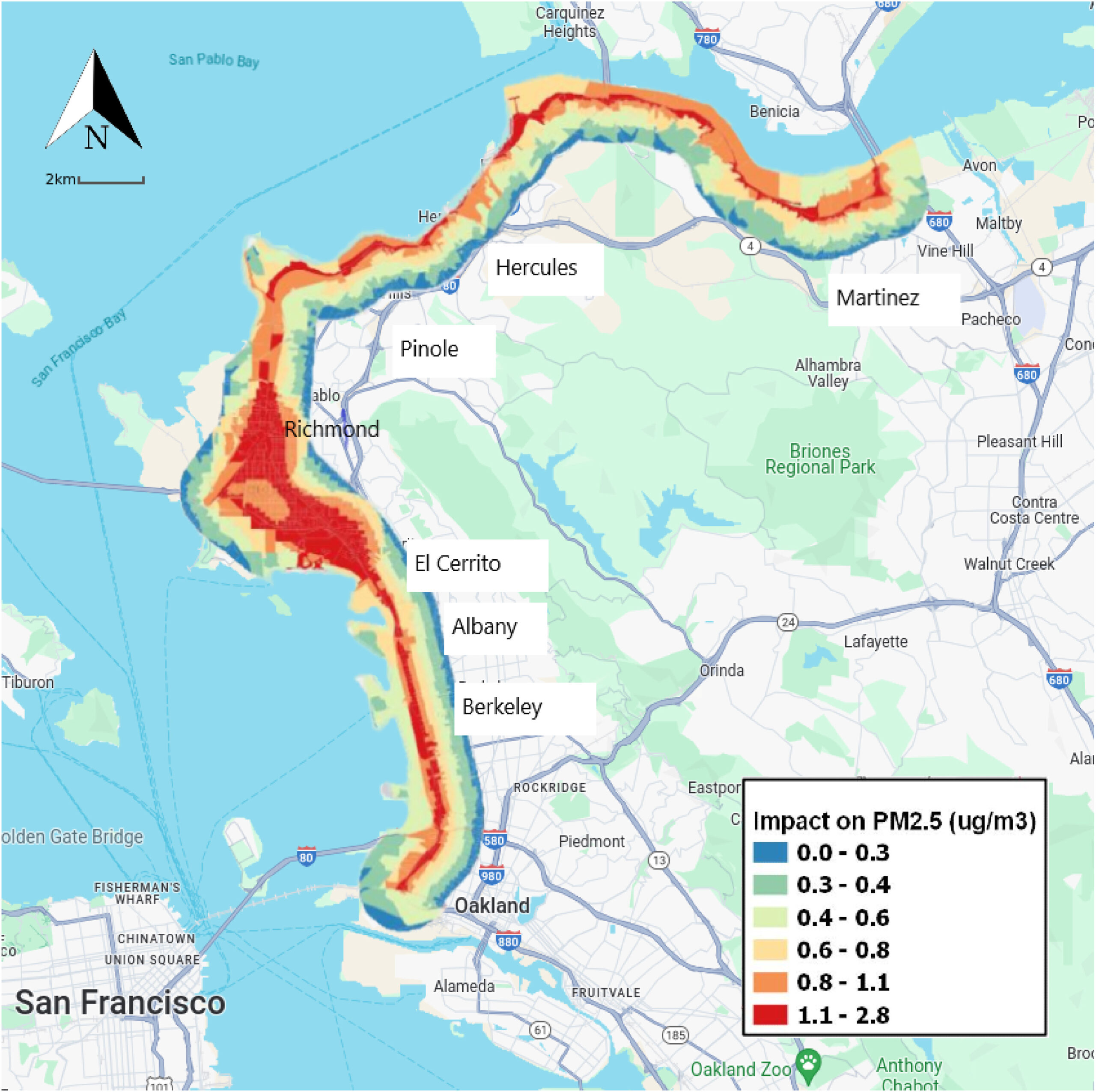
1) As you can see from this map, people of all classes would be hit by the toxic coal. But working-class communities would suffer the most. Workers are more than their jobs. They are parents whose children will be poisoned by coal. They are neighbors who will inhale toxic air and watch the people next door fall ill.
2) Our detractors tell us we have to choose between jobs and the climate, and we therefore must accept the consequences. But this terminal will create at most thousands of unhealthy, short-term jobs and a hundred permanent jobs in toxic workplaces. Some of our laboring brothers and sisters say, “Short-term unhealthy jobs are better than no jobs.” We hear them, we empathize with them, and therefore we are saying:
3) This is a “Yes to Healthy, Unionized Jobs” campaign as much as a No Coal campaign. Our coalition has been championing the redevelopment of the old Oakland Army Base, but in a way that will foster permanent, socially responsible employment. It is therefore crucial that many more unions and laborers join us because we can’t get that kind of development unless there is a mass movement of workers that puts pressure on local, state, and national governments to generate good jobs. This builds up to my next point:
4) The people who are behind this terminal – Trump and his oligarchs – are the same kind of people who bust unions throughout the country. They are also the ones who prevent any kind of legislation that would generate renewable energy jobs. In the last couple of years, bills that could have produced literally millions of green jobs in the US (with a heavy concentration in California) were killed due to their opposition. In other words, they are giving us (at best) thousands of unhealthy, short-term jobs with one hand, while they are taking away potentially millions of healthy, permanent jobs with their other hand.
5) This fight is also a matter of labor pride. The bosses want to build this terminal not just for the cash, which might be their primary motive, but also as an act of class vengeance. They always tell us that without them labor would be nothing. They create the jobs and they pay the wages, we are told. But the labor leadership in this campaign has shown that labor can coalesce with social movements and environmental justice communities to make big things happen. Whenever bosses see that kind of action, they are afraid for their fundamental privileges. That kind of victory shows that a world without oligarchs, a world where labor and communities self-consciously produce and control value, is possible. And therefore, they want to crush any living trace of such victories. Our win in 2016 is a cherished jewel of working-class memory. Ceding this turf to the oligarchs would mean abandoning our belief in a different world as much as abandoning our health and dignity.
.stk-th4q7m9 {margin-bottom:15px !important;} @media screen and (min-width: 768px){.stk-096d817 {flex:var(--stk-flex-grow, 1) 1 calc(37.5% - var(--stk-column-gap, 0px) * 1 / 2 ) !important;}} @media screen and (min-width: 768px){.stk-0373019 {flex:var(--stk-flex-grow, 1) 1 calc(62.5% - var(--stk-column-gap, 0px) * 1 / 2 ) !important;}}Cihan Tuğal is a sociology professor at UC Berkeley and an organizer in East Bay DSA’s Climate Action Committee. He studies social movements, populism, capitalism, democracy, and religion and has a forthcoming book from Stanford University Press entitled The Social Roots of Autocratic Resilience. This piece is based on remarks Cihan made at the community rally of September 15, 2026, outside the Berkeley City Council meeting that adopted a resolution opposing the proposed Oakland coal depot. Photo credit: Leon Kunstenaar
.stk-q7i5evo {margin-bottom:12px !important;}Photo at top: Labor delegation led by Alameda Labor Council leader Josie Camacho speaks out against coal at Oakland City Council meeting in 2015 | Credit: Brooke Anderson
Workers will fight for their self-interest
There aren’t very many Marxists around today who would defend central planning as practiced in the Soviet Union from the late 1920s through the 1980s. But there are many who still think some form of central planning is essential to socialism. Marxist Sociology Professor, Catalyst editor and podcaster Vivek Chibber isn’t one of them. In an aptly titled recent interview, “Socialism Has a Future. Central Planning Doesn’t”, he explained his position.
Chibber’s critique is based on the top-down, bureaucratic planning as it was practiced in the Soviet Union. As he notes, aside from its clones in Eastern Europe, North Korea, and, for a time China, there is no other actual existing model of central planning to examine. His argument is complex but boils down to the proposition that in an economy of any significant size where there is no market there are simply too many materials, inputs, and products for any commission or central authority to allocate efficiently. Only a competitive market could do this, according to Chibber. Hence misallocation, breakdowns, waste, poor products, wrong incentives, and the inevitable accumulation of these problems lead to a crisis of the system. No doubt this pretty much describes what actually happened in the Soviet Union and its satellites.
Chibber argues that these are unavoidable features of any centrally planned economy. Before we accept this, and with it the notion that only “market socialism” provides a workable model for the future socialist society we seek, we need to look more closely into the Soviet model and the society in which it played out. What is most glaringly absent in Chibber’s general description of the Russian model is the social reality of the Soviet Union from the late 1920s to the bitter end—above all the question of social class. This is all the more remarkable because Chibber is an ardent advocate of the almost exclusive centrality of “class analysis” when it comes to contemporary politics.
Socialism is the rule of the working class. Planning is an instrument of the democratic workers’ state for organizing production for human need under its collective political and social rule and the transition to a classless society. While the Soviet Union promoted itself as socialist and in the transition to a classless society, it was anything but. It was, in fact, a highly stratified and bureaucratized society.
Socialism is the rule of the working class. Planning is an instrument of the democratic workers’ state for organizing production for human need under its collective political and social rule…While the Soviet Union promoted itself as socialist and in the transition to a classless society…It was, in fact, a highly stratified and bureaucratized society.By the late 1930s anti-Stalinist Marxists began to question whether the USSR was still any sort of workers’ state, degenerated, deformed or otherwise. Many, mostly in the Trotskyist tradition, though not Trotsky himself, concluded that since there was no longer even a shred of workers’ democracy or the right to dissent, to organize for change, or form independent unions, much less to exert influence on the state’s economic priorities, that the bureaucracy that controlled the state was in fact a new ruling class. This bureaucracy controlled the means of production and collectively hired and directed the Soviet workforce. Some called it state capitalism (C.L.R. James, Tony Cliff) some bureaucratic collectivist or state collectivist (Joseph Carter, Max Shachtman, Hal Draper, Big Flame).nd Like good Marxists, they fiercely debated these differences, but all saw Russia and its offsprings as class societies.
This had enormous implications. For one, this new ruling class won and maintained its class position and power through the most ruthless means. Workers’ democracy was suppressed, no party other than the ruling Communist Party was permitted, no factions within the party were allowed, no free press, or rights to assembly, no independent unions. The potential penalty for active dissent was forced labor, the Gulag, or the firing squad. It was, in a real sense, a totalitarian society.
Chibber admits its “authoritarian” nature made things worse but insists it was not a basic cause, which was the lack of competition. In contrast, as Hal Draper wrote when the Soviet Union was at the peak of its power and influence in the early 1950s:
The Stalinist state has an economic plan. Like everything else in this totalitarian structure, it is a plan devised, imposed and enforced from above, bureaucratically. But no bureaucratic commission can itself plan such a labyrinth of social processes. Such a plan must be constantly checked from below, corrected from below; it must depend on initiative and responsibility below; it must be self-correcting through the give-and-take of democratic planning between the lower and upper echelons on every level.
And these were just what it lacked. Note that Draper wasn’t just talking about the millions of materials to be allocated to thousands of enterprises but the social processes between the various levels of planning: the central commission (GOSPLAN), regional commissions, industry, enterprise, the people who ran or worked for them, and the role of the party at every point. Of course, there was feed-back between various levels, but as Chibber points out almost everyone lied about shortages, resources, profits, etc. It wasn’t lack of competition that led to misallocations and lies, it was the repressive state, and the culture of the society as a whole, in which failure or criticism were seen as “sabotage” with serious punishment possible. This was combined, as we shall see below, with the conflicting interests of the different layers of Soviet society. Debates over inefficiencies and reforms such as those Chibber mentions took place within the central party bureaucracy aided by loyal academics and technocrats. The workers had no say in any of it.
Trotsky recognized this in 1932, at the end of Stalin’s first Five Year Plan:
The only prerogative which [the bureaucracy] ultimately left to the workers was the right to exceed production limits. Any attempt to influence economic management from below is immediately described as a right or a left deviation, that is, practically made a capital offence. The bureaucratic upper crust in the last analysis, has pronounced itself infallible in the sphere of socialist planning…. Thus the basic mechanism of socialist construction—the adaptable and elastic system of Soviet democracy—was liquidated [Emphasis in original.]
Before going further into the implications of Stalinist society’s class structure, it is necessary to look more closely at how the planning system worked.
Things, prices, money and conflicting class interestsThe Five Year Plan began with a census of production and materials based on information from existing workplaces.1This description of the planning system is taken mainly from George Gary, Money, Financial Flows, and Credit in the Soviet Union, National Bureau of Economic Research, Inc, 1977 and Ernest Mandel, The Soviet Economic Reforms and Yugoslav Experience, October 1968, Marxists.org, https://www.marxists.org/mandel/1968/10/ref-yugo.html ; Ernest Mandel, Marxist Economic Theory, London: Merlin Press, 1971, pp. 248-604. Although it was based on actual material things, the planners did not attempt to allocate each and every item to a workplace or enterprise. Allocation was done with prices and money. Each item, whether raw materials, machinery, parts, energy, etc. was given a price based on cost plus an average profit. These were not market prices, however, since they were seldom adjusted for changes in demand or technology. Nevertheless, they served to aggregate and direct millions of items. Aggregates were adjusted at the regional and industry level. To meet the planned targets, enterprises purchased their inputs from one another up and down their supply chains at the assigned prices.
While the state allocated resources for new investment, the national, regional, and industry planning centers did not distribute physical items themselves but tracked them in monetary terms. Targets (often missed) were adjusted annually. The principle of management bonuses tied to profitability of enterprises as an incentive to reduce costs was introduced as early as 1935, while the so-called Liberman reforms of the 1960s made enterprise profits the measure of performance. Each enterprise had a line of credit and could take loans from the State Bank in order to expand and/or adjust for shortages or bottlenecks. Some enterprises were even shaped by U.S. industry. As Victor Reuther recounts from his time in Russia, Ford engineers helped shape the giant Gorky Car works along the lines of Ford’s River Rouge complex, using the latest technology, while other U.S. giants such as General Electric, RCA, DuPont, and Westinghouse concluded technical and trade agreements with the Soviet government in the early 1930s.2Victor Reuther, The Brothers Reuther and the Story of the UAW/ A Memoir, Boston: Houghton Mifflin Company, 1976, pp. 90-93. Stalin, apparently, was not averse to new capitalist technology. Western inputs, though marginal, continued during the war with the lend lease program and afterward under “turnkey” projects such as a Fiat built auto plant in the 1960s. In the early days of the Soviet Union, workers often pushed themselves to help make targets, but that did not last as living standards stagnated and party-led management did the pushing.
There were various contradictions in this system. One lay in the conflicting interests between the enterprise managers and their workers, with managers receiving as much as four times the incomes of workers via bonuses. Another was that between the enterprises (and hence workers) and the bureaucratic state ruling class. According to a study by the National Bureau of Economic Research, cited above, to sustain and expand the state, on which the power and higher standard of living of the ruling class rested, 90 percent of state budget receipts were obtained from these enterprises.3Gary, p. 86. There was also a sales tax on consumer goods and some capital items, known as a “turnover” tax which was a form of regressive taxation.
But it was the expropriation of the profits from the enterprises -profits which came from the exploitation of the workers – that funded the state and its bureaucracy. The state budget grew by four times from 1950 to 1971, even as the economy slowed down. While Soviet enterprises could not go bankrupt, they were under pressure and incentivised via manager bonuses to produce increased surpluses to fund the state’s growth. This meant that enterprise managers were encouraged both to push the workers to create more profit, leading to poor working conditions, and to hoard resources in order to meet performance and bonus targets. Hence there were incentives for managers to both lie about their enterprises and to misallocate resources.
The contradictions in the Stalinist system of planning were most thoroughly analyzed in the mid-1960s by Polish Marxists Jacek Kuron and Karol Modzelewski (henceforth K&M), who spent a number of years in prison for their efforts.4Jacek Kuron and Karol Modzelewski, (henceforth K&M) “ An Open Letter to the Party”, an International Socialism Publication, 1968; also in New Politics, vol. 5, nos. 2 & 3, 1967. In their view “the central political bureaucracy is the ruling class” by virtue of its “exclusive command” of the means of production and the fact that “it buys the labor of the working class” collectively appropriates the surplus produced by the workers “in order to strengthen and expand its rule over production and society.” As we saw above, the central political bureaucracy rules collectively on the basis of the surplus it extracts from the workers in the enterprises that fund the power of the state. In practice this meant the expansion of what K&M call Department A, the production of the means of production at the expense of Department B, the production of consumer goods, a distinction similar to Marx’s division between Department I and Department II developed in volume II of Capital.
Evidence of this is that both Western and Soviet estimates for the relative growth of capital (K) and labor (L) inputs for the 1950s and 1960s show that capital inputs grew between seven and nine times more than that of labor inputs over that period.5Martin L. Weitzman, Soviet Economic Growth and Capital-Labor Substitution, The American Economic Review, Vol. 60, No. 4, September 1970, p. 677. Figures taken from Soviet sources also show that the growth rate of “Output of Production Means (Group A)” increased faster than that for “Output of Consumer Goods (Group B)” almost every year throughout the 1950s, 1960, and 1970s. Only as Soviet rulers desperately tried to curry favor with the workers, as the system’s crisis increased in the late 1980s, did consumer goods output grow slightly faster as the regime approached collapse.6Soviet History Archive (marxist.org), Annual Growth Rates in the Soviet Union, 1941-1989, https://www.marxists.org/history/ussr/government/economics/statistics/growth-rates.htm#1950s
As Chibber pointed out, the state provided or subsidized some aspects of working-class subsistence—healthcare, basic education, and to some extent childcare and housing. The overall living standards rose from the still largely peasant economy of the 1920s to an industrial economy of the post-war period. But for the working class living standards grew relatively slowly,well behind that in Western industrial countries and that of the bureaucracy and the new ruling class—as Russian workers could plainly see. The provision of most consumer goods, and hence worker living standards, depended on their production in Department B and that was seen by the bureaucracy as a cost that undermined the production of the means of production that allowed for the growth of the economy, the state, and the international and domestic power of the central political bureaucracy. This included not only capital goods and raw materials, but the nation’s massive military. It also underlies the bureaucracy’s penchant for huge infrastructure projects, many of which were famously wasteful or never completed: highways that ended in the middle of nowhere, bridges that failed to cross the river, and so on. Despite the outcome, the larger the project, the more income and influence for the planners and managers. This meant a perpetual constraint on the growth of the living standards of the working-class majority. Increases in effort or nominal wages made no difference since consumer production in Department B remained relatively limited and store shelves empty.
But it also meant an increasing disproportion, indeed a contradiction, between the growing means of production and relatively slower output for consumption, that led to overproduction and underutilization of the means of production and hence waste and the crisis of slower growth. As K&M put it, “The common cause of the non-utilization of productive capacity and of accumulation of unneeded reserves is the general inadaptation of production to needs (emphasis in original)” As they summarized it: “it is a contradiction between class goals of production and consumption, and it results from existing conditions, not from mismanagement.” On the basis of this contradiction, even in the mid-1960s over two decades before the collapse of the system, K&M predicted the crisis. They wrote of this disproportion.: “Without eliminating it, without changing the goal of production and the conditions of production as a whole, it will be impossible to overcome the ever growing crisis.”7K&M, p. 34.
Banned from striking or organizing genuine unions, fighting politically, or in any way influencing the functioning of the enterprise, much less the direction of resources under Stalinist planning, the working classes of Russia and its associated Eastern European nations turned to their weapon of last resort—the withdrawal of cooperation and efficiency. That is, the withholding of effort and the tacit skills and knowledge production workers everywhere possess. Those are the skills and knowhow that Frederick Taylor attempted to shift from the workers to management by breaking down tasks and offering incentives, that Elton Mayo and the human relations school sought to manipulate with changes in lighting and other conditions, and that lean production’s “constant improvement” (Kaizen) through teamwork tried to extract from the workers.8For Taylor and Mayo see Gerard Hanlon, The Dark Side of Management: A Secret History of Management Theory, New York: Routledge, 2016; for lean production, Sungur Savran, Lean Production and Flexibility: The Highest Stage of Taylorism, in Sungar Savran and E. Ahmet Tonak (eds.), In the Tracks of Marx’s Capital: Debates in Marxian Political Economy and Lessons for 21st Century Capitalism, Cham Switzerland: palgrave macmillan, pp. 265-316. Those skills and knowledge, along with extra effort, were withheld from the planners, bureaucrats, and managers of Stalinist central planning. As K&M point out, “The worker tries to lower efficiency and hides the reserves in his sector to delay the changes in norms; he makes a product of inferior quality in order to meet the norms more easily.”9K&M, p. 33.
Another form of worker dissatisfaction and/or resistance in the Soviet Union was the relatively high rate of labor turnover. In theory, the Soviet Union maintained full employment at all times. In reality, there was significant labor turnover due largely to job dissatisfaction. Measured as only voluntary quits and firings in official figures (yes, workers could be fired) from 1950 to 1970, turnover in industry averaged 20 percent, while in construction it ran in the mid-30s. Workers left jobs due to poor working conditions or to seek higher wages elsewhere. This turnover was cited by Soviet sources as one of the causes of low productivity. This figure did not include workers assigned to other jobs or regions by the state, those who left to care for children, enrollment in studies, etc. Total “separations” were much higher.10David E. Powell, Labor Turnover in the Soviet Union, Slavic Review, Vol. 36, No. 2, January 1977, pp. 268-285.
The consequence of these forms of resistance was an ever-decreasing rate of productivity, along with poor quality, and missed goals throughout the system that undermined planning targets, delivery of materials, the profits meant to measure performance, and innovation, further creating shortages and other problems. This most basic resistance was expressed in the well-known Russian workers’ joke of the 1960s through the 1980s, that “They pretend to pay us and we pretend to work.” In other words, it wasn’t just (or even) the lack of market competition that led to inefficiency and crisis, but the suppression of democratic norms, on the one hand, and the stagnation of working-class living standards that resulted from the bureaucracy’s production goals, on the other.
It wasn’t just (or even) the lack of market competition that led to inefficiency and crisis, but the suppression of democratic norms, on the one hand, and the stagnation of working-class living standards that resulted from the bureaucracy’s production goals, on the other.The irony here is that in the Stalinist system, the workers and public in general were paid in money and bought consumer goods with that money—like a market—but at the planners’ prices and within the constraints of Department B production. This led K&M to argue at one point that the market for needs should determine the output of consumer production. One might interpret this as advocating market socialism before the idea was common or simply that the goals of planning needed to begin with an assessment of production for needs as K&M did. In no way did they reject central planning. In their view, a democratic workers’ state “will set goals of social production, decide on the sharing and use of the national income, hence define the size and purpose of investments, the size and disbursement of expenditures for social benefits, health services, education, science and culture, the amount for the power apparatus and its current tasks.” Since such decisions “can only be made centrally” this requires a fully democratic multi-party system with workers councils and independent unions.11K&M, pp. 60-63. That is, central planning by the workers’ democratic state.
Certainly, in a workers’ democracy that must support any version of socialism in which workers possess the freedom and rights to organize economically and politically, complain, suggest, and produce for need rather than the priorities of an exploiting upper class, they will be motivated to use their skills and knowledge in the cooperative and collective pursuit of raising the living standards of the masses with whom they live and work. Workers will have a direct interest in pointing out the inefficiencies, blockages, and problems that will arise with central planning and have the power to correct them over time. They will be able to innovate for their own advancement. Few of those socialists who give thought to these questions imagine that democratic planning will emerge overnight in one stroke or reject out of hand that elements of the market might play a role in the transition to socialist planning. But to rule out central (or decentralized) planning altogether is to throw out the socialist baby with the Stalinist bathwater.
Market Socialism: An Oxymoron?In another interview published in Jacobin, Chibber lays out his arguments for what he sees as the only viable alternative to a planned economy: market socialism. His vision of this, as yet untried, version of socialism is one in which enterprises are state- or worker-owned, hence no capitalists, the market distributes resources, and an elaborate welfare state provides a decent standard of living and safety net for all, including the inevitable losers in market competition. Rather than attempting to pick apart Chibber’s description of and detailed arguments for market socialism, I want to put some admittedly rhetorical questions to Chibber or any defenders of this version of socialism.
Chibber’s basic argument for market socialism as opposed to a planned economy goes like this:
This is the key thing, and the reason you want market socialism. The biggest failure of the planned economies was the inability to innovate, and the absence of innovation, efficiency, dynamism. The whole motivation to move toward a market socialist model is to give managers of firms, producers, an incentive to consistently innovate. And that incentive comes from competition.
That is quite an assumption-loaded statement about the incentives for socialism, not to mention about human nature or desires. Is it really true that only competition can spur innovation? Isn’t the whole economically competitive ethos of capitalism and, indeed, capitalism itself, an historically specific and limited development? In fact, isn’t it mainly the capitalists and their hangers-on who are so economically competitive? On the other hand, isn’t it the case that workers given the opportunity to form unions in their defense will struggle, as J.R. Commons put it, “to take labor out of competition.” Doesn’t even our weak labor movement attempt to lessen competition through collective organization (i.e., cooperation), bargaining, and regulatory legislation to limit capital’s competitive drive?
Chibber’s abstract version of competition with its price signals overlooks the fact that competition between firms is in reality a battle over market share in which innovation is a means to that end. If this is a real market and not just something like the Soviet “market reforms” there will be winners and losers with real consequences. As Braverman, Noble, and others have argued, technological innovation is never socially neutral.12Harry Braverman, Labor and Monopoly Capital: The Degradation of Work in the Twentieth Century, New York: Monthly Review Peress, 1998; David F. Noble, Forces of Production: A Social History of Industrial Automation, New York: Oxford University Press, 1984. Would technological innovation for production for need be the same as that for increased market share? Why would socialists want state or worker owned enterprises (and hence their workers) to fight one another over market share rather than working cooperatively through mutually agreed local and national plans to increase production for need. Capital pits workers in competition with one another—individual v. individual, black v. white, men v. women, citizen v. immigrant, firm v. firm—in order to keep wages down, effort up, the competition down, market share up, and capital accumulating. Why would worker-owned enterprises want to follow that pattern? After all, struggle and the process of fighting for change transforms people and their values.
Why would socialists want state or worker owned enterprises (and hence their workers) to fight one another over market share rather than working cooperatively through mutually agreed local and national plans to increase production for need. Capital pits workers in competition with one another…Why would worker-owned enterprises want to follow that pattern?Why would workers in their millions organize, struggle, sacrifice, and endanger their lives and livelihoods to get rid of the capitalist bosses just to create state or cooperatively owned businesses that compete to survive, because—advanced welfare state or not—that’s what economic competition is about as even Chibber admits at one point. Not to mention the periodic crises that competition generates. Around a million business establishments in the U.S. go under in normal years, more during recessions.13BLS, Table 3, Number of private sector establishments by direction of employment, by establishment age, 5/22/26, www.bls.gov/bdm/us_age_naics_00_table3_txt Why wouldn’t they fail under market socialism? Why wouldn’t competition under market socialism lead to pressures for work intensification in order to survive? Might workers not worry that competition would, once again, lead to pressure to contain consumption rather than increase it and increase effort rather than reducing it?
Couldn’t it be, instead, that workers, inventors, technicians, computer wizards, etc. would cooperatively innovate in production in order to lighten the workload, shorten work time, raise the standard of living and the culture of society as a whole domestically and internationally, and, indeed, to save the planet and future generations? That instead of hoarding innovations through “proprietary” knowledge and technology, to get the upper hand in competition as competing firms do, they would share it through planning? Couldn’t it be that the incentive to collectively improve both work and life would prove as strong or stronger a motivation to innovate—this time in their own interest—than competition? Why assume that only competition and profits will motivate people to seek innovations in shifting to production for need? Couldn’t it be that the solution to efficiency and innovation lies not in competition, but above all in worker initiative spurred by the goal of a better life and a safer world and the experience of beginning to actually achieve both? Would workers really organize collectively and fight against great odds only to compete? Isn’t our goal the cooperative commonwealth?
No transition to socialism, no expropriation of the expropriators, without a ruptureHere I have to admit that my optimistic view of worker initiative stems in part from my years at Labor Notes seeing how workers we knew understood how production and competition actually worked and why collective action was their best defense. It also comes from my visit to Portugal in the mid-1970s during its revolution. There the young officer core of the military sided with, and indeed helped lead, the revolution that overthrew the fascist government so that capital was unable to mount a violent counter revolution. When the workers moved to seize the plants and other workplaces, most of the bosses and owners fled the country. The police and army stayed in their stations and barracks. The trams and trains ran for free, run and maintained by their workers. The lights stayed on. Our small group of ISers visited several worker-run facilities, but the most impressive was the giant shipyard at Lisbon.
A shipyard is a complex of factories producing parts for the huge assembly facilities on the river. It involves almost every skill any manufacturing firm would need. We met with the elected workers’ committee running the whole shipyard which was composed of workers from several political tendencies or parties,as well as non-affiliated workers. The old management personnel stayed meekly in their offices and played no role in production or discipline. The trade unions, some of whose leaders we also met with, functioned to defend workers when necessary and process grievances. Members of the elected managing committee abided by the “a partido” ethic whereby no one spoke for their tendency and all worked together cooperatively to manage the shipyard. Imagine that, socialists of different stripes working together! Of course, outside the workplace the parties competed for supporters as you would in a democracy. But, again, the struggle for a better life changes people.
They explained the process of production and when asked how they could run such a complex operation, one replied something like—we’ve always run it. The cafeteria was flush with free food and wine. Well, it was Portugal. This was procured by barter from farmers for whom the yard’s machinists made farm equipment parts and other tools in return for the food and wine. No market there. Needed inputs came from other worker-run factories and energy from worker-controlled utilities. Not sure how they were paid for. The biggest problem was that global capital was boycotting this and other worker-controlled firms and contracts were becoming scarce. International capital saw a precedent it didn’t like and acted to stop it. Tragically, the counter revolution, although relatively bloodless, was not far off as the Socialist Party and Communist Party made their peace with capital and its acceptably non-fascist politicians. None of the so-called socialist countries offered aid or contracts to these enterprises either, no doubt as workers’ control was as much anathema to them as to their capitalist rivals. The Portuguese workers didn’t have the opportunity to initiate planning above the enterprise level or rudimentary barter, but they did show the instincts and ability to turn to collective and cooperative production.
Remember, Chibber sees no capitalists in the market socialist economy. As he explains,14Chibber, How Socialism.
That means you’re not going to have privately owned means of production. Either you’re going to have the state owning the means of production at the national level; or you’re going to have an economy of workers’ cooperatives, in which there is no capitalist class that owns things but workers themselves have property rights.
“No capitalist class.” The expropriators are expropriated. But where did the capitalists go? Why did they go? Unlike in Portugal in the mid-1970s it is unlikely that the superrich U.S. capitalists would just pack up and leave. I checked Chibber’s manifesto, “Our Road to Power” written in 2017 to see what he said about transition. There was a lot in there about political and worker organization I agreed with (a mass cadre party with internal democracy, a certain level of discipline, rooted in the working class). But he also wrote, “Our strategic perspective has to downplay the centrality of a revolutionary rupture and navigate a more gradualist approach.”15Vivek Chibber, “Our Road to Power,” Jacobin, December 5, 2017, https://jacobin.com/2017/12/our-road-to-power “Strategic perspective”?! No matter how much one might wish to downplay rupture or attempt to move gradually, given their numbers, incredible wealth, the owners of capital in the U.S. will certainly see their impending or unfolding expropriation as a rupture of historic proportions. As, indeed, it would be. Much greater in scale and impact than the Russian Revolution no matter how it was done. It is inconceivable, given their legions of paid dependents, friends in politics and the military, their wealth, etc. that U.S. capitalists would simply surrender all of that without a vicious fight of some sort—even if, let’s imagine, a DSA-backed majority in Congress passed a law (gradually?) nationalizing their property and President Ocasio-Cortez signed the bill. I looked at the highlighted reference to “transition” in the text of the piece on market socialism, but it only led to an article about how social democracy had gone from a revolutionary movement to a reformist one as revolution ceased to be a foreseeable possibility. Hmm?
Is that really something new? Eduard Bernstein, a leading theorist of the Social Democratic Party of Germany (SPD), laid the basis of modern social democratic reformism in 1899, a decade or so before one of the biggest revolutionary upsurges in European history. He argued capitalism had stabilized and revolution was off the agenda. Then came 1905, 1917, 1918, etc. Despite his famous statement that the final goal was “nothing” and the movement “everything”, Bernstein denied abandoning socialism altogether but instead downplayed a “catastrophic” revolutionary transition (rupture?) in favor of the gradual accumulation of reforms and the movement’s strength, what was called at the time “revisionism.”. In his 1909 preface to the famous Evolutionary Socialism (bad translation of his title), he insisted, “the book can, all in all, be regarded as an exposition of the theoretical and political tendencies of the German social democratic revisionists.”16Eduard Bernstein, Evolutionary Socialism, New York: Schocken Books, 1961, pp. viii The revisionists would become the majority of the party’s leadership and parliamentary delegations. The leadership of the SPD consciously derailed the 1918 German revolution in which the workers initially seized production and set up workers’ councils.17Pierre Broué, The German Revolution, 1917-1923, Chicago: Haymarket Books, 2006, pp.129-283.
The problem is, as the history of German social democracy demonstrates, if you abandon the idea of a rupture, and simply embrace gradualism you necessarily give up the final goal: socialism of any kind in practice. As German (French, etc.) social democracy did well before the neoliberal era. 18See, for example, Hal Draper, The New Social Democratic Reformism, in Hal Draper, Socialism From Below, Chicago: Haymarket Books, 2019, pp. 97-114.See, for example, Hal Draper, The New Social Democratic Reformism, in Hal Draper, Socialism From Below, Chicago: Haymarket Books, 2019, pp. 97-114. There is no way to eliminate the capitalist class as a class without an historic social/political rupture. A world without capitalists is a qualitatively different one. You can, at least theoretically, do it by legislation rather than direct worker confiscation. You can go after the biggest ones first and work your way down the economic ladder, but it is still a rupture—and that is not a matter of semantics but of social reality. So, if you “downplay rupture”, what you are left with is a gradualism that has no way to achieve the expropriation of the expropriators. No doubt, Chibber would like to see the expropriators expropriated in order to achieve worker- or state-owned enterprises in market socialism. But he seems to have excluded any actual means of accomplishing that.
The history of German social democracy demonstrates, if you abandon the idea of a rupture, and simply embrace gradualism you necessarily give up the final goal: socialism of any kind in practice…There is no way to eliminate the capitalist class as a class without an historic social/political rupture. A world without capitalists is a qualitatively different one. …So, if you “downplay rupture”, what you are left with is a gradualism that has no way to achieve the expropriation of the expropriators.What about the Meidner Plan? The last refuge of gradualists, Sweden’s Meidner Plan came as close as one could to a non-rupture model of the transition to a version of market socialism.19I have mainly used this highly favorable account of the Meidner Plan: Joe Guinan, Socialising capital: Looking Back on the Meidner Plan, 2019, https://www.academia.edu/37368092/Socializing_capital_Looking_back_on_the_Meidner_Plan. Formulated fifty years ago, hence its current semi-centennial celebration as a panacea, by (German-born) Swedish trade union economist Rudolph Meidner, the plan proposed that each enterprise over a certain size annually issue new shares reflecting “excess profits” that would go into “wage-earner funds” that were to be governed by union officials. Its dividends were mostly to go to social projects such as worker education. The idea was that as profits grew, the number and proportion of the fund-based shares would grow. Hence, in theory at least, eventual worker-ownership under union control would result. Investment decisions, however, were left to management, not the wage-earner fund. Meidner estimated that for a highly profitable company like Volvo it would take 20 years for the wage-earner-fund to own a majority of company shares (52%)—longer for other companies. For the funds to control almost all shares (97%) it would take 100 years—and that’s for a highly profitable firm. The capitalists would be squeezed into a tiny minority of owners. Gradualism at its most glacial.
In addition, since the shares were based on increased “excess” profits it meant the workers would be encouraged to work harder and longer and/or reduce the workforce via new technology to get to socialism. Class struggle to increase worker income or improve conditions would in practice reduce profits and hence the number of shares sent to the wage-earner fund, thus lengthening the road to ownership. The incentive was for unions to minimize conflict. Nevertheless, due to strong employer opposition and the retreat of the Social Democrats, the plan was drastically watered-down when implemented in 1984. Share ownership by the funds was controlled by government officials with some employee representatives. Wage-earner fund shares in any one company were limited to eight percent. After seven years the funds controlled only 3.5 percent of the total value of all Swedish company shares. It was a flop and further opposition from capital and its conservative government killed it in 1992.
While in its original form it might appear to have passed the non-rupture test, its dilution and eventual death, in fact, underline the basic reason why there is no transition to socialism, no expropriation of the expropriators, without a rupture: the systemically-rooted dialectic of class conflict for survival. No matter how polite or gradualist the proposed transition, the capitalist class will recognize it as a threat and will not sit still for its own demise. In Sweden the threat was minimal and this was all quite peaceful. In Russia, Germany (ask Rosa), Chile, etc. not so peaceful. Any proposed “Road to Power” that fails to take that into account is a path to defeat or worse. There is no socialism without a rupture.
The major difference between revolutionary socialists and reformists or gradualists, of course, is not about whether you fight for reforms over time. Revolutionary socialists have always fought for reforms often alongside classic reformists and liberals. Nor is it a matter of revolutionary fantasies or impatience. It is about that big step, that rupture, the expropriation of the expropriators, no matter how it’s accomplished, without which the final goal is inconceivable.
Opinions expressed in signed articles do not necessarily represent the views of the editors or the Tempest Collective. For more information, see “About Tempest Collective.”
Featured Image credit: Dunk; modified by Tempest.
The post Workers will fight for their self-interest appeared first on Tempest.
COP31 electrification pledge leaves out clean power commitment
COP31’s flagship initiative to accelerate the electrification of the world’s economy has been criticised for failing to include a commitment to produce the power from clean energy.
Governments that sign the voluntary pledge at this year’s UN climate summit will commit to increasing electricity’s share of total energy consumption to 35% globally by 2035 in line “with pathways consistent with keeping 1.5C alive”, the text unveiled by the Turkish presidency on Tuesday says.
While the document says that the electrification goal is “complementary to efforts to expand renewable energy and improve energy efficiency”, governments are not explicitly asked to commit to producing the extra power with clean sources and driving down greenhouse gas emissions.
The text instead says the “use of clean electricity” will vary according to national circumstances. Fossil fuels are not mentioned by name, although the pledge cites the COP28 Global Stocktake decision, which called for “transitioning away from fossil fuels” in energy systems.
COP31 president Murat Kurum said earlier this month that the push to make electrification more “widespread” – through measures like the rollout of electric vehicles and heat pumps – will “automatically” lead to a reduction in the use of fossil fuels.
But many campaigners disagree, criticising the proposed pledge for failing to give an explicit signal on the fossil fuel transition.
Lack of clarity on energy sources“Let’s not let electrification become the Trojan horse of our times, used to hide new fossil fuel consumption rather than promote renewable energy,” Claire Smith from civil society umbrella group Beyond Fossil Fuels said in reaction to the pledge’s publication.
She added that the commitment will only help address the climate crisis if electrification is powered by a flexible energy system where solar and wind are complemented by enhanced grids and storage.
The pledge’s text says that the electricity goal should be supported by “diverse and sustainable energy sources”, but it stops short of explaining what these sources are.
Alden Meyer, an international climate policy expert and senior associate at think-tank E3G, said the details of the pledge matter to how effective it will be in helping bring planet-heating emissions down.
“It has to be clean, and we haven’t got enough clarity on a guarantee that it will be a decarbonisation move,” he told Climate Home News.
China’s industrial engine starts to break its fossil fuel habit
According to an annual electricity review from energy think-tank Ember, in 2025 renewables edged ahead of coal power for the first time in 100 years. Continued growth in solar and wind pushed the share of renewables above a third of global electricity generation to just under 34%, compared with coal at 33%, it said.
Janet Milongo, energy Transition lead at CAN International, said success cannot be measured simply by how much of the world’s final energy consumption becomes electric.
“We must ask what generates that electricity, who has access to it, who owns the infrastructure, and whether it is helping communities transition away from fossil fuels,” she added.
Electrification alone can’t meet climate goalsAnalysis published by the IEA on Tuesday, alongside the pledge, found that it would already be cost-effective to raise electricity’s share of global energy use from 23% today to around 33% with existing technologies, putting the COP31 goal “within striking distance”. Based on current policies, however, the share reaches only about 30% by 2035.
Hitting the 35% target would cut fossil fuel importers’ import bills by around $400 billion a year by 2035, the IEA said. At the higher prices caused by the conflict in the Middle East, that saving rises to more than $500 billion.
Speaking at New York Climate Week on Tuesday, IEA executive director Fatih Birol said the agency’s figures show that in 2026, about 80% of all new power plants built will run on renewables, with a few percentage points coming from nuclear power and the rest from fossils fuels. “So therefore, electrification itself will lead reduction of the [greenhouse gas] emissions,” he added.
IEA Executive Director Fatih Birol speaks at Climate Week NYC on September 22, 2026 (Photo: Megan Rowling / Climate Home News) IEA Executive Director Fatih Birol speaks at Climate Week NYC on September 22, 2026 (Photo: Megan Rowling / Climate Home News)However, the IEA warned in its new report that electrification “by itself is not enough” to meet the world’s climate targets. It noted that, if “low-emission” sources of power continue to simply grow in line with current policy scenarios, that would be only just enough to cover the extra demand from electrification, driving a modest decline in emissions.
Matt Webb, associate director of global clean power diplomacy at E3G, said the pledge is a “welcome signal of leadership” and can help COP31 be a “critical moment” for countries to double down on the energy commitments made at COP28.
But to secure the full benefits of electrification, he added, it is essential that we “urgently clean up” by speeding up the rollout of renewables and developing credible national plans to transition away from fossil fuels.
The post COP31 electrification pledge leaves out clean power commitment appeared first on Climate Home News.
We’re working to stop the slaughter of 300 wolves
Art and Science Exhibition Showcases Bird Extinction and Resilience
THE SHELL LEAKS FILES: 22 SEPTEMBER 2026
Archive reference: SLF-2007-065
Collection: The Sakhalin Papers
Principal scientific record: IUCN Independent Scientific Review Panel report, 2005
Authenticated corporate record: The Shell Sustainability Report 2005
Contemporaneous correspondence: Rick Steiner to Jeroen van der Veer, 14 July 2005; Ian Craig, Sakhalin Energy, to Steiner, 15 July 2005; Steiner resignation email, 29 August 2005
Contemporaneous reporting: Reuters-era coverage collected in the archive; The Guardian/Observer, March–September 2005
Judicial context: Export Credits Guarantee Department v Friends of the Earth [2008] EWHC 638 (Admin)
Evidence standard: Steiner’s scientific concerns and personal assessments are attributed to him. Sakhalin Energy’s responses are attributed to the company. ISRP conclusions are distinguished from Steiner’s individual position. Neither the panel nor Steiner possessed regulatory authority to stop Sakhalin II.
The previous three instalments followed Shell’s relationship with Sakhalin into the post-2022 world of Russian decrees, missing LNG cargoes, frozen compensation and litigation.
This file goes backwards.
To understand why Sakhalin II had become such an internationally sensitive project long before Vladimir Putin dismantled its original corporate structure, it is necessary to return to 2005.
And to a scientist who eventually decided he could no longer participate.
Rick Steiner was not an outside campaigner commenting on the Independent Scientific Review Panel from a distance.
He was inside the process.
The surviving documents provide something more useful than hindsight: they record what he said before the PA-B platform was installed, how Sakhalin Energy responded, and what he said when he subsequently withdrew.
That paper trail allows the disagreement to be reconstructed without turning either side’s position into established fact.
1. Steiner’s Sakhalin concerns pre-dated the whale panelRick Steiner’s involvement with Sakhalin did not begin in 2005.
Years earlier, he had examined oil-spill preparedness on the island with Dan Lawn and Jonathan Wills.
Their 1999 report, Sakhalin’s Oil: Doing It Right, was explicitly intended to review environmental monitoring and oil-spill prevention and response, and to recommend improvements. The authors described themselves as independent of government, the oil industry and organised environmental groups.
The report eventually contained 78 recommendations. Its sponsors recorded that the investigators remained concerned that Sakhalin was not yet adequately prepared either to prevent or respond to a major oil spill.
Steiner brought unusual personal experience to that subject. The report identifies him as a University of Alaska professor and former commercial fisherman who had participated in the response to the Exxon Valdez spill.
His separate paper, Oil Spills: Lessons from Alaska for Sakhalin, described catastrophic tanker accidents as a serious risk and argued for much stronger prevention and emergency-response arrangements.
Those were Steiner’s assessments.
They were not judicial findings against Sakhalin Energy.
But they establish that by the time the western gray whale controversy intensified, Steiner had already been examining Sakhalin petroleum risks for years.
2. The environmental argument widenedBy January 2003, environmental organisations from Russia, the United States, Japan and South Korea had issued a common set of demands concerning Sakhalin I and II.
They called for best available technology, higher pollution-control standards and application of the precautionary principle to western gray whale habitat.
Among their demands were that the proposed PA-B platform be positioned farther from the feeding habitat; offshore pipelines avoid that habitat; seabed disturbance be reduced; seismic activity be restricted while whales were present; and cumulative effects be independently studied.
Those demands were advocacy positions.
Sakhalin Energy disputed many of them.
But the same broad subjects — noise, cumulative effects, platform location, vessel risk, spill preparedness and independent scientific scrutiny — subsequently appeared in the formal independent review process.
3. Sakhalin Energy itself requested the independent reviewIn 2004, Sakhalin Energy asked the International Union for Conservation of Nature — IUCN to convene an independent scientific panel to examine the potential effects of Sakhalin II Phase 2 on western North Pacific gray whales.
The population was extraordinarily small.
IUCN’s published report described approximately 100 animals and classified the population as Critically Endangered at the time. (IUCN)
This point matters.
The ISRP was not imposed on Shell by a court.
It was not a Russian regulatory tribunal.
It was an independent scientific mechanism established under IUCN auspices at Sakhalin Energy’s request.
Rick Steiner became one of the participants.
4. The panel did not give Sakhalin II a clean bill of healthThe final 2005 report was far more cautious than a conventional project endorsement.
The panel acknowledged that Sakhalin Energy had spent substantial sums on whale research and mitigation.
It also concluded that significant information gaps remained.
One particularly important issue was Sakhalin Energy’s use of the engineering-risk principle:
ALARP — “as low as reasonably practicable.”
The panel said the lack of specificity in how ALARP had been applied to decisions including the PA-B platform locationprevented it from completing a rigorous evaluation of some risks and mitigation options. (IUCN Portals)
Its population modelling was equally sobering.
The panel concluded that the loss of one additional female each year, beyond then-current mortality, could drive the population towards extinction with high probability. (IUCN Portals)
The panel therefore adopted an explicitly precautionary approach.
Its strongest option was temporary suspension and delay of development around the feeding grounds while risk assessment and independent monitoring mechanisms were improved. (IUCN Portals)
That was scientific advice.
It was not an order.
5. Shell did make one major design changeThe story would be distorted if the response of Shell and Sakhalin Energy were portrayed simply as rejection of the scientific process.
In March 2005, Sakhalin Energy announced that the offshore pipelines would be rerouted approximately 20 kilometresfarther from the principal feeding ground.
Contemporaneous reporting described roughly 12 additional miles of pipeline. (The Guardian)
Shell’s own Sustainability Report 2005 subsequently said that Sakhalin Energy had taken the panel’s advice and moved the offshore pipelines farther from the feeding area.
The same corporate report said advanced acoustic modelling and independent scientific observers had been used during installation of the production-platform bases and reported that installation had been completed without signs of disturbance to the whales. That was Shell’s published assessment of the outcome. (Shell)
So there was a concrete result from the scientific intervention:
the pipeline route changed.
But the platform location did not.
6. The PA-B platform became the dividing lineContemporary press coverage immediately recognised the distinction.
The Guardian reported on 31 March 2005 that the pipelines had been rerouted but that campaigners continued demanding relocation of the platform itself. (The Guardian)
A few weeks later, Sakhalin Energy chief executive Ian Craig said the company would continue engaging whale experts and maintained that the company had been open and transparent about the project. (The Guardian)
Thus two things were simultaneously true.
Sakhalin Energy had altered part of the engineering design because of whale concerns.
And significant disagreement remained about the PA-B platform.
For Rick Steiner, that disagreement was not academic.
The concrete base was about to move.
7. 14 July 2005: an urgent letter to Jeroen van der VeerThe archive contains a remarkable one-page document dated:
14 July 2005It is marked:
URGENTIt is addressed directly to:
Jeroen van der Veer
Chief Executive Officer
Royal Dutch Shell
The subject is:
“postponement of PA-B platform tow-out to Sakhalin.”
Steiner identifies himself as a member of the Independent Scientific Review Panel and the subsequent review process.
He says the PA-B base is scheduled to be towed to the Piltun field the following day.
His request is unambiguous:
postpone it.
8. Steiner listed what he believed remained unresolvedThe significance of the letter lies in its specificity.
Steiner did not merely say that he disliked the project.
He identified outstanding subjects that he believed still required adequate resolution:
acoustic modelling;
the adequacy of the noise-impact assessment;
noise intervention and action levels;
noise-mitigation protocols;
independent oversight and monitoring;
ship-collision assessment and mitigation;
oil-spill prevention and response preparedness;
and:
independent review of the PA-B location and alternatives farther from whale habitat.
He argued that the precautionary approach required postponing the tow-out until independent review was complete and the outstanding issues had been reasonably resolved.
That is Steiner’s position in his own contemporaneous document.
It should not be conflated with a unanimous ISRP instruction.
9. The letter closely tracked concerns in the panel’s own reportThis is an important distinction.
Steiner’s demand to postpone the tow-out was his.
But many of the underlying subjects were not invented by him individually.
The ISRP report itself had identified uncertainties surrounding noise, vessel collision, cumulative effects, spill risks, monitoring, mitigation and the basis for the PA-B location decision. (IUCN Portals)
The panel’s oil-spill analysis was particularly detailed.
It said effective response in Sakhalin’s severe conditions would be difficult and expensive, and noted that the PA-B Health, Safety and Environment case had not yet been completed in documentation supplied to the panel at the time of its review. (IUCN Portals)
Thus the documentary distinction is:
Steiner personally demanded postponement.
But:
the risk categories underpinning his demand had been examined by the independent panel itself.
10. Shell’s chief executive did not ignore the letterThe following day, 15 July 2005, Sakhalin Energy chief executive Ian Craig replied.
The surviving company letter says Craig had been asked by Jeroen van der Veer to respond to Steiner’s fax because van der Veer believed Craig was the appropriate person to discuss the specific matters raised.
That is significant in itself.
The appeal reached the top of Royal Dutch Shell.
And a reply came back immediately.
Craig thanked Steiner for his role in the Independent Scientific Review Panel and described the ISRP report and subsequent exchanges with Sakhalin Energy as an important contribution to the company’s efforts to mitigate potential effects on the western gray whales.
The two sides were therefore not disputing whether the science mattered.
They were disputing what should happen while the scientific process remained unfinished.
11. Sakhalin Energy said the outstanding issues were still being worked onCraig’s reply acknowledged continuing work.
The company said a further workshop would address subjects including:
ship strikes and collisions;
noise;
oil and gas spills and accidents;
habitat disturbance and degradation;
the PA-B location;
cumulative effects;
research and monitoring;
mitigation;
and independent mechanisms for verifying compliance with protection measures.
This is an important company-side document because it confirms that, on the eve of PA-B installation, the scientific process had not simply ended.
Outstanding matters were still under discussion.
But Sakhalin Energy did not accept Steiner’s conclusion that this required stopping the platform.
12. The company relied on the Gland workshopCraig referred to a scientific workshop held at Gland, Switzerland, in May.
According to the IUCN summary quoted in his letter, many participants accepted the proposed platform location after explanation, although some preferred no installation at that site.
The letter also said most participants considered that moving the platform to another technically accessible location was unlikely to make a significant difference to potential impacts.
Sakhalin Energy said documentation supporting that conclusion was being finalised.
Craig added that the company was concentrating on effective mitigation during installation and had gained useful experience from installation of the Lunskoye gravity-base structure earlier that month.
The company’s position can therefore be stated fairly:
continued scientific review and mitigation were compatible with proceeding with the PA-B installation.
Steiner’s position was the opposite:
the independent review should be completed before the effectively irreversible tow-out occurred.
13. This was the real disagreementThe documentary record is more interesting than a simple argument about whether Shell “listened to scientists.”
It clearly did listen in some respects.
The pipeline was rerouted.
Scientific monitoring continued.
The permanent advisory structure was later expanded.
But the PA-B episode exposed a harder governance question:
When must scientific uncertainty actually stop construction?For Steiner, the unresolved issues justified a pause.
For Sakhalin Energy, they justified continued analysis, monitoring and mitigation while the project proceeded.
Those are materially different applications of the precautionary principle.
14. The platform proceededThe PA-B base was subsequently installed.
Shell’s Sustainability Report 2005 presented the installation as successfully managed from the standpoint of whale disturbance, stating that external scientific observers monitored noise levels and that the platform bases were installed without observed signs of disturbance to the whales. (Shell)
That is an authenticated Shell statement.
It is not the same thing as an independent finding that every concern raised by Steiner had been resolved.
Nor does the absence of observed immediate disturbance establish the absence of every possible longer-term, cumulative or population-level effect.
The original ISRP had specifically warned against waiting for conclusive population-level evidence before addressing risks. (IUCN Portals)
15. Six weeks later, Steiner withdrewThe archive also contains Steiner’s email dated:
29 August 2005Its heading records:
“ISRP resignation 8/29/05.”
Steiner told fellow participants:
“I have decided to opt out of further participation”
in the continuing Sakhalin II Phase 2 review process.
He said he had made his concerns clear to the other scientists, Shell and prospective lenders.
Then the email moved beyond technical criticism into personal judgment.
Steiner wrote that he believed the process was being unfairly exploited by Shell and singled out the PA-B location decision as an example.
That was Steiner’s opinion.
It was not an ISRP finding.
16. “Sub-optimization”Steiner used a revealing concept in explaining his departure:
“sub-optimization”He described it as doing something in the best possible way when, in his view, it should not be done at all.
He then said there was much Shell could do to make the project safer, but that he no longer believed the particular scientific process would achieve that objective.
He concluded that he could no longer participate and told potential lenders that his own recommendation was to opt out of the project.
Again, these were strong personal conclusions.
They should neither be diluted nor presented as collective findings of the other scientists.
17. The resignation became publicThe dispute did not remain within scientific correspondence.
On 11 September 2005, The Observer reported Steiner’s resignation and reproduced part of his explanation.
The newspaper described the resignation as a setback for the Sakhalin project and placed it in the context of the continuing environmental controversy and the project’s sharply increasing cost. (The Guardian)
One qualification is necessary.
Some contemporary press reports simplified complicated corporate and legal developments, and not every statement in them should be accepted uncritically.
For this archive, their value is narrower:
they independently confirm that Steiner’s withdrawal and criticism were public events at the time.
The resignation was not reconstructed twenty years later.
18. Steiner did not speak for the entire panelThis point is essential.
Rick Steiner was a member of the independent scientific process.
But his resignation did not mean the entire panel had resigned.
Nor does his criticism establish that all panel members shared his assessment of Shell’s conduct.
Indeed, Ian Craig’s July reply specifically relied on the Gland discussion as evidence that many participants were prepared to accept the PA-B location after considering the alternatives.
The proper documentary formulation is therefore:
There was significant scientific concern.
There was disagreement about how the precautionary principle should affect the construction schedule.
Steiner reached a point at which he personally could no longer participate.
Others continued.
19. Nor did the scientific process disappearIn October 2006, IUCN announced the creation of the longer-term:
Western Gray Whale Advisory Panel — WGWAPTen scientists were initially appointed to provide continuing independent advice on Sakhalin II and wider industrial risks to the whale population. (IUCN)
This is an important counterpoint to Steiner’s resignation.
The institutional experiment did not collapse.
It became more permanent.
Indeed, the WGWAP ultimately operated for many years, generating the extensive scientific record examined in earlier Shell Leaks Files.
But later disputes show that the underlying tension did not vanish.
In 2007, IUCN reported disagreement between the scientific panel and Sakhalin Energy over underwater-noise criteria. (IUCN)
In 2009, IUCN publicly criticised Sakhalin Energy for providing important information too late for effective panel review. (IUCN)
Those later events do not retrospectively prove Steiner right about every 2005 issue.
They do establish that questions about information, timing, independent review and the relationship between scientific advice and operational decisions remained part of the Sakhalin system years after he left.
20. Shell’s own later record acknowledged the long-term value of the processThere is another side to the historical record.
Shell did not subsequently repudiate the whale-review process.
Its 2006 Sustainability Report highlighted the pipeline reroute, continuing scientific monitoring and creation of the long-term advisory panel. It said the whale population had grown and described the project’s approach as one involving independent scientific advice and operational mitigation. (Shell)
A decade later, Shell’s 2015 Sustainability Report was still citing its partnership with IUCN and the 2005 pipeline reroute as examples of efforts to reduce effects on whale habitat. (Shell)
Thus the archive should avoid an overly simple conclusion.
The scientific process both:
changed Shell’s project, and
failed to persuade Shell to accept every recommendation or every scientist’s interpretation of precaution.
Both propositions are supported by the record.
21. The controversy eventually entered an English courtroom — but on a different issueSakhalin II later appeared in the English High Court in:
Export Credits Guarantee Department v Friends of the Earth
[2008] EWHC 638 (Admin).
The case concerned access to environmental information relating to proposed UK export-credit support.
Mr Justice Mitting recorded that approximately US$650 million in project support had been sought and that Sakhalin II posed potentially serious consequences for western gray whale habitat. (vLex)
But the limits of that judgment are critical.
The court did not decide whether Steiner was correct.
It did not decide that PA-B should have been postponed.
It did not find that the platform harmed the whale population.
It did not rule that Shell had unlawfully ignored the ISRP.
The case concerned governmental disclosure.
Its relevance here is simply that the environmental controversy surrounding Sakhalin II and the western gray whale became sufficiently important to form part of an English public-law dispute over contemplated British financial support.
22. What later history can — and cannot — tell usIt is tempting to judge the 2005 dispute by looking at what subsequently happened to the whale population.
That would be too simplistic.
Later conservation work recorded encouraging population growth.
But the whales continued to face industrial, shipping, fishing and other risks.
The eventual recovery trajectory cannot tell us what would have happened under a different 2005 construction plan.
Nor can it retrospectively demonstrate that every precaution urged by Steiner was necessary.
The stronger historical comparison is procedural.
Steiner warned about:
noise;
ship collision;
spill preparedness;
cumulative effects;
independent oversight;
monitoring;
and:
making irreversible project decisions before the scientific review was complete.
Many of those same categories remained central to the WGWAP programme for years afterwards. (IUCN)
That continuity is established.
Causation is not.
Documentary Findings EstablishedRick Steiner had been examining Sakhalin environmental and oil-spill risks years before the 2005 Independent Scientific Review Panel.
Sakhalin Energy asked IUCN to establish an independent scientific review of Sakhalin II Phase 2 and its potential effects on the western gray whale. (IUCN)
The ISRP identified substantial uncertainty concerning risks, mitigation and aspects of Sakhalin Energy’s decision-making, including the PA-B platform location. (IUCN Portals)
The panel’s most precautionary option was suspension and delay of development near the feeding grounds while risk assessment and independent oversight were strengthened. (IUCN Portals)
Sakhalin Energy subsequently rerouted the offshore pipelines approximately 20 kilometres farther from the principal feeding area. Shell later expressly attributed that change to the scientific review. (Energy Intelligence)
The PA-B platform itself was not relocated.
On 14 July 2005, Rick Steiner sent an urgent letter to Jeroen van der Veer requesting postponement of the PA-B tow-out and identifying multiple unresolved scientific and operational issues.
On 15 July 2005, Sakhalin Energy chief executive Ian Craig replied at van der Veer’s request. The company acknowledged continuing scientific work but defended proceeding with the platform location and mitigation process.
The PA-B installation proceeded.
On 29 August 2005, Steiner withdrew from further participation in the continuing review process.
His resignation and criticism were reported publicly in September 2005. (The Guardian)
IUCN established a permanent Western Gray Whale Advisory Panel in 2006. (IUCN)
Rick Steiner’s stated positionSteiner believed the PA-B tow-out should be postponed until independent review had been completed and the outstanding scientific issues reasonably resolved.
He later concluded that the continuing process was being used in a manner with which he could no longer associate himself.
He advised prospective lenders not to support the project.
Those are Steiner’s conclusions.
They are not presented here as findings by IUCN, the full ISRP, a court or a regulator.
Sakhalin Energy’s stated positionSakhalin Energy regarded the ISRP as a valuable contribution to whale protection.
It said the PA-B location had been extensively discussed; that many participants at the Gland workshop accepted the proposed location after explanation; that relocation within technically viable areas was not expected to produce a significant reduction in potential impact; and that mitigation and continuing scientific review could manage the remaining issues.
Shell’s subsequent Sustainability Report stated that monitoring during platform-base installation showed no signs of disturbance to the whales. (Shell)
Those are company positions and observations.
Not establishedIt is not established that Steiner’s July 2005 demand to postpone the PA-B tow-out represented the unanimous view of the ISRP.
It is not established that Royal Dutch Shell or Sakhalin Energy violated a legal obligation by declining to postpone the tow-out.
It is not established that installation of PA-B caused a population-level decline in western gray whales.
It is not established that the absence of observed immediate disturbance during installation proves the absence of every longer-term or cumulative effect.
It is not established that later growth in the whale population proves the 2005 scientific concerns were unnecessary.
It is not established that Steiner’s resignation invalidated the continuing IUCN scientific process.
And it is not established that the ISRP as a whole approved Sakhalin II merely because most of its members continued working with Sakhalin Energy.
CommentaryThe most revealing document in this file may be the one-day exchange between Steiner and Sakhalin Energy.
On 14 July, the scientist said:
wait.
On 15 July, the company effectively said:
the scientific work will continue, but the project will continue too.
That is the point at which the abstract language of precaution met the concrete reality of a multibillion-dollar construction schedule.
The disagreement was not simply science versus ignorance.
It was more difficult than that.
Shell had commissioned independent science.
The science had already altered the project.
Shell accepted some recommendations.
It rejected — or did not accept — the operational consequence Steiner drew from others.
And the scientist then had to decide whether remaining inside the process made him more useful than leaving it.
He chose to leave.
Why the July 2005 correspondence mattersThe letters also illuminate a recurrent problem in corporate scientific advisory systems.
An independent panel can investigate.
It can advise.
It can warn.
It can monitor.
But unless its mandate gives it decision-making authority, management retains the final decision.
That was true at Sakhalin.
The ISRP could identify the most precautionary option.
Steiner could appeal to Shell’s chief executive.
The scientists could continue reviewing noise, collision risks, spills and habitat.
But the scientists could not themselves order the PA-B base to remain in port.
That structural limitation does not mean the advisory process was worthless.
The pipeline reroute demonstrates the opposite.
But it explains why Steiner’s resignation deserves to be retained in the documentary history alongside Shell’s later celebration of the same scientific partnership.
Both are part of the record.
Source RecordThe principal scientific source is the 2005 IUCN Independent Scientific Review Panel report, Impacts of Sakhalin II Phase 2 on Western North Pacific Gray Whales and Related Biodiversity. It records the exceptionally small whale population, the project risks, weaknesses and information gaps in some risk assessments, the panel’s concerns regarding the PA-B decision and its precautionary recommendations. (IUCN)
IUCN — Independent Scientific Review Panel report, 2005
The authenticated corporate account is The Shell Sustainability Report 2005. Shell records the establishment of the independent panel, the approximately 20-kilometre pipeline reroute, acoustic modelling, monitoring during platform-base installation and its plans for a permanent whale advisory panel. (Shell)
Shell Sustainability Report 2005
The archive holds Steiner’s 14 July 2005 urgent letter to Jeroen van der Veer, requesting postponement of the PA-B tow-out and enumerating unresolved scientific and safety issues.
It also holds Sakhalin Energy chief executive Ian Craig’s 15 July 2005 response, sent after van der Veer asked him to address Steiner’s concerns.
The archive additionally contains Steiner’s 29 August 2005 resignation email, in which he explained why he was withdrawing from further participation and set out his personal assessment of the process.
Contemporaneous reporting documents the March 2005 pipeline reroute and the continuing disagreement over the platform location. (The Guardian)
The Guardian — Shell reroutes Sakhalin pipeline, 31 March 2005
The Observer subsequently reported Steiner’s resignation on 11 September 2005. (The Guardian)
The Observer — Rick Steiner resignation, 11 September 2005
IUCN’s 2 October 2006 announcement documents the creation of the permanent Western Gray Whale Advisory Panel following the original review. (IUCN)
IUCN — New Western Gray Whale Advisory Panel, 2 October 2006
The judicial background is Export Credits Guarantee Department v Friends of the Earth [2008] EWHC 638 (Admin). Mr Justice Mitting recorded the environmental significance of Sakhalin II, the western gray whale issue and the approximately US$650 million of contemplated UK-backed project finance. The case concerned environmental-information disclosure, not the merits of Steiner’s PA-B objections. (vLex)
Archive disclaimer: The direct Steiner correspondence records the views of one participant in the scientific process. His allegations and characterisations are attributed to him and are not adopted as findings of fact. Sakhalin Energy’s contemporaneous reply and Shell’s sustainability reporting record the company’s position. The ISRP’s conclusions are independent scientific assessments, not regulatory orders or judicial findings. No causal claim is made that PA-B installation produced a particular population-level outcome for western gray whales.
Site-wide disclaimer applies.
Next instalment The Sakhalin Papers LVI: Before the Whale Panel — Rick Steiner, Exxon Valdez and the 78 Warnings Shell Faced Before Sakhalin II Phase 2The 2005 resignation was not the beginning of Rick Steiner’s Sakhalin story.
Six years earlier, he had already travelled to the island with two other oil-pollution specialists.
Their report was called:
Sakhalin’s Oil: Doing It RightIt contained:
78 recommendations.The investigators examined tanker routes, double hulls, tug escorts, vessel monitoring, spill-response equipment, independent oversight, liability, emergency exercises and the implications of trying to clean oil from some of the harshest waters on earth.
Steiner then carried the lessons of the Exxon Valdez disaster into a separate warning about Sakhalin.
One sentence captured his central concern:
a major accident off Sakhalin would not merely be an environmental disaster — it could become an economic and social catastrophe as well.
The next file returns to 1999 and asks:
What did Steiner and his colleagues tell Shell and the Sakhalin authorities six years before he walked away from the whale-review process — and how many of those warnings were still unresolved when Sakhalin II Phase 2 moved ahead?
THE SHELL LEAKS FILES: 22 SEPTEMBER 2026 was first posted on September 22, 2026 at 7:09 pm.©2018 "Royal Dutch Shell Plc .com". Use of this feed is for personal non-commercial use only. If you are not reading this article in your feed reader, then the site is guilty of copyright infringement. Please contact me at john@shellnews.net
Why scientists want your photos of wildlife eating lunch
The food chain you learned about in school isn’t the full picture. Yes, the rat eats your garden crops, the ermine snags the rat, and the eagle picks off the ermine. But that linear story misses a whole lot of nuance. Parasites like ticks and intestinal worms feed on the eagle and ermine. When those predators die, ants and other scavengers devour their carcasses. Oh, and rats are known to eat their own babies, so they’re predators of themselves.
Capturing the extraordinary complexity of species interactions has been a time-honored — and time-consuming — process of scientists getting out in the field and spying on birds’ nests, for instance, to see what the parents feed their young. Less romantically, they’ve had to sift through scat for the bones of prey animals.
Now they’ve got an even more powerful — and far less smelly — tool in the form of a citizen science project called Who Eats Whom. It taps into the nonprofit social network iNaturalist, which identifies species in photos that people upload and geotag. You can search for “brown rat,” for example, and find an image of an American ermine carting one off near Monty Drive in Ottawa, Canada. If that’s not metal enough for you, search for “red-tailed hawk” to see the raptors laying waste to snakes and squirrels all across the United States.
Who Eats Whom isn’t just engrossing — it could help inform conservation efforts on a rapidly warming planet. So far, it’s incorporated 17,000 interactions involving 5,700 species in more than 100 countries. “That’s just kind of the power of crowdsourcing,” said ecologist Bradley Allf, who developed the platform while at North Carolina State University but is now at Colorado State University. “You can generate a ton of valuable information in a way that you can’t if you’re just an individual scientist trying to follow snakes around and hope they eat something while you’re watching them, or waiting for them to poop and be able to take their scat.”
While the database literally offers snapshots in time, the idea is to amass data over the coming years, revealing how ecosystems are transforming alongside the planet as a whole. “Even if we look back, say, five years ago, there have been a lot of changes in the feeding patterns of these animals,” said Aditi Mallavarapu, a computer scientist at North Carolina State University and co-author of a new paper describing the work in the journal PLOS Biology. “So not only looking at what is being observed, but also noticing what is not being observed.”
Who Eats Whom, then, is more than a repository of captivating photos. If you click on “Interactive Food Web” at the top right of the site, it brings up a sprawling web of interactions. Search again for “red-tailed hawk” and you’ll see a plethora of small mammals that people have photographed them predating. (Arrows pointing to a species indicate the food going into it.) Look even closer and you’ll find that one of its meals, the American robin, eats the common buckthorn and yaupon holly.
And let’s not forget the pollinators. Search for “Western honey bee” in the interactive food web and you’ll see that it — among many other insects — ends up in the belly of the goldenrod crab spider, an absolutely gorgeous, ghostly white arachnid. But notice also all the plants that the bee feeds on — honeysuckles, thistles, buttercups — and helps reproduce by spreading their pollen around. “There’s all kinds of complicated ways that energy moves through real food webs, and we’re trying to document that messiness as much as we can,” said Allf, who is also the lead author of the new paper.
Who Eats Whom offers plenty of surprises. People have snapped New World vultures dining on all manner of carcasses, from wild boars to raccoons to groundhogs. On a beach in California’s San Luis Obispo County, though, at least one of the birds found itself a baby white shark, which had likely been stillborn.
With so many smartphone-wielding folks wandering beaches and forests and deserts, ecologists have gained an army of invaluable allies. “The biggest challenge is really data acquisition, because there’s so many species and so many interactions out there,” said Peter Roopnarine, curator of invertebrate zoology and geology at the California Academy of Sciences, who wasn’t involved in the project. “They sometimes can be ephemeral — like it happens once in a lifetime of a species, and that’s it. And they’re dispersed all over the place.”
By better understanding who eats whom, scientists and conservationists can better protect species. As the planet rapidly heats, species are marching toward the relative coolness of the poles. This is reshuffling ecosystems and changing how species interact. With a platform like Who Eats Whom, normal people with smartphone cameras may well be the first to document the arrival of a new animal in their area. “It’s obviously super engaging, I think, for the people who are participating,” said Rebecca Johnson, director of the Center for Biodiversity and Community Science at the California Academy of Sciences, who wasn’t involved in the project. “It gives you a new way of thinking about your nature observations that you might share.”
At the same time, invasive species — most notoriously, things like the lionfish — are shaking up ecosystems the world over. Left unchecked, hungry invaders can decimate native species, which may already be weakened by skyrocketing temperatures and worsening droughts. “We need to know who’s being consumed by these invasive species,” Roopnarine said, “and are there species on that menu that we really need to be worried about?”
To properly protect species in this topsy-turvy world, conservationists can’t just set aside some land or sea and call it a victory. They also need to ensure that carnivores and omnivores have the prey they usually hunt, and herbivores have the plants they usually graze. “Species don’t just need space — they don’t just need a habitat,” Allf said. “They need the relationships that allow them to survive.”
This story was originally published by Grist with the headline Why scientists want your photos of wildlife eating lunch on Sep 22, 2026.
Building Thriving Farms: “Farmers Cannot Carry the Climate Transition Alone”
Farmers across the U.S. are facing mounting economic pressures alongside the growing impacts of climate change. More than half of farms had negative income in 2024, while extreme weather disasters cost farmers billions, in addition to new tariffs and soaring input costs, and rising land prices threaten access for the next generation.
Supporting viable farms and ranches is essential to strengthening rural communities and building a more resilient food system amid these challenges.
“Farmers cannot carry the climate transition alone,” Food Tank President Danielle Nierenberg said during “Thriving Farms and Ranches,” a summit held in partnership with the American Farmland Trust at Climate Week NYC. You can watch the entire event stream here.
“If we want healthier soils, if we want cleaner water, if we want to protect biodiversity, if we want nutritious food, if we want thriving rural communities, then we have to build an economy that rewards the people making those outcomes possible,” says Nierenberg.
Throughout the morning, speakers discussed how agriculture can help address climate change while ensuring the people who grow our food have the resources to thrive. A central theme emerged across conversations: Climate solutions must also support the economic well-being of farmers and rural communities.
“Even though more and more farmers are eager to follow regenerative practices, none of that makes much of a difference if farms are going out of business,” says John Piotti, President and CEO of American Farmland Trust.
Piotti highlighted the connection between farm profitability and environmental stewardship. While agriculture plays an important role in climate solutions, farmers need economic stability to sustain those efforts.
“Ultimately we need to pay farmers adequately not only for the food that they grow but for the ecological services they provide,” says Piotti. American Farmland Trust’s new Thriving Farms and Ranches initiative focuses on strengthening the economic viability of farms and ranches alongside their environmental contributions.
The economic challenges facing farmers also affect who can access land and continue farming. During a panel on farmland access for a new generation, Brooks Lamb, Director of Food Systems and Agriculture Policy at Vanderbilt Policy Accelerator, described rising land values and growing barriers for young farmers.
“In a lot of communities across the country, land values have skyrocketed…Sometimes even $40,000 an acre, in part because of real estate development,” says Lamb. “We’re seeing a lot of rural gentrification.”
Dominick Grant, Partner and Managing Director of Dirt Capital Partners, says land ownership is critical to supporting farmers’ long-term investments: “Land ownership is the foundation upon which everything is built…the ability for a farmer to invest in regenerative practices, their community, and a rural economy.”
Olivia Fuller, a fourth-generation farmer at Fuller Acres, points to another way communities can help sustain local farms: simply building relationships directly with farmers. “Find out who the farmers are in your community that you can support. Build relationships, show up at the farm for events…We need more of that.”
Speakers also explored how women farmers, local procurement, and farm-to-school programs can strengthen food systems. Hillary Barile, Owner of Rabbit Hill Farms, says farmers often want to make sustainable decisions but must balance those choices with economic realities.
“Every farmer that I’ve ever met wants to make the more sustainable choice that they can for their farm…but they have to balance those decisions with economic sustainability,” says Barile.
For Heather Oppel, Senior Climate Manager at General Mills, climate and agricultural solutions must also reflect the communities implementing them. Women comprise more than one third of U.S. agricultural producers, yet they face persistent systemic barriers in securing loans, land access, and technical assistance.
“Regenerative agriculture and women go hand in hand,” says Oppel. “In order to make this transition durable, it needs to be locally relevant.”
State policies also can—and must—help farmers respond to climate pressures.
“Our farmers are experiencing the impacts of climate change every day,” says Amanda Beal, Commissioner of the Maine Department of Agriculture, Conservation, and Forestry. “We are in a drought…we are seeing the impacts of extreme weather events, soil erosion, rivers flooding fields.”
And local procurement is a powerful way for institutions to support farmers, economic development, and children’s health: The school cafeteria is America’s biggest restaurant.
“Local procurement supports farmers and local economic development. Kids eat it, and therefore they will be healthier,” says Karen Ross, Secretary of the California Department of Food and Agriculture. “And there’s experiential learning. The children are connected with nature and understand how farming and nature can be compatible.”
Farm-to-school programs offer another way to connect farmers, communities, and the next generation. Kat Taylor, Chair of the Board of Directors at TomKat Ranch Educational Foundation, says California’s universal school meals program success demonstrates how quickly food systems can shift when investment and political will align.
“It’s not just the morally right thing to do for kids,” says Taylor. “It was also the right thing to do for the supply chain to shift it in favor of ecological and racial justice.”
Much of the work of ecological regeneration happens below the ground, in the soil. Ranchers joined the stage to speak about the realities of regenerative grazing, and how ranching can support soil health while strengthening rural economies and communities.
“The bounty is so great from the soil…and the economic impact. Our whole town is thriving,” says Will Harris, Owner of White Oak Pastures.
Finally, the program looked toward the next generation of eaters and farmers.
Access to land, economic viability, and opportunities to learn remain critical challenges to the next generation of farmers. But without more young people farming, the industry faces further consolidation or development that takes farms out of production and negatively impacts rural communities.
Connecting young people with farming and the natural world can help get children and young people excited about agriculture, says Jeff Tkach, CEO of Rodale Institute: “What gets kids excited is the world of soil. There’s a world beneath our feet…we only know about 5 percent of what we believe there is to know about it.”
And it’s working, says Deydra Steans, Manager of S3 Legacy Ranch—though young farmers still need much more education and support.
“There’s a trend. More young folks wanting to return to the farm,” says Steans.
Explore the entire Food Tank event schedule during Climate Week NYC 2026, and live-stream every Summit on FoodTank.com and Food Tank’s YouTube channel.
Articles like the one you just read are made possible through the generosity of Food Tank members. Can we please count on you to be part of our growing movement? Become a member today by clicking here.
Photo by Ryan Rose for Food Tank.
The post Building Thriving Farms: “Farmers Cannot Carry the Climate Transition Alone” appeared first on Food Tank.
Shell Singapore Charged Over Pulau Bukom Oil Leaks and Alleged Reporting Delays
The charges, filed on 22 September 2026 under Singapore’s Prevention of Pollution of the Sea Act, relate to separate incidents in October and December 2024 at the Shell Singapore Energy and Chemicals Park on Pulau Bukom.
According to Channel NewsAsia, the first incident involved approximately 40 tonnes of oily mixture being discharged into Singapore waters through a hole in a pipeline within Shell’s refining facility at about 8am on 20 October 2024. (CNA)
The charge alleges that Shell did not notify the port master until approximately 12.55pm that day. (CNA)
That timing is potentially important because Singapore regulations require operators of such facilities to report pollution incidents without delay and to the fullest extent possible.
A second leak two months laterThe prosecution also concerns a second pollution incident over the Christmas period of 2024.
According to the charges reported by CNA, an estimated 485kg to 956kg of oil mixture entered Singapore waters from the Pulau Bukom facility between approximately 9.30am on 26 December and 8.30am on 28 December 2024. (CNA)
Shell is again accused of failing to report the incident immediately.
The December incident had already attracted regulatory attention at the time. Singapore’s Maritime and Port Authority and National Environment Agency announced on 27 December 2024 that Shell had shut down an oil-processing unit while the suspected leak was investigated.
Shell estimated at the time that a few tonnes of refined petroleum products had leaked together with cooling-water discharge. Containment booms, absorbent material, dispersants and an oil-skimming system were deployed, while government agencies used boats, satellites and drones to monitor the surrounding waters. (MPA)
Precautionary booms were also deployed at locations including the Sisters’ Islands Marine Park and Sentosa.
The October 2024 incidentThe earlier October incident had involved what authorities described at the time as a leak from a Shell land-based pipeline between Bukom Island and Bukom Kecil.
The Maritime and Port Authority said on 20 October 2024 that it had been alerted at about 1pm to a leakage that had occurred at approximately 5.30am that morning. Shell deployed containment booms and vessels equipped with dispersants, while MPA deployed additional craft, drones and satellite surveillance. (MPA)
By the end of that month, Singapore authorities said the clean-up of the leaked material — described as “slop”, an oily mixture — had been completed and that no further oil sightings had been observed at sea or ashore. Investigations nevertheless remained ongoing. (MPA)
The significance of the latest development is that those investigations have now resulted in charges.
Shell asks for more timeAt the 22 September court hearing, a Shell representative reportedly requested an eight-week adjournment.
According to CNA, the company said it needed time to obtain internal instructions, appoint legal counsel and locate historical records.
One complication is that the business associated with the incidents was divested in 2025, according to Shell’s representative. The company therefore said additional time would be necessary to retrieve and examine the relevant historical material before responding to the allegations. (CNA)
The proceedings were adjourned until October.
CNA also reported that Shell faces a separate prosecution by Singapore’s National Environment Agency concerning the same incidents. (CNA)
Potential penaltiesThe penalties are not insignificant.
According to CNA, an entity convicted as the occupier of land from which oil or an oily mixture is discharged into Singapore waters may face a fine ranging from S$1,000 to S$1 million.
A failure to report such a discharge without delay and to the fullest extent possible can attract a further fine of up to S$5,000. (CNA)
These are charges, not findings of guilt. Shell has not yet presented its substantive response to the allegations, and the issues will now proceed through Singapore’s judicial process.
From “top priority” to courtroomThere is, however, an uncomfortable contrast between the present charges and Shell’s public statements when the December 2024 leak occurred.
At the time, Shell said that the health and safety of its employees and protection of the environment were its “top priority”, while emphasising that it was cooperating with authorities and carrying out containment and clean-up operations. (CNA)
Nearly two years later, Singapore prosecutors are not merely examining how the oil escaped. They are also alleging failures in the way the incidents were reported.
That makes this more than another historical Shell spill story.
The court will have to determine whether the prosecution’s allegations are proved. But the existence of formal charges means that questions surrounding the Pulau Bukom leaks — including how the discharges occurred and how promptly Shell informed regulators — are now matters for judicial scrutiny rather than simply corporate explanation.
For a company that routinely emphasises its commitment to safety, environmental responsibility and regulatory compliance, that is a development worth watching closely.
Source: Channel NewsAsia, 22 September 2026; Maritime and Port Authority of Singapore statements concerning the October and December 2024 Pulau Bukom incidents.
Shell Singapore Charged Over Pulau Bukom Oil Leaks and Alleged Reporting Delays was first posted on September 22, 2026 at 6:47 pm.©2018 "Royal Dutch Shell Plc .com". Use of this feed is for personal non-commercial use only. If you are not reading this article in your feed reader, then the site is guilty of copyright infringement. Please contact me at john@shellnews.net
As loss and damage fund stalls, Nepal crowdfunds flood relief
People around the world have donated almost $90 million to a government-led campaign to help Nepal recover from its recent devastating Himalayan flood, according to a Nepali climate negotiator, even as the UN chief slammed the tiny amount of money in a new fund to deal with such disasters.
Individuals and companies from Nepal and abroad have chipped in from $5 to “many millions” of dollars to the Prime Minister’s Disaster Relief Fund, Manjeet Dhakal, an advisor to the poorest countries at UN climate talks, told an event on Monday focused on early warning systems.
The prompt and substantial response from the public contrasts with the slower, more limited support that is potentially on offer from the UN’s new Fund for Responding to Loss and Damage (FRLD), set up by governments to compensate developing countries for climate disasters.
Comment: Human security relies on adapting to the world’s new climate reality
Over three weeks have passed since Nepal’s finance and environment ministers asked the FRLD board to take an urgent decision to allocate funding to help Nepal protect people and restore essential services in the wake of the disaster, which caused around 1,450 deaths and left more than 5,000 people missing.
“Time is of the essence,” the ministers wrote in an appeal to the FRLD on August 31, which was swiftly followed by a letter from a group of developing-country board members urging the FRLD board’s co-chairs to organise an extraordinary meeting to come up with a response.
Loss and damage fund hesitatesYet, despite informal online meetings, the co-chairs have yet to convene a meeting with the power to allocate funds. The board’s next scheduled meeting begins on December 15.
Dhakal said on Monday that the request has “received some positive response, but still there is some discussion ongoing about how to respond to that”.
“If they can’t respond in a timely manner, then is [the fund] fit for purpose in terms of disasters that the world would be facing in the coming years? The scale and intensity of these disasters is increasing,” he said.
With just $820 million pledged to it by rich countries and not all of that yet delivered, the FRLD has earmarked just $350 million to spend in its initial phase and without further contributions could run out of money next year.
Because of these limited funds, and a huge number of requests for funding totalling nearly $3 billion, the FRLD has said it will only give out a maximum of $20 million to each project for now. It has yet to approve funding for any projects.
Dhakal recently told The Nation magazine that this amount was just a “symbolic gesture”. Nepal’s government has estimated the costs of recovery and reconstruction at $4.8 billion, with homes, roads, bridges, hospitals and hydropower stations in the affected area needing to be repaired and rebuilt.
“Ridiculously small” fundingIn a speech to the UN General Assembly on Tuesday, the body’s outgoing Secretary-General António Guterres criticised the “ridiculously small” level of funds made available by wealthy governments to the FRLD. Developed countries should “make the loss and damage fund work at scale”, he said.
Secretary-General António Guterres speaks at UNGA (Photo: UN Photo/ Loey Felipe)The Portuguese diplomat told world leaders that when he travelled to Nepal three years ago, he had “sounded the alarm on accelerating glacier melt, warning that the rooftops of the world are caving in”.
“Some dismissed it all as overstating dangers, but as tragic events have shown, impacts are arriving sooner, hitting harder, and spreading further than many anticipated,” he said.
A recent study by scientists with the World Weather Attribution group found that climate change contributed to the rock-ice avalanche which sparked a huge flash flood along a river valley on the Nepal-Tibet border.
Speaking at a separate event in New York on Monday, leading climate scientist Johan Rockström highlighted those findings on the role of global warming in the Himalayan disaster.
“This will be potentially the first poster-child case of a loss and damage invoice, because here we have a proven case of a catastrophe which would not have occurred if it hadn’t been for human-caused climate change,” he said.
The post As loss and damage fund stalls, Nepal crowdfunds flood relief appeared first on Climate Home News.
Offshore wind job training built for a boom is facing down a bust
A former Navy sailor and union laborer from Local 1298 on Long Island, William “Billy” Bishop jumped at the chance to work on the water again when he learned two years ago about job opportunities on offshore wind construction projects.
After earning a safety certification from the National Offshore Wind Training Center — a collaboration between Long Island’s Suffolk County Community College, the Long Island Federation of Labor, and multinational wind farm developer Orsted — Bishop worked on a wind farm near Rhode Island. Now he’s doing structural inspections and maintenance on Sunrise Wind, which is under construction off the coast of Long Island in New York.
But the Trump administration’s efforts to crush offshore wind projects, part of its broader assault on clean energy, have created deep uncertainty for training programs like NOWTC and workers like Bishop.
“I would definitely do this forever, and I’ve looked into it since getting the job. But I see contracts are falling through nonstop now in America,” said Bishop. “This might be the last one for a while.”
In 2021, the Biden administration set a target to generate 30 gigawatts of offshore wind power by the end of the decade, starting from almost zero, which jump-started a massive effort to train people for jobs in the industry. That rapid ramp-up would have required an estimated 77,000 workers — to build the wind farms, connect the turbines to the grid, operate and maintain the facilities, manufacture the rugged steel components, and more.
Instructor Ian Champlin (second from left) demonstrates rescuing an unconscious casualty as part of a safety training at the National Offshore Wind Training Center onJuly 21 in Brentwood, New York.Annie Grossinger for The Hechinger Report
To that end, several states and energy developers collaborated with universities, unions and community workforce groups on a variety of offshore wind education and training initiatives, including safety certifications for skilled laborers, apprenticeships for turbine technicians, and graduate programs in offshore wind planning and policy.
But since President Donald Trump took office for his second term, an offshore wind industry that seemed primed to explode has been pummeled by legal, administrative, and economic challenges. While the Trump administration has also taken aim at solar and onshore wind, it has the most leverage over projects offshore, where the federal government is the landlord. The onshore wind industry in the United States already dwarfed its offshore cousin and continues to grow, for now, despite federal pushback. But the near-term outlook for offshore wind is bleak, and there could be more lasting consequences if wind developers shy away from investing in a market they perceive as risky.
When it comes to energy policy, “the pendulum always swings from one president to another,” said Timothy Fox, managing director of ClearView Energy Partners, an industry research firm based in Washington, D.C. “But now the swings are so dramatic that the pendulum’s going to fall off the clock.”
For now, offshore wind training programs are staying afloat by downsizing, focusing on skills that are also useful for careers outside of offshore wind, or sending graduates to work on the handful of offshore projects already under construction when Trump took office. The leaders of these training initiatives insist that an energy-hungry nation still needs offshore power and that the wind boom isn’t dead, just delayed.
“We’re not making any decisions right now,” said Roger Clayman, a NOWTC director and the retired executive director of the Long Island Federation of Labor. “Offshore wind will be back.”
Dan Ramos, let, and Pedro Costa practice using the 24-volt emergency rescue kit during training at the National Offshore Wind Training Center.Annie Grossinger for The Hechinger Report
The domestic offshore wind industry is still in its infancy; the first commercial-scale wind farm, off the Long Island coast, only started delivering power in December 2023. Back then, the industry seemed poised for exponential growth spurred by billions in federal grants, tax credits, loans, and other spending under Biden. Several much larger wind farms were already under construction and dozens more were in the permitting pipeline.
A March 2024 report by the Department of Energy estimated that the nation would face a massive deficit of qualified wind workers by 2030. “We anticipated not only expanding but that there would be multiple centers,” said Matthew Aracich, another NOWTC director and the president of the Building and Construction Trades Council of Nassau and Suffolk Counties in New York.
Instead, the wind rush came to a screeching halt on January 20, 2025. One of Trump’s first actions of his second term was to sign the “wind order,” pausing all new leases and permit approvals for both onshore and offshore projects. Later that year, the government issued emergency stop-work orders on the five offshore wind projects under construction, arguing that they raised national security concerns.
Both the stop-work orders and the wind order were eventually overturned in federal courts. But the Trump administration’s war on offshore wind continued on other fronts.
The government rolled back renewable energy tax credits, which it labeled “market distorting subsidies for unreliable, foreign controlled energy sources,” and rescinded hundreds of millions in grants earmarked for offshore wind and related projects. Meanwhile, the administration has tried to revoke existing permits for offshore wind and slow-walk permitting reviews for new wind projects. Earlier this year, the administration started paying wind energy developers to abandon their offshore leases.
Union member Joe Mascio adds his signature to a wall signed by everybody who earns a safety certification at the National Offshore Wind Training Center. Annie Grossinger for The Hechinger ReportThe combined effects have dimmed offshore wind’s near-term prospects. There are about 6 gigawatts of offshore wind online or under construction off the U.S. coast — less than a third of what the Biden administration had approved for construction. And no new offshore wind farms have broken ground since he left office. That could leave the programs preparing skilled laborers for offshore construction jobs in the lurch when all existing wind projects are complete.
“I think we’re going to be busy into 2027. How deep into 2027, we don’t know,” said Clayman. That’s when Orsted’s Sunrise Wind off the coast of Long Island is scheduled for completion. (Orsted declined to be interviewed for this story, as did Equinor, another major wind-farm developer in U.S. waters that invested in workforce development.)
Similar questions are facing other unions that upskilled their members for offshore wind jobs, including the Pile Drivers Local Union 56 in Boston, whose workers needed extra training to handle the massive offshore piles that can weigh about 1,800 tons. The heavy-lift training was supported by the international offshore energy company Deme, and grants from the Massachusetts Clean Energy Center, a state economic development agency. These workers helped build Vineyard Wind 1, completed this March off the coast of Martha’s Vineyard, and Revolution Wind, off the coast of Rhode Island, which was just finished.
“Right now, our projects are on the tail end,” said John Dunderdale, business manager for the pile drivers’ union. He said the trained workers assisted with projects off the coast of New York, and the union had been approached about sending workers to help build overseas wind farms.
Read Next Offshore wind power projects are flailing, just when the East Coast needs them most Austin CoronaWith or without new offshore wind projects, there’s plenty of work for pile drivers and other skilled labor on normal building and infrastructure projects. But Dunderdale mourns the missed opportunities, notably the New England Wind and SouthCoast Wind projects, both of which were on the cusp of starting construction when Trump took office but are now on indefinite hold.
“We should have been on to the next one,” he said. “The jobs were there. The training was there. The money, you know, everything was there.”
Other training programs are trying to adapt to the new realities of offshore wind, too. A half-hour drive from the NOWTC, on the campus of Stony Brook University, about a dozen undergraduates recently gathered in a lab for a lesson on wiring high-voltage direct current, or HVDC. Huddled around docking stations the size of vending machines, they attempted different wiring setups with simulated HVDC, which, because it transmits electricity efficiently over long distances, is often used for energy sources like wind and solar that are far from population centers.
The class was one of several started in 2024 on State University of New York campuses as part of an effort called the Offshore Wind Training Institute, funded with $20 million from the state and the SUNY system. The class was designed to prepare people specifically for the emerging offshore wind industry. But more recently, it has shifted to focus on a wider range of HVDC applications, such as connecting solar farms to battery storage and integrating regional grids.
Read Next Trump destroyed offshore wind. The Northeast can’t live without it. Jake Bittle“Luckily, we have a skill and a discipline that we’re teaching these students that does not entirely rely on offshore wind,” said Derek O’Connor, senior workforce development manager in Stony Brook’s Office for Research and Innovation.
A similar pivot occurred within “A Taste of the Trades,” a paid summer training program for local high schoolers created two years ago by Stony Brook, Suffolk County Community College, Brookhaven National Laboratory, and a company working on the Sunrise Wind project. The program offers hands-on learning for a wide range of jobs in the energy sector, including welding and microgrid development. The first summer, networking events and visits to job sites were designed to introduce students to opportunities in offshore wind, but more recently, students have been exposed to a wider range of electric grid operations and infrastructure jobs.
The more you look at the variety of skills needed for work in offshore wind, the more you see overlaps with what’s needed in the nation’s energy sector writ large, said O’Connor. “We’ve been flexible and agile in responding to some of the changes, being less focused on the power generation source and more about grid stability and reliability.”
Indeed, despite the political attacks on offshore wind and the diminishing opportunities, the clean energy sector overall faces a big and growing shortage of workers. Wind turbine technicians and solar installers, for example, are among the fastest growing occupations in the United States, according to the Bureau of Labor Statistics.
“The industry continues to grow, even with the uncertainty that we’re experiencing,” said Abby Huston, vice president of programs for the Clean Power Institute, the nonprofit workforce development arm of the American Clean Power Association, a national advocacy and trade organization. “What we’ve found is there’s a lot more adaptation in terms of how to build workforce programs rather than closing them down, because there’s still such a huge need.”
Other examples: Her group is partnering with schools and community colleges to build awareness of clean energy and its career opportunities broadly; the Massachusetts Clean Energy Center has shifted some of its funding focus from offshore wind to a new, broader portfolio in “ocean tech,” such as improving coastal resilience and monitoring the health of marine ecosystems by analyzing traces of DNA in the water; and a Maryland state job training program created in 2022 to bolster the offshore wind industry has placed thousands of people in fields requiring similar skills such as shipbuilding and aerospace.
Meanwhile, energy industry experts say there are plenty of reasons to believe that offshore wind could eventually make a comeback; the surging demand and cost of energy is putting more pressure on policymakers to tap every available source.
Back at the NOWTC, workers are still signing up for training, but they are increasingly people renewing their certifications, which last two years, rather than first-timers, according to Clayman.
This summer, one of those workers renewing their certificates was Bishop. He estimates that he has another year on the Sunrise project before it’s completed. At that point, he’ll likely return to working construction onshore — unless there’s a dramatic shift in offshore wind’s fortunes.
Sign up for Hechinger’s climate change newsletter.
This story was originally published by Grist with the headline Offshore wind job training built for a boom is facing down a bust on Sep 22, 2026.
In UN Speech, Trump Brags About Fossil Fuel Resource Grabs
Donald Trump used his platform at the UN General Assembly to brag about the U.S’s fossil fueled imperialism. From Iran, to Venezuela, to Greenland, Trump’s actions follow a familiar path: use military force to dominate sovereign nations, let Big Oil cash in, and leave ordinary people to bear the costs through war, pollution, rising energy bills, and worsening climate disasters.
Governments have a choice: Follow Trump into a future of conflict and economic volatility, or build prosperity and energy independence and political stability through clean, renewable energy. On the road to COP31, governments must reject Trump’s attempt to build a fossil fuel empire and show that his agenda will not dictate our shared future.
Lower energy costs, community benefits drive 30% battery growth rate: RMI
The report arrives as the energy storage industry faces headwinds from tariffs, Treasury regulations and new White House restrictions on foreign-made bulk electrical components.
Who Will Shape the Next Decade of Conservation in Texas?
Storytelling As A Catalyst For Change at Climate Week NYC Film Festival
Lights… Camera… Food system action!
Storytelling is a powerful catalyst for education, connection, and transformation, and filmmakers and documentarians are highlighting inspiring people and unsung innovations in food systems across the globe.
“Stories and food are what make us human,” says Haven Worley, Director of “Irish Farmers: A Love Story,” at the All Things Food & Agriculture Film Festival, hosted by Food Tank in partnership with Kat Taylor, President of TomKat Foundation; Halter; The Henry Ford; The Rockefeller Foundation; and Groundswell during Climate Week NYC.
Watch the livestream recording on Food Tank’s YouTube channel.
“As conveners, as storytellers, we can share what’s working across the country,” says Spence Medford, Senior Vice President and Chief Advancement Officer at The Henry Ford, after screening the foundation’s new “Farm to School Lunch Across America” film. “There’s innovation that’s happening in the food system right now; people just don’t know about it.”
At Climate Week, the packed audience also enjoyed a screening of clips from the documentary short “Language of the Land,” produced by Halter. The film follows 5th-generation ranchers Kacie and Zach Scherler-Abney of Scherler-Abney Land & Cattle, as they transition their Oklahoma farm to regenerative practices.
“It’s a beautiful thing to see producers from different parts of the world who share this goal and really want to work with one another,” says Helen Moore, VP of Commercial Strategy at Halter.
“Especially with our generation, there’s a huge interest in agriculture and…a real genuine interest in connecting with food sources,” Zach Scherler-Abney added.
In introducing the “Powered By Community” film series, a grassroots project highlighting local changemakers, Big Green president Madeleine Nelson reminded the crowd that “Small can scale.”
“These local projects are part of the solutions that we need to change the food system for the better,” she says.
Jennifer Sherman, Program Director at the Alice Waters Institute, echoed this sentiment.
“There is no change that is too small,” she says.
Then, Kat Taylor, Founder of TomKat Ranch and TomKat Ranch Educational Foundation, and director and producer Rebecca Harrell Tickell took the stage with clips from “Groundswell,” the feature-length documentary that premiered at the Cannes Film Festival earlier this year.
“The farmers are not only right; we should be listening to them more often and enabling them more, and giving them more agency,” Taylor says.
When pitching the film project, back in 2013, the team faced pushback from producers who didn’t believe regenerative agriculture was actually transformative, Harrell Tickell recalled. The film has been its own proof-of-concept.
“They laughed us out of Hollywood,” Harrell Tickell says. “We were filming a movement as it was coalescing. … It feels like we’re just getting started even though it’s been over a decade to get to this point.”
Stories like these, filmmakers said, only reinforce the importance of storytellers following their passions and telling true stories.
“We have to fight to curate and support and bubble up hope,” says Sara Farley, Regenerative School Meals Co-Lead and Vice President for the Food Team at The Rockefeller Foundation. She presented clips from “Food 2050,” which she described as a radical listening project.
“The future isn’t written,” she continued. “Use the creative part of your brain to imagine the future.”
Explore the entire Food Tank event schedule during Climate Week NYC 2026, and live-stream every Summit on FoodTank.com and Food Tank’s YouTube channel.
Articles like the one you just read are made possible through the generosity of Food Tank members. Can we please count on you to be part of our growing movement? Become a member today by clicking here.
Photo by Ryan Rose for Food Tank.
The post Storytelling As A Catalyst For Change at Climate Week NYC Film Festival appeared first on Food Tank.
UN Secretary-General Guterres calls for future beyond fossil fuels
Today, UN Secretary-General António Guterres called on governments at the United Nations General Assembly in New York City to “adopt a national plan to transition away from fossil fuels aligned with 1.5 degrees”.
In response, Romain Ioualalen, Global Policy lead at Oil Change International, said:
“The message from UNSG Guterres is clear: continued fossil fuel dependence is the pathway to climate and economic chaos. It exposes people to price shocks, geopolitical conflict, and devastating climate impacts, while fossil fuel billionaires reap the profits of the crisis they created.
“It’s time for countries to act, and it starts by developing their national roadmaps to achieve prosperity beyond fossil fuels. Their credibility is on the line. We need publicly led plans, with clear and time-bound plans for a fair fossil fuel phaseout that protects workers and communities, strengthens energy sovereignty, and mobilizes the necessary public funding. We need governments to step up.
“The newly published IEA report makes it clear that at the core of these roadmaps must be a commitment to electrifying economies. But this must come with a clear commitment to dismantling fossil fuel infrastructure and generating electricity through renewable energy.
“Oil and gas companies cannot be allowed to take in billions in profit while families struggle to pay skyrocketing energy and food bills. Taxing excessive oil and gas profits is an urgent step needed to make fossil fuel companies pay for the energy crisis they created, and for countries to mobilize public finance needed for climate action.”
Guterres’ final UN speech calls for "polluters to pay" as campaigners present over 2 million signatures at the UNGA
As UN Secretary-General makes final UN General Assembly speech, global campaigners say the call to “Make Polluters Pay” has gone mainstream. In his powerful speech, he reaffirmed the importance of national governments adopting national plans to transition away from fossil fuels, aligned with the 1.5°C goal, and made a clear call for those most responsible for the climate crisis to be held accountable:
“Those who polluted the most – and profited the most – must do far more to repair the damage they caused. Polluters must pay. And to the leaders, cities, civil society and citizens working to hold them accountable: you are on the right side of history. Keep going,” said UN Secretary-General António Guterres.
The call for greater accountability from the fossil fuel industry driving the climate crisis came just 1 day after campaigners presented 2 million signatures demanding that governments “Make Polluters Pay” to the United Nations.
Throughout his tenure, Guterres has been among the forceful voices calling on the fossil-fuel industry to be made to answer for the damage their products cause, from urging windfall taxes on record oil and gas profits, to endorsing ‘solidarity levies’ to close the international climate finance gap owed to Global South countries, and calling for action to tackle those he called the “godfathers of climate chaos”. Campaigners say his intervention today shows how far that argument has traveled, and voice their hope that his successor will carry it forward at a moment when the case has never been more urgent.
Earlier this week, members of the Make Polluters Pay International coalition, alongside frontline campaigners and communities, gathered in New York to highlight the growing public demand for fossil-fuel companies to pay for the costs of the climate damage their industry has caused. They presented at the UN petitions with a combined total of over 2 million signatures calling on governments to Make Polluters Pay.
This comes after a year marked by devastating wildfires, floods and deadly climate disasters, and continuing global energy insecurity linked to dependence on oil and gas. Campaigners say the message to governments is simple: we are breaching 1.5°C, a limit governments swore to hold, and the need for urgent action has never been clearer. As fossil-fuel companies keep raking in colossal profits, ordinary people are left paying the price through higher energy and food bills, and losses that can never be fully repaired: homes, harvest, lives.
The Make Polluters Pay campaign has mobilised millions of people around the world behind a demand for governments to introduce binding measures requiring fossil-fuel companies to contribute to the costs of climate damage, and shifting the financial incentives that keep money flowing towards coal, oil & gas.
Campaigners are calling for measures including climate damages taxes, surtaxes on fossil-fuel profits and fines, with revenues directed towards recovery, adaptation, loss and damage and a just transition to renewable energy.
The campaign saw members of the Make Polluters Pay International coalition come together including 350.org, Greenpeace International, Fossil Free Media and Oxfam International, alongside frontline campaigners and communities affected by climate change.
Louise Hutchins, Co-Convenor of the Make Polluters Pay International Coalition, said:
“When the UN Secretary-General calls for fossil-fuel companies to pay, you know this demand has become impossible to ignore. Millions of people around the world are calling for it and governments are starting to listen. After months of super-profits from the oil and gas industry, finance ministers are putting windfall taxes back on the agenda.
“This is a sign of how quickly the politics are changing. The movement is growing, the public is behind it, and governments need to catch up.”
Anne Jellema, Executive Director of 350.org, said:
“For years, campaigners and communities on the frontlines have been saying the same thing: the companies that profited from fossil fuels must pay their fair share of the costs of the crisis they helped create.
“Today, that demand is moving into the mainstream. The Secretary-General’s call for polluters to pay reflects what millions of people are demanding around the world.
“We have watched homes burn, communities flood and families struggle with the costs of climate and energy crises, while fossil-fuel companies continue to make extraordinary profits. We pay. They profit. It’s time to change that.
“The voices of more than 2 million people are now being brought to the UN. Governments have the power to make polluters pay , and they must use it.”
Mads Christensen, Executive Director of Greenpeace International, said:
“Guterres has spent years warning leaders where fossil-fuel dependence leads, and this year proved him right. From deadly heat to devastating fires and floods, the very dependence driving these disasters is shaking entire economies and leaving families exposed to volatile energy and food prices, while the companies behind it keep raking in the profits. The worse the crisis grows, the more they make: the very instability that empties people’s wallets fills theirs.
“That is the system permanent surtaxes on fossil-fuel profits start to break. New rules forcing governments to align their taxes and spending with global climate goals would raise hundreds of billions of dollars to support the countries and communities least responsible, while incentivising money out of fossil fuels and into secure, renewable energy that actually protects people. As long as destruction stays profitable, the transition to a safer, fairer future will keep being held back. Guterres has named the solution, governments must now act on it.”
Amitabh Behar, Executive Director of Oxfam International, said:
“The people who have contributed least to the climate crisis are paying the highest price. They are losing homes, livelihoods and access to food and facing an increasingly uncertain future, while fossil-fuel corporations and their billionaire backers continue to profit.
“The call to Make Rich Polluters Pay is about justice. It is about ensuring that those who have benefited most from the fossil-fuel economy pay for the damage it has caused.
“Today the Secretary-General joined millions of people around the world in demanding that ‘polluters must pay’. It’s time for governments to listen and ensure that new sources of finance reach the communities on the frontlines of this crisis.”
Rev. Fletcher Harper, Executive Director, GreenFaith
“Every religion teaches the same moral principle: you do not get to harm your neighbor and walk away from the damage. That simple truth is why religious leaders from around the globe – Christian, Muslim, Buddhist, Hindu, Jewish and many others – are calling for polluters to pay for the harm they’ve caused. Communities around the globe are suffering the mounting costs of climate damage – costs that have not been paid by the polluters. They have been pushed onto families, communities, and taxpayers. In moral terms, that is theft. And it must stop.”
Jamie Henn, Spokesperson for the US Make Polluters Pay Campaign
“Yesterday, more than two million people brought the Make Polluters Pay demand to the United Nations. Today, Secretary-General Guterres made clear that he stands with them. Around the world, people are paying the costs of a climate crisis fueled by a handful of wealthy fossil fuel corporations, while those same companies continue to rake in enormous profits. The Secretary-General has been a powerful voice for holding polluters accountable, and his message today shows just how far this demand has traveled. Now other world leaders need to follow his lead and make polluters pay.”
Campaigners say the Secretary-General’s intervention marks an important moment in the growing push to hold fossil-fuel companies financially accountable for climate damage. The call comes as governments gather in New York to discuss global security, economic stability and resilience. Campaigners argue that these conversations cannot be separated from the climate and fossil-fuel crises.
Continued dependence on oil and gas leaves economies exposed to volatile global markets while accelerating climate disruption. They say the real route to energy security is to rapidly reduce fossil-fuel dependence, accelerate clean electrification and ensure that fossil-fuel companies contribute to the costs of the transition, adaptation and loss and damage.
The campaigners are calling on governments to:
- Make fossil-fuel companies pay through climate-damages taxes, permanent surtaxes on fossil fuel profits and meaningful fines.
- Direct the revenues to communities, including funding adaptation, recovery and loss and damage.
- Accelerate the transition away from fossil fuels towards clean, affordable and secure energy.
- Ensure polluters are held accountable through progressive fiscal policy, rather than allowing the costs of climate damage to continue falling on ordinary people.
Pages
The Fine Print I:
Disclaimer: The views expressed on this site are not the official position of the IWW (or even the IWW’s EUC) unless otherwise indicated and do not necessarily represent the views of anyone but the author’s, nor should it be assumed that any of these authors automatically support the IWW or endorse any of its positions.
Further: the inclusion of a link on our site (other than the link to the main IWW site) does not imply endorsement by or an alliance with the IWW. These sites have been chosen by our members due to their perceived relevance to the IWW EUC and are included here for informational purposes only. If you have any suggestions or comments on any of the links included (or not included) above, please contact us.
The Fine Print II:
Fair Use Notice: The material on this site is provided for educational and informational purposes. It may contain copyrighted material the use of which has not always been specifically authorized by the copyright owner. It is being made available in an effort to advance the understanding of scientific, environmental, economic, social justice and human rights issues etc.
It is believed that this constitutes a 'fair use' of any such copyrighted material as provided for in section 107 of the US Copyright Law. In accordance with Title 17 U.S.C. Section 107, the material on this site is distributed without profit to those who have an interest in using the included information for research and educational purposes. If you wish to use copyrighted material from this site for purposes of your own that go beyond 'fair use', you must obtain permission from the copyright owner. The information on this site does not constitute legal or technical advice.
 This site is not the official webpage of the Industrial Workers of the World.