You are here
News Feeds
Earthworks celebrates Alannah Acaq Hurley, Goldman Environmental Prize Winner
Today the Goldman Environmental Prize, which celebrates grassroots leaders who prove that ordinary people can have an extraordinary impact on the environment, announced its 2026 winners. Among the six women who were awarded the prize this year were members of frontline communities affected by mining and oil and gas drilling, and Alannah Acaq Hurley, Executive Director of United Tribes of Bristol Bay, was one of them.
Hurley was recognized for her extraordinary work to stop the Pebble Mine in Alaska. Earthworks and our supporters spent more than a decade advocating alongside Tribal Nations and local groups to stop the destructive project. Our staff is delighted to see Hurley receive this recognition for her extraordinary leadership and her coalition’s victory.
This award is so well deserved! Alannah has been a fearless leader in the fight to protect Alaska’s Bristol Bay from the proposed Pebble Mine. She brings joy, community and a real strength of spirit to the work. The world is a better place because of her, and her work to protect the world’s largest wild salmon fishery—an ecological and economic powerhouse that sustains local communities and supplies the world with a bounty of healthy seafood. I had the great honor to attend an event at the White House rose garden, where Alannah joined President Biden on stage to celebrate Bristol Bay protections. I was so inspired by her passion for the region and her commitment to the people she was there to represent.
— Bonnie Gestring, retired Northwest Program Director, Earthworks
Additional Goldman Prize winners this year were honored for their efforts confronting extractive industries. Theonila Roka Matbob’s efforts compelled Rio Tinto to finally take responsibility for massive environmental contamination at the Panguna mine in Bougainville, Papua New Guinea. Yuvelis Moralis Blanco was awarded for organizing to prevent fracking in Colombia.
Learn more about Alannah Acaq Hurley and the other 2026 Goldman Prize winners.
Alannah Acaq Hurley in Dillingham, Alaska. January, 2026. Image courtesy of Goldman Environmental Prize.The post Earthworks celebrates Alannah Acaq Hurley, Goldman Environmental Prize Winner appeared first on Earthworks.
End the War
The wars being waged right now in Iran, Lebanon, Palestine and Ukraine are not abstract. They are children pulled from collapsed buildings. They are families who fled their homes carrying nothing. They are entire neighborhoods reduced to dust by weapons manufactured far away, financed by governments that call themselves defenders of democracy.
Ceasefires come and go, are announced and broken. But ceasefires are not peace – they are pauses in the same ongoing violence. What we are demanding is something far more urgent, far more real: a complete and permanent end to these wars.
As someone born and raised in Puerto Rico, an island that knows what it means to live under the shadow of militarization, colonial extraction, and disaster without accountability, I feel a deep, bone-level solidarity with the people of Palestine, Lebanon, Iran and Ukraine. We may be separated by oceans and languages, but we share the same wound: the wound of being considered expendable by empires that never asked for our consent.
The people of Iran, Lebanon, Palestine, Ukraine and other war zones are not symbols or numbers. They are neighbors, parents, scientists, teachers, humans with lives and dreams. Their suffering demands that governments act, that arms supplies stop, and that the international community treat civilian life as non-negotiable – wherever those lives are lived.
Here in Puerto Rico, I learned that when the hurricane comes, whether it is María or military occupation or economic austerity, it is always the women, the children, and the poor who suffer most. The same is true in all of Palestine, in southern Lebanon, in Iranian cities and Ukrainian villages. And when the fighting drives up food prices and energy costs worldwide, it is working people, families already in debt, communities already stretched thin, who absorb that blow.
This is the deal we were never asked about. That’s enough. Governments must stop hiding behind strategic interests and geopolitical calculations and start protecting the people whose lives hang in the balance. A permanent end to these wars is not a radical demand. It is the bare minimum of human decency.
Solidarity is not sympathy from a distance. It is the recognition that our struggles are connected, that no one is free while others are bombed into hunger and displacement. From Bayamón to Beirut, from San Juan to Kyiv, we stand together in demanding what should never have been in question: peace, dignity, and the right to a future.
Join the global call at https://350.org/they-profit-we-pay-fix-it-now/
The post End the War appeared first on 350.
An Open Letter to Councillors Fletcher, Chernos Lin, Colle and Pasternak
Dear Councillors Fletcher, Chernos Lin, Colle, and Pasternak, On Dec. 5, 2025 we sent out a bulletin to our supporters expressing our disappointment with respect to the City of Toronto’s Infrastructure and Environment Committee’s decision to delay action on reducing gas burning at the Portlands Energy Centre. Specifically, we were disappointed by the Committee’s decision
The post An Open Letter to Councillors Fletcher, Chernos Lin, Colle and Pasternak appeared first on Ontario Clean Air Alliance.
Cooperation is more powerful than coercion
This article Cooperation is more powerful than coercion was originally published by Waging Nonviolence.
This article was first published on Meditations in an Emergency.
What is power? It is at its most essential the ability to influence an outcome on any or all scales, to protect one’s own interests at a minimum and to influence, even control others at a maximum.
Violence is constantly misunderstood as power, and it certainly looks like power, and in some respects it is power, but a limited kind of power to harm and destroy. The threat of violence is often used to coerce — but also often has negative consequences, including the loss of other kinds of power, the powers that come with relationship, connection, alliance, trust. Violence isolates and alienates; it makes enemies, it stirs up dangers that linger. Friends are another kind of power built through another set of skills.
Botanist David George Haskell’s new book “How Flowers Made Our World: The Story of Nature’s Revolutionaries” describes a kind of power often ignored or dismissed, just as flowers themselves are. He writes, “When flowers arrived, they upended and transformed the planet. They were late arrivals on the world stage, appearing about two hundred million years ago, long after the evolution of complex animals and other land plants. By one hundred million years ago they were the foundation of most habitats on land.”
He expanded on the subject in a “Wonder Cabinet” podcast interview, declaring “We often think of power and revolution as about control, authoritarianism, and violence. Might makes right. But that’s not the only way in which revolution and power and transformation take place. Flowers offer a different narrative. They changed the world in revolutionary ways through cooperation, through collaboration, often mediated by beauty, by sensory experiences. So a flower is quite literally speaking to the sensory system of a bee or of a hoverfly or of a bird to draw that animal into establishing a cooperative relationship, a reciprocal relationship. And we’re just the latest animal to become enchanted by the flowers and to become loyal collaborators with the flowers.”
Flowers, as he unpacks, developed the power to influence others’ behavior by building symbiotic relationships: “I’ll feed you fruit if you scatter my seeds; I’ll give you nectar and pollen in return for pollination; I’ll let you domesticate me and provide you with your daily bread and you’ll plant and tend me across countless fields for countless generations.” In an earlier book, “The Botany of Desire,” Michael Pollan speculated that plants had domesticated us as much as we had domesticated them, since we serve their needs so that they may serve ours, from the most practical issue of bodily sustenance to the most poetic one of bouquets and beauty. That’s flower power.
A hawk moth on a morning glory I witnessed a few summers ago in Santa Fe. (Rebecca Solnit)But as Jonathan Schell reminded us in his landmark book from 2003, “Unconquerable World: Power, Nonviolence, and the Will of the People,” violence as military attack is often deployed because politics — the art of persuasion, the building of alliance, the finding of common ground — has failed. Violence itself often fails too. Schell came of age as a young writer who went to Vietnam at the height of the U.S. war there and perceived that for all its superior military might, the U.S. could not conquer the people of that country. Because the U.S. or some of its leaders didn’t learn that lesson, the same mistake was made in Afghanistan, Iraq, and is being made now in Iran.
People who have violence at their disposal often confuse it with power, and while it can achieve some things it fails at others. I think of the abusive spouses who think they can coerce love but often can only extort a reluctant simulation of the same by someone whose motivating feeling is fear rather than love and whose desire is often to escape.
Something that’s struck me about the Trump administration throughout its second term is its profound misunderstanding of power. Over and over again, Trump and his minions demonstrate that they think they have a monopoly on power and that history will unfold as their actions without any reactions, a literally inconsequential view, as in, “There will be no consequences other than the ones we impose.” It’s a version of reality so simple I would not accuse a toddler of holding it; toddlers know well there will be reactions and consequences, because they know others have power.
But the Trump administration’s thugs, for example, went into Minneapolis thinking they were a conquering army that would terrorize and intimidate the populace into subjugation and found that the populace was fearless in its defiance. It was a defiance motivated by a kind of moral beauty — solidarity, care, loving thy neighbor — that this administration has trouble imagining, especially when that solidarity reaches across differences of ethnicity and religion, as it did in Minneapolis. In this sense love is a power, or a motivating force to exercise the power of solidarity with the oppressed and the power of noncooperation with the oppressors. The abominable JD Vance doesn’t understand these forces; he had earlier misinterpreted Catholic theology to claim that, “We should love our family first, then our neighbors, then love our community, then our country, and only then consider the interests of the rest of the world.” Catholic theologians smacked him down then, and they haven’t stopped since.
Speaking of the Catholic church, this week The New Republic described this extraordinary situation:
Days after Pope Leo XIV delivered his State of the World speech, Undersecretary of Defense for Policy Elbridge Colby summoned Cardinal Christophe Pierre, the Vatican’s U.S. representative, to a closed-door Pentagon meeting for a bitter lecture. ‘The United States,’ Colby said, according to a blistering new report by The Free Press, ‘has the military power to do whatever it wants in the world. The Catholic Church had better take its side.’ One U.S. official present at the meeting brought up the Avignon papacy, a period in the 14th century in which the French monarchy bent the Catholic Church into submission, ordering an attack on Pope Boniface VIII that led to his downfall and subsequent death and forcing the papacy to relocate from Rome to Avignon, a region inside France.
Yes, these idiots reportedly threatened the head of this ancient institution, on the basis that the pope had better not dare oppose their power. But unless it wants to use violence against the pope and the Vatican, the Trump administration has very little power in that situation. And if it did use violence, the blowback would be profound, domestically and internationally.
#newsletter-block_d5faafb9d4dd4992d6954dd51f333936 { background: #ececec; color: #000000; } #newsletter-block_d5faafb9d4dd4992d6954dd51f333936 #mc_embed_signup_front input#mce-EMAIL { border-color:#000000 !important; color: #000000 !important; } Sign Up for our NewsletterThe power the administration constantly squanders without understanding the consequences is soft power. Take for example, the fact that when Trump wanted European countries to help him reopen the Strait of Hormuz, which was only closed because of his feckless unforced mistake of a war, heads of state laughed at him because he’d destroyed the U.S.’s once-good relationships with a number of their countries with his threats against Greenland, his waffling on support for Ukraine and NATO, and his tariffs.
USAID created soft power around the world while also doing actual good in saving lives and preventing suffering; dismantling the organization was one of many actions this administration took that weakens this country in the long run and, really, the short run — that with all that macho strutting and bullying, they don’t understand that they are weak and making this country weak says more about the epic incomprehension. This should remind us that knowledge is power, and understanding is power; stupidity is a weakness of theirs evident in the attack on Iran. The heroic uprising against the regime was undermined, not strengthened, as the Trumpists thought, by this attack. They strengthened the regime instead. And Iran has seized control, for now, of the Strait of Hormuz and is demanding huge tolls from ship traffic there.
The war has had catastrophic impacts around the world on the price and availability of fossil fuel and fertilizer (aka nutritional supplements for flowering plants), and that in turn has sacrificed more U.S. soft power and good will and created more suffering. The fact that this fossil-fuel crisis is pushing both nations and individuals to speed the transition to renewable energy is another consequence the fossil-fuel-allied regime did not foresee. Likewise, the Trump administration has exercised its power to sabotage climate efforts and renewable energy in ways that make this country weaker in the long term, but Trump is on his way out and clearly does not care about the long term in any way other than in masturbatory monuments to himself and illicit wealth for his family. In a similar way, Netanyahu has devastated Israel’s relationships with its neighbors and much of the world, because he apparently only cares about his own fate and not about his country’s, let alone the lives of those he has slaughtered in Gaza and Lebanon.
While the primitive machismo of the Trump administration sees violence and the ability to inflict harm as power, and asserts that because it is powerful it does not need alliances and good relationships internationally, these things have not made it and our country strong, but weak.
Vice President JD Vance has a playground bully’s understanding of power, as has been clear at least since he went to Europe in 2025 and went out of his way to insult and patronize the world leaders he met with there. It too sacrificed the long-term power of having the trust and support of European heads of state and diplomatic leaders. Vance said this week in response to the Iranian refusal to give up the right to enrich uranium, “You know what? My wife has the right to skydive, but she doesn’t jump out of an airplane because she and I have an agreement she’s not gonna do that, because I don’t want my wife jumping out of an airplane.” This stunningly idiotic analogy seems intended to mean that Iran is like his wife, someone who has to agree to his wishes, but he has instead shown that he doesn’t understand analogies, power, Iran and, possibly, wives.
Previous CoverageLast week Vance went to Hungary to try to stump for Viktor Orban, the authoritarian president there who as I write, has just lost the election after 16 years as prime minister, during which he worked hard to spread authoritarianism around the world, including in the U.S. The vice president’s efforts were said to have been the opposite of helpful. Only yesterday, the inexperienced Vance failed to gain anything in his negotiations with a far more skilled Iranian negotiating team. The Trump administration appears to have lost this war — had it won, it would be dictating terms, rather than unsuccessfully negotiating to return to the status quo of an open Strait of Hormuz. And of course the main justification after the fact for the war is Iran’s alleged pursuit of nuclear arms, but speaking of soft power and the power of cooperation, Trump sabotaged the deal the Obama administration struck with Iran. Soft power trumps the power of violence, over and over.
And then there’s the case of congressman and California gubernatorial candidate Eric Swalwell, exposed Friday by a detailed account in the San Francisco Chronicle of his alleged manipulation and sexual abuse of a staffer and by another report at CNN detailing accounts of sexual misconduct by more women. It’s a sordid story or several of them, and one that is only too familiar. Two things are most striking to me. One is his apparent gambling on getting away with exactly the kind of actions that have in recent years terminated a lot of men’s reputations and careers and sent some to prison (even if some have bounced back or escaped the most serious consequences).
The other is that while espousing Democratic and presumably lower-case democratic values, he allegedly used the power differential to bully and coerce young women, and counted on that inequality to keep them silent. Now he looks likely to pay for his abuse of power with a permanent loss of it. The term democratic values in the sense I just employed it means a world in which the rights and voices of young women matter even when they’re in conflict with a powerful man, a new world just emerging thanks to feminism. The soft power Swalwell had as allies, supporters and endorsers building possibilities of further political power is fast draining from him. By using coercive power, he has lost cooperative power.
#support-block_3a1e3fab28aeb59c5aba01af8f67ec17 { background: #000000; color: #ffffff; } Support UsWaging Nonviolence depends on reader support. Become a sustaining monthly donor today!
DonateThe lesson flowers offer is that when you treat others well, when you meet their needs, you can enter into relationships that serve you as well as them. When you use violence or otherwise exploit and coerce to get what you want, you create adversaries, not allies, and they too often turn out to have power. In a world of increasing equality over the past few centuries, cooperative power matters more, and violence, as Schell points out, has become an increasingly weak way to get what you want.
We are increasingly coming to understand nature itself — Haskell’s book is a fine exploration of this — as orchestrated by cooperation and symbiosis, not the Social Darwinist’s vision of brutal competition for scarce resources. Haskell’s is only one of many splendid books about this new vision of nature to appear recently. Forestry scientist Suzanne Simard, whose book “Finding the Mother Tree” was a hugely impactful account of how forests are essentially communicating cooperatives, a deeply interwoven whole, not a collection of lone competitors, has just come out with a new book I’m excited to start reading, “When the Forest Breathes: Renewal and Resilience in the Natural World.”
It is all connected. In my most recent book I quoted the scholar Judith Butler who has another explanation of why violence should not be conflated with strength or power: “In my experience, the most powerful argument against violence has been grounded in the notion that, when I do violence to another human being, I also do violence to myself, because my life is bound up with this other life.”
This article Cooperation is more powerful than coercion was originally published by Waging Nonviolence.
Environmentalism 101: An Earth Day starter guide for people who care about the planet
This Earth Day, we’re bringing it back to basics with Environmentalism 101.
If you care about the environment, climate change, public health, and protecting the places and people you love, this is for you.
We’ve compiled books, movies/documentaries, and podcasts that can help you learn more about environmental issues, better understand the systems behind them, and find inspiration for action.
Whether you’re just getting started or looking to deepen your knowledge, these are resources to help you grow as an environmental advocate.
BooksWant to build a stronger foundation in environmental issues? Start with a good book.
Written by Rachel Carson, this groundbreaking book exposed the environmental harm caused by pesticides, especially DDT. It helped spark the modern environmental movement by revealing how human actions were damaging ecosystems and public health.
In this blend of science and storytelling, Robin Wall Kimmerer weaves Indigenous wisdom with ecological knowledge to show a more reciprocal relationship with the natural world. The book emphasizes gratitude, respect, and interconnectedness as essential to environmental stewardship.
Alan Weisman imagines what would happen to Earth if humans suddenly disappeared, exploring how cities, infrastructure, and ecosystems would change over time. It highlights both the resilience of nature and the lasting impacts of human activity on the planet.
In this forward-looking work, Ayana Elizabeth Johnson explores hopeful and actionable visions for addressing the climate crisis. The book centers optimism, creativity, and justice as key ingredients for building a sustainable future.
Edited by Ayana Elizabeth Johnson and Katharine Wilkinson, this anthology brings together essays and poems by women leading climate work. It offers a powerful, collective vision for climate action rooted in equity, resilience, and community.
MoviesSometimes a film can make an environmental issue feel real in a way nothing else can.
This documentary explores the environmental and health impacts of plastic pollution while following individuals attempting to reduce plastic use in their daily lives. It highlights both the scale of the problem and practical solutions for creating a more sustainable future.
This short film breaks down the lifecycle of consumer goods, from extraction to disposal, revealing the hidden environmental and social costs of mass consumption. It encourages viewers to rethink their habits and advocate for more sustainable systems.
FernGully: The Last Rainforest
Set in a magical rainforest, this animated film follows a fairy and a human who work together to stop destructive logging and save their home. It delivers a strong environmental message about conservation and the importance of protecting ecosystems.
Based on a true story, this 2000 movie starring Julia Roberts follows a determined legal assistant who uncovers a major case of water contamination affecting a small community. Her persistence leads to a landmark legal victory against a powerful corporation.
This documentary investigates the effects of fracking on communities across the United States. Through personal stories and striking evidence, it raises serious concerns about environmental damage and public health risks.
PodcastsWant to learn on the go? Podcasts are a great way to stay informed and inspired.
This podcast from Clean Air Action focuses on exposing environmental injustice and pollution, highlighting the communities most affected and the fight for accountability. It combines storytelling with advocacy to push for cleaner, healthier environments.
An investigative true-crime style podcast about climate change, examining the history of fossil fuel companies and their role in spreading misinformation. It uncovers the people, politics, and strategies behind decades of climate denial.
A practical and approachable podcast that explores how individuals can live more sustainably without aiming for perfection. It emphasizes small, realistic lifestyle changes that collectively make a meaningful impact.
A podcast that dives into breaking down systems of environmental harm and injustice, often centering frontline voices and grassroots activism. It explores how communities are working to challenge and rebuild inequitable structures.
A lively, expert-driven discussion on the latest news and trends in energy, climate policy, and clean technology. The hosts analyze complex topics with insight and humor, making the energy transition accessible and engaging.
A podcast that blends candid conversations about the climate crisis with a focus on solutions and hope. Hosted by influential climate leaders, it explores how urgency and optimism can work together to drive change.
Energy Crisis Spurs Global Push for Remote Work
The energy shocks rippling from the war in Iran have prompted countries, from Cambodia to Peru, to embrace remote work. Leaders in Europe are now joining the push as they look to curb consumption of oil.
Don’t gamble Canadians’ money on a risky pipeline
Angka Keberuntungan dan Analisa dalam Togel
Jika sebelumnya aktivitas ini dilakukan secara konvensional, kini kehadiran platform digital membuat semuanya terasa lebih cepat, praktis, dan mudah diakses kapan saja.
Fenomena ini berkembang seiring meningkatnya penetrasi internet dan penggunaan smartphone. Banyak pengguna kini beralih ke sistem online karena dinilai lebih efisien. Hanya dengan beberapa langkah sederhana, pemain sudah bisa mengakses layanan tanpa batas ruang dan waktu. Hal ini menciptakan perubahan perilaku yang cukup signifikan di kalangan pengguna digital.
Pengguna yang Semakin Modern dan PraktisBerdasarkan berbagai pengguna, platform togel digital menawarkan kemudahan yang tidak bisa ditemukan pada sistem lama. Proses registrasi kini berlangsung cepat dan tidak berbelit. Pengguna hanya perlu mengisi data dasar, lalu akun bisa langsung digunakan.
navigasi sistem terasa mudah dipahami. Selain itu, layanan pelanggan biasanya tersedia selama 24 jam, sehingga pengguna bisa mendapatkan bantuan kapan saja saat dibutuhkan.
Tidak hanya itu, kecepatan transaksi menjadi salah satu keunggulan utama. Deposit dan penarikan dana dapat diproses dalam waktu singkat. Inilah yang membuat banyak pengguna merasa lebih nyaman dan memilih beralih ke platform digital.
Peran Teknologi dalam Meningkatkan SistemDi balik kemudahan tersebut, teknologi memegang peranan penting. Platform modern kini menggunakan sistem keamanan berlapis untuk melindungi data pengguna. Enkripsi tingkat tinggi menjadi standar utama dalam menjaga informasi pribadi tetap aman.
Selain itu, beberapa platform juga mulai mengadopsi sistem berbasis algoritma untuk memastikan transparansi. Teknologi ini membantu meningkatkan akurasi sistem serta mengurangi potensi kesalahan.
Penggunaan server yang stabil juga menjadi faktor pendukung. Dengan sistem yang kuat, gangguan teknis dapat diminimalisir sehingga pengguna bisa menikmati layanan tanpa hambatan berarti.
Kredibilitas Platform Menjadi Faktor PenentuSeiring meningkatnya jumlah platform yang tersedia, pengguna dituntut untuk lebih selektif dalam memilih layanan. Kredibilitas menjadi faktor utama yang harus diperhatikan. Platform yang terpercaya biasanya memiliki sistem yang transparan, informasi yang jelas, serta layanan yang konsisten.
Selain itu, reputasi juga berperan penting. Platform yang sudah dikenal luas cenderung memiliki standar operasional yang lebih baik. Hal ini memberikan rasa aman bagi pengguna dalam menjalankan aktivitasnya.
Pengamat industri digital menilai bahwa kepercayaan pengguna tidak dibangun secara instan. Dibutuhkan konsistensi layanan, kualitas sistem, serta komunikasi yang baik untuk mempertahankan reputasi di tengah persaingan yang ketat.
Perubahan Pola Perilaku di Era DigitalTransformasi digital tidak hanya mengubah sistem, tetapi juga memengaruhi pola perilaku pengguna. Akses yang mudah membuat aktivitas ini menjadi lebih cepat dan intens.
Di sisi lain, kemajuan teknologi juga membuka peluang untuk edukasi digital. Pengguna kini memiliki akses luas terhadap informasi.
PenutupTogel digital telah berkembang menjadi bagian dari ekosistem hiburan modern yang menawarkan kemudahan dan kecepatan.
Spring remembers the late Sudanese revolutionary Muzan Alneel
Due to their shared history, there are many links between the Egyptian and Sudanese peoples, including on the revolutionary left. So it is fitting that...
The post Spring remembers the late Sudanese revolutionary Muzan Alneel first appeared on Spring.
Colombia could save US$40 billion in fuel import by accelerating electric vehicle adoption
New analysis from Carbon Tracker finds that accelerated battery electric vehicle adoption in Colombia could save around US$40 billion in fossil fuel import costs through to 2050. It would also reduce pollution-related health costs and avoid climate-related economic damage.
London, 20 April, 2026 – Colombia’s continued reliance on internal combustion engine (ICE) vehicles is creating long-term economic liabilities and increasing exposure to imported refined fuels, according to a new report from Carbon Tracker. Transport accounted for 75% of Colombia’s oil consumption in 2023, with over 25% imported. Under a business-as-usual pathway, Colombia could spend up to US$226bn on fuel import for road transport through to 2050.
By contrast, an accelerated transition to battery electric vehicles (BEVs) would avoid 600 million barrels of oil equivalent (BOE) in fossil fuel use through to 2050 and deliver around US$40 billion in fuel import savings.
The report argues that continued ICE vehicle sales lock Colombia into decades of higher fuel demand, health costs and climate-related economic damage. Carbon Tracker estimates that every new petrol and diesel vehicle sold today adds substantial lifetime costs: nearly US$6k per passenger car, US$120k per medium-duty truck, US$278k per heavy-duty truck and US$350k per bus.
The analysis also points to the pressure on public finances. Carbon Tracker estimates fossil fuel subsidies at around US$6.8bn in 2025, compared with US$6.3bn in government revenues from fossil fuel sales, leaving a shortfall of US$0.5bn.
At the same time, the report finds that the global automotive market is shifting rapidly in ways that de-risk BEV adoption. China’s manufacturing expansion has helped cut battery costs by more than 80% since 2013, while expanding model availability and strengthening supply chains. For emerging economies such as Colombia, this is improving access to lower-cost electric mobility.
Carbon Tracker argues that Colombia is well placed to move faster in BEV adoption. The report highlights three key advantages: a relatively low (car ownership per capita), an electricity system primarily (72%) dependenton (clean) hydropower, and limited exposure to legacy domestic automotive manufacturing. Electricity also remains cheaper than petrol or diesel for road transport, lowering the lifetime ownership cost of BEVs compared to ICE cars for consumers.
Alongside the economic case, the report finds that an accelerated BEV transition could generate health cost savings from lower levels of harmful air pollution. It also estimates that lower vehicle fleet emissions could avoid up to c US$35bn (present value) in climate-related economic damages through to 2050.
Ben Scott, report author and Head of Energy Demand at Carbon Tracker, said:
“Colombia has a clear opportunity to avoid deeper dependence on imported transport fuels and the long-term costs associated with continued ICE vehicle sales. The country has structural advantages that support transition to BEVs, while providing an opportunity to phase down fuel subsidies, reducing pressure on public finances.”
The report calls on the Colombian government to develop a joined-up economic and industrial strategy that positions BEVs as a key sector in a modernised, low-carbon economy. It recommends strong supply-side regulations, co-ordinated fiscal reform, and targeted charging infrastructure rollout.
Read the full report here. Lea la versión en español y descargue el informe.Notes to editors
Leapfrog to Electric: Colombia. The Economic Benefits of Pro-Electric Vehicle Policy can be downloaded, free at [Link]. This report was produced in association with Polen Transiciones Justas.
Spokesperson: Ben Scott, Head of Energy Demand, Carbon Tracker
For more information and to arrange interviews please contact:
media@tracker-group.org
Carbon Tracker is a not-for-profit independent financial think tank that seeks to promote a climate-secure global energy market by aligning capital markets with climate reality. Part of the Tracker Group, Carbon Tracker’s research on the carbon bubble, unburnable carbon and stranded assets started a new debate on how to align the financial system with the energy transition to a low-carbon future.
The post Colombia could save US$40 billion in fuel import by accelerating electric vehicle adoption appeared first on Carbon Tracker Initiative.
Behold the Light: Farms, Photons, Futures
Dairy Producers Show Policymakers that AMMP Funding is Critical to Meeting Methane Reduction Goals and Staying Viable in California
On April 8, dairy producers and advocates from CalCAN and the California Dairy Campaign met with more than twenty legislative offices...
The post Dairy Producers Show Policymakers that AMMP Funding is Critical to Meeting Methane Reduction Goals and Staying Viable in California appeared first on CalCAN - California Climate & Agriculture Network.
The Hub 4/17/2026: Clean Air Council’s Weekly Round-up of Transportation News
“The Hub” is a weekly round-up of transportation related news in the Philadelphia area and beyond. Check back weekly to keep up-to-date on the issues Clean Air Council’s transportation staff finds important.
Join Transit Forward Philadelphia for events and actions to fight for transit funding and other wins in the City Budget. Attend City Council Budget Hearings, and learn how to advocate with Transit Forward Philadelphia.
Are you interested in improving the health and built environment of Philadelphia? The Nutrition and Physical Activity Team in the Health Department of Philadelphia is hiring a Built Environment Coordinator, and a Community Health Infrastructure Coordinator. Click the links in the titles to learn more about these roles and their impact!
Image Source: BillyPennBillyPenn: ‘Pop-up concrete’ event shows what bike lane protection on Spruce and Pine could be – Philly Bike Action (PBA) members set up their ideal bike lane protections, eight-in tall concrete barriers. Models made of cardboard were placed out on Spruce and Pine on Saturday, along with four pop-up stands, handing out coffee and pretzels for free, as well as information about safety improvements. The event’s goal was to highlight what proposed safety measures would look like and dispel common misunderstandings of cyclist and pedestrian safety initiatives.
Image Source: The InquirerThe Inquirer: SEPTA will keep $2.90 fare for World Cup transit rides. Boston is charging $80 – There is no plan to increase the base fare of $2.90 for SEPTA riders on the Broad Street Line to Lincoln Financial Field for World Cup matches. This is different from other World Cup host cities in the United States. NJ Transit will be charging over $100 for the 18-mile train ride from NY Penn Station to NJ Meadowlands. Boston transit will be increasing its prices from $20 to $80. SEPTA will be handling demand by operating extra trains to support sports complex lines, but regular service hours and open stations can be expected. Additional buses are also being dispatched to serve the FIFA Fan Festival in East Fairmount Park from mid-June through mid-July.
Image Source: The Philadelphia TribuneThe Philadelphia Tribune: SEPTA reports progress on crime, need for capital funding – SEPTA reported on Wednesday that the system has seen 51 consecutive months of rider growth. They also reported crime is down 30% for the first quarter of 2026, and fare evasion dropped 37%. Over the next decade, billions in improvements are planned, including new fleets for the Market-Frankford Line, trolleys, and regional rail lines. The New Bus Network will streamline bus service across the city, and these changes will result in 660 service hours to the system.
NBC: PennDOT crews to repair potholes on more than 35 highways in Philly region
PhillyVoice: NJ Transit unveils first of 40 new train cars expected to enter service this year
The Inquirer via MSN: Waymo robotaxis are helping cities map potholes. Could Philly be next?
PhillyVoice: Speed cameras activated on stretch of Route 13 in Northeast Philly
The Inquirer: Comcast Spectacor reveals new location for Sixers and Flyers arena
Amtrak Media: Amtrak Joins SEPTA to Celebrate Completion of Ardmore Station Improvements
NBC Philadelphia: SEPTA Transit Police welcoming four new K-9 recruits this spring
Zambia Under Pressure to Clean Up Shuttered Lead Mine Poisoning Town
Three decades after one of the largest lead mines in the world closed down, people in Kabwe, Zambia, are still dealing with the aftermath. Facing pervasive lead contamination that continues to endanger their children, families in Kabwe, with a coalition of human rights groups, are calling on the African Union to force Zambia to clean up the site.
Q&A: Look beyond Trump for the full story on US climate action, says university dean
Since Donald Trump moved into the White House for his second term as president in January 2025, you’d be forgiven for thinking the US has abandoned all action to tackle climate change and is working aggressively to undermine the efforts of other countries towards that end.
This week, at the Spring Meetings of the International Monetary Fund and World Bank in Washington DC, US Treasury Secretary Scott Bessent cast doubt on the scientific consensus around global warming and pressured the two institutions to reverse what he called their “mission creep” and “myopic focus” on climate.
But this hostile rhetoric from the Trump administration and its withdrawal from the UN climate regime – coupled with its support for fossil fuels – doesn’t tell the whole story of what’s happening in the US, according to Lou Leonard, the first dean of the School of Climate, Environment, and Society at Clark University.
At the state, city and community level, as well as in business and higher education, efforts are resolutely continuing to reduce planet-heating emissions, boost clean energy and adapt to climate shocks, Leonard, an environmental lawyer, told Climate Home News in an interview from Massachusetts.
Thanks to impetus from coalitions such as America Is All In – whose predecessor group he helped launch – the US can still make significant progress towards its 2035 goals to cut emissions, research shows. Leonard, who worked as senior vice president for climate and energy at the World Wildlife Fund for over a decade, explains how US climate action and the Paris Agreement can survive Trump’s wrecking ball.
Q: Has the effect of the Trump administration’s efforts to undermine global climate action and the UN climate process been worse than you expected?
A: A thing that is striking to me, looking at the decade of the Paris Agreement… is that over the course of that decade, the United States had a hostile sort of leadership in Washington, and the agreement has endured.
And it has endured despite the United States, not because of the United States – at least from a federal standpoint. The US was really important in the formation stage but has not been as vital to the endurance of the agreement.
Q: Is it not fair to say though that the current US abandonment of the UN climate process could reduce the impact and influence of the Paris Agreement?
A: The nature of an international cooperative framework means that the aggregate ambition is as strong as the countries that make up it, right? I’m not saying that, in the dream scenario where every country was in a really aggressively positive place that we would not get more out of the international framework. There’s no question that that’s true.
I think it’s just when we’re thinking about the singular role of one country – even the United States – there’s much more in play here than that theory of how things were going to work; the centrality of the United States to all this, especially at the Washington level. I think that turned out to be wrong – at least in the longest sweep of the progress that we’ve made.
Fossil Free Zones can be on-ramps to the clean energy transition
I think the reason why what’s happening in Washington didn’t have as great an impact as it might have in the rest of the world is because the story of what’s happening in the United States is not limited to what’s happening in Washington.
And that’s the second part – which is the things that sometimes frustrate people about the American political system – the sharing of power and the federal system, and all of those things which were intentionally built into the US system.
In these moments, that structure has helped create a reality… and then the rest of the world can see for itself that there’s all these efforts through America Is All In and in other places to bring those actors and that leadership and analysis of the impact of that effort to the rest of the world. I think that that has been an important part of the story of why the Paris Agreement has endured.
Lou Leonard, Dean of the School of Climate, Environment, and Society, speaks at an America Is All In event. Lou Leonard, Dean of the School of Climate, Environment, and Society, speaks at an America Is All In event.Q: What have some of the most important of those subnational efforts been in your view?
A: California’s the most obvious example, because it’s the world’s sixth largest economy and it’s certainly one of the most aggressive states moving forward on climate action. But it’s more than that: if you look at the America Is All In analysis that was released at COP30 in Belém, it shows a roadmap to maintain US trajectories, as a way to keep things from really collapsing when you have these changes in federal leadership.
There’s a parallel there to what’s happening globally – this is a distributed effort. We need all of society, all over the world, to be moving in this direction in order to reach our most ambitious goals.
And I think the fact that the US has over half of the economy, at least, really leaning in this direction really helps. And then if you just look at the energy transition in the US, we have begun to reach this tipping point where the role of the markets and the role of politics are shifting to some degree.
We really needed the policy incentives, and a lot of that [earlier] signal coming from Washington and then the states to get us to a point where renewable energy penetration was significant enough to begin to have momentum on its own, and I think we’re starting to see that. In just the last two years, over 90% of the new generation capacity in the United States has been renewables.
Q: Where do you see real momentum on US climate action continuing or gathering pace despite what Washington is up to?
A: What I really think is going to take us to another level than just relying on state governments… is the catalysing of more of a collaborative “all of society” approach here.
That’s what led me to higher education. I felt like there was an understanding and an alignment within higher education of the importance of these topics – and then the bench within higher education is filled with some of the top experts in the world on climate who were already leading as it related to climate science and talking about the problem. But if we could take that capacity and bring it into more direct relationship with businesses, municipalities and states, then that has the potential to unlock more of the impact of those actors together … that’s the reason I made the move.
The thing that drew me to [Clark] was you had a small university with really a national research capacity. And in Massachusetts, you have the only state in the country that has a chief climate officer that reports to the governor. You’ve got policy that’s been put in place related to green banks and zoning rules related to decarbonisation of buildings. And a state-based climate law that’s aligned with the Paris Agreement goals and has decarbonisation or net zero emissions by mid-century. You’ve got that policy piece in place, and then it’s how can you begin to catalyse some more of the collaboration that’s going be necessary to actually meet those goals? I think that’s really exciting.
Iran war could boost fossil fuel phase-out push, says Colombian minister
Another place where we’re seeing these ingredients come together is Pennsylvania. Just a month ago, the state of Pennsylvania created a new programme called Prepare PA, which is both about preparing for climate impacts and reaching goals related to the energy transition and the like. And they’re putting Penn State University at the centre of trying to help them implement a plan that involves businesses and municipalities. I think you’re seeing more and more of this kind of experimentation.
… This was always going to be an all-of-society effort, and the more we can see that, and the more we can make it real – how we all have roles to play at the local level, at the state level, in the private sector, in universities, in civil society, the more we have the opportunity to avoid this sense of powerlessness [about climate change] that can lead us to nihilism.
The post Q&A: Look beyond Trump for the full story on US climate action, says university dean appeared first on Climate Home News.
They Profit, We Pay. It’s Time to Fix It.
As world leaders gather in Washington this week (April 13–18) for the IMF and World Bank Spring Meetings to discuss debt and economies, a global coalition of 130+ organisations has a clear message for them: the system is failing ordinary people and it needs to change now.
While people in Iran, Lebanon, and across the region are being killed, while families struggle to heat their homes and put food on the table, fossil fuel companies and arms corporations are posting record profits. This is a system working exactly as designed. For them, not for us.
From Bangladesh to Brazil, Zimbabwe to Japan, we are all watching the same thing unfold and but we’re also letting our representatives know through an open letter: enough is enough.
We stand unwavering in our demandsIn just one month of war, over $100 billion was extracted from ordinary people through soaring energy prices. That same money could have powered 150 million homes with renewable energy. Instead, it padded the wallets of fossil fuel executives and weapons manufacturers.
The letter calls for four urgent actions:
- a complete and permanent end to the war
- windfall taxes on the corporations cashing in on the crisis
- investment in food security and homegrown renewable energy
- and cancellation of the crushing debt that leaves Global South countries with nothing left to protect their own people.
Ceasefires are not enough. Temporary pauses don’t rebuild homes, bring back the dead, or lower energy bills. The war must end and those who profited from it must be made to pay. Learn more here.
Why this moment mattersThis represents a genuinely global movement. From trade unions to climate groups, from faith organizations to youth activists — the breadth of voices shows this is not a fringe position. It is the growing consensus of people worldwide who are tired of paying the price for a crisis they didn’t cause.
The connection between war, fossil fuels, debt, and inequality is not abstract. It shows up in your energy bill. In the price of bread. In the public services disappearing around you.
What you can do right nowSimple: share this letter.
Post it on Facebook. Send it on WhatsApp. Put it on Bluesky. The more people who see these demands, the harder they become for governments to ignore. Every share builds the pressure.
This war is their business. Our pain. Our movement.
Share now and help make these demands impossible to ignore.
Share on Facebook
Share on WhatsApp
The post They Profit, We Pay. It’s Time to Fix It. appeared first on 350.
Expression of Interest: Social Media Consultancy for AFSA Campaigns & Podcast
The Alliance for Food Sovereignty in Africa (AFSA) is inviting expressions of interest from qualified, Africa-based firms to provide social media consultancy services for a period of 12 months, renewable based on performance.
AFSA is Africa’s largest civil society network, uniting 48 member organisations across 50 countries and advancing agroecology and food sovereignty for over 200 million people across the continent. As we scale our digital presence, we are seeking a creative, experienced, and mission-aligned social media partner to help amplify our work.
The consultancy covers two key areas. The first is the promotion and digital campaign management of AFSA’s four major Pan-African flagship campaigns — My Food Is African, Agroecology4Climate Action, Seed Is Life, and Defend Our Land, Restore Our Soil. The selected firm will be expected to develop campaign strategies, produce short-form videos, design visual assets, manage content across platforms, and deliver regular performance reports.
The second area covers the production and promotion of AFSA’s newly launched podcast, The Battle for African Agriculture, hosted by AFSA General Coordinator Dr. Million Belay. The consultancy will manage end-to-end weekly episode recording, professional audio and video editing, multi-platform promotion across YouTube, Spotify, Apple Podcasts, Facebook, Instagram, LinkedIn, and TikTok, as well as audience growth and analytics reporting.
Interested firms are required to submit a company profile, portfolio evidence of previous campaigns and podcast production experience, team and influencer profiles, a pilot social media plan, and a detailed budget proposal.
Proposals must be submitted to afsa@afsafrica.org by 27 April 2026 at 23:59 East Africa Time, with the subject line: EOI – Social Media Consultancy for AFSA Campaigns & Podcast. For technical inquiries, please contact kirubel.tadele@afsafrica.org.
For full details on the scope of work, submission requirements, and evaluation criteria, please refer to the Terms of Reference (TOR) attached.
Download the TOR Télécharger les Termes de RéférenceOut of Pocket: the real cost of fossil fuels on our water
This is a guest blog by Lucia Simmons, Marketing & Communications Lead at the Carbon Literacy Project. The Carbon Literacy Project is an UN-recognised global initiative, delivered by UK charity The Carbon Literacy Trust, providing a day’s worth of accredited climate action training and certification. Over 155,000 people and 14,000 organisations across 47 nations are certified Carbon Literate. Find out more at www.carbonliteracy.com.
Imagine waking up to find no water running from your taps. No water to drink. To flush the toilet. Wash your clothes. Your body. Your plates. That was the reality for Zofia, and thousands of other local home and business owners in the South of England in January this year, with no warning from the water company over supply failures.
Water is part of our daily lives. We drink it, cook with it, clean with it, and grow food with it. We expect it to be there when we need it with a twist of a tap. Unfortunately, that won’t be our reality forever if we continue as we are. For many, it already isn’t.
A UN report released at the start of this year declared that we’re now living in an era of ‘global water bankruptcy’. What does this mean?
Around the world, reservoirs and lakes are shrinking, floods and droughts are intensifying, and water supply is becoming less reliable. This isn’t random. Our burning of fossil fuels is heating the planet and disrupting the systems that keep water flowing. We are already paying the price.
How are water supply and fossil fuels connected?Water systems depend on a naturally balanced cycle of evaporation, rainfall, and replenishment, and global heating driven by burning fossil fuels is breaking that delicate balance.
Burning fossil fuels releases greenhouse gas emissions, which in turn increase global temperatures. Hotter air pulls more moisture from land and water. This speeds up evaporation and dries out rivers, lakes, and reservoirs.
Rainfall also becomes less predictable as the planet heats. Some places face longer droughts. Others see heavier downpours that overwhelm drains and flood homes, roads and green spaces. The same community can face both within a year. Nearly 1 in 4 people experienced drought conditions between 2022 and 2023 alone. The number of people exposed to floods around the world has risen by 25% from 1970 to 2020.
Low water levels in Woodhead Reservoir, Derbyshire, England, in June 2025, following the driest spring in England since 1893. Image credit: Alastair Johnstone-Hack / Climate Visuals
Rising global temperatures are melting glaciers and increasing flood risks in the short term. Around 2 billion people rely on water from mountains and glaciers for drinking water, farming, and energy generation. As glaciers shrink and disappear, so does their water supply. Communities from the Himalayas in Asia to the Andes in South America are already living with severe water shortages.
Fossil fuel extraction also directly harms the local water. Mining and drilling pollute rivers and groundwater, leaving local communities without safe water and forcing costly treatment or replacement.
Who pays the price for water losses?When water supply becomes less reliable, everyday costs rise for all of us. Here are just a few ways how:
- Household bills creep up: Water companies have to do more, already energy-intensive work to treat and supply water, as climate change disrupts water sources. But, to preserve profits, they pass on those costs to consumers, showing up in our household bills. In New Orleans, US, water bills now average $115 a month, more than twice that of comparable Southern cities. This is partly because ageing infrastructure must treat drinking water from the Mississippi River for pollutants and saltwater intrusion linked to sea level rise.
- Food gets more expensive: When drought reduces crop yields, food prices increase. Intense drought in Southern Europe from 2022 to 2023 severely reduced olive production, causing a 50% price increase in olive oil across the EU from January 2023 to January 2024. Agriculture uses around 70% of global water, so any disruption hits food systems quickly.
- Energy becomes less stable — and pricier: Water is needed to cool power plants and data servers. Power plant cooling is responsible for 43% of total freshwater withdrawals in Europe and nearly 50% in the USA. When water levels fall, energy supply becomes less stable and more expensive. Heatwaves in 2022 forced French Energy supplier EDF to reduce power output as high water temperatures and low river levels threatened cooling systems. The projected water and electricity demand from the many new AI data centres being built by big tech firms worldwide will make this even worse.
- Flooding caused by unpredictable rainfall patterns, as well as sea level rise, sends costs spiralling: Homes are damaged. Insurance premiums rise or become unavailable. Taxes are spent on repairs. We are paying for all of this through bills, taxes, and lost income. Initial costs of the devastating floods in Valencia in 2024 were estimated at €31.4 billion.
Extensive flooding submerges agricultural land in Somerset, England. Image credit: Alastair Johnstone-Hack / Climate Visuals
The good news though? People are already aware and taking action.
Across the world, Carbon Literacy training is helping people to understand these connections and take action to reduce these costs.
An international cruise operator has reviewed water use across its fleet and identified ways to reduce consumption by 12% each year, with associated cost savings. At a beach resort in Kenya, staff are working to cut water use per guest by up to 15%. This reduces pressure on local water supplies and lowers operating costs.
In Britain, a ballet company is installing water butts to collect rainwater for green spaces. This reduces reliance on mains water and cuts bills. Meanwhile, a racecourse grounds team is learning how to harvest and store rainwater. This helps manage dry periods and reduces both water costs and emissions linked to mains supply.
It’s not a fair shareNot everyone experiences this crisis in the same way. In wealthier areas, people can adapt more easily. The cost of higher bills might not be crippling; installation costs for new water-saving systems can be fronted.
Lower-income communities don’t have the same options. Around four billion people experience severe water scarcity for at least one month each year. When supplies become unreliable, the impacts are immediate. Crops fail. Jobs are lost. Health risks increase.
Communities in the Global South, which have contributed least to climate change, are facing the highest costs. Many depend directly on natural water systems for farming and daily life. When those systems change, there is little to buffer the impacts.
Water contamination also hits hardest where regulation is weaker. Communities living near extraction sites often face polluted water without the resources to fix it. For example, decades of oil spills and illegal oil leaks by fossil fuel giant Shell have contaminated the primary drinking water sources for the Agore and Bele communities in Nigeria, leading to poison levels 90 times higher than elsewhere in the country. This has rendered water unsafe for consumption and washing, forcing residents to buy water they cannot afford.
Who has the control?Governments continue to support fossil fuels through subsidies and incentives. At the same time, water infrastructure is often underfunded and unprepared for a changing climate. So fossil fuel conglomerates and private water companies keep the profits while communities pay the price.
But we’re not powerless. We can all use our unique roles to drive change. In Wales, after completing Carbon Literacy training, one specialist advisor is requiring water companies to report on expected emissions linked to infrastructure proposals. This helps shift responsibility back to those driving the problem.
Meanwhile, one Carbon Literate project manager is working to clean up water pollution from historic mining sites and bring low-carbon design and carbon management into all construction projects. This not only improves water quality in the short term but also reduces long-term costs for communities.
With more awareness, we can hold those responsible to account, and share knowledge and best practice, so the burden does not fall solely on individual households or businesses.
Action builds resilienceAcross sectors, through Carbon Literacy training action plans, people are building solutions that make water systems more resilient.
Throughout Britain, local authorities that have embedded Carbon Literacy are working to improve drainage and reduce flood risk. Many projects focus on sustainable urban drainage systems (SuDS) that slow water flow and reduce pressure on infrastructure.
The Grey to Green Development in Sheffield, England, is the UK’s largest retrofit sustainable urban draining scheme (SuDs). Planting beds take rain and surface water back into Sheffield’s rivers. Image credit: Alastair Johnstone / Climate Visuals
One Carbon Literate engineer at a local council is designing developments with features like overland flow routes and water recycling systems. These reduce flood risk and make better use of available water.
One county council planning team is mandating that new planning applications include drainage systems that support biodiversity and community wellbeing alongside flood protection.
One district council enterprise team is creating short videos to show how local businesses are reducing operational costs through water-saving strategies, creating models that other businesses can adopt.
Such actions are some practical solutions that protect homes and local businesses, reduce damage costs, and strengthen communities. Born from Carbon Literate people gaining the understanding, motivation and confidence to apply specialist skills they already have.
Scaling up solutionsBut more permanent solutions to protect our water already exist. What is needed is speed, scale and support for those bearing the brunt of the costs.
- The most obvious one is switching to clean, renewable energy that reduces the emissions that are putting water under threat. More stable temperatures mean more predictable water systems. That means lower costs for households, businesses, and governments.
- Ending fossil fuel subsidies would free up resources to invest in water systems that can cope with a changing climate.
- Holding polluters accountable would reduce the financial burden on the public.
We are all paying for fossil fuels through higher bills, damaged homes, and growing uncertainty. But we all have agency and a voice to demand more action from our governments and big corporations. Together, we are harder to ignore than any of us alone.
The post Out of Pocket: the real cost of fossil fuels on our water appeared first on 350.
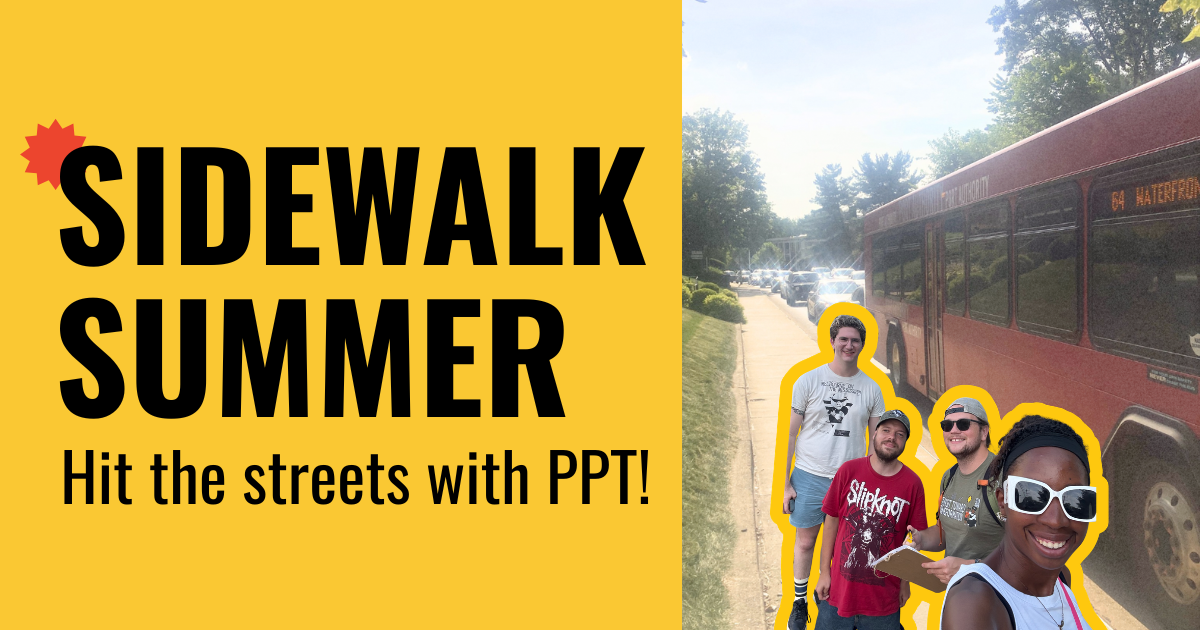
Sidewalk summer is back: hit the streets with PPT for sidewalk audits
Image Description: PPT members highlighted in yellow, on a glowy background of a bus stop on a summer day.
Bust out those cell phones and lace up those sneakers!Transit riders in Pittsburgh want more bus shelters, better bus stop amenities and connected sidewalks that take us to and from where we need to go! Our biggest takeaway from two years of bus shelter audits is that we cannot have bus shelters, benches and other amenities installed at our bus stops if our sidewalks are in poor or nonexistent condition.
Following the lead of our friends Pittsburgh Walks, PPT will host a series of sidewalk audits this spring and summer focusing on neighborhoods with high rider bus stops and busy transit corridors.
We will assess the quality of sidewalks in Pittsburgh and record findings via a mobile survey developed by the City of Pittsburgh. The collected data helps the City identify where sidewalks need to be improved or built, prioritize pedestrian infrastructure projects, and make the case for sidewalk funding.
The goal of these sidewalk audits is for participants to learn how to use this new tool and go on to gather data independently. Ultimately we aim to collect information about sidewalks (or where they’re missing) for every street in the City. This is a group effort and WE NEED YOU!
Audit Dates & Registration:Saturday May 16th 10am – 12pm, Sheraden
Saturday June 27th 10am-12pm, Hazelwood
Saturday August 29th 10am -12pm, Hill District
- Before the event, participants must watch this 15 minute video.
- Have a lesson on what makes sidewalks safe and accessible, how to use the web application.
- Pair up to walk several blocks of neighborhood streets, and record our observations using an online survey on our cell phones.
- Must have charged cell phone that can reach the internet and take photos.
- Must be able to navigate web browsers and privacy settings on cell phone.
- Pittsburgh weather can be unpredictable this time of year! Come dressed for the elements (good walking shoes, winter coats, hats, gloves, etc.). We will be outside for about an hour.
- We cannot guarantee the accessibility or safety of these walks as some of the terrain may have broken to no sidewalks. Some regions may be hilly and harder to walk on.
- Blind and low vision people will not be able to use the mobile survey application, but your input is of great value. You will be paired with a sighted person so that you can access the survey.
- If you have individual accessibility questions, or to request ASL interpretation, please reach out to Nicole@pittsburghforpublictransit.org.
- ASL interpretation must be requested at least 2 weeks in advance.
You can attend on your own, or bring a group of neighbors, friends, family, or coworkers! This is a great way to get your steps in, meet fellow community members, and help make our streets safe, accessible, and enjoyable for everyone!
The post Sidewalk summer is back: hit the streets with PPT for sidewalk audits appeared first on Pittsburghers for Public Transit.
AFSA Newsletter | January – March, 2026
This first quarter 2026 edition of the AFSA Newsletter captures a period of intense reflection, sharpened advocacy, and strategic action across Africa and beyond. From Lilongwe to Dakar, Garuga to Cartagena, AFSA and its members engaged critical questions shaping the future of African food systems, including school meals, land justice, seed sovereignty, public agricultural finance, cross border agroecological trade, territorial markets, and citizen mobilisation. Across these interventions, one message stands out clearly: the struggle for food sovereignty is not only about production, but also about power, policy, markets, culture, and the right of African people to define their own food futures.
In these pages, readers will see how AFSA continued to link grassroots realities with continental and global advocacy. This edition highlights the adoption of the Lilongwe Declaration on agroecology based school and college meals, AFSA’s participation in ICARRD+20 in Colombia, the launch of a major report on the African Development Bank’s role in reshaping African agriculture, renewed calls to centre farmers in regional seed policy processes, and important internal moments of alignment through the AFSA staff retreat, the Citizens Working Group on Agroecology meeting, and the TAFS annual review workshop. It also documents growing momentum in public campaigns and movement spaces, including the #MyFoodMyIdentity online campaign and continued efforts to strengthen agroecological trade, territorial markets, and African food cultures.
What this edition reflects most of all is AFSA’s continued commitment to building a food systems movement rooted in justice, resilience, dignity, and African knowledge. Whether confronting corporate capture, defending land and seed rights, supporting local markets, or reshaping public narratives around food, AFSA’s work remains anchored in the conviction that Africa’s food future must be led by its farmers, communities, women, youth, and social movements. We invite you to read, reflect, and continue walking with us as we strengthen the movement for agroecology and food sovereignty across the continent.
Download the newsletter herePages
The Fine Print I:
Disclaimer: The views expressed on this site are not the official position of the IWW (or even the IWW’s EUC) unless otherwise indicated and do not necessarily represent the views of anyone but the author’s, nor should it be assumed that any of these authors automatically support the IWW or endorse any of its positions.
Further: the inclusion of a link on our site (other than the link to the main IWW site) does not imply endorsement by or an alliance with the IWW. These sites have been chosen by our members due to their perceived relevance to the IWW EUC and are included here for informational purposes only. If you have any suggestions or comments on any of the links included (or not included) above, please contact us.
The Fine Print II:
Fair Use Notice: The material on this site is provided for educational and informational purposes. It may contain copyrighted material the use of which has not always been specifically authorized by the copyright owner. It is being made available in an effort to advance the understanding of scientific, environmental, economic, social justice and human rights issues etc.
It is believed that this constitutes a 'fair use' of any such copyrighted material as provided for in section 107 of the US Copyright Law. In accordance with Title 17 U.S.C. Section 107, the material on this site is distributed without profit to those who have an interest in using the included information for research and educational purposes. If you wish to use copyrighted material from this site for purposes of your own that go beyond 'fair use', you must obtain permission from the copyright owner. The information on this site does not constitute legal or technical advice.
 This site is not the official webpage of the Industrial Workers of the World.