You are here

Industrial Workers of the World (IWW)

Lockdown Defends the Albany Bulb! More Support Needed

From the Earth First! Newswire - May 16, 2014

Disclaimer: The views expressed here are not the official position of the IWW (or even the IWW’s EUC) and do not necessarily represent the views of anyone but the author’s.

A lockdown at the Albany Bulb ensured defense of the land for one more day yesterday.

Activist with the IWW Environmental Caucus and EF!er, Elliot Hughes, explained, “Today, I locked down to a backhoe and negotiated with Albany police that the Amber’s house and the two barricaded roads leading to it would not be demolished for the day after hearing cops threaten to demolish her house early in the morning. We need support to stop the eviction of the Albany Bulb ASAP!.”

The Albany Bulb is, according to its declaration, “an Autonomous Zone, a space where Art and Music continue to flourish, where People assemble Freely, where Dogs run unleashed, and where long-term Residents can continue to maintain and improve their Homesteads.”

The Bulb is known has been known as an anarchic place for a long time. Tolerance for camping has allowed human and nonhuman inhabitants to live and flourish among the tidal mudflats, sub tidal eel grass and salt marsh gum plants. The area is populated by barn owls, snakes, hawks, songbirds, and black-tailed hares, along with vegetation like Himalayan blackberries, acacia trees, and palms.

According to the website, Share the Bulb, “Over the past three decades, Nature and a particularly resourceful group of homeless people have reclaimed the Bulb as a wild space and a community space. The combination of reclaimed nature, community, and outsider art have made this former dump one of the most beautiful peninsulas into the San Francisco Bay, and has attracted daily dog-walkers, day-strollers, curious wanderers, picnickers, and others to an amazing place that reminds us of the many ways humans need the wild”

Last November, the state tried to forcibly evict the bulb, leading to barricades and an encampment. Residents sued the city to halt the eviction, and the suit was settled last month.

Chicago IWW Statement on May Day Arrests

Statement by the Chicago IWW - May 5, 2014

It is the official position of the Chicago branch of the Industrial Workers of the World (IWW) that the actions of the Chicago Police Department (CPD) and the marshals affiliated with Service Employees International Union (SEIU) and the Illinois Coalition for Immigrant and Refugee Rights (ICIRR) at the May 1st March to Stop Deportations were grossly inappropriate and condemnable. In collusion with the CPD, these marshals singled out and physically restrained two activists, leading to their arrests. While the arrests occurred, the marshals attempted to surround and enclose members of the IWW’s Red and Black Brigade contingent of the march, blocking their freedom of movement. The marshals also directed other participants to move past the enclosed contingent, preventing the other marchers from showing solidarity with the arrestees.

Jose “Zé” Garcia and Anne Meredith Wooton, the activists arrested during the march, have the full support of the Chicago branch of the IWW. Zé was released without charges, and Anne Meredith is facing misdemeanor charges. Zé is an outspoken advocate against ICIRR’s reformist policies, and actively spreads awareness of their tactics against dissenters. They are currently in the midst of fighting their own deportation. These facts, along with witness testimonials, suggest that these arrests may have been politically motivated. ICIRR’s official statement is that it was not their intention for these arrests to occur, while SEIU has not, to our knowledge, commented on the incident.

The actions of the marshals enabled the arrests. It is important that public marches be open to all who wish to participate without fear of state harassment, repression, and persecution. Above all, no one should be singled out for arrest based on their residency status—especially at a march against deportations. Given the historical legacy of May Day, it is crucial that anti-authoritarian and dissenting voices not be silenced by the state or its collaborators. If organizers expect broad participation at marches in the future, they must ensure that marshals do not aid in arrests and that solidarity with anyone who may be arrested is allowed. The IWW will always stand by the principle that an injury to one is an injury to all.

Zé has set up a GoFundMe page where you can read their personal account of the incident and donate to, in their own words, “help me fight my deportation so I can continue my fight against a brutal and illegitimate regime, my fight against the sellouts, my fight against EVERY deportation.”

An Interview With Staughton Lynd About the Labor Movement

By Andy Piascik - ZComm.net, April 30, 2014

Disclaimer: The views expressed here are not the official position of the IWW (or even the IWW’s EUC) and do not necessarily represent the views of anyone but the author’s.

For more than 50 years, Staughton Lynd has been a leading radical in the United States. He was an engaged supporter of the Black Liberation Movement in the Deep South in the early 1960’s, most notably as coordinator of the Freedom Schools during Mississippi Summer in 1964. He was an active opponent of US aggression in Indochina, including as chairperson of the first national demonstration against the war in Vietnam in April 1965.[1] In recent decades, Lynd has been an attorney representing prisoners, particularly at the Ohio State Penitentiary in Youngstown, and has written a book, a play and numerous articles about the 1993 uprising at the Southern Ohio Correctional Facility in Lucasville.[2]

Since the late 1960’s, Lynd has also been deeply involved in the labor movement as an activist, attorney and prolific writer.[3] Inspired by Marty Glaberman, Stan Weir and Ed Mann,[4] Lynd has been a passionate and prolific proponent of decentralized, rank-and-file driven unionism. In November 2014, Haymarket Books will publish a book by Lynd entitled Doing History from the Bottom Up: On E.P. Thompson, Howard Zinn, and Rebuilding the Labor Movement from Below and a new edition of his book Solidarity Unionism: Rebuilding the Labor Movement from Below with an introduction by radical labor scholar and activist Immanuel Ness will be published by PM Press in Spring 2015.

Piascik: What is your general view of the state of organized labor in the United States today?

Lynd: My general view, like that of everyone else, is that the labor movement is in catastrophic decline. My particular view is that the reason for this decline is not the Supreme Court, or the McCarthy period, or anything that might be remedied by changing the top leadership of unions, but the model of trade union organizing that has existed in all CIO unions since 1935. The critical elements of this model are: 1) Exclusive representation of a bargaining unit by a single union; 2) The dues check-off, whereby the employer deducts dues for the union from the paycheck of every member of the bargaining unit; 3) A clause prohibiting strikes and slowdowns for the duration of the contract; 4) A “management prerogatives” clause giving the employer the right to make investment decisions unilaterally.

In combination these clauses in the typical CIO contract give the employer the right to close the plant and prevent the workers from doing anything about it. So long as collective bargaining agreements conform to this template, the election of a Miller, a Sadlowski, a Carey, a Sweeney, or a Trumka will not bring about fundamental change.

Piascik: You have written extensively about the working class upheaval of the 1930’s, both the early years of the decade and the formation of the CIO.[5] How and why was the CIO consolidated as a top-down organization?

Lynd: It tends to be forgotten that the CIO was created by John L. Lewis. There is now a significant body of scholarship to the effect that 1) Lewis centralized the administration of the UMW so as to minimize the traditional influence of local unions and ran the national union in an altogether high-handed manner; 2) Lewis went out of his way to assure the business community that if they bargained with the CIO such phenomena as wildcat strikes would become a thing of the past; 3) many liberals and radicals such as Roger Baldwin of the ACLU opposed the Wagner Act, believing correctly that the result would be exactly what has occurred and that alternatives such as the Progressive Miners in southern Illinois would be steamrollered; 4) contrary to popular belief, the revival of unionism among miners began from below before the passage of the National Recovery Act with its Section 7 during the Spring of 1933 and the long-lasting miners’ strike the following summer was created and persisted in by rank-and-file miners despite endless attempts by Lewis and his lieutenant Philip Murray to settle it from above.

Piascik: You consistently underscore the importance of local initiatives. What do such initiatives look like in practice and why might they be more fruitful than national reform campaigns?

Lynd: At first glance any imaginable agglomeration of local groups appears helpless in contrast to gigantic international corporations. Indeed, in my early struggles with this dilemma, I highlighted the absence in the steel industry in the 1930s of effective coordination between new local unions improvised by the rank and file in a variety of locations.

The same problem presents itself today as low-wage workers in a variety of communities are simultaneously assisted, but also managed by, existing national unions like the UFCW and SEIU. For the moment, the unions say they only want to help these workers win specific demands through direct action. Down the road, however, these same unions may seek to make local direct actions serve as stepping stones to their familiar objective: exclusive bargaining status, complete with dues check-off and no-strike clause.

Arriving at May Day: Lockdowns, Throwdowns, and Direct Action

By the Earth First! Journal Staff - Earth First! Journal, May 1, 2014

Disclaimer: The views expressed here are not the official position of the IWW (or even the IWW’s EUC) and do not necessarily represent the views of anyone but the author’s.

When the Global Climate Convergence announced the Earth Day to May Day series of events and actions, it revealed a gap between daily reality and Hallmark posturing. More than 100 actions—such as the occupation of the DEQ in Portland, Oregon, by Rising Tide—have taken place in dozens of cities as part of the Climate Convergence.

Over the last few days, IWW fellow workers in California have protested the Koch Bros PetCoke Facility in Pittsburg, the Chevron Refinery in Richmond, and Crude by Rail at the Union Pacific’s Ozal Train Yard in Martinez.

One Wob organizer named Elliot Hughes U-locked himself to the gate of the Koch Brothers facility to halt business as usual. “Our goal is the liberation of the people on the planet that is our home. With the increasing amount of industrial disasters, we cannot wait any longer because the health and safety of all workers of the world is on the line.”

EF! shares numerous crucial membranes with the IWW and the labor movement, dating back to Judi Bari’s founding of the IWW timber workers local #1 in Northern California in the late 1980s. The goal of uniting loggers against Maxxam’s junk bond dealing, land grabbing, and clear cutting was to restore timber lands to the public interest. While some hardcore EF!ers were repulsed by the notion of chatting up loggers, let alone working to move timber lands into the hands of communities that would take part in “sustainable logging,” most agreed that the terms were vastly superior to clear cutting old growth.

Indeed, growth from the Redwood Summer movement at the turn of the 1990s fed the entire radical movement, developing critical understandings that would be cultivated and emerge in Seattle 1999 and again during Occupy. According to stories passed down to us over the years, activists being shot at in Northern California’s redwood forest by the same loggers they were trying to organize later on that night in the barroom would, ten years down the line, take part in the free states of Cascadia, and the No Borders Camp of the Sonoran desert five years later.

In the words of Buenaventura Durutti, “The bourgeoisie might blast and ruin its own world before it leaves the stage of history. We carry a new world here, in our hearts. That world is growing in this minute.” The inter-generational movement of Earth First! grows in the interstices of stories and ideologies, yet we often lag behind when it comes to social analysis.

May Day 2014: Reviving The General Strike

By Staughton Lynd
This article originally appeared in the May 2014 Industrial Worker

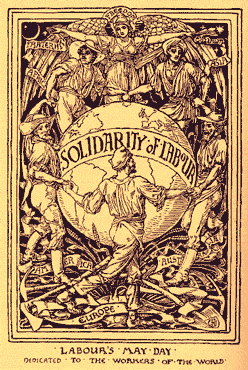
On May 1, 1886, the first general strike in U.S. history brought workers into the streets on behalf of one simple demand: an eight-hour working day. Their anthem was:
“We want to feel the sunshine;
We want to smell the flowers;
We’re sure (that) God has willed it
And we mean to have eight hours.

We’re summoning our forces from
Shipyard, shop and mill;
Eight hours for work, eight hours for rest,
Eight hours for what we will.”

As is the case in the movement of low-wage workers today, the movement for eight hours was characterized by skilled and less-skilled workers, and workers in different trades, making common cause.

On May 3, 1886, union members at the McCormick Reaper Works in Chicago, who had been locked out, confronted strikebreakers as they left the plant. A firefight broke out involving the police, and strikers were killed. In response a protest rally was called at a downtown open area called The Haymarket. The rally was peaceful, but as the meeting was coming to an end someone threw a bomb and seven policemen died. After a dramatic trial and unsuccessful appeals, four so-called “anarchists” were hanged.

This story became familiar to working-class movements all over the world. May 1 became international May Day. In Mexico City, it has been a tradition that every May Day translated excerpts from the last words of two of the executed men, Albert Parsons and August Spies, are read aloud to huge crowds in the central public square, or zocalo.

The Brief Origins of May Day

By Eric Chase - Published on IWW.ORG, written ca.1993.

Most people living in the United States know little about the International Workers' Day of May Day. For many others there is an assumption that it is a holiday celebrated in state communist countries like Cuba or the former Soviet Union. Most Americans don't realize that May Day has its origins here in this country and is as "American" as baseball and apple pie, and stemmed from the pre-Christian holiday of Beltane, a celebration of rebirth and fertility.

In the late nineteenth century, the working class was in constant struggle to gain the 8-hour work day. Working conditions were severe and it was quite common to work 10 to 16 hour days in unsafe conditions. Death and injury were commonplace at many work places and inspired such books as Upton Sinclair's The Jungle and Jack London's The Iron Heel. As early as the 1860's, working people agitated to shorten the workday without a cut in pay, but it wasn't until the late 1880's that organized labor was able to garner enough strength to declare the 8-hour workday. This proclamation was without consent of employers, yet demanded by many of the working class.

At this time, socialism was a new and attractive idea to working people, many of whom were drawn to its ideology of working class control over the production and distribution of all goods and services. Workers had seen first-hand that Capitalism benefited only their bosses, trading workers' lives for profit. Thousands of men, women and children were dying needlessly every year in the workplace, with life expectancy as low as their early twenties in some industries, and little hope but death of rising out of their destitution. Socialism offered another option.

A variety of socialist organizations sprung up throughout the later half of the 19th century, ranging from political parties to choir groups. In fact, many socialists were elected into governmental office by their constituency. But again, many of these socialists were ham-strung by the political process which was so evidently controlled by big business and the bi-partisan political machine. Tens of thousands of socialists broke ranks from their parties, rebuffed the entire political process, which was seen as nothing more than protection for the wealthy, and created anarchist groups throughout the country. Literally thousands of working people embraced the ideals of anarchism, which sought to put an end to all hierarchical structures (including government), emphasized worker controlled industry, and valued direct action over the bureaucratic political process. It is inaccurate to say that labor unions were "taken over" by anarchists and socialists, but rather anarchists and socialist made up the labor unions.

Green Unionism Strategy and Tactics - Railroad Workers and Crude by Rail Trains

By x344543, x356039, and x363464 - April 29, 2014

Disclaimer: The views expressed here are not the official position of the IWW (or even the IWW’s EUC) and do not necessarily represent the views of anyone but the author’s. This is not an official statement of either Forest Ethics or Railroad Workers United, and neither organization has vetted this article.

As many of you may be aware, there has been a growing uproar against crude-by-rail, which is one of the major components of the current fossil fuel capitalist driven extreme energy boom. This is due in large part to the fact that there were more derailments involving crude-by-rail trains in 2013 alone than the previous four decades combined. In some cases, like Lac Megantic, whole towns have been nearly wiped off of the map.

This is particularly true in the San Francisco Bay Area where residents in five different communities dominated by oil refineries are organizing to prevent increased transportation of crude-by-rail into their homes. The organizers have built coalitions with local environmental and social justice groups as well as called upon the support of environmental NGOs. Their efforts have included speaking out at public forums, attending public hearings, watch-dogging the regulatory process (such as it is), participation in in electoral campaigns, producing alternative media, rallies, marches, and even nonviolent civil disobedience.

These community activists have even cultivated relationships with rank and file workers employed by the refineries--at least those not buying the company line. Still, there's another group of workers that these coalitions could approach, and that is the railroad workers themselves, but how to do it?

Many of our fellow workers who are union railroad workers are quick to point out that in spite of all of the recent derailments, rail is nevertheless the safest mode of transportation of crude, even the heavy and dirty crude resulting from the extreme energy extraction of tar sands and shale, relative to all of the others. This, of course, is a matter of degrees.

Transportation of heavy crude by any means is a risky business. In addition to derailments, there have been oil spills by ship and pipeline breakages. As the folks at Forest Ethics have pointed out, there is really no completely safe way to transport this stuff.

And the railroad workers to which we have spoken have hinted that they're entirely supportive of the efforts to transition away from fossil fuels to greener, non-polluting alternatives. It's just that of all of the cargoes they transport, crude-by-rail is but one of many dangerous examples.

So, can there be any common ground between the community organizers and railroad workers? The answer is, "yes" (according to those very same railroad workers).

(Members of the) IWW Environmental Unionist Caucus protests Koch Bros, Chevron, and Crude by Rail

By Karen Hansen - SF Environmental News Examiner, April 28, 2014

Disclaimer: The views expressed here are not the official position of the IWW (or even the IWW’s EUC) and do not necessarily represent the views of anyone but the author’s.

The Environmental Unionist Caucus announced they will protest the Koch Bros PetCoke Facility today Monday, April 28 in Pittsburg; the Chevron Refinery tomorrow Tuesday, April 29 in Richmond; and Crude by Rail at the Union Pacific’s Ozal Train Yard in St. April 30 Martinez, Calif.

Union organizer and environmental activist Elliot Hughes released a statement this morning that his organization would be taking several direct actions over the next 3 days to orchestrate a general strike of the poor, the unemployed, and the working class. “Our goal is the liberation of the people on the planet that is our home. With the increasing amount of industrial disasters, we cannot wait any longer because the health and safety of all workers of the world is on the line.”

IWW Environmental Unionism Caucus on Terra Verde on Pacifica Radio KPFA 94.1 FM

Originally posted here - link

Disclaimer: The views expressed here are not the official position of the IWW (or even the IWW’s EUC) and do not necessarily represent the views of anyone but the author’s.

Earth Day is around the corner and May Day is coming up too, so what better time to discuss the ways that the labor and environmental movements intersect. Tune in to hear from three organizers who are bringing together many kinds of workers around the Bay toward a new economy with environmental aims: Brooke Anderson of Movement Generation Justice and Ecology Project, Stephanie Hervey of the Sunflower Alliance and the Action Hub in Richmond, and Elliot Hughes of the Industrial Workers of the World’s Environmental Unionism Caucus.

MP3 Audio File

For more on the Earth Day to May Day assembly, visit - earthdaytomaydayassembly.org.

Ecology, Ethics, Anarchism: In Conversation with Noam Chomsky (Updated with Transcript!)

By Javier S. Castro - Notes Towards an International Libertarian Socialism, March 31, 2013

Disclaimer: The views expressed here are not the official position of the IWW (or even the IWW’s EUC) and do not necessarily represent the views of anyone but the author’s.

This is a video of my interview with Noam Chomsky that took place at his office at MIT on Friday, 28 March 2014.  We discussed the place of anarchism and anarcho-syndicalism vis-à-vis the profound and ever-worsening environmental and climatic crises today.  Specifically, we conversed about Immanuel Kant, the Enlightenment, participatory economics (Parecon), indigenous struggle, the commons, direct action, really existing capitalist democracy (RECD), vegetarianism and veganism, conservatism, democracy, and reform vs. revolution.

Transcript courtesy of truthout.org - used by permission

There can be little doubt about the centrality and severity of the environmental crisis in the present day. Driven by the mindless "grow-or-die" imperative of capitalism, humanity's destruction of the biosphere has reached and even surpassed various critical thresholds, whether in terms of carbon emissions, biodiversity loss, ocean acidification, freshwater depletion, or chemical pollution. Extreme weather events can be seen pummeling the globe, from the Philippines - devastated by Typhoon Haiyan in November of last year - to California, which is presently suffering from the worst drought in centuries. As Nafeez Ahmed has shown, a recently published study funded in part by NASA warns of impending civilizational collapse without radical changes to address social inequality and overconsumption. Truthout's own Dahr Jamail has written a number of critical pieces lately that have documented the profundity of the current trajectory toward anthropogenic climate disruption (ACD) and global ecocide: In a telling metaphor, he likens the increasingly mad weather patterns brought about by ACD to an electrocardiogram of a "heart in defibrillation."

Rather than conclude that such distressing trends follow intrinsically from an "aggressive" and "sociopathic" human nature, reasonable observers should likely associate the outgrowth of these tendencies with the dominance of the capitalist system, for, as Oxfam noted in a January 2014 report, the richest 85 individuals in the world possess as much wealth as a whole half of humanity - the 3.5 billion poorest people - while just 90 corporations have been responsible for a full two-thirds of the carbon emissions generated since the onset of industrialism. As these staggering statistics show, then, the ecological and climatic crises correspond to the extreme concentration of power and wealth produced by capitalism and upheld by the world's governments. As a counter-move to these realities, the political philosophy of anarchism - which opposes the rule of both state and capital - may hold a great deal of promise for ameliorating and perhaps even overturning these trends toward destruction. Apropos, I had the great good fortune recently to interview Professor Noam Chomsky, renowned anarcho-syndicalist, to discuss the question of ecological crisis and anarchism as a remedy. Following is a transcript of our conversation.

JAVIER SETHNESS FOR TRUTHOUT: Professor Chomsky, thank you so kindly for taking the time today to converse with me about ecology and anarchism. It is a true honor to have this opportunity to speak with you. Before we pass to these subjects, though, I would like to ask you initially about ethics and solidarity. Would you say that Immanuel Kant's notion of treating humanity as an end in itself has influenced anarchist and anti-authoritarian thought in any way? The concept of natural law arguably has a "natural" affinity with anarchism.

NOAM CHOMSKY: Indirectly, but I think it's actually more general. My own view is that anarchism flows quite naturally out of major concerns and commitments of the Enlightenment, which found an expression in classical liberalism, and classical liberalism essentially was destroyed by the rise of capitalism - it's inconsistent with it. But anarchism, I think, is the inheritor of the ideals that were developed in one or another form during the Enlightenment - Kant's expression is one example - exemplified in a particular way in classical liberal doctrine, wrecked on the shoals of capitalism, and picked up by the libertarian left movements, which are the natural inheritors of them. So in that sense, yes, but it's broader.

You have described humanity as being imperiled by the destructive trends on hand in capitalist society - or what you have termed "really existing capitalist democracies" (RECD). Particularly of late, you have emphasized the brutally anti-ecological trends being implemented by the dominant powers of settler-colonial societies, as reflected in the tar sands of Canada, Australia's massive exploitation and export of coal resources, and, of course, the immense energy profligacy of this country. You certainly have a point, and I share your concerns, as I detail in Imperiled Life: Revolution against Climate Catastrophe, a book that frames the climate crisis as the outgrowth of capitalism and the domination of nature generally understood. Please explain how you see RECD as profoundly at odds with ecological balance.

RECD - not accidentally, pronounced "wrecked" - is really existing capitalist democracy, really a kind of state capitalism, with a powerful state component in the economy, but with some reliance on market forces. The market forces that exist are shaped and distorted in the interests of the powerful - by state power, which is heavily under the control of concentrations of private power - so there's close interaction. Well, if you take a look at markets, they are a recipe for suicide. Period. In market systems, you don't take account of what economists call externalities. So say you sell me a car. In a market system, we're supposed to look after our own interests, so I make the best deal I can for me; you make the best deal you can for you. We do not take into account the effect on him. That's not part of a market transaction. Well, there is an effect on him: there's another car on the road; there's a greater possibility of accidents; there's more pollution; there's more traffic jams. For him individually, it might be a slight increase, but this is extended over the whole population. Now, when you get to other kinds of transactions, the externalities get much larger. So take the financial crisis. One of the reasons for it is that - there are several, but one is - say if Goldman Sachs makes a risky transaction, they - if they're paying attention - cover their own potential losses. They do not take into account what's called systemic risk, that is, the possibility that the whole system will crash if one of their risky transactions goes bad. That just about happened with AIG, the huge insurance company. They were involved in risky transactions which they couldn't cover. The whole system was really going to collapse, but of course state power intervened to rescue them. The task of the state is to rescue the rich and the powerful and to protect them, and if that violates market principles, okay, we don't care about market principles. The market principles are essentially for the poor. But systemic risk is an externality that's not considered, which would take down the system repeatedly, if you didn't have state power intervening. Well there's another one, that's even bigger - that's destruction of the environment. Destruction of the environment is an externality: in market interactions, you don't pay attention to it. So take tar sands. If you're a major energy corporation and you can make profit out of exploiting tar sands, you simply do not take into account the fact that your grandchildren may not have a possibility of survival - that's an externality. And in the moral calculus of capitalism, greater profits in the next quarter outweigh the fate of your grandchildren - and of course it's not your grandchildren, but everyone's.

Pages

The Fine Print I:

Disclaimer: The views expressed on this site are not the official position of the IWW (or even the IWW’s EUC) unless otherwise indicated and do not necessarily represent the views of anyone but the author’s, nor should it be assumed that any of these authors automatically support the IWW or endorse any of its positions.

Further: the inclusion of a link on our site (other than the link to the main IWW site) does not imply endorsement by or an alliance with the IWW. These sites have been chosen by our members due to their perceived relevance to the IWW EUC and are included here for informational purposes only. If you have any suggestions or comments on any of the links included (or not included) above, please contact us.

The Fine Print II:

Fair Use Notice: The material on this site is provided for educational and informational purposes. It may contain copyrighted material the use of which has not always been specifically authorized by the copyright owner. It is being made available in an effort to advance the understanding of scientific, environmental, economic, social justice and human rights issues etc.

It is believed that this constitutes a 'fair use' of any such copyrighted material as provided for in section 107 of the US Copyright Law. In accordance with Title 17 U.S.C. Section 107, the material on this site is distributed without profit to those who have an interest in using the included information for research and educational purposes. If you wish to use copyrighted material from this site for purposes of your own that go beyond 'fair use', you must obtain permission from the copyright owner. The information on this site does not constitute legal or technical advice.