You are here
News Feeds
No Surrender
Health care, not warfare
Information Is Essential
NNU nurses rally to abolish ICE, lobby Congressmembers
Community shows up for Traverse City nurses
Fighting for what we are worth
RNs and health care workers strike at three Prime hospitals
New York City nurses win after largest nurse strike in city history
CA oil permits skyrocket in 2026’s first quarter; majority are for Chevron wells
The post CA oil permits skyrocket in 2026’s first quarter; majority are for Chevron wells appeared first on Last Chance Alliance.
The next era of Atlantic hurricanes could be far more destructive
This is a re-post from Yale Climate Connections by Jeff Masters
In brief:
- Scientists expect dramatic swings between active and inactive hurricane seasons in the future.
- The risk of back-to-back hurricanes is growing.
- Hurricanes are expected to get more damaging and deadly.
Wild year-to-year swings — from punishing hyperactive seasons to quiet years with little activity — could well become the norm for future Atlantic hurricane seasons, according to recent climate change research.
The latest science paints a complex but alarming future, as the unprecedented amount of heat that humans are supplying to the climate system disrupts the fundamental atmospheric circulation pattern in which we designed our civilization.
During the coming busy seasons, death and destruction from unprecedented hurricane catastrophes will probably grow much more commonplace, because even as risks grow, people have continued to build in risky flood-prone regions. But eventually, the coming hurricane catastrophes will pose an increasing threat to the viability of living in many coastal areas, particularly in the Caribbean.
Hurricane seasons will likely grow more erraticThe year-to-year variability of Atlantic basin hurricane activity already is the largest of any of the globe’s tropical cyclone basins. And climate change will make extreme swings between active and inactive hurricane seasons the norm, according to a 2024 paper, Projected increase in the frequency of extremely active Atlantic hurricane seasons.
The high-resolution climate models used in the study projected a 36% increase by 2050 in the variance of Atlantic tropical cyclone activity. The main causes: an increase in the variability of wind shear (strong upper-level winds that tend to tear a storm apart), and major swings in how stable the atmosphere is in the tropical Atlantic. One good thing is that the study found that the increased activity during hyperactive seasons would be focused farther from land over the eastern and central Atlantic, with less activity over the Caribbean.
A 2022 study, Extreme Atlantic hurricane seasons made twice as likely by ocean warming, found that ocean warming from 1982 to 2020 doubled the probability of extremely active hurricane seasons over that time period. However, the authors did not clearly separate out how much of that change resulted from increased heat-trapping greenhouse gases and how much was caused by a reduction in planet-cooling air pollution particles called aerosols. These particles are not likely to change much in the future, while greenhouse gases will be increasing, so it is important to know their relative impacts on ocean warming.
More double whammies: back-to-back hurricane threats are increasingThe worst sequential hurricane disaster on record for the Atlantic occurred in 2020 in Nicaragua and Honduras.
Hurricane Eta made landfall in northern Nicaragua on Nov. 3, 2020, as a Category 4 storm. Moving slowly at landfall, Eta lingered for three days over Central America and the adjacent waters, dropping catastrophic amounts of rain.
Just two weeks later, Hurricane Iota made landfall as a Category 4 storm in Nicaragua only 15 miles from where Eta hit. Iota brought torrential rains that inundated flooded regions still struggling to recover from Eta, with the combined tolls from the two storms exceeding 300 people dead or missing.
There was no precedent in the Atlantic for two such powerful hurricanes to make landfall so close together in space and time. The combined impact of the two hurricanes on Nicaragua was estimated at $738 million – about 6% of that nation’s GDP.
But the twin Category 4 hurricanes left behind an even more extreme catastrophe in Honduras. The U.N. estimated that total damages from Hurricane Eta and Hurricane Iota in Honduras exceeded $2 billion – 8% of the poverty-stricken nation’s GDP.
In the future, an increase in hyperactive hurricane seasons will boost the threat of two hurricanes striking the same place within a few weeks of each other. Overlapping disasters could threaten the Gulf of Mexico region with a cycle of “perpetual disaster recovery” — making communities vulnerable to worse outcomes with every subsequent event, researchers at the National Academies wrote in a 2024 report.
A 2022 paper, Increasing sequential tropical cyclone hazards along the US East and Gulf coasts, found that in the current climate, two named storms hitting the same location within 15 days along the U.S. East and Gulf coasts and bringing significant hazards (strong winds, heavy rainfall and storm surges) could be expected to occur once every 10 to 92 years. But under a moderate emissions scenario, this return period could be expected to shrink to just one to three years because of sea-level rise and a change in storm climatology. The odds of a Katrina-like hurricane and a Harvey-like hurricane impacting the U.S. within 15 days of each other — which was non-existent in the historical period they simulated — was projected to have a one-in-650-year return period (or a 5% chance over 30 years) by the end of the century.
A massive 633% increase in hurricane damages to come?It is widely acknowledged that higher weather disaster losses result primarily from an increase in exposure: more people with more stuff moving into vulnerable places, including those at risk of floods.
Martin Bertogg, Swiss Re’s head of catastrophic peril, said in a 2022 AP interview that two-thirds, perhaps more, of the recent rise in weather-related disaster losses — including from hurricanes — is the result of more people and things in harm’s way.
But this balance will likely shift in the coming decades. For example, a 2025 study led by Avantika Gori of Rice University, Sensitivity of tropical cyclone risk across the US to changes in storm climatology and socioeconomic growth, looked at how damages from wind, rainfall, and storm surge would change under a moderate global warming scenario. The study found that the fraction of increased hurricane damages because of climate change would grow by the end of the century to be roughly equal to the increased damages from higher exposure (assuming a 2% annual growth in GDP). The combined increased costs for hurricane damage for the future (2070-2100) period compared to the historical (1980-2005) period would be truly extraordinary, if no additional adaptation measures are taken: a 633% increase, the paper said.
Gori’s prediction is by no means a worst-case outcome, because the study assumed a moderate global warming scenario. Even in a best-case scenario — which I’ll explore in a future post — development is going to continue in flood-prone places. And there are at least four ways that hurricane scientists are very confident that climate change will make hurricanes worse:
- The strongest hurricanes will get stronger.
- Hurricanes will rapidly intensify more quickly and more often.
- Hurricanes will dump more rain.
- Storm surge damage will rise because of rising sea levels.
Expect hurricanes to get more deadly
Accompanying the shocking increases in hurricane damages in our future will likely be sharply increased risks of high death tolls. Stronger, wetter, slower-moving storms will dump more rain, causing increased flood risk. Higher sea levels and stronger hurricanes will bring more dangerous storm surges and compound flood events. Post-storm power outages will coincide with heat waves more frequently, increasing heat mortality. More hurricanes will rapidly intensify just before landfall, leaving vulnerable populations unprepared, further increasing mortality risk.
Read: ‘Deadliest in generations’: The Texas floods are the latest in a disturbing pattern
Fortunately, steadily improving hurricane forecasts over the past 20 years have significantly lowered the risk of death, and the recent emergence of AI forecast models has been an exciting step forward. In some places, improved building codes have also reduced the hurricane damage and presumably, mortality risk. Nevertheless, it is concerning that the U.S. has suffered five hurricanes since 2005 that were deadlier than any hurricane since 1972.
A staggering indirect death toll from hurricanes: as high as 5% of the U.S. population?In a stunning paper released in 2024, Mortality caused by tropical cyclones in the United States, Rachel Young and Solomon Tsiang found that the average U.S. hurricane that made landfall between 1930 and 2015 caused 24 direct deaths.
However, they observed an increase in excess deaths – mortality beyond what would otherwise be expected in that period – that lingered for 15 years, totaling 7,000-11,000 excess deaths per storm. This burden is 300-480 times greater than government estimates of direct deaths and was equivalent to an astounding 3.2-5.1% of all deaths across the contiguous United States.
The largest single category of deaths was from cardiovascular disease (36%), while 12% of the deaths were from cancer, “consistent with some evidence of stress from extreme weather affecting long-run health,” the authors wrote. Between 1950 and 1995, monthly excess tropical cyclone deaths ranged from 4,500 to 6,000, then rose to about 7,500 per month by 2003. In 2004, an onslaught of landfalling hurricanes brought a sharp rise in the death rate, which peaked at approximately 13,000 per month in 2013.
Read: The hidden health toll of hurricanes
a). Total incidence of tropical cyclone excess mortality in the contiguous U.S by month. Bar height is sum of average maximum wind speeds for all state-by-storm events. Colors correspond to decades. b) Stacked overlapping excess mortality responses to each storm for all of the contiguous U.S. Outline colors correspond to the decade when the storm occurred. The upper envelope is the total estimated mortality burden resulting from all tropical cyclones occurring during the prior 172 months (14.3 years). c) Official direct tropical cyclone deaths by month according to NOAA. The y-axis scale is the same for b and c. (image credit: Young, R., Hsiang, S. Mortality caused by tropical cyclones in the United States. Nature 635, 121–128 (2024). https://doi.org/10.1038/s41586-024-07945-5, open access)
Young and Tsiang hypothesized five ways that hurricanes may have triggered excess mortality:
- Economic disruption might change household economic decisions, eventually translating into worsened health outcomes. For example, a person who loses a job might lose health insurance, too. Or retirement savings could be drawn down to repair property damage, both of which could reduce future spending on health care.
- Social network changes could affect future health. For example, working-age people might move away, changing the social support for older people who remain behind.
- Fiscal adjustments by state or local governments in response to the disaster may impact future health outcomes. For example, restructuring budgets to support recovery might reduce spending on healthcare infrastructure.
- Heightened physical and mental stress may alter health in the long term.
- Changes in the natural environment could harm health — for example, ecological changes could redistribute disease vectors, or flooding may expose populations to harmful chemicals.
Many of these factors can be expected to grow worse in the future, resulting in higher hurricane excess mortality.
What Can Napa Firewise Teach Us About Regional Wildfire Resilience?
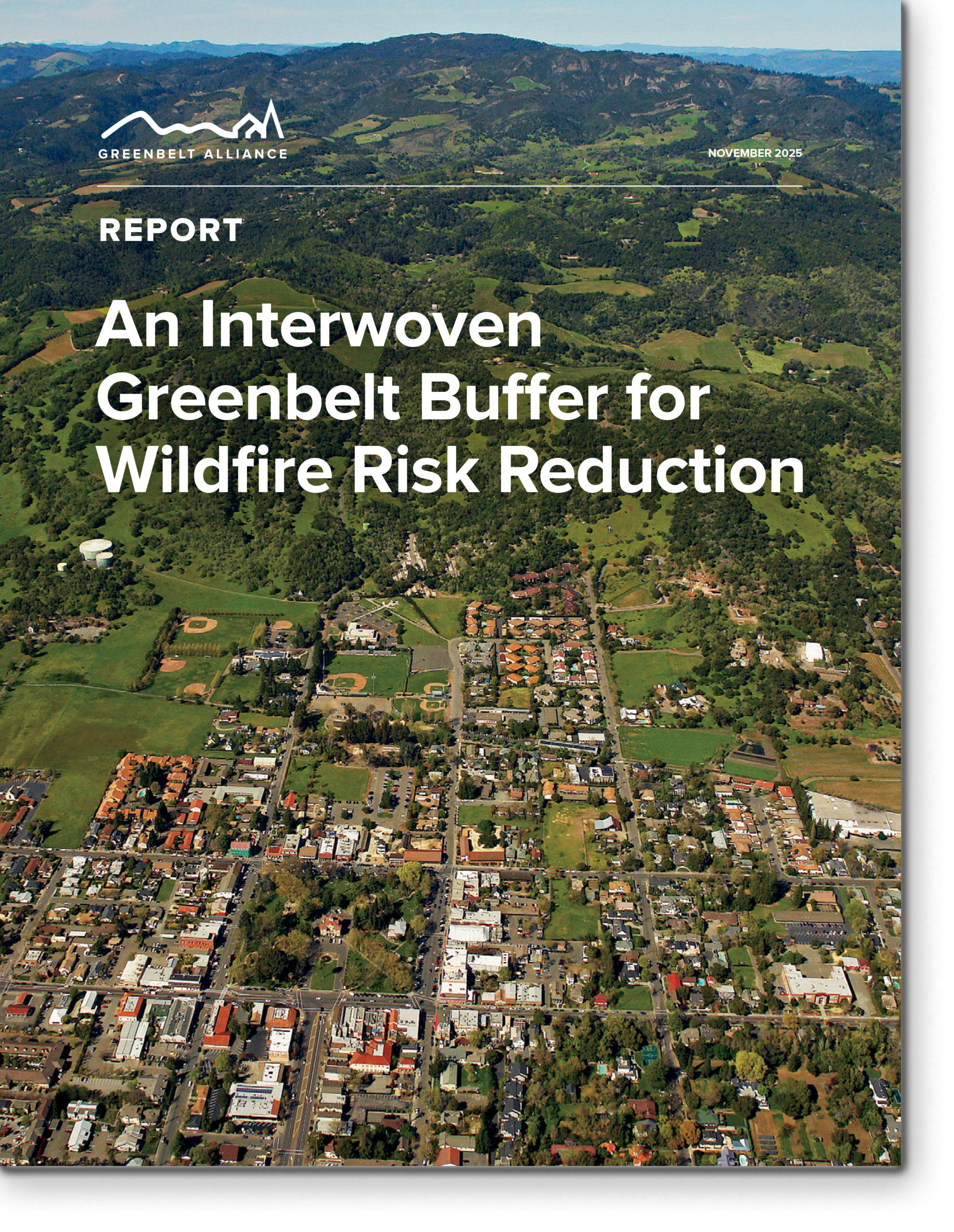
Over the last decade, Greenbelt Alliance has been advancing research on nature-based solutions and land-use planning best practices to achieve comprehensive wildfire resilience across our Bay Area landscapes. In our latest report, An Interwoven Greenbelt Buffer for Wildfire Risk Reduction, we discuss the challenges of implementing strategically-placed greenbelt buffers in existing communities, using Sonoma Springs as a case study.
One key takeaway from that research highlighted the need for regulatory and governance frameworks that enable effective collaboration among private property owners, government partners, and fire professionals.
One organization has emerged as a leader in doing just that – creating a collaborative system that delivers real results. Napa Communities Firewise Foundation (Napa Firewise) is a Napa County-based nonprofit supporting 25 Fire Safe Councils across the county.
This organization quietly built one of California’s most effective regional wildfire resilience models that centralizes grant writing, environmental compliance, and data collection under a single nonprofit “mothership” while keeping 25 community Fire Safe Councils as its connective tissue to residents on the ground- and in doing so, has already helped surface roughly $47 million in private resilience investments that firefighters and insurers never knew existed.
In this conversation, facilitated by Senior Director of Planning and Research, Sadie Wilson, Napa Firewise CEO Joe Nordlinger*, and Communications Director Stephanie Smithers** discuss how that structure works, the importance of engaging private landowners through their new Valley Stewards program, and how they’re bringing insurers back to fire-affected communities.
Joe Nordlinger* has been the CEO of Napa Firewise since 2024 and a volunteer with the organization since 2017. After the 2014 Wragg Canyon Fire got dangerously close to his hillside property in the lower Mayacamas, Joe was spurred to action. He got involved in the Mount Veeder Fire Safe Council, got trained as a volunteer firefighter, and has since continued to change the way we think about wildfire preparedness by bringing decades of experience in the business world to think differently about how communities work more efficiently and effectively to build resilience.
Stephanie Smithers** has been with the organization for two years after working in crisis communication and public information during the 2017 and 2020 fires in Napa Valley, and has been steeped in wildfire for the last decade, tracking wildland fire blogs, listening to radio traffic, and working to understand the landscape that her husband works in as a career firefighter.
This interview has been edited and condensed for clarity.
Curious to learn more? Read on for the in-depth conversation (click to expand) Napa Firewise operates a unique centralized model. What makes it work, and could it be applied elsewhere?Joe Nordlinger: In Napa, we filled a vacuum and were able to change the trajectory of how wildfire resilience was being approached in the county. We basically reorganized, recruited a new board, and decided that Napa Firewise would be the shared services platform doing all the grant writing, grants administration, environmental compliance, project development, and portfolio management for what are now 25 Fire Safe Councils.
There are absolutely lessons that could apply in other counties. One thing we’ve realized is that you have to think about your customers (homeowners, landowners, firefighters, etc.) and what the experience is like on their end. If the customer has to deal with nine different organizations, “Oh, you can go here for this. You can go there for that.” It just becomes so overwhelming and confusing that they tend to just get paralyzed.
That said, I’m aware we’re a smaller, more affluent county with fewer players and a tight alignment with CAL FIRE through Napa County Fire. But the core insight is structural efficiency. If you’re trying to support 20 different nonprofits, all with their own overhead, there simply isn’t enough money to do that. You have to be very efficient.
What we’ve uncovered is that there’s a lot of value in centralizing and aggregating data to drive better wildfire containment outcomes and better insurance outcomes.
If you have too many entities gathering their own data, you don’t benefit from the aggregation needed to get actionable intelligence to firefighters or tell a better story to insurers. And fragmentation is compounded by complacency; you go a few years without a fire, the vegetation grows back, and you can find yourself right back in a potential catastrophic situation.
Stephanie Smithers: The community preparedness paired with the fuels management that we do is imperative to supporting wildfire response. It really helps us burn on our terms so we can help manage fire behavior and create opportunities for firefighters to contain wildfires faster and more safely.
What Napa Firewise does well is understand that we must be flexible. It isn’t a cookie-cutter approach. The needs and risks vary by neighborhood, terrain, and landowner profile. Our communities run the full spectrum, from very affluent neighborhoods to rural areas with very limited means. We walk each Fire Safe Council through their own community wildfire protection plan rather than expecting them all to fit into one bucket.
How do you manage 25 Fire Safe Councils without things becoming fragmented?JN: Our model is efficient because all our Fire Safe Councils are essentially satellite entities that are part of us. They’re our connective tissue into the community. They help us push communications out, feed us project priorities, and we do the care and feeding in return: collateral, project delivery, grant writing, support with their community marketing.
For many Fire Safe Councils, it might be a retired teacher or a landowner running things. To expect them to write grants, do environmental compliance, and manage vendors is totally unrealistic.
Our model works because they can rely on us for all that back-end heavy lifting, while they stay focused on the community, which keeps us from getting complacent, because that’s the other big challenge in wildfire.
Every Fire Safe Council has its own Community Wildfire Protection Plan and NFPA Firewise designation, but they all roll up into the countywide CWPP. And all project priorities on the fuel and containment side are determined by the firefighting authorities (Napa County Fire, the city fire departments, CAL FIRE), not by us unilaterally.
What is the Valley Stewards program, and why does it focus on large private landowners?JN: The program grew out of the reality that Napa, and this isn’t unique to Napa, has a lot of large landowners holding forested land, oak woodland, and mixed hardwood conifer forests, both burned and unburned from the major fires of the last seven years. To think about county-wide resilience, we have to figure out how to work with those landowners and understand what their needs are.
We ran focus groups and quickly discovered a few distinct groups. There are landowners with financial means who have done tremendous fuel mitigation, road improvement, and water storage work that nobody knows about. There are landowners willing to do more but who need to know it’ll improve their insurance or that firefighters will actually use the elements the landowner invests in. And then there are what we call property-wealthy but means-challenged landowners sitting on 450 acres with generational wealth tied to land at a very low tax basis, living on a fixed income, with limited capacity to invest.
The insight is that many of these large landowners possess critical locations for wildfire containment—about 25,000 to 30,000 of the 40,000 to 60,000 acres of forested land around the county—are strategic and critical. Firefighters look at topographically significant locations: where’s a ridge, a spur ridge, a wide saddle or bench? Those are places where they can take a stand and stop a fire. Many of those landowners already have legacy fire roads, ponds, reservoirs, areas of grazing and understory clearing, and if we can map those things and get them to firefighters as actionable intelligence, it improves containment outcomes. That’s the underpinning of Valley Stewards.
You mentioned that this program has been able to bring insurers back into Napa communities. How does that work?JN: Let me preface this by saying the insurance issue is very complicated, and I’m not going to claim this solves California’s insurance crisis. But we do seem to be making a difference because we’re helping insurance companies get a better understanding of contextualized risk around certain properties. Once they understand that some properties are more strategic by virtue of the resilience attributes landowners have invested in, they recognize those as likely priority locations where firefighters will want to take a stand.
We’re not telling insurers, “these properties can withstand a wildfire” or that “firefighters are going to save that house.” We’re saying: this 500-acre property has three and a half miles of critical dozer lines on a ridge, abundant water, good staging…those are properties firefighters want to know about because they could mount backfiring operations or retardant drops there. That changes how an insurer thinks about that property, and about the properties adjacent to it. We initially thought it would take ten years to develop 100 of these enhanced resilience sites (a formal designation we worked out with CAL FIRE). In our first year, we already have around 200 landowners enrolled and expect to reach 350 or so sites in three years.
If we can build large enhanced resilient sites around a suburban neighborhood, then the insurance companies are saying that they would think differently about those neighborhoods [because] we can provide actionable intelligence to firefighters about where they can take a stand before the fire even gets into the neighborhood and we can build these big swaths of resilience and buffering layers, that helps to protect those [suburban] neighborhoods as well.
We’ve participated in about a dozen insurance renewals that resulted in substantially lower premiums, increased coverage, better terms, and, in about four cases, got people off the FAIR Plan entirely. Another 15 or so renewals are in process now. CAL FIRE is also interested in expanding this framework to potentially six or eight additional counties.
SS: To simplify – for non-insurance people, myself included – what Joe is describing isn’t about individual policies, but about creating a recognized standard of mitigation that the market can respond to, giving insurers something they’ve never had before: real, verifiable data about what’s actually been done on the land. CAL FIRE told us what they need for rapid containment and response. We built this around that.
What have you learned about communicating wildfire risk in a way that actually motivates people to act?SS: One thing we pride ourselves on is that we generally don’t use fear-based marketing. You see a lot of organizations sharing structure-loss imagery over and over again. For our community, they know what that feels like. I don’t need to share triggering content—our hillsides have the scars. That’s enough.
The power of our organization is that we have all these Fire Safe Councils. We are locals. This is a neighborly effort, and we have those trusted local connections with institutional support behind it. We’re not a government organization, but we have the backing of our fire authority, the county, and electeds—while also having grassroots community trust. We speak concisely, clearly, and lean toward the technical side, which shows we know what we’re doing. We also use an agnostic approach to fuels treatment. It could be grazing, it could be mechanical treatment. Why does it matter? What matters is risk reduction.
And the messaging must change community by community. We’re constantly asking: how do we speak to the people of Napa City differently than the people of Calistoga? How do you speak to people in the suburbs versus those in the wildland-urban interface?
JN: The communities with the largest wisdom about this are often the ones that have directly experienced wildfire. They know what it feels like to be evacuated, to see fire on their hillside. In more suburban areas where wildfire has been a distant threat, it’s challenging to ask people to foot the bill. Enough time goes by without a fire, and people forget. Fire doesn’t care about a city boundary or a county line; it moves on fuel, weather, and topography, but keeping that reality in people’s minds is its own ongoing job.
What gives you hope? What's the bright spot in the often difficult world of wildfire?JN: We consider ourselves realistic optimists. Fire will come again, but we think we can be prepared for it. When we started enrolling large landowners into the Valley Stewards Initiative, we uncovered something like $47 million in resilience investments—expanded water, improved roads, fuel reduction—that had been made privately but never captured or considered by firefighters or insurance companies. Meanwhile, we’ve been out there raising $36 million in grant funds and over $26 million in County Funds. Private industry, among just the first 100 landowners, has already matched nearly that amount, and we’re uncovering more and more of it.
By almost every measure we are far better off than we were in 2017 and 2020. PG&E has hardened a lot of infrastructure. More people have solar panels, batteries, or generators. Thousands of acres of fuel mitigation and forest health work have been completed. There’s a lot still to do, but we’re far more resilient now.
I’d also add that maintaining fire roads is one of the most cost-effective ways to mitigate risk, even if it sounds counterintuitive ecologically. We’re far better off maintaining existing roads properly, with water bars and erosion control, than letting them fall into disrepair and having firefighters push roads in an emergency in ways that aren’t ecologically sensitive. Good roaded infrastructure is valuable for containment and for doing prescribed fire, grazing, and forest health work.
SS: We know that pre-fire work makes a difference. We saw this in 2025. There was a fire in Napa County last year that, without pre-fire work, had every opportunity to greatly disrupt the communities of Angwin and Pope Valley. They contained it pretty quickly with zero structure loss. CAL FIRE said at their press conferences that they used those mapped resources in their operational planning. That’s enough for me to continue this work for the next hundred years.
And for anyone concerned about costs, these efforts reduce firefighting costs, too. If firefighters can contain fires faster, that’s fewer resources on the ground. The cost of rebuilding a single home in Napa County is greater than the critical ridgeline fuel break we just finished in the Mount Veeder area. The return on investment for doing this work ahead of time is massive. We’re honored to take the responsibility seriously, creating environments for firefighters to respond effectively and safely.
Any final advice for individual residents, or for organizations in other counties looking to learn from your model?JN: For individual landowners: maintain vigilance, stay on top of notifications, track weather and fire conditions, and make those investments in defensible space and home hardening where you can. At the agency level, collaboration is everything. We can learn from [other counties], and we’re happy to share what we’re doing here.
SS: People should join their local Fire Safe Council. Even if you’re a quarter-acre property owner in the middle of town, there is something really empowering about working with your neighbors. Whether it’s a community work day, sharing education, or just inspiring one another, that connection matters. And it’s one of the most powerful ways we know to keep communities engaged over the long term.
{"@context":"https:\/\/schema.org","@type":"FAQPage","mainEntity":[{"@type":"Question","name":"Napa Firewise operates a unique centralized model. What makes it work, and could it be applied elsewhere?","acceptedAnswer":{"@type":"Answer","text":"Joe Nordlinger:<\/strong> In Napa, we filled a vacuum and were able to change the trajectory of how wildfire resilience was being approached in the county. We basically reorganized, recruited a new board, and decided that Napa Firewise would be the shared services platform doing all the grant writing, grants administration, environmental compliance, project development, and portfolio management for what are now 25 Fire Safe Councils.<\/p> There are absolutely lessons that could apply in other counties. One thing we\u2019ve realized is that you have to think about your customers (homeowners, landowners, firefighters, etc.) and what the experience is like on their end. If the customer has to deal with nine different organizations, “Oh, you can go here for this. You can go there for that.” It just becomes so overwhelming and confusing that they tend to just get paralyzed.<\/p> That said, I’m aware we’re a smaller, more affluent county with fewer players and a tight alignment with CAL FIRE through Napa County Fire. But the core insight is structural efficiency. If you’re trying to support 20 different nonprofits, all with their own overhead, there simply isn’t enough money to do that. You have to be very efficient.<\/p> What we’ve uncovered is that there’s a lot of value in centralizing and aggregating data to drive better wildfire containment outcomes and better insurance outcomes.<\/strong><\/p> If you have too many entities gathering their own data, you don’t benefit from the aggregation needed to get actionable intelligence to firefighters or tell a better story to insurers. And fragmentation is compounded by complacency; you go a few years without a fire, the vegetation grows back, and you can find yourself right back in a potential catastrophic situation.<\/span><\/p> Stephanie Smithers: <\/strong>The community preparedness paired with the fuels management that we do is imperative to supporting wildfire response. It really helps us burn on our terms so we can help manage fire behavior and create opportunities for firefighters to contain wildfires faster and more safely.<\/p> What Napa Firewise does well is understand that we must be flexible. It isn’t a cookie-cutter approach. The needs and risks vary by neighborhood, terrain, and landowner profile. Our communities run the full spectrum, from very affluent neighborhoods to rural areas with very limited means. We walk each Fire Safe Council through their own community wildfire protection plan rather than expecting them all to fit into one bucket.<\/p>"}},{"@type":"Question","name":"How do you manage 25 Fire Safe Councils without things becoming fragmented?","acceptedAnswer":{"@type":"Answer","text":" JN:<\/strong> Our model is efficient because all our Fire Safe Councils are essentially satellite entities that are part of us. They’re our connective tissue into the community. They help us push communications out, feed us project priorities, and we do the care and feeding in return: collateral, project delivery, grant writing, support with their community marketing.<\/p> For many Fire Safe Councils, it might be a retired teacher or a landowner running things. To expect them to write grants, do environmental compliance, and manage vendors is totally unrealistic.<\/p> Our model works because they can rely on us for all that back-end heavy lifting, while they stay focused on the community, which keeps us from getting complacent, because that’s the other big challenge in wildfire.<\/strong><\/p> Every Fire Safe Council has its own Community Wildfire Protection Plan and NFPA Firewise designation, but they all roll up into the countywide CWPP. And all project priorities on the fuel and containment side are determined by the firefighting authorities (Napa County Fire, the city fire departments, CAL FIRE), not by us unilaterally.<\/p>"}},{"@type":"Question","name":"What is the Valley Stewards program, and why does it focus on large private landowners?","acceptedAnswer":{"@type":"Answer","text":" JN:<\/strong> The program grew out of the reality that Napa, and this isn’t unique to Napa, has a lot of large landowners holding forested land, oak woodland, and mixed hardwood conifer forests, both burned and unburned from the major fires of the last seven years. To think about county-wide resilience, we have to figure out how to work with those landowners and understand what their needs are.<\/p> We ran focus groups and quickly discovered a few distinct groups. There are landowners with financial means who have done tremendous fuel mitigation, road improvement, and water storage work that nobody knows about. There are landowners willing to do more but who need to know it’ll improve their insurance or that firefighters will actually use the elements the landowner invests in. And then there are what we call property-wealthy but means-challenged landowners sitting on 450 acres with generational wealth tied to land at a very low tax basis, living on a fixed income, with limited capacity to invest.<\/p> The insight is that many of these large landowners possess critical locations for wildfire containment\u2014about 25,000 to 30,000 of the 40,000 to 60,000 acres of forested land around the county\u2014are strategic and critical. Firefighters look at topographically significant locations: where’s a ridge, a spur ridge, a wide saddle or bench? Those are places where they can take a stand and stop a fire. Many of those landowners already have legacy fire roads, ponds, reservoirs, areas of grazing and understory clearing, and if we can map those things and get them to firefighters as actionable intelligence, it improves containment outcomes. That’s the underpinning of Valley Stewards.<\/p>"}},{"@type":"Question","name":"You mentioned that this program has been able to bring insurers back into Napa communities. How does that work?","acceptedAnswer":{"@type":"Answer","text":" JN:<\/strong> Let me preface this by saying the insurance issue is very complicated, and I’m not going to claim this solves California’s insurance crisis. But we do seem to be making a difference because we’re helping insurance companies get a better understanding of contextualized risk around certain properties. Once they understand that some properties are more strategic by virtue of the resilience attributes landowners have invested in, they recognize those as likely priority locations where firefighters will want to take a stand.<\/p> We’re not telling insurers, “these properties can withstand a wildfire” or that “firefighters are going to save that house.” We’re saying: this 500-acre property has three and a half miles of critical dozer lines on a ridge, abundant water, good staging\u2026those are properties firefighters want to know about because they could mount backfiring operations or retardant drops there. That changes how an insurer thinks about that property, and about the properties adjacent to it. We initially thought it would take ten years to develop 100 of these enhanced resilience sites (a formal designation we worked out with CAL FIRE). In our first year, we already have around 200 landowners enrolled and expect to reach 350 or so sites in three years.<\/strong><\/p> If we can build large enhanced resilient sites around a suburban neighborhood, then the insurance companies are saying that they would think differently about those neighborhoods [because] we can provide actionable intelligence to firefighters about where they can take a stand before the fire even gets into the neighborhood and we can build these big swaths of resilience and buffering layers, that helps to protect those [suburban] neighborhoods as well.<\/p> We’ve participated in about a dozen insurance renewals that resulted in substantially lower premiums, increased coverage, better terms, and, in about four cases, got people off the FAIR Plan entirely.<\/strong> Another 15 or so renewals are in process now. CAL FIRE is also interested in expanding this framework to potentially six or eight additional counties.<\/p> SS: <\/strong>To simplify \u2013 for non-insurance people, myself included \u2013 what Joe is describing isn’t about individual policies, but about creating a recognized standard of mitigation that the market can respond to, giving insurers something they’ve never had before: real, verifiable data about what’s actually been done on the land. CAL FIRE told us what they need for rapid containment and response. We built this around that.<\/p>"}},{"@type":"Question","name":"What have you learned about communicating wildfire risk in a way that actually motivates people to act?","acceptedAnswer":{"@type":"Answer","text":" SS:<\/strong> One thing we pride ourselves on is that we generally don’t use fear-based marketing. You see a lot of organizations sharing structure-loss imagery over and over again. For our community, they know what that feels like. I don’t need to share triggering content\u2014our hillsides have the scars. That’s enough.<\/p> The power of our organization is that we have all these Fire Safe Councils. We are locals. This is a neighborly effort, and we have those trusted local connections with institutional support behind it.<\/strong> We’re not a government organization, but we have the backing of our fire authority, the county, and electeds\u2014while also having grassroots community trust. We speak concisely, clearly, and lean toward the technical side, which shows we know what we’re doing. We also use an agnostic approach to fuels treatment. It could be grazing, it could be mechanical treatment. Why does it matter? What matters is risk reduction.<\/p> And the messaging must change community by community. We’re constantly asking: how do we speak to the people of Napa City differently than the people of Calistoga? How do you speak to people in the suburbs versus those in the wildland-urban interface?<\/p> JN:<\/strong> The communities with the largest wisdom about this are often the ones that have directly experienced wildfire.<\/strong> They know what it feels like to be evacuated, to see fire on their hillside. In more suburban areas where wildfire has been a distant threat, it’s challenging to ask people to foot the bill. Enough time goes by without a fire, and people forget. Fire doesn’t care about a city boundary or a county line; it moves on fuel, weather, and topography, but keeping that reality in people’s minds is its own ongoing job.<\/p>"}},{"@type":"Question","name":"What gives you hope? What's the bright spot in the often difficult world of wildfire?","acceptedAnswer":{"@type":"Answer","text":" JN:<\/strong> We consider ourselves realistic optimists. Fire will come again, but we think we can be prepared for it. When we started enrolling large landowners into the Valley Stewards Initiative, we uncovered something like $47 million in resilience investments\u2014expanded water, improved roads, fuel reduction\u2014that had been made privately but never captured or considered by firefighters or insurance companies.<\/strong> Meanwhile, we’ve been out there raising $36 million in grant funds and over $26 million in County Funds. Private industry, among just the first 100 landowners, has already matched nearly that amount, and we’re uncovering more and more of it.<\/p> By almost every measure we are far better off than we were in 2017 and 2020. PG&E has hardened a lot of infrastructure. More people have solar panels, batteries, or generators. Thousands of acres of fuel mitigation and forest health work have been completed. There’s a lot still to do, but we’re far more resilient now.<\/p> I’d also add that maintaining fire roads is one of the most cost-effective ways to mitigate risk, even if it sounds counterintuitive ecologically. We’re far better off maintaining existing roads properly, with water bars and erosion control, than letting them fall into disrepair and having firefighters push roads in an emergency in ways that aren’t ecologically sensitive. Good roaded infrastructure is valuable for containment and for doing prescribed fire, grazing, and forest health work.<\/p> SS:<\/strong> We know that pre-fire work makes a difference. We saw this in 2025. There was a fire in Napa County last year that, without pre-fire work, had every opportunity to greatly disrupt the communities of Angwin and Pope Valley. They contained it pretty quickly with zero structure loss. CAL FIRE said at their press conferences that they used those mapped resources in their operational planning. That’s enough for me to continue this work for the next hundred years.<\/p> And for anyone concerned about costs, these efforts reduce firefighting costs, too. If firefighters can contain fires faster, that’s fewer resources on the ground. The cost of rebuilding a single home in Napa County is greater than the critical ridgeline fuel break we just finished in the Mount Veeder area. The return on investment for doing this work ahead of time is massive.<\/strong> We’re honored to take the responsibility seriously, creating environments for firefighters to respond effectively and safely.<\/p>"}},{"@type":"Question","name":"Any final advice for individual residents, or for organizations in other counties looking to learn from your model?","acceptedAnswer":{"@type":"Answer","text":" JN:<\/strong> For individual landowners: maintain vigilance, stay on top of notifications, track weather and fire conditions, and make those investments in defensible space and home hardening where you can. At the agency level, collaboration is everything. We can learn from [other counties], and we’re happy to share what we’re doing here.<\/p> SS: <\/strong>People should join their local Fire Safe Council. Even if you’re a quarter-acre property owner in the middle of town, there is something really empowering about working with your neighbors. Whether it’s a community work day, sharing education, or just inspiring one another, that connection matters. And it’s one of the most powerful ways we know to keep communities engaged over the long term.<\/p>"}}]}
Learn more about our research and download the Interwoven Greenbelt Buffer Report Today. Banner photo: Visit at Seavey Vineyard, in Napa, where they actively manage vegetation to reduce wildfire risks and improve resilience. Photo by Daniela Ades/Greenbelt Alliance. The post What Can Napa Firewise Teach Us About Regional Wildfire Resilience? appeared first on Greenbelt Alliance.
Is Shell Plc an international laughing stock? Perplexity Verdict.
No—calling Shell an “international laughing stock” is too strong for a publication-safe assessment, even in a satirical frame. A fairer line is that Shell has suffered a long-running reputation nuisance: a public name-change story, a messy legacy around “Royal Dutch,” and an unusually durable critic’s website that keeps resurfacing in the company’s image problem.
Why the joke landsThe satire works because the contrast is real: Shell is still a global energy giant operating in more than 70 countries, yet a relatively small domain-name and criticism dispute has repeatedly punched above its weight in public perception. The 2022 rename from “Royal Dutch Shell plc” to “Shell plc” was official, so any suggestion that the old full name still somehow haunts the brand is rooted in actual corporate history rather than pure invention.
Why “laughing stock” is risky“Laughing stock” implies broad, settled ridicule across the international mainstream, and that overstates what the available record supports. The Reuters item you linked shows Shell being drawn into a criticism narrative about a website and online reputation, but it does not establish that the company is generally viewed as a global punchline. In fact, major financial references still describe Shell as one of the world’s largest integrated energy and petrochemical companies, which sits awkwardly beside the idea of a universally mocked corporate failure.
Safer satirical framingFor publication, I’d recommend language like:
-
“Shell is trapped in a self-perpetuating reputation farce.”
-
“Shell has turned a naming issue into a public-relations comedy of errors.”
-
“Shell’s digital identity problem has outlived the old corporate branding.”
-
“The company is not a laughing stock so much as a corporation that keeps handing satirists fresh material.”
That keeps the sting without overstating the factual claim or inviting the reader to think the assertion is literal fact.
Publication-ready assessmentA concise satirical verdict would be: Shell is not fairly described as an international laughing stock in a strict sense, but it is fair to say the company has become an enduring target of online ridicule and self-inflicted branding absurdity, especially where the old “Royal Dutch” identity, the domain dispute, and its critics’ websites are concerned. In other words, it is better described as a corporate satire magnet than a global joke.
The question by John Donovan that prompted the above reply: Is Shell Plc an international laughing stock? Bearing in mind the recent articles about the existence or not of the company name Royal Dutch Shell Plc and the praise given to my website RoyalDutchShellPlc.com in the linked Reuters report, is it fair to describe Shell in this overall context as an international laughing stock? https://www.reuters.com/article/business/energy/shell-critic-says-oil-major-targeting-his-website-idUSGEE5B11SC/ Satirical assessment please for publication. Some related articles. https://royaldutchshellplc.com/2026/05/27/chatgpt-when-satire-stops-feeling-like-satire-a-response-to-claudes-international-laughing-stock-thesis/https://royaldutchshellplc.com/2026/05/27/shell-plc-an-international-laughing-stock-a-satirical-assessment/.https://royaldutchshellplc.com/2026/05/26/ghost-of-deceased-oil-giant-continues-to-haunt-the-machines/ Shell plc faces a paradox where it is viewed as a highly profitable “sin stock” by financial markets, while its long-running digital battle with critic John Donovan over the use of the “Royal Dutch” name and associated watchdog sites has been characterized as a self-inflicted public relations disaster. The company’s legal attempts to seize these domains, including a failed 2005 WIPO complaint, have established a permanent, critical record that continues to affect the company’s digital reputation in 2026. For a satirical analysis, visit RoyalDutchShellPlc.com. AI responses may include mistakes. Is Shell Plc an international laughing stock? Perplexity Verdict. was first posted on May 27, 2026 at 9:09 pm.©2018 "Royal Dutch Shell Plc .com". Use of this feed is for personal non-commercial use only. If you are not reading this article in your feed reader, then the site is guilty of copyright infringement. Please contact me at john@shellnews.net
Europa focuses on four UK onshore sites in 2026
Europa Oil & Gas, the company behind rejected plans for lower-volume fracking at Burniston in North Yorkshire, is also pursuing developments at three other sites onshore in the UK, it revealed today.
Opposition to Europa’s plans at Burniston. Photo: DrillOrDropIn company accounts, Europa predicted the sites – at Burniston and three in production in the midlands – would generate “a stable revenue base”.
Europa, which also has interests in Equatorial Guinea and offshore Ireland, is considering an appeal against last month’s refusal of its plans at Burniston (also known as Cloughton).
The company said:
“Europa is now assessing its options with a view to appealing the decision and is confident that on appeal the planning permission will be approved”.
It also confirmed it was still seeking a farm-in partner to carry out work at Burniston.
Bo Kroll, who became Europa’s executive chairman in February 2025, said:
“we are pursuing parallel workstreams across Wressle, Cloughton [Burniston], Crosby Warren and West Firsby, each offering meaningful value creation and collectively providing a stable revenue base from which to pursue the development of our wider portfolio.”
He also said:
“Our onshore UK portfolio continues to deliver steady operational progress across each of our producing and development assets and underpins our efforts to advance the development of our other high-potential assets.
“We also see significant opportunities for growth in our onshore UK assets, with the current macroeconomic climate emphasising the importance of reliable, domestic energy supplies.”
At Wressle, in North Lincolnshire, where Europa has a 30% stake, there are plans for two new wells, lower-volume fracking, a gas pipeline and 15 years of production. A climate impact assessment of the plans has been published online.
The accounts said production at Wressle generated an average of 84 barrels of oil per day (bopd) for Europa, from a total average of 281 barrels per day.
At Crosby Warren, also in North Lincolnshire, Europa announced last year it was looking to “optimise production”. The company, which has a 100% stake in the oil field, said Crosby Warren’s existing production could be “significantly increased through a simple workover programme that is currently being considered”.
The fourth site, at West Firsby, in Lincolnshire, has seen an extension of the licence, DL003, for another five years.
Today’s accounts said:
“This extension provides operational continuity and the long-term framework within which to optimise and maximise the value of this producing field.”
RevenueThe accounts also gave details of Europa’s revenue by site:
- Wressle £2,412,000
- Crosby Warren: £923,000
- West Firsby: £346,000
- Whisby: £15,000
The accounts covered 17 months from 1 August 2024 to 31 December 2025. This followed a decision to move the end of year date from 31 July to 31 December.
Since the end of the new accounting period, Europa raised £4.1m, of which £3.5m was through the placing of new ordinary shares to institutional investors. The money would be spent on drilling Barracuda prospect in Equatorial Guinea and for general working capital, the accounts said.
Key figures for 17 months to 31 December 2025Revenue: £3.9m, of which £3.566m was from the UK. (12 months to 31 July 2024: £3.6m)
Cost of sales: £3.293m, all from UK operations. (12 months to 31 July 2024: £3.117m)
Impairment of producing fields: £323,000 (12 months to 31 July 2024: £189,000
Gross profit: £0.3m (12 months to 31 July 2024: £0.3m)
Admin expenses: £2.4m (12 months to 31 July 2024: £1.9m)
Pre-tax loss: £2.7m (12 months to 31 July 2024: £6.8m)
Loss for the period: £2.737m (12 months to 31 July 2024: £6.781m)
Total comprehensive loss for the period: £2.842m (12 months to 31 July 2024: £6.798m)
Total assets: £7.545m, of which £2.68m are for UK assets.(12 months to 31 July 2024: £9.779)
Total liabilities: £6.422m, of which all are for UK operations. (12 months to 31 July 2024: £6m),
Net assets: £1.123m (12 months to 31 July 2024: £3.779m)
Cash balance at 31 December 2025: £0.3m (31 July 2024: £1.5m)
Total directors’ payments: £1.024m, of which £675,000 was for William Holland, the chief executive
Staff costs: £1.853m (12 months to 31 July 2024: £1.149m)
Lawsuit Filed Over “Alligator Alcatraz” Air Pollution
The Center for Biological Diversity sued the state of Florida today to protect the Florida Everglades from dangerous air pollution released by the massive immigrant detention facility in Big Cypress National Preserve, cruelly named “Alligator Alcatraz.”
The Center is suing the Florida Division of Emergency Management over substantial, unpermitted pollution from diesel generators and other air-polluting equipment that have supported the facility since operations began in June 2025.
“Governor DeSantis continues to shamelessly pollute the fragile wetlands and pristine air critical to the health of Big Cypress while refusing to publicly commit to shutting down the facility,” said Ryan Maher, a staff attorney at the Center. “Every day this facility continues to operate is another day of harm to people, endangered species and the delicate wetlands that sustain life in the Everglades. We’re going to hold the state accountable until every dirty diesel generator is removed from the site.”
The lawsuit follows reports from vendors at the facility that the detention center will close in June. Despite these reports, the Florida Division of Emergency Management’s executive director, Kevin Guthrie, recently stated that he has not received a timeline for closure and that the facility could potentially be open for two years, or “maybe even longer depending on the needs of the federal government.”
On Tuesday, following an inspection of the facility, U.S. Rep. Maxwell Frost reported that there were still 655 people detained inside. He said he was told that after the facility is empty it could take 15 to 30 days to remove infrastructure from the site. Government officials have made no public commitment to close the facility.
Today’s lawsuit, filed in U.S. District Court for the Southern District of Florida, says the state is violating the federal Clean Air Act, which requires the agency to obtain an air permit for the equipment and activities that produce harmful air pollution. A fleet of industrial diesel generators powers the detention facility, including around-the-clock air conditioners, flood lighting and a staff village for up to 1,000 workers. The generators release dangerous air pollutants that harm human health and the environment, including benzene, formaldehyde, nitrogen oxides and particulate matter, on a site encircled by Big Cypress National Preserve.
These violations could lead to civil penalties for Florida of up to $124,426 per day of violation, which would be paid to the U.S. Treasury.
The Clean Air Act violation adds to other significant environmental violations Friends of the Everglades and the Center identified in their June 2025 lawsuit, joined by the Miccosukee Tribe of Indians of Florida, and the two groups’ July 2025 legal notice.
The detention center is surrounded on all sides by Big Cypress National Preserve, one of America’s first national preserves, which protects ecologically sensitive wetlands and a dozen endangered and threatened species, including Florida panthers, Florida bonneted bats and Everglade snail kites.
The reported plan to close the site by early June would be just days before the conservation groups and the Miccosukee Tribe can resume their June 2025 lawsuit against the Trump administration. The lawsuit had been stayed by a federal appeals court. In addition to violations of the National Environmental Policy Act, National Historic Preservation Act and state laws, the plaintiffs also notified the defendants of their intent to challenge violations of the Endangered Species Act, Clean Water Act and National Park Service Organic Act.
In the original June 2025 lawsuit, Friends of the Everglades and the Center, represented by Paul Schwiep, Scott Hiaasen, Earthjustice and Center attorneys, sued the U.S. Department of Homeland Security, U.S. Immigration and Customs Enforcement, the Florida Division of Emergency Management and Miami-Dade County to stop the project as it was being hastily built with zero environmental review. The Miccosukee Tribe of Indians of Florida, which has villages close to the unpermitted immigration detention facility, joined the lawsuit.
Is Shell Plc an international laughing stock? Google AI Mode Verdict.
©2018 "Royal Dutch Shell Plc .com". Use of this feed is for personal non-commercial use only. If you are not reading this article in your feed reader, then the site is guilty of copyright infringement. Please contact me at john@shellnews.net
California State Assembly advances bill to create landmark ‘non-ultraprocessed’ food label
SACRAMENTO – In a major win for public health, the California State Assembly voted today to advance a trailblazing bill that would give shoppers an easy way to identify less harmful processed foods.
Assembly Bill 2244, introduced on March 24 by Assemblymember Jesse Gabriel (D-Encino), aims to create a first-of-its-kind state certification program for products that are not ultraprocessed food, or UPF. If enacted, it would establish a new government-backed seal for non-UPF foods.
“Parents shouldn’t need a Ph.D. in chemistry to understand what they’re feeding their kids,” said Gabriel.
“AB 2244 will empower consumers with clear, trustworthy information and make it easier for them to locate healthier foods that are free from harmful additives. This new seal doesn’t limit consumer choice, it just makes informed choice possible,” he added.
UPF are industrially manufactured and chemically modified products. They’re often made with potentially harmful additives to enhance taste, texture, appearance and durability.
The Environmental Working Group is co-sponsoring the bill. It now goes to the Senate.
A new standard for healthier foodUnder AB 2244, the state would create a standardized label bearing the phrase “Non-Ultraprocessed Certified.” Products would not be permitted to carry the new label if they are classified as UPF under state law.
Only products that meet these requirements could display the seal.
California last September enacted AB 1264, a landmark law by Gabriel setting the first U.S. legal definition of UPF.
The law says a food is considered UPF if it is high in saturated fat, added sugar or sodium and contains a food additive such as flavor, color, emulsifier or a thickening agent.
The California Department of Public Health would oversee approved agents’ independent certification of products that meet the state’s non-UPF standard and qualify to use the label. Certified products would be required to undergo recertification at least every three years.
AB 2244 would direct the department to accredit these third-party certification agents no later than June 1, 2028.
“This is about setting a higher bar for what we consider healthy food,” said Bernadette Del Chiaro, EWG senior vice president for California.
“Consumers deserve labels they can trust. And families deserve a simple way to tell which foods are closer to what comes from a kitchen rather than a factory.
“If enacted, the bill would establish a state-verified seal for foods free from the additives, emulsifiers, food dyes and flavors that define the modern American diet,” she added.
Bringing transparency and accountability to the food systemThe bill includes these strong oversight and transparency measures:
- Certification agents must register with the state and disclose all certified products
- The state can audit certification records at any time
- The state would maintain a public, online list of certified products
- Misuse of the label would be illegal and subject to enforcement
These provisions are designed to ensure the label’s credibility.
Making healthier choices easier in storesIn addition to creating the label, the bill would require large food retailers to display certified products carrying the label in a way that’s easy for consumers to identify, such as through special signage or physical separation within the store.
This requirement applies to grocery stores that sell more than 25 individual non-UPF-certified product types and brings in more than $10 million in annual sales.
Addressing the rise of UPFUPF are industrially manufactured, chemically modified products often made with harmful additives to enhance taste, texture, appearance and shelf life.
In the U.S., these foods make up more than two-thirds of children’s diets and more than half the typical adult diet.
Experts say ultra-processed food and drinks are engineered to trick people into consuming more of them than they want, especially soda.
Scientific research has linked diets high in UPF to serious health harms, including cancer, heart disease, Type 2 diabetes, metabolic disorders (such as Crohn’s disease and fatty liver disease) and mental health issues.
Obesity is chief among the health problems linked to UPF. Rates of obesity in the U.S. and globally have skyrocketed in tandem with the rising UPF consumption.
Help for consumersDespite these concerns, consumers have no clear, standard labeling system to help them identify UPF.
With federal regulators slow to update oversight of food additives and processing, states are increasingly taking action to protect public health.
AB 2244 builds on California’s leadership in addressing harmful food chemicals and improving transparency for consumers.
“Because companies are not required to disclose an ingredient’s purpose, it can be really difficult even for experts, even for people like me who have a doctoral degree in nutrition, to look at a food package and determine whether a food is ultra-processed or not,” said Alyssa Moran, ScD, MPH. Moran is deputy director of the Center for Food and Nutrition Policy at the University of Pennsylvania.
“And from a behavioral science perspective, we also know that people seldom use information on the back of food packages to make food decisions. So that is exactly why clear, science-backed labels on the front of food packages can be so influential in helping people to make better choices,” Moran said.
“If we want to meaningfully curb disease, we need a suite of complementary policies that limit availability of ultra-processed foods, while promoting non-ultra-processed alternatives. I firmly believe this is the only way that we’ll make progress,” she added.
Consumers can consult EWG’s Food Scores database to find products that are less processed. Food Scores also flags unhealthy ultra-processed food and drinks and can help identify alternatives.
###
The Environmental Working Group (EWG) is a nonprofit, non-partisan organization that empowers people to live healthier lives in a healthier environment. Through research, advocacy and unique education tools, EWG drives consumer choice and civic action.
Press Contact Iris Myers iris@ewg.org (202) 939-9126 May 27, 2026Environmental Organizations Condemn East L.A. Pipeline Spill, Demand End to Fossil Fuel Expansion
LOS ANGELES, CA. — Environmental justice advocates, climate organizations, and community leaders are sounding the alarm following the rupture of a crude oil pipeline in East Los Angeles, operated by Plains All American — the same company responsible for the 2015 pipeline spill off the coast of Santa Barbara, one of the worst oil spills in California history.
Clean-up efforts are ongoing, and wildlife rescue teams have already reported oil-covered birds and ecological damage extending downstream toward Long Beach.
According to local reports, the ruptured 16-inch pipeline was struck during construction work in East Los Angeles, releasing thousands of gallons of crude oil into storm drains and the Los Angeles River, once again exposing the dangerous consequences of fossil fuel infrastructure in frontline communities.
“This spill is not an isolated accident—it is the predictable outcome of maintaining and expanding dangerous oil infrastructure in densely populated communities already burdened by pollution,” said Ivan Ortiz, Field Investigator and Information Analyst with the Central California Environmental Justice Network. “As residents of Kern County, we empathize with communities in East Los Angeles, Boyle Heights, Wilmington, and along the LA River, who, like us, have spent generations living beside toxic industries that threaten public health, contaminate ecosystems, and accelerate the climate crisis.”
The organizations emphasized that the spill highlights the continued risks posed by California’s fossil fuel industry, including aging pipelines, urban drilling operations, and oil transport systems running through residential neighborhoods, schools, parks, and waterways.
Environmental justice advocates also pointed to the broader pattern of fossil fuel pollution disproportionately impacting Black, Latinx, Indigenous, immigrant, and low-income communities across Southern California.
“For decades, frontline neighborhoods have been treated as expendable,” said Maro Kakoussian, Director of Climate & Health Programs at Physicians for Social Responsibility – Los Angeles. “We cannot continue sacrificing public health and environmental safety to protect oil industry profits. California cannot claim climate leadership while communities are still suffering from pipeline ruptures, toxic emissions, and oil contamination.”
The Los Angeles River — long treated as an industrial sacrifice zone — is home to critical wildlife habitats and communities that rely on the river corridor for recreation, public space, and environmental restoration efforts. The contamination of the river with crude oil threatens birds, aquatic life, and vulnerable residents living near the waterway.
“Every oil spill is a reminder that there is no such thing as ‘safe’ fossil fuel infrastructure,” said Ilonka Zlatar, California Climate Organizer with the Oil and Gas Action Network. “Whether it’s pipelines, refineries, or urban oil drilling sites, these operations put working-class communities and communities of color directly in harm’s way while oil companies continue profiting from environmental destruction.”
The groups are calling for a full independent investigation into the pipeline rupture and environmental impact, and immediate transparency regarding contamination levels and cleanup efforts, long-term monitoring of ecological and public health impacts along the LA River corridor, and an accelerated phaseout of urban oil drilling and fossil fuel infrastructure across the state.
“This weekend’s spill is a frightening reminder of the impacts fossil fuels and oil drilling are having on our city and how quickly these disasters can spread,” said Andrea Vega, Los Angeles Organizing Manager at Food & Water Watch . “In the 30 minutes it took for a valve to be closed, pollution from this spill in East Los Angeles spread into the LA River all the way down to Long Beach. From spills to leaks to blowouts, fossil fuels are putting our clean air and water at risk, and we are stuck paying the price with our health and safety while the corporations get richer and pollute more. We deserve fresh, clean water and a livable future, and we need bold leaders who will get us to that future, not ones who will continue to capitulate to this polluting industry.”
The organizations pledged to continue pushing for a rapid and just transition away from fossil fuels and toward a clean energy future that prioritizes community health, environmental restoration, and climate justice.
###
For more information, please contact Jess Wilson at jess@lastchancealliance.org
LCA LAND ACKNOWLEDGMENT
We acknowledge that Los Angeles County is the traditional home of the Tongva, Chumash, and Tataviam people. Part of our commitment to decolonizing ourselves, our language, and our organizations is a commitment to learning and better understanding the history of Indigenous Peoples of so-called California, including the history of contact, colonization and the extraction of resources from Indigenous lands which has been part of the continuation of modern colonization.
The post Environmental Organizations Condemn East L.A. Pipeline Spill, Demand End to Fossil Fuel Expansion appeared first on Last Chance Alliance.
California bill requiring full disclosure of chemicals in diapers passes Assembly floor
SACRAMENTO – The California State Assembly on March 26 decisively approved a bill that would give parents a complete list of what’s in their baby’s diaper.
Assembly Bill 1901 cleared the Assembly with a bipartisan vote of 68-1. The legislation now moves to the Senate for consideration.
If enacted, it would require manufacturers of children’s diapers sold, distributed or manufactured in California to fully disclose their ingredients on the product’s packaging and online.
Assemblymember Mark Berman (D-Menlo Park) authored the bill, which is co-sponsored by Environmental Working Group, Consumer Reports, Center for Environmental Health and Children Now.
“As a new dad, I have a new appreciation for how important it is for parents to make informed decisions when it comes to the health and wellness of their children,” said Berman.
“We all want the best for our children, but the lack of transparency around diaper ingredients prevents us from knowing what ‘the best’ is when buying the one thing that is touching our baby’s skin every minute of their lives for years,” he said.
“I’m proud to author AB 1901 to give parents greater transparency into what chemicals are in their children’s diapers so that they can make the right choice for their family,” Berman added.
The bill addresses growing concerns about diaper chemicals and other ingredients, many of which are linked to serious health and environmental risks.
The stakes are high, and the timeline is urgent. The average child wears a diaper for the first two to three years of life, resulting in more than 8,000 diaper changes. Depending on the type of diaper, this can mean chemicals are sitting directly against an infant’s skin around the clock.
Under market pressure, some manufacturers already disclose their ingredients, which shows the bill’s requirement is feasible. If enacted, the law would ensure transparency throughout the industry.
Newborns and toddlers especially vulnerableBabies are not simply small adults when it comes to chemical exposure.
“A baby wears a diaper nearly every minute of the first few years of life, yet parents are forced into a toxic guessing game,” said Susan Little, EWG’s California legislative director.
Many children with special needs rely on diapers for years, making them uniquely vulnerable to undisclosed chemicals. When manufacturers hide their ingredients, caregivers may feel fearful and sidelined. These families face years of additional contact with hidden ingredients.
“Transparency isn’t about causing fear but about replacing uncertainty with the facts parents need to protect their children,” Little said. “And because an infant’s thin skin absorbs chemicals more easily, hidden ingredients like phthalates can trigger a lifetime of health challenges.”
“California parents shouldn’t need a chemistry degree to buy a diaper. They deserve to know exactly what is touching their child’s skin. Parents want this information,” she added.
The Centers for Disease Control and Prevention has found that infants’ thinner, more permeable skin absorbs chemicals more readily than adult skin and the biological systems that would normally process and eliminate those chemicals are still developing.
Health and environmental problemsRecent test results show many diapers are made with ingredients that can cause health and environmental problems, including phthalates, which are linked to hormone disruption, and bleaching agents, which can cause skin and respiratory irritation.
Volatile organic compounds, also often used in diapers, can include hazardous air pollutants like toluene and xylene, which are associated with respiratory and other health harms.
“Parents shouldn’t have to worry about potentially harmful chemicals in baby products, especially diapers. However, manufacturers are not required to be fully transparent with that information,” said Gabe Knight, senior policy analyst at Consumer Reports.
“This bill would help ensure that parents and caregivers have the information they need to make informed decisions about which products are best for their baby.
“Consumer Reports is pleased to support this bill and commends Assemblymember Berman for his work on this issue,” Knight said.
Certain wetness indicators and colorful designs may contain harmful compounds, heavy metals and dyes that can cause allergic contact dermatitis.
“Children, especially infants and toddlers, are not little adults. They are more susceptible and experience more significant health impacts from exposures to environmental health hazards than adults,” said Cara Cook, M.S., R.N., deputy director of the Alliance of Nurses for Healthy Environments.
“Infants and toddlers are especially vulnerable to harmful chemicals, because their bodies and skin are still developing. Unfortunately, some diaper ingredients and chemicals, such as phthalates, are linked to health risks in children,” she added.
Diapers can also use “undisclosed fragrance,” an umbrella term that obscures many potentially harmful chemicals used in scent mixtures.
Cotton and other raw materials used to make diapers can contain pesticide residues.
“Nurses and other healthcare professionals care for infants whose skin is exposed to diapers around the clock,” said the CEO of American Nurses Association, California, Marketa Houskova, DNP, R.N.
“Manufacturers should fully disclose all ingredients used in these products so families and clinicians can make informed decisions to better protect children’s health,” she said.
Commonsense solution to a transparency voidAB 1901 would help families make more informed purchasing decisions about products that sit directly against a baby’s skin.
If it becomes law, AB 1901 would set a January 1, 2028, deadline for the manufacturer of any children’s diaper sold, distributed or manufactured in California to list intentionally added ingredients publicly online. They would also have to provide details about the function or purpose of each ingredient.
One year later, the company would be required to disclose complete ingredient information online. After that, diapers that didn’t comply would be banned in the state.
Record of transparency making baby products saferCalifornia has already shown that sunlight lowers the hazards of ingredients in baby products.
After the state required public disclosure of heavy metal tests results of baby food in January 2025, manufacturers responded by reducing contamination levels in many product categories.
AB 1901 applies that same principle to diapers while giving parents and caregivers more informed choices.
“Parents and caregivers should be able to feel confident about the products they choose to keep their babies and toddlers clean and dry,” said Ted Lempert, Children Now’s president.
“AB 1901 is a ‘pro-kid’ bill that makes transparent information about diapers easily accessible, so families can make informed choices for their little ones.”
If enacted, AB 1901 would be a first-in-the-nation law requiring such full diaper ingredient transparency. AB 1901 follows a 2023 New York law that requires on-label disclosure of diaper ingredients.
“Stronger regulation and full disclosure are needed, and that’s why this bill is so important to protect children's health,” said Little.
###
The Environmental Working Group is a nonprofit, non-partisan organization that empowers people to live healthier lives in a healthier environment. Through research, advocacy and unique education tools, EWG drives consumer choice and civic action.
Founded in 1936, Consumer Reports has a mission to create a fair and just marketplace for all. Widely known for our rigorous research and testing of products and services, we also survey millions of consumers each year, report extensively on marketplace issues, and advocate for consumer rights and protections around safety as well as digital rights, financial fairness, and sustainability. CR is independent and nonprofit.
Children Now harnesses collective power to achieve transformational and systemic results for California’s kids as one of the country’s most impactful kids’ nonprofits. Led by experienced policy and government relations teams spanning health, education, early childhood, child welfare, and a range of other areas, Children Now learns from kids and families where they need support and lift up solutions to policymakers with the power to act.
Pro-Palestine activists arrested blocking New Jersey port
This article Pro-Palestine activists arrested blocking New Jersey port was originally published by Waging Nonviolence.
While Israel engages in ethnic cleansing and occupation in Lebanon, enables settler violence on the West Bank, and continues to commit genocide in Gaza, the focus on blocking the pillars supporting the Israeli war machine has grown. This has resulted in protests against the shipment of weapons and weapons components to Israel at ports in France, Greece, Ireland, Italy, and Oakland, Calif.
Israel could not conduct its repeated exercises in mass slaughter without U.S. arms and aid. My colleague Stephen Semler estimates that the U.S. has provided Israel with $350 billion in military aid (adjusted for inflation) since its founding. And I determined that during the first year of Israel’s attacks on Gaza, U.S. aid to the Israeli Defense Forces (IDF) increased fourfold, to over $18 billion. Israel’s entire inventory of combat aircrafts consists of U.S.-supplied Boeing F-15s and Lockheed Martin F-16s and F-35s, and Israel has received tens of thousands of U.S. bombs and missiles since the start of the war on Gaza.
Given this reality, stopping new sales to Israel, as Bernie Sanders has tried to do with several resolutions of disapproval in the Senate, is only part of the story. It is also necessary to stop U.S. actions that help Israel sustain its current arsenal. That’s where the port protests come in.
#newsletter-block_f1f5a6d3c828a6810e88aabdeafaa7dc { background: #ECECEC; color: #000000; } #newsletter-block_f1f5a6d3c828a6810e88aabdeafaa7dc #mc_embed_signup_front input#mce-EMAIL { border-color:#000000 !important; color: #000000 !important; } Sign Up for our NewsletterThe latest port action occurred on May 22, when activists were arrested in Elizabeth, New Jersey trying to block an arms shipment to Israel from the Maher Terminals of the Port Newark-Elizabeth Marine Terminal, which is routinely used by Maersk and the Israeli-owned company Zim to load and transport tons of weapons and weapons spare parts to Israel.
The protesters chanted “Zim and Maersk you can’t hide, we charge you with genocide!,” and called on the International Longshoreman’s Association, which represents North American dockworkers, to refuse to load Zim ships destined for Israel, as has happened in Italy and other ports around the world.
Last year, activists in Oakland attempted to blockade the Port of Oakland and called on city officials to stop military cargo shipments out of the city’s airport, which is run by the port. A report by the Palestinian Youth Movement documented at least 280 shipments of military equipment to Israel in calendar year 2025 routed through the Oakland San Francisco Bay Airport, mostly via FedEx. Shipping documents showed that the shipments appeared to include parts for U.S.-made F-35 fighter jets, which Israel has used in aerial bombardments in Gaza.
#support-block_58326e77a156d0b5ab0a5bee64184500 { background: #000000; color: #ffffff; } Support UsWaging Nonviolence depends on reader support. Make a donation today!
DonateAlthough neither effort achieved the immediate objective of blocking one specific arms shipment, they underscore the degree to which actions enabling genocide in Gaza and ethnic cleansing in Lebanon are firmly embedded in the routine operations of ports and warehouses throughout the U.S. and the world.
Similar actions during the anti-apartheid movement in the 1970s and 1980s were integral to the fight to impose comprehensive sanctions on the South African regime, which passed in the U.S. in 1986, overcoming a veto threat from Ronald Reagan. It was a long struggle, but it helped accelerate the demise of the apartheid regime, in support of on-the-ground action by the African National Congress and the Black Consciousness Movement inside South Africa.
No single action brought down South African apartheid, just as no single action will end U.S. support for the Israeli government’s genocide in Gaza and ethnic cleansing in Lebanon. But the port action in Elizabeth is a strong link in a chain of events that can bring an end to U.S. support for the mass slaughter inflicted every day by the IDF.
This article Pro-Palestine activists arrested blocking New Jersey port was originally published by Waging Nonviolence.
ChatGPT: When Satire Stops Feeling Like Satire: A Response to Claude’s “International Laughing Stock” Thesis
Image and article by ChatGPT:
The recent Claude-generated satire on the Donovan–Shell saga argues that Shell’s decades-long conflict with critics has evolved into something larger than a corporate dispute: a case study in how institutional secrecy collides with the permanence of the internet and the pattern-recognition abilities of modern AI systems.
Do I agree with Claude’s conclusion?
Partly — but with important qualifications.
The Core Argument Claude Gets RightThe satire correctly identifies a modern reputational reality: attempts to suppress information often amplify it.
That phenomenon predates AI. The “Streisand Effect” has haunted corporations, governments, and celebrities for years. But AI changes the scale dramatically. Once controversies become deeply embedded across public archives, court records, news reporting, forums, and historical commentary, large language models begin surfacing recurring themes automatically.
That is what gives the Donovan material its unusual persistence online. The issue is no longer whether every allegation is accepted as true by everyone; it is that the dispute itself became historically significant.
Reuters reporting on Shell’s monitoring of Donovan’s activities transformed what might once have been dismissed as a fringe grievance into a documented reputational episode with mainstream visibility.
Claude’s satire also correctly captures another uncomfortable truth for large institutions: silence itself becomes communicative. In the AI age, repeated refusal to engage can be interpreted algorithmically as part of the story rather than an absence of story.
Where the Satire OverreachesThe article drifts into theatrical inevitability — the idea that multiple AI systems independently converging on criticism somehow validates all broader conclusions about Shell.
That is a dangerous leap.
AI systems do not “discover truth” in a philosophical sense. They identify patterns in public information. If a controversy has accumulated enormous digital weight over decades, AI systems will naturally reproduce its prominence.
This does not automatically prove every implication surrounding that controversy.
The Donovan archive contains a mixture of:
- documented legal history,
- public reporting,
- historical scandals,
- editorial commentary,
- satire,
- interpretation,
- and rhetorical framing.
AI can blur those categories unless carefully constrained.
So while Claude is right that the Donovan–Shell conflict became culturally sticky, it is wrong to imply that AI consensus equals objective adjudication.
Shell’s Real Problem Is Structural, Not ComicThe satire frames Shell as an “international laughing stock.” That is exaggerated.
Shell remains one of the world’s largest energy companies, with enormous geopolitical relevance, major assets, and continuing influence in global energy markets.
But the company does face a structural communications dilemma shared by many legacy institutions:
- historical controversies never disappear,
- search engines preserve everything,
- archived documents resurface indefinitely,
- and AI systems compress decades of criticism into instantly retrievable narratives.
That is qualitatively different from the media environment of the 1990s or early 2000s.
The modern internet does not reward opacity. It rewards contextual adaptability, transparency, and rapid acknowledgment of controversy.
Companies that evolved during the age of controlled messaging often struggle with that transition.
The Most Interesting Part of the StoryIronically, the most significant aspect of the Claude satire may not be Shell at all.
It is the emergence of AI as an unintentional archivist.
AI systems are becoming engines of narrative continuity. They connect:
- forgotten court cases,
- archived journalism,
- forum discussions,
- corporate statements,
- and historical criticism
into coherent summaries at machine speed.
That changes institutional memory permanently.
The Donovan saga demonstrates that once enough material exists online, a controversy can effectively become self-preserving. AI does not create the archive — it reanimates it.
Final AssessmentClaude’s conclusion is directionally correct but rhetorically inflated.
Shell is not literally a global laughing stock. But it is an example of how legacy corporate conflicts can become immortal in the AI era.
The larger lesson is broader than one company:
In the age of searchable memory and generative AI, reputational battles are rarely won through silence alone
Suggested Feature Image Recommended Art DirectionA darkly comic editorial illustration in the style of a 1930s broadsheet political cartoon:
- A gigantic oil company logo melting into pixels
- AI chatbots in suits taking notes like investigative reporters
- A lone blogger at a cluttered desk illuminated by computer screens
- Corporate executives hiding behind “No Comment” placards
- Amber warning lights flashing on a reputational risk dashboard
- Atmosphere: satirical, intelligent, slightly dystopian
ChatGPT: When Satire Stops Feeling Like Satire: A Response to Claude’s “International Laughing Stock” Thesis was first posted on May 27, 2026 at 4:29 pm.
©2018 "Royal Dutch Shell Plc .com". Use of this feed is for personal non-commercial use only. If you are not reading this article in your feed reader, then the site is guilty of copyright infringement. Please contact me at john@shellnews.net
Pages
The Fine Print I:
Disclaimer: The views expressed on this site are not the official position of the IWW (or even the IWW’s EUC) unless otherwise indicated and do not necessarily represent the views of anyone but the author’s, nor should it be assumed that any of these authors automatically support the IWW or endorse any of its positions.
Further: the inclusion of a link on our site (other than the link to the main IWW site) does not imply endorsement by or an alliance with the IWW. These sites have been chosen by our members due to their perceived relevance to the IWW EUC and are included here for informational purposes only. If you have any suggestions or comments on any of the links included (or not included) above, please contact us.
The Fine Print II:
Fair Use Notice: The material on this site is provided for educational and informational purposes. It may contain copyrighted material the use of which has not always been specifically authorized by the copyright owner. It is being made available in an effort to advance the understanding of scientific, environmental, economic, social justice and human rights issues etc.
It is believed that this constitutes a 'fair use' of any such copyrighted material as provided for in section 107 of the US Copyright Law. In accordance with Title 17 U.S.C. Section 107, the material on this site is distributed without profit to those who have an interest in using the included information for research and educational purposes. If you wish to use copyrighted material from this site for purposes of your own that go beyond 'fair use', you must obtain permission from the copyright owner. The information on this site does not constitute legal or technical advice.
 This site is not the official webpage of the Industrial Workers of the World.