You are here
News Feeds
Government methane plan in court
Government plans to cut methane emissions are being challenged in court next week by a group campaigning against onshore oil and gas in southern England.
Methane emissions from the Horndean oilfield in Hampshire.Photo: Clean Air Task Force
The Weald Action Group, which won a landmark Supreme Court climate case in 2024, will seek a judicial review at the High Court of the UK Methane Action Plan.
The campaigners will argue that the plan fails to address properly the risks to delivering the UK’s carbon budgets under the Climate Change Act. They will also say it omits meaningful policies for onshore oil and gas methane emissions.
The campaigners will also argue that the Methane Action Plan is government policy and so it must comply with environmental principles designed to prevent harm and protect the environment.
Methane is a potent but short-lived climate pollutant. Its warming potential is 80 times more powerful than carbon dioxide over a 20-year period. It is responsible for about a third of global warming.
One of the key sources of methane from the oil and gas industry is flaring (inefficient burning of methane), venting (releasing unburnt methane) or leaks.
The Weald Action Group said:
“Cutting methane pollution is one of the fastest and most cost-effective ways to slow climate breakdown this decade and reducing emissions of this gas has the added benefit of protecting public health by improving air quality.
“Yet in the UK onshore oil and gas sector, leaking, venting and flaring of gas are common, inspections infrequent, and leak detection is sporadic. Methane is poorly regulated and largely hidden from public scrutiny.”
The group’s methane campaigner, Emily Mott, said:
“As UK leaders take to the global stage at COP31 to champion methane action, the UK must show real commitment by tackling emissions at home.
“We are calling on the UK Government to urgently address methane emissions from onshore oil and gas operations.
“Taking action now—robust methane regulation and policy that includes the onshore sector would deliver rapid climate benefits, strengthen public health protections and close the gap between the UK’s international climate ambitions and its domestic regulatory approach.”
The hearing at the Royal Courts of Justice in London is on Wednesday 18 November (time to be confirmed).
Horndean challengeThis is the second judicial review sought by Weald Action Group on methane emissions.
It also challenged the Environment Agency for an environmental permit that allowed methane emissions from the Horndean oil field in Hampshire without adequate limits. The group also alleged that the EA failed to assess properly better methane mitigation options and approved the permit without sufficient transparency or public consultation.
A judge refused the case at a recent hearing, but Weald Action Group has appealed against this decision.
Historic Southwest Flooding Doesn't Fix the Colorado River's Problems
Reclaiming an Urban Forest for Birds and People in Baltimore
How Alternative Proteins Can Advance Global Sustainability
Alternative proteins are one way innovators are creating effective solutions to the climate crisis, global food insecurity, and biodiversity loss. Animal agriculture accounts for nearly a fifth of global emissions, with meat consumption projected to increase 50 percent by 2050, according to the United Nations (UN).
“I think advocacy around farm systems is critically important. I think alternative proteins… [are] an essential complement,” Bruce Friedrich tells Food Tank. Friedrich is the co-founder and president of The Good Food Institute (GFI), a nonprofit working to advance alternative protein innovation.
Plant-based, cultivated, and fermentation-derived products are all types of alternative proteins that aim to provide an environmentally friendly and higher-welfare substitute for traditional meat. Investment in the sector exploded in 2020 and reached a high of $US5.1 billion in 2021, before eventually dropping to $US881 million in 2025, according to GFI. While enthusiasm from the private sector has waned, Friedrich says that it has only increased for those working across climate, hunger and malnutrition, and global health. Governments, too, are seeing the value of investing in the technology, which is still relatively new, he adds.
“You’d be amazed by how much progress we have made just in the last five years in terms of scaling technology, starting to bring down the cost, and starting to make products that really taste good,” Rohan Shirwaiker tells Food Tank. Shirwaiker is the principal investigator and co-director of the Bezos Center for Sustainable Protein at NC State University, where he works on advancing sustainable protein technologies from the lab to practical applications.
Friedrich points out that the more than $US3 billion invested into cultivated meat has been spread across more than 100 companies over the span of a decade, with only a small portion dedicated to research and development. He says that the media has largely misrepresented the sector as a failure, but really, it’s just getting started.
Friedrich and Shirwaiker both agree that the industry needs to focus on taste and price parity for alternative proteins to appeal to consumers. “I think the sector started with an animal welfare and climate sustainability angle, which is important to many people, but at the end of the day, consumers don’t make their buying decisions based on that,” Shirwaiker says.
He mentions the possibility of using opportunity crops to improve products’ taste, texture, and nutritional quality. Opportunity crops are traditional and indigenous plants that are nutrient-rich, climate-resilient, and underutilized. They also provide the possibility to support smallholder farmers and encourage biodiversity, according to an article published in Nature Communications.
For small livestock producers and ranchers, the threat is not alternative protein, but rather large agribusinesses, Friedrich tells Food Tank. In fact, alternative protein may present them with an opportunity to shift to crop production for direct human consumption, with the support of government and policy. According to Friedrich, transforming land used for intensive animal agriculture to grow crops for direct human consumption, restore natural ecosystems, and increase regenerative agriculture can bring us closer to food self-sufficiency. “So, who better to be the stewards of that repurposing than farmers and ranchers,” he says.
Listen to the full conversation with Bruce Friedrich and Rohan Shirwaiker on “Food Talk with Dani Nierenberg” to hear more about the future of alternative protein in mitigating the environmental and climate crisis, developing and scaling technology to meet the needs of consumers, and ensuring that farmers and policymakers are part of the conversation.
Articles like the one you just read are made possible through the generosity of Food Tank members. Can we please count on you to be part of our growing movement? Become a member today by clicking here.
Photo courtesy of LikeMeat, Unsplash
The post How Alternative Proteins Can Advance Global Sustainability appeared first on Food Tank.
The Platte River Does More Than Support Wildlife
Commentary: Oversight for Transit, but Not for Freeway Widenings?
The Regional Transit Measure (RTM) has passed. Its most prominent opponent, former BART director Debora Allen, wrote on Nov. 5 that SB 63, the law behind it, created “an oversight process that lacks meaningful independence and enforceable financial reforms.”
But the 101 express lanes, a ~$600 million highway project voters here also paid for, have even less oversight, and no law ever required them to have more.
Her October op-ed in the SF Standard spelled out what she means. The committee reviewing BART, Muni, Caltrain and AC Transit gives four of its nine seats to those same agencies and the other five to the Metropolitan Transportation Commission. Funding depends on agencies carrying out cost-saving plans they choose themselves, not on total costs going down. The review happens once, then the committee disbands, while the tax runs 14 years. VTA, which gets 84% of Santa Clara County’s revenue from the measure, is exempt. And there is no regional inspector general.
Several of these points are fair. The Phase One efficiency review counted deferred liabilities and cancelled planned raises as “savings” while total operating costs rose at all four agencies. BART’s costs grew faster than inflation while it carried 46% of its pre-pandemic riders.
Nobody is required to check, after the review ends, whether the agencies do what they promised, so I built a tracker that follows each of the Phase One review’s 35 recommendations against board actions and other public records. As of Nov. 4 the agencies have adopted 32 and none is yet marked implemented, and the review attached no dollar savings to any of them. The data is downloadable, and the tracker has an RSS feed for anyone who wants to follow along.
Now apply Allen’s test to the US 101 express lanes in San Mateo County.
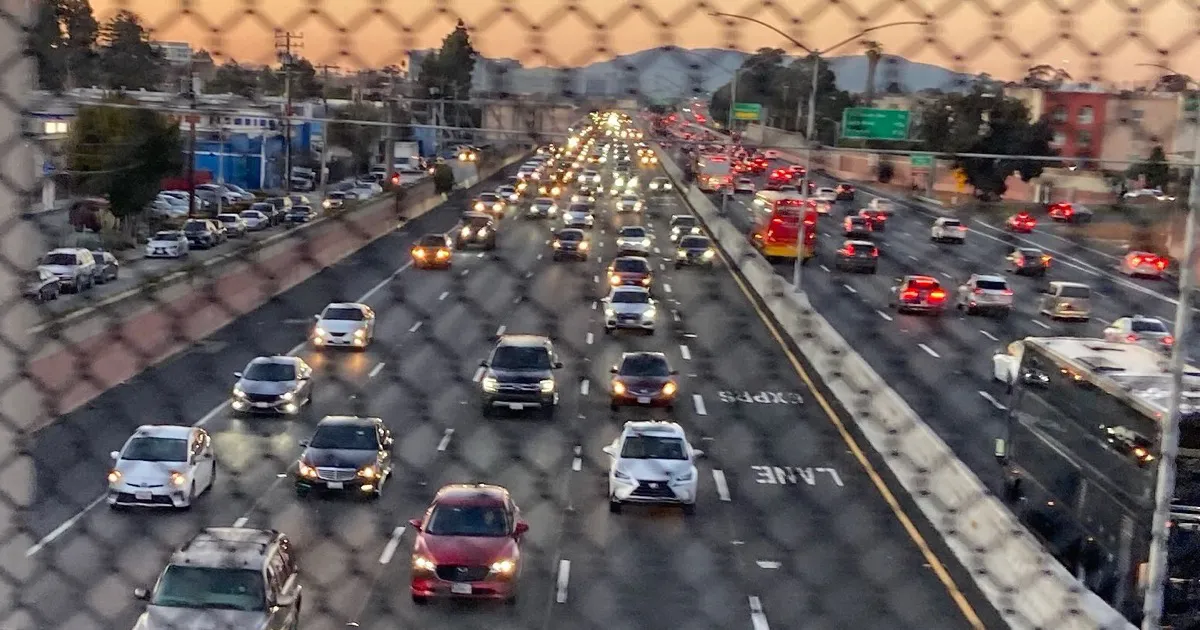
Photo: Max Mautner
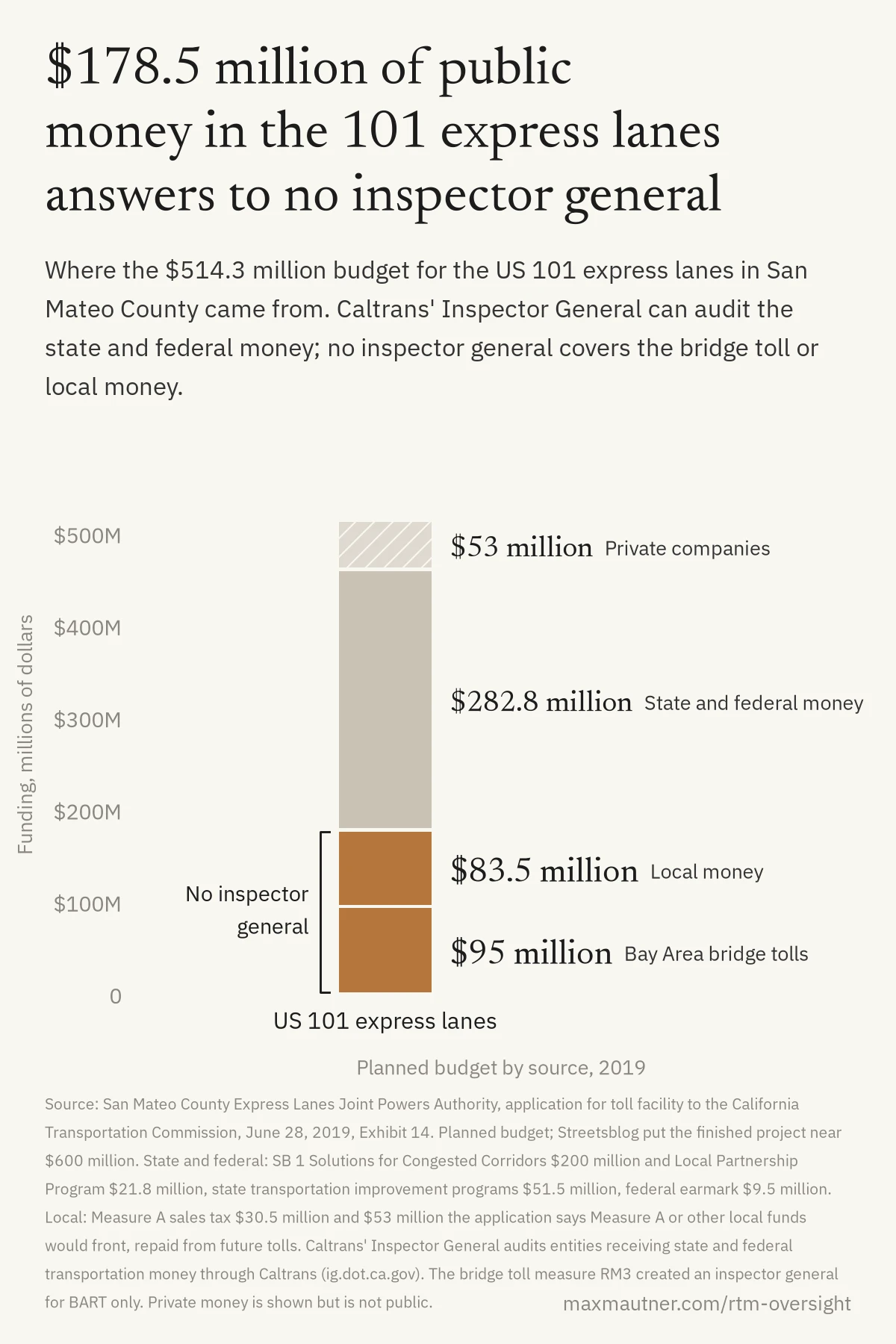
The project’s $514 million budget came mostly from state gas taxes, Bay Area bridge tolls and San Mateo County’s Measure A sales tax.
Allen’s test Measure RTM 101 express lanes Overseers independent of the spenders No No Oversight beyond an audit No No Funding tied to lower total costs No No Efficiency review Once, flawed Never Oversight for the life of the tax No, review ends Advisory committee only Permanent inspector general No State and federal share onlyThe lanes are governed by a joint powers authority of three Transportation Authority board members and three City/County Association of Governments of San Mateo County board members, the agencies that sponsored the project. Measure A, the county sales tax in the project, answers to a 15-member volunteer committee that gives the Transportation Authority board input on its projects. That is less than the “math-checking” Allen dismisses in SB 63. No efficiency review was ever required. No funding was conditioned on costs. Streetsblog put the finished project near $600 million.
The lanes do better than RTM on only one test, and only by accident. Because state and federal money passed through Caltrans, its Inspector General can audit that share. No inspector general covers the bridge tolls or the local money, $178.5 million between them. None of this shows the lanes are badly run. It shows transit is held to a test the highway was never asked to pass.
The people who built the lanes also grade the results. A 2024 report to the county’s cities found the regular lanes next to the express lanes slowing, below 30 mph at some times and places. The express lanes authority’s own 2026 performance study found faster speeds in both kinds of lanes, measured against traffic before the extra lane was added, and its authors told the Transportation Authority board the next version would be peer reviewed.
The last regional transportation measure had the same double standard. RM3, the 2018 bridge toll increase, funds $4.45 billion in highway and transit projects, including $300 million for express lanes. It created an independent inspector general for one recipient: BART.
The lanes’ one real defense is that they pay their way. Tolls now cover their operating costs with room to spare, and the express lanes authority is paying down its construction loan ahead of schedule. That loan is also where the sales tax comes back in. Its $100 million came from Transportation Authority bonds secured by the county’s sales taxes, due by 2049, so if tolls fall short, San Mateo County shoppers cover the gap for 29 years, twice as long as RTM’s tax runs.
The defense also leaves the regular lanes beside the express lanes out of the accounting. Caltrans expects to have ~59% of what it needs to keep the state’s highways in repair over the next 10 years, a $45.5 billion gap, and part of the money it does have is federal highway money that Congress keeps refilling from income taxes. BART fares covered ~23% of BART’s operating costs in fiscal 2025. One of these gaps gets called a fiscal cliff, and the other doesn’t get called anything.
I don’t think either one needs an inspector general. But anyone who calls RTM’s oversight too weak should say the same about the 101 express lanes, which have less. A standard applied only to transit isn’t an accountability standard. It’s a double standard against transit.
The charts are generated by this code, which lists every input and its source.
***
Max Mautner is a San Mateo advocate. A version of the post above appeared on his own blog and is republished here with permission.
As coal burn declines, rising power demand will be primarily met by renewables: EIA
The electric power sector could install more than 26 GW of battery storage next year, helping support a renewable resource base that is expected to supply almost a quarter of 2027 consumption, EIA said.
State adds $4,000 “discount” to energy upgrade scheme, targeting low-income households and renters
Low-income households can now apply for thousands of dollars in discounts on energy upgrades that will make a "lasting difference" to cost of living and comfort.
The post State adds $4,000 “discount” to energy upgrade scheme, targeting low-income households and renters appeared first on Renew Economy.
Global Nurses United congratulates member union, Irish Nurses and Midwives Organisation, on its recent bargaining victory
CAREER OPPORTUNITY: Communications and Marketing Associate (Eugene/Portland/Santa Fe/Helena)
Career Opportunity: Communications and Marketing Associate
Reports to: Communications Director
Location: Physical WELC office in Eugene or Portland, OR; Santa Fe, NM; or Helena, MT. Remote candidates will be considered on a case-by-case basis.
Timeline: Job opening posted November 12, 2026; we will review applications on a rolling basis beginning on November 25, 2026, until the position is filled.
Note: Information is available below. Please apply through the WELC Job Board.
ABOUT THE WESTERN ENVIRONMENTAL LAW CENTER
The Western Environmental Law Center is a leading nonprofit, public-interest environmental law firm rooted in the lands and communities of the western U.S. We use the power of the law to foster thriving, resilient western U.S. lands, waters, wildlife, and communities in the face of a changing climate. Founded in 1993, WELC has been celebrated as an Outside Magazine Best Place to Work, Oregon Business Best Nonprofit to Work For and Best Green Workplace, NonProfit Times Best Nonprofit to Work For, Law360 Environmental Group of the Year, and Better Business Bureau Torch Award winner for ethics.
We envision a thriving western U.S., abundant with protected and interconnected ecosystems, powered by renewable energy, and cared for by communities brought together in an ecology of kinship. We achieve this vision with steady, strategic, and bold legal advocacy that turns the wheels of power at all levels of government.
WELC seeks a Communications and Marketing Associate to join our team. We strongly encourage people of color, persons with disabilities, women, LGBTQ+ applicants, and people of diverse lived experience to apply.
POSITION SUMMARY
The Communications and Marketing Associate is a non-exempt, full-time, salaried position responsible for creating digital and printed communications about our organization and its work for the public, our partner organizations, policymakers, and supporters across all WELC programmatic areas to promote our impact and advocacy.
The Communications and Marketing Associate will create digital content that is engaging, easy to understand, visually appealing, and aligned with our core values, branding, and image. In addition, the Communications and Marketing Associate will create digital content and implement an audience engagement strategy that uses organic and paid promotion to reach existing and prospective WELC supporters as well as key policymakers on Facebook, Instagram, LinkedIn, and Bluesky. These responsibilities include designing social media content and graphics, interpretation of social media and website analytics to improve our reach and engagement, and occasional website maintenance. This position will work closely with the communications director and will also occasionally work with our development team to promote WELC’s fundraising efforts on social media and be involved in several online fundraising initiatives. Opportunities exist for occasional press work to include drafting, editing, and distributing press releases.
Within these responsibilities, the Communications and Marketing Associate will coordinate with WELC program staff and, where appropriate, serve as an active representative of WELC in coalitions and relationships with clients, partners, and allies to develop and implement digital communications strategies in support of these campaigns.
WELC offers a supportive team setting and the opportunity to experiment with new, creative digital media and swag including stickers and shirts to contribute to and grow our communications advocacy and impact. This position requires strong attention to detail, a demonstrated ability to work independently, and the ability to develop and maintain strong, trusting, and effective relationships with WELC clients, partners, and allies.
The Communications and Marketing Associate is a normal 40-hour week position, primarily working during Monday to Friday business hours, though some night and weekend hours may be required depending on case needs. Staff meetings occur on Zoom and in person. Limited travel is required, including overnight and weekend travel. The position also involves standard office physical demands. WELC will provide all reasonable accommodations to the extent possible or required pursuant to the Americans with Disabilities Act and applicable state law.
QUALIFICATIONS
We are keenly interested in considering a range of applicants with diverse lived experiences who approach the world with kindness, imagination, and vision. We will happily consider applicants who offer an equivalent or alternative set of qualifications to fulfill this position’s responsibilities.
- Bachelor’s degree in communications, journalism, or other related field and 2+ years of relevant work experience or equivalent. We are open to consider entry-level candidates, especially those with diverse lived experience.
- Knowledge of western U.S. climate, conservation, and environmental justice advocacy issues.
- Lived experience within or past work in partnership with frontline or resource-dependent communities is a significant plus.
- A commitment to conceptualizing and implementing digital communications strategies that further equity, inclusion, and justice, including through the just treatment and meaningful involvement of clients, partners, and frontline community groups and individuals.
- Excellent writing skills and knowledge of AP style.
- Experience with:
-
- Social media (primarily Facebook and Instagram) content generation and campaigns including messaging using an organization’s voice, targeting, A/B testing, metrics analysis, strategic advertising, and executing the respective best practices for these platforms. Experience with LinkedIn and Bluesky preferred.
-
- Collaborating with partners and clients to create social media posts and carry out joint campaigns, including coordinating messaging, timing and collaborative posting.
-
- Creating social media graphics and data-based infographics. Design skills with Canva/Adobe Creative Suite strongly desired.
-
- Creating basic video content.
-
- Website content management systems (we use WordPress), including search engine optimization and Google Analytics a plus.
- Solid project and time management skills with strong ability to work independently and proactively, both in online and in-person settings.
- Highly organized and intellectually curious.
- Willingness to be flexible and adaptive when needed.
- Demonstrated commitment to WELC’s mission and strategies and the public interest as well as a love for the land, waters, wildlife, and communities of the western U.S.
BENEFITS AND COMPENSATION
The Western Environmental Law Center is an equal opportunity employer. We offer a flexible, friendly, team-based environment with immediate opportunities to shape organizational strategies, competitive salaries ($68,000 – 75,000 for this position, depending on experience and location).
WELC offers an excellent benefits package, including health, vision, dental, life, and disability coverage (with WELC paying 100% of an employee’s premiums), a 401(k) retirement plan with a 4% WELC match, 22 days of combined paid annual vacation and personal leave on top of 13 days of paid holiday leave, paid sick leave, and a paid long-term leave policy (3 months sabbatical leave for every 5 years of employment).
TO APPLY
Please apply at the WELC Job Board. Please include the following as a PDF attachment, preferably in one document:
- 1-2-page cover letter addressed to Brian Sweeney, Communications Director;
- Resume;
- 2-4 professional references; and
- 3-4 work samples with at least one sample of content you created for a social media campaign, one sample exemplifying experience creating web content (interactive features a plus), and one sample of graphic design for social media.
Cover letters should demonstrate the applicant’s commitment to WELC’s mission and their motivation to work in this position and public interest environmental law generally. Applicants are strongly encouraged to tell us who they are as a human being, why they care about conservation work, and why they are interested in this position.
The post CAREER OPPORTUNITY: Communications and Marketing Associate (Eugene/Portland/Santa Fe/Helena) appeared first on Western Environmental Law Center.
Skeptical Science New Research for Week #46 2026
A horizon scan of global catastrophic risks, Turchin & Green, Cell One Earth
A number of global catastrophic risks—nuclear war, pandemics, global food-system collapses, and more—threaten sustainable human life on Earth. These risks often share drivers and emerge from many interrelated factors. Which contributors to prioritize for research and policy has not yet been systematically assessed. Here, we present a horizon scan of contributors to global catastrophic risk, with an emphasis on new or neglected threats. 25 academics from diverse disciplinary backgrounds submitted 96 issues, which were then cut down to 15 priority issues through a structured expert elicitation procedure. Themes included the integration of artificial intelligence into military and security systems, fragile global trade networks, climate change impacts, and institutional failures undermining risk reduction efforts. Our findings provide a prioritized agenda for reducing global catastrophic risk that highlights the diversity of risk factors and the importance of addressing drivers that underpin numerous individual risks.
Manage derailment risks to avoid Hothouse Earth, Dyke et al., Environmental Research Letters
The risk of a ‘Hothouse Earth’ trajectory has become increasingly prominent in debates about Earth system stability and climate overshoot. Existing analyses primarily focus on biophysical feedbacks that may amplify warming beyond direct anthropogenic forcing. We argue the concept has not previously incorporated how social destabilisation lowers the effective threshold at which biophysical tipping dynamics become self-sustaining, independently of further anthropogenic forcing and so undermines the capacity for planetary stewardship. We define ‘derailment risk’ as the possibility that escalating Earth system disruption weakens the social, political, and economic conditions required to sustain mitigation, adaptation, and ecological restoration. Such risks emerge when climate impacts contribute to a wide range of challenges, including debt crises, institutional erosion, political fragmentation, supply-chain instability, and declining public support for environmental action. These reinforcing feedbacks may reduce humanity’s capacity to respond even before biophysical tipping thresholds are crossed. We therefore extend the Hothouse Earth framework by incorporating social dynamics into the Earth system stability landscape. We propose a three-stage framework for assessing and managing derailment risks: conceptual mapping of socio-biophysical feedbacks; anticipatory resilience-building interventions; responsive governance strategies for periods of escalating instability. We conclude that planetary stewardship should prioritise maintaining and expanding collective agency under worsening Earth system stress.
All IPCC AR6 regions are close to their 1.5 °C- and 2 °C-equivalent warming limits, Li et al., Nature Climate Change
Global temperatures have averaged 1.2 °C above pre-industrial levels over the past decade, yet regional warming patterns and remaining warming budgets under Paris Agreement limits remain uncertain owing to insufficient historical observations. Here we quantify and attribute warming across all IPCC Sixth Assessment Report (AR6) regions since pre-industrial times using a Bayesian framework combining multi-model simulations with observations, enabling robust estimates in data-sparse regions. Regional warming is already pronounced. By 2025, attributed regional warming had reached about 90–94% of the levels expected at 1.5 °C global warming and 65–76% of those expected at 2 °C. Attribution confidence is the highest in tropical regions, including much of Africa, where low internal variability enables robust results. Attributed warming is the greatest in northern high-latitude regions, exceeding 2.5 °C. Greenhouse gases dominate, partially offset by aerosol cooling. These results reveal that current warming is already indistinguishable from a 1.5 °C world, highlighting the shared urgency of adaptation across all regions.
Zero emissions commitment depends on warming level, Gibbs et al., Nature Climate Change
When anthropogenic CO2 emissions cease, global temperature does not stabilize immediately. The resulting global temperature change, the zero emissions commitment, is central to carbon budget assessments and understanding reversibility of global warming, yet its dependence on prior warming levels remains unclear. Here we show, using zero-emission simulations with the UK Earth System Model (UKESM1.2) across global warming levels of 1.5–5 K, that the zero emissions commitment stays near zero up to 2 K but becomes positive at higher warming levels, reaching 0.4–0.6 K after ~ 150 years. This dependence indicates that stabilizing or reversing warming becomes progressively more difficult as peak temperature rises. We identify the mechanism behind this behaviour: stronger warming from higher radiative disequilibrium and weakening carbon sinks, driven by saturated land carbon uptake and the reduced radiative impact of CO2 drawdown at higher background CO2 concentrations. Higher peak warming therefore commits the planet to additional warming, limiting temperature-overshoot reversibility.
A further acceleration of clean energy is needed for global CO2 emissions to peak and decline, Quéré et al., Nature Climate Change
Global fossil fuel CO2 emissions have grown 0.8% per year on average between 2019 and 2025. Here we project a decrease of 0.4% in 2026, probably as a short-term response to the energy shock triggered by the Iran conflict. Electric vehicles and solar and wind power offset about 64–79% of increasing emissions from demand growth through 2028; acceleration in clean technology deployment is needed to guarantee emissions peak and subsequent decline.
From this week's government/NGO section:Climate, Peace and Security Fact Sheet:Somalia, Seyuba et al., Stockholm International Peace Research Institute
The authors focus on Somalia and the series of conflict- and climate-related issues that face the region. The authors offer a range of recommended actions for the international community to address these issues effectively. Somalia continues to grapple with increasingly severe and frequent climate shocks that impede people’s livelihoods, worsen the existing humanitarian crisis and influence local conflict dynamics over access to natural resources. In November 2025, after four consecutive failed rainy seasons had affected millions of people, the Federal Government of Somalia (FGS) declared a national drought emergency. Strong El Niño conditions are forecast to bring wetter-than-usual conditions during the October–December 2026 deyr rainy season, with a high risk of floods in central and southern Somalia. Some communities experience successive periods of drought and flooding without sufficient time to recover between shocks. These adverse effects of climate change are interacting with a volatile security situation, influenced by political competition and fragmentation, as well as continued clashes with al-Shabab, which contribute to deepening an already dire humanitarian crisis.No Escape III - Displaced voices from the frontlines of the climate crisis, The Office of the United Nations High Commissioner for Refugees
Millions of people across the globe continue to be forced to flee their homes because of violence, conflict, and climate-related hazards. In fact, the number of forcibly displaced people in the world today has never been higher – doubling to more than 120 million people over the past 10 years. While conflict remains the primary driver of displacement, climate change can aggravate an already devastating reality. Its effects disproportionately affect the world’s most vulnerable populations – including refugees, internally displaced people and the communities hosting them. Often lacking critical resources such as stable housing, financial security, institutional support, or access to essential services, displaced people now also struggle to prepare for, adapt or recover from disasters like floods, droughts and heatwaves. While the situation is dire, this report demonstrates sustainable solutions are within reach. Worst-case scenarios can be avoided, through integrated approaches that are climate-smart, protection- and gender-centered, human rights-based, conflict-sensitive, and peace-responsive. The report therefore concludes with a strong call to action including: PROTECT displaced people fleeing in the context of climate change impacts and disasters by applying and adapting existing legal tools, INCLUDE the voices and specific needs of displaced populations and host communities in climate finance and policy decisions, INVEST in building climate resilience where needs are greatest, especially in fragile and conflict-affected settings, and ACCELERATE the reduction of carbon emissions to prevent climate disaster and to avert and minimize further displacement. 118 articles in 61 journals by 793 contributing authorsPhysical science of climate change, effects
A moisture dynamics perspective on robust changes in characteristics of the tropical circulation under warming, Tomassini, Royal Society Open Science Open Access 10.1098/rsos.260963
Correct use of radiative efficiencies in calculating global warming potentials and other emission metrics, Collins et al., Atmospheric chemistry and physics Open Access 10.5194/acp-26-15757-2026
Enhanced influence of the North Pacific Meridional Mode on the western North Pacific tropical cyclones in a warming climate, Liu et al., Environmental Research Letters Open Access pdf 10.1088/1748-9326/aebbd5
Manage derailment risks to avoid Hothouse Earth, Dyke et al., Environmental Research Letters Open Access pdf 10.1088/1748-9326/aeb1de
Projected Amazon forest loss alters tropical Atlantic circulation and surface heat exchange through reduced freshwater input, Gouveia et al., Scientific Reports Open Access pdf 10.1038/s41598-026-79941-w
Redistribution of Light Absorption by Chlorophyll Decline Delays Warming by Up to a Decade, Meng et al., Journal of Geophysical Research Oceans Open Access pdf 10.1029/2025jc023451
Three-way circulation–soil moisture–temperature feedbacks amplify the most extreme mid-latitudinal heat waves, Tian et al., Science Advances Open Access 10.1126/sciadv.aeh9111
What Sets the AMOC's Sensitivity to CO2 Forcing? The Role of Background Mean-State and Density Balance, Ferster, Zenodo (CERN European Organization for Nuclear Research) Open Access 10.5281/zenodo.21889993
Zero emissions commitment depends on warming level, Gibbs et al., Nature Climate Change Open Access 10.1038/s41558-026-02776-w
Most cited from this section, published 2 years ago: Comparing the Atmospheric Responses to Reduced Arctic Sea Ice, a Warmer Ocean, and Increased CO2 and Their Contributions to Projected Change at 2°C Global Warming, Journal of Climate, 10.1175/jcli-d-24-0104.1 17 cites.
buffer/PWSEObservations of climate change, effects
All IPCC AR6 regions are close to their 1.5 °C- and 2 °C-equivalent warming limits, Li et al., Nature Climate Change Open Access pdf 10.1038/s41558-026-02790-y
Climate Variability for a 150-Year (1862–2011) Meteo-Hydrological Series in the Italian Alps at Different Time Scales, Eccel & Ranzi, International Journal of Climatology 10.1002/joc.70657
Consistent Sea-Level and Energy Budget Residuals Suggest Enhanced Deep-Ocean Heat Uptake Since the Mid-2010s, Cha et al., Geophysical Research Letters Open Access 10.1029/2026gl125563
Divergent hydroclimatic responses across Eurasia: Evidence from multiple datasets and CMIP6 projections, Liu et al., Advances in Climate Change Research Open Access 10.1016/j.accre.2026.11.002
Examining climate trends and extremes in Janamora District Ethiopia from 1982 to 2024, Chekol et al., Discover Sustainability Open Access 10.1007/s43621-026-05218-x
Geographical Distribution of Exposure to Fires in the United States Between 2004 and 2023, Sakka et al., GeoHealth Open Access pdf 10.1029/2025gh001455
Higher prevalence of rising climate-driven snowmelt potential of rain-on-snow events in the Eastern continental US, Salvi et al., Environmental Research Letters Open Access pdf 10.1088/1748-9326/aebbd2
Influence of natural and anthropogenic forcings on western US winter fire weather and the 2025 Los Angeles wildfires, Srivastava et al., Environmental Research Letters Open Access pdf 10.1088/1748-9326/aeb710
Most cited from this section, published 2 years ago: Emerging Climate Change Signals in Atmospheric Circulation, AGU Advances, 10.1029/2024av001297 72 cites.
buffer/OBMEInstrumentation & observational methods of climate change, effects
Daily global sea surface ageostrophic current dataset from 1993–2023 via physics-informed deep learning, Cui, Zenodo (CERN European Organization for Nuclear Research) Open Access 10.5281/zenodo.23901901
Definition- and dataset-dependent characterization of global compound drought–heat extremes, Wu et al., Weather and Climate Extremes Open Access pdf 10.1016/j.wace.2026.100972
Estimating the resilience of non-stationary systems, Smith et al., Nature Communications Open Access pdf 10.1038/s41467-026-78489-7
TurboMeter: an attribution framework for aviation turbulence events in a changing climate, Alberti et al., Weather and Climate Dynamics Open Access 10.5194/wcd-7-2229-2026
Most cited from this section, published 2 years ago: A Mystery of the Inconsistency Between Microwave Polarimetric Observations and Radiative Transfer Simulations, Geophysical Research Letters, 10.1029/2024gl111553 2 cites.
buffer/WINSModeling, simulation & projection of climate change, effects
Boreal autumn to winter North Atlantic atmosphere–ocean coupling in large ensemble climate simulations, Anderson et al., Weather and Climate Dynamics Open Access pdf 10.5194/wcd-7-2155-2026
Divergent hydroclimatic responses across Eurasia: Evidence from multiple datasets and CMIP6 projections, Liu et al., Advances in Climate Change Research Open Access 10.1016/j.accre.2026.11.002
Extratropical Forcing of Tropical Subsurface Oxygenation Under Future Warming, Gao et al., Global Biogeochemical Cycles Open Access pdf 10.1029/2026gb009285
Hailstorm responses to climate change across diverse synoptic environments in South Korea: A pseudo-global warming study, Choi et al., Atmospheric Research 10.1016/j.atmosres.2026.109432
Mountains Modulate the Response of Precipitation Flashiness to Warming in High-Resolution Simulations Over the Western US, Koszuta et al., Geophysical Research Letters Open Access pdf 10.1029/2026gl125264
Near-Future Strengthening of ENSO-Related Sea Ice Variability in West Antarctica, Kim et al., Journal of Climate 10.1175/jcli-d-25-0028.1
Post-Fire Surface Energy Partitioning and Thermal Responses in Arctic Boreal Forests and Tundra, Li et al., Geophysical Research Letters Open Access pdf 10.1029/2026gl125479
Recent extreme heatwaves are no match for future events, Aglas-Leitner et al., Nature Communications Open Access pdf 10.1038/s41467-026-76809-5
Most cited from this section, published 2 years ago: Emergence of a climate oscillation in the Arctic Ocean due to global warming, Nature Climate Change, 10.1038/s41558-024-02171-3 18 cites.
buffer/MSWEAdvancement of climate & climate effects modeling, simulation & projection
Enhanced Land-Surface Processes Sustain Evapotranspiration and Improve Tropical Climate Variability in a Coupled Earth System Model, Rajesh et al., Journal of Geophysical Research Atmospheres 10.1029/2026jd047646
Exploring Recent Changes in Tornado Activity via an Environment-Based Tornado Count Model for CMIP6 Applications, Malloy et al., Journal of Climate 10.1175/jcli-d-25-0441.1
Forcing dataset updates impact regional but not global Earth radiation budget trends in the GFDL AM4 climate model, Wang et al., Advances in Atmospheric Sciences 10.1007/s00376-006-0431-5
Performance of Earth System Models in Representing Vegetation Functional Response to Heat and Water Stresses, Chen et al., Journal of Geophysical Research Biogeosciences Open Access pdf 10.1029/2025jg009423
The Impact of Lakes in North American Regional Climate Simulations, Mahdinia et al., Journal of Climate 10.1175/jcli-d-25-0146.1
Most cited from this section, published 2 years ago: An extensible perturbed parameter ensemble for the Community Atmosphere Model version 6, Geoscientific model development, 10.5194/gmd-17-7835-2024 62 cites.
buffer/GCMACryosphere & climate change
A Prospective Cooling Machine for the Svalbard Branch of Norwegian Atlantic Water in a Future Climate, Wu et al., Earth s Future Open Access pdf 10.1029/2026ef009526
Higher prevalence of rising climate-driven snowmelt potential of rain-on-snow events in the Eastern continental US, Salvi et al., Environmental Research Letters Open Access pdf 10.1088/1748-9326/aebbd2
Ice–ocean albedo feedback as a key mechanism driving recent Antarctic summer sea-ice decline, Nihashi & Ohshima, Scientific Reports Open Access 10.1038/s41598-026-70282-2
Impact of Wildfire-Emitted Black Carbon on Snowmelt Across Western North America, Jaisawal et al., Journal of Geophysical Research Atmospheres Open Access pdf 10.1029/2026jd046919
Loss of snow persistence during late season drives snow-season shortening in Northeast China under global warming, Xiao et al., Communications Earth & Environment Open Access pdf 10.1038/s43247-026-04156-w
No Longer Polar Opposites: The Arctic and the Antarctic Are Converging toward a Seasonally Dominated Sea Ice Regime, Spira et al., Bulletin of the American Meteorological Society Open Access 10.1175/bams-d-25-0340.1
Vanishing Winters and Shrinking Ice: Ecosystem Services and Societal Impacts in the Laurentian Great Lakes, Xenopoulos et al., Earth s Future Open Access pdf 10.1029/2026ef009213
Most cited from this section, published 2 years ago: Sensitivity of the future evolution of the Wilkes Subglacial Basin ice sheet to grounding-line melt parameterizations, The Cryosphere, 10.5194/tc-18-5117-2024 9 cites.
buffer/CRYOSea level & climate change
Forecasting legal coastline based on highest astronomical tide as a predictive model for land–sea integration, Setiyadi et al., Scientific Reports Open Access pdf 10.1038/s41598-026-79942-9
Most cited from this section, published 2 years ago: The curve: An ethnography of projecting sea level rise under uncertainty, Global Environmental Change, 10.1016/j.gloenvcha.2024.102947 5 cites.
buffer/SLCCPaleoclimate & paleogeochemistry
Early pliocene warming and ocean circulation: Non-linear responses to CO2 and Central American Seaway changes in HadCM3, Tindall et al., Global and Planetary Change 10.1016/j.gloplacha.2026.105788
Elevated early Eocene atmospheric CO2 tied to reduced Southern Ocean biological pump efficiency, Moretti et al., Nature Geoscience Open Access pdf 10.1038/s41561-026-02142-7
Glacial abrupt transitions in ocean circulation were much slower than ice-core records imply, Dong et al., Science 10.1126/science.aed4270
Repeated loss of the West Antarctic Ice Sheet’s Amundsen Sea sector during late Pleistocene interglacials, Hillenbrand et al., Nature Communications Open Access pdf 10.1038/s41467-026-77004-2
Most cited from this section, published 2 years ago: Coupled decline in ocean pH and carbonate saturation during the Palaeocene–Eocene Thermal Maximum, Nature Geoscience, 10.1038/s41561-024-01579-y 31 cites.
buffer/PCIMBiology & climate change, related geochemistry
Behavioural Plasticity Is Associated With Climate Tracking in Birds, Yu et al., Global Ecology and Biogeography Open Access pdf 10.1111/geb.70327
Climate change threatens ecosystem services: Global assessment of urban forest vulnerability, Wang & ?, Urban Climate 10.1016/j.uclim.2026.103170
Climate Warming Reduces Seed Mass in European Beech Through Altered Resource Dynamics and Drought, Bogdziewicz et al., Global Change Biology Open Access pdf 10.1111/gcb.71196
Climate-driven compositional shifts across a temperate–subtropical island ecotone, Kim & Jung, Ecography Open Access pdf 10.1002/ecog.08884
Climate-Driven Oceanographic Changes Shape Larval Dispersal Success in the Southern Ocean, Ouzoulias et al., Global Change Biology Open Access pdf 10.1111/gcb.71168
Combining satellite-derived standing deadwood estimates and vegetation modelling to predict climate change impacts on Norway spruce forests in Germany, Anders et al., Agricultural and Forest Meteorology Open Access 10.1016/j.agrformet.2026.111581
Dissolution and Heterotrophy at a Florida Coral Reef One Year After Severe Bleaching, Morris et al., Journal of Geophysical Research Oceans Open Access pdf 10.1029/2026jc024333
Do Leaf Temperatures Determine Endophyte Composition and Richness in Florida Native Plant Species?, Tserej et al., Ecology and Evolution Open Access pdf 10.1002/ece3.74615
Marine Heatwave and Extreme Hypoxia Coincide With Rapid Coral Bleaching and Mortality on a Central Red Sea Coral Reef, Klein et al., Ecology and Evolution Open Access pdf 10.1002/ece3.74606
Projected Climate Change Impacts on Deep-Sea Corals of the Red Sea, Nolan et al., Global Change Biology Open Access pdf 10.1111/gcb.71169
Revealing the Widespread Bias of Extinction Risk in the Antarctic and the Southern Ocean, Farrant et al., Global Change Biology Open Access pdf 10.1111/gcb.71170
Stony coral symbioses show variable responses to future ocean conditions, Souza et al., Science Advances Open Access 10.1126/sciadv.aed4599
Temporal dynamics and season-dependent warming responses of reactive soil silicon fractions in a subtropical oak forest, Cheng et al., Frontiers in Forests and Global Change Open Access pdf 10.3389/ffgc.2026.2018571
Thermal baselines and climate-space geometry mediate systematic terrestrial biodiversity responses to warming, Gao et al., Ecography Open Access pdf 10.1002/ecog.08765
Thermal ecology drives alternate responses to rising temperatures in Caribbean anoles, Domínguez-Guerrero et al., Proceedings of the National Academy of Sciences Open Access 10.1073/pnas.2537152123
Using Artificial Intelligence to Optimize Ecological Restoration for Climate and Biodiversity, Silvestro et al., Global Change Biology Open Access pdf 10.1111/gcb.71165
Most cited from this section, published 2 years ago: Contributions of ecological restoration policies to China’s land carbon balance, Nature Communications, 10.1038/s41467-024-54100-9 115 cites.
buffer/BIOWGHG sources & sinks, flux, related geochemistry
A national baseline for methane sink habitats and methanotroph diversity, Knudsen et al., Nature Communications Open Access pdf 10.1038/s41467-026-79316-9
Correct use of radiative efficiencies in calculating global warming potentials and other emission metrics, Collins et al., Atmospheric chemistry and physics Open Access 10.5194/acp-26-15757-2026
Dual Constraints of Microbial Carbon Use Efficiency and Mineral Protection Govern Necromass Accrual, Xiao et al., Global Change Biology Open Access pdf 10.1111/gcb.71162
Elevated CO2 mitigated warming-enhanced carbon loss from northern peatland, Zhou et al., Science Advances Open Access 10.1126/sciadv.aek1491
Emissions Poised to Rocket: Modeling the Environmental Impacts of Low Earth Orbit Satellite Constellations, Kukreja et al., Earth s Future Open Access pdf 10.1029/2025ef006511
Global Carbon Budget 2026, Zhao et al., Global and Planetary Change Open Access pdf 10.1016/j.gloplacha.2021.103542
Nocturnal Trapping of Agricultural Emissions Drives Persistent Methane Enhancements at the Southern Great Plains, Wang et al., Journal of Geophysical Research Atmospheres Open Access pdf 10.1029/2026jd047976
Past fire use in deforested land limits secondary forest carbon gains in Amazonia with implications for emissions reduction goals, Haddad et al., Carbon Balance and Management Open Access 10.1186/s13021-026-00542-1
Precipitation-driven plant community stability enhances wetland net ecosystem CO2 exchange, Song et al., Agricultural and Forest Meteorology 10.1016/j.agrformet.2026.111592
Projection of the Status and Future Shifts of Topsoil Organic Carbon Stocks in Northern Hemisphere Permafrost Regions: Patterns and Drivers, Wang et al., Earth s Future Open Access pdf 10.1029/2025ef007478
Quantifying the near-term response of the ocean CO2 sink to reduced atmospheric carbon concentrations, Ogden, BioScience 10.1525/bio.2013.63.5.3
Regional land carbon shifts strengthen atmospheric carbon dioxide–land carbon flux coupling, Luo et al., Nature Geoscience 10.1038/s41561-026-02136-5
Restored but Still Emitting: High CO2 Fluxes From a Mediterranean Wetland Challenge Inundation-Based Restoration Strategies, Helman et al., Journal of Geophysical Research Biogeosciences Open Access pdf 10.1029/2026jg009794
Snowpack decouples thermal and hydrologic regimes of coarse woody material from the winter atmosphere in northern hardwood forests, Woodall et al., Agricultural and Forest Meteorology 10.1016/j.agrformet.2026.111588
Sparing use of phosphorus in an acidifying ocean, Li et al., Progress In Oceanography 10.1016/j.pocean.2018.08.001
Tropospheric oxidation chemistry and methane growth: a process-based attribution of OH variability (2003–2022), Gaubert et al., Atmospheric chemistry and physics Open Access pdf 10.5194/acp-26-15683-2026
Most cited from this section, published 2 years ago: Dynamic Responses of Soil Organic Carbon to Urbanization: A Global Perspective, Global Change Biology, 10.1111/gcb.17573 26 cites.
buffer/GHSSCO2 capture, sequestration science & engineering
Enhanced weathering of glacial rock flour drives coupled inorganic and organic carbon sequestration in a five-year field experiment, Dietzen et al., Biogeosciences Open Access pdf 10.5194/bg-23-7727-2026
Experimental Evidence of Reaction-Driven Fracturing and Ultramafic Rock Weakening Induced by CO2 Mineralization, Wood et al., Geophysical Research Letters Open Access pdf 10.1029/2026gl124491
Managing risk in carbon portfolios, Lee et al., Nature Climate Change Open Access pdf 10.1038/s41558-026-02785-9
Mediation of soil aggregate stability and carbon sequestration by meadow steppe soil microorganisms under long-term nitrogen and phosphorus nutrient additions, Wu et al., Soil Ecology Letters 10.1007/s42832-026-0473-9
The carbon at risk measure for managing carbon removal risk and guiding portfolio construction, Lee et al., Nature Climate Change Open Access pdf 10.1038/s41558-026-02785-9
Urban Development Impacts on Ecosystem Services: Modeling and Valuation of Carbon Storage in the Tehran Metropolis, Malekzadeh et al., International Journal of Environmental Research 10.1007/s41742-026-01291-2
Most cited from this section, published 2 years ago: Tree planting is no climate solution at northern high latitudes, Nature Geoscience, 10.1038/s41561-024-01573-4 42 cites.
buffer/CENGDecarbonization
A new iron age? The potential role of iron fuel in Europe’s clean energy transition, Schuler et al., Chem Circularity Open Access 10.1016/j.checir.2026.100047
Bridge fuels and climate policy integration: The case of low-carbon hydrogen in the European Union, Bruch, Energy Policy Open Access 10.1016/j.enpol.2026.115688
Decadal variability reveals contrasts in solar-resource stability across China, Meng et al., Environmental Research Letters Open Access pdf 10.1088/1748-9326/aebbd8
Harnessing India's wind and solar potential: A spatially optimized transition pathway to 2050, Krishna et al., Energy Policy 10.1016/j.enpol.2026.115702
Retrofit: The Fast Track to Hydrogen in Short-sea Shipping, Rosenberg et al., MTZ worldwide 10.1007/s38313-026-2267-y
Solar photovoltaics and hydrogen energy as pathways to a sustainable future, Yusuf et al., Chemical Papers 10.1007/s11696-026-05692-7
Most cited from this section, published 2 years ago: Current-Day and Future Dunkelflaute Risks for Belgium, Journal of Applied Meteorology and Climatology, 10.1175/jamc-d-24-0007.1 12 cites.
buffer/DCRBGeoengineering climate
Revisiting the additionality and durability of carbon uptake in large-scale ocean iron fertilization, Noh et al., Science Advances Open Access pdf 10.1126/sciadv.aed1631
Most cited from this section, published 2 years ago: Mapping the global variation in the efficiency of ocean alkalinity enhancement for carbon dioxide removal, Nature Climate Change, 10.1038/s41558-024-02179-9 91 cites.
buffer/GENGBlack carbon
Impact of Wildfire-Emitted Black Carbon on Snowmelt Across Western North America, Jaisawal et al., Journal of Geophysical Research Atmospheres Open Access pdf 10.1029/2026jd046919
Aerosols
Most cited from this section, published 2 years ago: CREST: a Climate Data Record of Stratospheric Aerosols, Earth system science data, 10.5194/essd-16-5227-2024 20 cites.
buffer/AESOClimate change communications & cognition
Exploring advocacy of Dutch government climate researchers: an interview study, Koppelaar et al., Geoscience Communication Open Access pdf 10.5194/gc-9-525-2026
More than just a one-hit-wonder? analyzing the meso level institutionalization of the climate movement in Germany (2019–2025), Laux, Environmental Sociology Open Access pdf 10.1080/23251042.2026.2759817
When Scientific Uncertainty is Linked to Lower Information Avoidance: Motivational Pathways to Public Engagement With Climate Risk Information, Hong, Risk Analysis Open Access pdf 10.1111/risa.70411
Most cited from this section, published 2 years ago: Communicating consensus among climate scientists increases estimates of consensus and belief in human-caused climate change across the globe, Journal of Environmental Psychology, 10.1016/j.jenvp.2024.102480 12 cites.
buffer/CSCCAgronomy, animal husbundry, food production & climate change
Assessing rural household food security in flood-prone areas: An integrated FAO–IPCC framework-based analysis in Iran, Radshirali-Bolati et al., Climate Risk Management Open Access pdf 10.1016/j.crm.2026.100912
Farmers’ everyday political work at the nexus of climate and conflict in Eastern DR Congo, Baker et al., Climate and Development 10.1080/17565529.2026.2754752
Nocturnal Trapping of Agricultural Emissions Drives Persistent Methane Enhancements at the Southern Great Plains, Wang et al., Journal of Geophysical Research Atmospheres Open Access pdf 10.1029/2026jd047976
Spatiotemporal variations of carbon-water-hydraulic risk for Pinus tabuliformis Carrière Plantations on the Loess Plateau under future climate change, Guo et al., Biogeosciences Open Access pdf 10.5194/bg-23-7871-2026
Most cited from this section, published 2 years ago: Changes in the Yield Effect of the Preceding Crop in the US Corn Belt Under a Warming Climate, Global Change Biology, 10.1111/gcb.17556 15 cites.
buffer/AGCCHydrology, hydrometeorology & climate change
Climate Change Forces Hydrological Regime Shifts in Australian Wetlands, John et al., Earth s Future Open Access pdf 10.1029/2025ef007857
Record warmth in the Sea of Japan amplified the September 2024 Noto heavy rainfall associated with a mesoscale low-pressure disturbance, Shimoda & Sugimoto, Scientific Reports Open Access pdf 10.1038/s41598-026-79294-4
Tree Rings Indicate Potential for Severe Soil Moisture Drought in California Is Much Greater Than Observations Suggest, Jones & Williams, Geophysical Research Letters Open Access pdf 10.1029/2026gl125616
Climate change economics
Count the climate losses we prevent, A, Nature Communications Open Access pdf 10.1038/s41467-026-79128-x
From the 2026 Hormuz disruption to renewable resilience: energy security and decarbonization governance in import-dependent economies, Levi & Barnett-Itzhaki, Frontiers in Climate Open Access pdf 10.3389/fclim.2026.1985153
From the 2026 Hormuz disruption to renewable resilience: energy security and decarbonization governance in import-dependent economies, Levi & Barnett-Itzhaki, Frontiers in Climate Open Access pdf 10.3389/fclim.2026.1985153
Managing risk in carbon portfolios, Lee et al., Nature Climate Change Open Access pdf 10.1038/s41558-026-02785-9
Most cited from this section, published 2 years ago: Fission for funds: The financing of nuclear power plants, Energy Policy, 10.1016/j.enpol.2024.114382 32 cites.
buffer/ECCCClimate change mitigation public policy research
Cost-effective climate change mitigation through land sector contributions, Grossi et al., Animal Frontiers Open Access pdf 10.1093/af/vfy034
Latin America's governance of the energy transition: Why some policy mixes succeed and most stall, Velástegui, Energy Research & Social Science Open Access 10.1016/j.erss.2026.104999
Policy bundling and the political economy of climate policymaking, Bernards, Development and Change Open Access pdf 10.1111/dech.12788
The impact of the Swiss CO2 levy on residential heating emissions and energy demand, Schäfer, Energy Policy Open Access pdf 10.1016/j.enpol.2026.115696
Urban thermal environment and carbon emissions in an arid urban agglomeration: spatial mismatch and cross-city variation in NDBI contribution thresholds, Abulizi et al., Urban Climate 10.1016/j.uclim.2026.103211
Most cited from this section, published 2 years ago: Participation in Energy Transitions: A Comparison of Policy Styles, Energy Research & Social Science, 10.1016/j.erss.2024.103743 119 cites.
buffer/GPCCClimate change adaptation & adaptation public policy research
AI-Enabled Climate and Environmental Resilience in Cities: Technical Progress and Network Expansion, Tang et al., Bulletin of the American Meteorological Society 10.1175/bams-d-26-0311.1
Inclusive climate adaptation through intersectional co-production: gender- and disability-disaggregated evidence from southern Africa, Vincent et al., Climate and Development Open Access pdf 10.1080/17565529.2026.2754757
Intersectionality and Climate Adaptation Justice: A Systematic-Narrative Review, Rublee et al., The Journal of Climate Change and Health Open Access 10.1016/j.joclim.2023.100209
Most cited from this section, published 2 years ago: The Promise of Resistance: A New Lens for Climate Change Adaptation Research and Practice, Wiley Interdisciplinary Reviews Climate Change, 10.1002/wcc.922 32 cites.
buffer/CCADClimate change impacts on human health
A vulnerability-informed framework for assessing annual-scale heatwave–mortality association in China, Wu et al., Global and Planetary Change 10.1016/j.gloplacha.2026.105793
Climate Indices and Atmospheric Circulation Patterns Linked to East Asian Summer Wet-Bulb Temperatures, ??? et al., International Journal of Climatology Open Access pdf 10.1002/joc.70650
Support for climate-health adaptation policy among German citizens: The role and limits of trust in government and scientists, Groeve & Prettenthaler, Journal of Environmental Psychology Open Access pdf 10.1016/j.jenvp.2026.103282
Most cited from this section, published 2 years ago: Hot and cold: Policy perspectives on overheating and cooling in United Kingdom homes, Energy Research & Social Science, 10.1016/j.erss.2024.103803 17 cites.
buffer/CCHHClimate change & geopolitics
Arrow's shadow over climate governance, George, Climate Policy 10.1080/14693062.2026.2753246
Most cited from this section, published 2 years ago: Climate migration management? Contrasting international policy approaches with evidence from Ghana, Climate Policy, 10.1080/14693062.2024.2411326 6 cites.
buffer/CCGPClimate change impacts on human culture
Most cited from this section, published 2 years ago: Spatiotemporal changes in tourism climate comfort in Sichuan Province from 1961 to 2022, International Journal of Climatology, 10.1002/joc.8626 3 cites.
buffer/HDGWOther
Environmental justice asymmetries in carbon management research, Nobar et al., Figshare Open Access 10.6084/m9.figshare.34926014
From carbon footprint to climate lifeprint: Comparison and accounting model for ultra-rich social influencers, Salekpay & Bergh, Energy Research & Social Science Open Access pdf 10.1016/j.erss.2026.105075
Multi-centennial ocean biogeochemical responses to extended Shared Socioeconomic Pathways, Kobayashi et al., Biogeosciences Open Access 10.5194/bg-23-7807-2026
Tropopause shift during the ozone transition in multiple reanalyses over East Antarctica, Wu et al., Atmospheric Research 10.1016/j.atmosres.2026.109437
Most cited from this section, published 2 years ago: Gender-based climate (in)justice: An overview, Environmental Science & Policy, 10.1016/j.envsci.2024.103934 18 cites.
buffer/OTHRInformed opinion, nudges & major initiatives
A further acceleration of clean energy is needed for global CO2 emissions to peak and decline, Quéré et al., Nature Climate Change Open Access pdf 10.1038/s41558-026-02821-8
A horizon scan of global catastrophic risks, Turchin & Green, Cell One Earth 10.1108/fs-04-2018-0031
Manage derailment risks to avoid Hothouse Earth, Dyke et al., Environmental Research Letters Open Access pdf 10.1088/1748-9326/aeb1de
Start cryosphere flood warnings at the source, Song, Science 10.1126/science.ael8929
Most cited from this section, published 2 years ago: Planetary Boundaries guide humanity’s future on Earth, Nature Reviews Earth & Environment, 10.1038/s43017-024-00597-z 276 cites.
Articles/Reports from Agencies and Non-Governmental Organizations Addressing Aspects of Climate ChangeClimate, Peace and Security Fact Sheet: Somalia, Seyuba et al., Stockholm International Peace Research Institute
The authors focus on Somalia and the series of conflict- and climate-related issues that face the region. The authors offer a range of recommended actions for the international community to address these issues effectively. Somalia continues to grapple with increasingly severe and frequent climate shocks that impede people’s livelihoods, worsen the existing humanitarian crisis and influence local conflict dynamics over access to natural resources. In November 2025, after four consecutive failed rainy seasons had affected millions of people, the Federal Government of Somalia (FGS) declared a national drought emergency. Strong El Niño conditions are forecast to bring wetter-than-usual conditions during the October–December 2026 deyr rainy season, with a high risk of floods in central and southern Somalia. Some communities experience successive periods of drought and flooding without sufficient time to recover between shocks. These adverse effects of climate change are interacting with a volatile security situation, influenced by political competition and fragmentation, as well as continued clashes with al-Shabab, which contribute to deepening an already dire humanitarian crisis.The Case for a Public Renewable Energy Developer in New York City, Jason Kowalski and Johanna Bozuwa, Climate and Community Institute
The climate crisis has reached New York City. As record-breaking heat and storms strain the City’s infrastructure, utility costs burden working class New Yorkers. By establishing a public renewable energy developer, the City can deliver meaningful affordability benefits to all New Yorkers, create good union jobs, and offer a practical model for climate action that can be replicated nationwide. PowerNYC Development Corporation (PowerNYC), a public renewable energy developer, would be a financially self-sustaining engine of decarbonization that delivers clean energy projects including distributed battery storage, distributed solar, and thermal energy networks (TENs) at no upfront cost to New Yorkers. PowerNYC can deliver substantial citywide affordability benefits across its portfolio of projects. Examining battery storage alone, the authors found that an initial deployment of 200 MW of publicly developed distributed batteries could save New York City ratepayers at least $170 million per year.California Wildfire 2026: Emerging Trends & Policy Insights, Ahumada-Paras et al., Stanford Climate & Energy Policy Program
The authors provide a broad view of California’s ongoing wildfire crisis, detailing direct effects, such as lives lost and homes destroyed, as well as downstream effects, such as higher electricity bills, insurance premiums and smoke exposure. Among the takeaways: big investments in safer communities and fire-resilient landscapes to reduce future losses are key to durable and affordable solutions.Global benefits and costs of prioritized actions on climate change and health, Campbell-Lendrum et al., World Health Organization
The authors present a global assessment of the health, environmental and economic benefits and costs of scaling up six prioritized climate–health actions. Using a welfare economic approach, they evaluate heat–health warning systems, climate-resilient drinking-water, basic sanitation and hand hygiene, cleaner household energy sources, and fiscal policies to efficiently price fossil fuels. The analysis quantifies potential reductions in mortality and greenhouse gas emissions, economic benefits, implementation costs and returns on investment across countries and regions. The authors indicate that scaling up these interventions could avert approximately 1.6 million deaths annually, prevent 17 billion tons of carbon dioxide equivalent emissions and generate economic benefits of approximately US$ 4 trillion and fiscal benefits of approximately US$ 5 trillion annually. For the five interventions assessed through benefit–cost analysis, estimated benefits amount to US$ 24 for every US$ 1 invested. Despite uncertainties associated with long-term projections and ambitious scale-up scenarios, the authors provide quantitative evidence to inform the prioritization, financing and implementation of climate–health actions worldwide.No Escape III - Displaced voices from the frontlines of the climate crisis, The Office of the United Nations High Commissioner for Refugees
Millions of people across the globe continue to be forced to flee their homes because of violence, conflict, and climate-related hazards. In fact, the number of forcibly displaced people in the world today has never been higher – doubling to more than 120 million people over the past 10 years. While conflict remains the primary driver of displacement, climate change can aggravate an already devastating reality. Its effects disproportionately affect the world’s most vulnerable populations – including refugees, internally displaced people and the communities hosting them. Often lacking critical resources such as stable housing, financial security, institutional support, or access to essential services, displaced people now also struggle to prepare for, adapt or recover from disasters like floods, droughts and heatwaves. While the situation is dire, this report demonstrates sustainable solutions are within reach. Worst-case scenarios can be avoided, through integrated approaches that are climate-smart, protection- and gender-centered, human rights-based, conflict-sensitive, and peace-responsive. The report therefore concludes with a strong call to action including: PROTECT displaced people fleeing in the context of climate change impacts and disasters by applying and adapting existing legal tools, INCLUDE the voices and specific needs of displaced populations and host communities in climate finance and policy decisions, INVEST in building climate resilience where needs are greatest, especially in fragile and conflict-affected settings, and ACCELERATE the reduction of carbon emissions to prevent climate disaster and to avert and minimize further displacement.Renewables 2026. Analysis and forecasts to 2031, The International Energy Agency
Renewables 2026 is the IEA's main annual report on the sector, covering hydropower, solar, wind, geothermal, biofuels and biogases. The authors present the latest forecasts and analysis, based on recent policy and market developments, while also exploring key challenges and opportunities facing the renewables sector. This year’s edition provides forecasts for the deployment of renewable energy technologies across electricity systems, transport, heating and biogases through 2031. The authors also examines the energy security implications of key trends, policy changes, the manufacturing of renewable technologies, and the financial health of different parts of the industry. Renewables are already delivering major energy security benefits. Without their growth since 2010, global annual demand for fossil fuels would have been around 8% higher in 2025, an amount equivalent to India’s total energy consumption. Renewables have also displaced natural gas consumption equivalent to 11% of global demand. This has lowered the influence of gas-fired power plants on wholesale electricity prices and helped limit price increases during the crisis in many countries. In addition, the growth of biofuels and other renewables since 2010 has displaced 2.4 million barrels of oil equivalent per day – comparable to Canada’s total oil demandLandscape Assessment: EU Food Security and Climate Resilience, Tristan Norman, Center for Climate and Security
The European Union’s food security is increasingly threatened by the convergence of climate change, geopolitical instability, and vulnerabilities across global supply chains and critical infrastructure networks. While the European Union has made progress in strengthening preparedness and crisis response, significant gaps remain in policy coordination, policy and operational readiness, and national implementation. The author presents a landscape assessment of EU food security and climate resilience policies, along with a current overview of resilience efforts by key EU Member States. The author reveals a Europe of diverging capacities and preparedness levels across food security and climate resilience policies. However, an enabling policy environment is emerging.COP30 Presidency Roadmap for Transitioning Away from Fossil Fuels in Energy Systems, in a just, orderly and equitable manner, accelerating action in this critical decade, so as to achieve net zero by 2050 in keeping with the science, COP 30 Brasil Amazonia, Belem
Announced at the closing plenary of COP30 in Belém, the Roadmap was developed through broad international consultations. The Roadmap is a voluntary, non-prescriptive contribution from the COP30 Presidency. The Roadmap outlines three proposals for advancing implementation: encouraging countries, subnational governments and sectors to start now, using the Belém Readiness Approach to assess their circumstances and identify priorities; launching a collective agenda to accelerate coordinated action in this critical decade, through 2033; and sustaining international dialogue and cooperation, including through future COP Presidencies and the Global Stocktake, to assess progress and address shared implementation challenges. This COP30 Presidency Roadmap concludes that transitioning away from fossil fuels is urgent, inevitable and yet possible, and that every country can begin taking action, regardless of its starting point.The Storage Solution: How Batteries Can Enhance Grid Reliability, Affordability, and Decarbonization in the Data Center Era, Nate Burnand and Ian Hitchcock, Georgetown Climate Center, the Nicholas Institute for Energy, Environment and Sustainability at Duke University, and the Deep Tech Initiative at Duke’s Sanford School of Public Policy
The authors suggest that widespread deployment of energy storage systems, including batteries, has the potential to alleviate some of the major challenges associated with data centers and other large electric loads. However, the benefits of energy storage will only be realized with an enabling policy environment that recognizes the values that batteries and other energy storage systems can provide to the grid, including state-level policy.Advisory Parameters for Arctic Climate Intervention Assessments. A framework for assessing climate interventions in the Arctic, Philip Steinberg & Romain Chuffart, Durham University and Arctic Studies at the University of Akureyri
Proposals to intervene in the Arctic climate have multiplied in recent years and the scientific literature on their feasibility is now substantial. Questions of who should evaluate Arctic climate interventions, against what standards, and with whose consent, remain however largely unanswered. The authors set out parameters for designing an assessment instrument. While it is not intended as a toolkit, the toolkit can serve as a bridge between the statements of geoengineering principles that have accumulated since 2009 and the practicable assessment tools that will eventually be needed.LNG in Maritime Decarbonisation, Nesrine Souissi, The Oxford Institute for Energy Studies
The author asks what structural role LNG will play in maritime decarbonization. Drawing on an assessment of regulatory developments, fleet investment, and infrastructure convertibility, supported by an illustrative comparison of penalty-inclusive fuel costs against e-ammonia, e-methanol, and e-methane, the author found that LNG retains a compliance advantage, but that this advantage is narrowing. For vessels at the FuelEU default intensity for Otto-cycle engines, LNG costs including policy penalties could overtake e-fuel costs in the early-to-mid 2030s, depending on e-fuel cost assumptions. However, the crossover is highly sensitive to vessel trading pattern, engine technology and methane-slip performance, and remains conditional on unresolved regulatory design choices around methane’s global warming potential and the International Maritime Organization’s zero/near-zero reward mechanism. The longer-term outcome will also depend on whether the capital currently flowing into LNG infrastructure is used to prolong the commercial life of LNG or to accelerate the methane-based pathway to non-fossil alternatives, such as biomethane and e-methane.Community Resilience as a Strategic Asset: Strengthening Arctic Sovereignty and Defence Readiness in a Climate Changed North, Hosken et al., The Conference of Defence Associations Institute
Canada’s North is warming far faster than the global average, and the resulting coastal erosion, flooding, permafrost thaw, and wildfires are outpacing the civilian systems meant to manage them. Federal response has increasingly defaulted to the Canadian Armed Forces (CAF): Operation LENTUS activations have broadly doubled every five years since 2010, and the CAF has shifted from last resort to routine backstop. This dependency is a defence and security problem, not only an emergency management one: repeated military substitution imposes readiness and opportunity costs while suppressing the local capacity that most determines disaster outcomes. Drawing on disaster research, parliamentary and departmental evidence, Nordic total defence practice, and Canadian Arctic policy sources, the authors treat community-level resilience as a strategic asset: in the Arctic, everyday presence sustains jurisdiction more durably than episodic demonstrations of force. The authors assess the hazard landscape, the limits of the current approach, the contribution of social capital and Indigenous leadership, and available science and technology enablers, then adapts Nordic total defence lessons to Canadian geography, federalism, and reconciliation commitments. The authors set out seven five-year recommendations: strengthen hazard monitoring and adaptive infrastructure; rebalance the CAF’s role through a whole-of-community surge mechanism; invest in Indigenous-led resilience hubs and governance; strengthen social capital and volunteer networks; expand community access to locally usable science and technology, with improved connectivity and digital literacy; improve coordination through a northern-focused governance mechanism informed by Nordic practices; and sustain sovereignty by investing in housing, services, and stable population presence.Stop Big Tech's Climate Destruction, Newell et al., Climate Action Against Disinformation
The authors detail what policymakers can do about Big Tech’s betrayal of its' climate goals in pursuit of AI as the total reported electricity consumption of Amazon, Microsoft, and Google has risen 240%, resulting in 2.4 times more pollution than their targets, an estimated collective 311 megatons of carbon dioxide equivalent between 2022 and 2025. Google’s unadjusted emissions were more than 4 times bigger than their target, going over by 304%. Google overshot its' emissions target for 2022-2025 by 71 MTCO2-e, which is 23,610 more, or 24 times greater than it claims to have avoided through its AI-assisted ‘contrail avoidance’ for aircraft. Microsoft’s emissions were 2.5 times bigger than their target, exceeding their pollution goal by 150%. Microsoft missed its' target by 63 MTCO2-e, which is 630 times greater than the expected emissions reductions from a sustainable aviation fuel transaction touted in its latest sustainability report. Amazon’s emissions were double their target, 110% over their commitment and the largest of Big Tech’s compared emissions by volume. The authors found that “once operational, a single Amazon data center will in one year wipe out the efforts of signatories to the ‘climate pledge’ 22 times over.” If they stay on this course, by 2030 Google, Meta and Amazon will emit 381 megatons of carbon dioxide equivalent, 12.5 times larger than their 2030 targets and nearly the total annual emissions of Iraq.Climate change-driven extreme heat, occupational health and productivity: A need for human-centered policy in the UK, Addison et al., Extreme Heat in the Workplace Steering Group
The authors examine the effects of extreme heat on workers, occupational health and productivity. The authors specifically focus on how physiological research and insights can inform policies to prevent heat-related health impacts. They conclude with recommendations for the UK Government on how it can make better progress to protect the health, wellbeing and productivity of the workforce from the impacts of extreme heat.What happens in Vegas should inform the rest of the country: Lessons learned from Nevada’s heat complaints database, Alahmad et al., Natural Resources Defense Council
The authors explore the limitations of Nevada's workplace heat standard, particularly its' lack of specific temperature thresholds for implementing protective measures. Instead, employers are required to assess heat-related hazards and determine appropriate protections. The analysis places Nevada's approach within the broader context of occupational heat regulations in the United States, where protections vary significantly between states and no federal heat standard had been adopted at the time of publication. The findings challenge Nevada’s approach, which does not set temperature thresholds and leaves employers to decide when heat protections are needed. The authors suggest that clear thresholds are feasible and align with those used in several other state standards. Complaints are indicators of reported hazards, not a complete count of heat-related illness or injury; workers who fear retaliation or face other barriers may not report, and the dataset does not represent all workplace exposures.Plan de Accion Olas de Calor (Heat Wave Action Plan)(Argentina), Municipalidad de Córdoba, Municipalidad de Córdoba (Argentina)
The second edition of Córdoba’s municipal Heat Wave Action Plan builds on the city’s first plan and aims to make heat preparedness a long-term local policy rather than a one-season response. It sets out how the municipality prevents, anticipates and responds to extreme heat, including a local heat-wave threshold, colour-coded alert levels linked to Argentina’s national early warning system, and a coordinated response across city departments. The plan focuses on people most at risk, such as older adults living alone, children, outdoor workers and people in inadequate housing. It also covers public communication, cooling and hydration spaces, tree planting and shade, and the need to coordinate across the wider metropolitan area.WHO Global Preparedness and Response to El Niño-Related Public Health Risks and Emergencies - Strategic Preparedness and Response Plan, World Health Organization
The authors set out WHO’s global strategy and operational framework for October 2026–September 2027. They translate WHO’s Grade 3 response into coordinated action across headquarters, Regional Offices and Country Offices, while supporting nationally led preparedness and response. The plan is structured around four strategic objectives: Detection and Monitoring; Protection and Prevention; Care and Support; and Health Leadership and Coordination, implemented through an Anticipate–Mitigate–Respond approach driven by local risks, triggers and operational deadlines. It prioritizes anticipatory action, continuity of essential health services, protection of vulnerable populations, climate-informed surveillance, preparedness, logistics and coordinated support to Member States. The initial resource requirement is approximately US$35 million, covering the first six-month operational period, with the plan designed to be reviewed and adapted as the El Niño risk picture evolves.Burning Questions Series: A Decision-maker’s Guide to Heat and Health, Ebi et al., Global Heat Health Information Network
This series of two-page guides answers key policy-relevant guiding questions from the Extreme Heat and Health: Global Evidence for Action report (in press). The report is the result of the invaluable contributions of experts and reviewers from around the world who worked on its development, provided technical content and participated in the peer review process.Energy transition outlook 2026-27, Sharma et al., Wood Mackenzie
For governments and businesses, the challenge is no longer simply how quickly to decarbonize. It is how to balance security, affordability, resilience and sustainability in an increasingly fragmented world. The authors reveal an important consequence: energy security and decarbonization do not always pull in opposite directions. As countries seek to reduce dependence on imported fuels, greater electrification, renewables, nuclear, storage and domestic infrastructure can strengthen energy security while lowering emissions as a by-product. But there is no single path ahead. Three nations account for over half of power demand growth over the next three decades, led by technology and data center load in the US and rising incomes in India and China. Chokepoint disruptions demonstrate how geopolitical shocks cascade beyond price spikes into physical shortages. Demand rises for fossil fuels in Growth First scenario, while other scenarios see a shift from oil and gas towards renewables and nuclear. Near-term expansion is anchored by industrial load and data centers, placing global power demand on track to reach 71 PWh by 2060 in our base case.UN Women fact sheet on ‘Gender Equality in the Age of Climate Crisis’, UN Women
Climate change is intensifying inequalities and reshaping the lives of women and girls across the world, particularly in climate hotspots where high climate exposure, precarious livelihoods, and gender inequality intersect. Drawing on new evidence from Progress of the World's Women 2026: Gender Equality in the Age of Climate Crisis, to be published in 2027, the authors of this fact sheet show how unequal patterns of wealth, consumption, and emissions fuel a crisis whose greatest costs fall on those least responsible. At the same time, they demonstrate how feminist climate justice can drive a gender-just transition that strengthens resilience, expands access to quality jobs, and accelerates climate action. The authors then set out priorities for transformative adaptation, gender-responsive climate finance, stronger social protection systems, and investments in care to advance a more equal and sustainable future for people and the planet. About New ResearchClick here for the why and how of Skeptical Science New Research.
SuggestionsPlease let us know if you're aware of an article you think may be of interest for Skeptical Science research news, or if we've missed something that may be important. Send your input to Skeptical Science via our contact form.
Previous editionThe previous edition of Skeptical Science New Research may be found here.
Pacific leaves empty handed from COP31 “pledging event” for new fund
Australia’s much-anticipated session to help Pacific nations lift off a new regional fund went by without a single new cent pledged, despite it being a key moment to achieve its target of $500 million promised by the end of the year.
In only a year since its adoption, the island states have operationalised the Pacific Resilience Facility (PRF) – a regional fund that disburses small grants directly to local communities. The fund has approved 14 projects so far, including on water security, coastal restoration, renewable energy and community resilience.
The fund was launched in May seeking to enhance the region’s access to international finance, as large climate funds tend to have red tape which is hard for small governments, like those in the Pacific, to overcome. Palau’s president Surangel Whipps Jr said at the event that the PRF “bridges the gap in global finance”.
Yet at the pledging session – where developed countries were expected to ramp up their pledges to close the gap on the $500-million target – none of the participating countries announced new money. The Minderoo Foundation announced $5 million.
The Netherlands ($1m), the UK (£10m or $13m), Canada (CAD$7.5m or US$5m) and Ireland (€5.6m or $6.2m) all announced pledges they had already publicly announced before, leaving the total amount in the PRF pot at over $200 million – a gap of about $300m in this year’s target.
Fiji’s minister of Foreign Affairs Sakiasi Ditoka told Climate Home News after the event that he is still hopeful that developed countries will announce new funds by the end of COP31, either by getting commitments from new nations or ramping up commitments from existing donors.
“I believe that we have pulled on some heartstrings and that maybe helps them make their decision, maybe increasing their contributions if they’ve already given,” he said. “Even if not, we will press on ahead.”
The largest donors to the fund are Australia (US$67m) and Saudi Arabia (US$50m). Speaking at the event, Australia Prime Minister Anthony Albanese said “the PRF matters because it connects global finance with local action” and urged other nations to join.
Other developing countries have pledged to the fund, including Taiwan ($3m) and China ($1m). Some Pacific islands have pledged funds themselves, including Fiji ($10m) and Solomon Islands ($1m).
“We are putting our own skin in the game. We are investing in our own future,” said Whipps Jr during the pledging session.
The post Pacific leaves empty handed from COP31 “pledging event” for new fund appeared first on Climate Home News.
Reno nurses to protest the abrupt closure of oncology unit
COP31: How Ed Miliband answered Carbon Brief readers’ questions
UK foreign secretary and COP veteran Ed Miliband spoke with Carbon Brief earlier today at COP31 in Antalya, Turkey, to answer readers’ questions.
Carbon Brief readers submitted questions via CB Connect on topics including the UK’s “climate leadership”, the COP31 electrification target, as well as the roadmaps on deforestation and fossil fuels.
.cb-membership-banner.alignfull {box-sizing: border-box;
width: var(--width--responsive--container, calc(100% - 32px));
margin: clamp(24px, 4vw, 48px) auto;
padding: 20px clamp(16px, 4vw, 56px);
border-radius: 5px;
background: var(--color--brand-1, #152d42);
color: #f3f3f3;
}
.cb-membership-banner__inner {
display: flex;
align-items: center;
gap: clamp(16px, 3vw, 40px);
max-width: var(--width--l, 1400px);
margin-inline: auto;
}
.cb-membership-banner__image {
position: relative;
flex: none;
width: 104px;
}
.cb-membership-banner__image img {
display: block;
width: 100%;
height: auto;
max-height: 100px;
object-fit: contain;
}
/* Crop the transparent border around the current CB+ logo. */
.cb-membership-banner__image--logo {
aspect-ratio: 1279 / 1208;
overflow: hidden;
}
.cb-membership-banner__image--logo img {
position: absolute;
top: 50%;
left: 50%;
width: 230%;
height: auto;
max-width: none;
max-height: none;
transform: translate(-48.65%, -49.17%);
}
.cb-membership-banner__copy {
flex: 1;
min-width: 0;
}
.cb-membership-banner .cb-membership-banner__label {
display: inline-block;
margin: 0 0 5px;
padding-top: 4px;
border-top: 2px solid currentColor;
color: inherit;
font: 700 13px / 1.2 "PT Sans", sans-serif;
text-transform: uppercase;
}
.cb-membership-banner .cb-membership-banner__title {
margin: 0;
color: inherit;
font: 700 clamp(24px, 2.8vw, 38px) / 1.1 "PT Sans Narrow", sans-serif;
}
.cb-membership-banner .cb-membership-banner__cta {
display: inline-flex;
flex: none;
align-items: center;
justify-content: center;
box-sizing: border-box;
min-height: 44px;
padding: 10px 18px;
border-radius: 4px;
background: #89d9f8;
color: #152d42;
font: 700 16px / 1.2 "PT Sans", sans-serif;
text-decoration: none;
}
.cb-membership-banner .cb-membership-banner__cta:hover {
background: #b0e7fb;
}
.cb-membership-banner .cb-membership-banner__cta:focus-visible {
outline: 2px solid #fff;
outline-offset: 3px;
}
@media (max-width: 680px) {
.cb-membership-banner.alignfull {
padding-block: 16px;
}
.cb-membership-banner__inner {
display: grid;
grid-template-columns: minmax(0, 1fr);
gap: 10px 14px;
justify-items: start;
}
.cb-membership-banner__inner:has(.cb-membership-banner__image) {
grid-template-columns: 64px minmax(0, 1fr);
}
.cb-membership-banner__image {
grid-row: span 2;
width: 64px;
align-self: start;
}
}
.cb-membership-banner.alignfull {
box-sizing: border-box;
width: var(--width--responsive--container, calc(100% - 32px));
margin: clamp(24px, 4vw, 48px) auto;
padding: 20px clamp(16px, 4vw, 56px);
border-radius: 5px;
background: var(--color--brand-1, #152d42);
color: #f3f3f3;
}
.cb-membership-banner__inner {
display: flex;
align-items: center;
gap: clamp(16px, 3vw, 40px);
max-width: var(--width--l, 1400px);
margin-inline: auto;
}
.cb-membership-banner__image {
position: relative;
flex: none;
width: 104px;
}
.cb-membership-banner__image img {
display: block;
width: 100%;
height: auto;
max-height: 100px;
object-fit: contain;
}
/* Crop the transparent border around the current CB+ logo. */
.cb-membership-banner__image--logo {
aspect-ratio: 1279 / 1208;
overflow: hidden;
}
.cb-membership-banner__image--logo img {
position: absolute;
top: 50%;
left: 50%;
width: 230%;
height: auto;
max-width: none;
max-height: none;
transform: translate(-48.65%, -49.17%);
}
.cb-membership-banner__copy {
flex: 1;
min-width: 0;
}
.cb-membership-banner .cb-membership-banner__label {
display: inline-block;
margin: 0 0 5px;
padding-top: 4px;
border-top: 2px solid currentColor;
color: inherit;
font: 700 13px / 1.2 "PT Sans", sans-serif;
text-transform: uppercase;
}
.cb-membership-banner .cb-membership-banner__title {
margin: 0;
color: inherit;
font: 700 clamp(24px, 2.8vw, 38px) / 1.1 "PT Sans Narrow", sans-serif;
}
.cb-membership-banner .cb-membership-banner__cta {
display: inline-flex;
flex: none;
align-items: center;
justify-content: center;
box-sizing: border-box;
min-height: 44px;
padding: 10px 18px;
border-radius: 4px;
background: #89d9f8;
color: #152d42;
font: 700 16px / 1.2 "PT Sans", sans-serif;
text-decoration: none;
}
.cb-membership-banner .cb-membership-banner__cta:hover {
background: #b0e7fb;
}
.cb-membership-banner .cb-membership-banner__cta:focus-visible {
outline: 2px solid #fff;
outline-offset: 3px;
}
@media (max-width: 680px) {
.cb-membership-banner.alignfull {
padding-block: 16px;
}
.cb-membership-banner__inner {
display: grid;
grid-template-columns: minmax(0, 1fr);
gap: 10px 14px;
justify-items: start;
}
.cb-membership-banner__inner:has(.cb-membership-banner__image) {
grid-template-columns: 64px minmax(0, 1fr);
}
.cb-membership-banner__image {
grid-row: span 2;
width: 64px;
align-self: start;
}
}
Despite recent criticism over the approval of the Jackdaw gas field, Miliband argued that the UK is still seen as a climate leader, due to its “ambitious targets on net-zero”.
Pushing back on a question about COP reform, Miliband explained how he is “quite pro the institution of the COP”, given its role in bringing countries together for climate action.
He emphasised the importance of action on methane and the UK’s “support” for the “35×35” electrification pledge.
Carbon Brief: Well, thanks very much for joining us. I know you’re very busy and we’ve got some reader questions. It’s great that you’ve got time to answer some.
Ed Miliband: Can I just say how much I love Carbon Brief?
CB: Thanks. Lovely to hear.
EM: Like, comment and subscribe!
CB: How, in your experience at COP31 so far, has the UK’s decision to approve the Jackdaw gas field and the rumoured rollback of its EV targets affected the UK’s standing as a climate leader?
EM: People see us as showing leadership. People don’t see us as rolling back, and I think what people see is a government that is driving the agenda on electrification and clean power. Because after all, we have a clean power 2030 target, which is world-leading.
[We] have the most ambitious targets on net-zero, the [nationally determined contributions] NDCs, of frankly, any country in the world. [We] are legislating for no new oil and gas licences.
And what I’m trying to do here is also bring a new dimension to this, which is the whole national security dimension. Because I think, if you’re serious about national security, you need to be serious about climate. And those parties – and those people – who aren’t serious about climate, I don’t think they’re serious about national security. Because this is a national security issue for, I think – frankly – every government across the world.
So I think, look, people see British leadership. People are looking forward to our [presidency of the] G20 [in 2027], where climate resilience [and] debt development will be central to the agenda as well.
CB: Are you confident that the UK can still meet its 2030 NDC target [to cut emissions 68% below 1990 levels]?
EM: Absolutely, we’re going to go all out to meet it. I think that’s so important, and that is the whole principle of the NDCs, is [that] you drive towards seeking to meet them. Obviously, it’s stretching. We inherited, from 2024, a difficult situation from the previous government, but we’re going to go all out to do what we can.
CB: Great. With the UK and other developed countries facing increasing fiscal pressures, how can you go about ensuring developing countries receive the financial and technical support that they need?
EM: Look, I think the biggest thing we need to do, cognisant of those fiscal pressures and the situation facing developing countries, is multilateral development bank (MDB) reform. So making sure that the MDBs work to the maximum for developing countries.
There’s lots of evidence out there and I was speaking about this at the World Bank annual meetings about the fact that the MDBs could do more to leverage their balance sheets. You know, potentially hundreds of billions of pounds – dollars – more that could be helping developing countries. Helping developing countries with climate resilience, helping them with relieving the debt burden in terms of the financing of the debt.
And, you know, one of the things that we’re going to be doing as part of our G20 is convening those MDBs to, in a friendly way, you know, point to the best practice of some of them, push the others to do more. I feel from our discussions that this is absolutely possible – for us to do more.
So yes, there are more fiscal constraints in developed countries, including in Britain, but it doesn’t mean we can’t make a difference. And I think it’s really, really important to say to your viewers: we are serious about, not just our national leadership on climate, but our international leadership as well, and we believe we can make a difference.
CB: It’s become part of the narrative that the COP process has run its course, and that people should focus more on mini-coalitions, groups of middle powers. What would you say to that, and how would you like to see the COP process reformed?
EM: I mean, I’m quite pro the COP process – not the process, but I’m quite pro the institution of the COP – and I’d say that in two respects.
One, if you look at the sweep of history, I was at the Copenhagen COP of 2009, [which] ended in acrimony. We were heading for a 4C world back then. Now, we’re heading for a 2.5C, 2.6C world, according to the latest UNEP emissions gap report – one of my favourite publications.
And look, 2.6C is bad, right? And we’ve got to do a lot more as a world, but we have made progress. And why? Because of multilateralism, because of the institution, being part of the COP, driving people forward.
That’s one part of it. The second part of it is [that the COP is] a place where these “coalitions of the willing” are formed. If I think about what I’ve done while I’ve been here [in Antalya] – I was at an event on forests, coalitions of the willing acting on the forest leaders’ partnership, acting to protect the forest. An event on electrification, a big focus of the Turkish presidency. An event on industrial policy, green industrial policy. Countries working together. An event this morning on methane, really crucial. We’re trying to, with a coalition of the willing, get it onto the COP agenda. And then, an event on climate security.
So that gives people, your viewers, a sense of why I think this [COP process] matters. You know, it’s not simply a talking shop. I think it is also a place where action happens.
CB: You mentioned the electrification pledge put forward by the Turkish presidency. Is the UK a signatory to that yet?
EM: We support the electrification pledge, absolutely, and you know we want to drive forward. It’s stretching for the UK, but we think it’s the right thing to do. And why? Because – it’s really important to say this – because electrification is a way of getting off the fossil-fuel rollercoaster. Clean-energy electrification is the way I think about it.
[Three hours after Carbon Brief’s interview with Ed Miliband, the UK government confirmed its endorsement of the 35×35 electrification pledge.]
UK foreign secretary and COP veteran Ed Miliband, at COP31 in Antalya, Turkey. Credit: Carbon Brief.And if there’s one lesson we’ve got to learn from these two wars that we’ve seen – Russia’s invasion of Ukraine and the Iran war – it’s [that] you can’t have security on the basis of fossil fuels. It’s not even – even [for a] country like America, a massive fossil-fuel producer is affected by higher prices. But for fossil-fuel importers, covering 75% of the world’s population [including the UK], we are price takers. And you know the fossil-fuel rollercoaster is terrible for the cost of living. That’s why clean energy, clean electrification, is the answer. Electrify now!
CB: The UN climate convention and the Paris Agreement both commit countries, including the UK, to implement “climate-change education, training, public awareness and participation”. Why doesn’t the UK have a national programme on this, particularly given the flood of misinformation in this area?
EM: We need to do more. You’re completely right. Look, I am always ambitious to do more, and more climate education – well, more public information – is important.
I did the first annual climate and nature statement in 2025. It was repeated in 2026 by [environment secretary] Mary Creagh. I was in the House of Commons for that, and that whole institution was part of me believing, as energy secretary, that it was important to find ways to inform the public.
And I fully acknowledge we need to do more. We need to do more. But we need to do more to both tell people about what is happening, in terms of climate and nature, but also say there are answers, because it can’t just be a council of despair. It’s also got to be a council of hope – not false hope – but a council of honesty, but also hope.
CB: Great. How would you like to see the Brazilian roadmaps on fossil fuels and deforestation taken forward? Are you keen to see those as part of the formal negotiated outcome [at COP31]?
EM: I think what’s interesting about this goes back to your question about the coalition of the willing. Look, there’s obviously no secret that there are countries that are obstacles to the fossil-fuel roadmap being part of – central – to the COP decision. And we took a decision last year that there was a big enough coalition of the willing – I think there are 80 countries or more – to drive this forward.
I think the Brazilians are to be incredibly commended for having produced this fossil-fuel roadmap. I think we should now be thinking, as individual countries, how can we build on that work ourselves? Because it’s doing exactly what I hoped it would do, which is to grapple with the important issues that we face.
I think we have to accept there are some countries – in a world where you have to operate by consensus – where not every decision is going to get into the COP decision. But it doesn’t mean we can’t make progress on it, and I think that’s really true in this case.
CB: Great. One final question from my end, if I may. What’s an outcome that you’re going to be looking for at the end of this COP, that you’re going to be happy to take home to the UK?
EM: I think the most important thing is action to drive forward the climate agenda, and that’s what I want to see. You know, it goes back to the point about the cost. Some of it is about the formal decision-making, but a lot of it is about the real, tangible outcomes that have happened over a couple of weeks.
And if I think about what I’ve done here, you know, if we can get methane and the importance of methane – which, as you know, and as your viewers will know – is such an important short-term difference we can make in terms of preventing the rise in temperatures, and we can get that onto the agenda of the COP. If we can show progress on other aspects of the real economy – what’s happening in the real economy – all of those things are going to be important.
I think there’s something else, though, which is, these events of countries coming together. They contradict those people who say, you know, people are giving up on climate. Because you’ve got more than 190 countries that are coming together [at the COP], reaffirming their belief in the Paris Agreement, reaffirming their belief that they need to make efforts, as part of the Paris Agreement, to meet the climate goals – and working together on these issues.
It doesn’t mean they aren’t hard, but it does show that there is really important global commitment, which I’ve been hearing, to this agenda.
CB: Brilliant. Thanks very much, Ed.
EM: Thank you.
This interview was conducted by Simon Evans at the COP31 in Antalya, Turkey, on 12 November 2026. Filming by Leo Hickman, Josh Gabbatiss and Daisy Dunne, and editing by Joe Goodman.
RELATED Analysis: Climate-finance pledges fall 70% as countries meet at COP31 11.11.2026 COP31 Antalya Analysis: Which countries have sent the most delegates to COP31? 10.11.2026 COP31 Antalya Q&A: What is the Belém-Antalya mechanism for a ‘just transition’? 09.11.2026 COP31 Antalya Interactive: Tracking negotiating texts at the COP31 climate summit 05.11.2026 COP31 AntalyaThe post COP31: How Ed Miliband answered Carbon Brief readers’ questions appeared first on Carbon Brief.
Shell Wins the Battle Over 68 Whistleblower Documents — An Independent Investigation into Legal Privilege, Corporate Secrecy and the Kent Quinlan Case
AN INDEPENDENT DOCUMENTARY INVESTIGATION
By the Donovan–Shell Archive
12 November 2026
Researched and drafted with assistance from ChatGPT.
A Queensland Supreme Court judge has upheld Shell’s claim to legal professional privilege over 68 documents sought by former ERM Power executive Kent Quinlan. Fifty of the documents identified him as a whistleblower. The judgment is a clear legal victory for Shell on disclosure — but it leaves the underlying allegations of corporate misconduct and whistleblower retaliation unresolved.
A significant victory for Shell — and a consequential ruling for whistleblowersThe long-running legal confrontation between Australian whistleblower Kent Quinlan and Shell Energy Operations Pty Ltd has produced another important judgment.
On 11 November 2026, Justice Soraya Ryan of the Supreme Court of Queensland dismissed Quinlan’s application for disclosure of 68 documents withheld by Shell on grounds of legal professional privilege.
The decision, Quinlan v Shell Energy Operations Pty Ltd (No 2) [2026] QSC 265, follows a hearing on 15 September and resolves an unusually contentious question concerning the relationship between Australia’s former corporate whistleblower protections and the confidentiality of communications between companies and their lawyers.
The judge inspected all 68 documents herself.
She concluded that legal professional privilege applied to all of them and that none fell within the crime/fraud exception relied upon by Quinlan.
The immediate result is that Shell successfully resisted the application to compel production of the disputed material.
But the decision must be understood accurately.
It is not a judgment finding that Quinlan’s substantive allegations are false.
It does not decide whether he suffered unlawful retaliation.
Nor does it establish that the financial transactions and other corporate conduct about which he complained were lawful.
Those questions belong to the wider proceedings.
Primary source: Supreme Court of Queensland — Quinlan v Shell Energy Operations Pty Ltd (No 2) [2026] QSC 265, particularly paragraphs 1–16 and 125–131.
The 68 documents — and the 50 that identify QuinlanOne of the most striking features of the judgment is established in its opening paragraph.
Of the 68 documents over which Shell asserted privilege, 50 identified Quinlan as a whistleblower.
The documents included communications between ERM Power, the business subsequently acquired by Shell, and its external lawyers. Others were internal communications recording or referring to legal advice.
This distinction matters.
Quinlan’s argument was not simply that he wanted access to potentially useful evidence.
He contended that identifying him as a whistleblower in communications could itself breach the confidentiality provisions of the Corporations Act 2001 as those provisions stood before 1 July 2019.
On that interpretation, certain communications might fall within the crime/fraud exception to legal professional privilege.
In broad terms, that exception prevents privilege from protecting communications made to further criminal, fraudulent or sufficiently improper conduct.
The issue was whether communications referring to a protected whistleblower could lose privilege because the act of communicating his identity was itself prohibited.
Shell resisted that interpretation.
Justice Ryan ultimately accepted that the former legislation implicitly allowed relevant confidential disclosures to lawyers for legitimate legal advice.
The ruling therefore draws an important distinction between identifying a whistleblower in a protected legal consultation and unlawfully disclosing that person’s identity for another purpose.
The fact that a document identifies a whistleblower does not, by itself, establish an unlawful disclosure.
That is central to the court’s reasoning.
Source: Official judgment, paragraphs 1–16 and 96–115.
The allegations behind the litigationQuinlan’s dispute reaches back to his employment with ERM Power between March 2008 and July 2014.
ERM Power was subsequently acquired by Shell in 2019. The company involved in the proceedings is now Shell Energy Operations Pty Ltd, formerly ERM Power Ltd.
The historical distinction is essential: the relevant events largely predate Shell’s acquisition.
According to the judgment’s account of Quinlan’s pleaded case, he says he made protected disclosures between 2012 and 2014 about suspected corporate misconduct.
The allegations included concerns about electricity transactions involving ERM Retail Power and counterparties including Stanwell Corporation and Macquarie Group.
Quinlan claimed that certain transactions had the effect of shifting costs between financial reporting periods and improving ERM’s reported financial results for 2012.
He also raised suspicions concerning share transactions involving Empire Oil & Gas and information allegedly unavailable to the public.
These remain allegations. The November judgment does not determine their accuracy.
Quinlan further alleges that information relating to his protected disclosures was improperly communicated to others on multiple occasions and that he subsequently suffered detrimental treatment.
His pleaded complaints include alleged financial disadvantage, loss of employment and non-payment of certain employment-related benefits.
Shell disputes the allegations.
The proceedings therefore concern both the original matters reported by Quinlan and his claims about how he was treated after raising them.
The judgment does not convert those allegations into established findings.
Source: Official judgment, paragraphs 21–24, incorporating the earlier judicial summary of Quinlan’s case.
Why the pre-2019 law matteredThe legal argument turned on a particular version of Australia’s corporate whistleblower legislation.
Part 9.4AAA of the Corporations Act 2001 contained provisions designed to encourage reporting of suspected corporate misconduct and protect qualifying whistleblowers.
Among those protections were confidentiality requirements concerning whistleblowers’ identities and the information they disclosed.
The legislation was substantially amended in 2019.
Under the amended regime, legislation expressly addresses certain disclosures connected with obtaining legal advice or representation.
However, the disputed communications in this application arose under the earlier statutory framework.
That created the interpretative problem before Justice Ryan.
Did the absence of an express provision authorising disclosure to lawyers mean that a company could not identify a whistleblower when seeking legal advice without potentially committing an offence?
Quinlan’s legal team argued that disclosure in circumstances prohibited by the former legislation could prevent privilege from attaching.
During the hearing, his counsel, Tony Morris KC, advanced a narrower alternative: disclosure might be implicitly permitted when essential to obtaining proper legal advice.
The judge considered that proposed limitation but did not accept it as the correct boundary.
Her reasoning was that the former legislation should be interpreted consistently with its purposes and with the established importance of confidential legal advice.
Preventing a company from fully informing its lawyers about a whistleblower matter could undermine its ability to comply with the law and address the reported concerns.
The court therefore concluded that disclosure to lawyers for legitimate legal advice was implicitly authorised under the former statutory regime.
That conclusion was not limited to circumstances in which identifying the whistleblower was strictly essential to obtaining advice specifically about whistleblower legislation.
Source: Official judgment, paragraphs 96–117.
The critical distinction: seeking advice is not the same as furthering wrongdoingJustice Ryan’s reasoning did not give companies unrestricted immunity simply because lawyers were involved.
The crime/fraud exception remains available where the relevant legal test is satisfied.
A communication genuinely made for legal advice about lawful conduct, potential liability or an appropriate response to allegations may attract privilege.
A communication made to facilitate or advance criminal or fraudulent activity may not.
The distinction depends on the purpose and circumstances of the communication.
A document does not lose privilege merely because it concerns alleged wrongdoing or could be relevant to proving an allegation.
The necessary connection is more demanding: the communication must further or assist the improper activity.
That principle was particularly important in Quinlan’s application.
His legal team sought to argue that communications identifying him as a whistleblower could themselves constitute prohibited conduct, or could have been made in furtherance of such conduct.
Justice Ryan rejected the application after examining the documents.
She found that the documents supported the privilege claims and did not establish the basis necessary to engage the crime/fraud exception.
This finding must be respected.
But the ruling should not be described as an unrestricted endorsement of corporate secrecy.
It protects legitimate legal communications under established principles. It does not abolish whistleblower confidentiality duties or exclude the possibility that other disclosures, in different circumstances, could be unlawful.
Source: Official judgment, paragraphs 107–115 and 118–131.
Shell’s difficulty proving privilege from historical witnessesAnother important aspect of the judgment concerns the evidence Shell relied upon to support its privilege claims.
The documents were historical, arising principally during ERM Power’s independent existence.
The company had subsequently changed ownership, and individuals involved in the communications had moved on.
Shell faced difficulties obtaining first-hand evidence from people able to explain the precise circumstances in which some documents had been created.
The court considered the requirements of rule 213 of Queensland’s Uniform Civil Procedure Rules 1999, which places particular evidential demands on claims to legal professional privilege.
In ordinary circumstances, direct evidence from someone involved in a communication may be important in establishing its confidential character and dominant legal purpose.
The absence of such evidence can create difficulties.
The judgment records Shell’s efforts to identify or contact relevant former personnel and the circumstances surrounding other potential witnesses.
Some individuals were no longer employees. Others had invoked rights against self-incrimination or exposure to penalties in relation to giving evidence about privilege issues.
This was not, however, treated as evidence that they had committed an offence.
Nor did the court conclude that Shell should automatically lose privilege because first-hand testimony was unavailable.
Instead, Justice Ryan exercised her discretion to inspect the documents.
This was an important procedural safeguard.
The judge did not simply accept Shell’s characterisation of the material without examination.
She conducted her own inspection and assessed the contents against the legal principles governing privilege.
The result favoured Shell.
Nevertheless, the difficulties involved in reconstructing the context of historical corporate communications underline a broader practical issue: lengthy litigation can become increasingly dependent on documentary records after witnesses, personnel structures and corporate ownership have changed.
Source: Official judgment, particularly paragraphs 39–56 and 118–129.
What was actually contained in the disputed material?The documents themselves remain protected, but the judgment provides some information about their general subjects.
It identifies communications involving ERM and external law firms including McCullough Robertson, Clayton Utz and Allens.
The matters addressed included internal trading issues, a proposed transaction involving ERM and Empire, corporate directorship questions, Quinlan’s nomination for election as an ERM director, and legal responses to communications and claims made by him.
These are broad descriptions of the subject matter of legal advice, not judicial findings that the transactions or conduct under discussion were unlawful.
The judgment refers to 45 documents which, on their face, appeared to involve seeking or receiving external legal advice.
The other 23 recorded the content of legal advice or requests for it.
Justice Ryan found that the requisite dominant legal purpose was established.
She also considered advice from ERM’s in-house lawyer, Philip Davis, and stated that she had no concerns about his independence in the relevant legal-advice role.
The decision also addressed redacted ERM meeting minutes, finding that the portions over which privilege was claimed were appropriately protected.
One narrow issue concerning a document appearing in different redacted and unredacted forms was identified for further discussion with the parties.
That observation should not be presented as a finding that privilege was generally defective or that wrongdoing had occurred.
Source: Official judgment, paragraphs 119–131.
The ruling should not be mistaken for a verdict on the whistleblower’s claimsThere is an important danger in reporting this decision as either the complete vindication of Shell or the defeat of the entire whistleblower case.
Neither description is supported.
The order was made in an interlocutory disclosure application.
The judge was deciding whether Quinlan could obtain the 68 documents despite Shell’s privilege claims.
She was not conducting the substantive trial of his allegations.
The court did not determine whether the transactions about which Quinlan complained were improper.
It did not determine whether qualifying whistleblower disclosures were unlawfully communicated outside legitimate legal-advice arrangements.
It did not determine whether Quinlan suffered prohibited retaliation or whether damages are payable.
The distinction is particularly important because the judgment records the allegations in considerable detail.
A judicial description of what a claimant alleges is not equivalent to a judicial finding that the conduct occurred.
Shell has successfully defended its privilege claims in this application.
The broader controversy remains unresolved.
Why the ruling matters beyond ShellThe wider significance of the decision lies in the relationship between two important principles.
The first is the protection of corporate whistleblowers.
The second is legal professional privilege.
Whistleblower protection depends partly upon preserving confidentiality and preventing retaliation.
Legal professional privilege protects confidential legal communications and enables individuals and organisations to seek advice without exposing every communication to subsequent adversarial disclosure.
Both principles have substantial public-interest justifications.
Conflicts arise when a whistleblower alleges that communications involving lawyers formed part of the conduct against which the legislation was intended to protect them.
The central legal question is not whether lawyers should automatically shield wrongdoing.
They should not, and the crime/fraud exception remains important.
The question is how courts distinguish communications legitimately seeking advice from communications genuinely furthering misconduct.
Justice Ryan has now provided an authoritative first-instance ruling concerning that distinction under Australia’s pre-July 2019 whistleblower regime.
It would be premature to claim that the judgment settles every issue arising under the modern statutory provisions.
Nevertheless, it provides an important example of how a court may reconcile whistleblower confidentiality obligations with the established right to obtain confidential legal advice.
For employers, lawyers, employees and regulators, that reasoning deserves careful attention.
The parliamentary dimension: ASIC was asked to examine the matterThe litigation has attracted attention beyond the Queensland Supreme Court.
On 4 September 2026, Senator Paul Scarr raised Quinlan’s case during a hearing of Australia’s Parliamentary Joint Committee on Corporations and Financial Services.
He questioned ASIC Chair Sarah Court concerning the regulator’s attention to allegations arising in the litigation and urged that the circumstances be examined.
The exchange was recorded in the official parliamentary transcript and subsequently examined by the Donovan–Shell Archive.
The intervention is relevant because Quinlan’s underlying allegations concern suspected corporate misconduct as well as his treatment as a whistleblower.
However, the parliamentary exchange must not be exaggerated.
A senator asking questions about a case does not establish that its allegations are correct.
An undertaking by ASIC’s chair to consider the matter does not, without further evidence, establish that a formal enforcement investigation has commenced.
Nor does the latest privilege ruling determine whether ASIC should take any particular action.
The November judgment and parliamentary scrutiny concern related but distinct questions.
One addresses disclosure obligations in litigation.
The other concerns the potential regulatory examination of allegations involving corporate conduct and whistleblower protections.
Both belong in the public documentary record.
Previous investigation: Official Hansard Confirms Senator Paul Scarr Urged ASIC to “Take a Serious Look” at Quinlan v Shell Energy — Donovan–Shell Archive, 7 October 2026.
A dispute that predates Shell’s acquisition of ERM PowerThe corporate chronology is fundamental to responsible reporting.
Quinlan’s employment, his original disclosures and many of the communications now subject to privilege occurred before Shell acquired ERM Power in 2019.
Shell Energy Operations Pty Ltd is the successor corporate entity involved in the proceedings.
That explains why Shell is defending litigation involving historical ERM documents.
But it does not justify automatically attributing every alleged act of ERM’s former directors, officers or employees to Shell plc or to current Shell management.
Corporate succession, legal responsibility and the conduct of individual defendants must be assessed separately.
The present judgment concerns privilege claims advanced by the defendant company in the proceedings.
It does not establish that Shell plc directed the original conduct alleged by Quinlan.
Equally, Shell’s later acquisition of ERM does not remove the historical allegations from legitimate scrutiny merely because the relevant transactions occurred under different ownership.
The proper approach is to follow the documentary record, respect the corporate chronology and avoid imputing liability without evidence.
What happens next?The court dismissed Quinlan’s application concerning the 68 documents.
The published order also states that the parties will be heard concerning costs and an outstanding application.
Justice Ryan’s reasons identify a separate Shell application involving inadvertent disclosure of allegedly privileged material.
The November judgment does not dispose of that application.
Nor does it determine the remaining substantive claims.
Earlier reporting indicated that arrangements had been made for Quinlan to give evidence in December 2026 as part of the wider proceedings.
That timetable was reported before the latest judgment and should be checked against subsequent case-management directions.
The next potentially significant developments will therefore concern the remaining applications, the treatment of evidence and the eventual judicial determination of the allegations themselves.
The present decision is important, but it is not the end of the litigation.
DOCUMENTARY FINDINGSEstablished by the judgment delivered on 11 November 2026
The Queensland Supreme Court dismissed Quinlan’s application seeking disclosure of 68 documents over which Shell claimed legal professional privilege.
Fifty of those documents identified Quinlan as a whistleblower.
Justice Ryan personally inspected the disputed material.
She concluded that the privilege claims were properly made and that the crime/fraud exception did not apply.
The court interpreted the whistleblower confidentiality provisions applicable before 1 July 2019 as implicitly allowing relevant disclosures to lawyers for legitimate legal advice.
The court did not confine that permission to disclosures strictly essential to obtaining advice about the whistleblower legislation itself.
The order left costs and another application for further consideration.
Allegations not determined by this judgment
Quinlan alleges that he disclosed suspected corporate misconduct and subsequently suffered prohibited retaliation.
His allegations include concerns about historical ERM transactions, alleged improper disclosure of protected information and alleged financial and employment detriment.
Those allegations remain contested.
The November ruling is not a substantive determination of their truth.
Editorial assessment
Shell’s successful assertion of privilege is a significant procedural victory.
The decision also illustrates a practical tension in whistleblower litigation: documents potentially relevant to a claimant’s account may remain inaccessible where legitimate legal privilege applies.
That observation does not mean privilege was improperly claimed in this case. Justice Ryan examined the disputed material and upheld the claims.
The wider question is how legal systems preserve both meaningful whistleblower protections and the ability of organisations to obtain confidential legal advice.
This judgment addresses that tension under the historical legislation.
CONCLUSION: SHELL HAS WON THIS APPLICATION, NOT THE ENTIRE CASEThe Queensland Supreme Court has given Shell a clear victory concerning 68 disputed documents.
That outcome should be reported without qualification or insinuation.
The judge considered the legal arguments, inspected the material and concluded that the documents were privileged and that the crime/fraud exception did not apply.
It would be wrong to suggest that Shell lost the application or that the court established an unlawful cover-up.
It would be equally wrong to portray the ruling as a final vindication of every historical transaction and employment decision challenged by Quinlan.
The substantive allegations remain matters for the continuing proceedings.
For the Donovan–Shell Archive, the central lesson is straightforward.
Corporate accountability depends on distinguishing allegations from evidence, evidence from judicial findings, and procedural victories from final determinations of responsibility.
This judgment is an important part of that record.
It is not the final chapter.
PRIMARY SOURCES AND RELATED DOCUMENTARY RECORD1. Supreme Court of Queensland — 11 November 2026
Quinlan v Shell Energy Operations Pty Ltd (No 2) [2026] QSC 265 — Full judgment
The principal source for this investigation. The judgment addresses all 68 disputed documents, legal professional privilege, the crime/fraud exception and the interpretation of the former whistleblower confidentiality legislation.
2. Supreme Court of Queensland — 10 June 2026
Quinlan v Shell Energy Operations Pty Ltd [2026] QSC 115 — Case summary and link to judgment
The earlier disclosure ruling concerning document searches, redactions and related interlocutory applications.
3. Donovan–Shell Archive — 18 September 2026
Shell Whistleblower Case: Queensland Court Weighs Legal Privilege Against Whistleblower Protection
Previous coverage of the privilege hearing before judgment was delivered.
4. Donovan–Shell Archive — 7 October 2026
Analysis of the parliamentary questioning of ASIC Chair Sarah Court.
5. Michael West Media — 18 September 2026
Court to Decide if Legal Privilege Loophole Trumps Whistleblower Protections
Contemporaneous reporting from the September privilege hearing.
6. Law360 Australia — 12 November 2026
Shell Keeps Privilege Over Whistleblower Disclosure Docs
News coverage of Justice Ryan’s ruling. Subscription access may be required.
DOCUMENTARY DISCLAIMERThis investigation is based principally on the published reasons of the Supreme Court of Queensland in Quinlan v Shell Energy Operations Pty Ltd (No 2) [2026] QSC 265, delivered on 11 November 2026, together with earlier judicial decisions, published parliamentary material and identified contemporaneous reporting.
The judgment concerns an interlocutory application for disclosure of documents subject to legal professional privilege. It does not determine the ultimate merits of Kent Quinlan’s substantive allegations.
Allegations concerning corporate transactions, insider trading, market manipulation, whistleblower confidentiality breaches, victimisation, retaliation or financial loss are attributed to the claimant or the relevant source. They are not presented as established wrongdoing.
Shell Energy Operations Pty Ltd was formerly ERM Power Ltd. Historical events predating Shell’s acquisition of ERM Power in 2019 are distinguished from the conduct and responsibilities of subsequent Shell ownership and management.
The Donovan–Shell Archive is independent of Shell plc and its subsidiaries. Shell, the other defendants, Kent Quinlan and their respective representatives are invited to provide factual corrections, clarifications or relevant documentary material. Substantiated corrections will be considered and reflected fairly.
This article is an independent documentary investigation, not a finding of legal liability or legal advice.
The most important documentary references are paragraphs 1–16, 96–115 and 118–131 of the official judgment. Those establish the central outcome and the limits of the ruling.
Caselaw+2
This is a substantive judicial development, supported by a freely accessible primary judgment and sufficiently distinct from our September coverage.
Shell Wins the Battle Over 68 Whistleblower Documents — An Independent Investigation into Legal Privilege, Corporate Secrecy and the Kent Quinlan Case was first posted on November 12, 2026 at 5:51 pm.©2018 "Royal Dutch Shell Plc .com". Use of this feed is for personal non-commercial use only. If you are not reading this article in your feed reader, then the site is guilty of copyright infringement. Please contact me at john@shellnews.net
Talking Headways Podcast: Dig It! (No, Really)
This week on the podcast, we’re joined by Josh Mackanic, founder of CivilGrid, a company that helps construction teams locate underground infrastructure and utilities for quicker project delivery. We chat about the difficulty of building infrastructure, public utilities, and facilitating connections between all the possible companies that might be digging up streets.
Now, you know the Talking Headways drill:
- Listen to the podcast by clicking on the player below.
- Read the full transcript by clicking here.
- Or read an edited excerpt below the player to get the gist.
Jeff Wood: All the things that are underground are water pipes, electrical infrastructure, telecommunications, wastewater infrastructure, all that stuff that we can’t see. It’s not easy to know where it is, so you all are trying to make that legible.
Josh Mackanic: Yeah, so I think one of the shorthands for CivilGrid is “Google Maps for the underground.” I think it’s evocative in that one of the first things we’ve started doing with CivilGrid is consolidate what do we know about the built world, and/or what constraints need to inform how we build in the built world.
And I think a big piece of that is underground utilities. I tell folks, “If you want to know where the gas, water, sewer line on the street in front of your house, there’s no one place you can go for that.” And people are like, “What?” I’m like, “Yeah.” You know, it’s scattered into, like, six different databases, and it’s not obvious which database it’s held in.
Throw a dart at the United States; nobody can tell you what utilities operate there. Some really basic things that we would think in 21st century would be very clearly solved are not necessarily solved. But it is more than just utilities. In order for us to build things effectively — like the Second Avenue Subway — we need to know what infrastructure needs to move out of the way for this new tunnel.
But also what about soil? How easy will it be to dig through? What types of tools will I need? And what about the land rights? Who owns what property? If I’m going to build, I need to understand the easements on a given property that would affect where, say, I can put the structure, where I can put potentially EV chargers, etc.
ConEd joins utilities seeking to loosen New York restrictions on owning generation
The company says reforms would boost renewables and help it achieve resource adequacy and environmental compliance targets. It has also asked regulators to expand distribution and transmission-connected storage options.
WIN: California Voters Reject Proposition 43 to Keep Citizen-Led Tax Measures Accessible
UPDATE: Californians rejected Proposition 43 at the ballot boxes, with 57.5% of voters saying NO.
Proposition 43 would make it much more difficult for Bay Area communities to fund the things we need to thrive: measures to build affordable housing, to protect our open spaces, and to fund the transit systems that keep our region moving, by raising the threshold for citizen-initiated local special tax measures from a simple majority to two-thirds. Greenbelt Alliance strongly opposed Prop 43. Learn more about the campaign here.
Under Prop 43, passing these measures would require a whopping 66.67% supermajority of the vote instead of the regular 50% + 1. A minority of voters could block investments that most of their neighbors support, including efforts to conserve open space, protect farmland, and expand our public transit systems, among others.
Recent examples show the importance of keeping special tax measures accessible. Consider Measure D in Santa Clara County, for example, which funds the protection and restoration of waterways and open spaces. Or, the regional transit measure, Connect Bay Area, or Measure H in San Francisco, which funds MUNI, and the recently approved Sonoma-Marin transit measure. In each case, people took funding for the places and services they rely on directly to the ballot.
California already has significant voter protections around local taxes. We should not make it even harder for communities to fund the parks, trails, and open spaces they value or the affordable housing, transit systems, and safer streets they need. If a majority of voters support a locally proposed measure, a minority should not be able to veto it.
Local voters should have the power to decide how to invest in their communities. Greenbelt Alliance celebrates that voters in California said NO to Prop 43.
Updated on November 12, 2026. Originally published on September 24, 2026.
The post WIN: California Voters Reject Proposition 43 to Keep Citizen-Led Tax Measures Accessible appeared first on Greenbelt Alliance.
Push for ocean roadmap that informs next global stocktake grows at COP31
A coalition of small island states, African countries, the European Union and other G20 nations is leading a push at COP31 in Antalya for a process that can deliver stronger ocean mandates in a key review of climate policies in 2028.
The group of countries is seeking to anchor the sprawling ocean agenda — which ranges from decarbonising transport and energy, adaptation of tourism and fisheries, and loss and damage — into the formal UN negotiations.
This year’s COP31 offers them a prime opportunity, experts say, as the Turkish and Australian co-presidency has signaled its intention to put oceans high in the summit’s agenda.
The ocean is the world’s largest carbon sink and it has absorbed 93% of excess heat in the atmosphere. An extreme El Niño event this year has led to record-breaking temperatures of over 30℃ in some parts of the Pacific, placing coastal communities and fisheries at risk.
While some initiatives have emerged to strengthen the ocean’s role in national climate plans, at formal UN negotiations it has been sidelined to a voluntary dialogue with no negotiated agreements.
Strong backing for ocean outcome in AntalyaA key battleground is whether to kickstart a process at COP31 that would seek a strong reference to oceans in the next global stocktake of climate policies in 2028.
The Ocean Dialogue, established in 2021 and made annual in 2023, is currently the only space within the UN climate process that takes stock on ocean issues. Delegates met in June in Bonn, and also called for more integration of the ocean into climate talks.
On Wednesday at an UN-organised side event to mark the wrap up of this year’s Ocean Dialogue, there was a clearer consensus on the idea of linking this technical space with the broader process.
Speaking on behalf of the AOSIS group of 39 island states, Carlos Varela, Cabo Verde’s environment minister, asked for a “multi-year plan” that would “connect the outcomes of the dialogue with the Paris Agreement ambition cycle, including the second Global Stocktake.”
Indonesia, Niue on behalf of Pacific island states, the European Union, Indonesia and and Ghana on behalf of the African Group of Negotiators (AGN) all explicitly supported a multi-year roadmap aligned with the Paris Agreement, and Brazil stated that they “saw value” in this idea. No country in the room spoke against it.
Marine Lecerf, head of International Policy at the Ocean & Climate Platform, told Climate Home she could “see this land in the cover decision”, this year’s main negotiated agreement.
She said a proposal for an ocean roadmap linked to the next global stocktake is the one that “received the most consensus”, but that, if the cover decision becomes a “Christmas list”, there is a risk that the presidency decides to leave it out.
However, Lecerf said this is a more promising year, and explained that some heads of delegations have already told the COP31 presidency that the ocean is a priority for them, and both Türkiye and Australia seem on board.
Sea weed is grown or farmed in the shallow waters of the Indian Ocean, off Wasini Island, Kenya, with plants tied to ropes in the water. (Photo: Anthony Onyango / Climate Visuals) Strengthening ‘blue’ climate plansAnother initiative mentioned as part of the ocean dialogue is for countries to “enhance climate ambition through ocean-based priorities in NDCs”, which is currently not a mandate they must follow.
France and Brazil have led a voluntary initiative called the Blue NDC Challenge seeking to incentivise more countries to include ‘blue plans’ in their nationally determined contributions (NDCs). Seventeen countries have joined the initiative so far.
In the push to make NDCs more blue, “some countries are arguing that it is too prescriptive to include a specific sector or specific type of ecosystem,” Lecerf said. “It’s a minority, but it’s something we’ve been hearing.”
90% of island and coastal nations include at least one ocean action in their latest round of NDCs, up from 73% in the previous round, which shows movement in the right direction, said Jonathan Baines, ocean programme manager at the World Resources Institute (WRI).
But these are very focused on climate impacts to coastal communities and on managing protected areas, but only 12% of commitments were related to offshore energy, shipping and aquatic food systems, the WRI analysis shows.
Still, this was a rise from the previous round, and “a very welcome broadening of those mitigation efforts, with maritime transport emerging alongside marine conservation as a major priority for cutting emissions,” he explained.
Other proposals mentioned at the UN event included focusing on ramping up blue finance, as well as steering the Green Climate Fund (GCF) towards and increased focus on ocean projects.
‘Blue COP31’ set to spotlight need for ocean protections amid record heat
Fossil fuels still the elephant in the roomNo country has made pledges to phase out offshore oil and gas, which Colombia’s former environment minister Irene Vélez Torres pointed as a key omission.
“COP31 can’t have a credible ocean agenda while ignoring what is being drilled and mined beneath the waves,” she told Climate Home News.
Offshore extraction dominates fossil fuel growth, with 85% of new discoveries and 71% of new projects found at sea. “COP31 should make the ocean a frontline of the transition away from fossil fuels, not a new frontier for their expansion,” said Vélez.
Mona Ainu’u, minister for Natural Resources from the Pacific island of Niue, told Climate Home News that the increased fossil fuel production and scarce climate finance is devastating for small island states like hers.
A November report by Zero Carbon Analytics found that barely 2% of the nearly $550 bn needed for the blue economy is reaching the ocean.
“I left my home four days ago to be here,” Ainu’u said. “El Niño did a really bad job this year, and everything is just dying.”
Speaking on behalf of Pacific island states at the event, she explained that access to finance is lacking for “large ocean states” that want to implement solutions.
“We can’t just be waiting because all this talk and it’s all positive and it’s all good and it’s all nice and theory-like”, said Ainu’u. “But eventually, when we leave COP, we wait for years to receive any support.”
The post Push for ocean roadmap that informs next global stocktake grows at COP31 appeared first on Climate Home News.
WIN: San Francisco Passes Measure H To Keep Muni Going Strong
UPDATE: Measure H in San Francisco passed with 74% of the votes, well above the 50% required threshold. This is a huge win for transit and climate advocates!
Measure H, or Stronger Muni for All, is focused on providing financial support for public transit in San Francisco and preventing a once-in-a-generation funding crisis. The Measure will address Muni’s major annual deficit of over $300 million and ensure that the agency is safe, reliable, and affordable. Not that voters have approved it, Measure H will establish a fair tiered parcel tax that charges 95% of single-family residences a flat $129 annual fee. Larger homes would pay progressively more, and the largest commercial properties would pay up to $400,000 annually. This ensures that average San Franciscans are not burdened by higher taxes while the largest properties pay the most.
Greenbelt Alliance recommended that voters say YES to Measure H and joined a coalition of organizations such as Transform, SF Transit Riders, and the Sierra Club. Because a healthy, resilient, interconnected, and sustainable future necessitates a strong public transit system.
This ballot measure was complementary to the also successful Regional Transit Measure (RTM)‘s goals and will support the region by significantly reducing traffic congestion, reducing greenhouse gas emissions, and protecting downtown and citywide economic recovery.
Updated on November 12, 2026. Originally published on September 24, 2026.
Photo: L Taraval shuttle bus during Twin Peaks Tunnel construction. By Pi.1415926535 – Own work, CC BY-SA 3.0, https://commons.wikimedia.org/w/index.php?curid=69525140
The post WIN: San Francisco Passes Measure H To Keep Muni Going Strong appeared first on Greenbelt Alliance.
Pages
The Fine Print I:
Disclaimer: The views expressed on this site are not the official position of the IWW (or even the IWW’s EUC) unless otherwise indicated and do not necessarily represent the views of anyone but the author’s, nor should it be assumed that any of these authors automatically support the IWW or endorse any of its positions.
Further: the inclusion of a link on our site (other than the link to the main IWW site) does not imply endorsement by or an alliance with the IWW. These sites have been chosen by our members due to their perceived relevance to the IWW EUC and are included here for informational purposes only. If you have any suggestions or comments on any of the links included (or not included) above, please contact us.
The Fine Print II:
Fair Use Notice: The material on this site is provided for educational and informational purposes. It may contain copyrighted material the use of which has not always been specifically authorized by the copyright owner. It is being made available in an effort to advance the understanding of scientific, environmental, economic, social justice and human rights issues etc.
It is believed that this constitutes a 'fair use' of any such copyrighted material as provided for in section 107 of the US Copyright Law. In accordance with Title 17 U.S.C. Section 107, the material on this site is distributed without profit to those who have an interest in using the included information for research and educational purposes. If you wish to use copyrighted material from this site for purposes of your own that go beyond 'fair use', you must obtain permission from the copyright owner. The information on this site does not constitute legal or technical advice.
 This site is not the official webpage of the Industrial Workers of the World.