You are here

Pacific-Lumber (PALCO)

Minutes of the founding meeting of IWW Local #1

Recorded by Judi Bari, x332349, November 19, 1989

The Mendocino-Humboldt General Membership Branch of the IWW held our first meeting on Sunday November 19, 1989. Fourteen (out of 24) members came.

Structure

We set up our basic structure as follows: Judi Bari was elected Corresponding Secretary and Anna Marie Stenberg was elected Financial Secretary. They were instructed to open a bank account and keep track of dues and other paperwork. Other than these utilitarian positions, we will have no officers. Decisions will be made by the members at the meetings. If events occur between meetings that require action, temporary decisions (subject to ratification at the next meeting) will be made by the Entertainment Committee. Membership on the Entertainment Committee is voluntary, and the people who volunteered were Mike Koepf, Treva VandenBosch, Judi Bari, Anna Marie Stenberg, Pete Kayes, and Bob Cooper.

Work So Far

The work of Our Branch was described: We are a General Membership Branch (GMB) and will take on whatever issues the members want, especially issues related to our workplaces. But so far our activities have been centered around providing support for timber workers who are fighting their employers’ destruction of forests, jobs, and working conditions. We hope to be a bridge between environmentalists and timber workers and help bring about community understanding of the workers’ problems.

Pete Kayes, employee of Pacific Lumber Company (PALCO), in Scotia , talked about the failed attempt by workers to form an Employee Stock Ownership Plan (ESOP) and buy the company back from corporate raider Charles Hurwitz. Pete also gave out copies of the rank-and-file newsletter Timberlyin’ that he and others produce and distribute at the Scotia mill.

Treva VandenBosch, recently retired employee of Georgia Pacific (G-P) Corporation in Fort Bragg, told about being doused with PCBs in the G-P mill and receiving no help from the company or union (IWA Local #3-469, AFL-CIO). She walked off the job and single-handedly picketed the plant, eventually hooking up with Anna Marie and Mike (now also IWW members), who helped get the story out. The plant was finally closed for three days for clean-up, and OSHA fined G-P $14,000 for willful exposure of workers to PCB’s. G-P is appealing that decision, and the hearing will be on February 1, 1990 in San Fran-cisco. You must sign up in advance to be allowed to attend the hearing. We are asking all Wobs to sign up, even if you don’t expect to come, to demonstrate public interest. See enclosed forms.

Anna Marie told about Fort Bragg millworker Julie Wiles being arrested and led away in handcuffs for distributing a leaflet calling for fellow IWA Local #3-469 members to vote “no” on a proposed union dues increase. IWA shop stewards distributing pro-dues increase leaflets were not interfered with by the company. The IWA has not provided Julie with any support on her arrest and charges. We are asking all Wobs to come to Julie’s trial, and we have been helping her with her defense. Ten people showed up to support Julie at her arraignment.

From Cheerleader to Earth First!: Judi Bari

By Bruce Anderson – Anderson Valley Advertiser, November 11, 1989

On a sweltering day last summer, a diminutive, energetic woman stood talking to a pair of reporters on the Ukiah Courthouse steps. The woman leaned at the reporters, leading with her chin—as they’d say in boxing—as she talked. The woman was Judi Bari, associated primarily with Earth First!, but in reality an American radical in the uniquely American tradition. When she’d left off her talk with the reporters and had disappeared into this area’s class warfare headquarters, the Courthouse, one reporter looked at the other to say. “You know, that woman can talk! She doesn’t even come up for air. Not a breath.”

Well, Judi is a serious person living in an area and in a time when real feeling is considered bad form or just kind of crazy, so Bari finds herself fighting on many fronts against many kinds of opposition, but this lady can fight so effectively, it’s hard to associate her with cheerleaderism. “I really didn’t grow up with any political feelings,” she says, describing a sedate, if mildly fearful, upbringing by a pair of genteel liberals intimidated by the McCarthy-ite fifties. “My parents taught me Wobbly songs as nursery rhymes but told me not to say where I’d learned them,” Bari remembers with a disbelieving snort. “One of the best things about them was my parents lectured me and my sister against racial and ethnic hatreds. Later, when I was in college and came home wearing a Chairman Mao badge they said to me, ‘We’ve got to have a talk with you.’ I mean, this was kill your parents time, remember. So they went on to warn me against tying the sixties student movement to a foreign power. I came away with a whole new respect for my parents. They knew much more than I thought they did. And they were right, of course. We need an American radical left, not one looking overseas for a model.”

For years before that breakthrough discussion with her parents, Judi Bari was distinctly not a political person. “I was head cheerleader at my high school, for god’s sake! Can you believe that?” Frankly, no, but boundless renewable energy of the Bari dynamo variety can carry one to the heights of some peculiar organizations.

Bari began life in a working-class area of a town near Baltimore. Her neighbors all worked in the area’s steel mills. Bari’s mother later radically enhanced the family fortunes when she went back to college, emerging with the first PhD awarded to a woman in mathematics by Johns Hopkins University. Bari pere is a diamond setter, “which is, where I get my perfectly steady hands from,” his second daughter, Judi, says. Daughter number one is a science writer for the New York Times while daughter three is described by sister Judi as “a perpetual student.” Apparently the third Bari remains in school past the age of goal-oriented scholars.

“I had no political consciousness when I left high school. My big thing was to get dates with football players. I thought I had to act dumb and be cute and sweet because I didn’t know there were other social options available to me. It never really fit my personality.” Bari recalls her first political stirrings during her last year in high school when a star athlete asked her out. He happened to be black. Bari was visited by a delegation of white athletes who informed her none of them would ever again grace her with their stimulating company if she dated the black kid. “I didn’t go out with him.” she says with what is clearly a painfully nagging memory of capitulation to intimidation. She doesn’t say so, but it may be one of the only times Bari has ever given in.

From the la la land of high school, Mendocino County’s premier radical went to the University of Maryland in pursuit, not of higher learning and the elusive keys to life but in quest of football players, the odd status symbols of millions of misdirected young American women. “We called Maryland U, 13th grade” Bari recalls. “It was the place Spiro Agnew was referring to in his famous ‘effete intellectual snobs swept into college on the wave of the ‘new socialism’ speech.” Bari doesn’t recall much intellectual activity of any kind, but as a 1967 freshman she was in the right place at the right time. “It was one of those crank em-out schools. Agnew had just been elected as a liberal alternative—if you can believe that—to another right-wing crank named Mahoney who’d run on a straight racist platform of keeping blacks confined to their neighborhoods.” Bari was soon disillusioned with football players. “They were gross: just a bunch of big, dumb assholes who treated women very badly and who thought treating women badly was funny.” In a world in flux, there remains one constant—the personal behavior of the college athlete.

Bari soon began to meet company of a more interesting and hopeful kind, “As soon as I got away from home, I quickly figured out I didn’t have to go to class. I was soon into sex, drugs, and rock and roll.” Which in those wild days included, in its more alert manifestations, side trips into radical politics. “My first demo was a trip with hundreds of other students to the college president’s house one night to demand his underwear. The politicos in the mob tried to get everybody to chant ‘Elkins [the college prexy] must go,’ but they were drowned out by calls for Mrs. Elkins to give up her drawers.” But students there and everywhere were getting restless and more serious, as many of them had to consider the distinct possibility they could be shipped off as foot soldiers in the expanding imperial adventure in Vietnam.

Bari was soon one of the more politically active students at U Maryland, recalling with obvious delight her own transformation from flower child naïf to street fighter. “When Nixon invaded Cambodia in ‘70 we had flat out political riots. We took over Route 1 for anti-war protests.” Route One is the main road into War Maker Central, or Washington, DC. “I have an old picture that was in the newspapers of me giving water and flowers to the cops. I cringe now when I look at it, because I got as tired of hippies as I did of jocks. I was getting more and more of a feminist consciousness because I always seemed to be with men who had no interest in women beyond sex. One day I was on acid with this guy and I remember thinking, ‘God, what am I doing? This guy is totally disgusting.’ My friends and I all seemed to be having similar feelings. I stopped going out with men for a year, both as a reaction to football players and the dumb hippie exploitation of women through so-called, free love.” Love is never free as the cowboy songs tell us, a fact of life many women seemed to learn from their hippie experience.

Timberlyin' (newsletter, 1989-90)

Introduction by x344543, August 31, 2013:

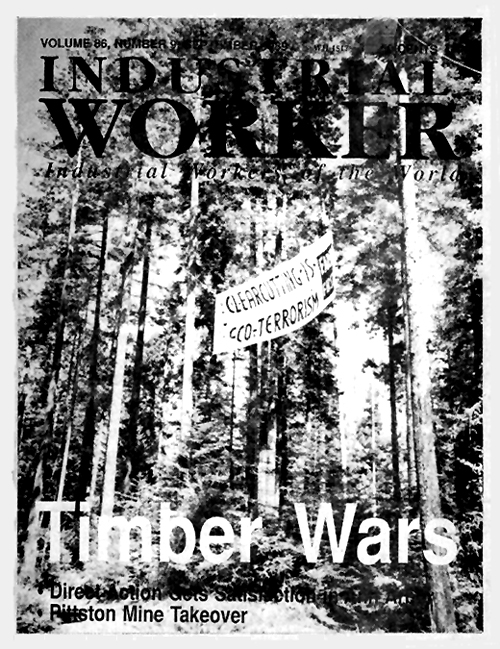
In her descriptions of the various efforts by Earth First! - IWW Local #1 to build alliances with timber workers on northwestern California's redwood coast, Judi Bari occasionally refers to an underground news letter called Timberlyin' published by a group of dissident Pacific Lumber workers, first in the article Timber Wars, published in the Industrial Worker in October 1989...

Pacific Lumber is another of the "big three" timber companies in the area. Until recently, it was a locally based, family-run operation paying good wages and amazing benefits. Pacific Lumber also treated the forest better than most and, because of its conservative logging and avoidance of clearcutting, has ended up owning most of the privately-owned old growth redwood that's left in the world.
But in 1986, Pacific Lumber was taken over in a leveraged buyout by MAXXAM Corporation, a high-finance holding company owned by Charles Hurwitz. Hurwitz financed the takeover with junk bonds, and is now liquidating the assets of the company to pay off the debt. But in this case, the assets of the company are the last of the ancient redwoods. Hurwitz has tripled the cut, instituting clearcutting. gutted the pension plan, and started working people overtime.

Employees reacted by attempting to organize an ESOP, or Employee Stock Ownership Plan, so that they could buy the company back and protect their jobs and community. As many as 300 people came to an ESOP meeting at its height. But Hurwitz, of course, refused to sell, and the ESOP plan died. MAXXAM expected everyone to just shut up and go back to work at that point. Instead some of the workers started publishing an underground paper called Timberlyin' (as opposed to the company's paper, Timberline), which lampoons management and, while rejecting the misleadership of both the ESOP and the AFL unions, calls on the workers to organize for self-protection.

Timber Wars: Footloose Wobs Urgently Needed

By Judi Bari, Industrial Worker, October 1989; Reprinted in Timber Wars, © 1994 Common Courage Press.

"You fucking commie hippies, I'll kill you all!" A shotgun blast goes off and the Earth First!ers scatter. What started as a peaceful logging road blockade had turned violent when a logger sped his truck through our picket line and swerved it towards the demonstrators. The loggers also grabbed and smashed an Earth First!er's camera and, for no apparent reason, punched a 50-year old protester in the face, breaking her nose.

The environmental battle in the Pacific Northwest has reached such a level of intensity that the press now refers to it as the Timber Wars. At stake is the survival of one of the nation's last great forest ecosystems. Our adversaries are giant corporations--Louisiana Pacific, Georgia Pacific, and MAXXAM in northern California, where I live, joined by Boise Cascade and Weyerhauser in Oregon and Washington.

These companies are dropping trees at a furious pace, clogging our roads no less than 18 hours a day, with a virtual swarm of logging trucks. Even old timers are shocked at the pace and scope of today's strip-logging, ranging from 1000-year old redwoods, one tree trunk filling an entire logging truck, to six-inch diameter baby trees that are chipped up for the pulp-mills and particleboard plants.

One-hundred-forty years ago the county I live in was primeval redwood forest. At the current rate of logging, there will be no marketable trees left here in 22 years. Louisiana Pacific chairman Harry Merlo put it this way in a recent newspaper interview: "It always annoys me to leave anything lying on the ground. We don't log to a 10-inch top, we don't log to an 8-inch top or a 6-inch top. We log to infinity. It's out there, it's ours, and we want it all. Now."

So the battle lines are drawn. On one side are the environmentalists, ranging from the big-money groups like Wilderness Society and Sierra Club to the radical Earth First!ers and local mountain people fighting the front line battles in the woods. Tactics being used include tree-sitting, logging road blockading, and bulldozer dismantling, as well as the more traditional lawsuits and lobbying.

On the other side are the big corporations and the local kulaks who do their bidding. Tactics used by them have included falling trees into demonstrators, suing protesters for punitive damages (and winning), buying politicians, and even attempting to ban the teaching at a local elementary school of a Dr. Suess book, The Lorax, which the timber companies say portrays logging in a bad light.

Northwest Wobs Call for Support to Keep L-P Mill Open

By Darryl Cherney - Industrial Worker, March 1989.

"Activists have always touted that sustained yield equals sustained jobs. Therefore, by keeping the mills open forever, we would logically have to ensure forests forever to keep them going."

IWW and EF! member Darryl Cherney and other Northwest Wobs and radical ecodefenders have joined forces to take on the anti-labor, anti-environmentalist Louisiana Pacific lumber corporation and to prevent the corporation's planned closure of a Potter Valley mill in April. Cherney has made an important 12-point proposal to Gladys Simmons, a Public Affairs Officer of the Louisiana Pacific Corporation Cherney, who is a prominent environmental activist and songwriter, says that he is tired of the mainstream press trashing environmentalists as being anti-labor and of mill owners who blame environmentalists for mill layoffs and shut downs. He points to one industry spokesman at a gathering of the Eureka Chamber of Commerce in mid-December who was quoted as saying that environmentalists are making life difficult for the timber companies as they spend time and money fighting lawsuits instead of spending time and money in the forest cutting down trees.

With the second highest nationwide timber cut being reported (12.6 billion board feet) and Mendocino County reporting nearly triple the timber revenues from last year's cut on National Forest land, Cherney finds it "repulsive that industry is blaming environmentalists for shortages that over logging is creating." Cherney comments: "While MAXXAM/Pacific Lumber bemoans four lawsuits filed against them as anti-labor, they have in fact increased their workforce by 33% and nearly tripled their cut over 1985 levels. Another case is L-P's closing of the Potter Valley mill which doubled its shift only five years ago."

Cherney asks: "When will northcoast citizens learn that artificially increased production leads to massive busts shortly thereafter? With production and profits at an all time high, industry's criticism of environmentalists can only mean one thing: the bust is well on its way."

Cherney likens the industry's complaints about environmentalists to "a baby crying about a booboo on its little finger. L-P has million dollar publicity budgets, dozens of attorneys on retainer, high paid lobbyists in Sacramento and Washington, Representative Bosco and Assemblyman Hauser in their pockets, a stranglehold on the workforce, and ownership of millions of acres of timberland. Should a lawsuit tie up 1/10th of one percent of their timber base, you can hear them howl for miles."

"I'm asking environmentalists to fight to keep L-P's Potter Valley mill open." said Cherney. His proposal which has already challenged the industry's traditional public relations defense, has also challenged environmental circles, and has been greeted with enthusiasm from members of the Sierra Club, the Northcoast Greens, the Mendocino Environmental Center, the Wilderness Coalition, Save the North fork and the International Woodworkers of America.

Cherney also believes that workers are coming to see the importance of environmental concerns. At a recent Earth First! demonstration, MAXXAM/PL actually imported counter demonstrators from other companies because their own employees, who are currently attempting to buy back the company, would not defend the policies of corporate raider Charles Hurwitz.

Cherney mailed his pitch to L-P spokesperson. Glennys Simmons and has some words of concern about her job: "Glennys will be one of the first to go when L-P closes their Ukiah mill. They already have a PR person, Shep Tucker, in Humboldt County. Besides, PR is one of L-P's lowest priorities. Look how they announced layoffs just before Christmas, after many people had begun their shopping," said Cherney. "L-P's treatment of their employees is reflective of their forest management. They can't tell us whether they can keep their people employed four months from now, and they expect us to trust them with long range forest management."

Tacoma Pier Shut Down!: Sea Diamond, Laden With Kaiser Aluminum Scab Cargo, Idled By MTW-Organized Solidarity Action

By x337969 - November 1998

Tacoma, Washington - At sunrise on Monday, November 7th, Puget Sound Marine Transport Workers and other Wobblies set up a picketline at Pier 7 in the Port of Tacoma in solidarity with locked-out Steelworkers from Kaiser Aluminum.

The Sea Diamond, a cargo ship loaded with bauxite destined for Kaiser's Tacoma and Spokane facilities, was delayed for 24 hours, after members of Earth First! (EF!) occupied a crane and a conveyor belt at Pier 7.

The action was called for by members of the United Steel Workers of America (USWA) who have been on strike for the last three months. The strike was prompted by Kaiser Aluminum's refusal to talk to the union over issues such as downsizing, cuts in medical and retirement benefits. Kaiser began moving trailers to house its scabs onto the polluted factory site before negotiations with the union were even set to begin.

Management at Kaiser--a subsidiary of the infamous Maxxam Corporation, owned by junk bond baron Charles Hurwitz--has conducted a determined effort to break the Steelworkers' union through the use of scab labor and strikebreaking goons from the International Management Assistance Corporation (IMAC).

The first ILWU dockworkers began arriving to work the ship at about 7:00 am. Jeremy Read, Branch Organizer of MTW-IWW San Francisco Bay Ports Local 9, explained to a crane operator the nature of the picket. The crane operator, realizing his right not to endanger the health and safety of anyone on the job site, promptly went home.

Longshore workers honored the picketline without hesitation. Many who had not been dispatched to work the Sea Diamond came down, out of both support and curiosity. Many were surprised that EF! had acted in solidarity with union workers, as many had viewed its past actions as opposed to workers' interests particularly in the lumber industry. Other longshore workers grabbed "bulls" (or forklifts), and moved checker shacks around to the picketline so pickets could get out of the rain.

EF! activists scouted Pier 7, and the first two were arrested after attempting to occupy the crane. Fortunately, others had made it up to the crane's boom, and some were posted in the scaffolding of the conveyor belt to the silos150 feet above ground.

As members of the press arrived, crane climbers rappelled from their position aloft in an attempt to unfurl a gigantic banner which read "HURWITZ CUTS JOBS AS FAST AS HE CUTS TREES". The wind ended up whipping the banner and the climbers about, creating a spectacle eagerly filmed by the TV crews. The climbers were cited for criminal trespass, but were not hurt. Climbers descended the crane in the afternoon, and were not cited or arrested.

The Sea Diamond dropped anchor at about 10:00am, and water craft ranging from an Wobbly sailboat to personal boats drifted around the port, preventing the ship from docking. Foss tugboats, operated by Inlandboatmen's Union of the Pacific members, cruised by to check out the action, as did Coast Guard vessels.

Throughout the action, Steelworkers maintained their legal six-member, informational picketline.

Guilty, Guilty: Earth First! - IWW Greenhouse Demo

By Judi Bari -  Composite of two articles from Industrial Worker, March 1989 and Earth First! Journal, Nov. 1, 1988; A substantially shortened summary also appeared in the Mendocino Commentary, October 6, 1988.

Web Editor's Note: Both the Industrial Worker and Earth First! Journal versions of this article are abridged in different places (evidently they’re both excerpted from a common press release). The following represents a combination of both articles. This is the very first article Judi Bari wrote for the Industrial Worker.

The best thing about our regional Earth First! gath-erings are the demonstrations afterwards. I mean, as long as you’ve got 200 yahooing Earth First!ers together, you might as well do an action. So, in keeping with this venerable tradition, our California Rendezvous September 16–18, 1988, we decided to indict some of the criminals responsible for the greenhouse effect. After all, as Fellow Worker Utah Phillips told us, “The earth isn’t dying; it’s being killed, and the people killing it have names and addresses.”

So we decided to use a traditional Wobbly tactic of an all-day roving picket line with the theme of the Greenhouse Effect. We printed indictment forms (with blanks to fill in the company name) and whipped up a few big banners saying “Guilty Guilty-Greenhouse Effect Violator,” and prepared some indictment forms to lay on the perpetrators.

We had plenty of violators to pick from, but time constraints forced us to limit it to four—Simpson Pulp Mill, MAXXAM / Pacific Lumber Corporation (in Scotia, CA), Eel River Sawmills, and a public hearing on offshore oil.

Simpson was the most dramatic. We gathered in the morning drizzle at Arcata Plaza. By the time our caravan reached Simpson pulp mill, we were 100 strong. Truck drivers were surprised by the sudden appearance of a raggedy mob, just back from three days in the woods, blocking the entrance road to the Simpson plant. We stretched our banners out in the road and, as the Arcata Union described it, “As a truck tried to turn onto Samoa Blvd., the Earth First!ers stood firm in its way and started howling like coyotes.” The first truck stopped and we ran over to tell the driver that the IWW says take a break on us. That was fine with him, and he kicked back to enjoy the show. The driver coming the other direction, though, didn’t take it so easy. No damn hippies were gonna stop him from going to work—he was going to ram our line. “Stop Mr. Block!” chanted the crowd, but the truck kept coming until Earth First!er Corbin Solomon courageously dove under the front wheel of the moving semi. The driver stopped, cursed, then rolled forward. Our line held firm, and people started yelling “Brian Willson!”  as the truck wheels came within feet of Corbin’s body before it finally stopped.

IWW rep Billy Don Robinson jumped up on the truck’s running board to talk some sense into his fellow wage slave. But Mr. Block wasn’t in a talking mood, and took a swing at Bill Don. “No jobs on a dead planet!” chanted the crowd, as the standoff continued for 30 minutes, with trucks backed up down the highway in both directions. Finally the police showed up and ordered us to leave. Since we had more work to do that day, we cheerfully obliged, jumping into our cars loudly announcing “Eel River Sawmills next!” Then we proceeded to Pacific Lumber Corp., skipping Eel River for now and losing our police escort.

Pages

The Fine Print I:

Disclaimer: The views expressed on this site are not the official position of the IWW (or even the IWW’s EUC) unless otherwise indicated and do not necessarily represent the views of anyone but the author’s, nor should it be assumed that any of these authors automatically support the IWW or endorse any of its positions.

Further: the inclusion of a link on our site (other than the link to the main IWW site) does not imply endorsement by or an alliance with the IWW. These sites have been chosen by our members due to their perceived relevance to the IWW EUC and are included here for informational purposes only. If you have any suggestions or comments on any of the links included (or not included) above, please contact us.

The Fine Print II:

Fair Use Notice: The material on this site is provided for educational and informational purposes. It may contain copyrighted material the use of which has not always been specifically authorized by the copyright owner. It is being made available in an effort to advance the understanding of scientific, environmental, economic, social justice and human rights issues etc.

It is believed that this constitutes a 'fair use' of any such copyrighted material as provided for in section 107 of the US Copyright Law. In accordance with Title 17 U.S.C. Section 107, the material on this site is distributed without profit to those who have an interest in using the included information for research and educational purposes. If you wish to use copyrighted material from this site for purposes of your own that go beyond 'fair use', you must obtain permission from the copyright owner. The information on this site does not constitute legal or technical advice.

