






 In 2016, the Korean government agreed with the US to place the American built anti-ballistic missile system THAAD (Terminal High Altitude Air Defense) in the quiet town of Seongju South Korea. The then government of South Korea headed by conservative president Park Geun-hye, steamrollered the project through a hasty environmental review during her last months in office. This weapons system will threaten peace in the world, particularly in South Korea and North East Asia, apart from facilitating the spread of US hegemony in this region. It is harmful to human health and the environment. A majority of the Korean people are absolutely opposed to this government’s unilateral policy decision. Korean peasants’ organisations have been consistently opposing the project as its threatens peace and stability in the region.
 Reasons to Divest from the War Machine NOW
 American Capitalism in Decline
On December 30, 1917 Seymour Melman was born in New York City. The 100th anniversary of his birth helps bring his intellectual legacy into focus. Melman was the most significant reconstructionist thinker of the 20th Century, championing alternatives to militarism, capitalism, and social decay by advancing a systematic counter-planning program for disarmament and economic democracy. His legacy remains of critical importance because today the United States is currently a society in which the economic, political and cultural systems are spiraling into an abyss. Economic and social reconstruction is the idea that planned alternatives to the incumbent mechanisms for organizing economic, political and cultural power exist in alternative institutional designs and matching systems to extend these designs.
The economic realities are well-known, defined by an economic system in which the richest 1% of the population controlled 38.6% of the nation’s wealth in 2016 according to the Federal Reserve. The bottom 90% controlled only 22.8% of the wealth. This wealth concentration is well-known and is linked to financialization of the U.S. economy which is matched by deindustrialization and the decline of the “real economy.” Melman analyzed this problem tied to Wall Street hegemony and managerial attacks on worker’s power in his classic 1983 study Profits without Production. Here Melman illustrated how profits –and thus power—could be accumulated despite the decline of industrial work and manufacturing. In fact, the rise in administrative overheads associated with the over-extension of managerial power actually helped reduce both the competiveness and competence of U.S. firms.
In politics, the Republican Party has emerged as a Trojan Horse society, helping to defund the welfare state and advancing the aims of the predatory warfare state. The 2018 defense bill signed by President Trump allotted about $634 billion for core Pentagon operations and allotted an addition $66 billion for military operations in Afghanistan, Iraq, Syria and elsewhere. More money was available for troops, jet fighters, ships and other weapons, even though there are millions of U.S. citizens living in poverty (40.6 million in 2016). Melman addressed the problem of the enduring post-war militarism of the U.S. in perhaps his most famous book, The Permanent War Economy, first published in 1974. The subheading of that book was “American Capitalism in Decline.” This economy emerged as way to consolidate the military largess bestowed on aerospace, communications, electronics and other war-serving industries, not to mention universities, military bases and associated institutions serving the military economy. This corporatist system, linking the state, corporations, trade unions and other actors was described by Melman in Pentagon Capitalism: The Political Economy of War, a 1971 book which showed how the state was the top manager who used its procurement and managerial power to direct these various “sub-managements.”
In culture, we see the reign of post-truth politics, in which politicians knowingly lie in order to advance political objectives and ideology makes facts irrelevant. A report by David Leonhardt and colleagues in The New York Times found that “in his first 10 months, Trump told nearly six times as many falsehoods as Obama did during his entire presidency.” The problem, however, is that the underlying system of U.S. governance has been based on many bipartisan myths. Melman’s career was based on trying to uncover such myths.
One such myth embraced by both the Republican and Democratic Parties was the idea that military power can be used without any limits. In Vietnam, Iraq and Afghanistan, the U.S. tried to defeat guerilla operations in which the opposing military was embedded in civilian zones. Attacking such areas deflated the U.S. military’s legitimacy with the projection of military power undermining U.S. political power in the region being attacked. In Vietnam, the U.S. lost politically and a backlash against that war triggered a domestic revolt. In Iraq, the toppling of Hussein pushed Iraq into the Iranian orbit, a country which is nominally a principal adversary of U.S. elites. In Afghanistan, the U.S. continues to fight its longest war with thousands dead and “no end in sight.” When it comes to terrorism, Melman saw terrorist actions as tied to alienation, individuals cut off and remote from social integration. Clearly social inclusion could remedy such a situation, but economic decline and an absence of solidarity simply compounded terrorist threats (whatever the diverse origins).
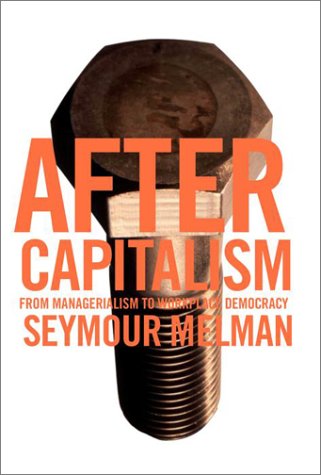
Another key myth was the ability to organize and sustain a “post-industrial society.” A report in Industry Week (August 21, 2014) noted that between 2001 and 2010, the U.S. economy shed 33% of its manufacturing jobs (about 5.8 million), which represented a 42% decline when controlling for the increase in the workforce. After controlling for increased in the working-age population during this period, Germany lost only 11% of its manufacturing jobs. While scholars debate whether trade or automation and productivity is more significant in causing such job loss, automation in a nation state serving to protect the domestic organization of work will clearly preserve more manufacturing jobs than others. In fact, the integration of automation and cooperative workforces can preserve jobs, a point made by Melman in his last great work, After Capitalism: From Managerialism to Workplace Democracy. Melman’s support for the domestic anchoring of jobs through proactive investments in civilian infrastructure including sustainable forms of alternative energy and mass transportation also belied the associated myths of globalization and free markets—both of which failed to automatically yield a proactive welfare state responsive to maintaining full and sustainable employment.
 The Earth Day 2017 March for Science signals resistance to Donald Trump’s sharp infusion of irrationality into the national discourse.
 The anti-war demonstration in London on 15 February 2003 was the biggest protest in British history. And probably the most popular slogan on the placards and banners that day was ‘No blood for oil’. It was a connection that seemed obvious to many on the march but was repeatedly ridiculed by supporters of the invasion of Iraq. Tony Blair said that ‘the oil conspiracy theory is honestly one of the most absurd when you analyse it.’
  Whereas; On March 3, 2016 the temperature across the northern hemisphere, crossed a line. For a short time it was more than two degrees Celsius above “normal” for the first time in recorded history. Governments are supposedly working to avoid crossing that so called “red line.” Arctic sea ice is at record low levels for the date. Last month a tropical cyclone hit Fiji with the highest wind speeds ever measured, causing substantial regional destruction. Storms on Mexico’s West Coast have carried the highest wind speeds in history for months and carbon dioxide in the atmosphere unexpectedly surpassed 400 parts per million, drastically changing the historical natural balance. This February we’ve seen record high temperatures. This is a glimpse into our climate changed future if we do nothing and,
 A previous article I wrote explored
 Aggressive militarism continues to emanate from the office of the presidency and the US government itself. With drone strikes in foreign countries, an “
 This site is not the official webpage of the Industrial Workers of the World.