






You are here
ecosocialism
 Five years ago, a group of us at the University of Alberta in Edmonton formed the Petrocultures Research Group to develop a sharper understanding of the ways we use (and abuse) energy. Our immediate intention was to examine the social, cultural and political implications of Canada’s turn-of-the-twentieth-century leap into the ranks of the world’s oil superpowers. Our interest in energy arose in part as a result of working at the research university closest to the Athabasca tar sands. In Edmonton, it’s hard not to see oil everywhere, and not only in the physical infrastructure of refineries, but also in its social costs and consequences: labour dislocation, inflated housing prices, alcohol and drug abuse, and rates of sexual violence and family dysfunction.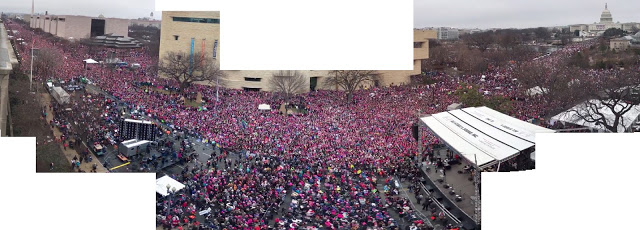
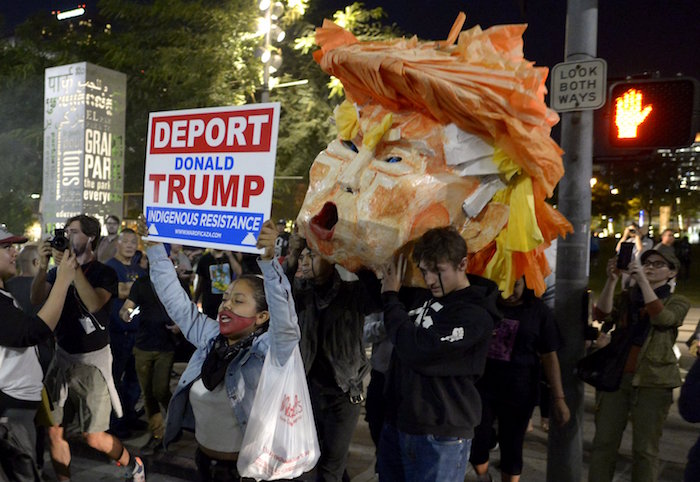 According to the Oxford English Dictionary, a dictator is “a ruler or governor whose word is law.” And whether it’s via Trump’s tweeted word, which triggers stocks to rise or drop across the planet, or via his signature on an executive order that just banned over 100 million people, including legal residents, from entering the U.S., Trump seems to be just that. Despite its lack of constitutionality, his word functions as the law. Although his Muslim ban (which discriminates against people based on national origin and religion, and is therefore a breach of the Due Process Clause of the Fifth Amendment and the Establishment Clause of the First Amendment to the U.S. Constitution) was temporarily stayed by the courts, Trump released a statement shortly afterward announcing that it remains in complete effect. In this defiance of the law he seems to be following the example of Andrew Jackson. For let us recall that Jackson notoriously defied the Supreme Court’s ruling in Worcester v. Georgia, which held that the Indian Removal Act was unconstitutional, and that the brutal removal of the Cherokee people via the infamous Trail of Tears to Oklahoma be stopped. Jackson (whose portrait was recently hung in Trump’s Oval Office) ignored the Court, permitting the ethnic cleansing of Georgia to continue.
 “It’s not enough to simply say ‘No’ to attacks [from the Trump administration]. It’s not enough because we know that where we are now, before the attacks come, is entirely unacceptable. The levels of inequality, the levels of racism―and the planet chaos that we have unleashed. We need radical system change.” —Naomi Klein
 THE ENORMOUS anti-Trump protests on January 21 are a major opportunity to build a new political resistance. Yet the expanding but still small radical left in the U.S. also faces a major challenge in creating an alternative to the failed strategy of channeling all opposition through the dead end of the Democratic Party.
 Facing the Anthropocene:
 Working out the time-scale of the Anthropocene epoch can not be left to natural scientists, a group of researchers
 The Fine Print I:
Disclaimer: The views expressed on this site are not the official position of the IWW (or even the IWW’s EUC) unless otherwise indicated and do not necessarily represent the views of anyone but the author’s, nor should it be assumed that any of these authors automatically support the IWW or endorse any of its positions.
Further: the inclusion of a link on our site (other than the link to the main IWW site) does not imply endorsement by or an alliance with the IWW. These sites have been chosen by our members due to their perceived relevance to the IWW EUC and are included here for informational purposes only. If you have any suggestions or comments on any of the links included (or not included) above, please contact us.
The Fine Print II:
Fair Use Notice: The material on this site is provided for educational and informational purposes. It may contain copyrighted material the use of which has not always been specifically authorized by the copyright owner. It is being made available in an effort to advance the understanding of scientific, environmental, economic, social justice and human rights issues etc.
It is believed that this constitutes a 'fair use' of any such copyrighted material as provided for in section 107 of the US Copyright Law. In accordance with Title 17 U.S.C. Section 107, the material on this site is distributed without profit to those who have an interest in using the included information for research and educational purposes. If you wish to use copyrighted material from this site for purposes of your own that go beyond 'fair use', you must obtain permission from the copyright owner. The information on this site does not constitute legal or technical advice.
 This site is not the official webpage of the Industrial Workers of the World.