You are here

renewable energy

(Preliminary) Workers' Climate Plan

By Lliam Hildebrand, et. al. - Iron and Earth, September 2016

Iron & Earth, a Canadian non-profit organization led by skilled trades workers with experience in Canada’s oil industry, is developing a Workers’ Climate Plan. This preliminary report describes how Canadacan become a leader in renewable energy, and a net exporter of renewable energy products, services and technology, by harnessing the industrial trade skills of current energy sector workers. A growing number of oil and gas trades people support a transition to renewable energy so long as it provides a just transition for current energy sector workers. By utilising Canada’s existing energy sector workforce, organizations and infrastructure, Canada can accelerate the transition to renewable energy, decrease the cost, and make Canada’s renewable energy sector globally competitive.

Throughout September and October, Iron & Earth will continue to reach out to energy sector workers over the phone and in person to speak about the Workers’ Climate Plan in more detail. Iron & Earth is consulting with a range of energy sectors take holders in partner ship with the Alberta-based EnergyFutures Lab in order to devise a set of recommendations based on worker demands. This will informan expanded Workers’ Climate Plan which we will release in November 2016 ahead of The 22nd session of the Conference of the Parties (COP 22). In this preliminary, abridged version of the Workers' Climate Plan, we share insights from current energy sector workers for the consideration of the Working Group on Clean Technology, Innovation and Jobs, as they compile their reports for the ministerial tables in September 2016.

Read the report (PDF).

If it's jobs they want, Labour and the unions must back renewables, not Hinkley C!

By Ian Fairlie - The Ecologist, August 30, 2016

On July 28, the Prime Minister's Office announced a delay until the autumn to allow a review to take place re the nuclear power station at Hinkley Point C proposed by the previous Government.

Since then, press criticisms of the mooted Hinkley C have continued unabated led by flagship editorials from the FT and The Economist.

These echo widespread concerns by the National Audit Office (NAO) in its recent preliminary report - Nuclear Power in the UK.

A detailed reading reveals serious question marks about the proposed project. According to The Times of July 31, the NAO will publish another damning report on Hinkley as soon as the Government has made its decision.

It would be infinitely preferable for the NAO's considerations to be made available to the Government before legally binding decisions were taken on Hinkley C, rather than afterwards.

This is not a minor matter: the Government is understood to have ready a draft Investor Agreement - essentially an irrevocable contract for electricity from Hinkley C for 35 years at a cost of £29.7 billion to British energy consumers, as estimated in the above NAO report. This is a discounted sum: economists consider an undiscounted sum of about £37 billion should really be applied. Whichever figure is used, this is an unconscionable sum.

But it is not just the NAO which is concerned: other institutions including the Treasury's National Infrastructure Commission, chaired by Lord Adonis, and its Infrastructure and Projects Authority. Members of Energy UK are also worried.

And two years ago, as stated in the UK Government's report of October 8, 2014 to the European Commission on state aid for Hinkley, the then Infrastructure UK arm of the Treasury evaluated the Hinkley project as 'Speculative BB+'.

Even this junk rating would have depended on the proper functioning of the proposed EPR at Flamanville in France which is by no means assured. In 2016, two years later, it is likely Hinkley's investment rating will be even lower.

Corporations Call for “Net Zero” Emissions: Do They Know How to Get There?

By Sean Sweeney - New Labor Forum, August 12, 2016

In the months leading to the December 2015 Paris Climate Conference, representatives of global institutional investors and multinational corporations made headlines after they demanded that world leaders adopt radical emissions reduction targets, among them “net zero” emissions by 2050. Examples include the Global Investor Statement on Climate Change, which was signed by 409 investors representing more than $24 trillion in assets, and the Prince of Wales’ Corporate Leaders Group (which includes the likes of Shell Global and Heathrow Airport Holdings Limited). Following the Statement’s adoption in Paris, a cluster of corporate heads led by Virgin Group’s Richard Branson (calling itself the “B Team”) demanded that all governments turn the Paris net zero emissions target into national-level laws.

What are we to make of this? The practical implications of the net zero target adopted in Paris—if it is seriously pursued—are nothing short of revolutionary, opening up a “system crunch” scenario when the forces of growth, profit, and accumulation that presently propel capitalism collide with the political imperatives required to reach virtually total “decarbonization” in little more than a generation.

Paradoxically, the corporate push to adopt net zero by 2050—a target that is unprecedented in terms of its ambition—merely draws attention to the fact that the corporate elite has no clear or convincing idea about how it might be achieved. The capitalist spirit is progressively willing, but the flesh grows all the time steadily weaker.

Thus, the Paris Agreement can be a clarifying moment for labor, the climate movement, and the broader left in that, more than ever before, it exposes the gulf between what needs to be done from a scientific standpoint and what the global corporate and political elite are actually able to deliver.

10,000 protesters demand ‘Clean Energy Revolution’

By Christine Marie - Socialist Action, August 17, 2016
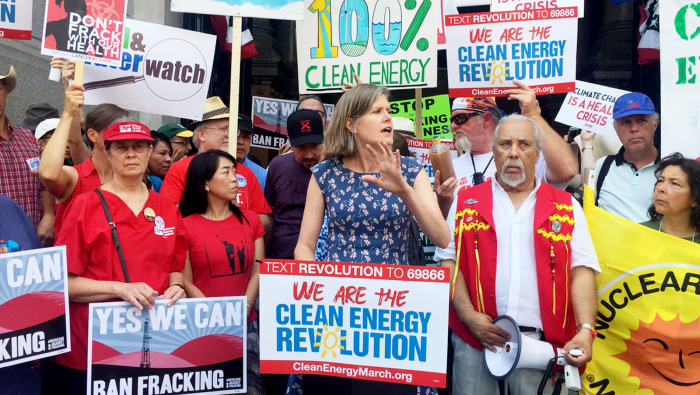
“People gonna rise like the water,” the most poignant of the new songs of the climate justice movement, makes a strong prediction. And the potential breadth and power of that people was on display in a new way on July 24, as close to 10,000 marchers took to the streets on a sweltering day (97 degrees) before the opening of the Democratic Party Convention in Philadelphia.

The march began at City Hall after a press conference anchored by front-line activists from communities devastated by extreme extraction from Pennsylvania to Honduras. There Teresa Hill of ACTION United condemned the plans to turn Philadelphia into a major “energy hub” for fracked gas, whose methane emissions are alone capable of taking us to a climate tipping point. Laura Zuñiga Cáceres, daughter of the slain Honduran environmental and Lenca warrior Berta Cáceres, closed with the now immortal words of her famous mother, “Wake up Humanity! Time is running out!”

While there have been larger marches, the July 24 “March for a Clean Energy Revolution” focused more pointedly on the immediate dangers of the fracking process and the massive infrastructure that is being constructed around the United States for fracked gas, which is obstructing the effort for an emergency transition to renewable energy. The unequivocal demands for a ban on fracking, keeping fossil fuels in the ground, and a quick and just transition to 100% renewable energy represent the vanguard of the movement and the terms on which the growing movement will be most effectively mobilized.

The insistence that both political parties were failing humanity on the climate front came through loud and clear. Mark Schlosberg, the organizing director for Food & Water Watch, the group that leads Americans Against Fracking and brought 900 national and local groups to endorse the march, built the demonstration by forcefully arguing, “both parties’ platforms fall far short of addressing the climate emergency we are in.”

These principled demands and the unwillingness to subordinate the movement to the Democratic Party agenda brought together a large number of activists from front-line communities in a display of determination to take back the earth from those who would sacrifice them and the land for profit. Participants included those struggling against the assault on their health in the Pennsylvania gas fields; those living next to the radioactive tailings ponds of the Southwest and the potential storage sites at Seneca Falls, N.Y.; and those from the urban centers where parked oil trains deprive their children of breath.

At the final rally, in front of Independence Hall, Theresa Hill of the Green Justice Philadelphia Coalition pointed out that the local refineries are located exclusively in economically depressed neighborhoods: “And they think that people of color and low-income people won’t fight back. But as we said to the CEO of this oil refinery, who still hopes to expand the refinery, we are saying NO! … We will fight! Fight for our right to breathe!” Marchers reflected the understanding of the enormity of this struggle in chants such as “Hydo-fracking: Shut it Down!; Oil Pipelines: Shut it Down!; the Whole Damn System: Shut it Down!”

One of the constituencies that were most warmly welcomed was that of public health advocates and workers. The organizer of the health contingent, Karuna Jagger of Breast Cancer Action, rallied the crowd at the final rally when she said, “We are marching to demand an end to fracking and other dangerous drilling practices that rely on toxic chemicals and are linked to an array of deadly diseases and disorders.”

The devastating impact of the fracking on working-class lives is now documented in rising number of white papers. Sandra Steingraber, the science adviser to Food & Water Watch, wrote in the wake of the march that the number of premature births—premature birth being the number one predictor of infant mortality—rose 40% if one was forced by economic circumstances to live amidst the drilling pads despoiling large swaths of the U.S.

Labor organizers who have stepped up to help combat the climate crisis very visibly built the demonstration. Joe Uhlein of the Labor Sustainability Network and the convener of the Labor Climate Convergence in January of this year, urged trade unionists to attend. “It is time for those of us in the labor movement to rise to the challenge and become a central player in the movement to build a sustainable future for the planet and its people—not only for the survival and wellbeing of all, but also for organized labor’s own self-interest,” he wrote in a blog post called “Why Trade Unionists Should March for a Clean Energy Revolution.”

The labor contingent at the march, which included groups from AFSCME and the postal workers union was modestly impressive and reflected the patient and systematic outreach and education being carried out in labor councils, union locals, and other labor bodies from one coast to another.

A Peace and Climate Justice contingent, initiated by Peace Action and built by Code Pink, organized its members under the demands: Slash the Pentagon and world military budgets, provide strong aid to climate refugees, and fund green energy, targeting 100% clean by 2030. The adoption by the peace community of the latter demand is reflective of the now broad acceptance of the real science of climate change, a science that is unanimous in concluding that we must have an emergency transition that begins today and is extremely advanced just 14 years from now.

Fortunately, Mark Jacobson and his team at Stanford have made it crystal clear that current technology will allow us to complete a transition to a 100% renewable energy grid by 2050. The only obstacle is the political elite who refuses to take responsibility for organizing this transition.

Front-line marchers included participants in the “Indigenous Leaders Protect Our Public Lands Caravan,” a group of youth activists and elders from Colorado, Oklahoma, New Mexico, and Arizona who traveled to Philadelphia on a nickel and hope. The 17 spokespeople for the Native American victims of extreme extraction by the fuel industry also anchored the impressive Summit for a Clean Energy Revolution, held the day before the march at the Friends Center in Philadelphia.

Other contingents included those organized by the faith community, by elders, by advocates of a nuclear-free transition from carbon, for those leading the drive to popularize local 100% renewable solutions, by SURJ (Showing Up for Racial Justice), and students. The success of this march, organized effectively despite the tremendous negative pressures of the bourgeois electoral season—bodes well for the next steps in our efforts to build a massive movement independent of the Democratic and Republican parties and reliant on its own power in the streets.

Carbon Bubble News #117

Compiled by x344543 - IWW Environmental Unionism Caucus, August 17, 2016

A supplement to Eco Unionist News:

Lead Stories:

Other Carbon Bubble News:

Utility Death Spiral News:

For more green news, please visit our news feeds section on ecology.iww.org; Twitter #IWWEUC; Hashtags: #greenunionism #greensyndicalism #IWW. Please send suggested news items to include in this series to euc [at] iww.org.

Carbon Bubble News #116

Compiled by x344543 - IWW Environmental Unionism Caucus, August 10, 2016

A supplement to Eco Unionist News:

Lead Stories:

Other Carbon Bubble News:

Utility Death Spiral News:

For more green news, please visit our news feeds section on ecology.iww.org; Twitter #IWWEUC; Hashtags: #greenunionism #greensyndicalism #IWW. Please send suggested news items to include in this series to euc [at] iww.org.

Carbon Bubble News #115

Compiled by x344543 - IWW Environmental Unionism Caucus, August 2, 2016

A supplement to Eco Unionist News:

Lead Stories:

Other Carbon Bubble News:

Utility Death Spiral News:

For more green news, please visit our news feeds section on ecology.iww.org; Twitter #IWWEUC; Hashtags: #greenunionism #greensyndicalism #IWW. Please send suggested news items to include in this series to euc [at] iww.org.

NY Times Pushes Nukes While Claiming Renewables Fail to Fight Climate Change

By Harvey Wasserman - EcoWatch, July 25, 2016

The New York Times published an astonishing article last week that blames green power for difficulties countries are facing to mitigate climate change.

The article by Eduardo Porter, How Renewable Energy is Blowing Climate Change Efforts Off Course, serves as a flagship for an on-going attack on the growth of renewables. It is so convoluted and inaccurate that it requires a detailed response.

As Mark Jacobson, director of Atmosphere/Energy Program at Stanford University, pointed out to me via email:

The New York Times article "suffers from the inaccurate assumption that existing expensive nuclear that is shut down will be replaced by natural gas. This is impossible in California, for example, since gas is currently 60 percent of electricity supply but state law requires non-large-hydro clean renewables to be 50 percent by 2030. This means that, with the shuttering of Diablo Canyon nuclear facility be 2025, gas can by no greater than 35-44 percent of California supply since clean renewables will be at least 50 percent (and probably much more) and large hydro will be 6-15 percent. As such, gas must go down no matter what. In fact, 100 percent of all new electric power in Europe in 2015 was clean, renewable energy with no new net gas, and 70 percent of all new energy in the U.S. was clean and renewable, so the fact is nuclear is not being replaced by gas but by clean, renewable energy.

"Further, the article fails to consider the fact that the cost of keeping nuclear open is often much greater than the cost of replacing the nuclear with wind or solar. For example, three upstate New York nuclear plants require $7.6 billion in subsidies from the state to stay open 12 years. To stay open after that, they will need an additional $805 million/year at a minimum, or at least $17.7 billion from 2028-2050, or a total of $25.3 billion from 2016 to 2050. If, on the other hand, those three plants were replaced with wind today, the total cost between now and 2050 would be $11.9 billion. Thus, keeping the nuclear plants open 12 years costs an additional $7.6 billion; keeping it open 34 years costs and additional $25.3 billion, in both cases with zero additional climate benefit, in comparison with shuttering the three plants today and replacing them with onshore wind."

Gideon Forman, climate change and transportation policy analyst at David Suzuki Foundation, also shared his dismay on the Times piece:

"The notion that non-renewable power sources are necessary is questionable at best. Some scientists believe that, over the next few decades, renewables could provide all our power. One is Stanford Prof. Mark Jacobson. He has done modeling to show the U.S. could be entirely powered by renewables by 2050.

"Porter is wrong to claim that nuclear produces 'zero-carbon electricity.' If we look at the full nuclear cycle, including production of uranium fuel, we find it involves considerable carbon emissions. Jacobson and his co-author, Mark A. Delucchi, have written, 'Nuclear power results in up to 25 times more carbon emissions than wind energy, when reactor construction and uranium refining and transport are considered.'

"Porter says if American nuclear plants were replaced with gas-fired generators it would lead to 200 million tons of additional CO2 emissions annually. But it's wrong to suggest that nuclear could only be replaced by natural gas. A full suite of renewables—along with energy storage and conservation programs—could meet demand, certainly in the not very distant future.

"Porter suggests that nuclear power can 'stay on all the time.' But of course, nuclear plants, like all generators, are sometimes out of service for maintenance. This downtime can be considerable. For example, it is expected that from 2017 to 2021, Ontario's Pickering nuclear station will require back-up almost 30 percent of the time."

Karl Grossman, professor of journalism at State University of New York/College at Old Westbury, called the Times piece "outrageous." He told me:

"The Times piece continues the paper's long record of minimizing and downplaying—not recognizing and indeed often denying—the deadly impacts of nuclear power. It's been a shameful journalistic dysfunction. As Alden Whitman, a Times reporter for 25 years, told me, 'there certainly was never any effort made to do' in-depth or investigative reporting on nuclear power. 'I think there stupidity involved,' he said, and further, 'The Times regards itself as part of the establishment." Or as Anna Mayo of The Village Voice related: 'I built a full-time career on covering nuclear horror stories that the New York Times neglected.'"

So where do I stand on the Porter piece? Here are my eight biggest complaints:

Carbon Bubble News #114

Compiled by x344543 - IWW Environmental Unionism Caucus, July 27, 2016

A supplement to Eco Unionist News:

Lead Stories:

Other Carbon Bubble News:

Utility Death Spiral News:

For more green news, please visit our news feeds section on ecology.iww.org; Twitter #IWWEUC; Hashtags: #greenunionism #greensyndicalism #IWW. Please send suggested news items to include in this series to euc [at] iww.org.

Carbon Bubble News #113

Compiled by x344543 - IWW Environmental Unionism Caucus, July 19, 2016

A supplement to Eco Unionist News:

Lead Stories:

Other Carbon Bubble News:

Utility Death Spiral News:

For more green news, please visit our news feeds section on ecology.iww.org; Twitter #IWWEUC; Hashtags: #greenunionism #greensyndicalism #IWW. Please send suggested news items to include in this series to euc [at] iww.org.

Pages

The Fine Print I:

Disclaimer: The views expressed on this site are not the official position of the IWW (or even the IWW’s EUC) unless otherwise indicated and do not necessarily represent the views of anyone but the author’s, nor should it be assumed that any of these authors automatically support the IWW or endorse any of its positions.

Further: the inclusion of a link on our site (other than the link to the main IWW site) does not imply endorsement by or an alliance with the IWW. These sites have been chosen by our members due to their perceived relevance to the IWW EUC and are included here for informational purposes only. If you have any suggestions or comments on any of the links included (or not included) above, please contact us.

The Fine Print II:

Fair Use Notice: The material on this site is provided for educational and informational purposes. It may contain copyrighted material the use of which has not always been specifically authorized by the copyright owner. It is being made available in an effort to advance the understanding of scientific, environmental, economic, social justice and human rights issues etc.

It is believed that this constitutes a 'fair use' of any such copyrighted material as provided for in section 107 of the US Copyright Law. In accordance with Title 17 U.S.C. Section 107, the material on this site is distributed without profit to those who have an interest in using the included information for research and educational purposes. If you wish to use copyrighted material from this site for purposes of your own that go beyond 'fair use', you must obtain permission from the copyright owner. The information on this site does not constitute legal or technical advice.

