You are here

renewable energy

Capitalism’s renewable energy roadblock

By James Plested - Red Flag, April 7, 2017

Who can forget the image? George W. Bush’s stupid, blank face staring out across the deck of the aircraft carrier USS Abraham Lincoln under a giant banner emblazoned with the words “mission accomplished”.

The date was 1 May 2003 – a little over a month after the US launched its invasion of Iraq – and Bush was there to declare an end to major combat operations. As it turned out, this was somewhat premature.

Today, the environment movement seems to be having a “mission accomplished” moment of its own. With the price of renewables such as solar in free fall and new battery technology coming on line, many environmentalists are sounding the death knell of fossil fuels.

A recent article by Australia Institute strategist Dan Cass in Meanjin, “The sun rises: the democratisation of solar energy might change everything” – makes the case. The cost of solar power has decreased to the point where it’s now as cheap as, or cheaper than, coal or gas. “As late as 2007”, he writes, “Australia had only about 8,000 solar systems in total. As of 1 June 2016, there were more than 1,548,345”.

Globally, it’s a similar story. According to a Frankfurt School of Finance and Management report, in 2015, for the first time, renewables made up the majority of newly built electricity generation capacity. Investment in renewable energy, at US$265.8 billion, was more than double the US$130 billion invested in fossil fuel power generation.

Cass declares that “renewables have won the energy wars”. Crucially, he argues, this isn’t happening because of government intervention, but is in line with “capitalism as usual”:

“Consumers are rushing to a new technology that saves them money. Capital is flowing to the next big thing. Conservative critics of clean energy can’t quite admit it yet, but the rise of solar and the collapse of the old-energy utilities is ‘creative destruction’. It is the Kodak moment for big energy.”

According to this logic, we needn’t worry too much about continuing with environmental campaigning. Naomi Klein was wrong. It’s not, as she had it, “capitalism vs. the climate”, but rather capitalism for the climate. Put simply, technological developments mean that, while it may not yet be apparent, fossil fuels are dead in the ground.

All this is very comforting for those of us who have been alarmed by the headlong rush of global capitalism toward climate catastrophe. But just as with George W. Bush’s arrogant imperial overreach, this kind of triumphalism is unlikely to end well.

Green Jobs and Intergenerational Justice: Trump’s Climate Order Undermines Both

By Dana Drugmand - Common Dreams, March 30, 2017

With the stroke of a pen, President Trump has written off both the biggest economic development opportunity of the twenty-first century, and the security of today’s young people, future generations and the other species inhabiting this planet. Or so it seems.

The White House’s “Energy Independence Executive Order” is clearly a blow to the progress made under the Obama Administration to fight climate change and transition from fossil fuels to a clean energy economy. The new Order aims to rescind the Clean Power Plan, lift a moratorium on coal mining on federal land and roll back regulations on methane emissions from oil and gas fields. It comes on the heels of Trump’s official approval of the controversial Keystone XL pipeline. These actions are supposedly meant to boost jobs, but the only thing they actually boost is the already enormous share of fossil fuel profits.

A review of the numbers indicates that this is indeed not about jobs. Keystone XL, for example, would result in only 35 long-term jobs post-construction, according to State Department analysis. By contrast, the wind power industry employed 88,000 Americans at the start of 2016, and wind power technician is now the fastest growing profession in the nation. In electric power generation, solar provides more jobs than coal, oil and natural gas combined. According to an Environmental Defense Fund report, both solar and wind jobs are growing at a rate 12 times faster than the rest of the U.S. economy. In almost every state, there are now more jobs in the clean energy sector than in fossil fuels. For a president that claims to be so intent on creating jobs, ignoring renewables and energy efficiency in favor of fossil fuel exploitation is simply irrational.

It is also completely irresponsible and immoral. Intergenerational equity tends to be overlooked in the climate change conversation, yet it is an important dimension of the issue. Decision-makers have spent decades expanding the fossil fuel economy and running up a huge carbon debt – and their children and grandchildren will be forced to foot the bill. According to a 2016 report by Demos and NextGen Climate, failing to make steep cuts in emissions will cost the Millennial generation nearly $8.8 trillion in lost lifetime income. Beyond this financial implication, exacerbating climate change threatens the very survival of future generations and most other life on Earth. According to famed climate scientist Dr. James Hansen, the climate crisis implies “young people and future generations inheriting a situation in which grave consequences are assured,” and it “requires urgent change to our energy and carbon pathway to avoid dangerous consequences for young people and other life on Earth.” But instead of changing course, the Trump Administration’s fossil fuel frenzy in effect mortgages the future of my generation and those to follow.

Of course this all-out assault on clean air, clean water, and a stable climate will not go unchallenged. Citizens and activists are already gearing up to fight back in the streets and in the courts. One lawsuit in particular pits the federal government and fossil fuel industry against a group of youth plaintiffs, with a trial expected later this year that observers are billing as “the trial of the century.” And following in the spirit and scope of the Women’s March, tens of thousands of people will gather in Washington DC and other cities on April 29th to take part in the People’s Climate March.

State and local governments are also taking action to move forward on addressing the climate crisis. Maryland lawmakers just passed a bill to ban fracking, which the state’s Republican governor is slated to sign. A handful of states in the northeast and on the West Coast currently have pending legislation to implement a fee on carbon pollution. Hawaii has a mandate for 100 percent clean energy electricity by 2045. Municipalities all across the country are taking steps to slash carbon and transition quickly to entirely renewable energy. These and other initiatives become ever more important in this alarming age of science skepticism and “alternative facts.”

What this all comes down to is a power struggle between the ruling elite class of billionaires and the greater populace. Ultimately the authority to govern is derived from the people. We can and must use our collective people power to counter the greed of the fossil fuel industry and the big money polluting our politics. Most importantly, we must continue to fight and refuse to give up.

Can Coal Make a Comeback?

By Trevor Houser, Jason Bordoff, and Peter Marsters - Columbia Center on Global Energy Policy, School of International and Public Affairs, and the Rhodium Group, April 2017

From the introduction: Six years ago, the US coal industry was thriving, with demand recovering from the Great Recession, and global coal prices at record highs along with the stock prices of US coal companies. By the end of 2015, however, the industry had collapsed, with three of the four largest US miners filing for bankruptcy along with many other smaller companies. While coal mining employment has been on the decline for decades – from a peak of more than 800,000 in the 1920s to 130,000 in 2011 – the pace of job loss over the past six years has been particularly dramatic. After campaigning on a promise to end what he called his predecessor’s “War on Coal,” President Donald Trump signed an Executive Order in March 2017 ordering agencies to review or rescind a raft of Obama-era environmental regulations, telling coal miners they would be “going back to work.”

This paper offers an empirical diagnosis of what caused the coal collapse, and then examines the prospects for a recovery of US coal production and employment by modeling the impact of President Trump’s executive order and assessing the global coal market outlook. In short, the paper finds:

  • US electricity demand contracted in the wake of the Great Recession, and has yet to recover due to energy efficiency improvements in buildings, lighting and appliances. A surge in US natural gas production due to the shale revolution has driven down prices and made coal increasingly uncompetitive in US electricity markets. Coal has also faced growing competition from renewable energy, with solar costs falling 85 percent between 2008 and 2016 and wind costs falling 36 percent.
  • Increased competition from cheap natural gas is responsible for 49 percent of the decline in domestic US coal consumption. Lower-than-expected demand is responsible for 26 percent, and the growth in renewable energy is responsible for 18 percent. Environmental regulations have played a role in the switch from coal to natural gas and renewables in US electricity supply by accelerating coal plant retirements, but were a significantly smaller factor than recent natural gas and renewable energy cost reductions.
  • Changes in the global coal market have played a far greater role in the collapse of the US coal industry than is generally understood. A slow-down in Chinese coal demand, especially for metallurgical coal, depressed coal prices around the world and reduced the market for US exports. More than half of the decline in US coal company revenue between 2011 and 2015 was due to international factors.
  • Implementing all the actions in President Trump’s executive order to roll back Obama-era environmental regulations could stem the recent decline in US coal consumption, but only if natural gas prices increase going forward. If natural gas prices remain at or near current levels or renewable costs fall more quickly than expected, US coal consumption will continue its decline despite Trump’s aggressive rollback of Obama-era regulations.
  • While global coal markets have recovered slightly over the past few months due to supply restrictions in China and flooding in Australia, we expect this rally to be short-lived. Slower economic growth and structural adjustment in China will continue to put downward pressure on global coal prices and limit the market opportunities for US exports. Indian coal demand will likely grow in the years ahead, but not enough to make up for the slow-down in China. The same is true for other emerging economies, many of whom are negatively impacted by decelerating Chinese commodities demand themselves.
  • Under the best case scenario for US coal producers, our modeling projects a modest recovery to 2013 levels of just under 1 billion tons a year. Under the worst case scenario, output falls to 600 million tons a year. A plausible range of US coal mining employment in these scenarios ranges from 70,000 to 90,000 in 2020, and 64,000 to 94,000 in 2025 and 2030 -- lower than anything the US experienced before 2015.

These findings indicate that President Trump’s efforts to roll back environmental regulations will not materially improve economic conditions in America’s coal communities. As such, the paper concludes with recommendations for steps that the federal government can take to safeguard the pension and health security of current and retired miners and dependents and support economic diversification. Attracting new sources of economic activity and job creation will not be easy, and even at its most successful will not return coal country to peak levels of past prosperity.

But responsible policymakers should be honest about what’s going on in the US coal sector—including the causes of coal’s decline and unlikeliness of its resurgence—rather than offer false hope that the glory days can be revived. And then support those in America’s coal communities working hard to build a new economic future.

Read the text (PDF).

How we can turn railroads into a climate solution

By Patrick Mazza - Grist, March 7, 2017

Railroads have become a nexus of controversy in recent years due to their role in transporting climate-twisting fossil fuels. But they could become a locomotive driving the growth of clean energy. That is the aim of a new proposal to electrify railroads, run them on renewable energy, and use rail corridors as electricity superhighways to carry power from remote solar and wind installations to population centers.

The proposal, called Solutionary Rail, has been developed by a team of rail experts, economists, and public interest advocates assembled by the Washington state–based Backbone Campaign. Bill McKibben writes in the foreword to the recently released Solutionary Rail book that he has “been following the debate over energy, transportation, and climate change since the late 1980s … So it’s hard to come up with an idea I haven’t come across before. Rail electrification, as proposed in this remarkable book, is that rarest of things: a genuinely new idea, and one that makes immediate gut sense.”

An activist movement, sometimes known as the “thin green line,” has grown up in the Northwest in recent years to resist coal and oil shipments through the region, between the rich fossil resources east of the Rockies and the growing markets of Asia. The Backbone Campaign, a group that develops innovative strategies and tactics to build grassroots democratic movements, has been enmeshed in this movement.

The movement has been successful in stopping many fossil fuel export facilities from being built along the Pacific Coast. But it’s largely been a defensive campaign rather than a proactive one. In 2013, a rail labor leader challenged Backbone Executive Director Bill Moyer to green a labor concept for modernizing rail lines in the northern states, a “yes” to accompany the “no.” Moyer took up the challenge, and the result is Solutionary Rail.

Rail electrification is common in other parts of the world. Around the globe, electricity serves nearly a quarter of railroad track miles and supplies over one-third of the energy that powers trains. But in the U.S., under 1 percent of tracks are electrified. That’s due to high upfront capitalization costs, an obstacle that publicly owned railroads in other nations do not face. Railroads in other countries also do not have to pay property taxes on electrification infrastructure, which U.S. railroads do.

Few industries are as well positioned as railroads to lead a transition to a clean economy. Unlike other heavy, long-haul transportation vehicles such as ships, planes, and semitrucks, trains can be easily electrified, and electricity is increasingly coming from clean sources such as sun and wind. Rail is already the most efficient form of ground transportation, and it has an unparalleled capacity to provide clean freight and passenger mobility.

Under the Solutionary Rail plan, electrification would be accomplished in conjunction with track modernization. Together, these would allow express freight service running above 80 miles per hour and high-speed passenger service up to 125 mph. Very high-speed passenger rail operates above 180 mph in Europe and Asia, and is being developed in California and the U.S. Northeast, but it generally requires dedicated tracks. Solutionary Rail’s more modest increase in speed is the economically practical option for most U.S. lines. Existing tracks can be upgraded, and freight and passenger trains can be accommodated on the same lines.

The proposal also includes running power transmission lines through the rail corridors. It’s currently difficult to get the rights-of-way needed to build new long-distance, high-capacity transmission lines, which means that some renewable energy, like wind power produced in the Great Plains, is stranded and can’t get to where it’s needed. But rail corridors are already being put to industrial use, so they could easily accommodate new power infrastructure, connecting renewable-energy-rich rural areas to big metropolitan areas.

To pay for all this, the Solutionary Rail team developed the concept of Steel Interstate Development Authorities, public agencies that would be able to raise low-cost capital from financial markets and take advantage of federal transportation dollars. SIDAs for different rail corridors would be created by interstate compacts and work in public-private partnerships with railroads. The electrification would remain under public ownership, managed by the SIDA, alleviating the property tax issue. Backbone is initially pushing a SIDA in the Northern Corridor, which has rail lines stretching from Chicago to the Northwest, to demonstrate the feasibility of electrification on lines mostly owned by BNSF, a property of Warren Buffett’s Berkshire Hathaway.

Rail in the U.S. is not a huge contributor to climate disruption — it’s responsible for only 2 percent of greenhouse gases from the nation’s transportation sector. But it could be a huge part of the climate solution. A cleaner, more robust railroad system could replace substantial amounts of truck traffic, while making intercity passenger service more reliable and competitive with highways and aviation. This could help railroads thrive without being reliant on transporting bulk shipments of fossil fuels. The Solutionary Rail strategy still relies on resistance movements to stop those shipments, but offers the “yes” to strengthen the “no.” That is why the proposal has drawn support from labor leaders: It would help railroad workers make a “just transition” away from fossil fuels.

The huge, public benefits of rail electrification justify a public expenditure. But electrification would also greatly benefit privately owned railroads, and so they must offer public benefits in return. One is labor justice. Solutionary Rail has adopted the justice agenda of Railroad Workers United, a group that unites rail labor across union lines. It includes good working and safety conditions. The Solutionary Rail plan also calls for right-of-way justice for native tribes, renegotiating easements where tribes have historic grievances.

With Solutionary Rail, the oldest form of mass mechanized transportation can create a track to 21st century clean transportation and become an engine for sustainably and broadly realized prosperity.

Even Trump Can’t Stop the Tide of Green Jobs

By Yana Kunichoff - In These Times, February 22, 2017

Donald Trump was elected in November on a platform that included both climate denial and the promise of jobs for Rust Belt communities still hurting from deindustrialization. In the months since, his strategy to create jobs has become increasingly clear: tax breaks and public shaming of companies planning to move their operations out of the country.

Take the case of Carrier, a manufacturing plant in Indianapolis that produces air conditioners. Trump first threatened to slap tariffs on Carrier’s imports after the company announced it would move a plant to Mexico. Then, he reportedly called Greg Hayes, CEO of the parent company United Technologies, who agreed to keep the plant in the United States in exchange for $7 million in tax breaks. (Carrier later admitted that only a portion of the plant’s jobs would remain in the country.)

The company’s decision to keep jobs in the United States was declared a victory for the Trump PR machine, but it’s unclear that it can create a major change in access to jobs in the long-term. Hayes, announcing that the tax breaks would allow additional investment into the plant, noted that the surge of money would go towards automation. And with automation, eventually, comes a loss of jobs.

“Automation means less people,” Hayes told CNN. “I think we’ll have a reduction of workforce at some point in time once they get all the automation in and up and running.”

Unlike traditional manufacturing jobs, green jobs in the clean energy industry have been on a steady upward swing. This past spring, for example, U.S. jobs in solar energy overtook those in oil and natural gas, and a Rockefeller Foundation-Deutsche Bank Climate Change Advisors study found that energy retrofitting buildings in the United States could create more than 3 million “job years” of employment.

That means green jobs remain one of the key hopes for revitalizing communities. But can they move forward under a climate-skeptic and coal-loving president?

Red state rural America is acting on climate change; without calling it climate change

By Rebecca J. Romsdahl - The Conversation, February 21, 2017

President Donald Trump has the environmental community understandably concerned. He and members of his Cabinet have questioned the established science of climate change, and his choice to head the Environmental Protection Agency, former Oklahoma Attorney General Scott Pruitt, has sued the EPA many times and regularly sided with the fossil fuel industry.

Even if the Trump administration withdraws from all international climate negotiations and reduces the EPA to bare bones, the effects of climate change are happening and will continue to build.

In response to real threats and public demand, cities across the United States and around the world are taking action to address climate change. We might think this is happening only in large, coastal cities that are threatened by sea-level rise or hurricanes, like Amsterdam or New York.

Research shows, however, that even in the fly-over red states of the U.S. Great Plains, local leaders in small- to medium-size communities are already grappling with the issue. Although their actions are not always couched in terms of addressing climate change, their strategies can provide insights into how to make progress on climate policy under a Trump administration.

King CONG vs. Solartopia

By Harvey Wasserman - The Progressive, December 5, 2016

As you ride the Amtrak along the Pacific coast between Los Angeles and San Diego, you pass the San Onofre nuclear power plant, home to three mammoth atomic reactors shut by citizen activism.

Framed by gorgeous sandy beaches and some of the best surf in California, the dead nukes stand in silent tribute to the popular demand for renewable energy. They attest to one of history’s most powerful and persistent nonviolent movements.

But 250 miles up the coast, two reactors still operate at Diablo Canyon, surrounded by a dozen earthquake faults. They’re less than seventy miles from the San Andreas, about half the distance of Fukushima from the quake line that destroyed it. Should any quakes strike while Diablo operates, the reactors could be reduced to rubble and the radioactive fallout would pour into Los Angeles.

Some 10,000 arrests of citizens engaged in civil disobedience have put the Diablo reactors at ground zero in the worldwide No Nukes campaign. But the epic battle goes far beyond atomic power. It is a monumental showdown over who will own our global energy supply, and how this will impact the future of our planet.

On one side is King CONG (Coal, Oil, Nukes, and Gas), the corporate megalith that’s unbalancing our weather and dominating our governments in the name of centralized, for-profit control of our economic future. On the other is a nonviolent grassroots campaign determined to reshape our power supply to operate in harmony with nature, to serve the communities and individuals who consume and increasingly produce that energy, and to build the foundation of a sustainable eco-democracy.

The modern war over America’s energy began in the 1880s, when Thomas Edison and Nikola Tesla clashed over the nature of America’s new electric utility business. It is now entering a definitive final phase as fossil fuels and nuclear power sink into an epic abyss, while green power launches into a revolutionary, apparently unstoppable, takeoff.

In many ways, the two realities were separated at birth.

Now Hiring: The Growth of America’s Clean Energy and Sustainability Jobs

By Eskedar Gessesse, et. al. - Blue Green Alliance, January 2017

The following text is by Elizabeth Perry, Work and Climate Change Report, February 3, 2017:

Following on the January 2017 report US Energy and Employment  from the U.S. Department of Energy, more evidence of the healthy growth of the clean energy industry comes in a report by the Environmental Defense Fund Climate Corps and Meister consultants.  Now Hiring: The Growth of America’s Clean Energy and Sustainability Jobs compiles the latest statistics from diverse sources, and concludes that “sustainability” accounts for an estimated 4.5 million jobs (up from 3.4 million in 2011) in the U.S. in 2015. Sustainability jobs are defined as those in energy efficiency and renewable energy, as well as waste reduction, natural resources conservation and environmental education, vehicle manufacturing, public sector, and corporate sustainability jobs.

Statistics drill down to wages and working conditions – for example, average wages for energy efficiency jobs are almost $5,000 above the national median, and wages for solar workers are above the national median of $17.04 per hour. Comparing clean energy with the fossil fuel industry, the report states that the 1.4 million jobs in energy efficiency construction and installation alone is more than double the number of workers in fossil fuel mining, extraction and electric power generation combined. Now Hiring states that for every $1 million invested in building retrofits and industrial efficiency, 8 direct or indirect jobs are created; in comparison, 3 are created by a comparable investment in the fossil fuel industry. This final comparison of job multiplier effect is based on “Green versus brown: Comparing the employment impacts of energy efficiency, renewable energy, and fossil fuels using an input-output model” by Heidi Garrett Pelletier at PERI, and appears in the February 2017 issue of Economic Modelling.

Read the report (Link).

Diversity is Strength: The German Energiewende as a Resilient alternative

By Tadzio Mueller - New Economics Foundation, Rosa Luxemburg Foundation, 2017

Extract: Social movements, it has been argued since their heyday in the late 1960s, are actors, or maybe processes, that expand the limits of the possible, that bring ‘the new’ into the world, precisely because they emerge around problematics that the existing set of social and political institutions cannot find solutions for. At the same time, it is precisely this quality of bringing the new into the world that also brings with it one of the key problems of a politics based in movement(s): how do the gains of social movements become generalised and permanent? It is hard, in fact impossible, to constantly stay mobilised. The German anti-Nuclear movement, for example, fought long and hard against any new nuclear power installation in the country. But nobody can stay in the streets forever, so at some point, it becomes necessary to institutionalise movement gains. It is here where movements often fail – and where, for a variety of reasons, the German Energiewende did not fail. It is therefore to the institutionality of the process we now turn.
I will argue that its remarkable dynamism and resilience are the result of a peculiar combination of local movement processes and national legislation, and of an unusual combination of political and economic logics. It is what it is not because of the basis of a particular purity, but because it lives by an open logic of articulation.

Download PDF

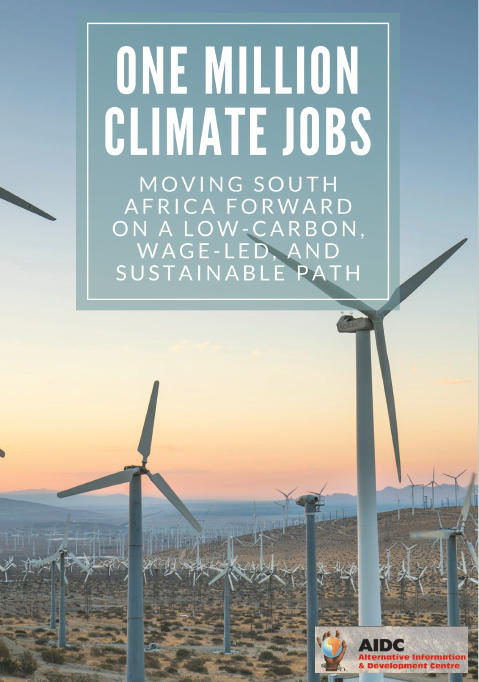
One Million Climate Jobs: Moving South Africa Forward on a Low-Carbon, Wage-Led, and Sustainable Path

By Brian Ashley, et. al. - One Million Climate Jobs - December 2016

The One Million Climate Jobs Campaign is an alliance of labour, social movements and popular organisations in South Africa that is campaigning for the creation of a million climate jobs as part of a collective approach to the crisis of unemployment and climate change. The Campaign was launched in 2011 and since then has been mobilising thousands of South Africans around real solutions to slowing down climate change, protecting the natural environment, improving the quality of life for all and moving towards a sustainable development path. Climate change will exacerbate inequality and poverty because it reduces access to food, water, energy and housing. Thus it is vital that social justice struggles around these issues incorporate struggles around climate change.

This booklet is a follow-up, six years later, to the first booklet that was produced in 2011. It is based on well- researched solutions for how South Africa can immediately begin a just transition, away from the Minerals-Energy Complex that continues to dominate the South African capitalist economy, to a low carbon economy in which the basic needs of communities are met in an equitable, sustainable and affordable way.

It recognizes that in these six years there have been many developments – for instance, renewable energy is now firmly established as part of the energy mix (although still a minor part); retrofitting buildings, and the development of environmentally friendly construction methods, is being developed, and the Rapid Bus Transit system is being slowly implemented in some municipalities.

But most of these solutions are being pursued within the logic of the market. It is not possible, we would argue, within these market parameters, to respond adequately to the enormous challenges facing us – what is needed is a publicly-driven solution for the shift to a sustainable, low-carbon future. The research that this booklet is based on begins to set out what such a transition could look like. We hope that it will be an important contribution to the ongoing work of building a political movement to struggle around these issues.

Download (PDF).

Pages

The Fine Print I:

Disclaimer: The views expressed on this site are not the official position of the IWW (or even the IWW’s EUC) unless otherwise indicated and do not necessarily represent the views of anyone but the author’s, nor should it be assumed that any of these authors automatically support the IWW or endorse any of its positions.

Further: the inclusion of a link on our site (other than the link to the main IWW site) does not imply endorsement by or an alliance with the IWW. These sites have been chosen by our members due to their perceived relevance to the IWW EUC and are included here for informational purposes only. If you have any suggestions or comments on any of the links included (or not included) above, please contact us.

The Fine Print II:

Fair Use Notice: The material on this site is provided for educational and informational purposes. It may contain copyrighted material the use of which has not always been specifically authorized by the copyright owner. It is being made available in an effort to advance the understanding of scientific, environmental, economic, social justice and human rights issues etc.

It is believed that this constitutes a 'fair use' of any such copyrighted material as provided for in section 107 of the US Copyright Law. In accordance with Title 17 U.S.C. Section 107, the material on this site is distributed without profit to those who have an interest in using the included information for research and educational purposes. If you wish to use copyrighted material from this site for purposes of your own that go beyond 'fair use', you must obtain permission from the copyright owner. The information on this site does not constitute legal or technical advice.

