Gaswork, the Fight for CJ's Law

By Josh Fox; Introduction by Alex Lotorto - Vimeo, October 6, 2015

Disclaimer: The views expressed here are not the official position of the IWW (or even the IWW’s EUC) and do not necessarily represent the views of anyone but the author’s.

This is a tremendous film by Josh Fox about worker safety issues in the oil and gas industry and CJ's Law, part of a concept of worker organizing that I've been talking about for years.

There was a retired steelworker who once told me in 2010 that the only way he foresaw worker organizing in the shalefields would be to run an issue-campaign for a Workers' Bill of Rights that enrolls workers and environmentalists into the same general membership union. In addition to safety, it would strengthen pay theft penalties, provide outplacement or re-training for workers who are laid off during downturns, paid time off, sick leave, personal days, etc.

That union, if it grew to scale, could then leverage themselves against various drilling and supply contractors, and eventually against industry associations like the union trades have done with the pipeline industry association project labor agreements (PLAs). It would take a chunk of change to hire the staff to support a campaign like that and open offices in the shalefields, which is the most difficult piece of the puzzle.

Numsa Press Statement on the Numsa 14th of October 2015 Anti-Corruption March

By Irvin Jim - NUMSA, October 7, 2015

Disclaimer: The views expressed here are not the official position of the IWW (or even the IWW’s EUC) and do not necessarily represent the views of anyone but the author’s. The following event is unfolding as this goes to press:

A. The origins and foundations of South Africa’s unique corruption

There is concrete evidence, and also an admission by a key individual with a conscience, Ronnie Kasrils, about the extent of the sell-out deals the ANC made with capital during the 1990s, namely that the ANC would only get political power, without economic power, and that no radical measures would be embarked upon to restructure and to transform the South African economy.

We now know for certain that those deals sold the struggle for liberation in South African down the drain, and instead they ensured that post apartheid South Africa would be an extremely corrupt neoliberal capitalist state and society. South Africa is now in that space – an Olympic gold medal winning corrupt neoliberal capitalist system and society.

In place of the radical and full implementation of the Freedom Charter, the ANC abandoned both the philosophy and ideology of the liberation struggle – which were based on moving South Africa out of apartheid capitalism and all its evils including corruption and environmental destruction, into a society free of racism, colonialism, patriarchy and one of shared human values, social and economic justice and a transition to socialism.

Such a society was not capable of being created on the foundation of our inherited racist and patriarchal colonial capitalism.

Secretly and publicly, the ANC sold the dream for a racism free, equal and just society for a neoliberal capitalist society, complete with the corruption that comes with that package.

Apart from accepting International Monetary Fund (IMF) and World Bank neoliberal capitalist dogma, and guaranteeing that land justice would never take place outside the capitalist markets, here are some of the deals the ANC struck with the devil, literally and figuratively, between 1990 and 1994:

  • The ANC accepted to repay $25 billion of inherited apartheid-era foreign debt (October 1993).
  • They gave the central bank formal independence in the interim and final constitutions (November 1993 and July 1996).
  • They borrowed $850 million from the IMF with tough conditions (December 1993)
  • They reappoint apartheid finance minister Derek Keys and SA Reserve Bank governor Chris Stals (May 1994).
  • They agreed that South Africa would join the General Agreement on Tariffs and Trade (later renamed World Trade Organisation) on disadvantageous terms (August 1994).
  • They agreed to lower the main corporate tax rate from 48% to 29% and maintain countless privileges enjoyed by wealthy white people and corporations (1994-99)
  • They agreed to privatise peripheral parts of the state (January 1995).
  • They agreed to relax exchange controls (the ‘finrand’) and raise interest rates (March 1995).
  • They granted permission to South Africa’s biggest companies to move their financial headquarters to London (1999).
  • Finally, of course, they adopt a neoliberal Growth, Employment and Redistribution (GEAR) policy (June 1996).

The adoption of the GEAR policy (June 1996) effectively buried any hope of sustaining any liberation ethos and cultures, as South Africa was now fully confirmed as a neoliberal capitalist state and society replete with all the cutthroat competition, capitalist greed and pathological craving for accumulation of wealth by all means necessary including all and extreme forms of corruption.

All that we have said above is in the public domain. Why are our own state regulators, academics and journalists not blowing the whistle? Why must it take the FBI to tell us the details of the $10 million bribe that Thabo Mbeki and Danny Jordaan made to Sepp Blatter’s cronies, and the $6 million (R80 million) that Chancellor House made from the corrupt Hitachi deal to build Medupi’s boilers?

In effect an elite has agreed to use its control of the state to allow the white racist colonial capitalist foundation of South Africa to remain intact, in the process, allowing white dominated and foreign corporations to continue with their economic activities unchanged. It has done this in exchange for a share of the spoils. We know some of them are direct beneficiaries. They are businessmen and women during the night and politicians during the day. And of course their families are crony capitalists night and day. Today, the ANC itself acknowledges this fact – just read their 2015 NGC documents.

There is no difference between the ANC and the network of public officials and private individuals who agree to corruptly allocate tenders in exchange for a share of the spoils. This behaviour is a logical and necessary corrupt character structure of the society that neoliberal capitalism thrives on.

Railroad Work Is Getting More and More Dangerous. These Workers Want To Change That

By Kari Lydersen - In These Times, October 10, 2015; image by Jon Flanders

Disclaimer: The views expressed here are not the official position of the IWW (or even the IWW’s EUC) and do not necessarily represent the views of anyone but the author’s.

CHICAGO—Railroad workers from around the country and Chicago residents stood on an overpass on a recent bright September Sunday, watching a seemingly endless line of black tanker cars pass on the railroad tracks below. The train was likely carrying crude oil from the Bakken shale in North Dakota, judging by the red hazard placards on the cars and widely documented trends in crude oil shipment.

Chicagoans have become increasingly worried about oil trains carrying the highly explosive Bakken crude through the city, a major transport hub on the way to East Coast refineries. A conference hosted by the progressive labor group Railroad Workers United in Chicago Sept. 19 brought together railroad workers and local residents and train buffs to discuss how railroad workers’ safety and labor rights issues dovetail with safety and environmental concerns for the larger public.

Oil trains are a perfect example, speakers and participants at the conference noted. Just look at the July 6, 2013 disaster in Lac-Mégantic, Quebec, when a parked oil train dislodged and plowed into the town, killing 47 and causing massive destruction and ecological devastation.

The train was operated by a single crew member, engineer Thomas Harding, who now faces the possibility of life in prison, with trial starting in November.

While prosecutors and the now-defunct Montreal Maine & Atlantic Railway have blamed Harding and several other railroad employees for the disaster, labor unions and other advocates say such tragedies are bound to happen more often if railroads are allowed to operate trains with single-man-crews and otherwise make staffing and management decisions driven by the bottom line rather than the needs and rights of railroad employees plus public safety.

This weekend, October 11-12, there will be rallies in Lac-Mégantic and Chicago, demanding freedom for Harding and railroad traffic conductor Richard Labrie, accountability from railroads and government regulators including bans on one-man-crews and a continued ban on shipping crude oil through Lac-Mégantic. A flier for the Chicago rally, held at noon on October 12 outside the Canadian consulate at 180 N. Stetson Drive, calls on “environmentalists, neighborhood organizations, railroad workers, steel workers, firemen, all unions and all justice-loving people” to support Harding and Labrie and demand strict safety regulations from the federal government.

Oil “Bomb” Train, Lac-Megantic Solidarity Protest

The following protest took place on October 12, 2015 at the Consulate General of Canada in Chicago, at Randolph and Stetson, 1 block east of the NE corner of the Randolph and Michigan and was endorsed by Railroad Workers United following #RailCon15

Disclaimer: The views expressed here are not the official position of the IWW (or even the IWW’s EUC) and do not necessarily represent the views of anyone but the author’s.

No Oil Bomb Trains in Lac-Mégantic, Chicagoland or Anytown. Keep the explosive oil in the soil and out of our towns!

The coalition of groups endorsing this action are determined to send the message that we stand with the railroad workers in their efforts to keep our communities safe from the inherent dangers of these volatile oil trains, and that the railroad and oil corporations involved in the tragedy of July 6th, 2013, in Lac-Mégantic are the principal offenders. Specifically, we demand:

  • 1. More than one man crews for all freight trains, especially the High Hazard Flammable Trains, such as the Bakken oil trains. In light of fatigue and emergency situations, a single man crew is insufficient for handling all possible dangerous scenarios.
  • 2. No oil should be transported through Lac-Mégantic by rail until all the tracks in the town have been repaired and passed inspections. The people of Lac-Mégantic have been adamant about this and their demands should not be ignored.
  • 3. We agree with the victims and residents of Lac-Mégantic when they call for the Canadian government to stop scapegoating Mr. Harding, the engineer of the train involved in the Lac-Megantic disaster. The residents are asking for further investigations, and that the blame for the accident climb up the chain of command and throughout the entire unsafe infrastructure of the railroad and oil corporations.
  • More information can be found at: https://www.facebook.com/events/920554121361635/
  • Endorsed by: Chicagoland Oil By Rail, Pilsen Alliance, McKinley Park Progressive Alliance, Chicago Greens, Frack Free Illinois, Near West Citizens for Peace and Justice, 350Kishwaukee, Forest City 350, Northern Illinois Jobs with Justice, Railroad Workers United, Fox Valley Citizen's For Peace And Justice

Unions and the Climate Justice Movement

By That Green Union Guy - IWW Environmental Unionism Caucus, October 7, 2015

Disclaimer: The views expressed here are not the official position of the IWW (or even the IWW’s EUC) and do not necessarily represent the views of anyone but the author’s.

Where does the union movement stand on the issue of climate justice? The answer to that question is not entirely simple. First of all, it's important to understand the differences between revolutionary unions (most of which are syndicalist--such as the CNT, FAI, SAC--or Marxist--such as NUMSA--in their orientation, or some hybrid inclusive of both and more--such as the IWW) and mainstream reformist unions, such as the AFL-CIO.  For most revolutionary unions, climate justice is an inherent part of the struggle to overthrow capitalism, abolish wage slavery, and create a new society within the shell of the old. For example, the IWW has organized an environmental unionism caucus that dedicates itself to climate justice and other ecological issues. The South African union, NUMSA, is a supporter of Trade Unions for Energy Democracy (TUED)1 and has issued a statement calling for the end to the "Mineral Industrial Complex" (even though they represent mine workers) in favor of renewable energy.

Where the reformist unions (sometimes called "business unions" or "class collaborationist" unions by their detractors) stand varies widely, and to be accurate, some of these "reformist" unions have more (or less) "revolutionary" orientation within the spectrum of the mainstream labor movement. While many still believe that capitalism can be reformed, the evolving realities of capitalism--which is becoming extremely repressive as it imposes increasingly crushing austerity upon the working class--the ever heightening urgency of addressing capitalist induced global warming, and the increasingly impossible-to-ignore realities of police violence, movements like Black Lives Matter, and other social issues are driving many unions to question their adherence to it, beyond the mere rank and file militants within each of them.

One would expect the Building Trades and most heavy industry based unions in the United States, many of which are still largely dominated by white male workers, to be least supportive of climate justice (or even likely to swallow the rhetoric of climate denialism) and conversely expect the service unions, many of which are predominantly composed of women and People of Color to be most supportive of it, and in some cases that's true, but not always! The actual "geography" of where unions stand on climate justice is actually quite complex2, inconsistent, and in some instances contradictory.  Sorting it out completely is well beyond the scope of this article, but it is illustrative to cover some general ground and cite a few interesting examples.

NUMSA fully backs Coal sector strike

By Castro Ngobese - NUMSA, October 5, 2015

Disclaimer: The views expressed here are not the official position of the IWW (or even the IWW’s EUC) and do not necessarily represent the views of anyone but the author’s.

The National Union of Metalworkers of South Africa (Numsa), on behalf of its 365 000 members, pledges its unwavering support and unflinching solidarity with the striking coal workers, as led by two class orientated and anti-capitalist workers formations, the National Union of Mineworkers (NUM) and the Association of Mineworkers and Construction Union (AMCU).

We call on workers to unite behind their legitimate and genuine demands, irrespective of their union’s logos or t-shirt colours. Furthermore, we call on the striking workers to use this strike to agitate and propagate for coal as a strategic mineral resource to be nationalized, in order to build the required and necessary capacity for the democratic State to supply cheaper electricity to Eskom and the national grid.

The strike is happening amidst the socio-economic burden faced by workers of taking care of the vast number of the unemployed, especially amongst the youth and women, who are ravaged by squalor and poverty in working class communities, informal settlements and rural slums, post the 1994 failed negotiated political settlement. The workers are demanding a fair share of the surplus in the absent of a legislated Minimum Wage, as a stated key socio-economic demand of the Freedom Charter.

The ongoing strike should consolidate working class power from below to challenge the colonial and racist economic dominance and wealth concentration in the hands of a tiny minority. This is against the super remuneration packages and benefits enjoyed mining’s Chief Executives, whilst ordinary workers are paid Apartheid poverty wages. The demands by the unions on behalf of their members will elevate the socio-economic living standard of workers, including a life of dignity.

We call on the workers not to soften their demands when Executives, Shareholders’ salaries, bonuses and perks remain obscene, whilst workers who are producers of wealth are squeezed deeper into abject poverty and economic misery.

Numsa calls on the coal mining oligarchy to concede to the reasonable and affordable demands of workers. In line with workers’ battle slogan: “an injury to one; and injury to all”, Numsa calls on its members and communities to join the picket’s line in solidarity with the striking workers. Through solidarity actions we shall diminish the fictitious wall erected between community struggles and struggles on the shopfloor.

Post Carbon Radio Episode 93: Flood Wall Street West and Greywater Systems

By Karen Nyhus - KWMR, September 30, 2015

Disclaimer: The views expressed here are not the official position of the IWW (or even the IWW’s EUC) and do not necessarily represent the views of anyone but the author’s.

Karen interviews activists (including two members of the Bay Area IWW) at Flood Wall Street West ... in the San Francisco Financial District, who were taking direct action against institutions profiting from dirty energy. We then speak with Laura Allen, Executive Director of Greywater Action and author of The Water-Wise Home: How to Conserve, Capture and Reuse Water in Your Home and Lands, about greywater systems and best practices.

Can Autoworkers Save the Climate?

By Lars Henriksson - Jacobin, October 2, 2015

Disclaimer: The views expressed here are not the official position of the IWW (or even the IWW’s EUC) and do not necessarily represent the views of anyone but the author’s.

At the COP 19, the even-more-depressing-than-usual climate summit that took place in Warsaw in 2013, one small ray of light made it through the dark corporate clouds that were otherwise suffocating even the slightest effort to address the ongoing environmental disaster.

On the last day of the conference, an unusual alliance was formed as environmental organizations and trade unions together walked out of the venue under the banner of “Enough Is Enough.” Sick of the meaningless talks, they stated:

We are now focusing on mobilizing people to push our governments to take leadership for serious climate action. We will work to transform our food and energy systems at a national and global level and rebuild a broken economic system to create a sustainable and low-carbon economy with decent jobs and livelihoods for all. And we will put pressure on everyone to do more to realize this vision.

If not entirely unique, this action nevertheless promised a new hope for a climate movement that never recovered after its (greatly exaggerated) expectations cruelly disappointed at the summit in Copenhagen four years earlier. The relationship between trade unions and environmentalists has often been strained, if there has been one at all. More often than not, those claiming to defend the earth and workers’ rights are operating at a crossroads, sometimes colliding in head-to-head confrontation — especially when jobs are pitted against environmental interests.

I found myself in that squeeze when the financial crisis hit the auto industry in 2008. The previous year, Al Gore and the Intergovernmental Panel on Climate Change (IPCC) were awarded the Nobel Peace Prize, and climate change topped worldwide headlines. But with the bankruptcy of Lehman Brothers and the auto industry in free fall, the climate crisis quickly disappeared from general discussion, even more so among auto-industry workers. Profits (disguised as “jobs”) were the main issue, not the complicated and distant phenomenon of global warming.

RailCon15: Chicagoland Conference Reflections

By Hieronymous - LibCom.Org, September 30, 2015

Disclaimer: The views expressed here are not the official position of the IWW (or even the IWW’s EUC) and do not necessarily represent the views of anyone but the author’s.

In his 1914 poem, “Chicago,” Carl Sandburg called the city a “Player with Railroads and the Nation's Freight Handler.” Others have called it the “Rome of Railroads,” as in all railroads lead to Chicago. It’s the biggest, busiest and most complex rail hub in the world, with at least 1,300 passengers and freight trains passing through it daily. It remains the central node of the North American rail transportation system. Despite the city’s vast size, you can’t visit a neighborhood without seeing traces of how railroads developed the city – in the process connected the eastern U.S. with all of the West through this major portal. And it’s not just railroads, as barges, tractor-trailers, and bellies of planes make Chicago a hub that ranks just behind Singapore and Hong Kong for the world’s highest intermodal volume – not to mention the pipelines that carry liquid commodities into the city.
So Chicago couldn’t have been more fitting for the third Railroad Safety Conference. I arrived the day before, Friday, September 18th to help prepare. From O’Hare Airport I took the CTA "L" Blue Line to the Loop downtown, strolled over to Millennium Park and immediately discovered it was built a decade ago on a steel superstructure over Illinois Central’s original Chicago rail yard. An RWU member met me at Union Station and gave me a tour of its once grand interior, detailing its demise. Until 1969 Chicago had six intercity passenger rail terminals; Union Station is the only one that is in any way close to its original form.

The conference location at the union hall of United Electrical, Radio and Machine Workers of America (UE) couldn’t have been more appropriate either. In response to McCarthyism inspired raids by competing unions, UE left the CIO in 1949. By 1950 eleven unions left or were expelled from the CIO; only two remain today, UE and the West Coast-based International Longshore and Warehouse Union (ILWU). Both remain strong unions, with democratic governance, and have led some of the most inspiring recent struggles. For the UE, it was the week-long occupation of the Republic Windows and Doors factory on Goose Island in Chicago in December 2008. For the ILWU it has been the willingness to take political stands, like the work stoppage on May Day 2008 when all 29 ports on the West Coast ceased operating for the day.

The conference, titled Railroad Safety: Workers, Community and the Environment, carried on the agenda of the previous two conferences in California and Washington State with around 80 in attendance. Carl Rosen, President of UE, gave us a warm welcome to the hall, then RWU General Secretary Ron Kaminkow gave a brief history of RWU and mentioned the recent defeat of a union proposal for single-person crews at BNSF. Conference attendees introduced themselves, showing how far some had traveled to attend, from as far as New York, Washington DC, Seattle, San Francisco and Quebec, Canada; in addition, each cluster of tables came up with their goals for the conference. Most concerned educating affected communities about the realities of fossil fuel transport, especially rail, as well as upholding the principle of keeping energy resources “in the ground.” Next RWU members gave two sessions about the safety concerns of railroad workers. Included in the first were Single Employee Train Crews, Teamwork, Chronic Fatigue and Scheduling. In the second they were Long & Heavy Trains, Track Maintenance, and Rail Safety Programs. A guest, Michael Termini from the Government Accountability Project, talked about legal protections for whistleblowers.

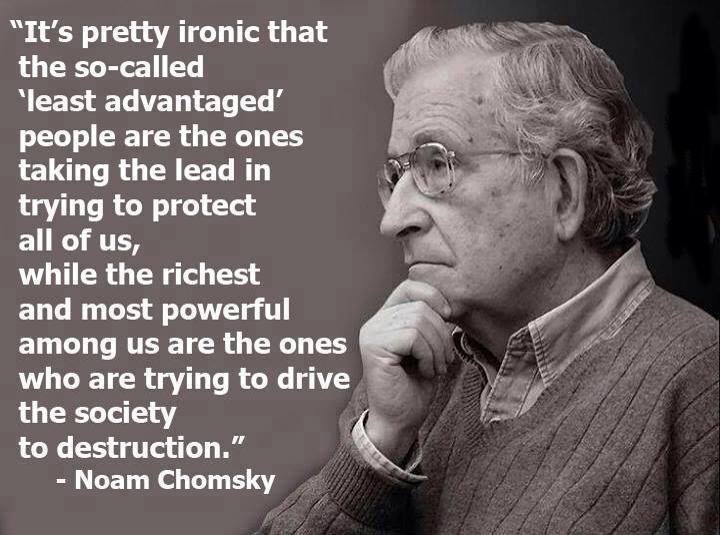
Chomsky: History Doesn’t Go In a Straight Line

Noam Chomsky interviewed by Tommaso Segantini - Jacobin, September 22, 2015

Disclaimer: The views expressed here are not the official position of the IWW (or even the IWW’s EUC) and do not necessarily represent the views of anyone but the author’s.

Throughout his illustrious career, one of Noam Chomsky’s chief preoccupations has been questioning — and urging us to question — the assumptions and norms that govern our society.

Following a talk on power, ideology, and US foreign policy last weekend at the New School in New York City, freelance Italian journalist Tommaso Segantini sat down with the eighty-six-year-old to discuss some of the same themes, including how they relate to processes of social change.

For radicals, progress requires puncturing the bubble of inevitability: austerity, for instance, “is a policy decision undertaken by the designers for their own purposes.” It is not implemented, Chomsky says, “because of any economic laws.” American capitalism also benefits from ideological obfuscation: despite its association with free markets, capitalism is shot through with subsidies for some of the most powerful private actors. This bubble needs popping too.

In addition to discussing the prospects for radical change, Chomsky comments on the eurozone crisis, whether Syriza could’ve avoided submitting to Greece’s creditors, and the significance of Jeremy Corbyn and Bernie Sanders.

And he remains soberly optimistic. “Over time there’s a kind of a general trajectory towards a more just society, with regressions and reversals of course.”

Pages

The Fine Print I:

Disclaimer: The views expressed on this site are not the official position of the IWW (or even the IWW’s EUC) unless otherwise indicated and do not necessarily represent the views of anyone but the author’s, nor should it be assumed that any of these authors automatically support the IWW or endorse any of its positions.

Further: the inclusion of a link on our site (other than the link to the main IWW site) does not imply endorsement by or an alliance with the IWW. These sites have been chosen by our members due to their perceived relevance to the IWW EUC and are included here for informational purposes only. If you have any suggestions or comments on any of the links included (or not included) above, please contact us.

The Fine Print II:

Fair Use Notice: The material on this site is provided for educational and informational purposes. It may contain copyrighted material the use of which has not always been specifically authorized by the copyright owner. It is being made available in an effort to advance the understanding of scientific, environmental, economic, social justice and human rights issues etc.

It is believed that this constitutes a 'fair use' of any such copyrighted material as provided for in section 107 of the US Copyright Law. In accordance with Title 17 U.S.C. Section 107, the material on this site is distributed without profit to those who have an interest in using the included information for research and educational purposes. If you wish to use copyrighted material from this site for purposes of your own that go beyond 'fair use', you must obtain permission from the copyright owner. The information on this site does not constitute legal or technical advice.

