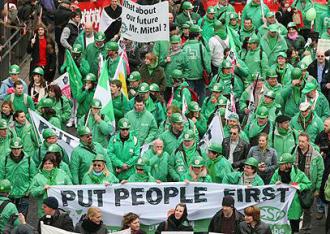
Greenpeace Workers Strike Amid Claims of Exploitation

By Cyrus Ward - Young Progressive Voices, August 16, 2015

Disclaimer: The views expressed here are not the official position of the IWW (or even the IWW’s EUC) and do not necessarily represent the views of anyone but the author’s.

Workers at two California Greenpeace offices have gone on strike amid concerns over an unjust quota system that creates a zero-sum, high pressure environment which puts canvassers in risk of being fired, every 3 weeks.

According to a press release sent by a new organization named “Greenpeace on Strike,” many the environmental organization’s canvassers with over 1 year experience regularly raise nearly 6 to 7 times as much money as they are paid. Despite the significant payday for Greenpeace, the organization uses a quota system that doesn’t take into account the lifetime fundraising totals of canvassers. The system runs on a 3 week quota that means that canvassers can be fired for short-time lull in fundraising even if the canvassers’ lifetime totals are still above the 3 week average.

In response to the strike, 16 of the Greenpeace workers in San Diego were delivered with letters of intent to terminate by Greenpeace under a claim of job abandonment. Greenpeace On Strike’s press release claims that these letters are a direct violation of section 7 & 8 of the National Labor Relations Act.

Despite the threatening response by Greenpeace, one of the striking canvassers said “by no means are we doing this to bash Greenpeace. We love Greenpeace, and we are Rainbow Warriors. That’s why we want to make Greenpeace better.”

Regardless of the outcome, it is abundantly clear that despite its leftist political ideology, Greenpeace’s workplace is far from democratic.

Moving Beyond Protests and Counter Protests; the transition to a renewable economy requires the climate movement and unions to work in solidarity together

By Catherine Nadel - 350.org, August 15, 2015

Disclaimer: The views expressed here are not the official position of the IWW (or even the IWW’s EUC) and do not necessarily represent the views of anyone but the author’s.

In the lead up to the Ende Gelände action, that will see a mine shut down in the Rhineland this weekend, there have been rumours of a counter protest organised by the union for RWE employees. This possibility is disappointing for a number of reasons. The climate movement’s mission is not only to respond to the climate crisis by dismantling our reliance on fossil fuels, but to a build a movement that is capable of achieving this in a way that is just and fair. Central to this strategy are workers. It is understandable that the actions of climate activists, such as Ende Gelände can seem threatening to those who rely on the fossil fuel industries for their jobs and livelihoods. It is our hope that the communities that currently depend on these jobs, understand that there is no greater threat to them than the threat of climate change. This is a threat that will fundamentally change the way we live. If we do not work together to confront this challenge and transition to a cleaner, fairer future, we risk not only jobs and livelihoods, but everything.

Research into the fossil fuel industry reveals that the interests of unions and the climate movement are fundamentally aligned. The two groups share many common values; financial stability, job security and strong communities are among the clearest of them. We also share a common challenge, responding to an industry that values profit margins over the safety and security of both their employers and the climate.

RWE is not only the single biggest emitter of CO2 in Europe, it is also one of the continent’s most negligent companies. According to research commissioned by Greenpeace in 2012, RWE’s coal power stations cause over 900 deaths a year in Germany. RWE’s failure to adapt its business model at a time when the rest of Germany is transitioning to a low-carbon economy has caused its share price to drop by 70% since 2007. Predictably, these losses have not fallen on the executives of the company, but on the workers. In 2014 alone RWE slashed over 5000 jobs.

RWE’s business model is founded on disregard for both social and environmental consequences. When Ende Gelände activists walk into the mine tomorrow, their aim will be to disrupt this destructive model. They do this in the knowledge that when the action disrupts RWE’s business tomorrow, it will also be disrupting an ordinary workday for many people. This can justifiably be perceived as inconvenient and inconsiderate to the employees of the mine. This is regrettable, however climate change is disruptive and inconsiderate. It poses a threat to every one of us, a threat that we must respond to together.

It is for this reason that when Ende Gelände calls on RWE to change its ways, it also calls on the German government to invest in a transition to an economy based on renewable energy and sustainable long-term jobs. To us, this means investing time and money in the re-skilling and employment of workers, to rapidly deploy decentralised renewable energy solutions, that support whole communities rather than profits for a few and climate disruption for the rest. We want to extend an invitation to the workers and communities of the Rhineland, to join us in this fight.

The fight for a clean future involves transition for all of us. This includes transition for the workers of fossil fuel industries; this transition must not only be just and fair, it must be lead by workers. This is why the idea of a worker counter protest is so deeply saddening. As a climate movement we know we can do better to put the rights of working people at the centre of our work, but we know that to change everything, it will take everyone. Climate change is not just a siloable environmental issue, it is a people issue; and it is a threat to communities everywhere. That is why it is so important that we move beyond protests and counter protests and work together to build a fossil free future that is centred on fairness and justice for all.

Another World is Possible, but How Can We Get There?

By Ablokeimet - Melbourne Anarchist Communist Group, August 10, 2015

Disclaimer: The views expressed here are not the official position of the IWW (or even the IWW’s EUC) and do not necessarily represent the views of anyone but the author’s.

This is the text of a presentation given by a MACG member during a debate on the class struggle approach to Anarchism held at the Melbourne Anarchist Bookfair on Saturday 8 August 2015. It was delivered almost verbatim.

Thanks. I’m going to take it for granted that we want an Anarchist society – one where capitalism and the State have been abolished, where all forms of social oppression are eradicated and the human race lives sustainably and in harmony with the Earth. What we’re debating here is how to get there – the path from present day capitalism to an Anarchist society.

The traditional Anarchist view of the route to an Anarchist society is through a workers’ revolution, which occurs as the culmination of a progressively intensifying phase of class struggle. This is the position I support. I think workers’ revolution is both possible and necessary, for reasons I will go on to elaborate.

First of all, though, I’d like to clear up the concept of class, since it is often a source of great confusion. The working class is composed of those with nothing to sell except their labour. You don’t have to work in a factory to be working class, or even to have a job at all. You don’t have to be a white, heterosexual male, either.

Now, I’m going to read out a list of categories of people. See if you’re in any of them:

  • Your main source of income is interest, rent and/or dividends;
  • You own a business and work inside it for your main income, regardless of whether you employ anybody else. It doesn’t count if the so-called “business” is the supply of your own labour to a single employer that supervises your actions as it would an employee and is only doing it to avoid taxation and/or industrial relations laws;
  • You are a manager in the public or private sector with the right to hire and fire;
  • You are a copper, a prison warder, a military officer or member of the security services (e.g. ASIO);
  • You are a Member of Parliament or a local government Councillor, or a judge, magistrate or person with similar powers (e.g. member of the Administrative Appeals Tribunal).
  • You are employed by a trade union, political party or NGO as an organiser or office bearer.
  • You are reasonably confident that, in the next five or ten years, you will be in one of the above categories. It doesn’t count if you’re just hoping or if you’ll need a bit of luck for it to come off;
  • You stand to inherit, whether from a spouse, parent or otherwise, millions of dollars over and above a house to live in.

If you’re in one of those categories, can you put your hand up? You don’t have to say which one it is, because there are some it may be embarrassing to admit to being a member of. OK. Everyone who didn’t put their hand up is a member of the working class. You have an objective interest in getting rid of capitalism, over and above any ethical commitment you may have. Those of you who did put your hand up, you can still join the struggle as an ally, provided you have the ethical commitment to do so. You’re just not in the same position to have an impact.

So, what’s important about the working class? As we’ve just shown, it comprises the vast majority of society. You can’t change society without having at least a majority of the working class on your side and, if you want a revolution, the vast majority. Second, it is the experience of co-operation in the capitalist workplace that provides the experience that is necessary to co-operate in the class struggle.

Breaking: Land Defenders Protest Mining Co. After River Poisoning

By Jesse Fruhwith - Peaceful Uprising, August 10, 2015

Disclaimer: The views expressed here are not the official position of the IWW (or even the IWW’s EUC) and do not necessarily represent the views of anyone but the author’s.

PR SPRINGS, UT –Several dozen climate justice land defenders will enforce a shut down at the US Oil Sands tar sands mine today in the Book Cliffs of Utah. The action comes just days after a century-old mine poured millions of gallons of toxic sludge into waterways that sustain 40 million Americans.

Calgary-based US Oil Sands is amidst an $80-million construction phase to assemble processing equipment, clear cut more land for more strip mine pits and ultimately to turn tar         sands rocks into liquid fuels. The company operates on land traditionally inhabited by Ute people and is now managed and leased to private corporations by the state of Utah.

The Animas River in nearby Colorado Wednesday was doused in toxic heavy metals from a long-abandoned gold mine–lead, arsenic and other poisons turned the river bright mustard yellow for several days. Many people risk drinking water contamination and water shortages. Thousands of mines across the region are in similarly dangerous condition.

Peaceful Uprising and other critics say tar sands and oil shale mining as well as oil and gas fracking open a new era of looming mining-related environmental disasters in the Upper Colorado River Basin.

“Thousands of mines like open wounds tell the story of a century of exploitation, destruction and violence–against the people of this land and the land and water themselves,” said Melanie Martin of Peaceful Uprising, on behalf of the crowd. “US Oil Sands continues that sick tradition by squandering precious water in a thirsty region and saddling future generations with a toxic legacy of climate catastrophe that there is no way to clean up.”

US EPA has attempted to intervene in construction of the tar sands mine in “Indian country,” but the company has stubbornly rebuffed the federal regulators. The state of Utah Division of Oil Gas and Mining recently approved an expansion of the the US Oil Sands strip mine operation, but also demanded the company begin monitoring its toxic water emissions into the Colorado River watershed. That came after a University of Utah study found US Oil Sands mining plans are unsafe to the aquifers and water systems of the East Tavaputs Plateau.

The action comes on the heels of a week-long action training camp for about 80 people that the US Bureau of Land Management sought to stop.

People-enforced shut downs of operations have plagued the company for years and campaigners from Utah Tar Sands Resistance and Canyon Country Rising Tide, and others, vow some day to shut down the tar sands mine completely and forever.

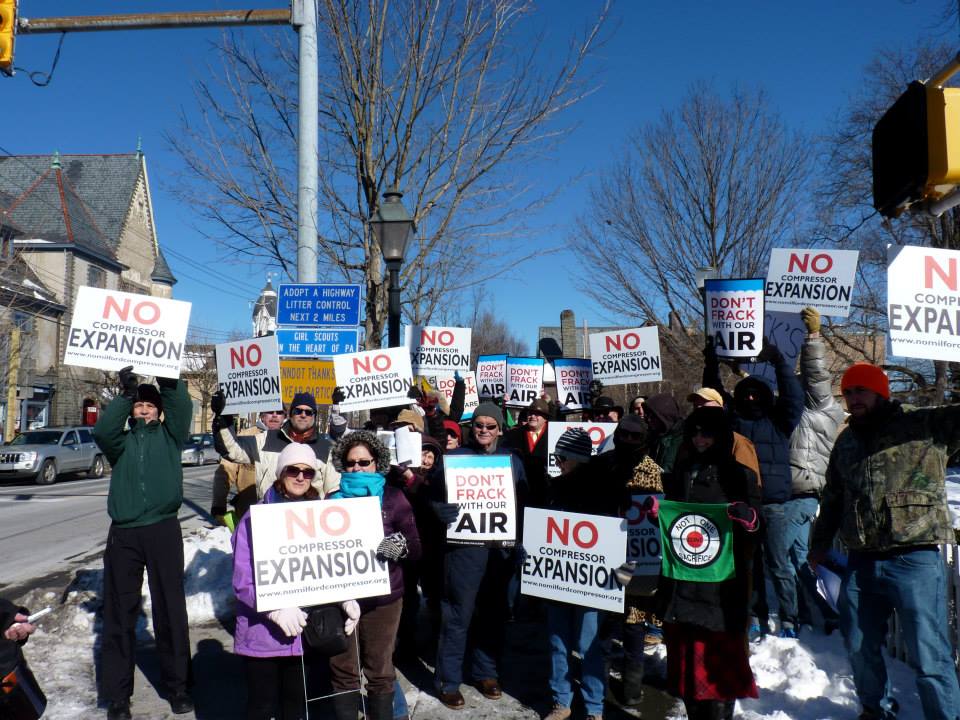
Statement on the Milford Compressor Station Fire by Alex Lotorto, Shale Gas Program Coordinator for Energy Justice Network, Local Resident

By x362102 - Energy Justice Network, August 9, 2015

Disclaimer: The views expressed here are not the official position of the IWW (or even the IWW’s EUC) and do not necessarily represent the views of anyone but the author’s.

Late last night (August 8), an explosion and fire occurred at the Milford Compressor Station construction site. We at Energy Justice Network are very glad that no one was hurt or injured.

Columbia’s security personnel told concerned residents on Fire Tower Rd that the fire was the result of a contractor leaving an arc welder on or plugged in inside a building. We hope investigators will pursue that lead before concluding it was an arson attack.

We believe a worker negligence scenario should be fully investigated by both the company and state police, especially because work continues at the compressor station daily. There may be a need to re-train or review safety procedures with pipeline contractor employees. This is important for the safety of workers, residents, and first responders.

It is plausible, at the end of the workday Saturday, in a hurry or a lapse of judgment, the workers did not shut the equipment down properly. Workers at that site have been working from dawn to dusk most days since the wintertime and it is possible exhaustion has numbed their awareness of workplace safety. If it is determined that exhaustion contributed to this incident, Columbia and its contractors should, at the very least, offer workers more paid time off.

This incident also highlights the urgent need for an emergency management plan for the compressor and the three interconnected transmission pipelines at that location. Residents living along Fire Tower Rd should never again have to hear an explosion, see emergency vehicles rushing to the location, and wonder whether they should shelter in their homes or evacuate. Phone calls to Columbia's emergency line either went unanswered, or were not helpful.

An emergency management plan is one of the four remedies that have been presented to Columbia during residents' ongoing Environmental Hearing Board appeal's technical settlement negotiations, although no formal agreement has been reached. We hope the company's deficient emergency response to this incident will inform the settlement discussions in a productive way.

How to Support Clean Energy and Not Be a Jerk; As the nation turns away from coal, what do we owe coal workers?

By Jonathan Tasini - Sierra, July-August 2015

Disclaimer: The views expressed here are not the official position of the IWW (or even the IWW’s EUC) and do not necessarily represent the views of anyone but the author’s.

Michael Phillippi makes $28.50 per hour working as a mechanic at Murray Energy's Monongalia County coal mine in West Virginia. That's almost double what he made as a crane operator before snagging this coveted job four years ago. With healthcare and pension, that figure is close to $60 per hour, all because he's a member of the United Mine Workers of America (UMW). That's a hefty paycheck in a state where the minimum wage is $8 per hour and the poverty rate is one of the highest in the nation.

The amiable, broad-shouldered Phillippi brings home more than twice what his wife makes as a teacher's assistant. He puts 10 percent of his paycheck into a 401(k) and invests another chunk in education savings for his three kids. He pays the bills and still has enough left over for a boat and a little camp where his family spends time in the summer. "I know guys making eighteen, twenty thousand," he says. "We had a banker start a few months ago—he was in charge of loans at a bank. He makes more money and has better benefits as a coal miner."

If the mine closed, Phillippi says, he'd have to learn to live off $15 an hour or less. To find a salary comparable to his current job's, he'd have to drive 75 miles north to Pittsburgh. But he probably wouldn't. "I won't move," he says. "I am from here. My family is from here. My grandparents are from here. My wife and her family. This is our community. I want to raise my children here. I plan on dying here. It's the sad truth that the good jobs aren't here."

Phillippi's paycheck also matters to the small businesses he sprinkles money on, like the mom-and-pops he stops at on his 35-minute drive from his home in Morgantown to the mine. Sitting in a small conference room in the UMW regional office in Fairmont, Phillippi points across the table to Mark Dorsey, who worked underground for 34 years before retiring in 2010: "For every hour I work, I'm helping to pay his pension." 

There are hundreds of thousands of Michael Phillippis spread out across the nation, from the coalfields of West Virginia and Kentucky to the more than 500 coal-generating power stations located in virtually every state. These workers now face the loss of their good-paying jobs due to the declining competitiveness of coal compared to other energy sources and new Environmental Protection Agency regulations intended to address air pollution and climate change. 

Those regulations, of course, have clear benefits for Phillippi, Dorsey, and everyone who breathes. Stronger soot standards alone would prevent 35,700 premature deaths per year and 1.4 million cases of aggravated asthma. Shifting to renewable energy, says the Union of Concerned Scientists, would create three times as many jobs—although likely not as well paid—as an equivalent investment in fossil fuels. And the value of avoiding catastrophic climate change is incalculable. 

But it won't pay the mortgage. As the coal industry withers, what will happen to Phillippi, Dorsey, and the communities they live in? The classic free market answer: That's life. Economies change, so suck it up. When the car replaced the horse and cart, buggy manufacturers moved on. 

That is not the only answer. Slowly, tentatively, unions and environmentalists are beginning to talk about an entirely different option called Just Transition, a guarantee that the cost of bringing down the curtain on the coal industry will not be paid by coal workers alone, but will be spread across society. It would be a huge undertaking, ideally encompassing the tens of thousands of workers directly employed in coal, from mining to electric-power generation, plus the communities that depend on their spending and taxes.

Our Perspectives and Tasks on the Revolution in Rojava

By Black Rose Anarchist Federation / Federación Anarquista Rosa Negra - Black Rose Anarchist Federation, August 4, 2015

Disclaimer: The views expressed here are not the official position of the IWW (or even the IWW’s EUC) and do not necessarily represent the views of anyone but the author’s.

#Rojava #Kobane #internationalsolidarity
As revolutionaries in North America we would like to outline the foundations of our political perspective as well as how we as an organization have agreed to relate the recent events and the struggle underway in Rojava in the Middle East.

Our Perspective

The Rojava Revolution has probably made more concrete progress towards libertarian socialism than any other large-scale struggle at least since the Zapatista insurrection. For this reason alone it is important to engage with this struggle to support the most revolutionary elements of it and to hold it up as an international example of what the self-activity of the popular classes can accomplish.

While we have many questions about the overall political ideology of the Kurdistan Workers’ Party (PKK) and the Democratic Union Party (PYD) (which would need to be addressed in a separate and longer article), the specific project of democratic confederalism (which is only one part of their political vision for “democratic modernity” and the reorganization of society) has set the popular classes of Kurdistan in motion, constructing autonomous alternatives to capitalism, oppression and the state. In Rojava, and in some cases also in Bakur (north Kurdistan) when state repression doesn’t forbid it, workers’ cooperatives are being formed, land is being collectivized, women’s collectives are spreading, neighborhood assemblies are taking on power, restorative justice is replacing the court system, a democratic militia is defending the region, and other aspects of self-governance are being organized. This is not all that there is to this struggle – much of the land and capital is intended to remain in private hands, the PYD has created a new minimal state instead of abolishing the state, forced conscription has occasionally been implemented, PYD politicians have been lobbying western countries, foreign corporate investment is pursued, etc. But despite much remaining vagueness about the exact details of what’s happening on the ground (even among those who have been to Rojava), it is clear that much of the popular classes in Kurdistan are engaged in a revolutionary process that we should support. It is also clear that since a democratic revolution is based on the will of the people, it will only be through the long-term political education and organizing work among the popular classes of Rojava that the revolution will generalize beyond the current active minority and continue to take shape. We believe that we have a responsibility to both contribute to that process and to learn from it.

Prisons, Ecology and the Birth of an Empire

By Panagioti - Earth First! Newswire, July 25, 2015

Disclaimer: The views expressed here are not the official position of the IWW (or even the IWW’s EUC) and do not necessarily represent the views of anyone but the author’s.

Strange sometimes how worlds collide. Nine years ago I found myself in the swamps of the northeastern Everglades listening to an independent, traditional Seminole activist asking for support in challenging the state and federal government’s plans to fund a celebration of 500 years of Florida—a history that began, in many ways, with the founding of one of the best known tourist traps in this country’s history.
If Christopher Columbus is a symbol marking the origin of Manifest Destiny’s rampage across the western hemisphere, then conquistador Pedro Menendez de Aviles, who established the colony of St. Augustine, built the first literal foundation under that genocidal, ecocidal mindset.

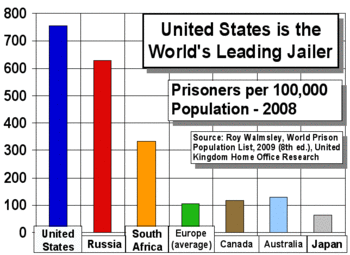
Today, as I occupy my time developing the Prison Ecology Project, aimed at mapping the intersections of incarceration, ecology and environmental racism, it’s hard not to also view St. Augustine as the first prison town of what would be become the U.S. Empire—a nation that has distinguished itself in the modern world by simultaneously pushing global policies that have facilitated an unprecedented pillaging of the planet for resources and for locking people up at a never-before-seen scale or pace in human history.

For many people I’ve spoken with over the past several months, there is a gut level, intuitive response to view these things—mass incarceration and industrial pollution—as connected in some way. Since the Prison Ecology Project began earlier this year, it has been able to establish dozens of concrete examples of that connection all across the country in the here-and-now. But learning more about the history of St. Augustine, as their big 450th Anniversary celebration is about to commence in 6 weeks (featuring a planned appearance by the King and Queen of Spain), has got me thinking a lot about the deeper roots of the prison/ecology intersection. And it ain’t pretty.

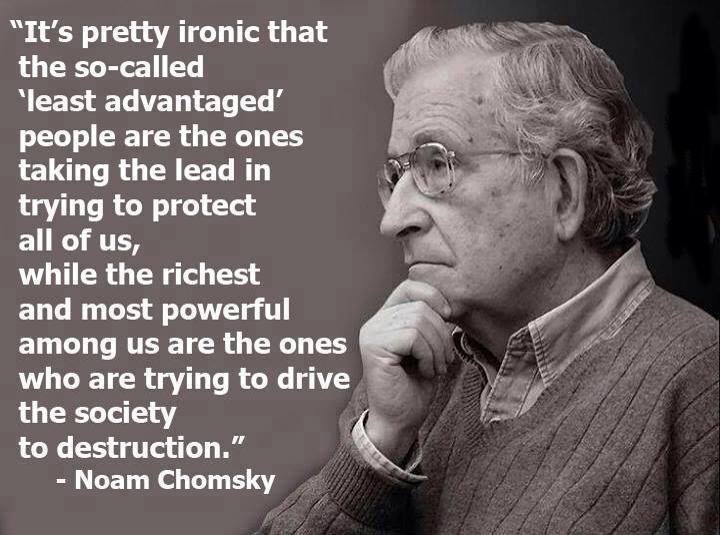
Noam Chomsky: The Kind of Anarchism I Believe in, and What's Wrong with Libertarians

Noam Chomsky interviewed by Michael S. Wilson - Infoshop News, August 1, 2015

Disclaimer: The views expressed here are not the official position of the IWW (or even the IWW’s EUC) and do not necessarily represent the views of anyone but the author’s. The following is the adapted text of an interview that first appeared in Modern Success magazine.

So many things have been written about, and discussed by, Professor Chomsky, it was a challenge to think of anything new to ask him: like the grandparent you can’t think of what to get for Christmas because they already have everything.

So I chose to be a bit selfish and ask him what I’ve always wanted to ask him. As an out-spoken, actual, live-and-breathing anarchist, I wanted to know how he could align himself with such a controversial and marginal position.

Michael S. Wilson: You are, among many other things, a self-described anarchist — an anarcho-syndicalist, specifically. Most people think of anarchists as disenfranchised punks throwing rocks at store windows, or masked men tossing ball-shaped bombs at fat industrialists. Is this an accurate view? What is anarchy to you?

Noam Chomsky: Well, anarchism is, in my view, basically a kind of tendency in human thought which shows up in different forms in different circumstances, and has some leading characteristics. Primarily it is a tendency that is suspicious and skeptical of domination, authority, and hierarchy. It seeks structures of hierarchy and domination in human life over the whole range, extending from, say, patriarchal families to, say, imperial systems, and it asks whether those systems are justified. It assumes that the burden of proof for anyone in a position of power and authority lies on them. Their authority is not self-justifying. They have to give a reason for it, a justification. And if they can’t justify that authority and power and control, which is the usual case, then the authority ought to be dismantled and replaced by something more free and just. And, as I understand it, anarchy is just that tendency. It takes different forms at different times.

Anarcho-syndicalism is a particular variety of anarchism which was concerned primarily, though not solely, but primarily with control over work, over the work place, over production. It took for granted that working people ought to control their own work, its conditions, [that] they ought to control the enterprises in which they work, along with communities, so they should be associated with one another in free associations, and … democracy of that kind should be the foundational elements of a more general free society. And then, you know, ideas are worked out about how exactly that should manifest itself, but I think that is the core of anarcho-syndicalist thinking. I mean it’s not at all the general image that you described — people running around the streets, you know, breaking store windows — but [anarcho-syndicalism] is a conception of a very organized society, but organized from below by direct participation at every level, with as little control and domination as is feasible, maybe none.

Numsa National Executive Committee (NEC) statement

By Karl Cloete - NUMSA, July 23, 2015

Disclaimer: The views expressed here are not the official position of the IWW (or even the IWW’s EUC) and do not necessarily represent the views of anyone but the author’s.

The National Union of Metalworkers of South Africa (Numsa) held its ordinary and scheduled National Executive Committee (NEC) meeting, from Tuesday 21 July to Thursday 23 July, at Vincent Mabuyakhulu Conference Centre, Newtown, Johannesburg.

The NEC was attended by the National Office Bearers, elected NEC members from our nine Regions, as well as representatives from our sub-structures, namely our Youth Forum; Gender and National Education Committees.

The NEC received a comprehensive analysis of the current political and organisational challenges confronting the union.  We spent considered time hearing different perspectives, openly debating and collectively agreeing on solutions which will best serve our members.

Pages

The Fine Print I:

Disclaimer: The views expressed on this site are not the official position of the IWW (or even the IWW’s EUC) unless otherwise indicated and do not necessarily represent the views of anyone but the author’s, nor should it be assumed that any of these authors automatically support the IWW or endorse any of its positions.

Further: the inclusion of a link on our site (other than the link to the main IWW site) does not imply endorsement by or an alliance with the IWW. These sites have been chosen by our members due to their perceived relevance to the IWW EUC and are included here for informational purposes only. If you have any suggestions or comments on any of the links included (or not included) above, please contact us.

The Fine Print II:

Fair Use Notice: The material on this site is provided for educational and informational purposes. It may contain copyrighted material the use of which has not always been specifically authorized by the copyright owner. It is being made available in an effort to advance the understanding of scientific, environmental, economic, social justice and human rights issues etc.

It is believed that this constitutes a 'fair use' of any such copyrighted material as provided for in section 107 of the US Copyright Law. In accordance with Title 17 U.S.C. Section 107, the material on this site is distributed without profit to those who have an interest in using the included information for research and educational purposes. If you wish to use copyrighted material from this site for purposes of your own that go beyond 'fair use', you must obtain permission from the copyright owner. The information on this site does not constitute legal or technical advice.