Sept. 4, 1921: Battle of Blair Mountain Ends

By Brandon Nida - Zinn Education Project, September 4, 2015

Disclaimer: The views expressed here are not the official position of the IWW (or even the IWW’s EUC) and do not necessarily represent the views of anyone but the author’s.

September 4 marks the end of fighting at the Battle of Blair Mountain, which was the largest example of class war in U.S. history. It was fought over the course of five days in 1921 by 10,000 coalminers. The coalminers were rebelling against inhumane conditions in the West Virginia coalfields. The region led the nation in mine fatalities and the coal companies controlled almost every aspect of mining families’ lives.

The miners had attempted to unionize for decades, but were constantly blocked by a corrupt political system, brutal intimidation for organizers, and other forms of harassment such as blacklisting where union sympathizers were barred from working in the region.

These struggles all came to a head when the United Mine Workers of America (UMWA) went on a national strike in 1919. The southern coalfields of West Virginia at this time were the only major coal-producing region that was non-union. The continued production in the region during the strike seriously undercut the UMWA’s position. After the national strike was resolved, the UMWA set their sights on the problematic region.

This began two years of determined efforts on the miners’ part to unionize these fields. The first efforts were focused on Logan County. The union organizers met stiff resistance from the county sheriff, Don Chafin, who was in the employment of coal operators. Chafin used intimidation, beatings, and even murder to keep the union out.

Eviction of Mobile Home Park for Fracking Water

By Alex Lotorto - Energy Justice Network, September 2, 2015

Disclaimer: The views expressed here are not the official position of the IWW (or even the IWW’s EUC) and do not necessarily represent the views of anyone but the author’s.

Riverdale Mobile Home Park was located on the Susquehanna River in Piatt Township, Jersey Shore, Pennsylvania. Residents were ordered to leave the park in March 2012 by Aqua PVR LLC, a project of Aqua America, a private water utility, and Penn Virginia Resources, a natural gas pipeline company.

The property was purchased in order to build a water withdrawal pump station and water line that would withdraw three million gallons per day for use in hydraulic fracturing by Range Resources, a Texas-based Marcellus shale drilling company. Each shale gas well requires five to nine million gallons of water to force open the rock, allowing the gas to flow out.

Aqua America's facility takes 6,000 water truck trips off the road each day, according to Aqua America, which displaced truck drivers, parts suppliers, fuel deliverers, mechanics, and service employees from their jobs in Lycoming County. The Marcellus shale industry hasn't proposed any relief, solution, or alternative to this loss of employment opportunities for Pennsylvania residents.

The facility's two permits were approved by the Susquehanna River Basin Commission, a federal commission made up of Governors Corbett (R-PA), Cuomo (D-NY), O'Malley (D-MD), and President Obama.

The capacity of the park was 37 units and in March 2012, 32 families lived there. The initial offer from Aqua America included $2,500 for residents to move by April 1 and $1,200 for residents to move by May 1.

Immediately after the tragic story of Riverdale hit the press with the help of volunteers, Aqua America extended the deadline for $2,500 in compensation until June 1st.

A series of town halls, vigils, and picnics were organized by residents with some help from volunteers from around northeast and central Pennsylvania in opposition to the project. Residents and allies even held protests at Aqua America's headquarters in Bryn Mawr, at their shareholder meeting, and in front of Aqua's CEO Nick DeBenedictis' mansion in Ardmore.

Unfortunately, many residents felt forced to leave the park for reasons including fear of losing the $2,500 offer, uncertainty of what Aqua would do on June 1, and termination of their leases.

We should all get three-day weekends: all the time

By David Spencer - The Conversation, August 28, 2015

Disclaimer: The views expressed here are not the official position of the IWW (or even the IWW’s EUC) and do not necessarily represent the views of anyone but the author’s.

As we enjoy the August bank holiday and a three-day weekend, it is worth reassessing the amount of time we devote to work.

What if all weekends could last for three or even four days? What if the majority of the week could be given over to activities other than work? What if most of our time could be devoted to non-work activities of our own choosing?

To even pose these questions is to invite the criticism of Utopian thinking. While a fine idea in principle, working fewer hours is not feasible in practice. Indeed, its achievement would come at the expense of lower consumption and increased economic hardship.

For some advocates of the work ethic, the route to health and happiness lies with the perpetuation of work, not with its reduction. Work makes us healthier and happier.

Such pro-work ideology is used to legitimate welfare reforms that seek to coerce the non-employed into work, whatever its rates of pay and qualitative features. It also offers an ideological barrier to the case for spending less time at work. Working less is presented as a threat to our health and happiness, not a means to improve it.

Yet, the idea of working less is not only feasible, it is also the basis for a better standard of life. It is a mark of how we have come to accept work and its dominant influence in our lives that we do not grasp this idea more readily.

Mass Incarceration vs. Rural Appalachia

By Panagioti Tsolkas - Earth Island Journal, August 24, 2015

Disclaimer: The views expressed here are not the official position of the IWW (or even the IWW’s EUC) and do not necessarily represent the views of anyone but the author’s.

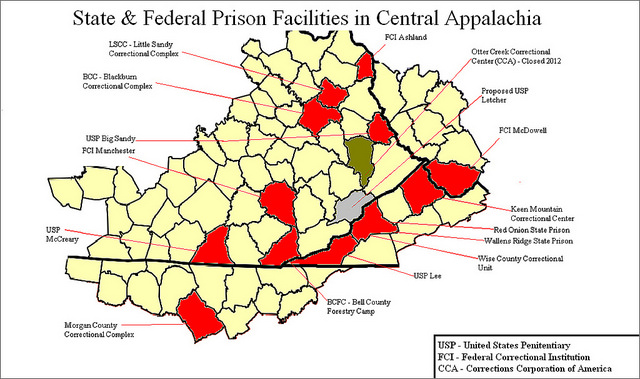
Feds want to build a maximum-security prison on top of a former mountaintop removal mining site in eastern Kentucky

For all practical purposes the [Cumberland Plateau] has long constituted a colonial appendage of the industrial East and Middle West, rather than an integral part of the nation generally. The decades of exploitation have in large measure drained the region.

Harry M. Caudill, author, historian, lawyer, legislator, and environmentalist from Letcher County, in the coalfields of southeastern Kentucky (May 3, 1922 – November 29, 1990)

The United States Bureau of Prisons is trying to build a new, massive maximum-security prison in the Appalachian mountains of eastern Kentucky — and there’s a growing movement to stop it.

The prison industry in the US has grown in leaps and bounds in the past 20 years— a new prison was built at an average rate of one every two weeks in the ’90s, almost entirely in rural communities. As of 2002, there were already more prisoners in this country than farmers. The industry seems like an unstoppable machine, plowing forward at breakneck speed on the path that made the world’s largest prison population.

Today, about 716 of every 100,000 Americans are in prison. Prisoners in nations across the world average at 155 per 100,000 people. And in the US, Southern states rule the chart. Viewing these states as countries themselves, Kentucky ranks at lucky number seven.

“Sounds terrible…” you may be thinking, “But what does it have to do with the environment?”

Well, this seemingly impenetrable multi-billion dollar bi-partisan government-driven industry does have a weak point: it’s a well-verified ecological mess. For a 10-year period of the Environmental Protection Agency’s Prison Initiative, prison after prison that the EPA’s inspected in the Mid-Atlantic region was plagued with violations. Violations included air and water pollution, inadequate hazardous waste management and failing spill control prevention for toxic materials.

From the initial breaking ground on construction in rural and wild places to the inevitable sewage problem from operating chronically over-populated facilities — running a prison is dirty business. And when you factor in the plethora of environmental justice issues facing the prisoners, disproportionately low-income and people of color, it becomes an outright nightmare.

Back to the future for work

By Andrew Curry - The Next Wave, August 20, 2015

Disclaimer: The views expressed here are not the official position of the IWW (or even the IWW’s EUC) and do not necessarily represent the views of anyone but the author’s.

Most discussion of the future of work assumes that the work, or the lack of it, is our coming problem. But what if we’ve got the question the wrong way around? What if we’re slowly, or not so slowly, giving up on the idea of work? After all, we all know that most work is dull. And even the interesting stuff is exploitative, somewhere along the line.

The thought struck me while reading Dan Hancox’ book The Village Against The World, about the anarcho-syndicalist village of Marinaleda, in Andalusia. After 20 years of intense political struggle, the village won some land for itself, and later added some food processing plants. Unemployment there is five or six per cent, a fraction of the level in other parts of Andalusia. But the young people, generally, are less willing to work in either. Work in the fields is hard; work in the processing plants is boring. And this is, pretty much, a universal truth.

In The Village Against The World, a young woman called Christina who lives part-time in the village and part time in the larger town of Estapa explains it to Hancox this way:

“A thousand euros a month is fine – 1,200 euros a month is pretty good.” We were talking about the mileuristas, her generation, so called because they had learned to get by on a one thousand euros a month. Christina was living with her mother in Marinaleda while also renting a room in a flat in Estapa, where she works as a teacher some of the week.

A thousand euros a month is about £750 or $1,400; not a lot, in other words. Spain, of course, has an acute version of this problem. But even if it an outlier, it is not unusual. The labour contract with capitalism is breaking down.

Murray Bookchin: The Bernie Sanders Paradox: When Socialism Grows Old (1986)

By Murray Bookchin - Socialist Review issue 90, November & December 1986

Disclaimer: The views expressed here are not the official position of the IWW (or even the IWW’s EUC) and do not necessarily represent the views of anyone but the author’s.

The posters that appeared all over Burlington — Vermont’s largest city (pop: 37,000) in the winter of 1980-81 were arresting and provocative. They showed an old map of the city with a label slapped across it that read: “For Sale.” A bold slogan across the top, in turn, proclaimed that “Burlington Is Not for Sale,” and smiling amiably in the right-hand corner was the youngish, fairly well-known face of Bernard Sanders, sans tie, open-collared, almost endearingly shy and unpretentious. The onlooker was enjoined to rescue Burlington by voting for “Bernie” Sanders for mayor. Sanders, the long-time gubernatorial candidate of Vermont’s maverick Liberty Union, was now challenging “Gordie” Paquette, an inert Democratic fixture in City Hall, who had successfully fended off equally inert Republican opponents for nearly a decade.

That Sanders won this election on March 3, 1981, by only ten votes is now a Vermont legend that has percolated throughout the country over the past five years. What gives Sanders almost legendary qualities as a mayor and politician is that he proclaims himself to be a socialist — to many admiring acolytes, a Marxist — who is now in the midpoint of a third term after rolling up huge margins in two previous elections. From a ten-vote lead to some fifty-two percent of the electorate, Sanders has ballooned out of Burlington in a flurry of civic tournaments that variously cast him as a working-class hero or a demonic “Bolshevik.” His victories now make the New York Times and his trips outside of Burlington take him to places as far as Managua, where he has visited with Daniel Ortega, and to Monthly Review fundraising banquets, where he rubs shoulders with New York’s radical elite. Sanders has even been invited to the Socialist Scholar’s Conference, an offer he wisely declined. Neither scholarship nor theory is a Sanders forte. If socialist he be, he is of the “bread-and-butter” kind whose preference for “realism” over ideals has earned him notoriety even within his closest co-workers in City Hall.

The criss-crossing lines that deface almost every serious attempt to draw an intelligible sketch of the Sanders administration and its meaning for radicals result from a deep-seated paradox in “bread-and-butter” socialism itself. It trivializes this larger issue to deal with Sanders merely as a personality or to evaluate his achievements in the stark terms of lavish praise or damning blame. A sophomoric tribute to Sanders’ doings in the Monthly Review of a year ago was as maladroit as the thundering letters of denunciation that appear in the Burlington Free Press. Sanders fits neither the heaven-sent roles he is given in radical monthlies nor the demonic ones he acquires in conservative letters to moderate dailies.

To dwell heavily on his well-known paranoia and suspicious reclusiveness beclouds the more important fact that he is a centralist, who is more committed to accumulating power in the mayor’s office than giving it to the people. To spoof him for his unadorned speech and macho manner is to ignore the fact that his notions of a “class analysis” are narrowly productivist and would embarrass a Lenin, not to mention a Marx. To mock his stolid behavior and the surprising conventionality of his values is to conceal his commitment to thirties’ belief in technological progress, businesslike efficiency, and a naive adherence to the benefits of “growth.” The logic of all these ideas is that democratic practice is seen as secondary to a full belly, the earthy proletariat tends to be eulogized over the “effete” intellectuals, and environmental, feminist, and communitarian issues are regarded as “petit-bourgeois” frivolities by comparison with the material needs of “working people.” Whether the two sides of this “balance sheet” need be placed at odds with each other is a problem that neither Sanders nor many radicals of his kind have fully resolved. The tragedy is that Sanders did not live out his life between 1870 and 1940, and the paradox that faces him is: why does a constellation of ideas that seemed so rebellious fifty years ago appear to be so conservative today? This, let me note, is not only Sanders’ problem. It is one that confronts a very sizable part of the left today.

RailCon 15 coming to Chicago

By Ron Kaminkow and Mark Burrows - Railroad Workers United, August 24, 2015; image by Jon Flanders

Disclaimer: The views expressed here are not the official position of the IWW (or even the IWW’s EUC) and do not necessarily represent the views of anyone but the author’s.

On Saturday, September 19th, the cross-craft solidarity group Railroad Workers United (RWU) will sponsor a conference on rail safety. RWU is partnering with other labor, citizens and environmental groups to organize this innovative and cutting edge conference, entitled “Railroads Safety, Workers, Community and the Environment.” The Chicago conference is a follow up to two earlier conferences held in March of this year in Richmond, CA and Olympia, WA. All interested parties concerned about the safety and the future of railroads are invited to attend.

In the past two years, public attention has focused on the railroad in a way not seen for decades. In the wake of Lac Megantic and other train derailments, resulting fires and explosions, the public is alarmed about the movement of trains through their communities. Environmental activists are up-in-arms about the amount of fossil fuels moving by rail. Farmers and other shippers are concerned about the recent oil train congestion. All this attention gives railroad workers an invaluable opportunity to educate the public about the railroad, its inherent efficiencies and value to society, its great potential, and also the challenging situation that railroad workers face on the job every day.

The public has little idea what railroads are all about. These conferences will shed light on worker issues such as crew fatigue, single employee train crews, excessively long and heavy trains, short staffing, limited time off work and more. These are safety concerns not just for railroaders, but for society in general. Non-railroaders in attendance at the conference will come away with a deeper understanding and a greater appreciation of the issues facing rail and railroad workers. Railroaders will gain insight into the environmental movement and learn how to forge alliances with public citizens. And all participants will come away with a better understanding of how all of us can work together to build a safer, greener and more just railroad that meets the needs of current and future generations.

Tentative workshops and discussion topics at the conference include:

  • Single employee train crews and the hazards they pose for workers, communities and the environment.
  • Excessively long and heavy trains and their inherent problems and dangers.
  • Crew fatigue and “task overload” and the need for well-rested, well-trained, alert and safe train crews.
  • Building worker-to-worker alliances along the supply chain of all transport workers and communities.
  • Chicagoland citizen efforts to deal with the dangers and hazards of trains moving through their community.
  • A history of worker-community-environmental alliances and how to build one around the railroad industry.

The conference is planned for Saturday, September 19th at the United Electrical (UE) Union Hall at 37 South Ashland Avenue, Chicago, Illinois 60607. Registration Fee is $20.00 and includes a healthy lunch. For those interested, a banquet at a nearby restaurant will follow in the evening. Scholarships are available. For more information and/or to register, check the official conference website at www.railroadconference.org; and the RWU website at www.railroadworkersunited.org.

Calling the Social Strike?: a response to Plan C’s “On Social Strikes and Directional Demands”

By Unknown - New Syndicalist, August 21, 2015

Disclaimer: The views expressed here are not the official position of the IWW (or even the IWW’s EUC) and do not necessarily represent the views of anyone but the author’s.

Keir Milburn’s “On Social Strikes and Directional Demands”, originally authored as a contribution to ongoing debates within Plan C, has initiated some interesting debates on strategy, tactics and orientation within the libertarian milieu. The original article can be found here. Our friends at the Angry Workers blog have also made a particularly useful contribution, their response can be found here. We, however, felt there were some areas within this discussion that needed to be looked at in greater detail and that also overlapped with our priorities and what we are trying to achieve here through New Syndicalist.

Our response largely covers the idea and strategies behind the notion of a “Social Strike”. Although Keir does look critically at the recent practices of the UK Left, we felt that the original article overlooked changes in the structure of capitalism and class composition in recent decades which have drastically changed the dynamics of both our movements and contemporary organising. We explore this as well as developing further some of the points of contention raised by the Angry Workers piece about the continued usefulness of the “traditional” strike. We felt that these two issues were very much related so thought it necessary to spell out more clearly the connections between potential new and largely unexplored areas for organising and restructuring of the UK workforce. Our central concern, however, was Keir’s description of the social strike and whether this is a practical possibility for us and our movements in the here and now. This led us to question the current infrastructure and capacity that the libertarian left has developed to call, organise and sustain a social strike. If the traditional left, or “Plan B”, can be said to still maintain a grip on the direction of the workers’ movement this is derived from the historic organisations it has built in pursuit of its goals – the Labour party, the TUC, social democratic arts, media, clubs, societies and think tanks. Some of these have taken the forms of mass movements capturing the hopes and aspirations of hundreds of thousands of working people. We pose the question as to what the current libertarian milieu offers as both an alternative and as a practical means of pursuing its own objectives, including the social strike. Although painting a rather more pessimistic picture, we believe this is the basis for a more grounded discussion into strategy, how and where to move forward. We finish by imagining the kind of activities and organisations we believe would form the basis for being able to call a social strike and putting “plan C” as a credible alternative to working people.

Capital Blight: Overshooting the Message

By x344543 - IWW Environmental Unionism Caucus, August 21, 2015

Disclaimer: The views expressed here are not the official position of the IWW (or even the IWW’s EUC) and do not necessarily represent the views of anyone but the author’s.

On or around August 13, 2015, many news sources, including especially mainstream environmental news sources announced with great foreboding that "Earth Overshoot Day" occurred at its earliest point during the calendar year in recorded history. In case one is not familiar with Earth Overshoot Day, there is a wesbite devoted to it, which explains the concept in simple, concise, and stark terms: 

"Global overshoot occurs when humanity’s annual demand for the goods and services that our land and seas can provide—fruits and vegetables, meat, fish, wood, cotton for clothing, and carbon dioxide absorption—exceeds what Earth’s ecosystems can renew in a year. Overshoot means we are drawing down the planet’s principal rather than living off its annual interest. This overshoot leads to a depletion of Earth’s life-supporting natural capital and a buildup of carbon dioxide in the atmosphere.

"The concept of Earth Overshoot Day was first conceived by Andrew Simms of the UK think tank New Economics Foundation, which partnered with Global Footprint Network in 2006 to launch the first global Earth Overshoot Day campaign. At that time, Earth Overshoot Day fell in October. WWF, the world’s largest conservation organization, has participated in Earth Overshoot Day since 2007."

This narrative sounds ominous, and indeed it is, because it's true, at least in general, and it demonstrates just how precariously close to the brink of destruction humanity (and perhaps life on Earth itself) currently stands. There are no shortage of dire reports being released daily about just how serious global warming's effects are being currently felt, how the Earth is already locked into rising sea levels, how those trends are accelerating and are going to continue to accelerate, and how the planet is perhaps on the brink of the 6th Mass Extinction in its biological history. The time in which humanity has to prevent disaster seems to have already past. At present, our choices seem limited to survival or annihilation. Earth Overshoot is yet one additional grisly reminder of our peril.

Yet, the narrative offered by the Earth Overshoot folks is nevertheless deeply flawed, because it fails to identify the cause and provide the solution to ending "overshoot", and that's capitalism.  You see, dear reader, the reason why the demands of "humanity" are exceeding what Earth’s annual "resource" output is because it is locked into an economic system that is based on the internal logic of "growth for growth's sake," an ideology that Ed Abbey once identified as the "ideology of a cancer cell".  Now at the risk of beating a dead horse, I won't repeat all of the arguments that clearly demonstrate how capitalism is inherently irreconcilable with ecological sustainability, nor am I going to rehash the rebuttals to Malthusian pseudo-scientific dogma which has been thoroughly debunked (other than to encourage you--for the sake of brevity--to follow the links to the rich corpus of work on both subjects we have preserved on ecology.iww.org).

However, I do feel compelled to point out that it does no good to constantly browbeat the 99%, like a broken record (or a skipping .mp3 file for those of you who are too young to remember what "a broken record" means), that "we need to radically change our 'overconsumptive' ways" lest the Earth rise up a smite us (granted that this will happen if we don't, of course, but that's not the point).  The problem is that under capitalism, the ability of the 99% to make any meaningful change is severely limited, if capitalism is allowed to continue.  As Ragina Johnson and Micheal Ware point out in an article written after last year's Earth Overshoot Day, Whose Consumption is Killing the Planet?, for the 99%, the vast majority of our consumption patterns are beyond our capability to alter.

Listen, Platformist!: Fragments of a Twenty-First Century Manifesto

By Shane Burley - The Hampton Institute, August 19, 2015

Disclaimer: The views expressed here are not the official position of the IWW (or even the IWW’s EUC) and do not necessarily represent the views of anyone but the author’s.

"Our future is unwritten."

These old libertarian socialist maxims have become so cliché that they can be an indicative street sign indicating for you to take a detour around whatever post-left jargon that comes next, but we can try to delve a little deeper. Many people dove into the Occupy Movement with the kind of fervor that can only happen when your politics are validated in an incredibly clear and material way. The financial crisis of 2008, and the subsequent housing crisis in 2010, was felt so personally amongst an entire range of people that the waves of deregulated capitalism are splashing hard enough to stop us from finding our heads above water. We were treated to a second collapse when our response, the diversified and shockingly quick faces of Occupy, also crumbled in a pretty predictable fashion. A movement built on anarchist principles and vision fell apart for lack of cohesive structure, as well as a media betrayal and enough liberal guilt to go around. In the shadow of that fallen statue many are looking forward to create an anarchist structure with a little more staying power, which means looking backwards and trying to find a series of patterns that illustrate what success can look like.

What this means is a much more intentional project, what Mark Bray calls a more "big A" anarchism as opposed to the "small a" variety that often permeates radical circles(1). The ideas of solidarity, mutual aid, and direct action have been solidified in the activist mindset and we want to make a step forward with an ideological organization that allows us to both build our own internal world view as well as push these radical ideas in the movements around us. For those inclined towards this "big A" anarchism, the trajectory is usually towards both American and European Platformism and the Latin and South American Especifismo, who bring a generally similar perspective on what it means to have a consistent anarchist organization that can create a revolutionary impulse in working class movements. This often means a degree of agreement about ideas and strategy, working with movements that are not exclusively anarchist, and having an organization of their own. This is not, as we know, the only approach that can be taken, and still bears a barrage of criticism for using organizational elements that people often assume are Marxist in character.

What we actually have in front of us is both a new politic and a set of fresh ideas that are demanding to be considered if we are to stay relevant. The organizations that we are developing now may be inspired by the success of the past, but even if we look to them as a blueprint there is no way that we can expect for our functionality to be a carbon copy of theirs. Different circumstances, people, developing notions about late capitalism and power relationships, shifting struggles, and even just personal identities leave us without a clear picture of exactly what our organizations will become. Quite literally, our future has not been decided. No matter how accountable and organized, we could still devolve into disarray. Even if founded on direct action and direct democracy, we could still get hopelessly drawn into progressive reformism or let strong personalities make the primary decisions.

Instead, what we have is a bit of trial and error. We have to look at our particular situations, take lessons as they come, and find inspiration rather than schematics in the organizations of the past(or even the present).

These notes ahead are fragmented, as they should be. As we collectively build new ideological institutions we will learn bits and pieces at a time, not a grand theory that encompasses all. The anarchist canon fundamentally works differently than the Marxist. It does not discern all theory from one grand scripture and prophet, but instead derives theory from practice and builds from many voices to construct a constantly changing narrative. While Marx begins as a communist prophet outlining their "theory of history," divergent paths take though the different "practical applications" of this thought through, Lenin, Trotsky, Mao, Debord, or anybody else whose name has become more important to their ideas. The libertarian tradition instead creates a shifting perspective where ideas are traded, enhanced and abandoned, and structured out of the lived experience.

If we were to create a modern manifesto, a declaration of the anarchist movement of today, it could not be written by one person in a document. It would be the collective ideas of the mass attempting to come together and construct something that can challenge capitalism and the state in this new context. It would be built as a patchwork quilt from the fragments of hard lessons, scraps of paper from old meetings, and loud arguments between friends. We would have to build a new manifesto that collects as much as we can to find something cohesive, yet is open to our own failure and diversity of ideas. We do not know what organization will ensure our success, and if we did we already would have seen our revolution. Instead, we have to hammer together the individual ideas and then step back to see if we have a shelter that is inhabitable, and to keep building until we find something that works.

Pages

The Fine Print I:

Disclaimer: The views expressed on this site are not the official position of the IWW (or even the IWW’s EUC) unless otherwise indicated and do not necessarily represent the views of anyone but the author’s, nor should it be assumed that any of these authors automatically support the IWW or endorse any of its positions.

Further: the inclusion of a link on our site (other than the link to the main IWW site) does not imply endorsement by or an alliance with the IWW. These sites have been chosen by our members due to their perceived relevance to the IWW EUC and are included here for informational purposes only. If you have any suggestions or comments on any of the links included (or not included) above, please contact us.

The Fine Print II:

Fair Use Notice: The material on this site is provided for educational and informational purposes. It may contain copyrighted material the use of which has not always been specifically authorized by the copyright owner. It is being made available in an effort to advance the understanding of scientific, environmental, economic, social justice and human rights issues etc.

It is believed that this constitutes a 'fair use' of any such copyrighted material as provided for in section 107 of the US Copyright Law. In accordance with Title 17 U.S.C. Section 107, the material on this site is distributed without profit to those who have an interest in using the included information for research and educational purposes. If you wish to use copyrighted material from this site for purposes of your own that go beyond 'fair use', you must obtain permission from the copyright owner. The information on this site does not constitute legal or technical advice.