






 Lights, cell service, sewer and water treatment plants came back on quickly in Florida and Houston after hurricane Maria. But Puerto Rico still remains largely in the dark one month later, with power restored to only 20% of the island.
 “The whole of Puerto Rico is like this. I don’t think we are the only ones like this… We will survive,”
  THE SOCIALIST German playwright Bertolt Brecht once wrote that "famines do not simply occur; they are organized by the grain trade."
 The "fire sale" privatization of Greece started in 2015, following the infamous Syriza referendum in which more than three-fifths of the Greek people voted to reject Troika-imposed bailout conditions -- and yet their government, led by Alexis Tsipras, chose to accept the deal anyway.
 A gentle revolution is underway in Barcelona, Spain. Until recently, prevailing wisdom has been that efficient, quality and cheap services are best provided by handing everything over to the private sector. These days are gone. From energy supply to kindergartens to funeral services, the municipality is providing more and more of the basic needs of its citizens at affordable and transparent prices. Following a city council motion in December 2016, Barcelona is now aiming to municipalize its water service. Since the progressive coalition
  Saying "It's just a bus but without the regulation/without unions/only for people with smartphones" is very incomplete as well, and it's worth unpacking why.
 In 2000 and 2001, one of the biggest, filthiest, most audacious and wide-scale con jobs ever perpetrated on a state population occurred in California. And even though many citizens chose, reflexively, to blame the “government,” the entire fiasco (other than the state assembly stupidly laying the groundwork for it) was invented and put into play by the private sector.
And once the smoke cleared, and people realized what just happened, California had lost roughly $40-$45 billion, its first governor in history had been recalled, the state’s second-largest energy company PG&E (Pacific Gas & Electric) had gone bankrupt, and Austrian steroid hound Arnold Schwarzenegger was now governor.
It all began in 1996, with Republican Governor Pete Wilson. He and the state assembly, seeking to stimulate competition, pushed through a law (AB 1890) calling for the “partial deregulation” of the energy market. Not to point fingers, but if there were any justice in the world, Wilson would’ve been taken out and shot with a rusty bullet.
Basically, what happened in the wake of AB 1890, was that the energy companies, seeing the opportunity for astronomical profits, began manipulating the market in ways that no one had ever witnessed or even imagined. They did it by creating shortages where none existed. Before this began, California had a generating capacity of 45 gigawatts (GW). Demand was still only 28GW. Things were good. There hadn’t been “blackouts” for 40 years.
But energy suppliers (notably Enron, a Texas company) had devised a plan. With deregulation of wholesale pricing now in effect, the hoary, time-honored “supply and demand” formula raised its ugly head. Inevitably, the energy suppliers began taking steps to diminish supply and increase demand, albeit artificially.
In order to depress supply and raise the price, they began messing with the grid. They illegally shut down pipelines and intentionally took power plants off-line during periods of peak demand by pretending that these facilities needed “maintenance.” Of course, it was all a lie. Anything to create a shortage.
They exploited loopholes. Because California law allowed energy companies to charge higher fees when the energy they sold was produced out-of-state, they engaged in a form of “megawatt laundering” (analogous to “money laundering”), where they disguised the source—disguised it to make California-produced energy appear to have been produced out-of-state.
They also ran “overscheduling” scams. Essentially, this consisted of purposely overscheduling the transportation of electricity along power lines in order to get the state to pay them a lucrative “congestion fee” for willingly alleviating the congestion (even when they had no intention of using them). The state had no choice. People need electricity. You do everything you can to provide it.
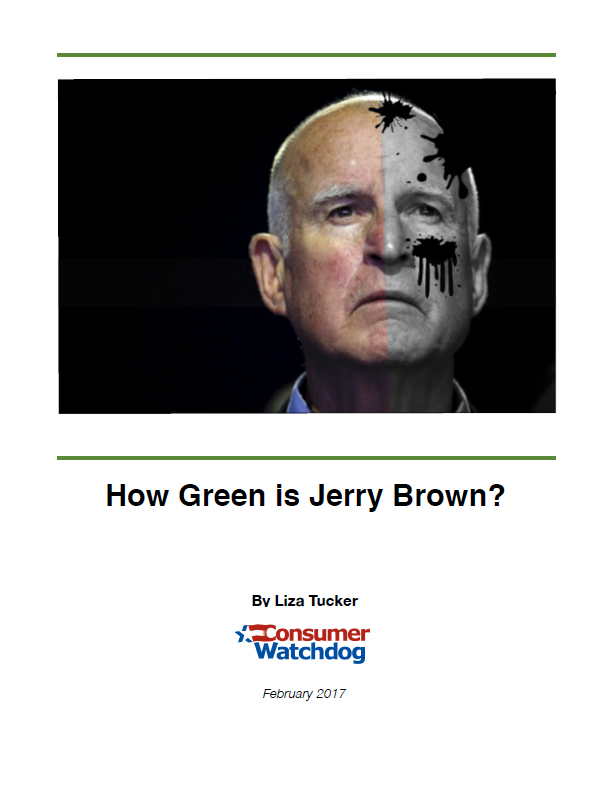 This review fact-checks the perception of Jerry Brown as an environmentalist against his actions since taking office as Governor in 2011 to answer the question: “How Green Is Brown?” On a continuum of “Green” to “Murky” to “Dirty,” the review concludes that Brown’s environmental record is not green. The following advocates and public interest groups concur with the report’s analysis, conclusions, and recommendations: Food & Water Watch, Physicians for Social Responsibility-Los Angeles, Rootskeeper, Powers Engineering, Basin & Range Watch, Aguirre & Severson LLP, Public Watchdogs, the Southern California Watershed Alliance, The Desal Response Group, Restore The Delta, and Committee to Bridge the Gap.
 This site is not the official webpage of the Industrial Workers of the World.