You are here

mining

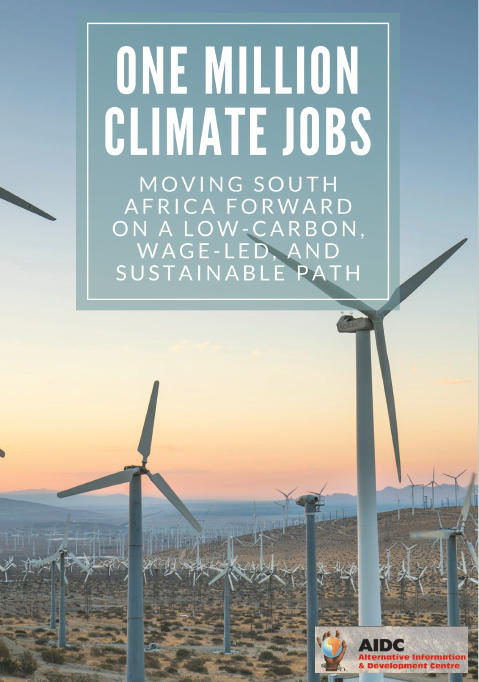
One Million Climate Jobs: Moving South Africa Forward on a Low-Carbon, Wage-Led, and Sustainable Path

By Brian Ashley, et. al. - One Million Climate Jobs - December 2016

The One Million Climate Jobs Campaign is an alliance of labour, social movements and popular organisations in South Africa that is campaigning for the creation of a million climate jobs as part of a collective approach to the crisis of unemployment and climate change. The Campaign was launched in 2011 and since then has been mobilising thousands of South Africans around real solutions to slowing down climate change, protecting the natural environment, improving the quality of life for all and moving towards a sustainable development path. Climate change will exacerbate inequality and poverty because it reduces access to food, water, energy and housing. Thus it is vital that social justice struggles around these issues incorporate struggles around climate change.

This booklet is a follow-up, six years later, to the first booklet that was produced in 2011. It is based on well- researched solutions for how South Africa can immediately begin a just transition, away from the Minerals-Energy Complex that continues to dominate the South African capitalist economy, to a low carbon economy in which the basic needs of communities are met in an equitable, sustainable and affordable way.

It recognizes that in these six years there have been many developments – for instance, renewable energy is now firmly established as part of the energy mix (although still a minor part); retrofitting buildings, and the development of environmentally friendly construction methods, is being developed, and the Rapid Bus Transit system is being slowly implemented in some municipalities.

But most of these solutions are being pursued within the logic of the market. It is not possible, we would argue, within these market parameters, to respond adequately to the enormous challenges facing us – what is needed is a publicly-driven solution for the shift to a sustainable, low-carbon future. The research that this booklet is based on begins to set out what such a transition could look like. We hope that it will be an important contribution to the ongoing work of building a political movement to struggle around these issues.

Download (PDF).

Trump Can’t Hold Back the Tide of Climate Action

By Oscar Reyes - Foreign Policy in Focus, November 21, 2016

One of the sad ironies of Donald Trump’s victory is that climate change has risen up the political agenda only after the campaign, when both candidates and debate moderators largely ignored it. Trump’s denialism in the face of an urgent, planetary threat provides some potent imagery for how the devastation caused by his presidency might look.

Climate scientists have been quick to condemn Trump’s election as a “disaster,” and it’s not hard to see why.

The last three years have broken temperature records, with 2016 set to become the hottest yet. The UN Environment Program just warned that we need to do far more and far faster, while a new study of pledges from G20 countries found that even under Obama, the U.S. remained a long way off meeting its share of the global effort to tackle climate change. Yet we’ve just elected a man who promises to drill more oil, burn more coal, and scrap our national climate plan.

The Trump disaster could hit communities on the front line of climate justice struggles the hardest. Scenes like the militarized response to the struggle against the Dakota Access Pipeline could be the new normal under Trump if the expansion of fossil fuel infrastructure is matched with increasingly repressive policing.

It’s little wonder, then, that Trump’s election has left climate advocates reeling. But as mourning turns to anger and resistance, it’s worth recalling that there are significant limits on what Trump can do to hold back action on climate change.

The transition to cleaner energy will carry on regardless, as coal will remain uncompetitive. States and cities could ramp up their own climate efforts irrespective of the federal government. And international climate action has a momentum that’s not solely dependent on who occupies the White House.

Rogue State

Some of the loudest noises coming from the Trump camp suggest that his administration will withdraw from the Paris climate deal.

Since this process takes four years, it’s rumored that Trump is considering the shortcut of leaving the United Nations Framework Convention on Climate Change (UNFCCC), which George Bush Sr. signed in 1992 and the Senate ratified. That would set the U.S. apart from every other nation on earth (except the Vatican, which is strongly in favour of climate action all the same). There would be no clearer way to signal that Trump is making the U.S. a rogue state.

Unilateralism on this scale could throw up legal, political, and diplomatic hurdles that Trump’s team might not easily overcome. The Senate might demand a say on leaving the UNFCCC — and it’s not a given that a majority would favor the path of global isolation.

Alternatively, the Trump administration might choose to ignore Washington’s commitments without formally abandoning the international climate process. One of the first victims could be the global Green Climate Fund, which was set up to help developing countries with their climate transitions — and is now unlikely to see at least $2 billion of the $3 billion originally promised to it by the United States.

But the Trump wrecking ball won’t be able to destroy everything in its path. There are strong signs that U.S. isolation won’t wreck the Paris Agreement. Many other countries (including Saudi Arabia) have suggested that they will stick to their international climate commitments with or without the United States. There’s precedent here, too: When George W. Bush withdrew from the last global climate treaty, the Kyoto Protocol, the rest of the world continued with it anyway.

Faced with failed harvests, floods, droughts, and ever more extreme weather, most countries now realize that taking on climate change is in their own self-interest. Ultimately, the countries that lead the way in renewable energy, efficient buildings, and improved public transport (among other climate measures) will be best placed to cope with changes in the global economy.

Managed Decline: A Just Clean Energy Transition and Lessons from Canada’s Cod Fishing Industry

By Adam Scott and Matt Maiorana - Oil Change International, September 12, 2016

There’s a clear logic to the global challenge of addressing climate change: when you’re in a hole, stop digging. If we’re serious about tackling the global climate crisis, we need to stop exploring for, developing, and ultimately producing and consuming fossil fuels. This inevitably leads to the decline of the oil, gas, and coal industries.

This leaves us with two clear options. Either we carefully manage the decline of the fossil fuel industry to ensure a smooth and just transition, or we let the chips fall where they may and risk decimating communities that are reliant on the fossil fuel economy. The path we choose will make all the difference to those communities as the decline of fossil fuels becomes inevitable.

A textbook example of how NOT to manage the decline can be found in the painful history of the Newfoundland cod fishery.

One of eastern Canada’s premier industries, the cod fishery defined the economy and the culture of coastline communities for centuries. Commercial fishing off the Grand Banks of Newfoundland dates back as far as 1500, but it wasn’t until factory trawlers were introduced around 1950 that catches became increasingly unsustainable. At its peak in 1968, the catch of northern cod in the Atlantic reached 1.9 million tons. However, the impact of overfishing soon became apparent.

In the 1980s, Canada’s Department of Fisheries and Oceans received increasingly dire warnings about the rapidly diminishing fish stock from fishermen and scientists, but these were largely ignored. Much like climate science models today, these marine science models were often ignored when setting quotas and planning for future catches. These plans weren’t set by the scientific models, but instead by politicians. Despite mounting evidence, the Department of Fisheries and Oceans continued to boost catch quotas without regard to the impacts of their actions. A 1992 Canadian Department of Fisheries and Oceans audit found that the science regarding the health and management of cod stocks “was gruesomely mangled and corrupted to meet political ends.” As a result, fish stocks continued to plummet.

Carbon Bubble News #122

Carbon Bubble News #121

Compiled by x344543 - IWW Environmental Unionism Caucus, September 13, 2016

A supplement to Eco Unionist News:

Lead Stories:

Carbon Market Watch:

Other Carbon Bubble News:

Utility Death Spiral News:

For more green news, please visit our news feeds section on ecology.iww.org; Twitter #IWWEUC; Hashtags: #greenunionism #greensyndicalism #IWW. Please send suggested news items to include in this series to euc [at] iww.org.

Carbon Bubble News #120

Compiled by x344543 - IWW Environmental Unionism Caucus, September 7, 2016

A supplement to Eco Unionist News:

Lead Stories:

Carbon Market Watch:

Other Carbon Bubble News:

Utility Death Spiral News:

For more green news, please visit our news feeds section on ecology.iww.org; Twitter #IWWEUC; Hashtags: #greenunionism #greensyndicalism #IWW. Please send suggested news items to include in this series to euc [at] iww.org.

Breathing in the benefits: How an accelerated coal phase-out can reduce health impacts and costs for Albertans

By Benjamin Israël, Kim Perrotta, Joe Vipond, Leigh Allard, and Vanessa Foran - Pembina Institute, September 2016

With the phase-out of coal power announced by the provincein November 2015, Albertans stand to avoid significant health impacts caused by coal pollution. By extension, afurtheraccelerated phase out of coal power facilities would both hastenand amplify those avoided health impacts.The health benefits and costs savings in avoided health outcomes would be significant, and should be consideredin the government’s planning of the coal phase-out from now to 2030.

While the provincial government has announced a coal phase-out, they have not yet released a transition schedule. This analysis assesses the relative benefits of an accelerated stepwise transition away from coal, as proposed by the Pembina Institute,versus the back-loaded phase-out that otheranalyses haveposited.

In 2012, when the federal government finalized its coal regulations that —in effect —reduce electricity generation from coal plants, Environment Canada(as it was called at that time)estimated considerable health impacts would be avoided, usinghighly regarded modelling techniques. Logically, thesesignificantbenefits from reducing coal necessarily mean that the use of coal for power generation causesconsiderablehealth impacts in the first place.

By extrapolating the health benefit results from Environment Canada’s analysis, this report highlights the full impact of coal-fired generation in Albertaand indicates attainable benefits associated with the province’s coal phase- out.When the federal government weakened its proposed coal regulations back in 2012 in response to lobbying from some coal generators, allowing coal plants to continue unabated longer than first proposed,it left health savings on the table. Alberta can now grasp these savings byaccelerating our transition away from coal-fired electricity.

Read the report (PDF).

Life After Coal: Pathways to a Just and Sustainable Transition for the Latrobe Valley

By Anne Martinelli, et. al. - Environment Victoria - September 2016

The Latrobe Valley has a proud history of supplying the electricity that powers Victoria. But coal-burning power stations are ageing and –responding to climate change – the world is moving rapidly to cleaner energy sources. In this shifting context, the Latrobe Valley faces inevitable change. The question is: how will that change be managed?

With recent news that Hazelwood power station may close as early as in April 2017, there is a narrow window of opportunity to ensure that the Latrobe Valley prospers during the transition to a cleaner economy, rather than suffers as it did during previous economic changes.

A ‘just transition’ is a framework for managing the shift towards such new economies, with a focus on inclusive participation for those affected and a fair distribution of the costs and benefits of change.

This report explores what a just, and well-managed, transition process for the Latrobe Valley might look like. As experience from around the world has shown, when industrial change does arrive it can come very quickly, and being unprepared is costly.

In South Wales, UK, where there was little transition planning prior to the 1980s coal-mine closures, the damaging economic and social consequences have been profound and long-lasting. By contrast, Rochester, New York, which started planning its transition two decades before the city’s main employer – Kodak – collapsed, the situation has been more positive.

The first closure of one of the four large coal-burning power stations in the Latrobe Valley could be as early as 2017, and the rest could quickly follow. Tangible action and funding to develop an alternative economic future is required now.

For the Latrobe Valley to successfully achieve a just transition, two equally important processes must occur: (1) an orderly and planned transition away from coal; and (2) a collaborative and inclusive transition towards a sustainable local economy.

Read the Report (Link).

Carbon Bubble News #119

Compiled by x344543 - IWW Environmental Unionism Caucus, August 31, 2016

A supplement to Eco Unionist News:

Lead Stories:

Carbon Market Watch:

Other Carbon Bubble News:

Utility Death Spiral News:

For more green news, please visit our news feeds section on ecology.iww.org; Twitter #IWWEUC; Hashtags: #greenunionism #greensyndicalism #IWW. Please send suggested news items to include in this series to euc [at] iww.org.

Carbon Bubble News #118

Compiled by x344543 - IWW Environmental Unionism Caucus, August 24, 2016

A supplement to Eco Unionist News:

Lead Stories:

Carbon Market Watch:

Other Carbon Bubble News:

Utility Death Spiral News:

For more green news, please visit our news feeds section on ecology.iww.org; Twitter #IWWEUC; Hashtags: #greenunionism #greensyndicalism #IWW. Please send suggested news items to include in this series to euc [at] iww.org.

Pages

The Fine Print I:

Disclaimer: The views expressed on this site are not the official position of the IWW (or even the IWW’s EUC) unless otherwise indicated and do not necessarily represent the views of anyone but the author’s, nor should it be assumed that any of these authors automatically support the IWW or endorse any of its positions.

Further: the inclusion of a link on our site (other than the link to the main IWW site) does not imply endorsement by or an alliance with the IWW. These sites have been chosen by our members due to their perceived relevance to the IWW EUC and are included here for informational purposes only. If you have any suggestions or comments on any of the links included (or not included) above, please contact us.

The Fine Print II:

Fair Use Notice: The material on this site is provided for educational and informational purposes. It may contain copyrighted material the use of which has not always been specifically authorized by the copyright owner. It is being made available in an effort to advance the understanding of scientific, environmental, economic, social justice and human rights issues etc.

It is believed that this constitutes a 'fair use' of any such copyrighted material as provided for in section 107 of the US Copyright Law. In accordance with Title 17 U.S.C. Section 107, the material on this site is distributed without profit to those who have an interest in using the included information for research and educational purposes. If you wish to use copyrighted material from this site for purposes of your own that go beyond 'fair use', you must obtain permission from the copyright owner. The information on this site does not constitute legal or technical advice.