

You are here

mining

Beyond Coal: Scaling Up Clean Energy to Fight Global Poverty

By lmi Granoff, et. al. - Overseas Development Institute, 2016

Eradicating global poverty is within reach, but under threat from a changing climate. Left unchecked, climate change will put at risk our ability to lift people out of extreme poverty permanently by 2030, the first target of the Sustainable Development Goals. Coal is the world’s number one source of CO2 emissions. Most historic emissions came from the coal industry in the developed world in the last century, with China joining the biggest emitters at the beginning of this one. It is widely accepted that a rapid and just response to climate change will require the urgent replacement of coal with low-carbon energy sources in rich economies.
Now the coal industry claims that expanding coal use is critical to fighting extreme poverty and improving energy access for billions of people in developing countries. In fact, the opposite is true. The global commitment to eradicate extreme poverty and energy poverty by 2030 does not require such an expansion and it is incompatible with stabilising the earth’s climate. The evidence is clear: a lasting solution to poverty requires the world’s wealthiest economies to renounce coal, and we can and must end extreme poverty without the precipitous expansion of new coal power in developing ones.

This paper explores the role of energy in fighting poverty, arguing that:

  • More coal will not end energy poverty
  • Coal is given too much credit for the reduction of extreme poverty
  • Better energy options exist to lift people out of income poverty
  • More coal will entrench poverty.

Read the report (EN PDF) | (JA PDF) | (ZH PDF).

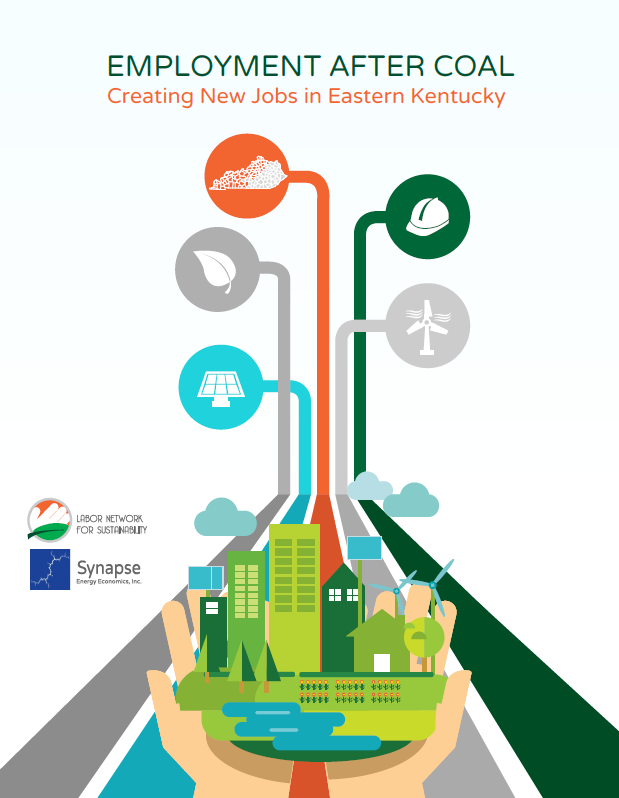
Employment After Coal: Creating new jobs in eastern Kentucky

By Frank Ackerman, PhD and Tyler Comings - MACED, December 30, 2015

The steep, ongoing decline of coal mining has caused the loss of 30,000 coal jobs in eastern Kentucky in the last 30 years. Trends in energy markets and public policy make it clear that a coal‐based economy is not coming back. A successful response to this crisis, replacing the lost kingdom of coal with a sustainable, community‐controlled economy, is crucial to the hopes for forward‐looking economic development in the region.

The issue reverberates far beyond the coalfields, as the national search for clean energy alternatives confronts impassioned claims about the need to protect coal mining jobs. In Kentucky and in the nation, a common but misleading frame on the debate suggests that there is no alternative, that “real” jobs can only be created by traditional industries, even if they are environmentally damaging.

In fact, the narrow, coal‐centered vision of “real” jobs is fading away, and discussion of newer, cleaner alternatives is already underway. Community organizations such as the Mountain Association for Community Economic Development (MACED) and Kentuckians for the Commonwealth (KFTC) have sponsored grassroots job creation initiatives, and have identified key sectors where employment growth should be possible. Both MACED and KFTC advocate for a Just Transition, a bigger picture that combines existing initiatives into a single vision of a working economy, mapping the sustainable occupations and industries that will fill the void left by coal.

Our analysis describes a new pattern of employment that Appalachian Kentucky could aspire to reach by 2030. It is a more challenging and longer‐term goal than is usually found in immediate grass‐roots campaigns. At the same time, it is more limited, detailed and practical than a grand statement of ultimate objectives. It occupies an intermediate level of abstraction, a mid‐range strategic vision of what the regional economy could look like in ten to twenty years.

Read the text (PDF).

The Cost of Coal: Impact of Russian coal mining on the environment, local communities and indigenous peoples

By Natalia Paramonov - EcoDefense, December 2015

In four hours of flight from Moscow, in the middle of the country, lies the coal heart of Russia.

Coal mining and burning are generally known to be polluting atmosphere with loads of CO2 and causing climate change. But people of Kuzbass have little concern about global problems. They get used to open-cut mines operating and huge trucks roaring right out of their windows. Shot operations destroy houses, and spoil piles grow up around. Air and rivers are contaminated with coal dust, and fertile land is being devastated.

These particular problems can be discovered only by visiting surroundings of Novokuznetsk. Bad news about violations over environmental rights in Kemerovo Oblast would never reach Moscow themselves. They are hidden behind companies' ambition to get coal at any cost.

Number of official statistics provides evidence for contamination of air, water, and soil, high mortality and sickness rates in Kemerovo Oblast. Local authorities and regulatory bodies, however, prefer to avoid looking into particular cases. There is Kemerovo Oblast with a range of general environmental problems, but there are no particular people whose violated rights need to be protected. This way, there are no victims and no need to pay out compensations or think about mine reclamation.

This report begins with statistic data which reflect environmental conditions in Kuzbass, followed by testimonies of the local residents. Interviews with those suffered from coal production but unable to get it acknowledged and fully compensated by the state are enclosed in the appendix.

Behind every figure of the official statistics presented below, there are lives of people who live in Kuzbass and battle for their rights.

Read the report (PDF).

Railroads lay off hundreds and close routes in Appalachia

By Jeff Lusanne  - WSWS.org, October 29, 2015

Disclaimer: The views expressed here are not the official position of the IWW (or even the IWW’s EUC) and do not necessarily represent the views of anyone but the author’s.

In the rugged, mountainous region of Central Appalachia—covering West Virginia, eastern Tennessee and Kentucky, and Western Virginia—many towns and cities exist because of a particular industry. Sometimes, the name of a town itself shows this: for example, Alloy, WV, where a silicon metal alloy plant is located on the banks of the Kanawha River. Countless towns were built around coal mines, many have which have faded away as mines closed, or become shells of their former prosperity. Indeed, Prosperity, WV is a place, located near the high-quality coal in Raleigh County.

The railroads, built through the challenging terrain of the Appalachian region to transport its valuable resources to domestic and international markets, created railroad towns. The sorting of traffic, maintenance of track and equipment, and administrative tasks created hundreds of jobs in cities across the region.

In the last two months, mass layoffs of railroad workers in response to falling coal traffic have called into question the fate of several towns that are inextricably linked to the railroad industry, where generations of workers have been employed by railroads.

The most severe blow was the sudden October 15 announcement by CSX Railroad that it was effectively ending operations in Erwin, Tennessee, a yard and maintenance base on a major route through the area. Employees of the railroad in Erwin heard the news in the morning at the beginning of their shifts, and then some spent their shift assembling all the equipment in the yard into the last train to leave town. When it did, 300 workers lost their jobs.

On October 20, CSX announced another 180 layoffs of yard and maintenance in Corbin, Kentucky, another major regional terminal. Due to declining coal traffic, the railroad closed the locomotive terminal and car shop, where workers inspect and maintain equipment. A hundred employees will remain and the terminal will stay open.

In both Corbin and Erwin, CSX stated that workers have the option of moving for work outside of the area—which could mean hundreds of miles away. An engineer wrote in the Erwin Record that with the last shift of crews, the conversation was “Where you going, Nashville? Birmingham? Etowah? Tampa?.” Followed by the “It’s been good working with you,” then “the handshakes, the hugs, the misty eyes, the turns and walks away.”

The positions of engineers, conductors, maintainers, and repairman were skilled operating or mechanical jobs with wages that are not commonly available elsewhere in the region, and their loss will have a devastating impact on the local economy and the workers affected.

EcoUnionist News #71 - Don Blankenship on Trial

Compiled by x344543 - IWW Environmental Unionism Caucus, October 19, 2015

Disclaimer: The views expressed here are not the official position of the IWW (or even the IWW’s EUC) and do not necessarily represent the views of anyone but the author’s.

Follow the trial of Massey CEO and union buster Don Blankenship: 

Lead Stories:

Ongoing News Sources:

Court Transcripts and Legal Documents:

Other:

For more green news, please visit our news feeds section on ecology.iww.org; Twitter #IWWEUC; Hashtags: #greenunionism #greensyndicalism #IWW

Labor Disaster: Remembering America’s Worst Industrial Accident

By Mark Hand - CounterPunch, September 7, 2015

Disclaimer: The views expressed here are not the official position of the IWW (or even the IWW’s EUC) and do not necessarily represent the views of anyone but the author’s.

The Hawk’s Nest Tunnel disaster killed more than 750 workers in West Virginia in the early 1930s. It’s the worst industrial accident in U.S. history. And it’s an atrocity few Americans know about.

Union Carbide Corp., the same company responsible for the death of thousands of people in Bhopal, India, was at the center of the Hawk’s Nest disaster. The 1984 toxic gas release in Bhopal, the world’s worst industrial accident, has justifiably received a large amount of attention over the past 30 years, while the Hawk’s Nest disaster is largely forgotten.

Industry officials, politicians and the news media successfully downplayed the deaths and injuries at Hawk’s Nest. When corporations cause mass carnage, it often gets swept under the rug or is justified as the price of progress. Mix in the fact that more than half the workers killed at Hawk’s Nest were poor African Americans and you have the perfect recipe for a nonevent.

Many labor historians and native West Virginians are familiar with the Hawk’s Nest disaster. A few books have been written on the topic, most notably Martin Cherniack’s The Hawk’s Nest Incident: America’s Worst Industrial Disaster, published in 1986 by Yale University Press. Sheldon Rampton and John Stauber dedicated a portion of Trust Us, We’re Experts: How Industry Manipulates Science and Gambles with Your Future, a book on corporate public relations efforts published in spring 2001, to Hawk’s Nest. The disaster also was the subject of a novel called Hawk’s Nest, written by West Virginia author Hubert Skidmore and published in 1941.

What is the Hawk’s Nest disaster? Union Carbide wanted to build a 3.8-mile tunnel through Gauley Mountain in Fayette County, W.Va. The tunnel would divert water from the New River and allow it to drop down about 160 feet. The force of the water would then power turbines to create electricity that would be distributed to a nearby Union Carbide metallurgical plant. The name Hawk’s Nest is derived from the many fish hawks that inhabited the cliffs on Gauley Mountain.

Union Carbide awarded a two-year construction and engineering contract to Rinehart & Dennis Co., based in Charlottesville, Va. Construction of the tunnel began in spring 1930. Rinehart & Dennis worked under Union Carbide engineers, giving Union Carbide tight control over the project. In an effort to save time and money — and to avoid penalties for late completion — Rinehart & Dennis cut many corners.

To build the tunnel, workers moved forward through the mountain at a rate of about 300 feet per week. But here’s the problem: Workers were forced to break through 99.4% pure silica. At the time, experts knew that miners who inhaled silica dust would contract silicosis, an often deadly lung ailment. Inhalation of silica dust had been identified 15 years earlier as the cause of silicosis.

Aware of the dangers, Rinehart & Dennis still ordered the workers to use a dry drilling technique that would create more dust. Dry drilling is faster than wet drilling, in which dust raised by drilling is washed out of the air by spraying water at the drill tip. In addition, Rinehart & Dennis provided inadequate ventilation, failed to issue protective respirators, and imposed poor living conditions upon the workers.

How to Support Clean Energy and Not Be a Jerk; As the nation turns away from coal, what do we owe coal workers?

By Jonathan Tasini - Sierra, July-August 2015

Disclaimer: The views expressed here are not the official position of the IWW (or even the IWW’s EUC) and do not necessarily represent the views of anyone but the author’s.

Michael Phillippi makes $28.50 per hour working as a mechanic at Murray Energy's Monongalia County coal mine in West Virginia. That's almost double what he made as a crane operator before snagging this coveted job four years ago. With healthcare and pension, that figure is close to $60 per hour, all because he's a member of the United Mine Workers of America (UMW). That's a hefty paycheck in a state where the minimum wage is $8 per hour and the poverty rate is one of the highest in the nation.

The amiable, broad-shouldered Phillippi brings home more than twice what his wife makes as a teacher's assistant. He puts 10 percent of his paycheck into a 401(k) and invests another chunk in education savings for his three kids. He pays the bills and still has enough left over for a boat and a little camp where his family spends time in the summer. "I know guys making eighteen, twenty thousand," he says. "We had a banker start a few months ago—he was in charge of loans at a bank. He makes more money and has better benefits as a coal miner."

If the mine closed, Phillippi says, he'd have to learn to live off $15 an hour or less. To find a salary comparable to his current job's, he'd have to drive 75 miles north to Pittsburgh. But he probably wouldn't. "I won't move," he says. "I am from here. My family is from here. My grandparents are from here. My wife and her family. This is our community. I want to raise my children here. I plan on dying here. It's the sad truth that the good jobs aren't here."

Phillippi's paycheck also matters to the small businesses he sprinkles money on, like the mom-and-pops he stops at on his 35-minute drive from his home in Morgantown to the mine. Sitting in a small conference room in the UMW regional office in Fairmont, Phillippi points across the table to Mark Dorsey, who worked underground for 34 years before retiring in 2010: "For every hour I work, I'm helping to pay his pension." 

There are hundreds of thousands of Michael Phillippis spread out across the nation, from the coalfields of West Virginia and Kentucky to the more than 500 coal-generating power stations located in virtually every state. These workers now face the loss of their good-paying jobs due to the declining competitiveness of coal compared to other energy sources and new Environmental Protection Agency regulations intended to address air pollution and climate change. 

Those regulations, of course, have clear benefits for Phillippi, Dorsey, and everyone who breathes. Stronger soot standards alone would prevent 35,700 premature deaths per year and 1.4 million cases of aggravated asthma. Shifting to renewable energy, says the Union of Concerned Scientists, would create three times as many jobs—although likely not as well paid—as an equivalent investment in fossil fuels. And the value of avoiding catastrophic climate change is incalculable. 

But it won't pay the mortgage. As the coal industry withers, what will happen to Phillippi, Dorsey, and the communities they live in? The classic free market answer: That's life. Economies change, so suck it up. When the car replaced the horse and cart, buggy manufacturers moved on. 

That is not the only answer. Slowly, tentatively, unions and environmentalists are beginning to talk about an entirely different option called Just Transition, a guarantee that the cost of bringing down the curtain on the coal industry will not be paid by coal workers alone, but will be spread across society. It would be a huge undertaking, ideally encompassing the tens of thousands of workers directly employed in coal, from mining to electric-power generation, plus the communities that depend on their spending and taxes.

EcoUnionist News #59

Compiled by x344543 - IWW Environmental Unionism Caucus, August 4, 2015

Disclaimer: The views expressed here are not the official position of the IWW (or even the IWW’s EUC) and do not necessarily represent the views of anyone but the author’s.

The following news items feature issues, discussions, campaigns, or information potentially relevant to green unionists:

Lead Stories:

Ongoing Mobilizations:

Bread and Roses:

Numsa National Executive Committee (NEC) statement

By Karl Cloete - NUMSA, July 23, 2015

Disclaimer: The views expressed here are not the official position of the IWW (or even the IWW’s EUC) and do not necessarily represent the views of anyone but the author’s.

The National Union of Metalworkers of South Africa (Numsa) held its ordinary and scheduled National Executive Committee (NEC) meeting, from Tuesday 21 July to Thursday 23 July, at Vincent Mabuyakhulu Conference Centre, Newtown, Johannesburg.
The NEC was attended by the National Office Bearers, elected NEC members from our nine Regions, as well as representatives from our sub-structures, namely our Youth Forum; Gender and National Education Committees.

The NEC received a comprehensive analysis of the current political and organisational challenges confronting the union.  We spent considered time hearing different perspectives, openly debating and collectively agreeing on solutions which will best serve our members.

EcoUnionist News #58

Compiled by x344543 - IWW Environmental Unionism Caucus, July 27, 2015

Disclaimer: The views expressed here are not the official position of the IWW (or even the IWW’s EUC) and do not necessarily represent the views of anyone but the author’s.

The following news items feature issues, discussions, campaigns, or information potentially relevant to green unionists:

Lead Stories:

Bread and Roses:

An Injury to One is an Injury to All:

Carbon Bubble:

Just Transition:

Other News:

For more green news, please visit our news feeds section on ecology.iww.org; Twitter #IWWEUC; Hashtags: #greenunionism #greensyndicalism #IWW

Pages

The Fine Print I:

Disclaimer: The views expressed on this site are not the official position of the IWW (or even the IWW’s EUC) unless otherwise indicated and do not necessarily represent the views of anyone but the author’s, nor should it be assumed that any of these authors automatically support the IWW or endorse any of its positions.

Further: the inclusion of a link on our site (other than the link to the main IWW site) does not imply endorsement by or an alliance with the IWW. These sites have been chosen by our members due to their perceived relevance to the IWW EUC and are included here for informational purposes only. If you have any suggestions or comments on any of the links included (or not included) above, please contact us.

The Fine Print II:

Fair Use Notice: The material on this site is provided for educational and informational purposes. It may contain copyrighted material the use of which has not always been specifically authorized by the copyright owner. It is being made available in an effort to advance the understanding of scientific, environmental, economic, social justice and human rights issues etc.

It is believed that this constitutes a 'fair use' of any such copyrighted material as provided for in section 107 of the US Copyright Law. In accordance with Title 17 U.S.C. Section 107, the material on this site is distributed without profit to those who have an interest in using the included information for research and educational purposes. If you wish to use copyrighted material from this site for purposes of your own that go beyond 'fair use', you must obtain permission from the copyright owner. The information on this site does not constitute legal or technical advice.
