

Standing Rock and Beyond: Big Oil’s Corporate Dislocations and Extortions

By Wendell G Bradley - CounterPunch, November 4, 2016

If a corp (o’rat) wants to be criminally normal, here is how it must think/act:

Conceive of a project that is bigger than ever, yet still propagandizable as ‘in the public interest’.

Such capitalization, in the billions, makes it eligible for government-engineered (made-easy) credit access, and with regulatory approval already ‘play-booked’, for example, as with oil and gas.

Make the project as ‘venturesome’ (risky) as possible, thus bondable only in those high-yield categories the especially brave, free market entrepreneurs alone dare to inhabit, ostensibly creating benefits for everyone.

Big banks are anxious to use their tax-gifted, ever accumulating slush funds (already in the hundreds of billions) to financially ‘correct’ low interest environments.

Such projects are said to deserve their automatic (publicly guaranteed) insurance policies against any/all failures, given they are integral to ‘our’ economy, especially as general job creators.

‘Too big to fail’ projects are not subject to the free market, democratic process. They are not about ‘informed consumers making rational choices’. Foreign Trade Agreements, for example, are made in secret. Slick advertising of the effective kind, affordable only by big, corporate money, is highly successful in shaping public attitudes. The corporately touted basis for ‘free markets’ becomes undermined.

Indeed most risky, big project ideas (think internet) are developmentally funded by public money, at places like MIT. Upon corporate adoption, such tax-financed, highly promoted developments will yield insured, private profit, not free market trials under creative competition.

A particularly instructive ‘case in point’ is fracked oil and its delivery. At current and expected prices ($50/bbl), US oil is largely uneconomic to produce and pipeline to market. For example, the break-even price for both the Bakken (ND) and Niobrara (CO) oil fields has proven to be, on average, at least $75/ bbl (includes acquisition, leasing, capitalization, and transportation charges).

Of course some wells, a few percent in very localized ‘sweet spots’, can still yield profits. However, large scale projects such as the Dakota Access Pipeline (DAPL), if based on total-formation output figures, will prove wholly unjustified–least of all for any public-benefit argument used to justify takings of private property, say by eminent domain proceedings.

For example, it simply does not make economic sense to justify DAPL’s $5 billion project cost on the basis of 400,000 bbl/day Bakken production if 90% of that oil, 360,000 bbls/day, is transported simply to recover some revenue from bad, initial investments at the wells.

The environmental degradations from the daily pipeline releases experienced across the US are huge. However, such costs do not figure into official economics. They are simply dismissed from accounting as ‘economic externalities’—another of the privileging violations of actual free market cost/benefit.

At current oil prices, the Bakken has few ‘economically recoverable’ reserves–the only ones that count in Securities Exchange calculations of legitimate investment. Accordingly, the future of legitimate oil development’s production/transport per the Bakken is highly speculative; too much so to establish any clear public benefit from DAPL. For example, if today’s proven oil reserves provided all US consumption, their depletion would fail energy independence in only 1.5 years.

Under a full accounting, DAPL’s justifications for forcible ‘takings/leasing’ finally evaporate altogether. For example, according to the International Energy Agency, two-thirds of all oil reserves must stay in the ground if economically devastating climate change limits are to be heeded. DAPL approval is therefore a form of climate denial, one directly counter to Obama’s professed doctrine requiring special review for all additions of climate-influencing infrastructure.

So, why take oil’s public risks, such as its economic and environmental dislocations from pipeline ruptures, when clean, renewable solar is currently available, more economically. For example, solar produces utility-level electricity at less expense than does oil production’s natural gas complement, according to our National Energy Lab (Berkeley). Renewables are even replacing oil in production of plastics and clothing.

Clearly, the oil industry is experiencing a market-based decline known as ‘creative destruction’ under solar penetration. It can no longer compete, even though hugely subsidized. Exxon, the world’s leading oil company, experienced stock price declines (17%) apparently due to profit declines (17%) since 2014, and had a credit rating reduction to its lowest value in 17 years.

The smart money is ‘going solar’; divestments and bankruptcies in oil are increasing (105 filings since 2015; expecting around 200 overall).

Oil is rapidly becoming the dinosaur of energy, yet it continues to enjoy developmental subsidies, world-wide, of about a million dollars per day. Oil is not a rational-market operation.

Indeed, oil’s bigger-than-ever project justifications, such as DAPL, can only be entertained within a captive regulatory framework whose blatant defiance of rational, democratic choice is increasingly being understood as a form of Class Warfare, one enabling an economic elite to extort wealth from a 70% disenfranchised public (Princeton study.)

Witness the deep, gritty awareness at Standing Rock, ND where indigenous people are the first to make all of the above crystal clear in their direct resistance to Big Oil as Water Protectors. What can be more fundamental to well-being than that?

Our Poisonous Economic System Needs A Grassroots Intervention

By Taj James - The Leap, November 2, 2016

Last month, nearly two hundred nations signed on to a legally-binding global climate deal seeking to phase out the greenhouse gases known as HFCs. And this Friday, the non-binding Paris Agreement will officially enter into force for seventy-six nations, which have made voluntary pledges to keep global temperature rise below 2 degrees Celsius and if possible, below 1.5°C.

These agreements are important, but they are not enough to save us. That is because admitting a problem is only the first step. To move forward, we must also properly diagnose and get to the root of the problem.

Right now, the problem that the Earth and the people on it are facing is a potentially terminal case of fossil fuel poisoning. We have a very short time window to stop the injection of the poison into our collective body and repair the harm done over previous decades. If we do not seize this moment, the future for humanity will be relatively short and extremely painful.

While national governments are finally admitting there is a problem, they have failed to diagnose the disease accurately. As a result, they are proposing solutions that will be fatal for the patient.

Their approach is like going to tobacco companies and asking them to handle the problem of lung cancer by coming up with a new tobacco product to cure it.

Our governments are opting for false solutions: they are looking to oil companies and market-based approaches to fix a problem that oil companies and market-based approaches created. They seem to believe that banks and the fossil fuel industry are the only players powerful enough and smart enough to address this crisis.

Thankfully, people all over the world are rising up to release their governments from the grip of corporations and demand that politicians serve the future of the people and the planet. Most importantly, communities are not waiting for national governments to act. They know what the real solutions are, and they are coming together to implement them in their towns, cities, and states. We’ve seen grassroots movements stop the Keystone pipeline and bring international pressure to bear on the Dakota Access pipeline, end fracking in New York State, and put Hawaii and other states on the path to 100% clean energy.

The fight for democracy, peace, and climate justice is accelerating. It is time to join the chorus of voices insisting that national governments do their part.

We have the power to divest from climate chaos and reinvest in local democracy and flourishing. We can build the next regenerative economy and repair the harm of the current system by restoring wealth back to the communities and countries that produced it. Such efforts include The Reinvest Network, which is moving money into a democratically-governed cooperative that invests in projects owned and operated by frontline communities, in order to build economic democracy rooted in ecological integrity; the Black Land and Liberation Initiative, a trans-local, Black-led land reclamation and reparations leadership network; and support for internally displaced climate refugees that recognizes present and historical structures of racial injustice. Projects such as these are crucial for eliminating the inequality on which our extractive economy thrives.

This is not a climate movement—it’s a movement for the future of humanity.

It will take all of us to accelerate the solutions already in our hands.

The Lucas Plan: how Greens and trade unionists can unite in common cause

By David King - Breaking the Frame, November 2, 2016

Forty years ago workers at Lucas Aerospace created a detailed plan to transition out of the arms industry and into green, sustainable products and technologies, writes David King. it never happened, yet the Lucas Plan provides a blueprint for similar initiatives today to build a deep-rooted, broad-based movement for social, economic and ecological progress.

One problem that environmental campaigns against harmful industries such as nuclear power and weapons, fracking, arms, etc. often face is opposition from trade unions and local people concerned about the impact on jobs.

But as an inspiring initiative by workers themselves in the 1970s showed, it doesn't have to be that way. 2016 is the 40th anniversary of the Lucas Plan.

No, there's no connection to the eponymous Green MP! It was a plan by workers at the Lucas Aerospace arms company to convert the company's production to socially useful products. Amongst their ahead-of-their-time ideas were wind turbines, heat pumps, and hybrid car engines, which are now in widespread use.

At a conference in November trade unionists, environmentalists and peace activists are coming together to celebrate the anniversary and take forward more recent workers' plans like the Million Climate Jobs campaign. We hope the conference will give new impetus towards a 'people's transition' to sustainability with social justice.

Socially useful production

The Lucas Plan came about not as the result of activism from the peace movement, but as a positive response by the Lucas workers themselves, to save their jobs, in the face of recession and planned government defence spending cuts. In the early 1970s the workers at Lucas had organised themselves into a cross-union Combine Committee, which had already been extremely effective in fighting redundancies.

The Combine Committee worked on the plan throughout 1975, when it circulated questionnaires to the workforce requesting product suggestions which answered a social need and could be produced using the workforce's existing skills and technology. Emphasis was also to be put on the way the products were to be made, making sure that workers were not to be deskilled in the process of producing them.

150 product ideas were put forward by the workforce. From them, products were selected to fall into six categories: medical equipment, transport vehicles, improved braking systems, energy conservation, oceanics, and telechiric machines.

Oilpatch workers have a plan, but Ottawa needs to act: Four-point plan would get tradespeople retrained and back to work in clean energy

By Lyndsey Easton - Iron and Earth, Novemver 1, 2016

EDMONTON — A group of oil-and-gas workers has a plan to create job opportunities and retrain workers for clean energy projects, and they are calling on the federal government to step up.

The Workers’ Climate Plan was released today by Iron & Earth after four months of consultations with workers and industry. The tangible four-point plan stands in contrast to recent publicity stunts involving “roughneck” workers on Parliament Hill.

“This isn’t about taking jobs away from people, this is about opening up sustainable opportunities for skilled workers so their families can thrive,” said Lliam Hildebrand, executive director of Iron & Earth. “We’re giving a voice to real oil and gas workers who deserve a say in these issues and who want a better future.”

“Workers deserve something sustainable, so we don’t find ourselves in this boom-and-bust mess ever again,” said Kerry Oxford, mechanical engineering technologist and member of Iron & Earth. “That’s why we’re taking time out of our lives to work on this problem together. That’s why we spent four months talking with colleagues, coming up with a plan that works for the long term.”

Iron & Earth released the plan at a solar panel installation training facility in Edmonton — the kind of place where tradespeople and skilled labourers could find new opportunities in the energy transition. Making the switch is possible: of the energy workers surveyed for the Workers’ Climate Plan, the overwhelming majority say they could switch to renewable energy projects with minimal retraining, or sometimes no retraining at all.

The Workers’ Climate Plan identifies the four most important needs the government must address:

  1. Upskilling for the energy sector workforce
  2. More manufacturing capacity for renewable energy in Canada
  3. Support for contractors and unions that want to transition to renewables
  4. Integrating renewable technologies into existing energy projects

A draft of the plan was sent to the federal government during its climate change consultations in September. They’re asking the government to address their four-point plan in the federal climate strategy to be released in early December.

Iron & Earth has also submitted the Solar Skills proposal  to upskill 1,000 tradespeople for renewable energy jobs. The initiative would give them the skills to work on solar, energy efficiency and electrical vehicle installation projects. As these industries grow, out-of-work tradespeople are looking for help to make a transition.

Public Servants or Corporate Security? An Open Letter to Law Enforcement and National Guard in North Dakota

By Winona LaDuke, Ann Wright and Zoltan Grossman - CounterPunch, November 2, 2016

So you joined law enforcement or the National Guard because you wanted to uphold the law, protect innocent civilians against the bad guys, and help your community in times of need. Instead, they’re having you blockade unarmed people who are trying to hold a prayer vigil, chasing them with armored vehicles and ATVs, raiding their tipis and sweat lodges at gunpoint, and shooting them (and their horses) with pepper spray, concussion grenades, tasers, and rubber bullets. You thought you’d be the cop on the beat or the citizen soldier, and they’ve made you into the cavalry riding in with Custer.

If you signed up for the National Guard, you swore a solemn oath to “support and defend the Constitution of the United States…against all enemies, foreign and domestic.” This is a good time to read the text of that Constitution, including the First Amendment that prohibits abridging the free exercise of religion, or “the freedom of speech, or of the press; or the right of the people peaceably to assemble, and to petition the Government for a redress of grievances.” Article Six of the Constitution defines “all Treaties made” (including those with Native nations) as “the supreme Law of the Land.”

The religious rights of Native people are further enshrined in the Indian Religious Freedom Act and the Native American Graves Protection and Repatriation Act, both of which have been literally plowed under by the Dakota Access Pipeline. Energy Transfer Partners and Enbridge even hired private security goons, who on September 3 unleashed attack dogs on Native people praying to “petition the Government for a redress of grievances.” On October 27, praying people holding tobacco and sage had their arms stomped until they released the offerings. Impersonal numbers were written on the arms of the arrestees, who were held in dog kennels. Genuine law enforcement or military wouldn’t take sides or turn a blind eye to these shameful violations of constitutional rights, but protect the lives and property of all residents, whether Native or non-Native. If you deny others their humanity, you lose your own humanity.

Yes, some of the water protectors are trespassing on private property and locking themselves to pipeline construction equipment. Their actions are part of a long tradition of nonviolent civil disobedience in the face of tyranny, from Henry David Thoreau to Martin Luther King Jr. Remember the Boston Tea Party, in which rebellious Americans posing as Indians took direct action against British tea taxes? The only real difference at Standing Rock is that they’re not posing as Indians. When we visited there, we met many prayerful people who were justifiably angry—what if an explosive oil pipeline or train threatened your home, your drinking water, or your kids’ school?

Yes, many of the water protectors are from out of state, but they were invited by the Standing Rock Sioux Tribe, with one of the conditions that they don’t have weapons. The state of North Dakota has invited out-of-state armed police and unaccountable private security thugs, all to defend a corporation from Texas. Some of the police have come as far as Ohio and Wisconsin (and what self-respecting Packers fan would side with a corporate franchise based in Dallas?). Why is that that armed white militia members, from out of state and uninvited, are acquitted in Oregon, but invited, unarmed Native people are being criminalized and assaulted in North Dakota?

The trend of state security forces being turned into private corporate security is hardly unique to North Dakota. In his book Resource Rebels, Al Gedicks documents how Nigeria set up a special internal security force to crush Ogoni protests against oil leaks and pipeline explosions. Shell Oil not only admitted funding and arming the military force, but provided access to its boats and helicopters. The commander of the force wrote that Shell operations would be “impossible unless ruthless military operations are undertaken for smooth economic activities to commence.” When Ijaw women led protests against Chevron’s oil pollution, the company flew in police and military personnel that killed unarmed protesters.

Gedicks also documented how in Colombia, “human rights abuses have risen dramatically in the areas with the most intense oil activity,” such as death squad killings and disappearances. BP and Occidental contracted with military units and private security firms to guard their oil pipelines, and BP gave photos and videotape of Indigenous community organizers to Colombian military units, which proceeded to arrest and kidnap them as “subversives.” One army unit even sported a shoulder patch with an oil derrick.

In Ecuador, police and military units have recently repressed protests by Amazon Indigenous communities against oil drilling and oil access roads in the Yasuní rainforest reserve. The repression echoes previous governments’ militarization around ARCO and Texaco drilling operations, including detention without charge and torture. Are these the kind of security forces that you’d be proud to be part of, merely appendages of Big Oil? These governments criminalize dissent not because they’re afraid of illegality; it’s because they’re afraid of legal dissent winning the day. They know, just as North Dakota Governor Dalrymple knows, that if the movements grow and gather support, they have the power to stop oil pipelines from damaging their land and water.

It seems impossible that the mostly-built $3.7 billion Dakota Access Pipeline could be defeated. But that’s what happens when industries go into decline–corporations lose some of their enormous profits. The Bakken oil fracking boom is already starting to bust, from lower oil prices and declining well yields. When the nuclear power industry similarly went bust in the 1980s after the Three Mile Island accident, utilities abandoned mostly-built reactors worth up to $2.5 billion ($6 billion in today’s dollars). Why violate treaties and the Constitution for a pipeline that may carry less oil than anticipated, and eventually none at all? In a so-called “free enterprise” system, it’s not your job to prop up energy companies and guarantee returns for their shareholders. It’s your duty to defend the Constitution.

In North Dakota, National Guard personnel are ordered to staff checkpoints, with concrete barriers and lights modeled on Traffic Control Points in war zones like Iraq. At least one of the private security firms guarding the pipeline, TigerSwan, has also worked in Iraq and Afghanistan. Police officers are given trainings that demonize citizens exercising their First Amendment rights as the enemy, and are deployed to prevent legal demonstrations from taking place, even on public property. Outside agencies come in with hyped-up intel briefings and sensationalized scary videos that blow a few of the pipeline confrontations out of proportion.

But guess what? If the Native water protectors continue to be injured or worse, the conflict will only polarize and escalate, and you (and your department) will be left holding the bag. After the outside briefers fly home, you’ll be left with the public relations disasters, crippling security costs, and expensive lawsuits. And are you absolutely certain that your own department won’t hang you out to dry, by refusing to stand behind its “bad apples” who violently violated constitutional rights?

For Guard personnel, the Uniform Code of Military Justice (Article 92) establishes a duty to obey lawful orders, but also a duty to disobey unlawful orders to that are clearly contrary to the Constitution. “I was just following orders” is not a legal defense for harming or violating the rights of civilians. If you feel you are being given an unlawful order to do so, you can legally send an “appeal for redress” to Congress that is protected under the Military Whistleblower Protection Act. You probably know quiet, creative ways to “work-to-rule,” and share vital information about unlawful actions, to help slow down the madness. And if in doubt, you can always kneel and pray for guidance.

You’re probably being kept in a bubble of skewed briefings and biased media coverage. But it is our hope that this letter will be shared widely so it reaches you through your friends and family (DoD Directive 1325.6 allows military personnel to possess one copy of unauthorized printed material that is “critical of government policies or officials”). We hope that you read it with an open mind, and act according to your conscience. As the German playwright Bertolt Brecht wrote on the eve of World War II, “General, your tank is a powerful vehicle. It smashes down forests and crushes men. But it has one defect: It needs a driver….General, man is very useful. He can fly and he can kill. But he has one defect: He can think.”

Stand with Standing Rock: Pittsburgh Native Americans, healthcare workers to join #NoDAPL protest

By Sarah Anne Hughes - The Incline, October 31, 2016

A group of more than a dozen people including Native Americans and healthcare workers from the Pittsburgh area will travel to North Dakota this week to join a protest against a pipeline they say threatens a tribe’s drinking water and sacred land.

Jared McCray, a night-shift housekeeper at UPMC Mercy, is helping organize the trip. McCray said he had discussed the protests happening near the Standing Rock Sioux Reservation with a co-worker and close friend who has Native American ancestry. She has a son with her boyfriend, who is also a Native American.

“This is something that’s very deeply rooted for her family,” McCray said. “She really wanted to try to get out there to bring supplies and to bring people to [show] support.”

McCray can’t make the trip to Standing Rock, but he started a GoFundMe page to help get others there. The delegation — which includes members of Pittsburgh’s Council of Three Rivers American Indian Center — has raised about half of its goal: $5,000 for transportation and shelter costs.

“We’re raising money to get them there to represent workers and the Native community in Pittsburgh and to show solidarity with Standing Rock,” McCray said.

In September, hundreds of activists gathered in Downtown Pittsburgh to protest the pipeline, which the Texas-based corporation Energy Transfer Partners wants to send under the Missouri River — the Standing Rock Sioux’s main drinking water source — as well as through sacred land and burial sites.

The tribe says the pipeline’s planned course puts its water at risk, and hundreds of indigenous people and allies have been camped for months near Standing Rock to block construction. Police have arrested more than 400 protesters, referred to as water protectors, since August; 141 people were arrested Oct. 27 alone, as law enforcement in riot gear shot people with beanbags and rubber bullets and deployed pepper spray and concussion grenades. Some of those arrested said they were kept in “dog kennels.”

UPMC workers like McCray are locked in a struggle of their own in Pittsburgh. Service Employees International Union has been trying to organize UPMC workers for several years, as the National Labor Relations Board has accused the hospital chain of violating workers’ rights.

Some of those who plan to go to Standing Rock, McCray said, are workers who are fighting to unionize and for a $15 minimum wage. McCray and his friend reached out to SEIU for support when organizing the trip, he said.

As a person who works in healthcare, McCray said the risk of a ruptured pipeline is a health concern.

“If that were to happen here, that would have a drastic impact,” he said.

McCray said he believes “we’re definitely at a critical point in history.” It’s time, he said, to take human rights seriously, to call for civil rights and environmental justice, and to show solidarity with people who are having their lives’ threatened.

“If we let people pollute water in North Dakota, they can pollute water anywhere.”

What if the workers were in control?

By Hillary Wainwright - Red Pepper, November 2016

Back in the 1970s, with unemployment rising and British industry contracting, workers at the arms company Lucas Aerospace came up with a pioneering plan to retain jobs by proposing alternative, socially-useful applications of the company’s technology and their own skills. The ‘Lucas Plan’ remains one of the most radical and forward thinking attempts ever made by workers to take the steering wheel and directly drive the direction of change.

Forty years later, we are facing a convergence of crises: militarism and nuclear weapons, climate chaos and the destruction of jobs by new technologies and automation. These crises mean we have to start thinking about technology as political, as the Lucas Aerospace workers did, and reopen the debate about industrial conversion and economic democracy.

‘What so inspires me about the Lucas Plan is the democratic egalitarianism which runs through its every part – the work processes, the products and even the very technology they propose.’

This egalitarian ethic inspired Laurence Hall to make the Lucas Plan the focus of a recent national gathering of Young Quakers in Lancaster, up the line from the Trident nuclear submarine yards in Barrow. Eurig Scandrett from the Scottish Green Party made it the theme for Green Party trade unionists because ‘it is the most inspiring example of workers on the shop floor who get self-organised and demand to make what humanity needs.’

The fact that the plan was defeated has not diluted its capacity to inspire. For Eurig Scandrett, its defeat demonstrated that ‘it is the vested interests of the military-industrial machine which is the problem, and that workers liberating their collective brain is where the solution lies.’

The broad outline of the Lucas Aerospace workers’ story was familiar enough in the mid-1970s. Workers faced redundancies, got organised, resisted and insisted that their skills and machinery were not redundant. But here they went further. They drew together alternative ideas with those of supportive academics and, with the encouragement of Tony Benn (then industry secretary in the Labour government), produced their ‘Alternative Corporate Plan for Socially Useful Production’, illustrated with prototypes. Management refused to negotiate. The government, under pressure from the CBI and the City, made gestures of a willingness to talk, but would not move against management. The plan was never implemented, or even seriously considered, although commercial companies elsewhere picked up some of the ideas.

So what are the lessons we can draw from this past experience of ‘ordinary’ people organising and sharing their practical knowledge and skills to illustrate in the present the changes of which we dream? Some of the main ones are discussed below.

Rank-and-File Union Members Speak Out at Standing Rock Camp

By staff - Indian Country Today, October 30, 2016

Image by Karen Pomer

Despite escalating police violenceand AFL-CIO leadershipof pipeline, a delegation of union members from around the U.S. are spending the weekend of October 29 at Standing Rock camp to join Sioux water protectors against Dakota Access Pipeline (DAPL.)

The delegation from Labor For Standing Rock(LSR), comprised of rank-and-file union members and working people.

Liam Cain,Union Laborer at LIUNA Local 1271 Cheyenne, WYand a LSR spokesperson, over years worked on numerous heavy construction sites and pipeline construction spreads. "To the union laborers working on these projects I would just implore you to listen to what regular folks are saying," Cain said. "Don't just listen to the bosses, and not to just the echo-chambers on the spread.

"Listen to the water protectors, listen to folks talking about just transition, a view of the future, involving good paying union jobs, involving many of your skill-sets. Just generating energy in a much more environmentally sustainable manner, rather than just gross over reliance on fossil fuels, that we currently engage in. As the saying goes, 'there's no jobs on a dead planet'."

Cliff Willmengis a registered nurse with UFCW Local 7, and former member of United Brotherhood of Carpenters Local 1 in Chicago. He is a leader in Colorado fight against fracking, a rank-and-file labor activist and organizer for the Colorado Community Rights Amendment. Cliff’s work against the oil and gas industry made national headlines when Lafayette, Colorado banned frackingin 2013. He and his daughter Sasha delivered water tanks to Standing Rock Camp after authorities removed the water supply in August.

“As a healthcare provider, as a father of two, and as a union member I will be heading up to Standing Rock,” said Willmeng, union member and a co-founder of LSR. "We will be supporting the First Nations fight against the Dakota Access Pipeline, to protect the environment for my kids, and as a rejection of the decision of the AFL-CIO support the pipeline."

Michael Letwinis former President of the Association of Legal Aid Attorneys/UAW Local 2325in New York City, and Co-Convener of Labor for Palestine, whose online petitionin opposition to DAPL has garnered more than 12,000 signers and helped lay the basis for Labor for Standing Rock. In 1973, at age 16, he and others were arrested by the Nixon-era FBI under the Rap Brown Actfor participating in a relief caravanto the American Indian Movement occupation at Wounded Knee.

"Escalating police attacks against unarmed water protectors at Standing Rock on behalf of the oil and gas industry evokes images of Wounded Knee in 1890 and 1973, brutality against the civil rights movement, and state violence today from Ferguson and Baltimore to Palestine," Letwin said. "The labor movement has faced similar violence throughout its history, and from the same forces of greed and injustice."

Labor For Standing Rockwas created by rank-and-file workers and union members to mobilize growing labor support for the First Nation's fight against the Dakota Access Pipeline.

The response from working people around the country has been nothing short of staggering. It is clear that the labor movement is no longer content to sit aside while Native American sovereignty is violated, and while land and water are risked. No oil company profits are more important than our rights and environment.

"We at Oceti Sakowin Campwelcome any and all support from our Union brothers and sisters," said Standing Rock Council in an October 13 message to Labor for Standing Rock. "This camp stands to protect our sacred water and support a new energy paradigm, jobs and work in green energy fields. We welcome your support in any ways you feel appropriate, join us in paving a new road to a sustainable future for many future generations."

VIDEO from this weekend here. Photos here.

Nurses Condemn Attacks on Water Protectors Opposing the Dakota Access Pipeline Project

By staff - National Nurses United, October 27, 2016

National Nurses United today sharply condemned police and armed guard attacks on members of the Standing Rock Sioux Tribe, other First Nations, environmental activists, and other protectors who have bravely participated in protests against the Dakota Access pipeline project.
Reports of police using pepper spray, military grade equipment, and other military style tactics follow physical attacks on protesters by armed security guards who have who have used dogs in ways reminiscent of assaults on peaceful protesters during the Civil Rights movement, as well as arrests of media covering the protests.

“This has become a seminal battle over the First Amendment protection of public protest. It is also a challenge for everyone who is concerned about the rights of First Nation people and their sacred sites and water sources, as well as the threat the pipeline poses to environmental degradation, public health, and to accelerating the climate crisis,” said NNU Co-President Jean Ross, RN.

NNU, through its Registered Nurse Response Network, a national network of volunteer RNs, has deployed nurse volunteers to assist with first aid needs for the land and water protectors. NNU remains committed to continuing that program in support of the DAPL protests as needed, said Ross.

“We are proud of those who are raising their voices for all of us. We are gratified to see the many public figures, including Sen. Bernie Sanders, who have stood with the Standing Rock Sioux and other protectors, as well as our union brothers and sisters in the Communications Workers of America, Amalgamated Transit Union, American Postal Workers Union, and Service Employees International Union who have also expressed solidarity for this historic fight,” Ross added.

NNU voiced its support for the protectors in early September, and also challenged claims that pipelines are a way to ensure safety of the transport of dirty, polluting crude oil.

“Contrary to claims of supporters, pipeline transportation of this volatile oil is far from safe. We have already witnessed many examples of pipeline spills from ruptured pipelines that have contaminated water supplies and led to numerous problems of respiratory ailments and other health symptoms associated with the spills,” Ross said.

We can have good jobs and healthy communities

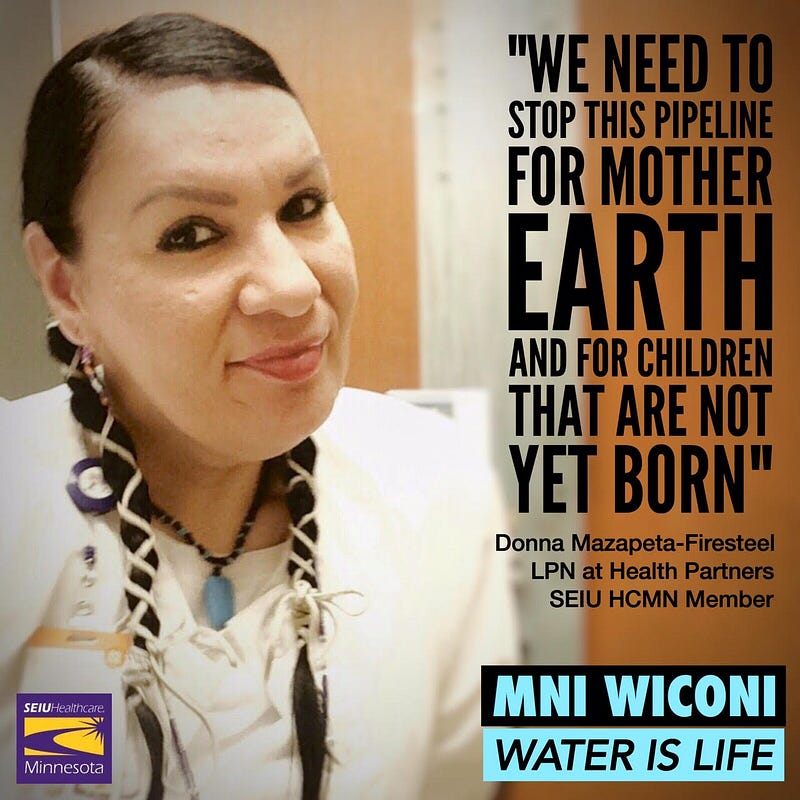
By SEIU Healthcare Minnesota’s Indian Healthcare Board* - Medium, October 28, 2016

In too many communities across our country, children and families suffer from exorbitant asthma rates and other respiratory ailments from air pollution caused by corporate activities that burn fossil fuels and contaminate our air. Toxins leeched into our drinking and bathing water from this same fossil fuel industry causes serious skin, digestive, and even cancerous impacts on young and old alike. As healthcare workers, we stand on the front lines of trying to help families deal with these life-altering impacts.

Our families and children deserve clean air and water and we must do all that we can to stop allowing corporations to corrupt our livelihood unchecked. Where possible, we must choose clean alternative options so that our economy and our families can thrive. It is not a one or the other choice. We can have good jobs and healthy communities by shifting away from an economy dependent on fossil fuels to one that creates jobs for workers through a just transition to a clean energy economy.

We can and must be the change we want to see in the world and we have the chance to do it right now. In North and South Dakota, construction of a crude-oil pipeline, known as the Dakota Access Pipeline, threatens the lives and livelihoods of the people of the Standing Rock Sioux Tribe. The pipeline would pass under the Missouri River (at Lake Oahe) which is just half a mile upstream from the boundary of the Standing Rock Sioux’s reservation and provides their drinking water.

Over the last three years there have been over 200 known pipeline leaks in the United States. A spill at this site would be a health, economic and cultural catastrophe for Standing Rock Sioux families. Further, the pipeline would pass through incredibly precious culturally significant sacred lands, like burial grounds, for the tribe and infringe on their freedom to practice and protect their culture and beliefs.

We are so proud that our union, the Service Employees International Union, along with other labor unions, didn’t stand idly by and let this injustice prevail. Instead SEIU along with like-minded good jobs and justice-focused partners have stood strong with the Standing Rock Sioux tribe.

Not only do the Standing Rock Sioux deserve the respect and protection of their sacred grounds, but they deserve to know the water they are drinking is uncontaminated and safe. This is yet another instance where a low income, community of color is subjected to contamination at the hands of powerful corporations and an unresponsive government. It’s a scenario that’s all too familiar to SEIU members, having struggled through the water crisis in Flint, MI and the recent flooding in Baton Rouge.

We stand with our union and the people of the Standing Rock Sioux tribe, as well as the thousands of others who could be harmed by the construction of the pipeline. As energy technology and transportation infrastructures change to reduce harmful emissions, so should the focus of the unions that fight for a better future for all families. We can let go of environmentally and racially unjust practices and look to create the good jobs and safe communities of the future.

From asthma to cancer, America’s workers suffer at the hands of big polluters. We have a choice. We can find a solution that protects people’s health and good jobs and wages. The time is now. Our government must stop the construction of the Dakota Access Pipeline, protect the interests of the Standing Rock Sioux Tribe and transition the jobs of those whose lives and livelihoods could be impacted by ending this pipeline to good family-sustaining jobs of the future.

Pages

The Fine Print I:

Disclaimer: The views expressed on this site are not the official position of the IWW (or even the IWW’s EUC) unless otherwise indicated and do not necessarily represent the views of anyone but the author’s, nor should it be assumed that any of these authors automatically support the IWW or endorse any of its positions.

Further: the inclusion of a link on our site (other than the link to the main IWW site) does not imply endorsement by or an alliance with the IWW. These sites have been chosen by our members due to their perceived relevance to the IWW EUC and are included here for informational purposes only. If you have any suggestions or comments on any of the links included (or not included) above, please contact us.

The Fine Print II:

Fair Use Notice: The material on this site is provided for educational and informational purposes. It may contain copyrighted material the use of which has not always been specifically authorized by the copyright owner. It is being made available in an effort to advance the understanding of scientific, environmental, economic, social justice and human rights issues etc.

It is believed that this constitutes a 'fair use' of any such copyrighted material as provided for in section 107 of the US Copyright Law. In accordance with Title 17 U.S.C. Section 107, the material on this site is distributed without profit to those who have an interest in using the included information for research and educational purposes. If you wish to use copyrighted material from this site for purposes of your own that go beyond 'fair use', you must obtain permission from the copyright owner. The information on this site does not constitute legal or technical advice.