For the second time today, concerned citizens shut down Dakota Access Pipeline construction in Keokuk

By Aaron Murphy, Ruby Montoya, and Jim Arenz - Mississippi Stand Camp, October 10, 2016

Keokuk, IA - For the second time today concerned citizens stopped construction on the Dakota Access Pipeline. Jessica Garraway of Minneapolis, Minn., locked down to a construction vehicle blocking access to the Dakota Access boring site under the Mississippi River.

At approximately 7:30pm, citizens who had gathered around the entrance advised the truck driver that a human being was underneath the truck. It took several minutes for the truck driver to shut the vehicle off. Approximately 15 minutes passed until the truck was secure from rolling over her body.

During this time, pipeline security officers did not provide chocks for the truck’s wheels. Citizens at the construction site entrance placed rocks behind the wheels, securing the vehicle.

After police arrived, roads were blocked and views were obstructed. Witnesses sang and chanted in support of Garraway’s actions. Pipeline construction workers dismantled the truck’s axle and Garraway was arrested 45 minutes later.

Earlier today, several people locked arms and blocked construction access for at least one hour. One woman remained seated and the police appeared to use stress positions in an attempt to force compliance.

For weeks citizens have held an encampment on Mississippi River road in Keokuk, Iowa, called “Mississippi Stand” (http://www.mississippistand.com). Hundreds of people from the tri-state area have come to engage in nonviolent civil disobedience against the pipeline. Supporters continue to mobilize from across the country and more arrive each day.

Footage of this evening’s occurrence was livestreamed on Mississippi Stand’s Facebook page. https://www.facebook.com/MississippiStandCamp/

Registered Nurse Response Network Sends Nurse Volunteers to Assist With First Aid at Standing Rock

By Staff - National Nurses United, October 10, 2016

National Nurses United (NNU)’s Registered Nurse Response Network (RNRN), a national network of volunteer direct-care RNs, will deploy nurse volunteers to help existing medical volunteers at the Standing Rock Sioux Reservation meet first aid needs for thousands of land and water protectors as winter approaches, NNU announced today.

NNU recently released a statement of solidarity with the Standing Rock Sioux Tribe and fellow protectors, who, f or months, have sought to halt construction of the Dakota Access Pipeline (DAPL), which nurses say poses great risk to public health. The proposed 1,172-mile Dakota Access pipeline would carry nearly a half million barrels of dirty crude oil every day across four states from the Bakken fields of North Dakota to Illinois, threatening water resources as well as the Standing Rock Sioux Tribe’s ancestral sites.

Nurses say spills from ruptured pipelines that contaminate water supplies can lead to numerous problems of respiratory ailments and other health symptoms associated with the spills.

RNRN volunteers will begin with an Oct. 9-17 deployment to assist medic tents at the North and Sacred Stone camps—and to help local partners establish a Mni Wiconi (Water is Life) clinic to meet the ongoing healthcare needs of the Standing Rock Sioux community.

RNRN is powered by NNU, the largest organization of registered nurses in the U.S., who say they will continue standing in solidarity with the land and water protectors at Standing Rock.

The Sky’s Limit: Unpacking the Climate Math

By David Turnbull - Oil Change International, October 6, 2016

Four years ago, the concept of “unburnable carbon” hit the mainstream when Bill McKibben published “Global Warming’s Terrifying New Math” in Rolling Stone magazine, based off of work by the analysts at Carbon Tracker and before that Greenpeace. The research underlying that concept showed that the carbon embedded in proven fossil fuel reserves on the books of fossil fuel companies is many times greater than what climate scientists have determined the atmosphere can withstand in a safe climate scenario. This month, new analysis by Oil Change International updated that math, took it further, and is making waves.

In the new report, entitled “The Sky’s Limit: Why the Paris Climate Goals Require a Managed Decline of Fossil Fuel Production,” we’ve identified a stark reality when it comes to fossil fuel development and the climate: Existing fossil fuel production, if allowed to run its course, would take us beyond the globally agreed goals of limiting warming to well below 2?C and aiming towards 1.5?C.

For the first time ever, this study utilized data from industry databases (e.g. Rystad Energy UCube) to catalog the fossil fuels that exist in current mines and wells — those sites where investments have been made and development is already underway — and compared it to carbon budgets associated with a two-in-three chance of staying below 2?C, or even chances of limiting warming to 1.5?C, backed by data from the Intergovernmental Panel on Climate Change (IPCC).

Our research found that the carbon budgets will be exhausted with current development, and in fact some currently-operating fossil fuel projects will need to be retired early in order to have appropriately high chances of staying below even the 2?C limit. Further, to meet a 1.5?C goal, the existing oil and gas wells currently in production have enough fuels in them to fill the budget, even if coal were phased out tomorrow.

This analysis is already sending shockwaves through the climate movement and being echoed by influential thought leaders around the globe. More than a dozen organizations, ranging from smaller groups like the Health of Mother Earth Foundation in Nigeria to larger groups such as 350.org and Christian Aid, joined in to release the report. Climate scientists and energy analysts have expressed agreement with the findings since the release, and countless organizations and prominent individuals have joined the choir to spread the word about the report.

As George Monbiot writes in The Guardian, the report presents three scenarios for moving forward:

First: a gradual, managed decline of existing production and its replacement with renewable energy and low-carbon infrastructure, which offer great potential for employment. Second: allowing fossil fuel production to continue at current rates for a while longer, followed by a sudden and severe termination of the sector, with dire consequences for both jobs and economies. Third: continuing to produce fossil fuels as we do today, followed by climate breakdown.

The good news, as highlighted in our report, is that if the right investments of political will and financing are made, a just transition to renewable energy is definitely possible in the timeframe necessary. Renewable energy is expanding at ever-increasing rates, becoming cheaper by the day, and could be poised to follow the path to universality seen by recent technologies such as the personal computer and cell phone. The report lays out a number of studies that show renewable energy can absolutely fill in the energy gap as fossil fuels are phased out.

Many have already called the report “the math behind the Keep It In The Ground movement,” and, with any luck, just as unburnable carbon entered the public consciousness four years ago, the climate imperative of ending new fossil fuel development may do the same.

Washington State Labor AFL-CIO Resolutions On Mass Public Transit, Railroad Health and Safety

By staff - Washington State Labor Council, July 27, 2016

Every year, delegates to the Washington State Labor Council convention discuss, deliberate and act on resolutions submitted by the affiliated union locals and councils. These resolutions establish policy, programs and action for the WSLC. The following were passed by delegates at the WSLC’s 2016 Convention held July 19-21 at the Coast Wenatchee Hotel and Convention Center.

The following resolutions specifically address matters of transportation workers. See the original post for a complete list of resolutions passed:

RESOLUTION ON SOUND TRANSIT 3

Resolution #7

WHEREAS the Greater Puget Sound Region’s traffic is the sixth worst in the country, the average driver losing 66 hours of his or her life each year due to gridlock; and

WHEREAS, relief from gridlock will get major help from the bold Sound Transit 3 plan (ST3) announced by Sound Transit, to go before the voters of King, Snohomish and Pierce counties this November; and

WHEREAS, ST3 will greatly expand mass transit in the Puget Sound region adding 62 miles of light rail, commuter rail, and bus rapid transit, to the existing Sound Transit System and upon completion of ST3 we will have 116 miles of light rail — about the size Washington, D.C.’s Metro System — extending from Tacoma in the South, West Seattle and Ballard to the West, Issaquah and Redmond to the East, and Everett to the North; and

WHEREAS, ST3 will be a $54 billion infrastructure project creating about 50 million labor hours providing many tens of thousands of building and construction jobs and great opportunities for local hire and for new, young apprentices to join the trades and few years into the project and ST-3 will account for over 1 in 10 construction jobs through both good and bad economic cycles; and

WHEREAS, the wages from these jobs will be spent locally giving an economic boost to businesses in the region and bringing much needed tax revenue into state and local governments; now, therefore, be it

RESOLVED, that the WA State Labor Council support the Mass Transit Now campaign to pass ST3 this November; and be it further

RESOLVED, that the WSLC engage with affiliated unions and community partners to endorse Mass Transit Now and pass ST3.


Sample Resolution for Local Unions on the Dakota Access Pipeline

By Brooke Anderson - Climate Workers, October 3, 2016

Click here to download the sample resolution as an editable Word doc

[Sample] Local Union Resolution Against the Dakota Access Pipeline

WHEREAS, the $3.78Billion, 1,172-mile Dakota Access Pipeline would carry over half a million barrels of dirty crude oil from the Bakken oil fields in North Dakota, through South Dakota and Iowa to Illinois to connect to other pipelines bringing oil to the East Coast and the Gulf; and

WHEREAS, the pipeline is slated to pass through the tribal lands of Standing Rock Sioux near Cannon Ball, North Dakota, and underneath the Missouri River, the main source of water for the tribe; and

WHEREAS, the pipeline desecrates the ancestral burial grounds of the Standing Rock Sioux; and

WHEREAS, millions of workers – including many union members – their families, and communities live in the path of the proposed pipeline; and

WHEREAS, the transport of heavy crude is particularly volatile, leading to 18.4 million gallons of oils and chemicals spilled, leaked, or released into the air, land, and waterways between 2006 and 2014 in North Dakota alone, causing death, contamination of soil and water, and all kinds of disease; and

WHEREAS, scientists have warned that in order to avoid wide-scale, catastrophic climate disruption, the vast majority of known remaining fossil fuel reserves must be left in the ground; and

WHEREAS, Native American land protectors and their supporters have been brutally attacked by private security forces with attack dogs and pepper spray; and

WHEREAS, Native Americans and other activists defending their land and water have the same right to defend their land and engage in non-violent protest as workers who are protesting the actions of an unfair employer; and

WHEREAS, the U.S. Congress has repealed the ban on exporting oil, meaning that the oil transported by the pipeline is likely to be sold overseas and not contribute to US energy independence; and

WHEREAS, we know that the real threat to workers’ lives and livelihoods is catastrophic climate change; and

WHEREAS, many large corporations, and especially fossil fuel corporations, have been putting profits ahead of the common good of workers, the public, and the environment, and these corporations have been granted the unjust constitutional rights and powers of person-hood, and the doctrine of money as speech through activist Supreme Court decisions thereby diminishing democracy and the voice and power of the people; and

WHEREAS, numerous national and international unions have already passed resolutions against construction of the pipeline, including National Nurses United, the Amalgamated Transit Union, the Communications Workers of America, the United Electrical Workers, and others; and

WHEREAS, this local union is already on record supporting the development of renewable energy sources and investment in sustainable energy including quality union jobs; and

WHEREAS, more long term good paying jobs would be created by investing in sustainable energy infrastructure projects using already existing technologies while at the same time reducing pollution that creates greenhouse gases; and

WHEREAS, we support the rights of our union brothers and sisters building the pipeline to work in safe environments at jobs that are consistent with respect for the environment and the rights and safety of frontline communities; therefore be it

RESOLVED, that we call upon the Federal Government to make permanent the moratorium on construction of the Dakota Access Pipeline by revoking permits for construction issued by the Army Corps of Engineers; and be it further

RESOLVED, that this local union calls on the labor movement to support a just transition to a renewable energy economy and investment in the construction of a nationwide sustainable energy infrastructure that will address the growing threat of climate change and its consequent droughts, floods, fire, crop failure, species extinction and other dire consequences of global warming; and be it further

RESOLVED, that this local union make a financial contribution of $_____ to the land protectors at the Standing Rock protest camps; and be it further

RESOLVED, this local union urges its internal union and the rest of the labor movement to become actively involved in promoting a just transition to a sustainable alternative energy economy that protects the environment and respects the rights of all working people to good paying safe jobs, human rights and justice for all; and be it finally

RESOLVED, that a copy of this resolution be forwarded to the International Union and all Central Labor Councils we are affiliated, with, with a request for concurrence.

From Pipelines to Prisons: The intersection of native rights, mass incarceration and environmental justice

By Panagioti Tsolkas and Nicholas Todd - Earth First! Journal, September 30, 2016

Over the past month, two seemingly disparate issues of prisons and pipelines have captured the attention of activists and independent media across the country. On September 9, as a judge ruled to halt construction on the Dakota Access Pipeline (DAPL), prisoners around the country began a work strike coinciding with the anniversary of the famous Attica uprising.  As we write, demonstrations are continuing nationwide to express solidarity with native tribes resisting the DAPL and for prisoners who launched a coordinated nationwide strike against slave labor in the American prison system.

Now, perhaps more than ever before, the spotlight is on the pushers of pipelines and prisons. Despite a void of coverage by mainstream outlets, social media is ablaze with independent articles covering these two topics. Pipeline opponents who’ve been amassing in North Dakota are now also looking south as drilling under the Mississippi River begins and nearly 340,000 gallons of gas spilled in central Alabama from one of the region’s major pipelines; likewise, prisons in at least 11 states all across the country remain on lockdown in response to the strikes and detailed reports of the strike are only now trickling out.

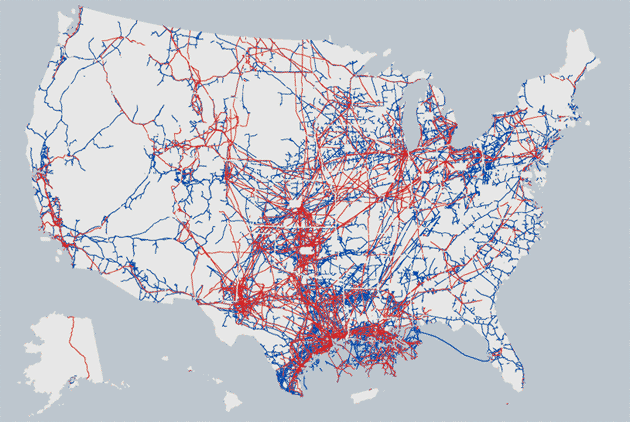
Just as the U.S. has the largest prison population in the world, with 25% of the world’s prisoners held in its 5000 detention facilities, it also has the world’s most vast network of energy pipelines, with more than 2.5 million miles of pipe which is reported to suffer hundreds of leaks and ruptures every year.

pipeline_line_map-630x420

Pipelines in the U.S. as of 2012

While battles around indigenous land rights have a long history of overlap with the environmental justice (EJ) movement, there is a developing body of research and activism placing prisoners’ rights in the EJ context as well, since prison populations in every state of the U.S. are populated disproportionately by people of color. Only establishing common ground over the conventional concept of “environmental” angles surrounding these issues offers too shallow of an analysis; deeper solidarity requires understanding the bigger picture: the history of a social ecosystem surrounding broken treaties and toxic prisons alike. Doing so can only increase the effectiveness and long term success of struggles to defend the Earth.

Prisons in the U.S. as of 2015

At first glance, drawing a relationship between struggles surrounding prisons and pipelines may seem a stretch, but 45 years ago, activists were readily making these connections. Organizations like the American Indian Movement (AIM) and the Black Panther Party arose and co-existed in a very similar setting. Their bold direct actions inspired the solidarity of many people outside their respective communities as well. One example being activist-attorney William Kunslter, with the National Lawyers Guild, who went from negotiating on the side of the predominately Black prisoners of Attica to representing AIM members after the Wounded Knee stand-off at Pine Ridge. Activists today must know this history and continue to build on this tradition.

Hundreds at Heathrow ‘die-in’ protest against airport expansion

By staff - Reclaim the Power, October 1, 2016

Hundreds of activists stage ‘die-in’ and disruptive ‘critical mass’ bike ride at Heathrow to protest aviation expansion and highlight injustice of climate change impacts.

ecology.iww.org editor's note: IWW members particopated in organizing this action.

This afternoon, over 100 people took part in a ‘die-in’ flashmob inside Heathrow terminal 2. Protesters wearing gas masks lay on the floor, as testimonies from communities already affected by climate change were read [1].

Simultaneously, a ‘critical mass’ bike ride with 150 riders wearing red [2] circled the area, visiting Harmondsworth Detention Centre to highlight the link between climate impacts and migration, and obstructing traffic by circling the main roundabout on Bath Road and dropping banners.

The action was part of a global wave of actions opposing airport expansion (including Austria, France, Mexico, Turkey), timed to coincide with a major UN conference aiming to address the emissions impact of aviation. The process has received criticism for not attempting to reduce emissions, instead focussing on controversial ‘carbon offsets’.

A ‘flash-mob’ picnic protest also happened at Gatwick this morning.

The decision on airport expansion is expected on the 11th or 18th October; with recent reports suggesting there is parliamentary support for Heathrow.

Nurses Union Slams AFL-CIO's Endorsement of Dakota Access Pipeline

By Staff - Real News Network, September 16, 2016

The National Nurses United a member of the AFL-CIO, strongly rebuked the AFL's decision to endorse the Dakota Access Pipeline.

AFL-CIO Backs Dakota Access Pipeline and the “Family Supporting Jobs” It Provides

By Kate Aronoff - In These Times, September 17, 2016

The American Federation of Labor and Congress of Industrial Organizations (AFL-CIO) came out this week in support of the Dakota Access Pipeline, the construction of which was delayed last week by an order from the Obama administration—a decision that itself stemmed from months of protests led by the Standing Rock Sioux.

In a statement, Richard Trumka, AFL-CIO president, said, “We believe that community involvement in decisions about constructing and locating pipelines is important and necessary, particularly in sensitive situations like those involving places of significance to Native Americas.”

But it “is fundamentally unfair,” he added, “to hold union members’ livelihoods and their families’ financial security hostage to endless delay. The Dakota Access Pipeline is providing over 4,500 high-quality, family supporting jobs.

“(Trying) to make climate policy by attacking individual construction projects is neither effective nor fair to the workers involved. The AFL-CIO calls on the Obama Administration to allow construction of the Dakota Access Pipeline to continue.”

It’s an open secret in labor that North America’s Building Trades Unions—including many that represent pipeline workers—have an at-times dominating presence within the federation’s 56-union membership. Pipeline jobs are well-paying union construction gigs, and workers on the Dakota Access Pipeline (DAPL) can make some $37 an hour plus benefits. As one DAPL worker and Laborers International Union member told The Des Moines Register, "You’ve got to make that money when you can make it.”

But an old blue-green mantra says, “there are no jobs on a dead planet.” The parts of organized labor that have taken that phrase to heart are far from unified around Trumka’s DAPL backing—even within the AFL-CIO. National Nurses United (NNU) has had members on the ground at Standing Rock protests and others around the country have participated in a national day of action.

"Nurses understand the need for quality jobs while also taking strong action to address the climate crisis and respecting the sovereign rights of First Nation people,” said RoseAnn DeMoro, NNU’s executive director and a national vice president of the AFL-CIO.

In response to the federation’s endorsement, DeMoro cited the work of economist Robert Pollin, who found that spending on renewable energy creates approximately three times as many jobs as the same spending on maintaining the fossil fuel sector.

NNU isn’t alone. As protests swelled this month, the Communications Workers of America (CWA) released a statement in support of the Standing Rock Sioux, stating that “CWA stands with all working people as they struggle for dignity, respect and justice in the workplace and in their communities.”

Unions like the Amalgamated Transit Union and the United Electrical Workers have each issued similar statements supporting protests against the pipeline, and calling on the Obama administration to step in and block the project permanently.

For those who follow labor and the environment, however, the above unions might be familiar names. Many were vocal advocates for a stronger climate deal in Paris, and sent members to COP21 at the end of last year. They were also those most vehemently opposed to the Keystone XL pipeline, and all supported Bernie Sanders’ primary campaign against Hillary Clinton. While friendly to progressives, these unions have tended to have a relatively limited impact on bigger unions, like the American Federation of Teachers and the American Federation of State, County and Municipal Employees (AFSCME).

According to Sean Sweeney, though, this small group of unions might now be gaining strength. “Progressive unions are becoming a more coherent force,” he told In These Times.

Sweeney helped found a project called Trade Unions for Energy Democracy, which works with unions around the world on climate change and the transition away from fossil fuels, including the National Education Association and Service Employees International Union (SEIU) Local 32BJ in the United States. He also runs the International Program for Labor, Climate and the Environment at City University of New York’s Murphy Institute.

“It could be said that it’s just the same old gang making the same old noise, but for health unions and transport unions to go up against the building trades and their powerful message and equally powerful determination to win ... that was a bit of a cultural shift in the labor movement,” he said, referencing the fights against the Keystone XL and Dakota Access pipelines. “That suggests that it's going to continue.”

Sweeney mentioned, too, that it wasn’t until much later in the fight around Keystone XL that even progressive unions came out against it. “A lot of these unions,” he added, “know a lot more about energy and pollution and climate change than they did before.”

Between Trumka’s DAPL endorsement and the Fraternal Order of Police’s endorsement of Donald Trump for president, this week has shown a stark divide between parts of American labor and today’s social movements. Progressive unions face an uphill battle on many issues, within and outside of organized labor. The question now—on the Dakota Access Pipeline—is whether today’s “Keystone moment” can break new ground in the jobs versus environment debate.

Managed Decline: A Just Clean Energy Transition and Lessons from Canada’s Cod Fishing Industry

By Adam Scott and Matt Maiorana - Oil Change International, September 12, 2016

There’s a clear logic to the global challenge of addressing climate change: when you’re in a hole, stop digging. If we’re serious about tackling the global climate crisis, we need to stop exploring for, developing, and ultimately producing and consuming fossil fuels. This inevitably leads to the decline of the oil, gas, and coal industries.

This leaves us with two clear options. Either we carefully manage the decline of the fossil fuel industry to ensure a smooth and just transition, or we let the chips fall where they may and risk decimating communities that are reliant on the fossil fuel economy. The path we choose will make all the difference to those communities as the decline of fossil fuels becomes inevitable.

A textbook example of how NOT to manage the decline can be found in the painful history of the Newfoundland cod fishery.

One of eastern Canada’s premier industries, the cod fishery defined the economy and the culture of coastline communities for centuries. Commercial fishing off the Grand Banks of Newfoundland dates back as far as 1500, but it wasn’t until factory trawlers were introduced around 1950 that catches became increasingly unsustainable. At its peak in 1968, the catch of northern cod in the Atlantic reached 1.9 million tons. However, the impact of overfishing soon became apparent.

In the 1980s, Canada’s Department of Fisheries and Oceans received increasingly dire warnings about the rapidly diminishing fish stock from fishermen and scientists, but these were largely ignored. Much like climate science models today, these marine science models were often ignored when setting quotas and planning for future catches. These plans weren’t set by the scientific models, but instead by politicians. Despite mounting evidence, the Department of Fisheries and Oceans continued to boost catch quotas without regard to the impacts of their actions. A 1992 Canadian Department of Fisheries and Oceans audit found that the science regarding the health and management of cod stocks “was gruesomely mangled and corrupted to meet political ends.” As a result, fish stocks continued to plummet.

Pages

The Fine Print I:

Disclaimer: The views expressed on this site are not the official position of the IWW (or even the IWW’s EUC) unless otherwise indicated and do not necessarily represent the views of anyone but the author’s, nor should it be assumed that any of these authors automatically support the IWW or endorse any of its positions.

Further: the inclusion of a link on our site (other than the link to the main IWW site) does not imply endorsement by or an alliance with the IWW. These sites have been chosen by our members due to their perceived relevance to the IWW EUC and are included here for informational purposes only. If you have any suggestions or comments on any of the links included (or not included) above, please contact us.

The Fine Print II:

Fair Use Notice: The material on this site is provided for educational and informational purposes. It may contain copyrighted material the use of which has not always been specifically authorized by the copyright owner. It is being made available in an effort to advance the understanding of scientific, environmental, economic, social justice and human rights issues etc.

It is believed that this constitutes a 'fair use' of any such copyrighted material as provided for in section 107 of the US Copyright Law. In accordance with Title 17 U.S.C. Section 107, the material on this site is distributed without profit to those who have an interest in using the included information for research and educational purposes. If you wish to use copyrighted material from this site for purposes of your own that go beyond 'fair use', you must obtain permission from the copyright owner. The information on this site does not constitute legal or technical advice.