You are here

COP21

Our Responsibility After Trump's Climate Withdrawal

By Kevin Zeese and Margaret Flowers - Popular Resistance, June 3, 2017

President Donald Trump’s decision to withdraw from the Paris climate agreement follows the path of previous presidents who have undermined international climate agreements. We disagree with Trump but it is important to understand his actions in the context of the history of the United States regarding previous climate agreements. Once again, the political problems in the US are bigger than Trump. His action brings greater clarity to the inability of the US government to confront the climate crisis and clarifies the tasks of people seeking smart climate policy.

The US Has Always Prevented Effective International Climate Agreements

The US has consistently blocked effective climate agreements because both parties in power have put the profits of big energy before the climate crisis when it comes to domestic and international policies. The Republicans proclaimed themselves the “drill baby drill” party while the Democrats are the “all of the above energy” party. Both slogans mean the parties seek to ensure US corporations profit from carbon energy. Both have supported massive oil and gas infrastructure and extreme energy excavation including the most dangerous forms, i.e. tar sands and fracking. Both parties have also supported wars for oil and gas. All of these positions will be viewed as extreme as the world confronts the great dangers of the climate crisis and the US will be deservedly blamed.

Climate Change and the Need for a New Paradigm

By Yavor Tarinski - Resilience, June 1, 2017

Despite many international meetings, dealing with every subject from biodiversity to climate change, the national political elites have found it impossible to come to meaningful agreements to deal with the environmental crisis. […] There is no avoiding imagining new and different scenarios than the status quo. Surely another world is possible.”
– Dimitrios Roussopoulos[1]

We live in times where there seems to be a crisis in just about everything – from the so called financial sector, through the contemporary mass migratory processes, to the severe corrosion of the social fabric. The ruling elites, devoted to the dominant doctrine of economism, advocate for the priority that should be given to the economy, many activists struggle for the humane treatment of migrants, while growing numbers of new age mysticists call for escapism and individual salvation.

One crisis in particular, however, is being unevenly neglected, in comparison with the above mentioned crises – the climate one. There is reason why this serious problem is being constantly postponed by those in seats of power. Unlike the financial crisis, which offers a wide playground for different economic “shamans” to put forward their theories that do not leave the imaginary of economism, the climate change and the ongoing environmental degradation questions the contemporary dogmas of constant growth and domination, demanding solutions beyond them. Surely there are international summits and agreements for tackling this problem, but their outcomes are nonbinding and often neglected in the expense of economic “prosperity”.

The climate crisis, as growing number of researches are revealing, will have us pay a dear cost for the wasteful and destructive lifestyle that capitalism promotes. It will even deepen the rest of the ongoing crises. It is not yet completely clear what exact effects and processes will be triggered by the climate change, but it is increasingly clear that the results will not be favorable to us, unless we decide to change the contemporary dominant paradigm with a new one that will allow us to develop our potential inside the planetary limits.

Paris is Burning

By James P. Hare - Rosa Luxemburg Stiftung, June 2017

With Trump’s decision to formally withdraw from the Paris Agreement, he has put an end to months of apparent indecision. This withdrawal does not dissolve the agreement, which still includes nearly every nation on the planet, but it is hard to imagine how an already weak agreement can be expected to slow—not to mention reverse—greenhouse gas emissions without the participation of the United States. Seeing this decision as anything other than a nail in the coffin of the global climate regime is nothing but wishful thinking.

For an administration that has promoted a seemingly unending series of bad policies—from healthcare to immigration to militarism to the unceasing transfer of wealth from working people to the wealthy—this may be its worst. When future generations look back at the harm done by this president, they may remember this as his greatest crime. This is not to minimize the damage of his other policies or of the racism, xenophobia, and misogyny that drove his campaign and brought him into the White House, but climate change is the ultimate issue. It will affect everyone while exacerbating existing inequalities, and we only have one chance to get it right.

This decision is no surprise. Throughout his campaign, Trump promised to pull out of the Paris Agreement as part of his “America First” agenda that pits the promise of domestic jobs against environmental protections and international cooperation. We must reject Trump’s noxious brand of nationalism and climate denialism. It is critical, however, not to sugarcoat the nature of much of what passes as international cooperation. So-called trade agreements have benefitted corporations and the wealthy at the expense of working people both in the United States and abroad.

It is not, as Trump’s nativist critique would have it, that the United States made a bad deal with Mexico when negotiating NAFTA. Rather, elites in the United States, Mexico, and Canada made a good deal for themselves at the expense of the citizens of each country. Still, working people understand what NAFTA did to their workplaces and their communities, and Trump’s attack on trade deals may have helped him to win enough working-class support in critical states to shift the electoral map in his favor, even if the extent of his working-class support has been greatly overstated by centrist commentators.

Beyond Democrat Dead-ends: What Real Climate Action Looks Like

By Carol Dansereau - CounterPunch, June 2, 2017

The global warming situation is absolutely crazy.  Millions of people are already experiencing drought, famine, floods, wildfires, superstorms and other climate disasters.  As a species, we are teetering on the edge of full-blown catastrophe, with extinction a distinct possibility.  Yet, we can’t seem to put in place obvious solutions that are sitting right there in front of us.

Even crazier, environmentalists repeatedly praise Democrats for phony climate action plans that don’t come close to what’s needed.

Take the “100 by ‘50” legislation recently introduced by Oregon Senator Merkley and other Democrats.  Environmental leaders lined up to celebrate this as the blueprint that will get us beyond global warming, even though it’s nothing of the sort.  Some environmentalists used their endorsements to denounce Republicans for being funded by the fossil fuel industry, deftly ignoring the funding received by Democrats from that same industry.  The message was clear: when we put Democrats back in power and pass a bill like “100 by ‘50”, we’ll be on our way to solving the climate crisis.

This is pure hogwash.  The Democrats have kept us running in circles as the climate crisis has deepened.   And although this new bill purports to get us to 100% clean and renewable energy by 2050—hence the catchy title—it almost certainly won’t do that.  Yes, it is “the most ambitious piece of climate legislation Congress has ever seen”.  But that’s only because prior offerings were so pathetic that “100 by ’50” seems ambitious in comparison.

It’s crucial that we understand this as Donald Trump and the Republicans move forward with their horrifying agenda.  More than ever, we need to be uniting behind a real climate action plan and the broader vision for society it engenders.  We need to be building a movement that has a clear understanding of where our power lies and how to use it.

GGJ Statement on Trump's Withdrawal from Paris Agreement

By staff - Grassroots Global Justice Alliance, June 2, 2017

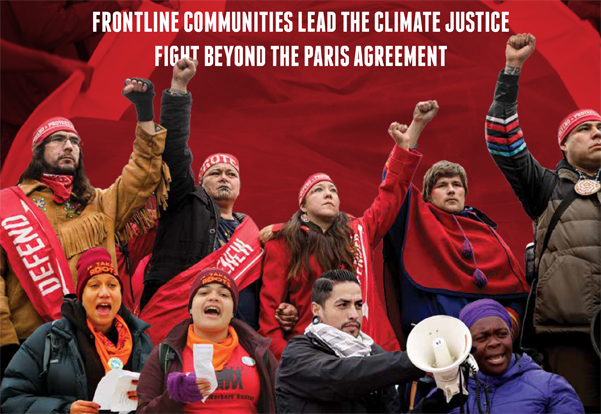
While the accord was far from what the planet needs, Trump's reckless decision underscores a key overarching issue with the Paris Agreement in the first place.  When the Paris Agreement was signed in 2015, we put out this report entitled "We Are Mother Earth’s Red Line: Frontline Communities Lead the Climate Justice Fight Beyond the Paris Agreement."  We laid out 5 key concerns in the report.  Our number one concern (see page 6) with the agreement was “The Agreement relies on voluntary versus mandatory emission cuts that do not meet targets scientists say are necessary to avoid climate catastrophe.”  Trump’s withdrawal is a clear example that voluntary pledges are not enough.

“Donald Trump is showing us the art of breaking a deal,” says Tom BK Goldtooth, Executive Director of Indigenous Environmental Network. “By abandoning the Paris Agreement, this administration will further perpetuate environmental racism and climate injustice against Indigenous peoples experiencing the worst effects of climate change across the globe. We’ve stated before that the Paris Agreement falls short of embracing the sort of climate solutions that lift up human rights and the rights of Indigenous peoples. Regardless of its shortcomings, it is critical that the United States be held accountable for its contributions to the climate chaos we are seeing across the globe and to take ambitious action to meet the Agreement’s goal to limit temperature increases to 1.5 degrees Celsius. Backing out of this agreement continues a long history of broken promises and threatens the vital and sacred life cycles of Mother Earth.”

Our number two concern (page 6) was “The Agreement advances pollution trading mechanisms that allow polluters to purchase “offsets” and continue extremely dangerous levels of emissions.”  If we truly aim to reach the stated goal of reducing carbon emissions to 1.5 degrees Celsius, we will never get there with a carbon market system.

Monique Verdin, Secretary of the United Houma Nation Tribal Council, Louisiana says “the Paris Accord is not a perfect solution, but to step out of it is to step back. Our coastal communities in the Mississippi River Delta are surrounded by a web of pipelines, oil and gas canals, while our sinking lands are pock marked by oil waste pits. We are being told that our traditional territories may have to be sacrificed to the sea and that our post-colonial sanctuary settlements may have to be abandoned in this unprecedented wake of sea-level rise. If we don’t change our relationships with extreme extraction the heartache of losing some of the most precious biodiversity in the world, will be disregarded for the delusions of “progress.”

While the agreement was far from what we need at the global scale, at minimum it was still a significant indication that world leaders were taking climate change seriously.  Across the globe, the Paris Agreement was being used as a baseline argument to continue promoting the real Just Transition that we need away from a fossil fuel economy.

Sharing the challenges and opportunities of a clean energy economy: Policy discussion paper A Just Transition for coal-fired electricity sector workers and communities

By staff - Australian Council of Trade Unions - November 2016

The ACTU is primarily concerned with workers, their rights, their welfare and their future. A just and civil society is one where everyone shares in the wealth of the nation but it is also one where economic costs are equally shared.

Transitioning an industry is a massive economic and social disruption. History shows that this has often been done poorly in Australia, with workers and communities bearing the brunt of such transitions - suffering hardship, unemployment and generations of economic and social depression.

Research in the textiles, clothing and footwear (TCF) and car manufacturing industries shows, for example, that only one third of workers find equivalent full time work following their retrenchment, while one third move into lower quality jobs (lower wage, lower job status or into part-time and casual work) and one third are locked out of the labour force altogether.

International experience however shows that a transition can be done equitably, achieve positive outcomes for workers, save communities and forge new areas of industrial growth and prosperity.

Australia is currently facing one such transition in the coal-fired electricity sector. If Australia manages this transition well, the nation would have a structured and equitable approach that could apply to any industry undergoing similar change in the future.

At last year’s Paris climate conference, Australia alongside 194 countries, committed to limit global warming to less than 2°C above pre-industrial levels. As part of this historic agreement, unions successfully achieved recognition of the need for a ‘Just Transition’ that supports the most affected workers obtain new decent and secure jobs in a clean energy economy.

While Australia’s international obligations will require a range of complementary policies that focus on emission reduction across a number of sectors of the economy, as the largest contributor to Australia’s emissions, effective reform of the electricity sector has been identified as a key step in tackling climate change.

Download (PDF).

Cultural shifts in the climate justice movement

Kevin Buckland - ROARMag, March 22, 2016

hundred days on, as the climate justice movement looks back to the COP21 Climate Summit to see what may be learned, we reflect on the context of the violent attacks of November 13, 2015 that foreshadowed the unstable and volatile world we will all inhabit for the rest of our lives.

The ensuing crackdown on climate protesters sent shock waves through the Climate Coalition’s (CC21) plans for a series of mass climate mobilizations around the COP21 UN climate summit. This opened fissures at every weak point, revealing the political values dormant beneath and bringing to the front cultures of resistance that had the structural integrity and coherence to be able to thrive under the Parisian “State of Emergency”.

Several underlying trends that characterized successful activism during COP21 indicate an emerging cultural shift in climate activism, especially in places where the call for “system change” was not just being demanded, but enacted by the movements themselves. Three trends in particular can be identified:

  1. The spread and increased role of creativity in activism;
  2. The deepened commitment to indigenous leadership; and
  3. The evolving tensions between rhetoric and form among different organizational models.

What these trends may portend for the future of this growing movement as it begins to inhabit its politics, is that it is tilting from a protest movement towards being a truly revolutionary force.

A few thoughts on studying the most radical social movement of the 21st century

By John Foran - Resilience, March 14, 2016

Introduction

We are living through an unprecedented crisis, in a world beset by massive social problems – the obscene poverty and inequality that neoliberal capitalist globalization has wreaked on at least two-thirds of humanity, the immobility of the political elite almost everywhere, and cultures of violence that poison our lives from the most intimate relations to the mass murder of the world’s wars.

These interconnected problems are rooted in long-standing processes of inequality – patriarchy, racism, colonialism, capitalism, and now corporate-controlled globalization – whose ongoing, overlapping legacies are making the early twenty-first century a crucial hinge of history.

And now, with climate change, we are facing a perfect storm of suffering. In fact, given the timeline that climate science is screaming at us, we confront a crisis of humanity and of all species that must be resolved for better or worse by those living on this precarious planet today.  We are called by the urgency of the crisis to “change everything” as Naomi Klein puts it, and to do so in something like the next two decades.

With other observers, activists, and scholars I believe that only the assembling of the broadest, most powerful social movement the world has ever seen has a chance of doing this in the narrow window the science imposes on us. The movements for environmental, climate, and social justice that I have spent my life studying and now participate in must become much stronger than at present.  But my reading of world history leads me to believe that they can succeed.  They must, if we are to safely navigate the present crisis and even come out of it living in ways that are far more egalitarian, deeply democratic, and fulfilling than the world we presently inhabit.

Those of us who are academics (or journalists, or writers and creators of culture of every kind) need to focus our minds now, I think, on the “wicked” problem of climate change, to reinvigorate our own disciplines and work on our interdisciplinary skills (another way of saying learning how to connect the dots) and bring all this into a wide open dialogue, in ways that are consistent with the first principle of sociology, of ecology, of systems thinking, and, ironically enough, of Buddhism, as I understand it (and of Gaia theory, for that matter):  everything is connected.

How Strong is the Climate Justice Movement?

The movement I study and am part of is growing, getting bigger, stronger, smarter, more diverse, and more creative with every passing year – and that’s important.

But it’s still not enough.

The task – and the question on every scholar-activist’s mind – is how do we get from where we are to where we need to be?  And how do we do that thoughtfully, quickly, and for the long haul?

If I had to try to sum up the broad outlines of what the climate justice movement is planning going into 2016, it would be something like Resist, Rethink, Retool, Re-imagine…

Who Wins From “Climate Apartheid”?: African Climate Justice Narratives About the Paris COP21

By Patrick Bond - New Politics, Winter 2006

The billion residents of Africa are amongst the most vulnerable to climate change in coming decades, and of special concern are high-density sites of geopolitical and resource-related conflicts: the copper belt of the Democratic Republic of the Congo and mineral-rich African Great Lakes stretching into northern Uganda, western Ethiopia (bordering the Sudanese war zone), Madagascar and smaller Indian Ocean islands, and the northern-most strip of Africa and West Africa including Liberia and Sierra Leone (recent sites of diamond-related civil war and then Ebola epidemics). In other words, the African terrains hardest hit by war and economic looting are going to be sites of climate stress and socio-political unrest, according to the University of Texas project researching vulnerability for the U.S. Pentagon (Busby et al 2013).

The lost opportunity to change this map at the United Nations Framework Convention on Climate Change (UNFCCC) summit in Paris, December 2015, is tragic. In the 2015 Pew Research world public opinion survey, a near majority of those surveyed—46 percent—identified climate as a threat about which they were “very concerned,” the highest score of any issue in the poll (economic crisis was second). But where it counts most, in the top two polluting countries, the percentage of people who name climate as a major threat is just 42 in the United States and 19 in China (Carle 2015). And even if consciousness rises faster from below, global elites apparently remain too paralyzed to take necessary actions to keep temperature increases below 1.5 degrees Celsius, the point at which runaway, catastrophic climate change is likely to take off (Bond 2012, Klein 2014). Going into the Paris UNFCC Conference of the Parties (the 21st, COP21), the French hosts estimated that the combined declarations of voluntary commitments would warm the planet by 3 degrees Celsius this century, but this is a vast understatement given the likelihood of runaway climate change once a 2-degree tipping point is reached.

The annual UNFCCC Conference of the Parties (COP) has been held in Africa thrice: in 2001 in Marrakech, 2006 in Nairobi, and 2011 in Durban. But the critical moment that defined Africa’s future climate crisis was in December 2009 in Copenhagen. The negotiations at COP15 were diverted one night into a room where five leaders—from the United States and the group of Brazil, South Africa, India, and China (BASIC)—agreed on a side deal, the Copenhagen Accord. That was the source of Africa’s major problems in climate negotiations for years thereafter, including at the Paris COP21.

The fortnight-long COP talk-shops are typically sabotaged by U.S. State Department negotiators, recently joined by brethren governments in Australia and Japan, with Canada a loyal co-polluter prior to the October 2015 election (and probably long after, given the national elites’ commitment to exploiting the Alberta tar sands). Initial hopes that the Brazil-Russia-India-China-South Africa (BRICS) bloc might make a difference in world climate policy as well as address undemocratic global financial governance have since been dashed, not only because of BASIC’s 2009 alliance with Barack Obama (Bond and Garcia 2015). Individually, they are each failing to grapple with new responsibilities to decarbonize their economies.

The world’s largest single emitter is China, even if in per capita terms it is far lower than the Northern countries. Beijing claims to have recently reduced coal consumption are dubious given notorious undercounting (probably by 15 percent). The Communist Party leadership decided upon an upward trajectory of greenhouse gas emissions at least through the 2020s. The Chinese standpoint that they need more emissions to “develop” is contradicted by a stark reality: Recent U.S. and European claims to be slowing their emissions rely upon their corporations and consumers outsourcing large amounts of emissions to new production sites, mostly in East Asia. According to the Intergovernmental Panel on Climate Change, “A growing share of CO2 emissions from fossil fuel combustion in developing countries is released in the production of goods and services exported, notably from upper-middle-income countries to high-income countries” (Hawkins 2014). In the case of China, the amounts of such outsourcing are vast, having risen from 404 million tons of CO2 in 2000 to 1.561 billion tons in 2012.

Moreover, BRICS leaders have all endorsed carbon markets, the capitalist strategy for offsetting local emissions by buying someone else’s carbon allowances. Initially, from 2005-2012, these took the form of United Nations “Clean Development Mechanism” (CDM) opportunities to sell often-corrupt and gimmick-ridden “emissions credits” as contributing to emissions mitigation (Bond, Dada and Erion 2009). 

In recent years, after the BRICS no longer qualified for CDMs, seven Chinese cities started their own carbon markets, with Brazil and South Africa likely to follow in a few years. Moreover, China’s attempts to control emissions in future appear certain to foster faith in dangerous techniques such as nuclear energy, hydropower, and untested carbon-capture-and-storage technology.

The strongest efforts to address climate change from the North are in Europe, where in October 2014 a new goal of 40 percent greenhouse gas reduction from 1990 levels by 2030 (not including the carbon outsourcing of hundreds of millions of tons per year) was sought—far too low according to most scientists, but far ahead of goals set by other historic pollution sites. In a late-2014 deal between China and the United States, the latter’s goal was only 15 percent reduction by 2025 (from 1990 levels).

In short, very little reason for hope on climate or other aspects of environmental stewardship can be found in any of the major countries’ governments. There is, of course, the exception of Cuba, which by compulsion began a strong decarbonization strategy once Russian-subsidized oil became unavailable after 1990. But the good examples that were anticipated in 2008-2011 from left-leaning Latin American countries—Bolivia, Ecuador, and even oil-rich Venezuela—subsequently soured, as each turned to more intense hydrocarbon “extractivism,” albeit with nationalist redistributive ends instead of multinational corporate profiteering. 

When the September 2014 United Nations special leadership summit on climate was preceded by a march of 400,000 people with strong messages of anger about elite procrastination, nothing more than vague promises were offered. The array of global and national power appears as difficult to affect as ever, what with unprecedented corporate influence—including of fossil fuel companies—over policymakers, and with further awareness that major restructuring of vast industries will be needed. 

Going back to 2009, the US+BASIC meeting in Copenhagen not only “blew up the UN,” as Bill McKibben (2009) of 350.org put it, in terms of evading the more democratic process. The Copenhagen Accord also promised only inadequate and voluntary emissions cuts. Japan, Russia, Canada, and Australia subsequently announced they would withdraw earlier commitments made under the Kyoto Protocol. 

By November 2015, the (voluntary) Intended Nationally Determined Contribution (INDC) statement of the G20 countries confirmed huge barriers to reaching the required emissions cuts. According to Climate Action Tracker (2015), “None of the G20 INDCs are in line with holding warming below 2°C, or 1.5°C.” The agency rated the following contributions as “inadequate”: Argentina, Australia, Canada, Indonesia, Japan, South Korea, Russia, Saudi Arabia, South Africa, and Turkey, with the INDCs of another set—Brazil, China, India, the EU, Mexico, and the United States—also “not consistent with limiting warming to below 2°C either, unless other countries make much deeper reductions and comparably greater effort.” 

Nothing to do, nowhere to go, nothing to say: How the broad climate movement has failed us

By James Jordan - Links, January 13, 2016

Image: Activists deliver the Our Power Plan to the EPA’s regional office in San Francisco on January 19, 2016 (Facebook/CEJA)

It has been a month since the UN climate summit in Paris, aka COP 21. One might expect the kind of ebb and flow we often see in popular movements. Interest in climate issues, the cause of the day during the summit, might be expected to wane and move to the back burner of public discourse until such time as another development pushes it forward again.

However, climate change is fundamentally different. It is going to get worse — we will be getting slapped in the face with this one for a long, long time, even under the best scenarios. Only a few weeks after COP 21, the world experienced a wave of floods and extreme weather exacerbated by global warming. In the US, there were record-setting floods along the Mississippi River. In South America, floods caused the evacuation of 180,000 persons. In Scotland, floods cut across class lines to threaten a historic castle neighboring the Queen's Balmoral residence, its foundation being eaten away by the swollen Dee river. Meanwhile, oil wars and drought continue to drive an immigration crisis in Syria and throughout the Middle East and Northern Africa. The issue of climate is not the “struggle du jour” - it is going to be the main course for quite a while.

Shamefully, the broad, “mainstream” climate movement in the so-called “developed” world is woefully inadequate to address this concern. It is not producing the kind of real life strategies, analysis and resistance that current conditions call for. Right now, the dominant character of this movement is actually holding us back, not pushing us forward. It is a movement that trumpets ambiguous desires for sustainability, but is all too silent when it comes to meaningful demands.

What we got from COP 21 was an accord that set inadequate and unenforceable carbon emissions limits; failed to guarantee reparations or support for the poorest, most exploited nations to develop alternative technologies; adopted market-based schemes that entrench international inequality; ignored the demands of indigenous peoples; and refused to address the huge and negative climate impact of US militarism and resource wars. Of course, no one expected such measures to be passed, so it might be justly claimed as a victory that any kind of agreement or protocol was passed at all. As has been noted, had the agreement been enforceable, the Republican-dominated US Congress would have quashed that government's participation. But what victory there has been is a Pyrrhic one.

The good news from Paris was those groups that defied the ban on public marches and protests instated following the November 13 terrorist attacks. There were some 200 protesters arrested on November 29, the opening day of the summit, when they broke ranks with officially-tolerated activities and took to the streets, despite authorities having “preventatively” detained a number of activists before the summit began. There was also the December 6 flotilla of indigenous peoples protesting the exclusion of indigenous rights from the accord minus a brief mention in the preamble. The flotilla exposed the machinations of the US, European Union, Australia and others to exempt indigenous rights from the body of the agreement. It was refreshing to hear of these and others who refused to cooperate with this gag rule.

Around the world people are getting radicalized and making bold efforts to save this biosphere we know and love. In the US, Flood the System called for and carried out multiple climate justice actions. The Global Climate Convergence is continuing its work to build a Peoples Climate Strike. Groups like the Indigenous Environmental Network and Climate Justice Alliance are confronting the legacy of colonialism and its damage to land and water. Fossil Fuel Student Divestment Network is organizing to divest universities from the oil and coal companies. Still, the reality is that the broad climate movement in the “developed”world has mostly been a failure and an obstacle to building an effective and truly relevant movement.

Pages

The Fine Print I:

Disclaimer: The views expressed on this site are not the official position of the IWW (or even the IWW’s EUC) unless otherwise indicated and do not necessarily represent the views of anyone but the author’s, nor should it be assumed that any of these authors automatically support the IWW or endorse any of its positions.

Further: the inclusion of a link on our site (other than the link to the main IWW site) does not imply endorsement by or an alliance with the IWW. These sites have been chosen by our members due to their perceived relevance to the IWW EUC and are included here for informational purposes only. If you have any suggestions or comments on any of the links included (or not included) above, please contact us.

The Fine Print II:

Fair Use Notice: The material on this site is provided for educational and informational purposes. It may contain copyrighted material the use of which has not always been specifically authorized by the copyright owner. It is being made available in an effort to advance the understanding of scientific, environmental, economic, social justice and human rights issues etc.

It is believed that this constitutes a 'fair use' of any such copyrighted material as provided for in section 107 of the US Copyright Law. In accordance with Title 17 U.S.C. Section 107, the material on this site is distributed without profit to those who have an interest in using the included information for research and educational purposes. If you wish to use copyrighted material from this site for purposes of your own that go beyond 'fair use', you must obtain permission from the copyright owner. The information on this site does not constitute legal or technical advice.