






You are here
NoDAPL
 Protests against the Dakota Access Pipeline in North Dakota are continuing, according to
  This article is part of a collaboration between YES! Magazine and
  We are unions representing members in health care, domestic work, public transit, railroads, manufacturing and other sectors.
 I just returned from Standing Rock, North Dakota where I stayed at the camp with thousands of others gathered to resist the Dakota Access Pipeline (DAPL). I decided to go because, despite the lack of major media coverage, this has been the most visible Native-led movement against America’s system of exploitation in our country, and one that deeply impacts all of us, from issues of clean drinking water to climate change. I also went because I believe that we can’t allow the fossil fuel industry or our government to perpetuate a history of genocide for profit by jeopardizing the water source of thousands of Native Americans while ignoring their treaty rights and sacred lands – an example of capitalism at work. I knew that the water protectors at Standing Rock wanted people to come out there, so I went to contribute whatever I could to win the battle.
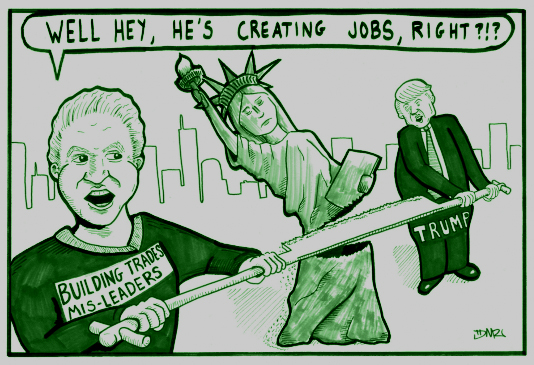 The Trump presidency presents organized labor with a dilemma.
 One of Donald Trump's first acts as president was to sign executive orders to push through construction of the Dakota Access Pipeline (DAPL) and Keystone XL Pipeline. Both projects were flashpoints of Indigenous resistance, especially DAPL, which sparked a rebellion at Standing Rock that galvanized months of protest and political action around the country.
 AUTHOR’S NOTE: If your the type who likes to cut to the chase, here it goes: There are two open comment periods for Environmental Impacts Statements (EIS) that you should know about. One for the
  The water protectors’ efforts to stop the Dakota Access Pipeline were a historic mobilization of Native American tribes from all across the country coming together in solidarity for the Standing Rock Sioux. The original route of the pipeline was moved from Bismarck, North Dakota, onto Standing Rock Sioux reservation land and sacred tribal grounds.
 Back in 2009, when I was an undergraduate student, I went to a talk given by Eriel Tchekwie Deranger of the Athabasca Chipewyan First Nation which had a significant impact on my understanding of environmental justice.
The Fine Print I:
Disclaimer: The views expressed on this site are not the official position of the IWW (or even the IWW’s EUC) unless otherwise indicated and do not necessarily represent the views of anyone but the author’s, nor should it be assumed that any of these authors automatically support the IWW or endorse any of its positions.
Further: the inclusion of a link on our site (other than the link to the main IWW site) does not imply endorsement by or an alliance with the IWW. These sites have been chosen by our members due to their perceived relevance to the IWW EUC and are included here for informational purposes only. If you have any suggestions or comments on any of the links included (or not included) above, please contact us.
The Fine Print II:
Fair Use Notice: The material on this site is provided for educational and informational purposes. It may contain copyrighted material the use of which has not always been specifically authorized by the copyright owner. It is being made available in an effort to advance the understanding of scientific, environmental, economic, social justice and human rights issues etc.
It is believed that this constitutes a 'fair use' of any such copyrighted material as provided for in section 107 of the US Copyright Law. In accordance with Title 17 U.S.C. Section 107, the material on this site is distributed without profit to those who have an interest in using the included information for research and educational purposes. If you wish to use copyrighted material from this site for purposes of your own that go beyond 'fair use', you must obtain permission from the copyright owner. The information on this site does not constitute legal or technical advice.
 This site is not the official webpage of the Industrial Workers of the World.