You are here

movement politics

Why Union Workers and Environmentalists Need to Work Together with Smart Protests

By Les Leopold - Alternet, June 21, 2017

As Trump slashes and burns his way through environmental regulations, including the Paris Accord, he continues to bet that political polarization will work in his favor. Not only are his anti-scientific, anti-environmentalist positions firing up some within his base, but those positions are driving a deep wedge within organized labor.  And unbeknownst to many environmental activists, they are being counted on to help drive that wedge even deeper.

Trump already has in his pocket most of the construction trades union leaders whose members are likely to benefit from infrastructure projects – whether fossil fuel pipelines or new airports or ...... paving over the Atlantic. His ballyhooed support of coal extraction  has considerable support from miners and many utility workers as well.

But the real coup will come if Trump can tear apart alliances between the more progressive unions and the environmental community. Trump hopes to neutralize the larger Democratic-leaning unions, including those representing oil refinery workers and other industrial workers.  That includes the United Steelworkers, a union that has supported environmental policies like the federal Clean Air Act and California’s Global Warming Solutions Act, and has a long history of fighting with the oil industry – not just over wages and benefits but also over health, safety and the environment.  

To get from here to there, Trump is hoping that environmental activists will play their part -- that they will become so frustrated by his Neanderthal policies, that activists will stage more and more protests at fossil fuel-related facilities, demanding that they be shut down in order to halt global climate crisis.  

Oil refineries present a target-rich arena for protest. On the West Coast they are near progressive enclaves and big media markets in California and Washington.  Yet many who live in fence line communities would like the refineries gone, fearing for their own health and safety. Most importantly, they are gigantic symbols of the oil plutocracy that has profiteered at the expense of people all over the world.

But from Trump's point of view, nothing could be finer than for thousands of environmentalists to clash at the plant gates with highly paid refinery workers. Such demonstrations, even if peaceful and respectful, set a dangerous trap for environmental progress. Here's why: 

From Solidarity Networks to Class Organisation in Times of Labour Hallucinations

By Angry Workers World - LibCom.Org, June 24, 2017

Dear sisters and brothers,

Some comrades from Frankfurt got in touch recently, wanting to set up a solidarity network. They approached us with some concrete questions. [1] We want to use the opportunity to reflect more generally on our limited experiences with our solidarity network initiative so far and about the political direction we want to take steps towards. We do this against the current background of post-election ‘Corbyn-mania’ and a surge in political activities focused on the Labour Party. The first part of this text briefly explains our opposition to the focus on electoral activities, whether that be through the Labour machinery or in the more post-modern form of ‘municipalism’ [2] – despite the fact that locally in our area, the election circus had less of an impact, given that most workers here are not allowed to vote anyway. And as an alternative to this electoral turn, the second part focuses on our political proposals towards a locally rooted class organisation. We then go on to talk in more detail about our concrete experiences with the solidarity network in west London.

The Labour of wishful thinking

  • * We understand that ‘hope’ is needed amongst a divided and beaten working class and that Labour’s rhetoric of social unity and equality is welcomed.
  • * We would criticise our comrades of the radical left if they merely proliferate this ‘message of hope’ and material promises (end of austerity), without questioning the structural constraints which will make it difficult for a Labour government to deliver on their promises. Syriza in Greece has shown how a hopeful high can quickly turn into an even deeper depression once ‘our government’ has to turn against us.
  • * For us it is less about warning the working class not to vote on principle or focusing on Corbyn’s problematic power struggle within the Labour apparatus, but about pointing out the general dynamic between a) a national social democratic government, b) the global system of trade, monetary exchange and political power and c) the struggle of workers to improve their lives. In other words, all of the historical lessons have shown us that the outcomes of channelling working class energies into parliamentarism within a nation state that fits into an overall system of capital flows, has always ended up curtailing a longer-term working class power.
  • * The Labour party proposals in general are not radical as such, e.g. their promise to increase the minimum wage to £10 per hour by 2020 (!) under current inflation rates would more likely lead to a dampening of wage struggles amongst the lower paid working class, rather than instigating them. The minimum wage regulation introduced by Labour under Blair in 1998 had this effect in the long run.
  • * An increase in taxation to mobilise the financial means to deliver on their promises will increase capital flight and devaluation of the pound – most capital assets which bolster the UK economy are less material than in the 1970s, therefore it would be difficult to counter the flight with requisition (‘nationalisation’), a step which Labour does not really consider on a larger scale anyway.
  • * While any social democratic program on a national level is more unlikely than ever, the Labour program focuses workers’ attention increasingly on the national terrain: struggle for the NHS, nationalisation of the railways etc.; (in this sense the leadership’s leaning towards Brexit is consequential and at odds with most liberal Corbynistas); while officially Labour maintains a liberal approach towards migrants, those Labour strategists who are less under public scrutiny as politicians, such as Paul Mason, are more honest: if to carry out a social democratic program on a national scale means to have tightened control over the movement of capital, by the nature of capital-labour relation, this also means to tighten the control over the movement of labour; it would also mean re-arming the national military apparatus in order to bolster the national currency that otherwise wouldn’t have the international standing the pound still has. [3]
  • * A social democratic government needs a workers/social movement on the ground in order to impose more control over corporate management, e.g. through taxation. At the same time it hampers the self-activity of workers necessary to do this – e.g. through relying on the main union apparatus as transmission belts between workers and government.
  • * In more concrete terms we can see that groups like Momentum or local Labour Party organisations have done and do very little to materially strengthen the organisation of day-to-day proletarian struggles on the ground, but rather channel people’s activities towards the electoral sphere, siphoning off energy and turning attention away from concrete proletarian problems. Many ‘independent’ left-wing initiatives – from Novara media to most of the Trot organisations – became election advertisement agencies.
  • * While for the new Labour activists – many of them from a more educated if not middle-class background – there will be advisory posts and political careers, we have to see their future role with critical suspicion.
  • * If a Labour government would actually try to increase taxation and redistribute assets, the most likely outcome is a devaluation of the pound and an increase in inflation due to a trade deficit, which cannot be counteracted easily (see composition of agriculture, energy sector, general manufactured goods etc.)
  • * The new Labour left – trained in political activism and speech and aided by their influence within union leadership – will be the best vehicle to tell workers to ‘give our Labour government some time’, to explain that ‘international corporations have allied against us’ and that despite inflation workers should keep calm and carry on; wage struggles will be declared to be ‘excessive’ or ‘divisive’ or ‘of narrow-minded economic consciousness’. More principled comrades who told workers to support Labour, but who would support workers fighting against a Labour government risk losing their credibility and influence.
  • * Instead of creating illusions that under conditions of a global crisis ‘money can be found’ for the welfare state we should point out the absurdity of the capitalist crisis: there is poverty despite excess capacities and goods (for which ‘no money can be found’ if they don’t promise profits for companies or the state). We have to be Marxists again, analysing structures rather than engaging in wishful thinking.
  • * We should focus our activities to a) build material counter-power against bosses and capitalist institutions that makes a difference in the daily lives of working class people and b) prepare themselves and ourselves for the task of actually taking over the means of (re-)production. [4] For this we need to be rooted and coordinated internationally. We can clearly see that in the face of these big questions our actual practice seems ridiculously modest, but we want to share our experiences honestly and invite others to organise themselves with us. [5]

Why Union Workers and Environmentalists Need to Work Together with Smart Protests

By Les Leopold - Alternet, June 21, 2017

As Trump slashes and burns his way through environmental regulations, including the Paris Accord, he continues to bet that political polarization will work in his favor. Not only are his anti-scientific, anti-environmentalist positions firing up some within his base, but those positions are driving a deep wedge within organized labor.  And unbeknownst to many environmental activists, they are being counted on to help drive that wedge even deeper.

Trump already has in his pocket most of the construction trades union leaders whose members are likely to benefit from infrastructure projects – whether fossil fuel pipelines or new airports or ...... paving over the Atlantic. His ballyhooed support of coal extraction  has considerable support from miners and many utility workers as well.

But the real coup will come if Trump can tear apart alliances between the more progressive unions and the environmental community. Trump hopes to neutralize the larger Democratic-leaning unions, including those representing oil refinery workers and other industrial workers.  That includes the United Steelworkers, a union that has supported environmental policies like the federal Clean Air Act and California’s Global Warming Solutions Act, and has a long history of fighting with the oil industry – not just over wages and benefits but also over health, safety and the environment.  

To get from here to there, Trump is hoping that environmental activists will play their part -- that they will become so frustrated by his Neanderthal policies, that activists will stage more and more protests at fossil fuel-related facilities, demanding that they be shut down in order to halt global climate crisis.  

Oil refineries present a target-rich arena for protest. On the West Coast they are near progressive enclaves and big media markets in California and Washington.  Yet many who live in fence line communities would like the refineries gone, fearing for their own health and safety. Most importantly, they are gigantic symbols of the oil plutocracy that has profiteered at the expense of people all over the world.

But from Trump's point of view, nothing could be finer than for thousands of environmentalists to clash at the plant gates with highly paid refinery workers. Such demonstrations, even if peaceful and respectful, set a dangerous trap for environmental progress. Here's why: 

Trump goes for bust on the national-populist trail. What did you expect?

By Daniel Tanuro - International Viewpoint, June 15, 2017

The United States has denounced the Paris climate agreement, cancelled all the measures decided by the United States in application of this agreement and withdrew from the Green Fund for the Climate. These are the major decisions that Donald Trump finally announced, on Thursday, June 1, after a long period of suspense.

These decisions are in line with the promises made by the new President during his election campaign. In the past few months, some observers had wanted to believe that Trump would change his tune, but he did no such thing. On the contrary, the speech he delivered in the Rose Garden of the White House flowed from a disturbing nationalist and populist demagogy. What did you expect? - as the advertisers say...

Victimization and nationalism

For Trump, the Paris agreement was nothing but a scandalous piece of trickery imposed on the USA. "The Paris agreement is not about the climate," he said, "it’s about the financial advantage that other countries get compared to the United States. The rest of the world applauded when we signed the agreement. They were happy, for the simple reason that we suffer from a very great economic disadvantage."

Drawing an apocalyptic picture of the implications of the agreement, the president said it would lead to the loss of 2.7 million jobs, cost the US $3 trillion and would result in a loss of purchasing power for US citizens of up to $7,000 a year. He listed the figures of the reductions in economic activity that would affect the industrial sectors: "86 per cent in the coal sector", he said... omitting of course to mention that solar energy already gives employment to 800,000 US workers (against 67,000 in coal) and creates more jobs than the coal industry loses.[1]

For Trump, it is simple, there is a conspiracy: the poor Americans, who are too honest, are victims of an enormous injustice hatched by an evil machination of all the other countries. The denunciation of the agreement is therefore an elementary reaction of sovereignty and national dignity: "The heads of state of Europe and China should not have more to say about the policy of the United States than American citizens do. We do not want to be the laughing stock of the world. We will not be."

Donald Trump, the Paris Agreement, and the Meaning of America

By Paul Arbair - Paul Arbair, June 12, 2017

Donald Trump’s decision to withdraw the United States from the Paris Agreement on climate change has sparked a global uproar. Yet America’s reluctance to reduce its use of fossil fuels is, in fact, logical. Not only because of the U.S. president’s overt denial of man-made climate change, but also and more fundamentally because it reflects America’s historical essence and trajectory.

So he did it. Donald J. Trump, 45th president of the United States of America, finally announced his decision to withdraw his country from the Paris Agreement on climate change. According to the White House occupant, this agreement negotiated by the Obama administration was a ‘bad deal’ for America, undermining its competitiveness and jobs, costing millions to its taxpayers, imposing disproportionate and unfair restrictions on its carbon emissions, and weakening its sovereignty. This agreement, he said, “is less about the climate and more about other countries gaining a financial advantage over the United States”. It is “a massive redistribution of United States wealth to other countries”, and “the American family will suffer the consequences in the form of lost jobs and a very diminished quality of life.” Such a bad deal is unacceptable to a president who has pledged to ‘Make America Great Again’ and to put America and its workers first.

Obviously, Trump’s core supporters have cheered this momentous decision. The billionaire real estate mogul-turned-president, they say, has made good on a pledge he made during last year’s campaign, showing once again that he meant what he said. The rest of America, on the other hand, as well as much of the world, couldn’t be more outraged. By reneging on its commitment to help fight climate change alongside the international community, America is abdicating its claim to global leadership, many argue. By joining the group of countries that are not signed up to deal reached in the French capital in December 2015, a group that so far comprises only Nicaragua and Syria, it is even turning into a ‘rogue state’, some suggest. A state that rejects science, progress and enlightened values, choosing instead a one-way trip back to the ‘Dark Ages’. A state that cannot anymore be relied upon, as German Chancellor Angela Merkel put it just a few days ago, or even that represents a growing danger to the world. Sad!

In the U.S., Trump’s announcement has triggered a sharp reaction from cities, states and businesses, which have vowed to meet U.S. climate commitments regardless of what Washington says or does. More than 1,000 city mayors, state governors, college and university leaders, businesses, and investors signed a “We Are Still In” open letter to the international community, saying they are committed to delivering concrete carbon emissions reductions that will help meet America’s emissions pledge under the Paris Agreement. Billionaire and former New York City mayor Michael Bloomberg even promised to provide up to $15 million in funding that he says the United Nations will lose as a result of President Trump’s decision to pull out from the climate deal. Emblematic CEOs such as Tesla’s Elon Musk and Disney’s Robert Iger announced they would quit Trump advisory councils, and anti-Trump demonstrations have been held across the country.

Outside the U.S., the reaction has been no less virulent, and Donald Trump’s decision has been vehemently condemned across the international community. Emmanuel Macron, the young and newly elected French president, rebuked his U.S. counterpart in a televised speech – the first speech ever given in English by a French President from the Elysée Palace – condemning his decision as a historic “mistake” and issuing a call to “make our planet great again“. This call, a direct jibe at Trump’s ‘Make America Great Again’ election slogan, went immediately viral on social media… The leaders of the European Union and China, backed by India and Japan, announced they would fully implement the Paris Agreement despite Washington’s withdrawal. The deal, they insisted, is not up for renegotiation, despite what the U.S. president might say. Trump’s decision, many observers suggested, could actually trigger a wide-ranging geopolitical shake-up that would isolate the U.S., or even make it a ‘global pariah’, and hand China a chance for global leadership.

Beyond America’s geopolitical standing and diplomatic reputation, the reactions to Donald Trump’s decision have of course focused on what it may mean for the planet’s climate. A number of observers have suggested that the American president might actually be doing the world and global climate a favour: outside of the Paris deal, the U.S. will not be in a position to block progress as it has done so many times in the past on climate negotiations, and the rest of the world will therefore be able to step up its efforts. The ‘climate revolution’ they say, is already unstoppable anyway, including in the U.S. The stunning growth of renewable energies, fuelled by rapid technological progress and by their falling costs, will ensure that the ‘decarbonisation’ of the global economy accelerates in the coming years, whatever Mr. Trump may say or do.

Most analysts and climate activists, however, consider that the U.S. withdrawal will severely undermine the international community’s fight against climate change. The disengagement of the world’s only superpower and current second largest CO2 emitter – and by far the biggest carbon polluter in history – might in fact weaken the Paris Agreement in many ways. Not only because it may reduce incentives for some countries that only reluctantly signed up to the deal to meet their voluntary emissions reductions pledges, but also because it may slow down the pace of technological progress needed to enable the transition to ‘clean energy’. The U.S. indeed remains the world’s technological powerhouse, and a lot of the ‘solutions’ required to accelerate the deployment and use of renewable energies (e.g. concerning electricity storage or carbon capture) are expected to come from its research labs and tech companies. Without sufficient political support and government funding, these solutions may take longer to be developed, or even never emerge. In addition, America’s withdrawal will also undermine the Green Climate Fund, which aims to help developing countries reduce emissions and adapt to the changes already set in motion by past emissions, and to which the U.S. was the largest contributor in absolute terms. Trump’s decision, hence, appears to many as an irresponsible move, a ‘moral disgrace’ or even a ‘crime against humanity’. Future generations will reap catastrophes and conflicts, and “people will die” because of this reckless withdrawal, some have warned.

Capitalism is destructive and unsustainable: It needs to be replaced

By John Bachtell - People's World, June 6, 2017

This article is based on remarks made by the author at the CPUSA National Labor Conference, May 20-21, in Chicago.

Several crises of contemporary capitalism have reached or are reaching dangerous tipping points. They are rooted in a path of destructive and unsustainable development.

They include extreme wealth and social inequality, job loss and dislocation from automation, and the existential threat posed by the ecological crisis.

These interconnected crises are impacting everything and must be addressed together. And they can be.

But standing in the way are Trump, the GOP and extreme right, and their main support base: monopoly-finance capital, the fossil fuel industry, and the military-industrial complex. Their agenda is intensifying these crises and must be defeated.

This underscores the urgency to build the broadest resistance movement and radically elevate the fight for unity of our multi-racial, male-female, LGBTQ, immigrant and native-born working class and people. This is central to guarantee the working class emerges as leader of the entire movement to break the extreme right political stranglehold and open the way for the challenging, contested, and complex transition to a just, peaceful, eco-socialist society.

Wrong way! A climatic baby step forward beats a giant leap back

By Pete Dolack - The Ecologist, June 7, 2017

The world surely is approaching a danger point when the abrogation of an inadequate agreement is cursed as a disaster.
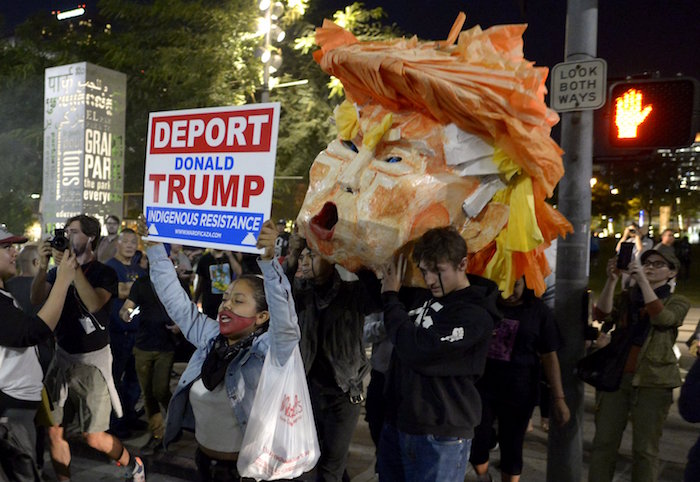
The Paris Climate Summit goals can't be characterized as anything significantly better than feel-good window dressing, but the argument that the world has to start somewhere is difficult to challenge.

Better to take a baby step forward than a giant leap backward!

As always, we must ask: Who profits? The Trump administration's decision to withdraw from the Paris Accord is due to factors beyond Donald Trump's astounding ignorance and his contempt for science or reality. There is a long history of energy company denial of global warming, a well-funded campaign.

Never mind that a widely cited 2015 study by the Stockholm Resilience Center, prepared by 18 scientists, found that the Earth is crossing several "planetary boundaries" that together will render the planet much less hospitable.

Or that two scientific studies issued in 2015 suggest that so much carbon dioxide already has been thrown into the air that humanity may have already committed itself to a six-meter rise in sea level.

Or that the oceans can't continue to act as shock absorbers - heat accumulated in them is not permanently stored, but can be released back into the atmosphere, potentially providing significant feedback that would accelerate global warming.

Trump spurns Paris Climate Accord

By Michael Schrieber - Socialist Action, June 5, 2017

“We’re getting out!” President Trump declared before the press and a knot of governmental officials who had gathered in the White House Rose Garden on June 1. “In order to fulfill my solemn duty to protect America and its citizens, the United States will withdraw from the Paris Climate Accord.”

Trump characterized the Accord as being “less about the climate and more about other countries’ gaining a financial advantage over the United States.”

He continued his xenophobic message: “The rest of the world applauded when we signed the Paris agreement—they went wild; they were so happy—for the simple reason that it put our country, the United States of America, which we all love, at a very, very big economic disadvantage.”

Trump singled out in particular the “Green Climate Fund,” which he said has been siphoning billions of dollars out of the U.S. economy, “a massive re-distribution of United States wealth to other countries.” The fund was intended to help underdeveloped nations move to renewable energy and mitigate the effects of climate change. So far, the fund has raised a total of around $10 billion from wealthier capitalist countries, including $3 billion from the U.S. (about one-hundredth of one percent of the U.S. budget).

According to the precepts of the Paris Accord, it will take more than three years for the U.S. to formally withdraw from it. But Trump indicated in his speech that he believes his announcement can help dampen any legal challenge to the measures that his administration has already put into place that weaken environmental safeguards in order to ramp up oil, coal, and other extractive industries.

And what about the climate? That burning issue was scarcely apparent in Trump’s June 1 speech. Although his address was long, rambling, and repetitive, Trump never found a single moment to utter the words “climate change.”

Our Responsibility After Trump's Climate Withdrawal

By Kevin Zeese and Margaret Flowers - Popular Resistance, June 3, 2017

President Donald Trump’s decision to withdraw from the Paris climate agreement follows the path of previous presidents who have undermined international climate agreements. We disagree with Trump but it is important to understand his actions in the context of the history of the United States regarding previous climate agreements. Once again, the political problems in the US are bigger than Trump. His action brings greater clarity to the inability of the US government to confront the climate crisis and clarifies the tasks of people seeking smart climate policy.

The US Has Always Prevented Effective International Climate Agreements

The US has consistently blocked effective climate agreements because both parties in power have put the profits of big energy before the climate crisis when it comes to domestic and international policies. The Republicans proclaimed themselves the “drill baby drill” party while the Democrats are the “all of the above energy” party. Both slogans mean the parties seek to ensure US corporations profit from carbon energy. Both have supported massive oil and gas infrastructure and extreme energy excavation including the most dangerous forms, i.e. tar sands and fracking. Both parties have also supported wars for oil and gas. All of these positions will be viewed as extreme as the world confronts the great dangers of the climate crisis and the US will be deservedly blamed.

An American Uprising: Assessing Opportunities for Progressive Political Change

By Anthony DiMaggio - CounterPunch, April 20, 2017

We live in a time of tremendous instability and change. Concerns about growing authoritarianism in American politics – as reflected in the rise of corporate power in politics, the intensification of militarism, and the diversion of the masses from political participation – are legitimate. There’s always been negativity on “the left” regarding American politics and society, and for good reason. We live in a time of ecological unsustainability that threatens human survival. Record inequality means a growing number of Americans are economically insecure and struggling to pay for basic goods such as health care and education. The threat of militarism is real, with the Trump administration’s saber rattling against Russia and North Korea. Militarism was a problem under Obama as well, although many Americans held out hope based on Trump’s rhetoric that he’d cool relations with Russia.

Progressives are right to spotlight the dangers to democracy and human survival we face, and to condemn a political-economic system that’s engaged in an all-out assault on the public. But these dangers are far from the whole story when we talk about American politics today. There’s also a pathology that defines much of left discourse, marked by a fixation on condemning the political system, independent of any constructive effort to develop positive suggestions for transforming politics. This negativity suggests a refusal to recognize the unique moment we find ourselves in regarding the rising intensity of social protests over the last decade. Simply put, we are in the middle of what I’d call a second renaissance of social movement activism, equaled only by the social movements of the 1960s and early 1970s. This earlier period was a time of rapid change. Activists came together to protest state repression on many fronts, in opposition to America’s racial caste system, to resist an imperialist, murderous, immoral war in Asia, in support of challenging misogynist patriarchal norms, in opposition to environmental degradation via air pollution and nuclear power, and in pursuit of basic consumer protections.

We find ourselves in another critical and historic juncture today. Post-2008, we see movement after social movement emerge to assault a political-economic status quo that is rejected by the vast majority of Americans. Citizens are realizing that U.S. political system is working only to benefit the wealthy few. Gallup found in 2015 that less than one-in-four Americans trusted the national government “a great deal” or a “fair amount” – a record low since the organization started tracking this question in 1972. Just one-in-five Americans said in 2015 that government was “run for the benefit of all,” rather than for the few. As the Washington Post reported that year, “across party lines, Americans believe our economic system is rigged to favor the wealthy, and big corporations, and that our political system is, too – so much so that by nearly a 2-to-1 margin, Americans believe their ‘vote does not matter because of the influence wealthy individuals and big corporations have on the electoral process.’”

As a young, idealistic undergraduate college activist 15 years ago, I would have died if this many Americans had articulated such distrust of government. This is fertile ground for organizing, and progressives should rejoice at this historic opportunity. Young Americans are increasingly estranged from an economy that provides income gains only to the top one percent, while assaulting the rest of the population. This anger was on display in a 2016 Harvard Survey finding that just 42 percent of Millennials expressed support for capitalism. Young Americans aren’t stupid. They can read the writing on the wall, and they recognize that our economy is broken, functioning for the affluent few at the expense of the many. And young Americans will be vital to producing structural political or economic change in the coming decades.

We don’t have to wait to see growing pressure for change. A mass public uprising has been going on for years. I’m reluctant to say it started with the “Tea Party,” since polls demonstrated that these protesters were largely nativist, racist reactionaries who were preoccupied with preventing future tax increases and stifling efforts to repair our country’s broken health care system. Polls from the early 2010s found that Tea Partiers were quite privileged economically speaking, earning incomes well above the national average, and benefitting from high education levels. And there was no evidence that these individuals were more likely than other Americans to have been hurt by the outsourcing of manufacturing jobs. Since the decline of the Tea Party, however, many progressive waves of protest have emerged. Some are now gone, others remain. These include the Madison uprising against Governor Scott Walker (2011); Occupy Wall Street (2011), “Fight for $15” (2013 to present); Black Lives Matter (2013 to present); the Sanders uprising within the Democratic Party’s base (2016), and the anti-Trump protests (2016 to present), not to mention the environmental movement, which has remained relevant on numerous fronts over the last few decades.

Pages

The Fine Print I:

Disclaimer: The views expressed on this site are not the official position of the IWW (or even the IWW’s EUC) unless otherwise indicated and do not necessarily represent the views of anyone but the author’s, nor should it be assumed that any of these authors automatically support the IWW or endorse any of its positions.

Further: the inclusion of a link on our site (other than the link to the main IWW site) does not imply endorsement by or an alliance with the IWW. These sites have been chosen by our members due to their perceived relevance to the IWW EUC and are included here for informational purposes only. If you have any suggestions or comments on any of the links included (or not included) above, please contact us.

The Fine Print II:

Fair Use Notice: The material on this site is provided for educational and informational purposes. It may contain copyrighted material the use of which has not always been specifically authorized by the copyright owner. It is being made available in an effort to advance the understanding of scientific, environmental, economic, social justice and human rights issues etc.

It is believed that this constitutes a 'fair use' of any such copyrighted material as provided for in section 107 of the US Copyright Law. In accordance with Title 17 U.S.C. Section 107, the material on this site is distributed without profit to those who have an interest in using the included information for research and educational purposes. If you wish to use copyrighted material from this site for purposes of your own that go beyond 'fair use', you must obtain permission from the copyright owner. The information on this site does not constitute legal or technical advice.

