

You are here

movement politics

Toward A Green New Future

By Thea Riofrancos and Daniel Aldana Cohen - Socialism 2020, July 26, 2020

Join Thea Riofrancos and Daniel Aldana Cohen for a discussion of the Green New Deal and the future we can build out of our crisis-ridden present. This event is part of the Socialism 2020 Virtual conference. See more at socialismconference.org.

Frontlines Climate Justice Executive Action Platform

By staff - Demos, July 22, 2020

As communities across the country, as well as countless people all over the world, face accelerating impacts and risks of climate change, federal, state, and local leadership in the United States is critically important for advancing immediate and aggressive climate action in public policy.

The science shows we no longer have the luxury to act incrementally. We must rapidly transform every sector of society if we are to limit global warming to 1.5 degrees Celsius. But urgent action on climate change cannot come at a price of expedience and further sacrifice for frontline communities. Frontline communities are primarily communities of color, indigenous communities, and struggling working-class communities most impacted by fossil fuel pollution and climate change—which are all the more vulnerable due to historic and continuing racism, segregation, and socioeconomic inequity.

In tackling the urgency of the climate crisis, prioritizing the most impacted communities for the protections and benefits of an economy-wide renewable energy transition is a moral imperative. This is, in large part, the meaning of a “just transition.” The economic transition we need to reverse the climate crisis must not leave behind impacted communities and workers. Racial and economic equity must be at the core of all climate solutions.

The executive branch can set the stage for a transformative climate justice agenda by taking immediate action at this intersection of climate, racial justice, and economic transformation. The Frontlines Climate Justice Executive Action Platform speaks to this opportunity by identifying regulatory rulemakings and other executive actions to advance an equitable climate agenda from day one. While major legislation in many areas will ultimately be needed to advance a bold federal agenda of climate action, this platform proposes a set of actions the executive branch can take without new legislation, major new appropriations, or other Congressional authority. However, many of the proposed executive actions can be harmonized with, be complementary to, or set a direction for statutory advancement of transformative climate action when that becomes possible.

This platform identifies actions in 4 basic categories that speak to the policy work and movement-building that frontline leaders in the climate movement have developed over many years, as they have forged a clear vision of equitable and resilient social and economic transformation:

  1. Environmental Justice: Protecting frontline communities from continuing harms of fossil fuel, industrial, and built environment pollution.
  2. Just Recovery: Ensuring just and equitable recovery from, and resiliency against, climate disasters.
  3. Climate Equity Accountability: Elevating equity and stakeholder decision-making in federal climate rules and programmatic investments.
  4. Energy Democracy: Remaking the monopoly fossil fuel energy system as a clean, renewably-sourced, and democratically-controlled commons.

In each of these areas, the platform presents a policy outline of possible rulemakings, executive orders, or other presidential actions that, taken together, aim to put frontline needs and priorities at the center of climate policy, including empowering grassroots stakeholders to be decision-makers in the process.

Read the summary (PDF).

Read the text (PDF).

How an Old-School Electricians Union Got Behind a Socialist Running on the Green New Deal

By Mindy Isser - In These Times, June 25, 2020

Nikil Saval is an unlike­ly Philadel­phia politi­cian. The social­ist, writer, orga­niz­er and for­mer edi­tor of left-wing mag­a­zine n+1beat long-time incum­bent Lar­ry Far­nese for state sen­ate in the First Dis­trict in a sur­prise upset. Although the Covid-19 pan­dem­ic threat­ened to derail his cam­paign, the issues Saval embraced — a Homes Guar­an­tee, Uni­ver­sal Fam­i­ly Care, and a Green New Deal — have grown more urgent as our econ­o­my has unrav­eled. And mak­ing him an even more unlike­ly can­di­date, he won the back­ing of a con­ser­v­a­tive elec­tri­cians union — a rare feat for a Green New Deal advo­cate. His plat­form, which was proven pop­u­lar enough to beat a fair­ly pro­gres­sive leg­is­la­tor, will be extreme­ly chal­leng­ing to imple­ment. In order to win life-chang­ing reforms like a Green New Deal, Saval and his allies will need to build a broad and pow­er­ful coali­tion — includ­ing with some strange bedfellows. 

Saval’s Green New Deal plat­form includes clean­ing up every tox­ic site in the city with the use of union labor; bas­ing all tax incen­tives, sub­si­dies and con­tracts on project labor stan­dards; retro­fitting schools, libraries and recre­ation cen­ters; and estab­lish­ing a Region­al Ener­gy Cen­ter, which would ​“unite the state’s util­i­ties around the goals of increased ener­gy effi­cien­cy through green build­ings retro­fits, and full elec­tri­fi­ca­tion of Pennsylvania’s build­ings by 2040.” Much like the fed­er­al Green New Deal leg­is­la­tion, many of Saval’s poten­tial poli­cies could mean the cre­ation of thou­sands of union jobs, as some­one will have to dri­ve the new South­east­ern Penn­syl­va­nia Trans­porta­tion Author­i­ty (SEP­TA) busses, clean up brown­fields, and update build­ings with green tech­nol­o­gy. Saval also wants to elim­i­nate coal-gen­er­at­ed elec­tric­i­ty by 2025 and achieve 100% clean elec­tric­i­ty by 2030. These aspi­ra­tions would obvi­ous­ly mean that work­ers in extrac­tive indus­tries would lose their cur­rent jobs, which is why build­ing trades unions — and their pow­er­ful labor fed­er­a­tion, the AFL-CIO — have been wary of the Green New Deal nationally.

Green New Deal: top-down or bottom-up?

By Sergio Belda and Victoria Pellicer - Science for the People, Summer 2020

From different parts of the world, we are being called upon to embrace a brand new green deal as an unassailable solution to the climate crisis. The appeal is coming from powerful actors: transnational entities, governments and political leaders (not only those with a progressive orientation),1 major newspaper headlines,2 successful financiers and leaders of large corporations,3 and intellectuals of international standing4 are calling for a great deal that will guarantee us a future that is not only green and sustainable, but truly enjoyable.

With this deal, the solutions to the problems of sustainability that we are suffering from are within our reach, right around the corner. Everyone agrees on the imagined green future we want and how to achieve it. We have the recipe, the technology, and the capacity. We just need the will, the drive, and sufficient investment.5

We are all familiar with the images of this utopian green world. The solutions that it offers delight the senses and the imagination: green, infinite, super-automated fields where fashionable, organic products grow and later fill the unlimited supermarket shelves; a world free from animal slaughter thanks to 3D-printed meat in restaurants, produced in factories and even space stations;6 autonomous electric cars filling wide, smart highways,7 finally expelled from historic city centers, which are now fully dedicated to pedestrian walkways between global franchises offering sustainable menus for all pocketbooks;8 energy produced by majestic wind turbines, bringing new prosperity to the plains of Iowa, Texas and Nebraska and new productivity to the oceans;9 in cities, huge glass skyscrapers with smart apartments on beautiful green tapestries; in the countryside, exceptionally comfortable and spacious single-family homes that are fully sustainable thanks to their intelligent design;10 at all times, unlimited access via our mobile phones to every product and service imaginable, with the peace of mind that they are offered to us without producing any waste that is not subsequently recovered (or whose environmental impact has not been incorporated into the cost and compensated for); and always the personal peace of mind from the knowledge that we are able to monitor our health twenty-four hours a day with portable devices that will not only patiently watch over us, but will also open up a huge new market.11 Images, in short, that reveal the encounter between sustainability, technology, intelligence, new markets, and prosperity. Images that should make us see the new great green deal not as a threat to our current lifestyle, but as the way to save our way of life, our planet, our individual welfare, as well as our capitalist system.12

Lighting a spark: How to Blow Up a Pipeline

By Harry Holmes - Bright Green, December 14, 2020

How to Blow up A Pipeline starts with what will be a familiar image for many. It’s the yearly climate negotiations, activists have streamed towards the conference space, pleading with representatives to ratchet up their ambition to tackle the climate crisis. People block city traffic with banners, with activists dancing and playing music in the reclaimed streets. The next day brings a giant public theatre performance, with environmentalists pretending to be animals run over by cars whilst ‘negotiators’ walk around with signs saying ‘blah blah blah.’
Was this a collection of Extinction Rebellion activists performing and blocking traffic? Was it even earlier, in 2015 at the Paris negotiations? Maybe it’s 2009, during the economic crisis and the Copenhagen conference? No, this image comes all the way from COP1, the climate conference that started it all – in the lost world that was 1995.

Speaking straight from his experiences of this first COP, Andreas Malm’s recollection of these early climate protest indicates a wider malaise – a certain sluggishness of environmental strategy. Despite the growth in awareness around the climate crisis and the rapid increase in the number of people organising for environmental justice, there has been limited change in the actions climate groups are willing to take to defend life.

In How to Blow Up a Pipeline, Malm has written a short and gripping manifesto which aims to wrench the climate movement out of its complacency. By convincingly arguing against movements’ dogmatic attachment to milquetoast non-violence, Malm makes clear that as the climate crisis escalates so too must the tactics of those seeking to defend life. Not content simply dispelling the misguided understandings of pacifism environmentalists hold, How to Blow Up a Pipeline gives a balanced assessment of the conditions which make sabotage, vandalism, and other forms of strategic direct action necessary in a warming world. Coming out of the pandemic, with movements regrouping and attempting to navigate the mess that is the 2020s, this book is the shock to the system the world needs.

Extinction Rebellion – in or out?

By various - New Internationalist, December 5, 2019

In October 2018, Extinction Rebellion (XR) launched a series of protests that mobilized thousands of (many first-time) activists and caught the attention of the media.

The rebels had three key demands: that the UK government tell the truth about the climate devastation by declaring an emergency, the establishment of a citizen’s assembly to overview a repeal of climate-negligent laws and the enactment of new policies in line with climate science.

They injected a new sense of energy and urgency into the climate movement. Thousands joined non-violent actions; London bridges were blocked, hundreds arrested. But the group has also come under fire for neglecting more political questions of justice, power and racism.

One month since XR burst on to the UK climate scene, five climate-concerned campaigners – from both in and outside the movement – give their views:

Populist alliances of ‘cowboys and Indians’ are protecting rural lands

By Zoltán Grossman - Waging Nonviolence, May 17, 2019

By appealing to the hearts and minds of their white neighbors, Native Americans are carving out common ground and building unity through diversity.

This article was first published by The Conversation under a Creative Commons license.

The sea of red on recent election maps make it look like rural areas are uniformly populated by Republicans. And conventional wisdom suggests that those Americans are largely conservative populists who question many government regulations and do not welcome cultural diversity.

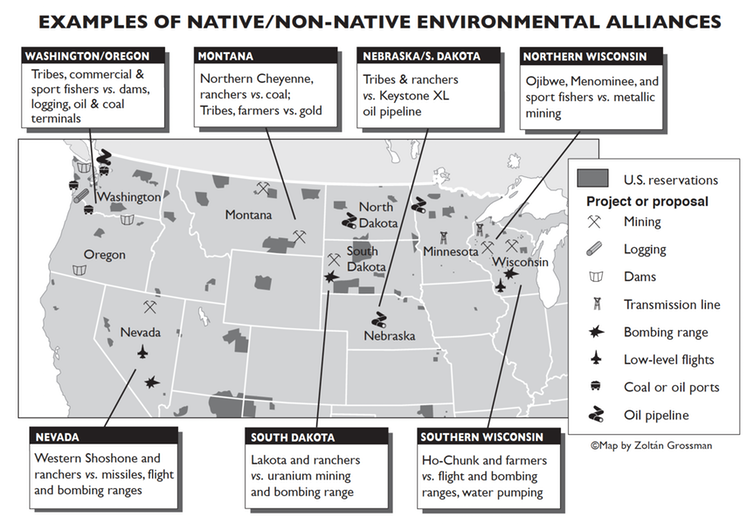
But the growing influence of Native American nations in some rural areas is starting to change that picture. Empowered by their treaty rights, they are beginning to shift the values of their white neighbors toward a populism that cuts across racial and cultural lines to challenge large corporations.

I’m a geographer who studies the relationships between tribes and rural white farmers, ranchers and fishers. In my book “Unlikely Alliances: Native Nations and White Communities Join to Defend Rural Lands,” I relate what I learned through dozens of interviews with Native Americans and their non-Native allies who described how the tribes are fusing the power of their sovereignty with the populist grievances of the tribes’ historic enemies.

By teaming up to defend the place they all call home, they are protecting their lands and waters for all.

Extinction Rebellion Must Evolve to Tackle Our Systemic Climate Crisis

By Steve Rushton - Occupy.Com, May 9, 2019

The movement known as Extinction Rebellion (XR) has pushed climate change firmly into the British consciousness, clearing the political hangover left by the never-ending Brexit fog. But there are constructive critiques to this monumental, London-centred climate activism that bear mentioning. Namely, what does this movement need to do to gather enough popular support and halt the ongoing climate meltdown.

XR takes over London

For 10 days in April, Extinction Rebellion created headline disruption, taking over prominent sites across London, including Parliament Square. They demanded that the UK government "tell the truth" about the scale of the climate crisis; enact legally binding policies to reduce carbon emissions to net zero by 2025; and do both through a Citizens Assembly (more on citizens assemblies here).

People last month participated in the tens of thousands, and many of then were new to activism. Holding these sites created space for public assemblies and direct action. When police arrested activists – more than 1,000 in total – more came forward until jail cells were full. Actions went far beyond London, from road blocks in Brussels to stopping a coal train in Australia, and die-ins as well as other actions from India to South Africa to Seattle.

Pressure from XR made Labour table a motion in Parliament to declare a climate emergency. The Welsh assembly did the same just days before. Now, as XR expands its effective activism globally, it is worth asking: what does this movement need to do to stop the climate catastrophe?

Socialist Dog Catchers (or Presidents) Won’t Save Us

Gender Diversity in the Peasant Movement

Translated by staff - La Via Campesina, October 3, 2016

The global peasant movement La Via Campesina is slowly beginning to open up to the subject of gender diversity. By Paula Gioia, member of the coordinating committee of ECVC

Food Sovereignty is also connected to gender relations – and to respecting different ways of life and the rights of LGBTTQI*. The movement of landless peasants in Brazil is showing this and providing important inspirations for debates in Europe.

Since its founding in 1993, La Via Campesina has promoted Food Sovereignty and a change of the capitalist and patriarchal power relations that are dominating our world today. La Via Campesina is an international movement of peasants, land workers and landless people, fisher folk, pastoralists and migrant workers. It has about 200 million members, organized in more than 160 organizations in 73 countries. In Via Campesina, feminist approaches to Food Sovereignty have played an important role in our peasant movement from the start, to counteract discrimination and all forms of violence against women in rural areas. The participation of women in leading positions has been central to all Via Campesina organizing and campaigning, with all committees made up of 50% men and 50% women. But only after more than 20 years a debate on sexual and gender diversity is slowly beginning.

The visibility and recognition of the rights of lesbian, gay, bisexual, transgender, trans*sexual, intersexual and queer identifying persons (LGBTTQI*) within Via Campesina

have found little consideration in our debates so far. As a movement that is the global leader in the political project of Food Sovereignty and fighting against social exclusion based on the principles of collective living and mutual respect, we must commit to widening this framework to include the rights of LGBTTQI* peasants and food producers.

Within the international context of LVC, incorporating the rights of peasants and food producers that identify at LGBTTQI* is still being sensitively explored and developed. However on localized and regional levels there are grassroots movements who are members of LVC that are already engaging with and incorporating the rights of LGBTTQI* peasants and food producers into their organizations. One example is the Brazilian movement of landless workers (Movimento dos Trabalhadores Rurais Sem Terra – MST), whose experiences can serve as important reference points to the debates arising currently in the European context of Via Campesina.

Pages

The Fine Print I:

Disclaimer: The views expressed on this site are not the official position of the IWW (or even the IWW’s EUC) unless otherwise indicated and do not necessarily represent the views of anyone but the author’s, nor should it be assumed that any of these authors automatically support the IWW or endorse any of its positions.

Further: the inclusion of a link on our site (other than the link to the main IWW site) does not imply endorsement by or an alliance with the IWW. These sites have been chosen by our members due to their perceived relevance to the IWW EUC and are included here for informational purposes only. If you have any suggestions or comments on any of the links included (or not included) above, please contact us.

The Fine Print II:

Fair Use Notice: The material on this site is provided for educational and informational purposes. It may contain copyrighted material the use of which has not always been specifically authorized by the copyright owner. It is being made available in an effort to advance the understanding of scientific, environmental, economic, social justice and human rights issues etc.

It is believed that this constitutes a 'fair use' of any such copyrighted material as provided for in section 107 of the US Copyright Law. In accordance with Title 17 U.S.C. Section 107, the material on this site is distributed without profit to those who have an interest in using the included information for research and educational purposes. If you wish to use copyrighted material from this site for purposes of your own that go beyond 'fair use', you must obtain permission from the copyright owner. The information on this site does not constitute legal or technical advice.
